
In extraordinary times, extraordinary measures need to be taken. And these are extraordinary times. On Thursday when we heard these words coming from the highest seat of law, we heaved a sigh of relief. When the Supreme Court agreed to hear the bail petition of a young man, Kanhaiya, saying that “a citizen has come saying that his fundamental rights are under threat…” we felt safe. We felt that the most ordinary, unarmed citizen of this country ,powerless before the might of a state and defenceless before the viciousness of a mob ,had a place to go. That in this country the life and dignity of every single person matters. That concern and care for the life and dignity of human beings survives in the otherwise soulless apparatus of the state. Continue reading A matter of Form
Category Archives: Bad ideas
Wanted Students Surface in JNU: JNUSU Vice President Shehla Rashid Shora and Umar Khalid Speaking to Students
[ In a dramatic new development, four students, Umar Khalid (ex-DSU), Anirban (ex-DSU), Rama Naga and Asutosh (AISA), from amongst the list of ‘students wanted by the police’ resurfaced on the night of Sunday, 21 February, and stayed with their fellow students till the early hours of Monday, February 22 on the JNU campus. Reportedly, they are still on campus, with their fellow students. One of them, Umar Khalid, spoke at a large gathering in front of the administration block, where all protesting students have been meeting. The gathering was also addressed by the Jawahar Lal Nehru Students’ Union (JNUSU) vice-president and All India Students Association (AISA) activist, Shehla Rashid Shora (against whom there are no charges made out by the police at the moment). The police, did not enter the campus at that time, given the very large number of students who had gathered in solidarity with their ‘wanted’ friends. The statements of the JNUSU vice president, Shehla Rashid Shora, and of Umar Khalid (who is one of students ‘wanted’ by the police), were recorded by a correspondent of the online portal, Catchnews.com during the early hours of Monday, 22nd February, as they addressed the gathered students. We are sharing those recordings, with thanks to Catchnews.com, with our transcript/translation of what was said by both Shehla and Umar. As is clear from both statements, the students are not in hiding, they are offering peaceful resistance, and the charges of sedition against them are utterly without foundation. Listen, and read, for yourselves.]
Human Rights in India: Who defends the defenders?: Srishti Agnihotri
This is a guest post by SRISHTI AGNIHOTRI
Reports have come in of an attack on Tribal Rights Activist and leader Soni Sori. Reports suggest that oil paint mixed with chemicals was thrown on her face by unknown assailants. This attack, which has left the activist in intense pain, and other reports of intimidation of persons such as lawyers and journalists working in the Jagdalpur area raises the question of the safety of human rights defenders, and shows that there isn’t enough being done by the State machinery to defend the defenders.
Human rights defenders are those who work to protect or promote human rights. The State has an obligation to protect human rights defenders from violence, and also to create an enabling environment for them to work in. The phrase ‘human rights defenders’ been used increasingly since the Declaration on Human Rights Defenders was adopted in 1998. Though the Declaration is not a legally binding document, the roots of the State’s duty to protect the defenders can also be found in the International Covenant on Civil and Political Rights, which India has ratified. These rights can also be derived from Indian Constitutional law, particularly the celebrated golden triangle of Article 14, 19 and 21 of the Constitution.
We often refer to human rights defenders using many phrases such as ‘activists’ ‘monitors’ ‘development professionals’ etc. It is not necessary to be a person being paid to do full time human rights work, to qualify as a human rights defender, and many other professionals may be doing work that is strongly allied with human rights. For example journalists, doctors, teachers, or even engineers may, in the course of their work, promote or protect the human rights of people, and as such they are human rights defenders. Further it is not necessary to be correct to qualify as a human rights defender. For example, the criticism of a Human Rights Defender to a particular development project may not be legally correct. However, this does not and should not disentitle them to the protection of the State against violence and reprisals. The reason for this will become clear when we examine the role human rights defenders play in a society.
Continue reading Human Rights in India: Who defends the defenders?: Srishti Agnihotri
Oxford University Members and Alumni in Solidarity with JNU: Oxford Students, Faculty and Alumni
Guest Post by students, faculty and alumni of Oxford University, UK
We, the undersigned members and alumni of the University of Oxford, stand firmly in solidarity with fellow students, teachers and scholars at the Jawaharlal Nehru University (JNU). We condemn the ongoing persecution of the student community in JNU, in particular the arrest of JNU Students Union (JNUSU) president Kanhaiya Kumar under sedition charges. We protest the use of institutional and state machinery to stifle dissent on campuses, and the attempt to persecute those whose views do not conform to the narrow narratives of ‘nationalism’, ‘nationhood’ and ‘Indian culture’ promoted and endorsed by the ruling party. We view the crackdown in JNU in a continuum with the use of state machinery to clamp down on dissenting views and ideologies on campuses, most prominently at the FTII, Jadavpur University, IIT-Madras and the University of Hyderabad (UoH). We would like to point out that it was a similar witchhunt, backed by state authority, that led to the suicide of Dalit scholar and student leader of the Ambedkar Students’ Association, Rohith Vemula. We also stand in solidarity with the ongoing rally hunger strike at UoH and the struggles of the Joint Action Committee for Social Justice, demanding justice for Rohith Vemula.
Support and stand for Jagdalpur Legal Aid Group: Mohammad Zafar
This is a guest post by MOHAMMAD ZAFAR
We are going into a dangerous situation now. It is that time when we all should come together to work against autocracy, state led atrocities, bullying, dictatorship and authoritarianism and any other form of injustice. We all know about JNU case, role of Lawyers & MLA O. P. Sharma in the shameful acts of abuse and warnings to people who take initiative to speak against atrocities and injustice all-over the country. Now Raman Singh’s model of development has also showed us two shameful cases in Chhattisgarh. One is attack on Tribal activist and AAP’s leader Soni Sori who has faced a lot of humiliation, atrocities and pain but always stood steadfast on her path and is still fighting. And one more case of state-led dictatorship is related to Jagdalpur Legal Aid Group, which is a legal aid group to support tribal people who are facing problems in that region in terms of false cases, fake encounters, etc. for details about its existence see this link of the Hindu’s article (http://www.thehindu.com/news/national/a-group-of-lawyers-trying-bring-law-to-lawless-bastar-region/article7735079.ece) They worked for people facing false charges of Naxalism, against controversial encounters and other issues where there is a need to work hard for giving support to the voice of justice among tribes.
This has become problematic for state and police. They first started annoying them, throwing false allegations against their degrees and eligibility to fight case. When they fought and won against those charges now some organizations (with the support of state officials & police) also warned them to leave that place and said that they are Maoist sympathizers. And now finally they left their landlord’s rented home in Jagdalpur when police pressurized their landlord who (according to one member of Jagdalpur Legal Aid Group (JAGLAG) in an interaction to a reporter) is very good for them and they don’t want to be a problem for him. For further details and mail of a member of JAGLAG see the article in this link.
We should think again, is it development where state itself making people speechless and generating more mistrust among people for government, where they do violence by their own way and more than that they are even silencing voices of resistance. These officers will get awards by government like Ankit Garg who shamelessly ordered humiliation and sexual abuse of Soni Sori. They want to silence voices like JAGLAG so that they will punish more innocents in the name of Naxalism as they did with Kartam Joga, who because of lot of efforts of Lawyers and activists found a new life after 3 years’ Jail and pain of brutality of Police. They don’t want any voices of resistance because they know their reality will emerge; so they beat people without any reason as they did with Lakhan Lal and broke his legs just for replying “Laal Salaam” in the dead of the night; their shameful act of humiliating Soni Sori in jail in the name of police inquiries is also for the same reasons. In the name of Anti-Naxalism/Maoism they are trying to silence all voices and justifying all their acts as their friends are trying to do in the name of nationalism in other parts of country. We should support now all members of Jagdalpur Legal Aid Group and raise this issue on all platforms.
University of Minnesota Stands in Solidarity with Jawaharlal Nehru University
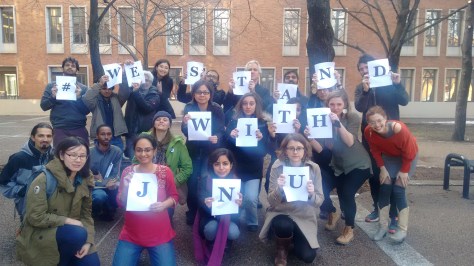
We, the undersigned at the University of Minnesota, strongly condemn the concerted attack on the students, faculty and academic culture of Jawaharlal Nehru University. At the behest of the government, the Delhi police has pressed sedition charges on unnamed students of the university. Reminiscent of the Emergency, the students’ union president Kanhaiya Kumar has been arrested, several students have been suspended and the Delhi police has been hounding students in hostels, homes as well as public spaces in the city. Sections of the mainstream media have launched a vicious campaign to declare JNU an “anti-national” university, and some journalists have gone so far as to spin lies about the “terrorist connections” of student activist Umar Khalid. As a consequence, mob violence against JNU students and faculty has spread across the city and even entered the courtrooms where the case against the JNU students’ union president was being heard. We strongly condemn this hate campaign and demand the immediate release of the JNU students’ union president. We also demand that the suspension of students is revoked and unsubstantiated sedition charges are withdrawn immediately.
Continue reading University of Minnesota Stands in Solidarity with Jawaharlal Nehru University
भारत माता की जय बोल
‘भारत माता की जय बोलो’, अचानक तिरंगा झंडा लिए नौजवानों का एक समूह शिक्षकों की सभा के पास आ धमका. “मुझे माइक पर भारत माता की जय बोलने दो”, उसने धमका कर कहा.
टी वी चैनेल का एंकर चीख कर सामने बैठे नौजवान से बोला: भारत माता की जय का नारा लगा कर दिखाओ.
मुझे रवीन्द्रनाथ टैगोर के उपन्यास ‘घर-बाहर’ का बिमला का पति निखिल याद आ गया. बिमला उससे खफा है क्योंकि वह जुनूनी बंदे मातरम का नारा लगाने से इनकार करता है. वह भारत माता जैसी किसी देवी की वंदना करने से इनकार करता है. वह याद करता है कि उसके मास्टर साहब ने बताया था कि देश का मतलब पांवों के नीचे की ज़मीन नहीं, उसके ऊपर के लोग हैं. क्या जो भारत माता की जय का नारा लगाते हैं, उन्होंने इन करोड़ों-करोड़ लोगों की ओर आँख उठाकर भी देखा है, क्या वे उनके दुःख-दर्द के साझीदार हैं?
और मुझे फिर नेहरू याद आए. Continue reading भारत माता की जय बोल
Sambit Patra Flying the Tricolour on Times Now, in JNU and on Iwo Jima – History Re-Imagined (Once Again) by the BJP
A recent ‘Newshour’ non-debate on Times Now on whether or not an order emanating from the Ministry of Human Resources Development to erect 207 feet high steel flagpoles and giant tricolour flags in Central Universities across India featured a wonderful intervention by Sambit Patra, BJP spokesman and digital magician extraordinaire.
#AssamwithJNU – Thousands take to the Streets in Assam: Bonojit Hussain
Last two days had seen several #AssamWithJNU #JusticeForRohith protests and rallies demanding justice for Rohith Vemula and against the assault on JNU, police crackdown and arrest of JNUSU President Kanhaiya Kumar under the charges of sedition, media trial of Umar Khalid, and the undeclared emergency in the country.
Continue reading #AssamwithJNU – Thousands take to the Streets in Assam: Bonojit Hussain
Undeclared Emergency? State Repression from JNU students to HONDA workers: Nayan Jyoti
Guest Post by Nayan Jyoti
[ Even as the repression on students in universities, continues, the BJP regimes in Rajasthan and Haryana have attacked peaceful assemblies of young workers in the National Capital Region (NCR). This calls for widening and deepening the resistance against the Modi regime, whose fascist character is now nakedly visible. When the state starts hunting down workers and students at the same time, it is time for workers and students (and their friends) to stand united together and resist the repression by all means necessary and possible. We are posting below an account by Nayan Jyoti, a young activist, of the violence unleashed by the BJP governments in Rajasthan and Haryana, in collusion with factory managements, using the brute force of armed police and hired thugs in the last few days, with the hope that it will add crucially to our understanding of what exactly is going on in India.The Modi regime is in a deep crisis, and the only way the BJP (both at the centre and at the provincial levels) knows how to respond is through violence. Modi is the best student of Indira Gandhi in Indian politics, and he is following totally in her footsteps, invoking exactly the same ‘Anti-National’ tag, especially in terms of the way she led up to the declaration of the emergency in 1975. Things are different now, but also very similar. This is the beginning, as the author of this post says, of an undeclared emergency. The difference between a declared and an undeclared emergency appears at the moment to be only a formality. It is time we saw through the veil of this formality.]
We #standwithJNU and raised our united voices against State repression and witch-hunt of students for #righttodissent since 9th February. On 18th February, more than 15,000 people said so clearly in Delhi and pointed out that this has directly followed in a coordinated manner more recently from the institutional murder of Rohith Vemula in HCU by the anti-Dalit administrations under influence of the BJP, and right-wing attack on FTII students to completely control freedom of thought and expression earlier and the murder of progressive intellectuals by right-wing groups in recent times.
As this terrorizing and silencing of progressive voices, students and intellectuals goes on by both the BJP government and its police-administration from the top and the RSS vigilante groups on the streets, another much more brutal crackdown on thousands of workers has just happened and continues in the Haryana-Rajasthan border.
#StandWithJNU: Solidarity Statement by Academics in the UK
This is a statement by over three hundred and fifty academics based in the UK.
We, the undersigned, stand in solidarity with the students, faculty, and staff of Jawaharlal Nehru University (JNU). We condemn the BJP government-sanctioned police action in the JNU campus and the illegal detention of the JNUSU President Kanhaiya Kumar. We strongly condemn the manner in which political dissent is being stifled, reducing academic spaces to fortresses. We also condemn the widespread witch-hunt of left-wing students and student groups that this police action has unleashed.
These recent acts are representative of the larger trend that we have been observing – the imposition of an authoritarian and regressive agenda in institutions of higher learning from Films and Television Institute [FTII], Hyderabad Central University [HCU] to Jawaharlal Nehru University [JNU]. From the institutional murder of HCU student, Rohith Vemula, and the suppression of student protests at FTII to the illegal detention of the student union leader Kanhaiya Kumar and pervasive police presence at JNU, there has been a constant non- observance and disregard of administrative and legal norms as well as a gross infringement of the democratic rights of the student community. These actions are embedded in a deeply chauvinistic cultural nationalism, which espouses a casteist and Brahmanical, homophobic, and patriarchal worldview.
We strongly believe that student politics is being targeted currently by giving a new lease of life to a sedition law that was a draconian tool in the hands of the colonial state and has no place in a democracy. It is our democratic right to dissent, disagree, organise and struggle against state, institutions or policies that transgress and suppress democratic and egalitarian values. Expression of dissent cannot and should not be equated with being ‘anti-national’ (or any other such constructed category) and is definitely not punishable under law especially if it is non-violent.
Disguising targeted assault on oppositional student groups/political movements within the narrative binaries of nationalism/anti nationalism only reflects how vulnerable the BJP government feels in its own ability to provide accountable governance.
We also believe that institutions of higher learning should be publicly funded spaces for political engagement, debates, and critical discussions – a legacy campuses (be it JNU, DU, or FTII) have embodied. As they always have, university spaces should subsidise costs of education for students, irrespective of the political disposition of the students. A rather disturbing feature of the narratives around this issue has been the construction and furthering of an artificial dichotomy between academics and politics that suggests that being ‘political’ is an aberration. This would certainly appear to be the case, if seen through the neoliberal lens of perceiving education as an industry that produces ‘semester bred’ automated ‘disciplined’ individuals who are mere consumers.
However, as the nonviolent expressions of dissent by students in JNU clearly demonstrate, contrary to this neo liberal view of academia,we believe that ‘personal is political’ and there is no sphere that is devoid of politics.We believe that good academic work necessarily involves a critical engagement with society and its power inequities and in that sense is always politically engaged. This engagement thrives in the democratic space of the university where many dissenting views can be heard and debated. The vilification of JNU as a space of ‘anti-national’ politics is being carried out by ABVP and BJP in order to attack and break this democratic spirit of academic and political life in Indian universities.
As teachers, students, scholars, and academics from the UK, who are keenly observing the developments unfolding in JNU, we express our solidarity with the students, faculty and staff of JNU as they non-violently resist this infringement on their rights. We urge the Vice Chancellor of JNU to uphold the institutional autonomy and the democratic rights of the student community. We also urge the government of India to stop encroaching on our rights as citizens, students, activists, political and politicised subjects.
Continue reading #StandWithJNU: Solidarity Statement by Academics in the UK
A message of Solidarity and a Statutory Warning: Pankaj Mishra
Guest Post by author Pankaj Mishra
One can only welcome the broad coalition that has sprung up against the assault on JNU and in defense of the right–eternally vouchsafed to students–to intellectual freedom. But the imperative of solidarity should not make us forget that this multi-pronged violence—ordered by the government, and assisted by police officers, university officials, lawyers and sections of the media—has been in the making for a while—at least a decade and a half.
The empowerment of a technocratic elite that presumes to know exactly what the ‘New India’ ought to do in order to be wealthy and powerful made much intellectual and artistic endeavour, not to mention political struggle, seem unnecessary. Its cherished epithet ‘jholawallah,’ aimed to scornfully delegitimate a whole spectrum of demands for justice and equality as well as a culture of reflection and debate. Wealth-creators and their lackeys in politics, business and the media have long been united in their contempt for intellectual dissent—roughly interpreted as anything that seems to impede or slow down their own progress towards more wealth and power.
Continue reading A message of Solidarity and a Statutory Warning: Pankaj Mishra
JNU: 1975, 1983 and 2016: Two interviews
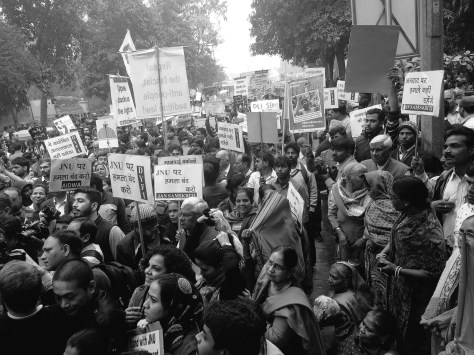 At the JNU rally in Delhi yesterday, I caught up with JNU alumni and historians, Rana Behal and Mukul Mangalik and asked them about their experiences as students at JNU in the 1970s (Behal) and 1980s (Mangalik) and what brought them to Mandi House on a damp, but pleasant, thursday afternoon.
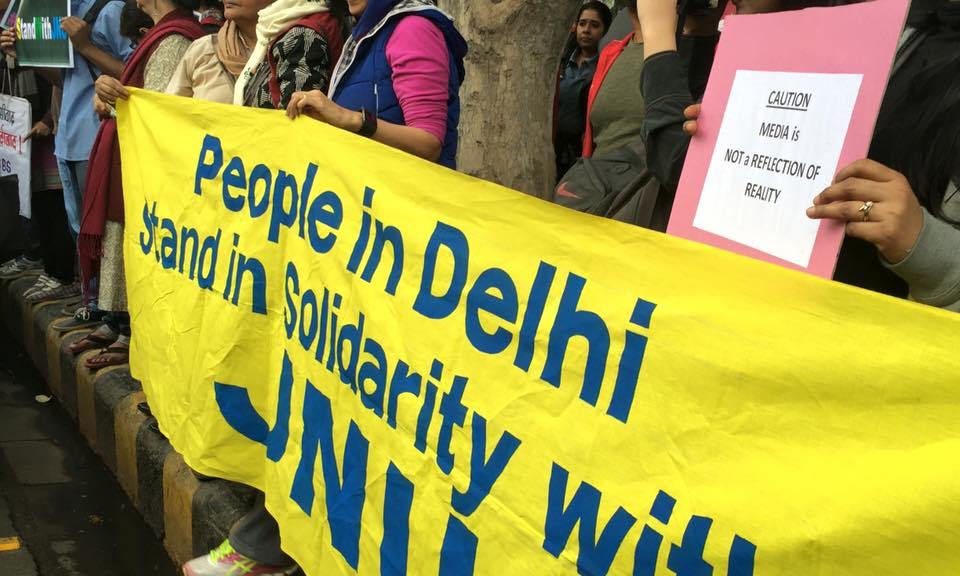
Delhi Stands With JNU Students and Against the Evil Modi Regime
“Because things are the way they are, things will not stay the way they are...”-
Bertholt Brecht
This afternoon saw an amazing, uplifting show of peaceful, joyful strength by students, young people, teachers, friends in Delhi, in support of JNU, in memory of Rohith Vemula, in solidarity with Kanhaiya, Umar and all the students in JNU who are being so stellar in their principled opposition to this evil, venal Modi regime. Reports of massive protests are coming in from Kolkata, Russia to and elsewhere. Something is changing in the air.
It was a perfect spring afternoon, overcast like our times, but breezy like our morale. There must have been at least 15,000 people on the march today. We met old and long lost friends and made new ones.
The gathering was totally peaceful. Young women and men, student profits from JNU in the eighties, grey haired, felt young again as their student held aloft flowers, flags, signs and homemade banners. Everyone looked their best, as if they had come to a massive street party.
It was so infectious, the mood this afternoon, such a contrast to the vile bad temper of the men who attacked Kanhaiya and his supporters two days in a row at the Patiala House Courts two days in a row that the difference between two entirely different visions of politics was palpable on your skin. The contrast sent a clear message to all our senses.
The RSS-ABVP-BJP brand of politics is diseased. It’s on its last legs and that is why it is so desperate. It cannot perform, it has no ideas, it is morally and culturally bankrupt.
Universities are in crisis and all that the bad TV actress who makes a joke of her ministry (HRS) every day can think of today while thousands March against her and her boss is about sticking giant flagpoles into the ground and stitching gigantic silk shrouds for her government and her party.
Modi, Rajnath and Manusmriti Irani should quake in fear. Their time is up.
Very proud of JNU students and the people of Delhi today.
#StandwithJNU #StandwithKanhaiya
#StandwithUmar
#Standwithallstudents
#NowitchHuntofStudents
Modi Govt. Stifles Dissent and Democratic Values – The real aim of the politics of ‘Desh-droh’ and ‘Gaddaar’ : NSI
Guest Post by New Socialist Initiative (NSI)
There is poison in the air. Loud abuses of ‘deshdrohi’, ‘gaddar’, ‘maaro maaro’ are rending the air. Angry men shouting these words have beaten up teachers and students of one of the best known universities in the country in the Patiala House Court of Delhi, barely three kilometers away from the seat of the national government. An elected MLA of the ruling party was part of the team of attackers. Women teachers of the university have publicly said that they were physically harassed by the mob, while the police looked the other way. This happened on 15th February. We can turn a day back.
The Home Minister of the country announced to the world that a protest by a handful of students at the Jawaharlal Nehru University was the handiwork of India’s ‘enemy number one’, Hafez Saeed of Lashkar-E-Taiba. The basis of his claim proved to be a fake tweet within hours. Three days before that, the elected president of JNU students union Mr Kanhaiya Kumar was arrested by Delhi police on charges of sedition, under the same clause of IPC which was used by the colonial rulers against Indian freedom fighters.
Solidarity with JNU and Conversations on Kashmir: JKCCS
Guest Post by Jammu Kashmir Coalition of Civil Society
Jammu Kashmir Coalition of Civil Society (JKCCS) expresses its solidarity with the striking students and teachers of Jawaharlal Nehru University, New Delhi. We have watched with a sense of horror and dismay, the violent criminalizing of student democracy and dissent, not just at Jawaharlal Nehru University but across Indian campuses in the recent past. Having long and intimate knowledge of violent repression and legalized impunity that Indian state is capable of, especially against those it considers ‘anti-national’ we are not surprised by these events, but have a special empathy with all who suffer its horrors. We demand the release of all student dissenters and political prisoners in the custody of the Indian state, and an end to acts of policing and surveillance on campuses, and targeting of students on the basis of political beliefs and speech.
The Kashmiri students in different colleges and universities in India, who have always faced discrimination and intimidation time to time, are now feeling the extreme regressive and oppressive means used by right wing groups and the government. After being hounded, Kashmiri students have begun leaving Delhi. There are several places where the landlords, in whose properties Kashmiri students were renting flats, have asked the students to vacate. These experiences of Kashmiri students are part of the larger reality faced by Kashmiri youth in Jammu and Kashmir and in India. The voices of dissent in Jammu and Kashmir have been dealt with administrative detentions under Public Safety Act, illegal detentions, torture, surveillance and killings by armed forces including the most recent one of Asif and Shaista at Pulwama on 14th of February.
We also view with alarm, the reports about the cynical use of Kashmiri students studying in Delhi as hostages in the politically illegitimate process of government formation in Srinagar.
We are dismayed that the public narrative about the recent events has often descended into disputes over Indian ‘patriotism’ and the shrill condemnation of a few ‘fringe’ ‘radical’ ‘traitors’ for ‘irresponsible’ slogans. These sentiments are neither mere slogans nor represent the ‘fringe’ in Kashmir, the very place they were made in reference to. As Kashmiris, we believe that the right to self-determination is inseparable from the right to political association, dissent and free expression, and these rights cannot be selectively asserted or upheld. In the competitive public proclamations of nationalistic credentials, what has been lost is that courageous act of defiant solidarity with the Kashmiri people’s struggle for justice and self-determination, that lies at the heart of these debates. Despite the disavowals and the state repression, the solidarity with the political rights of the Kashmiris is growing and spreading, as events in Jadavpur University demonstrate. We acknowledge the emerging spaces in Indian civil society to converse on the question of Kashmir, beyond nationalist framings. We hold out hope for future alliances with students, groups and individuals willing to engage in honest conversations, in which they alone do not determine the boundaries of what can or cannot be said, thought or felt.
Spokesperson
JKCCS
JNU Teachers Statement
After the arrest of JNUSU President Kanhaiya Kumar on 12 February and the entry of the police into JNU Campus, the situation has worsened for our students over the last few days. Sections of the mainstream and social media have carried unsubstantiated rumours targeting students, and organised groups have been making threats against them and indulging in hate speech in order to intimidate. The viciousness of this section of the media and amounts to a public trial and the frightening abuses being hurled at them make us feel deeply concerned for their personal safety and possibilities of their obtaining justice.
We strongly condemn these acts that create an environment of extreme prejudice and potential violence. We demand that the campus be allowed to return to normalcy at the soonest, so that students can return to their regular academic life in an atmosphere of trust and safety. The slander campaign against the University based on unsubstantiated claims not only tarnishes JNU’s image as one of best regarded institutions of higher education in the country, it also destroys JNU’s peaceful academic life. We are deeply concerned about the students’ future, which is being affected by this malicious campaign against JNU.
We the teachers of JNU wish that the Indian people should see through this orchestrated design to transform JNU into a space which will be unable to encourage or sustain critical thinking, so vital to the functioning of our democracy and our nation. It will also endanger the futures of thousands of students who are uncertain about the consequences that such a sustained campaign will have on their futures. We call upon the broadest possible sections of the Indian people to preserve the character of this much cherished national institution.
C.P. Chandrasekhar
G. Arunima
Ayesha Kidwai
Udaya Kumar
Pratiksha Baxi
Chirashree Dasgupta
Saradindu Bhaduri
Rajat Datta
Vinay Kumar Ambedkar
Ranjani Mazumdar
Jayati Ghosh
Navaneetha Mokkil
Rohith Azad
Ameet Parameswaran
Joy Pachuau
Yashadatta Alone
Rajarshi Dasgupta
Mohan Rao
Vikas Bajpai
Sujatha V
Parul Mukherjee
Ramila Bisht
Surinder Jodhka
Happymon Jacob
Supriya Varma
Mallarika Sinha Roy
Parnal Chirmuley
Nivedita Menon
Hemant Adlakha
Lata Singh
Urmimala Sarkar
Rajib Dasgupta
Rama Baru
Prachin Ghodajkar
Vikas Rawal
Partho Datta
Papia Sengupta
Ira Bhaskar
Sandesha Rayipa-Garbiyal
Veena Hariharan
Pradipta Bandyopadhyay
Biswajit Dhar
Neera Kongari
Geetha Nambissan
Brahma Prakash
Brinda Bose
Maitrayee Chaudhuri
Rashmi Barua
Letter of solidarity from members of the faculty of IIT Bombay
[This statement is issued in our individual capacities, and does not represent the institution’s opinion]
We, the undersigned, members of the faculty at IIT Bombay, are deeply concerned with the recent events that have undermined the autonomy of institutions of higher education in this country. We believe that these institutions are spaces of critical thinking and expression. Matters of contention that might arise in the conduct of intellectual and social engagements need to be addressed democratically and rationally. These methods in turn should be within the purview of institutional procedures that are responsible and accountable.
The state cannot dictate on the many meanings of what it is to be ‘Indian’ or mandate the meaning of ‘nationalism’. Rather, the state should be the one that makes sure that multiple ways of imagining one’s relationship with the nation are allowed to flourish especially when it might contradict dominant ways of thinking. In this context, we condemn the overreach of the state in the recent incidents in a number of institutions and the attempts of the Hindu Right to stifle dissent and suppress differences.
Signatories:
Abhijit Majumder, Assistant Professor, Department of Chemical Engineering, IIT Bombay
Aftab Alam, Professor, Department of Physics, IIT Bombay
S. Akshay, Assistant Professor, Department of Computer Science and Engineering, IIT Bombay
Alka Hingorani, Associate Professor, Industrial Design Centre, IIT Bombay
Aliasgar Q. Contractor, Professor (retired), Department of Chemistry, IIT Bombay
Amitabh Bhattacharya, Assistant Professor, Department of Mechanical Engineering, IIT Bombay
Amitabha Nandi, Assistant Professor, Department of Physics, IIT Bombay
A. Sanyal, Professor, Department of Computer Science and Engineering, IIT Bombay.
UK Anandavardhanan, Associate Professor, Department of Mathematics, IIT Bombay
Anil Kottantharayil, Professor, Department of Electrical Engineering, IIT Bombay
Azizuddin Khan, Associate Professor, Department of Humanities and Social Sciences, IIT Bombay
A. Chatterjee, Professor, Department of Aerospace Engineering, IIT Bombay
Dayadeep Monder, Assistant Professor, Department of Energy Science and Engineering, IIT Bombay
Dibyendu Das, Professor, Department of Physics, IIT Bombay
Dipankar, TREELabs, IIT-Bombay
Douglas Allen, Professor of Philosophy, University of Maine, USA, and Visiting Chair Professor in Gandhian Philosophy, IIT Bombay
Kushal Deb, Professor, Department of Humanities and Social Sciences, IIT Bombay
Madhu N. Belur, Professor, Department of Electrical Engineering, IIT Bombay
Mukta Tripathy, Assistant Professor, Department of Chemical Engineering, IIT Bombay
Mithun Kumar Mitra, Assistant Professor, Department of Physics, IIT Bombay
N.C. Narayanan, Professor, CTARA, IIT Bombay
Om Damani, Associate Professor, Department of Computer Science and Engineering, IIT Bombay
D. Parthasarathy, Professor, Department of Humanities and Social Sciences, IIT Bombay
Paulomi Chakraborty, Assistant Professor, Department of Humanities and Social Sciences, IIT Bombay
Pradeepkumar P. I., Associate Professor, Department of Chemistry, IIT Bombay
Purushottam Kulkarni, Department of Computer Science and Engineering, IIT Bombay
Raghunath Chelakkot, Assistant Professor, Department of Physics, IIT Bombay
M S Raghunathan, Distinguished Guest Professor, Department of Mathematics, IIT Bombay
Priya Jadhav, Assistant Professor, Centre for Technology Alternatives for Rural Areas, IIT Bombay
Raja Mohanty, Professor, Industrial Design Centre, IIT Bombay
Ramesh Bairy T. S., Associate Professor, Department of Humanities and Social Sciences, IIT Bombay
Ratheesh Radhakrishnan, Associate Professor, Department of Humanities and Social Sciences, IIT Bombay
Ravi N. Banavar, Professor, Systems and Control Engineering, IIT Bombay
C. D. Sebastian, Associate Professor, Department of Humanities and Social Sciences, IIT Bombay
Sharmila Sreekumar, Associate Professor, Department of Humanities and Social Sciences, IIT Bombay
Shishir Kumar Jha, Shailesh J. Mehta School of Management, IIT Bombay
Shrikrishna G. Dani, Distinguished Guest Professor, Department of Mathematics, IIT Bombay
Siby K. George, Associate Professor, Department of Humanities and Social Sciences, IIT Bombay
Siddhartha Chaudhuri, Assistant Professor, Department of Computer Science and Engineering, IIT Bombay
Sriram Srinivasan, Adjunct Professor, Department of Computer Science and Engineering, IIT Bombay
Supratik Chakraborty, Professor, Department of Computer Science and Engineering, IIT Bombay
V. S. Borkar, Professor, Department of Electrical Engineering, IIT Bombay
Sudhir R. Ghorpade, Institute Chair Professor, Department of Mathematics, IIT Bombay
Harish K Pillai, Professor, Department of Electrical Engineering, IIT Bombay
V. Sarma, Department of Humanities and Social Sciences, IIT Bombay
Anurag Mehra, Professor, Department of Chemical Engineering, IIT Bombay
Ravi Raghunathan, Department of Mathematics, IIT Bombay
P Sunthar, Chemical Engineering, IIT Bombay
Siddhartha Ghosh, Department of Civil Engineering, IIT Bombay
Kishore Chatterjee, Department of Electrical Engineering, IIT Bombay
Naresh K. Chandiramani, Department of Civil Engineering, IIT Bombay
R. Chakrabarti, Assistant Professor, Department of Chemistry, IIT Bombay
Sushil K Mishra, Assistant Professor, Department of Mechanical Engineering, IIT Bombay
Anindya Datta, Professor, Department of Chemistry, Indian Institute of Technology Bombay
Arup Ranjan Bhattacharyya, Professor, Department of Metallurgical Engineering and Materials Science, IIT Bombay
Indradev S Samajdar, Professor Department of Metallurgical Engineering and Materials Science, IIT Bombay
Mrinmoyi Kulkarni, Department of Humanities and Social Sciences, IIT Bombay
Sachin C. Patwardhan, Professor, Department of Chemical Engineering, IIT Bombay
#NoDissentNoCOUNTRY #StandwithJNU
Bol, ke lab azaad hai tere: Speak for your lips are yet free
Akshaya Tankha (JNU 2006) University of Toronto
A full Hindi transcript and video of Kanhaiya Kumar’s speech may be found here: http://kafila.org/2016/02/15/jnusu-president-kanhaiya-kumars-speech-before-being-arrested/
A complete English translation may be accessed here:http://www.telegraphindia.com/1160216/jsp/frontpage/story_69576.jsp#.VsVc8HQrK8r
Stand With JNU – SUNY College, Colgate and Syracuse Universities for Academic Freedom in India
Guest Post by Students and Teachers of Syracuse University, Colgate University and SUNY College of Environmental Science and Forestry
We, the undersigned at Syracuse University, Colgate University, and SUNY College of Environmental Science and Forestry, are in solidarity with our comrades at Jawaharlal Nehru University (JNU), India against the ongoing anti-democratic actions by the Indian state. We demand an immediate end to the police action against students on campus, and withdrawal of all charges against Kanhaiya Kumar, President of the JNU Students’ Union. We further demand that the Central Government put an immediate end to its prejudiced persecution of student activists on campuses across the country.
We strongly believe that the charge of sedition against Kanhaiya Kumar follows spurious claims. This arrest is an excuse for the state to root out dissenting voices on JNU campus, a move towards converting educational institutions like JNU into an arm of the authoritarian state. Attempts of a similar nature have been witnessed recently at other Indian educational institutions such as Film and Television Institute of India (FTII) and Hyderabad University. The growing threat to academic freedom posed by the current political climate is transnational, and extends beyond India to other parts of the world–it is a threat we face here in the United States, too.
For any word or action to qualify as being “seditious” under Indian law, it has to directly issue a call to violence. This was not the nature of the protest held by a group of JNU students against the judiciary’s decision regarding Afzal Guru, who was convicted of an attack on the Indian parliament. The peaceful protest held on February 9 on campus was not unlike other protests convened at the university over the last several decades. Dissent is an essential part of a healthy democracy. We therefore strongly condemn the Indian government’s response to the students’ protests and demand that the state refrain from authoritarian behaviour. In this spirit, we urge the Vice Chancellor of JNU to protect members of the university community and safeguard their democratic rights. Continue reading Stand With JNU – SUNY College, Colgate and Syracuse Universities for Academic Freedom in India
Indian Scientific Community Letter to Jawaharlal Nehru University Vice Chancellor
This is a guest post by SUVRAT RAJU
Three hundred and seventy-nine Indian scientists and academics have written a letter to the Vice Chancellor of JNU expressing their dismay at the recent events there.
In the letter, the signatories express their “deep disappointment” with the actions of the JNU Vice Chancellor, and call on him to take “urgent corrective steps to ensure that the police releases the arrested students, and also to ensure that it drops the unsubstantiated charges against them.”
The list of signatories includes hundreds of scientists from the leading scientific institutions in the country. The fact that so many members of what is otherwise an apolitical community signed this letter within about 24 hours indicates the level of outrage that these events have generated.
Please see below a full text of the letter and a list of signatories.
16 February 2016
Prof. M. Jagadesh Kumar
Vice Chancellor
Jawaharlal Nehru University
New Delhi-110 067, India
Dear Prof. Kumar,
We are writing, as a group of academics, to express our deep disappointment with your actions in the events leading up to the arrest and detention of several students last week.
We understand that last Tuesday, a student group organized a rally to commemorate the death anniversary of Afzal Guru. The police alleges that some of the students voiced controversial opinions. The police then proceeded to arrest the president of the JNU Students Union, Kanhaiya Kumar, and charged him with sedition. This has been followed by a number of further detentions. What is most disturbing is that the JNU administration appears to have defended and aided these repressive actions by the police, rather than defending the students who were involved in a non-violent activity.
The arrest of the president of the JNUSU is especially troublesome since he was not even an organizer of the rally but merely present to express his solidarity. However, even as far the organizers and the speakers at the event are concerned, we hope that you recognize that expressing controversial views in a peaceful forum cannot be equated with sedition. For example, many people believe that Afzal Guru was let down by a lack of appropriate legal representation in his trial, and that his execution was therefore a grave miscarriage of justice. One may agree or disagree with this viewpoint — and, indeed, signatories to this letter hold different positions — but we are unanimous that students should have the right to freely discuss this issue. This is such a basic pillar of academic ethics that we were dismayed by the statement made by the registrar of JNU, Mr. Bupinder Zutshi, who reportedly said “The government of India hanged him [Afzal Guru] after declaring him a terrorist. How could we allow them to organise an anti-Indian programme?” This indicates a complete lack of appreciation of the concept of academic freedom.
India is a vast country, and no one group can define what it means to be “nationalist” or “anti-national” is, in specific terms of positions to hold and causes to support. The country’s fabric is strong enough to accommodate a plurality of views. It is the attempt to suppress differing viewpoints that is genuinely damaging for the country’s democratic ethos. Further, we believe that creativity in all branches of knowledge — surely in the interest of our nation — finds highest expression in a milieu that does not put constraints on the freedom of thought.
It is ironic that this attempt to suppress dissent occurred at one of the country’s leading Universities. A University is a site where contesting ideas are explored and where students should be able to freely debate and discuss various views, including controversial ones, without the threat of state action.
Senior members of the government have aggressively targeted your students. The JNU administration should have protected its students against these attacks and charges that have also vitiated the police investigation. We are deeply disappointed that you have failed to carry out this responsibility.
We hope that you will take urgent corrective steps to ensure that the police releases the arrested students, and also to ensure that it drops the unsubstantiated charges against them. We also hope that, in the future, you will take steps to protect freedom of speech on the JNU campus.
Continue reading Indian Scientific Community Letter to Jawaharlal Nehru University Vice Chancellor
 KAFILA - COLLECTIVE EXPLORATIONS SINCE 2006