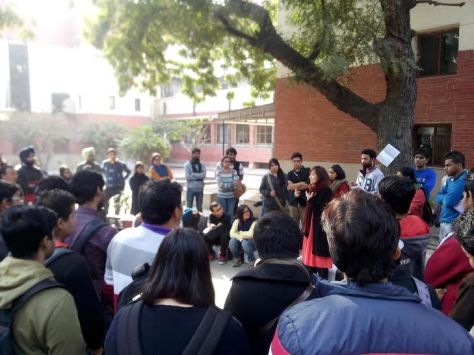
News reports are indicating that an FIR has been registered with respect to a public meeting organized on the JNU campus on the evening of 9th February. These reports claim that the meeting was about the hanging of Afzal Guru, and it is alleged that during its course, some people raised incendiary slogans. According to reports, the FIR has been registered under Section 124A of the Indian Penal Code (sedition), and the Police have already arrested one person.
It is important to note that under the Indian law of sedition, the events at the public meeting, even if completely true, do not even come close to establishing an offence. In Kedar Nath Singh’s Case, 5 judges of the Supreme Court – a Constitution bench – made it clear that allegedly seditious speech and expression may be punished only if the speech is an ‘incitement’ to ‘violence’, or ‘public disorder’. Subsequent cases have further clarified the meaning of this phrase. In Indra Das v State of Assam and Arup Bhuyan v State of Assam, the Supreme Court unambiguously stated that only speech that amounts to “incitement to imminent lawless action” can be criminalized. In Shreya Singhal v Union of India, the famous 66A judgment, the Supreme Court drew a clear distinction between “advocacy” and “incitement”, stating that only the latter could be punished.
Continue reading Arrest of Kanhaiya Kumar : A Short Summary of the law of Sedition in India