Category Archives: Capitalism

Aspirational India? Raj Nandy

Guest post by RAJ NANDY

0209-delhi-homeless-children_full_600

Image of homeless children from For Donald

Mainstream media recently carried stories about Prema Jayakumar, daughter of an auto-rickshaw driver who topped the Chartered Accountancy exam, and of several other young men and women who have made the journey from village to city, overcoming ‘poverty, social discrimination and even political strife to succeed in life‘ and are now set to step into elite professions.

The same story linked to above, suggested that Prema-type examples also show that “this tale of personal courage and excellence is embedded in the ethos of aspirational India” and that the “idea of aspiration has proved to be one of the most binding factors in the country”.

I disagree. To glorify and salute such examples of exceptional hard work and determination is, of course, apt and well deserved. However, to present a tiny fraction – say, a few hundreds or thousands as reflecting the temper or character of millions muddling through crippling poverty and malnutrition seems like mistaking the shadow for the substance. Continue reading Aspirational India? Raj Nandy
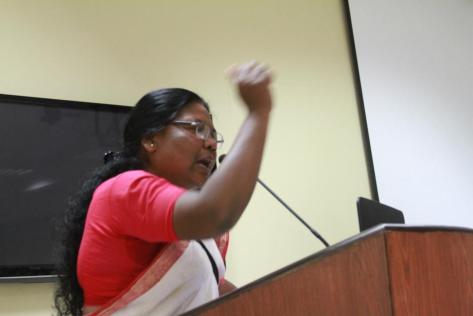

Dalit and Adivasi Women Warriors Question Caste and Gender Oppression: Sujatha Surepally

Posted at Round Table India

SUJATA SUREPALLY shares her impressions from the first National Dalit and Adivasi Women’s Congress held on February 15-16, 2013, at Tata Institute of Social Sciences, Mumbai.

We live in nature! We die in Nature! It’s our life, if you occupy our land where should we go and how do we live? Whose land is this?

dayamani

The hall is echoing with the furious voice of Dayamani Barla, veteran Adivasi activist from Jharkhand. She is trying to unite people against mining in Jharkhand, around 108 mining companies are waiting to destroy Adivasi life in the name of mining, first they come for coal, next they say power houses, it continues, we are pushed out and out further. How do we live without our land? Spectacular speech for an hour, pin drop silence all around, everyone is identifying with her pain and agony. At the end of it, what is she is trying to convey?

Humko Jeene Do! Let us live our own life! If this is called development, we care a damn about it!  Blanket statement. [Continue reading]

Arindam Chaudhuri, Silchar

Given below is the text of a press release put out by THE CARAVAN magazine in 2011. This was first published in Kafila on 22 June 2011 and is being republished today for all those who may be interested in following up on the defamation case filed against The Caravan for a profile of Arindam Chaudhuri. The Supreme Court had stayed the case in August 2011.

When I read The Caravan‘s cover story on Arindam Chaudhuri some months ago, I wondered when he was suing them. And he’s done it! While a court injunction has made The Caravan remove the story from their wesbite, you can read it thanks to Google cache. No wonder Chaudhuri’s sued Google India as well! Given below is the full text of the press release put out by The Caravan. Unlike when Chaudhuri took on bloggers in 2005, I’m glad it is an organisation with the resources to fight the case and take him head on – not to say that requires some spine as well. After you’re done reading the release below, entertain yourself with all the Arindam jokes on Twitter.  

IIPM’s Rs500-million lawsuit against The Caravan
In response to our February profile of Arindam Chaudhuri, the IIPM has sued The Caravan. Here’s why we’re fighting the suit. Continue reading Arindam Chaudhuri, Silchar

All India Protest Day in Support of Maruti Suzuki Workers: MSWU

Guest post by MARUTI SUZUKI WORKERS UNION (Provisonal Working Committee)

[This is a statement issued by the MSWU – Provisional Working Committee on the All India Protest Day held on the 5th of February in many cities and industrial areas in Solidarity with the workers of the Maruti Suzuki Factory in Manesar, Gurgaon, Haryana. Predictably this important statement and report was not carried by the mainstream media.]

MSWU, Registration No. 1923, IMT Manesar, Gurgaon, Date: 5 February 2013

Today, 5th February 2013, the great response to our appeal to all trade unions, workers, democratic organizations and progressive forces to hold an ALL-INDIA PROTEST DAY in solidarity with our struggle, against the continued exploitation, repression and injustice by the Maruti Suzuki company and Haryana Government, has further strengthened our resolve. 147 of our fellow workers are arrested and have not got bail for last 7 months, 66 more have non-bailable arrest warrants against them, 546 permanent and 1800 contract workers terminated from our jobs have not been reinstated, and we continue to face continued police repression, anti-worker administration and a state which has nakedly sided with the company-management. Even thus we are determined to carry forward our struggle to release all jailed workers, reinstate all terminated workers, impartial probe into the 18 July incident, implementation of labour laws and abolition of contract worker system.

Continue reading All India Protest Day in Support of Maruti Suzuki Workers: MSWU

Sexual Violence, Consumer Culture and Feminist Politics – Rethinking the Critique of Commodification : Sreenanti Banerjee

Guest Post by SREENANTI BANERJEE

I will begin with the by now well-known interview of author and social activist Arundhati Roy, conducted by Channel 4 (a British Media House), about the widespread protests after the horrific December 16th incident of the brutal gangrape of the 23 year old medical student in Delhi. Permit me to quote Roy at length as I do not wish to take bits and pieces from her talk, and pluck them out of their context.

We are having an unexceptional reaction to an event which isn’t exceptional […] But the problem is that why is this crime creating such a lot of outrage is because it plays into the idea of the criminal poor, the vegetable vendor, the gym instructor, the bus driver actually assaulting a middle-class girl. But when rape is used as a means of domination by upper castes, by the army or the police it’s not even punished. Continue reading Sexual Violence, Consumer Culture and Feminist Politics – Rethinking the Critique of Commodification : Sreenanti Banerjee

Patriarchy, Women’s Freedom and Capitalism: Kavita Krishnan

Guest post by KAVITA KRISHNAN

(This article began as a rejoinder to Hindi columnist Raj Kishor [Vaam se dakshin tak ek hi tark, (‘The same argument from Left to Right’), Rashtriya Sahara, January 13 2013], but it has also provided an occasion to address some common misconceptions about women’s freedom and capitalism.)

When women demand ‘freedom,’ why does it immediately raise the spectre of ‘licentiousness’?
Why, in other words, is women’s freedom automatically taken by many as equivalent with ‘licence,’ whereas the similar freedom on the part of men is never branded as ‘licence’?

This question arose in my mind after reading a piece by Hindi columnist Raj Kishor. Raj Kishor’s argument is that those – from Left leaders like I, to those whom he sees as representatives of the market – who are calling for women’s freedom are ‘consigning women into the fire of capitalism.’ When he hears me use the word ‘azaadi’ (freedom) he calls such freedom ‘utshrnkhalta’ (literally ‘unbridled-ness’, or licentiousness). He says and I, and the capitalist market alike, are calling for women to be free to ‘break all bounds of licentiousness’ if they so choose. Of course, Raj Kishor anticipates my criticism of his use of the word ‘utshrnkhalta’, since he says that is a word that ‘has feminists up in arms, demanding with red (infuriated) eyes the definition of ‘utshrnkhalta’.

Continue reading Patriarchy, Women’s Freedom and Capitalism: Kavita Krishnan

Condemn Police Repression on Maruti Suzuki Workers’ Protest Rally: MSWU

Guest post from Provisional Working Committee (MSWU)

We from the Maruti Suzuki Workers Union (MSWU) and our families continue to face not only an exploitative company management but also continous state repression since we started our agitation demanding justice and legitimate rights of workers.

This morning, Imaan Khan, one of the members of the Provisional Working Committee, MSWU, was picked up by the Haryana police while a Press Conference was underway, from outside the union office of Sarva Karmachari Sangh in Civil Lines, Gurgaon near Puspanjali Hospital.

Continue reading Condemn Police Repression on Maruti Suzuki Workers’ Protest Rally: MSWU

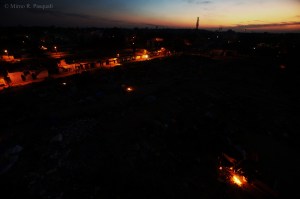
Photographs from Ejipura Demolition : Mirno R. Pasquali

Mirno Pasquali  is a photographer who has been documenting the EWS evictions in Ejipura Bangalore. Gautam Bhan has written about the evictions here

I spent the past few days photographing in the Ejipura slum which has been the focus of many activists working here in Bangalore. This has been my first attempt at documenting these types of issues, and being a foreigner has made it particularly interesting. I hope to have done so in a way that is fair, unbiased and ultimately insightful.

A number of activist have referred me to this forum as an intellectual space to post stories, issues and ultimately begin a dialogue about a number of different topics. I am happy to have found a place to place these photographs, and I hope doing so will aid to this goal.

Please feel free to use them for any publication, write up or other purposes. I only ask for acknowledgement and the passing along of my contact information.

mirno.pasquali@gmail.com

http://indiathough.blogspot.com

Mobile (+91) 8197862434

Jan 23 morning 060

Continue reading Photographs from Ejipura Demolition : Mirno R. Pasquali

Posco – Building A Better Tomorrow with Steel: Madhumita Dutta

Guest post by MADHUMITA DUTTA

11TH_POSCO_SITE_655201g

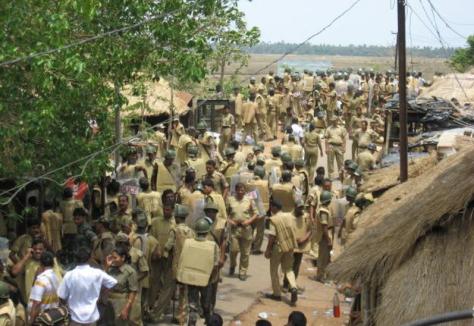
Policemen deployed at the proposed Posco site in Jagatsinghpur, June 2011

As I read the ‘sustainability-commitment’ page[1] on the website of Posco India Ltd, I was reminded of the images of a morning in a village square in the Ersama block of Jagatsingpur district in the Orissa. On April 1, 2008, Balithutha, a small village square, became the battle ground as hundreds of women, men, young and old tore down with their bare hands a 20 feet high bamboo barricade erected by the district police.  An act of defiance by people who came in hundreds, mustering whatever they had—courage, fear, rage—to battle a giant – Posco Steel company of South Korea and the state of Odisha. They came to say ‘we disagree, we oppose’ the plans to take over the lands that we have farmed for generations. That day the sound of their voices and ululations reverberated from the small village square of Balithutha to the offices of the powerful. Continue reading Posco – Building A Better Tomorrow with Steel: Madhumita Dutta

Notes from a bachelorette party in New India: Swathi Sukumar

Guest post by SWATHI SUKUMAR

Last week, I went to a bachelorette party. The party props were unbelievable to the point of being ridiculous—shot-glasses shaped like body parts, kinky trinkets, balloons in unmentionable shapes and sizes—and other items that would have made many women of another generation collapse in horror.

At the end of the party, everyone was slightly drunk and a good deal of time had been spent asking the bride-to-be embarrassing questions and cracking dirty jokes.  I realized that our revelry had a close parallel in the cult classic “The Hangover”, a story of four men who go to Las Vegas to celebrate a very eventful bachelor’s party. Our party shared common themes from the script of the movie, including inebriation and the obsession with bodies, both perfect and imperfect. We missed the tiger and the stripper from the movie, but I am told that strippers are a very common feature in bachelorette parties in India.

Tigers are not common, I hope. Continue reading Notes from a bachelorette party in New India: Swathi Sukumar

Cash Transfers and UID: Essential Demands

Statement by citizens (signatures below)

We support cash transfers such as old age pensions, widow pensions, maternity entitlements and scholarships. However, we oppose the government’s plan for accelerated mass conversion of welfare schemes to UID-driven cash transfers. This plan could cause havoc and massive social exclusion. We demand the following:

1. No replacement of food with cash under the Public Distribution System. 

The PDS is a vital source of economic security and nutrition support for millions of people. It should be expanded and consolidated, not dismantled.

2. Immediate enactment of a comprehensive National Food Security Act, including universal PDS.

Instead of diverting the public’s attention with promises of mass cash transfers before the 2014 elections, the government should redeem its promise to enact a National Food Security Act (NFSA).  Continue reading Cash Transfers and UID: Essential Demands

Jharkhand, twelve years later: Mahtab Alam

Guest post by MAHTAB ALAM

The state of Jharkhand was created after several decades of struggle. On 15 November, the state  completed 12 years of its formation. The day is considered to be the birth anniversary of the legendary leader Birsa Munda. The state, famous for its rich mineral resources, occupies an area of 28,833 square miles (74,677 square km) and has a population of nearly 330 lakh people according to 2011 estimates. Like every year, the formation day was celebrated with the great pomp and show by the government and the political elite in the state capital Ranchi and elsewhere.

However, this year, greater effort was made to bolster its ever declining public image due to mass displacement, brutality by police and security forces and rampant corruption in the state over the years, by giving advertisements not only in local and Hindi newspapers but also in major national dailies. On 15th of November, in the Times of India (Delhi edition), a full page advertisement was published with smiling faces of Shibu Sonren, once a popular leader and referred as Dishom Guru or the Great Leader of Tribal, Jharkhand Mukti Morcha (JMM) chief and also head of the ruling alliance, along with chief minister Arjun Munda and his team, in Hindi with the heading, ‘Vikas ke path par agrasar Jharkhand: Zameen par utri Haqeeqat’ (Jharkhand on the path of Development: Reality on the ground), enumerating ‘landmark works of development’ of the government. I was also told by friends that similar advertisements appeared in other newspapers as well. Continue reading Jharkhand, twelve years later: Mahtab Alam

Save indie cinema in India

To:
Door Darshan India (Director General)
President of India (Shri Pranab Mukherjee)
Vice President of India (Shri Hamid Ansari)
Information and Broadcasting Minister (Manish Tiwari)

This petition is jointly filed by: Oscar Award and National Award winning sound engineer Resul Pookutty; National Award Winner and Oscar nominees Ashvin Kumar, Ashutosh Gowariker; National Award winning filmmakers Anant Mahadevan, Aparna Sen, Ashim Ahluwalia, Buddhadev Das Gupta, Girish Kasaravalli, Goutam Ghosh, Jahnu Barua, Janaki Viswanathan, Nila Madav Panda, Onir, Rituparno Ghosh, Sachin Kundalkar, Shivajee Chandrabhushan, Shyam Benegal, Sanjay Suri, Shonali Bose, Sooni Taraporevala, Sudhir Mishra, Suman Mukhopadhyay, Umesh Kulkarni, Vinay Shukla, Vishal Bharadwaj; Film makers Aamir Bashir, Amole Gupte, Anusha Rizvi, Bedabrata Pain, Homi Adajania, Kaushik Mukherjee (Q), Kiran Rao, Krishna D.K., Nandita Das, Rahul Bose, Samar Khan, Srijit Mukherji , Subhash Kapoor, Sudish Kamath, Vinta Nanda, Vipin Vijay, Zoya Akhtar; 5 time National Award winning actror, social activist and MP Shabana Azmi and actor/producer Juhi Chawla

As the country celebrates 100 years of cinema we want to bring to your notice how New Wave Indie Cinema of India is under threat. Among the various challenges that we face as Indie film makers, the biggest is that of exhibition. The multiplexes which were given tax benefits to promote small budget content film have in fact been instrumental in destroying small cinema by only playing the box office game. Continue reading Save indie cinema in India

Maruti Suzuki Workers Union Release – Dharna and Strike on 7th and 8th November

Onwards to the Dharna and Hunger Strike of 7th and 8th November !!

The Maruti Suzuki Workers Union (MSWU: Reg. no. 1923) has decided to hold a protest dharna in the form of a two-day hunger strike on 7th and 8th November 2012. Our family members, relatives and well-wishers and organizations have staged regular protests across Haryana and given memorandum to all the ministers in the state but to no avail. We were not allowed to unite and express our side of the story and our indignation atbeing falsely implicated in the unfortunate incident of 18th July 2012.

Continue reading Maruti Suzuki Workers Union Release – Dharna and Strike on 7th and 8th November

Emami’s Bitter Harvest

In August this year, I moved to Ethiopia to cover the growth of Indian investment in Africa. As many of our readers may know, a flurry of reports by groups like Human Rights Watch and the Oakland Institute have implicated Indian companies in what they call “land grab” in Africa. While it is too early for me to pronounce any sort of verdict on the modalities and support for large-scale land investments in Ethiopia and elsewhere in the continent; one of my early reports suggests that things havent quite worked out as some Indian companies expected. 

Indian companies which invested in controversial deals involving hundreds of thousands of acres of land in Ethiopia have found themselves out of their depth in a fast-growing African economy that is still in the process of building critical transport and irrigation networks.

Documents related to one such transaction reveal how Emami Biotech, a subsidiary of the Rs.2,200-crore Emami Group, pulled out of a Rs. 400-crore, 40,000-hectare, bio-fuel plantation only a year after the project was announced.

Indian companies are the second largest investors in the Ethiopian economy with approved investments worth nearly $5 billion.

While a majority of the businesses are small manufacturing and trading enterprises run by business families long settled in East Africa, the big money has come with the recent entry of large Indian investors.

A number of Indian companies have signed agreements to lease more than 4,40,000 hectares of land across Ethiopia, 1,00,000 hectares of which has been granted to a single Bangalore-based company, Karuturi Global Ltd. International. Rights organisations and NGOs have characterised the deals as instances of land grab and have accused the government of forcibly resettling pastoral communities.

Read the rest here:

Bootlegging Education – Four Strategies for Fighting Back

Yes, this is what we must do now on a large scale – bootleg education.

Thanks to the conjunction of new heights of intellectual bankruptcy with new regimes of intellectual property, a large scale attack on equitable access to education is upon us. A longer discussion on  ‘Intellectual property’ is required, but the immediate provocation for this post is of course the Delhi University photocopying case. Elsewhere on Kafila, there is a post that links to a petition by authors and academics on this issue. The case, very simply is this: three big corporate publishers, namely Oxford University Press, Cambridge University Press and Taylor and Francis have filed a petition in the Delhi High Court, claiming infringement of copyright with regard to course packs used by students. The offender against these giant publishers is a small photocopy shop in Delhi School of Economics. As many legal experts on intellectual property and the Indian copyright law have stated, this kind of photocopying is well within the framework of the law (See some of the discussion here and here).

At the moment, however, I am not concerned with the pure legality of the issue. The question of ‘course packs’ concerns the vital interests of our society as a whole. For there was a time when teaching at the college and university level was  conducted largely through substandard kunjis, or guidebooks – honourable exceptions apart, of course.  Even today we have at least one of the corporate giants (that happens to be among those suing the little Rameshwari photocopier), producing slightly upmarket versions of such guidebooks. University professors willing to write a substandard book a month that fits into some course or the other, are also published by  publishers like these now, euphemistically called ‘textbooks’. In an earlier time, such books of barely passable scholarship (largely plagiarized cut-and-paste jobs) would be published only by dubious publishers.

Continue reading Bootlegging Education – Four Strategies for Fighting Back

An open letter to the jury of The Economic Times Awards for Global Excellence: G. Ananthapadmanabhan

This open letter has been put out by G. ANANTHAPADMANABHAN of Amnesty International (India)

Dear Mr Deepak Parekh, Mr Kumara Mangalam Birla, Mr K V Kamath, Mr Kris Gopalakrishnan, Mr A M Naik, Ms Chanda Kocchar and Mr Cyril Shroff,

We at Amnesty International India are deeply disappointed by your decision to give the Economic Times Business Leader of the Year 2012 award to Mr Anil Agarwal, Chairman of Vedanta plc.

The Business Leader award is given to individuals who have demonstrated “a strategic direction for success, and pursued a vision”. But Vedanta, in its efforts to have a bauxite mine opened at the Niyamgiri hills in Orissa and expand an aluminium refinery near Lanjigarh, has demonstrated an utter lack of both leadership and vision. What it has shown instead is a brazen disregard for Indian law and an utter lack of respect for the rights of local communities. Continue reading An open letter to the jury of The Economic Times Awards for Global Excellence: G. Ananthapadmanabhan

‘Big Ticket’ Reforms and Bigger Deceptions: Shankar Gopalakrishnan

Guest post by SHANKAR GOPALAKRISHNAN

When the country’s rulers have to tell barefaced lies to get their policies through, you know that there’s something wrong. Consider the recent “big-ticket reforms,” of which the two biggest (in terms of direct impact) have been the diesel price hike and the opening of the retail sector to FDI. The diesel hike, we’re told, was a “tough decision” necessary to “prune subsidies.” Except that diesel isn’t subsidised in this country. To repeat: there is no subsidy on diesel in India. As for FDI in retail, the Cabinet statement on the policy cites four justifications, accompanied by a “Studies show…” claim. Except that the data in the government’s sole study on the issue does not support three of these four justifications. As for their much touted “safeguards”, at least one has been said to be illegal by the Commerce Ministry itself, while the very same CCEA meeting diluted a similar safeguard for single brand retailers. Continue reading ‘Big Ticket’ Reforms and Bigger Deceptions: Shankar Gopalakrishnan

On the Violence Unleashed against Protesting Citizens in Koodankulam: Chennai Solidarity Group

A Statement issued by the Chennai Solidarity Group

Background

For more than a year the people of Idinthakarai village, along with fellow citizens from nearby villages have been protesting the setting up of a nuclear power plant at Koodankulam in Southern Tamil Nadu. The protests have been peaceful and have included people from different strata of society. Women have been in the forefront of the struggle, and over the last year even children have learned about the perils of nuclear power plants and the need to look for alternative energy sources.

In spite of this being a peaceful citizens’ protest, the state has chosen to treat it as dangerous – and arrested hundreds of people, intimidated many others and have more than once treated Idinthakarai village and its environs as if it were ‘enemy’ territory. Sedition charges have been slapped against the protesters, along with other criminal charges. The legality of these measures has since been subject to questioning. A high level Public Hearing, presided over by Former Chief Justice A B Shah has in fact called attention to the manner in which the law has been misused in this instance, and in fact abused to harass and prevent ordinary citizens from exercising their right to protest, and defend their constitutionally guaranteed right to life and livelihood. Continue reading On the Violence Unleashed against Protesting Citizens in Koodankulam: Chennai Solidarity Group

Zero tolerance for democracy – Kudankulam, Omkareshwar, Aseem Trivedi

Which of these three images brings dishonour to India?

This one?

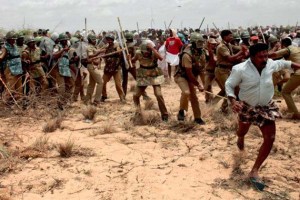
The full coercive force of the state slams down on villagers who have been so far peacefully protesting the location of a nuclear power plant in Kudankulam, Tamil Nadu.

Charges of sedition have been laid on hundreds of protesters in Kudankulam.

The women of Kudankulam wrote recently in a moving message to their fellow citizens:

When we carried the dead body of democracy and burnt it in the outskirts of our village on Aug 15th, 2012, little did we realize that so soon we would witness the real death of democracy. As this last nail is being tightened on our lives, we realize how insignificant has been our voice. But this has only strengthened our vow to be together.

(Read the latest update from Kudankulam below)

Continue reading Zero tolerance for democracy – Kudankulam, Omkareshwar, Aseem Trivedi

Don’t let him drink water because then he’ll also want to go to the bathroom

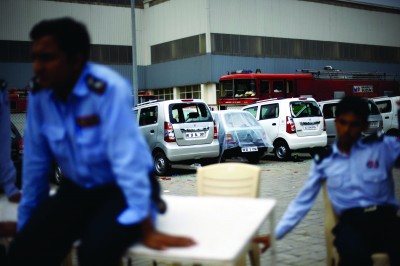
Photo credit: Ishan Tankha

My name is… let that be. Maruti Suzuki is out to get me, not because I did anything but because they want to put virtually every worker in jail, even those who belonged to the third shift and were not even present when violence took place in the Manesar factory on 18 July. I was present there and will tell you what happened, but to understand it you will have to let me begin from the beginning. Read more…