Category Archives: Culture

Statement on the Events at HCU and JNU From Faculty of the Tata Institute of Social Sciences


We, the undersigned, are deeply shocked and dismayed by the processes that led to the suicide of Rohith Vemula at HCU in January and the ongoing attacks on students and faculty of JNU. At Hyderabad Central University, RohithVemula a Dalit research scholar was labelled as anti-national and driven to suicide in January through systematic persecution. At Jawaharlal Nehru University (JNU), New Delhi over the past few days, Kanhaiya Kumar, the President of the JNU Students Union is held in police custody on the trumped up charge of sedition. On February 15, 2016, the police stood by as mute spectators while a group of lawyers and hooligan elements attacked students and faculty of JNU who had gone to the Patiala House courts in Delhi in solidarity with Kanhaiya Kumar who was to be produced there. Continue reading Statement on the Events at HCU and JNU From Faculty of the Tata Institute of Social Sciences

The Right to Reason and Imagine: Architects in Solidarity with the JNU Community

Guest Post by Architects from all over India and elsewhere

To: The JNU Teachers Association, JNU Students Union

CC: Vice Chancellor, JNU

We, the undersigned, are writing this in utmost shock and despair regarding the recent events and developments at your campus. We want to extend our full support to the JNU teachers association and the democratically elected JNU Student Union. We believe there is a difference between the nation, the state and the government of the day, and fully support your constitutional right to air your positions, as different or diverse as they may be, without illegal interference from any particular ruling ideology, party or state machinery.

As those engaged in architecture, we believe that imagination and reason are the highest of human faculties. This gift is what we constantly cultivate and rely on – in academia and in practice – when we question what exists, however natural, fixed and irreplaceable it may seem, and fearlessly posit alternatives. Indeed, there is little difference for us between possessing a moral imagination and being able to imagine such alternate worlds and other ways of being.

The inability therefore to envision life in another’s shoes, to disagree and to counter ideas with more aesthetic or eloquent ones without resorting to character assassination, violence and charges of anti-nationalism, betray to us an alarming lack of imagination, and we strongly condemn this in all its forms.

We condemn this absence of imagination and the physical and epistemic violence it has unleashed on the university community especially teachers and students. We stand with you in support of the university as a marketplace of ideas where all ideas and opinions are passionately argued, ripped apart, defended and critically re-imagined in ever new ways, leading to a more enlightened citizenry. This must be allowed to happen without fear or favor, risk of persecution or charges of sedition. If nothing else, the imagination of our founding fathers demands it, and we are in solidarity with your right to exercise it.

(This statement represents us in our individual capacities and not the institutions we are associated with.)

(In alphabetical order)

Continue reading The Right to Reason and Imagine: Architects in Solidarity with the JNU Community

ज़ी न्यूज़ के पापों से घिन आ रही थी, प्रोड्यूसर विश्वदीपक ने दिया इस्तीफ़ा !

ज़ी न्यूज़ के पत्रकार विश्वदीपक ने ज़ी न्यूज़ से इस्तीफ़ा दे दिया. ज़ी न्यूज़ को लिखा उनका ख़त पढ़ने लायक़ है. मीडिया विजिल.कॉम  से साभार. An English translation of this piece is available at Scroll.in.

प्रिय ज़ी न्यूज़,

एक साल 4 महीने और 4 दिन बाद अब वक्त आ गया है कि मैं अब आपसे अलग हो जाऊं. हालांकि ऐसा पहले करना चाहिए था लेकिन अब भी नहीं किया तो खुद को कभी माफ़ नहीं कर सकूंगा.

आगे जो मैं कहने जा रहा हूं वो किसी भावावेश, गुस्से या खीझ का नतीज़ा नहीं है, बल्कि एक सुचिंतित बयान है. मैं पत्रकार होने से साथ-साथ उसी देश का एक नागरिक भी हूं जिसके नाम अंध ‘राष्ट्रवाद’ का ज़हर फैलाया जा रहा है और इस देश को गृहयुद्ध की तरफ धकेला जा रहा है. मेरा नागरिक दायित्व और पेशेवर जिम्मेदारी कहती है कि मैं इस ज़हर को फैलने से रोकूं. मैं जानता हूं कि मेरी कोशिश नाव के सहारे समुद्र पार करने जैसी है लेकिन फिर भी मैं शुरुआत करना चहता हूं. इसी सोच के तहत JNUSU अध्यक्ष कन्हैया कुमार के बहाने शुरू किए गए अंध राष्ट्रवादी अभियान और उसे बढ़ाने में हमारी भूमिका के विरोध में मैं अपने पद से इस्तीफा देता हूं. मैं चाहता हूं इसे बिना किसी वैयक्तिक द्वेष के स्वीकार किया जाए.

असल में बात व्यक्तिगत है भी नहीं. बात पेशेवर जिम्मेदारी की है. सामाजिक दायित्वबोध की है और आखिर में देशप्रेम की भी है. मुझे अफसोस के साथ कहना पड़ रहा है कि इन तीनों पैमानों पर एक संस्थान के तौर पर तुम तुमसे जुड़े होने के नाते एक पत्रकार के तौर पर मैं पिछले एक साल में कई बार फेल हुए.

मई 2014 के बाद से जब से श्री नरेन्द्र मोदी भारत के प्रधानमंत्री बने हैं, तब से कमोबेश देश के हर न्यूज़ रूम का सांप्रदायीकरण (Communalization) हुआ है लेकिन हमारे यहां स्थितियां और भी भयावह हैं. माफी चाहता हूं इस भारी भरकम शब्द के इस्तेमाल के लिए लेकिन इसके अलावा कोई और दूसरा शब्द नहीं है. आखिर ऐसा क्यों होता है कि ख़बरों को मोदी एंगल से जोड़कर लिखवाया जाता है ? ये सोचकर खबरें लिखवाई जाती हैं कि इससे मोदी सरकार के एजेंडे को कितना गति मिलेगी ?

Continue reading ज़ी न्यूज़ के पापों से घिन आ रही थी, प्रोड्यूसर विश्वदीपक ने दिया इस्तीफ़ा !

Mea Culpa, Mea Culpa! : To A Student from CDS

Dear Student from CDS who pasted the posters criticising  our collective effort to stand with JNU

I write in response to the views that you expressed on those posters. First of all, let me tell you how much I’d have appreciated if you expressed those views openly right from the beginning, so that we could have had a proper debate. I do wish we stopped scribbling comments on each others’ posters – this is an open campus, and surely, we don’t practice the Sangh Parivar’s intolerance of a contrary opinion. No one, I assure you, will harm you in any way, and I am sure all my fellow teachers, students, and non-teaching staff will join me in assuring you thus.

Continue reading Mea Culpa, Mea Culpa! : To A Student from CDS

STATEMENT OF SOLIDARITY WITH STUDENT ACTIVISTS IN INDIA: University of Pennsylvania & Philadelphia South Asian Collective

We, activists and academics in the Pennsylvania region, strongly condemn the attack on academic freedom at Jawaharlal Nehru University (JNU), New Delhi. The arrest of Kanhaiya Kumar, the President of the JNU Student’s Union, on charges of sedition has brought to light the intervention of the Union Government in the internal matters of the university. The repeated interference by police personnel at the behest of Vice Chancellors on university campuses is a draconian move. The charges against students were brought after an event organized by a section of students on campus premises to discuss the judicial execution of Afzal Guru. The JNU Students’ Union was subsequently held responsible for the “anti-national” slogans that were chanted by a group of students. We condemn these trumped-up and unconstitutional charges and stand in solidarity with the efforts to repeal capital punishment in India.

The events unfolding at JNU reveal disturbing similarities with instances of government repression on other campuses. We remember, with distress, the actions of the University of Hyderabad (UoH) administration in cahoots with the Central Government, actions that led to the death of a promising Ambedkarite student-activist, Rohith Vemula. The protests that arose indicted the discriminatory atmosphere prevailing in our universities as tantamount to the denial of the fundamental right to education to socially marginalized groups. Further, the murder of social thinkers like Govind Pansare and M.M. Kalburgi by hyper-nationalist elements under the tacit encouragement of the policies of the Central Government has shocked all advocates of free speech in India.

The charges of sedition against students participating in democratic discussion of public events is highly objectionable. The stifling of voices through intimidation and muscle power does not bode well for educational institutions.

Debate and dissent are integral parts of a strong democracy. Universities are critical public spaces that support these democratic practices to realize the values of social justice enshrined in the ideals of the constitution. International campuses like JNU, FTII and UoH bring together diverse group of students in the spirit of self-reflexive and deep intellectual engagement to ask fundamental questions of their social realities. An attack on these institutions is an attack on this precious pedagogical space. Student movements in India in alliance with other social movements in the country have historically been a resilient and sensitive force. The BJP government’s efforts to undermine them is nothing but an assault on Indian democracy. The government has failed to protect the rights of student bodies, and the highhandedness of the police highlights the insecurities of the present government.

In the United States during a presidential election year, we watch increasingly bigoted views against blacks, Muslims, and immigrants gaining ground. These events cannot be seen in isolation and we stand at the intersection of socio-political movements in the US and South Asia.

We stand in solidarity with students and faculty of JNU and demand the immediate release of the detained students. We appeal to all advocates for academic freedom in India and abroad to stand united against this state atrocity.

  1. Anannya Bohidar, Graduate Student, South Asia Studies, University of Pennsylvania
  2. Ammel Sharon, Graduate Student, South Asia Studies, University of Pennsylvania
  3. Meghna Chandra, Philadelphia South Asian Collective
  4. Ania Loomba, English, University of Pennsylvania
  5. Projit Mukharji, History and Sociology of Science, University of Pennsylvania
  6. Najnin Islam, Graduate Student, English, University of Pennsylvania

Continue reading STATEMENT OF SOLIDARITY WITH STUDENT ACTIVISTS IN INDIA: University of Pennsylvania & Philadelphia South Asian Collective

Letter of solidarity with JNU: Students, Staff and Faculty, Ashoka University

We, the undersigned—who study and work at Ashoka University, as well as the alumni of the Young India Fellowship, in our private capacity—write to voice our solidarity with the students and faculty at Jawaharlal Nehru University (JNU). Recent events at JNU, including the arrest of the JNUSU President over the charge of sedition, as well as other disproportionate measures, amount to a deeply troubling attack on academic and cultural freedom. We strongly condemn the display of brute force by the police, who were given free entry to the campus, including hostels, to question, detain and arrest students and faculty members. We protest the lack of police protection to those students and faculty, and condemn the use of State force against democratic expressions of dissent.

As proponents of liberal education, we believe that societies can only grow when they foster intellectual engagement with fundamental social questions and contemporary political issues through non-violent debate and argumentation. University campuses are, and should be, autonomous spaces where people can peacefully express as well as challenge dissent and opinions. However, the recent spate of events involving many university campuses across the country has posed a serious threat to the sanctity of such spaces as well as the democratic right to dissent and freedom of speech and expression. This includes the turn of events that led to Rohith Vemula’s death at the University of Hyderabad, the withholding of grants by the Ministry of Human Resource Development to Panjab University, and several instances of violent disruption of the screening of the film Muzaffarnagar Baaqi Hai in campuses across the country.

We condemn the State-backed misuse of the charge of sedition, a colonial era provision in the Indian Penal Code, against the JNUSU President, Kanhaiya Kumar. In the documented absence of any allegedly ‘anti-national’ actions or rhetoric on his part, we see the charge as an attempt to stifle dissent from the dominant order and silence critique of the State. We strongly believe that the provision against sedition, which was repealed in the United Kingdom itself in 2009, has no place in modern democracy. Most immediately, we strongly disapprove of the action of certain lawyers and a Member of the Legislative Assembly who physically attacked JNU students and faculty members as well as journalists outside the Patiala Court House premises on 15th February, 2016.

We fear that the continued State inaction against such instances of violence will foster an environment in which the label “anti-national” or “traitor” can be imposed on every voice of dissent.

We urge that:

the JNU campus be restored to normalcy and the police be withdrawn from all parts of the campus.

the JNUSU President, Kanhaiya Kumar be released from police custody immediately and all charges be dropped against him.

such unconstitutional actions be denounced.

we be allowed to nurture our universities as tolerant, democratic spaces where dissent and disagreement is respected, discussions are nurtured, and critical thinkers are born.

Faculty

Ajit Mishra

Bhaskar Dutta

Malvika Maheshwari

Alex Watson

Debarati Roy

Mandakini Dubey

Anisha Sharma

Durba Chattaraj

Maya Saran

Anunaya Chaubey

Gilles Verniers

Nayanjot Lahiri

Anuradha Saha

Gwendolyn Kelly

Rajendran Narayanan

Aparajita Dasgupta

Jonathan Gil Harris

Ratna Menon

Aparna vaidik

Kranti Saran

Ravindran Sriramachandran

Arunava Sinha

Kunal Joshi

Saikat Majumdar

Aruni Kashyap

M A Ahmad Khan

Supriya Nayak

Pulapre Balakrishnan

Madhavi Menon

Vaiju naravane

Bharat Ramaswami

Malabika Sarkar

Vishes Kothari

Staff

Adil Shah

Kanika Singh

Shiv D Sharma

Aniha Brar

Karuna

Shreya Khedia

Anu Singh

Meena S. Wilson

Sudarshana Chanda

Anuja Kelkar

Mercia Prince

Suha Gangopadhyay

Charu Singh

Priyanka Kumar

Sukanya Banerjee

Chiranjit mahato

Sarah Afraz

Sushmita Nath

Dr Maaz Bin Bilal

Saumya Varma

Swarnim Khare

Harshita Tripathi

Saurav Goswami

Tanita Abraham

Ishan de Souza

Sayan Chaudhuri

Zehra

Sushmita Samaddar

Surya Raman

Sandeep Saraswal

Apoorva Gupta

Aditya Sarin

Chandan Sharma

Alumni

Aafaque R Khan

Kaavya Gupta

Rishi Iyengar

Akanksha

Kande Sruthi Niveditha

Ritesh Agarwal

Akshay Barik

Kaustubh Khare

Rohini Singh

Ananta Seth

Maansi Verma

Rupali Kapoor

Antony Arul Valan

Malini Bose

Sai Krishna Kumaraswamy

Anushka Siddiqui

Mayank Sharma

Sakshi Ghai

Ashish Kumar

Mrudula Nujella

Shahzaib Ahmed

Ashweetha

Neil Maheshwari

Shaleen Wadhwana

Avni Ahuja

Neelakshi Tewari

Shashank Mittal

Chaarvi Badani

Nikita Saxena

Shivangi Pareek

Danish Ahmad Mir

Nina Sud

Shrestha Mullick

Debanshu Roy

Nipun Arora

Shweta Subbaraman

Deepika Ghosh

Parushya

Simeen Kaleem

Devleena Chatterji

Pavithra Srinivasan

Simranpreet Oberoi

Dhaneesh Jameson

Poornima Sardana

Sonal Jain

Dhwani Sabesh

Pragya Mukherjee

Subhodeep Jash

Hardika Dayalani

Prama Neeraja

Tanuj Bhojwani

Harsh Mani Tripathi

Rahul Sreekumar

Taysir Moonim

Harsh Snehanshu

Rajat Nayyar

Vaishnavi Viraj

Himanshu Ranjan

Ratul Chowdhury

Venkat Prasath

Jahanara Rabia Raza

Rimjhim Roy

Vishal Khatri

Delhi Stands With JNU Students and Against the Evil Modi Regime

Because things are the way they are, things will not stay the way they are...”-

Bertholt Brecht

This slideshow requires JavaScript.

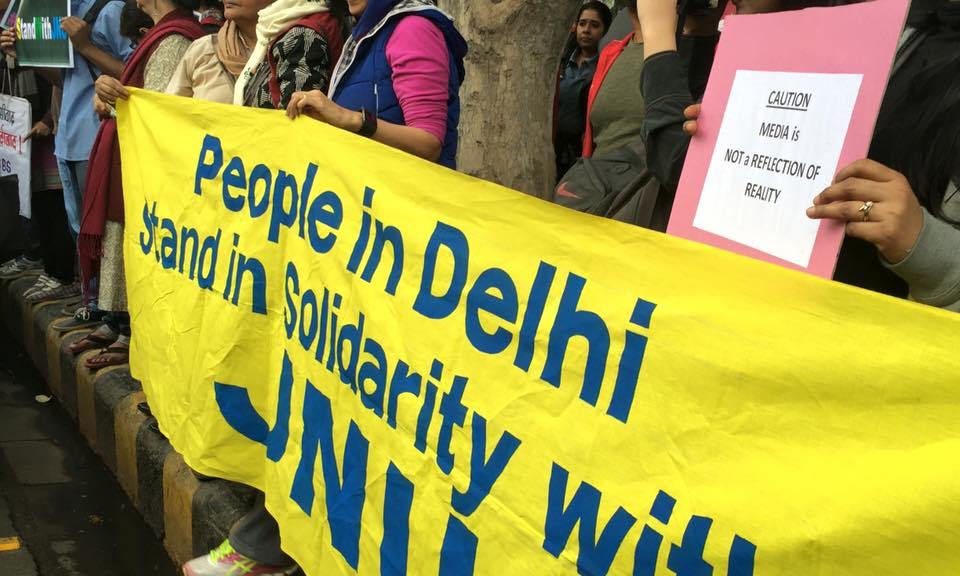
This afternoon saw an amazing, uplifting show of peaceful, joyful strength by students, young people, teachers, friends in Delhi, in support of JNU, in memory of Rohith Vemula, in solidarity with Kanhaiya, Umar and all the students in JNU who are being so stellar in their principled opposition to this evil, venal Modi regime. Reports of massive protests are coming in from Kolkata, Russia to and elsewhere. Something is changing in the air.
It was a perfect spring afternoon, overcast like our times, but breezy like our morale. There must have been at least 15,000 people on the march today. We met old and long lost friends and made new ones.

The gathering was totally peaceful. Young  women and men, student profits from JNU in the eighties, grey haired, felt young again as their student held aloft flowers, flags, signs and homemade banners. Everyone looked their best, as if they had come to a massive street party.

It was so infectious, the mood this afternoon, such a contrast to the vile bad temper of the men who attacked Kanhaiya and his supporters two days in a row at the Patiala House Courts two days in a row that the difference between two entirely different visions of politics was palpable on your skin. The contrast sent a clear message to all our senses.

The RSS-ABVP-BJP brand of politics is diseased. It’s on its last legs and that is why it is so desperate. It cannot perform, it has no ideas, it is morally and culturally bankrupt.

Universities are in crisis and all that the bad TV actress who makes a joke of her ministry (HRS) every day can think of today while thousands March against her and her boss is about sticking giant flagpoles into the ground and stitching gigantic silk shrouds for her  government and her party.

Modi, Rajnath and Manusmriti Irani should quake in fear. Their time is up.

Very proud of JNU students and the people of Delhi today.

#StandwithJNU #StandwithKanhaiya

#StandwithUmar

#Standwithallstudents

#NowitchHuntofStudents

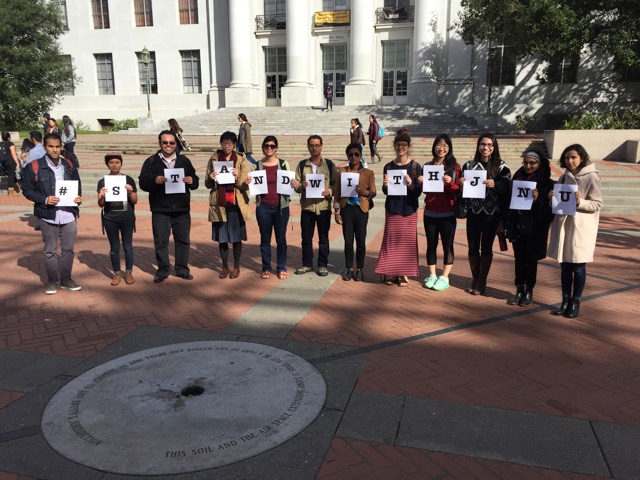
As The People’s Republic of New Delhi Marches in the Free Air Students of Berkeley #StandWithJNU

As the people of Delhi march, sing, run and dance to freedom’s call, as they cock a snook at the shackles of nationalism, casteism and authoritarian stupidity, a gift of love from afar. Look at them standing in the free air! Look at them standing around a piece of earth unbound from the myopia of nationalism!

BerkeleyStudents

“This soil and the air space extending above it shall not be a part of any nation and shall not be subject to any entity’s jurisdiction,”
 At the memorial to the 1964 Free Speech Movement on the campus of University of California, Berkeley, students and faculty stand in love and solidarity with JNU. #standwithJNU
 The memorial the 1964 Free Speech Movement at the University of California, Berkeley, like the thing it celebrates, is both invisible and embattled. The monument appears to be a circle of concrete six feet in diameter, in the middle of the famed Sproul Plaza where thousands of students gathered to demand the right to free speech and academic freedom on one of America’s most prominent and celebrated public university campuses. But that monument is so much more than what can be seen. The concrete circle, bearing the inscription “This soil and the air space extending above it shall not be a part of any nation and shall not be subject to any entity’s jurisdiction,” encompasses a 6-inch wide indentation into the ground that reaches into the soil below and 60,000 feet upwards into the sky, to the limits of American airspace. That is, in fact, the monument to free speech at Berkeley: 60,000 feet and 6-inches of invisible insistence that to speak freely is not and cannot be a right granted by any sovereign, mandated by any state. The width of the depression in the ground is as large as a person’s two feet. The ground on which they stand. From which they speak. This is the lasting monument to free speech at Berkeley. From a space as wide as our stance, reaching in an unseeable column of air to the limits of the stratosphere. A monument of air that can never, like free speech itself, be contained, torn down, or granted by another. It lies, unassuming, built as it is out of the immateriality of inalienable rights, in the middle of a campus that grapples daily with the legacy of that now 50 year old fight for the right to claim the space of the university as one of protest, of politics, of resistance.


But Berkeley, we mustn’t forget, exists on occupied territory. Its celebrated monument digs into soil that was taken, without recompense or acknowledgement, from the Ohlone people who were stripped of their lands, their language, their culture, and their lives in what America today celebrates as its great westward expansion. Thus, the monument to free speech at the University of California, Berkeley, roots itself into a soil it claims belongs to no nation and also reifies centuries of the genocide of indigenous people and of settler colonialism. This too is the legacy of the Free Speech Movement. Of the student-led activism that created Ethnic Studies programs across California and the rest of the United States. To stand in the 6-inch wide memorial is to stand in land that is occupied and to nonetheless believe that no occupation, no nation, no state, mandates our ability and our right to speak, to protest, to imagine otherwise the world in which we live.

From Berkeley to JNU. With love and solidarity.

Poulomi Saha

University of California, Berkeley

Modi Govt. Stifles Dissent and Democratic Values – The real aim of the politics of ‘Desh-droh’ and ‘Gaddaar’ : NSI

Guest Post by New Socialist Initiative (NSI)

There is poison in the air. Loud abuses of ‘deshdrohi’, ‘gaddar’, ‘maaro maaro’ are rending the air. Angry men shouting these words have beaten up teachers and students of one of the best known universities in the country in the Patiala House Court of Delhi, barely three kilometers away from the seat of the national government. An elected MLA of the ruling party was part of the team of attackers. Women teachers of the university have publicly said that they were physically harassed by the mob, while the police looked the other way. This happened on 15th February. We can turn a day back.
The Home Minister of the country announced to the world that a protest by a handful of students at the Jawaharlal Nehru University was the handiwork of India’s ‘enemy number one’, Hafez Saeed of Lashkar-E-Taiba. The basis of his claim proved to be a fake tweet within hours. Three days before that, the elected president of JNU students union Mr Kanhaiya Kumar was arrested by Delhi police on charges of sedition, under the same clause of IPC which was used by the colonial rulers against Indian freedom fighters.

Continue reading Modi Govt. Stifles Dissent and Democratic Values – The real aim of the politics of ‘Desh-droh’ and ‘Gaddaar’ : NSI

“A Glorious Thing Made Up Of Stardust:” What Pat Parker & Rohith Vemula Ask Us to Consider Lata Mani

This is a guest post by LATA MANI

The first thing you do is to forget that I’m black
Second, you must never forget that I’m black

Pat Parker (1978)

In these opening lines of her poem, For the White Person Who Wants to Know How to be My Friend, Pat Parker names a paradox at the heart of challenging socially produced difference. Parker is speaking not to diversity in nature, nor to the diversity of nature. Not to the variations of appearance – size, shade, height, foliage, texture; or mode of expression – hoot, howl, accent, gesture, cultural practices. Her lines address a uniquely human phenomenon: prejudice. They speak to the poignant difficulty of challenging a spurious and malevolent construction of racial difference in a society still in the grip of its miasma.

I have recalled Parker’s lines many times in the days of sorrow, tumult and righteous rage that have followed Rohith Vemula’s suicide. “Rohith Vemula’s suicide.” I am holding off from saying “Dalit scholar Rohith Vemula’s suicide.” Or, as is now being said with good reason, “Dalit scholar Rohith Vemula’s institutional murder.” I defer by a couple of sentences a description of him that refers to the caste into which he was born; to honour if only symbolically his anguish that the contingent facts of his birth had indelibly defined his life.

Continue reading “A Glorious Thing Made Up Of Stardust:” What Pat Parker & Rohith Vemula Ask Us to Consider Lata Mani

Solidarity Statement from Writers and Activists in Nepal

We stand with JNU From Nepal

We are deeply concerned by recent developments in one of India’s premier academic institutions, Jawaharlal Nehru University. The fact that Mr. Kanhaiya Kumar, JNUSU president, has been arrested and accused of sedition for a speech meant to promote more meaningful dialogue on civil liberties and freedom to dissent is an attack on the freedom of expression,a universal value which ought to be at the heart of any center of learning.

The Indian state apparatus has come out aggressively to demean and dismiss an institution’s independent practice of scholarship. This should be a cause of concern, not only to the citizens of India, but to each individual who envisions a more equal and just society. Because the impulse to stifle dissent begins incrementally, but then it becomes a barrage, a torrent, and an avalanche until it smothers every differing voice. Such attempts at stifling any voice at all should be condemned unequivocally.

We, the signatories from Nepal as listed below, unequivocally condemn the oppression of dissent at Jawaharlal Nehru University. We condemn in the clearest terms the actions of the Indian state and non-state mechanisms that have shown alarming vigor towards silencing dissent and curbing free speech.

Manjushree Thapa, Writer

Khagendra Sangraula, Writer

CK Lal, Writer

Kishore Nepal, Writer

Hari Roka, Writer/JNU Alumni

Continue reading Solidarity Statement from Writers and Activists in Nepal

#NoDissentNoCountry #StandwithJNU

Bol ke labh azaad hain tere: Speak for your lips are yet free

Partha Chatterjee, Columbia University and CSSS Calcutta

A full Hindi transcript of Kanhaiya Kumar’s speech is available here:http://kafila.org/2016/02/15/jnusu-president-kanhaiya-kumars-speech-before-being-arrested/

A full English translation can be accessed here:http://www.telegraphindia.com/1160216/jsp/frontpage/story_69576.jsp#.VsVc8HQrK8r

#NoDissentNoCOUNTRY #StandwithJNU

Bol ke labh azad hain tere: Speak for your lips are yet free

Eleanor Newbigin, SOAS, University of London

A full Hindi transcript and video of Kanhaiya Kumar’s speech is available here:http://kafila.org/2016/02/15/jnusu-president-kanhaiya-kumars-speech-before-being-arrested/

An English translation can be accessed here: http://www.telegraphindia.com/1160216/jsp/frontpage/story_69576.jsp#.VsVc8HQrK8r

Break Down the Barriers: Reading Robin T, Bhimrao and the Nation State in JNU

Jai Bhim, Joy Guru, Lal Salaam

Two of the greatest, crazies, most beautiful minds produced by the Indian subcontinent in the Twentieth Century would have been arrested by the police and attacked by the RSS, as ‘Anti-Nationals’, perhaps rightly so, had they been alive today.After all, they never stopped being young.


The Young Ambedkar
The Young Ambedkar

One of them was tall, you know him – the big guy, with  glasses, always dressed to the nines, (no itchy khadi or scratchy khaki would do for him) .

995
The Young Tagore

The other had long hair and a beard, and even became a contemporary artist in his old age.

The cops, or thugs-in-law of the RSS might even have said “saala JNU ka lagta hai” (looks like this ***** is from JNU).

So, here they are – Bhimrao Ambedkar (Baba Saheb), and Rabindranath Tagore.

Once again, Jai Bhim, Joy Guru. And pass the ammunition.

Continue reading Break Down the Barriers: Reading Robin T, Bhimrao and the Nation State in JNU

Fearless Minds and Heads Held High: To the CDS Student Community


Dear Friends

Ever since the Hindutva right-wing attacks on the country’s youthful citizens intensified – from the Kiss of Love protests to the attacks on politicized dalit youth on the campuses of IIT Madras and HCU, and now, against JNU – we have come together several times as a group to defend our right to critical thinking, action, and speech and protest against atrocities in the name of national interest and culture. We have come out not to defend our petty interests but in defense of the Indian Nation as we imagine it – differently from the right-wing – as belonging to  the communities of peasants, workers, students, artisans, dancers, singers, small traders, and thousands of other groups that contribute to the economy of this country, as the homeland of vast sections of underprivileged people denied humanity in the name of caste, class, culture, ethnicity and gender. Continue reading Fearless Minds and Heads Held High: To the CDS Student Community

Massive Turnout at JNU Protest Meeting

Even as the  government and the new JNU administration under the hand-picked  new Vice Chancellor step up their witch-hunt, the waves of protest grow stronger with a massive turnout at the admin block this evening. Despite the administration withdrawing at the last minute, permission to use mikes,…more and more students and teachers stand up to be counted. The will to fight grows stronger!

Protest meeting JNU
Protest Meeting in JNU outside the administration block. Image courtesy India Resists


Dissent in dark times : Ajita Banerjie

This is a guest post by AJITA BANERJIE

In the dark times, will there also be singing?

Yes there will also be singing.

About the dark times

– Bertolt Brecht.

In the dark times we live in right now, resistance to fascist forces could lead to arrest or death. Dissent comes with a rather heavy price to pay.Issues of democratic-national relevance  have ranged from consuming beef, resisting death penalty, resisting political control over academic institutions, protesting against privatisation of education and the most recent tragedy of Rohit Vemula’s suicide. Continue reading Dissent in dark times : Ajita Banerjie

Tibetan Artists Silenced at Dhaka Art Summit: Ahmad Ibrahim

This is a guest post by AHMAD IBRAHIM

20160207_200806
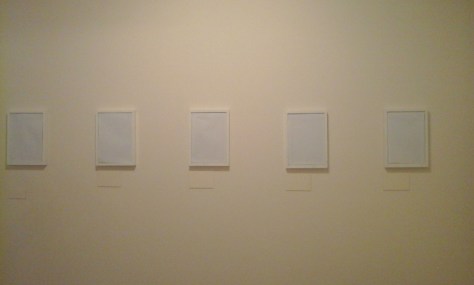
These pictures, which depict blank walls, are symbolic of the attack. Pictures of the original art cannot be shared due to copyright issues.

On the 7th of February, Tibetan artist Nortse and Indian artists Ritu Sarin and Tenzing Sonam had their photographs and art installations removed at the behest of the Chinese ambassador to Dhaka from the Dhaka Art Summit taking place in Shilpakala Academy in the capital of Bangladesh. The art project by Nortse was titled Prayer Wheel, Big Brother and Automan (2007) which showed the artist don traditional Tibetan clothes along with modern objects to show the surveillance that marks their lives. .Ritu Sarin and Tenzing Sonam produced a piece called “Last Words”, which consists of five facsmilies of five last messages written by the self-immolators in Tibet, along with their English translations. Ritu Sarin and Tenzing Sonam depicted Tibetan monks in the act of self-immolation as a way of political and religious protest against the occupation of Tibet by the Chinese government. At the end of the 6th of February, both artists were still depicted on the walls of the Art Summit. On the 7th, what greeted the visitors and patrons were blank stretches of white wall with white frames. It was as if the works had never existed. This is not the first time the Chinese government has tried to shut down political art work that aims to show the real face of Chinese occupation of Tibet. What is even more reprehensible is that it happened inside the walls of an institution that was proclaiming itself to be a haven of bold art and artistic expression. That the Chinese government could go to such lengths to silence an exhibition happening thousands of miles away shows the depth of their oppression over an entire country. Since February 2009, 142 Tibetans have self-immolated in their homeland, 120 dying from their actions.

A link to Tenzing Sonam’s twitter:

A Facebook link to a picture when the exhibit was still standing. 

Ahmad Ibrahim is a Dhaka based journalist.

If You Can’t Beat Them, Join ’em – Or, Ente Dinkeswara!

A new wave, nay, tsunami, of (THE) Faith has risen in Kerala. Soon, it will sweep the Nation.  This is the mighty thrust of Lord Dinkan, now known all over Kerala as Dinkamatam – or Dingoism.

…. Yellow, and black, and pale, and hectic red/ Pestilence-stricken multitudes: O Dinka,/ Who chariotest to their dark wintry bed ... [from ‘Ode to Dinka’ by the early Dinka devotion poet Muroidea Muridae Murinae, later stolen by Shelley and rewritten as ‘Ode to the West Wind’. Note that Dinkan,  superhero airborne rat and Shelley’s West Wind are both powers of the Air]

If you don’t believe me, visit this url:

https://www.dinkoism.com/

Now, like many others, I too was an unbeliever until I went there. One click, and I knew this was truly Faith. Market logic is nowadays the true marker of anything genuine (redefined an anything worth pursuing), and Dinkoism is unmatched in this regard. Even Amritanandamayi who successfully packages and sells all styles of Hinduism (the astrologer-obsessed style, the Saibaba-singing-style, the Sivakasi-print style, the shallow version of the Upanishadic style, the Christian-inflected Hugging-Mother style, the belligerent Hindutvavadi-style) cannot match him. Upon opening this Divine page, my eyes fell upon a notice in Malayalam which said: Mega offer before the world ends in 2012 [that needs updating, I suppose – small error; the spirit is more important] . 100 % guarantee in securing sin-free existence. Many years of service. Ridding of curses undertaken responsibly. We have no branches. Now, what further proof did I need to be convinced that this was the true Faith? Who doubts now that faith in the Logic of the Market precedes faith in faith? The Logos of Dinkan and the Logic of the Market are in perfect harmony!

Continue reading If You Can’t Beat Them, Join ’em – Or, Ente Dinkeswara!

In solidarity with Rohith Vemula: Concerned students and faculty at the Indian Institute of Management, Calcutta

Open letter to the President of India from Concerned students and faculty at the Indian Institute of Management Calcutta.

To

The President of India

Subject: An urgent appeal to address discrimination and political interference in academic institutions in the wake of the death of RohithVemula.

We, a group of students and faculty of the Indian Institute of Management Calcutta,expressour grief over the loss of the precious life of RohithVemula, a Dalit research scholar, at the University of Hyderabad.The events that transpired in the particular case were indeed tragic, with allegedinfringement of freedom of expression, caste discrimination and partisan interference by the higher State apparatus. This event is symptomatic of the larger malaise of failure of our institutions to provide a climate where students, irrespective of their social backgrounds, could find a way to excel. To create such a climate would require synchronised efforts in the parts of the State, the educational institutions and the society at large. Continue reading In solidarity with Rohith Vemula: Concerned students and faculty at the Indian Institute of Management, Calcutta

Paranoia and Procedure – Everyday Life within a University Labyrinth, Circa 2016: Prasanta Chakravarty

This is a guest post by PRASANTA CHAKRAVARTY

“The nature of peoples is first crude, then severe, then benign, then delicate, finally dissolute.”

–Giambattista Vico
The past congeals in savoir faire or habit, conserved as an ethos, in the corridors of the Arts Faculty at Delhi University. We all remember what is happening, while it is happening; watching ourselves as live spectators of our own actions. Wherefore such a sense of centripetal actuality? How this despotic pathology of inevitability in a place which was supposed to be the harbinger of a future? But the future arrives as a gyre, a loop. Continue reading Paranoia and Procedure – Everyday Life within a University Labyrinth, Circa 2016: Prasanta Chakravarty