Category Archives: Culture

A God by Any Other Name: Sumbul Farah

Guest Post by SUMBUL FARAH

The move from ‘Khuda Hafiz’ to ‘Allah Hafiz’, which Shireen Azam sees as a move towards Arabisation of subcontinental Islam is problematized by Nandagopal Menon when he questions if ‘Arabised’ Islam is an Islam ‘we do not like’. Menon’s argument provides some important ways of thinking about cultural assimilation, territorially bounded nationalisms and notions of piety central to Islam. However, it misses out on the important point that the project of ‘correcting’ belief is often premised on an exclusivist understanding of religious interpretation.

To emphasize the ‘correct’ usage might well in be accordance with Islamic notions of ‘islah’ and piety but unless we stop and question as to who is it that determines ‘correctness’ we risk aligning ourselves with the hegemonic narratives within Islam. The issue underlying the usage of ‘Khuda’ versus ‘Allah’ is not that the Indian version of Islam is somehow more desirable than an Arabised one owing to some notion of cultural nationalism, which is premised on modern nation-states; it is a questioning of the processes through which traditionally acceptable usages and idioms become marked out as ‘incorrect’ in the light of a hegemonic narrative. Particularly in the context of Islam, there is a tendency to seek a return to a supposedly ‘pure’ version of Islam, which in turn, means privileging the Arabian interpretation of Islamic beliefs and practices. Continue reading A God by Any Other Name: Sumbul Farah

#Hokkolorob – The Politics of Making Noise: Rajarshi Dasgupta

Guest Post by RAJARSHI DASGUPTA

We must not celebrate every time we see a movement. Movements can be very popular without being very meaningful, disturbing only the surface of society. Some can be pretty and harmless like candle light vigils; others dangerous and ugly like ‘love jihad’. Some want efficient governance like Hazaare; others regime change like Nandigram. For those tired with political apathy, it is of course good news that a spate of new movements is emerging thanks to new technologies and media coverage. But it is equally true that they seem to be going indifferent directions, without any common end. The picture is not clear. Who knows better than us how ‘change’ can be purely rhetorical? It is not difficult to imagine why people are weary of dramatic social unrest. They hardly fail to bring yet more conservative and unscrupulous sections to power. If we don’t want to get carried away, it is because of repeated disillusionments with the promise of change that everybody makes but nobody keeps. Politics is not, we better understand, about promise but manipulation, bargaining for daily needs, livelihood and resources, and so it should be. Movements may come and go like fashion, they are incidental to reality, which changes very slowly if at all. There is an institutional process of elections we have put in place, and it has proven to be resilient and reliable.

Bandh Bhengey Dao – Break All Bonds –
Lyrics and Music – Rabindranath Tagore & Asian Dub Foundation
From the Original Sound Track of ‘Tasher Desh’ a film adaptation by Q
of Rabindranath Tagore’s Joyous Anarchist Opera

Continue reading #Hokkolorob – The Politics of Making Noise: Rajarshi Dasgupta

Freedom and the University – Reflections from a Teacher: Rimi.B.Chatterjee

Guest Post by RIMI B.CHATTERJEE. Photographs by RONNY SEN.

Graffiti on Jadavpur University Walls. Photograph by Ronny Sen

There has been a lot of noise about the recent agitation at Jadavpur University, and a lot of slanted media coverage. Allow me to set the record straight on a number of points.

Continue reading Freedom and the University – Reflections from a Teacher: Rimi.B.Chatterjee

Prose of Power and the Poetry of Protest – An Outsider’s Attempt to Make Sense of the ‘Kolorob’ in Kolkata: Uditi Sen

Guest Post by UDITI SEN

51288650-29337-hokkolorob
#Hokkolorob – Embodied

It’s been more than a week since tens of thousands of students marched in a rain drenched Saturday in Kolkata, in solidarity with Jadavpur University students and their fight for justice. Much has happened since to delegitimise this mammoth, genuinely popular and student-led march. A counter-march, the co-optation of the victim’s father by the ruling party, adverse propaganda in the press and fatigue and confusion amongst the protestors have been some of the dampening developments that followed the unexpected show of student power. True to their clarion call, hok kolorob (let there be clamour), the marchers made a lot of noise. A week later, as the numbers of protestors on the streets have dissipated as fast as they had congregated, it is perhaps time to step back from the euphoria of the gathering and the intimidation and murky co-optation of protest that followed, to reflect on the political meanings and potential of this uprising.

The march was not organised by any single political party, though many with experience or background in student politics of one ilk or the other, marched. The vast majority, however, were students who had never marched before and had no experience of politics. The question therefore arises, what, if anything is the unifying ideology of this body of protestors? What goals motivate them? Above all, the question that is doing the rounds the most, on social media, on mainstream news and on the streets is what are the politics of the protestors? The question of politics is seldom posed directly. Its ubiquitous presence, however, can be clearly read in the answers provided regarding the nature of the march, the motivations of the protestors and the identity of the marchers. Unsurprisingly, diametrically opposite sets of answers emerge from members of the ruling party, inside and outside Jadavpur University; and the people who took to the streets on Saturday. From the Vice Chancellor, the Education Minister and officially ordained leaders of the ‘youth’, such as Abhishek Banerjee and Shankudeb Panda, characterisations emerge that focus on indiscipline on campus, presence of Maoist and other outsiders and deep conspiracies. From students of Jadavpur University and their sympathisers, assertions emerge that this protest is about justice and not about politics. Both characterisations fail to capture what is at stake.

Continue reading Prose of Power and the Poetry of Protest – An Outsider’s Attempt to Make Sense of the ‘Kolorob’ in Kolkata: Uditi Sen

Terror, Performance and Anxieties of Our Times – Reading Rustom Bharucha and Reliving Terror: Sasanka Perera

Guest Post by SASANKA PERERA

[ This post by Sasanka Perera is a review of  Terror and Performance by Rustom Bharucha (2014). Tulika Books, New Delhi. Kafila does not ordinarily post book reviews. An exception is being made for this post because we feel that the subject of terrorism, which has interested Kafila readers in the past, is an important one, and needs to be thought through with seriousness. We hope that this post initiates a debate on Kafila regarding terror, the state, performance, and the performances – serious, or otherwise – that typically attend to the discussions of terror, whether undertaken by the agents of the state or by non-state actors, commentators in the media, or by intellectual interlocutors. ]

When I started reading Rustom Bharucha’s latest book, Terror and Performance, it immediately became an intensely personal and gripping engagement. It was difficult to read in a single attempt as the mind kept wandering from one unpleasant moment in our recent annals of terror to another in some of which I had also become an unwitting part – mostly as a spectator. From the beginning, my reading was a conversation with Bharucha’s text through detours of my own experiences and an interrogation to a lesser extent. In 1986, as a young man when I went to the Colombo International Airport to pick up my father who was returning from the Middle East, I was shaken by a tremendously loud sound for which I had no immediate references. I had not heard such a sound before. People started running towards the sound. It was a bomb that had blown up an Air Lanka flight which had come from Gatwick. The Central Telegraph Office in Colombo was bombed in the same year. We learnt that everyone was running towards the sound and not away from it. Dry local political humor very soon informed us that people were trying to get inside the bombed out telegraph office hoping that they could get free phone calls to their relatives in the Middle East as they had heard phones were dangling from the walls with no operators in sight. That was long before mobile phones and call boxes. We were still young in terms of our experiences with terror. However, we soon had very viable references to what all this meant as the political narrative of Lanka unfolded with devastating consequences. But in 1986, when the kind of terror that was to follow in all its fury was still relatively new and quite unknown, we were acutely unaware of the dynamics of the actual act of terror and the structure of feeling it could unleash. This is why many of us in these initial years were naively attracted towards the epicenter of the act rather than being mindful to run away from it. But as the society grew in experience, people soon learned their lessons. Though an academic text in every conceivable way, I was reminded one could always find a few rare books of this kind which might personally and emotionally touch a reader in addition to whatever intellectual stimulation it might also usher in. Terror and Performance is clearly one such book. From the perspective of the writer, Bharucha himself recognizes this personal emotional engagement and investment early in the book. For him, “this writing demands stamina as it faces an onslaught of uncertainties and cruelties at the global level that challenges the basic assumptions of what it means to be human” (xi). It is the same kind of stamina that one also needs to read it as most of us in South Asia would be reading it squarely sitting in the midst of our own worlds of unfolding terror. This is why all those thoughts came gushing into my mind throughout the reading. I was not only reading Bharucha; I was also reading my own past.

Continue reading Terror, Performance and Anxieties of Our Times – Reading Rustom Bharucha and Reliving Terror: Sasanka Perera

Have the Gods Fled Their Own Country? Mohan Rao

Guest Post by MOHAN RAO

kathakali-performance-in-stree-vesham-in-mumbai

I returned a few days ago after four wonderful days in Trivandrum – having gone back there after some thirty years. Looking over Trivandrum from my seventh floor hotel room was a wondrous sight for sore eyes, a thick lush greenness everywhere. Hardly any high rises, an occasional mosque, temple or church rising above the green.

Going for a walk the next morning, around the medical college area, it was vastly reassuring to still see some old bungalows, and a number of ugly new ones of course. But not that many apartment blocks. Unlike Bangalore, the ones that have come up are not named Malibu Towers or Sacramento, but Revi Apartments.

Yes, it was wondrous to see Lakshmi still spelt Lekshmi and Ramya, Remya. Continue reading Have the Gods Fled Their Own Country? Mohan Rao

Remembering Maqsood Pardesi

Shiite_Calligraphy_symbolising_Ali_as_Tiger_of_God

On 23rd September 2014 Maqsood Pardesi lost his life. He had gone to the National Zoological Gardens in Delhi to meet a tiger. The tiger killed him. He was 20 years old. Maqsood worked as a daily wage laborer and lived with his family under the Zakhira flyover in central Delhi. He is survived by his father Mehfuz Pardesi, his mother Ishrat, his brother Mehmood and his wife Fatima.

There are conflicting reports as to how Maqsood found himself en face a tiger. Several reports state that, despite being discouraged by a guard on two occasions, he managed to climb into the tiger’s enclosure when the guard’s attention wavered. Some reports suggest that he accidentally fell into it. The authorities have vigorously denied the possibility of accidental entry and contested the assignation of blame on the zoo, or the tiger, for Maqsood’s death. Other reports have dwelt on Maqsood having a history of mental illness. Some state that he was drunk when he entered the enclosure. Some claim that he threw stones at the tiger, lost his balance and fell. Like the dissection of Maqsood, there has been speculation about Vijay, the tiger. The zoo authorities defend against charges that Vijay is aggressive. The tiger is not at fault many say: how can it be held responsible for the death of a man who enters its enclosure? The head zoo keeper has said, “Maqsood was mentally unstable otherwise why would a sane person jump into the tiger’s enclosure.” Why indeed? Continue reading Remembering Maqsood Pardesi

Koni koni chhe Gujarat: Rita Kothari

Guest post by RITA KOTHARI

[‘Koni koni chhe Gujarat’ is a poem by Narmadashankar Lalshankar Dave, popularly known as Narmad, who is understood to have introduced the notion of Gujarat in the 19th century, by identifying the region of Gujarati-speaking people. In the poem ‘Koni koni chhe Gujarat’ Narmad wrote that Gujarat belongs to people from different religions and also to those who belong to other parts of the country or globe.]

In 2006, St.Xavier’s College in Ahmedabad (where I then taught) hosted a conference on “Ahmedabad: Past and Present.” Towards the end of the conference a panel discussion focused on religious, linguistic, and other minorities to discuss how for instance, Jews, Muslims, Christians and Parsis felt about the city. Did they feel they belonged to the city, was their experience of citizenship complete, the panel moderator had asked. It was saddeningly clear that Ahmedabad, despite being multi-religious and multi-ilingual, did not hold the same social meaning and comfort for all. The reasons why this city, like some others, has been losing its historical contours of experience and pluralism are not far to seek. Some of the answers could be found in the history of Ahmedabad by Achyut Yagnik and Suchitra Sheth. I would only be reiterating the familiar and well established story of a majoritarian hegemony that has transformed lives irrevocably. Anyway, of the many stories that emerged during this panel, one in particular stayed in mind, reappearing intensely at some times, but receding again in ‘normal’ times.

Continue reading Koni koni chhe Gujarat: Rita Kothari

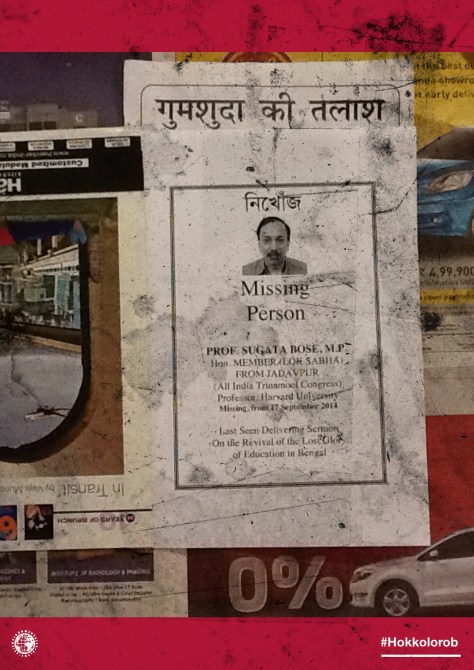
Missing Person Notice: Ben Zachariah

Guest Post by Benjamin Zachariah

Looking for Prof. Bose

It was not so long ago that Sugata Bose, now Lok Sabha Member for Jadavpur, made his way back from Harvard to serve his people. West Bengal had voted for ‘poriborton’, ‘change’, and as everybody assumed that Bengalis loved their fellow-men who had been anointed abroad, Sugata Bose returned to conquer the heights of Bengali higher education. The plan was to use a brand name within a brand name to shore up another brand name : Harvard, Netaji, Presidency. The Trinamul Congress, Bose was confident, would not interfere with his plans. Or so he said in public; his mother, Krishna Bose, had been the Trinamul Congress’s Presidential candidate, and long regarded as the force behind the attempted bhadramahilafication of Didi, apparently a prerequisite for political acceptability in West Bengal (otherwise known as Waste Bengal or Poschimbongobongo). It was therefore no surprise that his plans did not diverge from the plans of the TMC, although ‘internal differences’ were often heard of. It was also no surprise that, as the attempts to turn Presidency ‘University’ into the font of moral and intellectual legitimation for the TMC faltered, Bose took the mantle of his great-uncle upon himself and stood as a candidate for the TMC in the Lok Sabha elections, from the Jadavpur constituency. There was not even the pretence that Sugata Bose stood on his own credentials: his campaign marches were led by a child in Netaji uniform and Netaji glasses, prompting a complaint to the National Commission for Protection of Child Rights.

Now, in the Jadavpur constituency, duly won by Netaji’s heir, and not by a hair’s breadth, developments at Jadavpur University are cause for concern.

Continue reading Missing Person Notice: Ben Zachariah

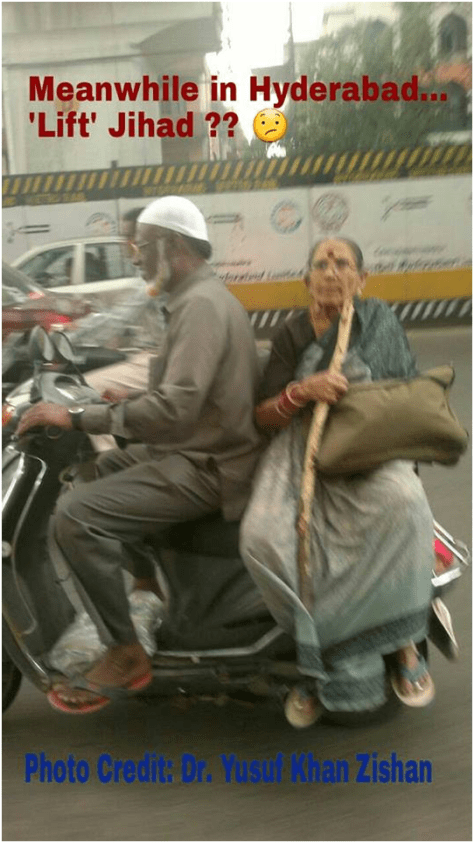
Lift Jihad: Yusuf Khan Zishan

This picture by YUSUF KHAN ZISHAN is circulating widely on Facebook. Received @ Kafila from Janaki Rajan who writes:

I was in Hyderabad on that day – August 19th, the day of the Telengana Intensive Household Survey, when people with two wheelers volunteered to help those arriving by trains to reach their homes as autos and taxis were not permitted to to ply that day… a spontaneous idea..

securedownload


A Letter to the Vice Chancellor of Jadavpur University, Kolkata: Ahona Panda

Guest Post by AHONA PANDA

[Ek Je Cchilo VC / Once There Was a VC – Thanks to Utsavdan, and to Manik-da of Bishop Lefroy Road]

To

The Vice Chancellor,
Jadavpur University,

and the Education System of West Bengal.

Respected Sir,

I would like to return to this university a gold medal that it awarded me, then a girl of 21, in the year 2009. I’ve never worn that medal since my convocation, and it lies in the box it was awarded in. I was a student of the English department in this university, and went on to study at Oxford and University of Chicago. Continue reading A Letter to the Vice Chancellor of Jadavpur University, Kolkata: Ahona Panda

The Islam we do not like: Nandagopal R Menon

Guest post by NANDAGOPAL R MENON

Some recent posts on Kafila have identified a “movement of sorts” in South Asian Islam – A Short Memoir On the Arabisation of Islam in India and The Sheepification of Bakistan

Named ‘Arabisation’, this is a “remarkably dispersed” and “subtle” movement most readily evident in certain changes in quotidian linguistic choices, for example, Khuda Hafiz and Ramazan has or is being replaced by Allah Hafiz and Ramadan. This linguistic shift from Farsi/Urdu to Arabic is taken to index a “great cultural battle” under way in South Asian Islam – one that attempts “to ‘correct’ Islam as Muslims in the subcontinent have understood, practiced and lived it, and instead replace it with an Islam which is uniform, seemingly universal and which need not have any affiliation with our cultural and local identities and beliefs”. That ‘Arabisation’ is not something innocuous or laudable is clear, for it “conveniently ignores” – or undermines? – Islam’s “age-old assimilation in the Indian sub-continent”. The following are some thoughts provoked on reading these posts. This is not meant as a coherent response to any of the posts, but just an unsystematic attempt to think through some of the assumptions that condition the creation of concepts like ‘Arabisation’ in public discourse.  Continue reading The Islam we do not like: Nandagopal R Menon

Notes from Jadavpur: Ahona Panda

Guest Post by Ahona Panda

About eight years ago, while lounging about doing nothing much in the campus of Jadavpur University where I was a student of the English department, I came across some callously etched graffiti:

Jodi prem na dile praane
Tobe Jadavpure pathanor ki mane?
(If you haven’t given this life some love–
What is the point of sending one to Jadavpur?)

Eight years on I cannot imagine the luxury of lounging about doing nothing much. One moves on in life after graduating from Jadavpur University. Meanwhile, in home and the world, the complete freedom (some will persist in calling this anarchy) of the JU campus has made it a legend somewhat like Dirty Harry: either worship and put it in on a pedestal, or condemn it thoroughly. The reputation of JU since the infamous 1970s has been as a hub of constantly bubbling anarchism, where Naxalites are hatching their next program of action, where ignorant armies like SFI and other anti-SFI groups clash by night.

Continue reading Notes from Jadavpur: Ahona Panda

Happy to Disturb – RJ Sayan and The Jadavpur Police Station, Kolkata

The disgusting police violence and simple thuggery unleashed by the Vice Chancellor of Jadavpur University at the behest of his masters in the Trinamool Congress Party and the West Bengal Government has resulted in a counter-offensive that features rage mixed with humour, mirth, music and creativity. Nothing can be more lethal for the zombies in power than the laughter and music of the young.

Here is a brilliant radio clip – produced by RJ Sayan (Meter Down, 104 FM, Kolkata).

Thanks to Debjani Dutta for the translations and the English subtitles in the video.

http://youtu.be/8kqQLIPFY8Y

Muslims should Counter the Divisive ‘Love Jihad’ Campaign with Friendship Towards Secular Hindus: Kaleem Kawaja

This is a guest post by KALEEM KAWAJA

Abhee sub kuch nahin mita shaayad
Hindu-Muslim main pyaar baaqi hai
Ek Bhaayee kaa ek Bhaayee pur
Pyar ka kuch udhaar baaqi hai … 

Jawaid Badauni.

unnamed

Since the past one year, especially after the parliamentary elections were looming close, extremist RSS elements have become all the more aggressive all over the country, especially in the north, east and west. They have taken pains to circulate false news stories about Muslims in general, and Muslim youth in particular, as somehow prone to violence ,and conniving to entrap Hindu girls in romantic relationships with the sole object of securing their conversion to Islam. Regional vernacular newspapers have carried fabricated stories about Muslim youth turning to terrorism and planning bomb blasts in many Indian cities.

Since the past one year, especially after the parliamentary elections were looming close, extremist RSS elements have become all the more aggressive all over the country, especially in the north, east and west. They have taken pains to circulate false news stories about Muslims in general, and Muslim youth in particular, as somehow prone to violence ,and conniving to entrap Hindu girls in romantic relationships with the sole object of securing their conversion to Islam. Regional vernacular newspapers have carried fabricated stories about Muslim youth turning to terrorism and planning bomb blasts in many Indian cities. Continue reading Muslims should Counter the Divisive ‘Love Jihad’ Campaign with Friendship Towards Secular Hindus: Kaleem Kawaja

The Indian Illusion: Shashank Kela

Guest post by SHASHANK KELA

Some time ago, I wrote an article seeking to dissect certain myths about Indian politics – and the class that dominates it, despite protestations to the contrary, the middle-class.[1] It is one of the habits of this class to see, and self-pityingly portray itself as victim – of mass politics, reservation policies, the great unwashed, of politicos bent upon appeasing the poor at the cost of sound principles and policies. Its conviction, of course, is that India was great, and on the cusp of becoming so again. This unfading glory is no more to be disputed than the existence of the sun, although opinions differ upon the precise placement of our golden age.

To the rabid fanatics of Hindutva, it resides in an unspecified Vedic time, when Hindus (not Indians) mysteriously succeeded in inventing aeroplanes, dynamite, nuclear weapons, the wheel, zero, and what have you (and mysteriously losing most of these wonderful things). To the Nehruvians, it is the age of Akbar, Ashoka, Harsha, periods of syncreticism and unique tolerance, where people of different faiths lived together peacefully and a composite culture flowered. To them, and to Gandhians, it also resides in the figure of Gandhi and the tradition of practical spirituality. To the fanatics of Islam, it is probably the age of Alauddin Khilji, the reign of Aurangzeb, and so on.

The never-ending debate about India’s pasts contains a diversity of opinions; however, on its future destiny, these begin to converge. The RSS and BJP believe, for example, that India is destined to become a great industrial power. So did Nehru, and assorted Indian Marxists. Indeed, it is an article of faith for the burgeoning middle-class (mostly, but not entirely Hindu) that India can, should and will equal China to become a great power, economic and military (thus leaving Japan and South Korea in the dust). Continue reading The Indian Illusion: Shashank Kela

Of Money-in-the-Blood and Blood-Money: Ravi Sinha

Guest Post by Ravi Sinha

Recently, the Indian Prime Minister had occasion to report to the Japanese on his genealogy and haematic chemistry. Addressing a house-full of corporate honchos in Tokyo he declared, “I am a Gujarati, money is in my blood”. One does not know what percentage of Gujaratis would feel insulted by such a description. It can be asked, perhaps more meaningfully, if great civilizations are created by money-in-the-blood types and one may wonder if Gujarati greats such as Narsi Mehta, Narmad, Govardhan Ram or Gandhi, too, had money flowing in their blood.

There is also some irony in the situation – prime minister of a country with the largest number of world’s poor boasting about ‘money in the blood’ to the richest men of a country that has, in the post-war decades, made more money per capita than any other on the planet. This prime minister can be accused of many things but not of lacking in hubris unencumbered by learning and cultivation.

One may wonder about something else too. The Indians may deserve their new prime minister and all his speeches – on the Independence Day, the Teacher’s Day and on all the other days. After all, they have elected him. But what have the Japanese done to deserve this? What forces them, despite the depth and dignity of their civilization, to lap up such crassness and banality?

The answer can be given in one word – money. Continue reading Of Money-in-the-Blood and Blood-Money: Ravi Sinha

Temperance in the time of Rahu

So Onam is here again — despite the fact that several contradictory stars above  now form a malefic conjunction in the fate of poor Malayalis in Kerala. Indeed, rarely has a stranger gang dominated the starry heavens of our destiny: V M Sudheeran’s targeted gullet moralism that promises to close down a very large number of bars in Kerala and pave the way for total prohibition in the future, gangs of Hindu right wing youth and women forcing the government’s liquor outlets to close, policemen puffed up with jingoistic nationalism who hallucinate about Maoists in wake and sleep and declare social activists like Ajitha “dead”, CPM offspring who think that making foul, putrid public statements justifying murder is politics. All these are, well, rather drunk on self-righteousness and to be true, present a slightly ridiculous sight. Even the weather looks ridiculously inebriated – the sky alternates between bright sunny spells and horrid, harsh showers, crazily swinging between sunny smiles and bursts of tears. Continue reading Temperance in the time of Rahu

‘लव जेहाद’ की असलियत – इतिहास के आईने में: चारू गुप्ता

Guest post by CHARU GUPTA

लव जेहाद आंदोलन स्त्रियों के नाम पर सांप्रदायिक लामबंदी की एक समकालीन कोशिश है. बतौर एक इतिहासकार मैं इसकी जड़ें औपनिवेशिक अतीत में भी देखती हूँ. जब भी सांप्रदायिक तनाव और दंगों का माहौल मज़बूत हुआ है, तब-तब इस तरह के मिथक गढ़े गए हैं और उनके इर्द गिर्द प्रचार हमारे सामने आये हैं. इन प्रचारों में मुस्लिम पुरुष को विशेष रूप से एक अपहरणकर्ता के रूप में पेश किया गया है और एक ‘कामुक’ मुस्लिम की तस्वीर गढ़ी गयी है.

मैंने 1920-30 के दशकों में उत्तर प्रदेश में साम्प्रदायिकता और यौनिकता के बीच उभर रहे रिश्ते पर काम किया है. उस दौर में लव जेहाद शब्द का इस्तेमाल नहीं हुआ था लेकिन उस समय में भी कई हिंदू संगठनों — आर्य समाज, हिंदू महासभा आदि –- के एक बड़े हिस्से ने ‘मुस्लिम गुंडों’ द्वारा हिंदू महिलाओं के अपहरण और धर्म परिवर्तन की अनेकोँ कहानियां प्रचारित कीं. उन्होंने कई प्रकार के भड़काऊ और लफ्फाज़ी भरे वक्तव्य दिए जिनमें मुसलमानों द्वारा हिंदू महिलाओं पर अत्याचार और व्यभिचार की अनगिनत कहानियां गढ़ी गईं. इन वक्तव्यों का ऐसा सैलाब आया कि मुसलमानों द्वारा हिंदू महिलाओं के साथ बलात्कार, आक्रामक व्यवहार, अपहरण, बहलाना-फुसलाना, धर्मान्तरण और जबरन मुसलमान पुरुषों से हिंदू महिलाओं की शादियों की कहानियों की एक लंबी सूची बनती गई. अंतरधार्मिक विवाह, प्रेम, एक स्त्री का अपनी मर्जी से सहवास और धर्मान्तरण को भी सामूहिक रूप से अपहरण और जबरन धर्मान्तरण की श्रेणी में डाल दिया गया. Continue reading ‘लव जेहाद’ की असलियत – इतिहास के आईने में: चारू गुप्ता

A civil-war is on the doorstep of India: Interview with Kancha Ilaiah by Mahmood Kooria

This is a guest post by Mahmood Kooria

We are publishing an English translation of an important interview of the intellectual and academic Kancha Ilaiah, conducted by Mahmood Kooria for the Malayalam weekly Mathrubhumi. While what I see as Professor Ilaiah’s underestimation and perhaps misreading of the historic role of the Communists in Indian politics leaves me severely uncomfortable, especially when he exonerates the right from commensurate charges of elitism, his framing of Hindustva and Modi’s appeal within the great stream of caste in the subcontinent is brilliant and thought-provoking, as always. 

Kooria conducted the interview as well as translated it in to English. His introduction is as follows, “At a time when there was no any such discussion, in 2002 Professor Kancha Ilaiah predicted that Narendra Modi will be the prime-ministerial candidate of Baratiya Janata Party. It has come true and now Modi is in the office. At this point, I talked with him at Moulana Azad Urdu University Hyderabad where he chairs the Centre for the Study of Social Exclusion and Inclusive Policy. In the conversation, he talked about the future of Modi government and he predicted that a civil war is going to break out in India if Modi does not cater the needs of backward classes. A Malayalam-version of this interview was published in the Mathrubhumi Illustrated Weekly (August 24, 2014).”

Mahmood Kooria: Ten years ago you wrote that Modi will be the prime ministerial candidate of BJP. What would be your response as your prediction has come true?

Kancha Ilaiah: Well, at that time I was predicting that based on the Left parties’ indifference to understand the caste question. The caste question is not been seriously taken by the Left parties. And, after Mandal, the BJP and the RSS wings started looking at caste-question seriously because when Babari Masjid was demolished they mobilized a lot of backward classes. Though they oppose Mandal reservation, they wanted the backward classes to be part of the Hindu religion. Around 1994, a non-Brahmin called Rajju Bhaiya became the Sarsanghchalak of the RSS. Then he recruited a large number of backward classes, large number of youth, and he promoted the people like Narendra Modi, Uma Bharati at that time. Earlier, the first backward-class chief minister of Uttar Pradesh was a BJP man: Kalyan Sing. He was the chief minister in 1992 when the Babri Masjid was demolished.

The Sangh Pariwar was responding to the backward class demands more. But the Left or the Congress was not responding to the OBCs. The Congress was responding to the Dalits and Muslims. There was upper caste all the time on the top. So, when Narendra Modi became the chief minister and this whole atmosphere was created, I was writing a column in The Hindu. I thought that this seems to be cause/course of India, since the Hindu religion is surviving because of the backward classes. It is inevitable for the Hindutva organizations that they will have to project an OBC for the prime-ministership. But there was resistance from within itself. It is not that the Brahmins have given up the principle of varna-dharma. After that article came and of course after my writing Why I am not a Hindu itself, the backward classes even within RSS seemed to use that material for their advantage. The communists did not use or recognize it. The question of labour and caste which I have been consistently raising, which was also part of their theory, they did not care about. So the Communist Party remained tightly under the control of upper castes.

Continue reading A civil-war is on the doorstep of India: Interview with Kancha Ilaiah by Mahmood Kooria

Who is guiding Modi’s economic thinking and what is their background?: Aditya Velivelli

Guest post by ADITYA VELIVELLI

The Modi government’s actions over WTO are a case of much ado about nothing. They have pointedly created a false perception over a non-issue so as to appear pro-poor. Modi said “Do we choose feeding our poor or getting good press world-wide?” Turn this statement around and one gets to see the truth of the matter. The real attempt here is “How to masquerade as pro-poor and get good press in India by using WTO?”

This demonstration of concern for the poor helps Modi’s government in implementing ultra-neoliberal economic policies in the coming months. To understand the game-plan one should only look at the people guiding Modi’s economic thinking. Continue reading Who is guiding Modi’s economic thinking and what is their background?: Aditya Velivelli