Category Archives: Culture

Of a Few, By a Few, For the Few: Bobby Kunhu

Guest post by BOBBY KUNHU, carrying the debate on the Anti-corruption movement forward

I am distinctly uncomfortable with predictions – using either scientific or unscientific tools. For me it smacks of charlatanry – from astrology to psephology to stock market speculation. But with the charade that was unleashed for the past few days on news television by the mainstream media and of course at Jantar Mantar and a few other town squares across the “mainstream” Indian political landscape by Anna Hazare’s fast – I did dare to make an attempt – both at prediction and more comfortably with dissent. I foretold the outcome of the fast tableau at an emergency meeting that was convened by some co-travellers at the Salem Citizen’s Forum to debate on whether and how to show solidarity to Anna Hazare…

…Well, it is not just Anna Hazare and his team who won this match comfortably. All actors who joined the show have won the match. Everyone – the “civil society” that sat on fast at Jantar Mantar and other places, the Corporate media, the glamour world, the Government, political establishment of all hues and shades – everyone who bothered to join the game. It was like bathing in the Ganges during the Maha Kumbh – everyone’s sins were washed away. And of course nobody in their right minds regardless of political affiliations or ideologies could take a position “for corruption”!!! A veritable Bush-ian position — either you are with Anna Hazare or you are with corruption. And yes, India Incorporated has won the match and it is time for celebrations!

Read the full post on Countermedia

Dastan-e-Sedition

Free Binayak Sen Campaign

Justice on Trial:
three days of cultural events
April 4 – 6, 2011
@ Alliance Francaise de Delhi
72, Lodhi Estate, New Delhi 110003

Justice on Trial (Facebookers RSVP here) is a collaborative programme put together by leading contemporary artists, photographers, film makers, musicians, performers, and activists to commemorate struggles for democracy, freedom and rights. An exhibition of photographs and art works, talks performances and screenings all are directed at drawing renewed attention to the trial of Dr. Binayak Sen, who has emerged in recent times as a symbol of courageous resistance, and a reminder of the many injustices that surround us. Our aim is to provoke a dialogue with the colours and sounds that emerge from the idea of what Dr. Sen represents.  Continue reading Dastan-e-Sedition

Why so serious?: Anuj Bhuwania

Guest post by ANUJ BHUWANIA

Cellphone videos of the celebrations at India Gate after India won the semi-final against Pakistan


So cricket is the opiate of the Indian masses, and India’s left-liberals (henceforth LLs) can’t deal with it. Or with popular cinema or religion, for that matter. All of which are things that these oh-so-serious people can’t quite seem to fathom. The only cinema you should enjoy are art house/multiplex films with the right ‘social message’, the only religion you can profess is Sufism and the only cricket you are allowed to enjoy is West Indies winning a test match, because CLR James has apparently said it’s ‘empowering’ or  ‘anti-imperialist’ or some such. These trivialities – cinema, religion, cricket – are just there to distract people from the really important issues. We should all only obsess about ‘important’ topics like nuclear energy, the 2G spectrum scam or the UID. Continue reading Why so serious?: Anuj Bhuwania

Madan Gopal Singh on the Jugni debate

Guest post by MADAN GOPAL SINGH


Arif Lohar sining a Jugni with multiple beat instruments – dholak, dhol and bongo and chimta. Even the alghoza – two short and narrow reed flute like instruments – used to keep fast rhythm between three to four notes.
*

With extreme reluctance, I am trying my hand at English even though my command of this language remains highly suspect. After a recent discussion on Kafila, I felt encouraged to contribute my two-penny bit to the lively debate about Jugni… Continue reading Madan Gopal Singh on the Jugni debate

Corruption, CPI(M) and Neoliberalism: Sankar Ray

Guest post by SANKAR RAY

Prasenjit Bose, chief of research cell, central committee of CPI(M) deserves kudos for his article Corruption and Forbearance under Neoliberalism, published in the journal of The Centre for Policy Analysis, and reproduced in pragoti.org. However, corruption is not an exclusive phenomenon under the capitalist system. Socialist countries – I mean the social orders encouraged by the Third International – were also afflicted by corruption, not to speak of People’s Republic of China (both in Mao and post-Mao years). Even the CPI(M)-led governments in Kerala and West Bengal never waged a principled war against corruption.  Hence Bose’s inference that “the state under the neoliberal regime has increasingly become a vehicle for capital accumulation and also a site for primitive accumulation, by the established corporate players as well as new entrants to the big business club” – is only half the truth. Continue reading Corruption, CPI(M) and Neoliberalism: Sankar Ray

The ‘new’ Indian filmi woman: Arpita Das

Guest post by ARPITA DAS

In these times of celebrating ‘small’ films, ‘new’ unheard-of young directors, little India, and non-filmi characterizations, it seems to have become mandatory for critics to praise every film claiming to build its  narrative around a so-called non-mainstream idea.  If this were not so, two ‘small’, ‘different’ films which created a lot of hype recently, would not have gathered as much post-release steam.  I am talking about No One Killed Jessica and Manu weds Tanu.  Both have been promoted and described in reviews as bold films, with star heroines showing a no-holds-barred temperament and verbal acumen, and this being the central focal point of their ‘different-ness’, both have made that oft-repeated Bollywood claim, ‘pikchar hatke hai’. If the films are to be believed, this new Indian woman can be instantly recognized by one or more of the following traits: smoking nicotine or other substances, mouthing expletives both in Hindi and English with ease, being sexually promiscuous or even vaguely ambivalent, manipulating people close to them without giving a thought to causing hurt, and a sound lack of any sense of ethics in the professional sphere or personal turf.

Continue reading The ‘new’ Indian filmi woman: Arpita Das

Who is Jugni?: Indu Vashist

Guest post by INDU VASHIST

The character of Jugni has been featuring in Punjabi popular and folk music for well over a century. The most recent references of this rebellious, fiery female character have appeared in diverse productions like Pakistan’s Coke Studio (above), Punjab’s sensicore rocker Rabbi Shergill, and of course Bollywood in films like Tanu Weds Manu and Oye Lucky! Lucky Oye! Continue reading Who is Jugni?: Indu Vashist

Reflections on Sudipta Kaviraj’s ‘Marxism in Translation’

[The following is a revised version of some comments made during a discussion with Sudipta Kaviraj at the Centre for the Study of Developing Socoeties, Delhi on 21 October 2010. Kaviraj made a presentation based on a recent essay of his ‘Marxism in Translation: Critical Reflections on Indian Political Thought’ (published in Political Judgement: Essays in Honour of John Dunn, Eds Raymond Geuss and Richard Bourke) to which some of us responded. AN]

It is interesting to revisit, with Sudipta Kaviraj, the field of ‘Indian Marxism’. It is an abandoned field, a piece of haunted land where no living beings go – at least not in their senses. What is more, it is a field that ‘Indian Marxists’ themselves are afraid of revisiting. It is their past – the land of the dead, of unfulfilled ancestral spirits, where the ghosts of yesteryears hang like betaal from every tree. The terror of this forbidden territory has redoubled, after the collapse of socialism. It is as if some deep secrets of the past lie buried there which they would rather not bring back to life, for fear of what might be revealed to them of their own selves. It is strange but true that Marxists who swear by history are perhaps as afraid of it as anybody else.

Read the full post in Critical Encounters.

You fill up my Census…

…quipped my brother Dilip in response to the following mail from my sister Pramada:
So the bell rings this afternoon. desperate clanging. i open the door and there is a man with forms in his hand and a general irritated demeanor. figured that this was the census man. he comes in and settles down. starts by wanting to know who the head of the household is. i say there is no one. he insists. i continue to say no one.

Census of India 2011 mascot

He proceeds to explain that if the parents live in the house, then they are the head of the household, if married then the husband is. I proceed to ask for definition and say that all three of us who live in the house are head of the household since we all earn and take decisions. he promises to erase what he has written since he was sure my mother was head of household.

He seemed to find my gender a bit dubious so questioned my mother if i was a boy or a girl and then repeatedly said “ladki” to me. having established that i indeed was a woman, he wanted to know date of birth, which was not difficult, but place of birth he found extremely challenging. he could not get his spellings right, or did not know districts or states in the country so tattamangalam in palghat district in kerala was as baffling as mysore in karnataka. calcutta was easy to deal with and he said calcutta was in calcutta!!! mother tongue caused him more angst because he had to write malayalam and again the spelling eluded him.

Continue reading You fill up my Census…

10% Anthology: Tarun Bhartiya

A review by TARUN BHARTIYA

The Oxford Anthology of Writings From North-East India : Poetry and Essays
Edited by Tilottoma Misra
Oxford University Press
New Delhi, 2011, 332 Pages / Rs. 595 ISBN 0-19-806749-6

If you are on the marginalisation trip, and India’s North East is your illicit high, you should be worried. In the last ten years, trying to make up for the dark fifty years of Indian ignorance, anthologies of literature from the region have begun to appear almost annually.

But before I get accused of an inside job, a disclosure that I am loathe to make:

I know many of the poets (some of whose biographies smell of Shillong) who feature in The Oxford Anthology of Writings From North-East India : Poetry and Essays. We share little magazines, anthologies, dark bye-lanes of love, anger, feuds, booze, and journeys to find our next fix.  So, I promise to dull my taste and leash my judgment. And only occasionally lapse into pointless gossip. Continue reading 10% Anthology: Tarun Bhartiya

Teaching Harmony, Practicing Disharmony

This was presented as a paper at a symposium on Peace Education organised as part of National Conference on Indian Psychology, on 6 February 2011 at the India International Centre.

This piece seeks to underscore the cleavages that exist in our society, explore the foundations upon which the edifice of intolerance has risen and to look at the tools, like education for peace and harmony, with which we try to dismantle this citadel of intolerance.

Peace education, you would agree, cannot be confined merely to teaching the message of Love and brotherhood, our text books have been teaching this message for as long as I remember and my memories of our text books go back, at least to my senior school days in the mid sixties, almost 45 years ago.

If telling students in their classes that we should all love each other because we are all Indians and that we are all equal was enough then we would not have many of the problems that we are confronting today. Continue reading Teaching Harmony, Practicing Disharmony

A Moment of Revelation: Prasanta Chakravarty

Guest post by PRASANTA CHAKRAVARTY

[A Report on ‘The Everyday Life of a Discipline’- a colloquium on contemporary English Studies that took place on February 4, 2011, at the Department of English, University of Delhi]

Unlike the social sciences, humanities in India at least, have been less systematic and meticulous about introspection. This is slightly odd owing to the fact that the onslaughts on humanitities, from both outside and from within its own quarters, have been quite relentless and ballistic of late. Besides, it is a good idea to take stock of things from time to time as disciplines morph and change gear. So, when I was asked to be part of a group of practitioners of humanities who were at the forefront of the last bit of stock-taking that took place during the late nineteen-eighties, I was curious to know how they see their own transition at this point of time and also get a sense about their assessment of English studies now, apart from my own contribution to the current debates.

Continue reading A Moment of Revelation: Prasanta Chakravarty

Chitrasutram: Post-modern Cinema?

Months ago, while watching what was in effect a docu-hagiography about a prominent literary icon in Malayalam and wondering about its structure, I was enlightened by a little voice that piped up from a few rows behind. “Nyoosh” (news), it said. On screen, the literary icon appeared and began to talk. A few minutes later, the little voice trilled again, “Parshyam” (commercial). And lo! The icon dissolved, followed by what looked exactly like a commercial, a sequence of visual tricks, visual hallelujah to the wisdom of the revered sage. The little voice thus revealed to me that the structural rhythm of the docu-hagiography was effective precisely through its prayer-like repetitiveness; it also alerted me to the fact that it was extraordinarily similar that to the visual strategy of television (Truth-dream-Truth-dream…), which again is perhaps vital to its sway over viewers. Continue reading Chitrasutram: Post-modern Cinema?

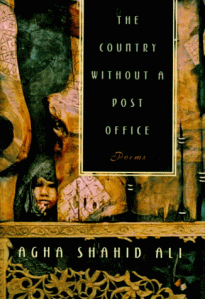
‘i swear…i have my hopes’: Agha Shahid Ali’s Delhi Years: Akhil Katyal

This is a guest post by AKHIL KATYAL

Born on 4th February, 1949, Agha Shahid Ali would have been 62 next month. The Kashmiri-American poet who spent the last half of his life in the States (he migrated to Pennsylvania in the mid 70s) died in the winter of 2001 due to brain tumour. The next year had begun with papers and journals in the States, and in Kashmir and India, remembering Shahid. ‘Your death in every paper,’ Shahid had written for his own idol the singer Begum Akhtar after she passed away in 1974, ‘boxed in the black and white / of photographs, obituaries.’ In his new absence, he similarly reappeared in the words of his friends as an insurmountably beautiful poet, a gregarious Brooklyner, a near perfect cook, an impossibly good teacher and a lasting friend. Apocrypha started building around him very soon after his death. One could say this was the final proof that Shahid’s name would abide – that stories began to be spun around him as soon as he was not around. The Pakistani novelist Kamila Shamsie, Shahid’s creative writing student at Hamilton College in New York and then at the University of Massachusetts in Amherst in the 90’s, and someone who always recounts his indelible influence on her writings (he coloured her drafts red), was one of the first to add to the stories that have multiplied since in this decade after Shahid’s death. Kamila’s friend, also a student of Shahid, had told her that some months after he was diagnosed with brain cancer, Shahid was riding the subway going to teach his class at NYU when he started to feel faint and began to black out. ‘For a moment,’ her friend told her, ‘he thought, “I’m dying,” and then he told himself, “No. First I’ll teach my class, then I’ll die.”’

Continue reading ‘i swear…i have my hopes’: Agha Shahid Ali’s Delhi Years: Akhil Katyal

The Birth of God: Siddhartha Gigoo on Pt Bhimsen Joshi (1922-2011)

Guest post by SIDDHARTHA GIGOO

It was on a nice summer evening in the year 1996 that I first got to attend Pandit Bhimsen Joshi’s concert.

I was studying literature at the Jawaharlal Nehru University in New Delhi. Those were terrible times for me. I struggled with my studies. Good grades evaded me. Failure stared at my face and the world mocked me. It was difficult to trudge through the endless days and the nights. Reading books became a cumbersome task because one had to present seminars and write the boring term papers at the end of the semesters. Some of us slept during the days and idled during the nights. There seemed to be no respite in sight. Life, what atrophy? I laboured somehow from one book to another, sometimes seeking enjoyment and sometimes to broaden my experience and understanding of life and the world. I had heard somewhere that one must not seek knowledge. Some said knowledge didn’t exist, while others argued that knowledge was a perilous trap from which there was no escape. I was perhaps frantically looking for a reprieve from my fears and imperfections. Continue reading The Birth of God: Siddhartha Gigoo on Pt Bhimsen Joshi (1922-2011)

Sound Enough: How to Enjoy the Jaipur Literature Festival: Revati Laul

Guest post by REVATI LAUL

“Excuse me, Mr. Farooqui, I just need a sound byte from you,” said a young reporter from the fairly young news channel News X. He was talking to my friend Mahmood Farooqui, author of Besieged: Voices From Delhi 1857, co-director of the Oscar nominated film Peepli Live and founder-revivalist of Dastangoi – the rich, medieval art of storytelling. Seeing that the setting was the beautiful and quaint Diggi Palace in Jaipur with a substantial gathering of the world’s literati for the Jaipur Literary Festival, Mahmood was preparing to hold forth on storytelling, culture, 1857…when this completely unexpected gem poured forth from the fearless reporter’s lips.

“Can you sum up what you think of literature in one word?” Continue reading Sound Enough: How to Enjoy the Jaipur Literature Festival: Revati Laul

Sumangala Damodaran on IPTA’s protest music

See also: Singing of Defiance

Ab Bhi Dilli Dur Hain: On ‘No One Killed Jessica’: Kartik Nair

Guest post by KARTIK NAIR

Why does No One Killed Jessica open with the execution of Jessica Lal but rush so quickly to the windswept altitudes of Kargil? And why, when she first blasts on to the screen as embedded journalist Meera reporting on the war, does Rani Mukerji look more like she’s embedded inside an SNL skit on Barkha Dutt? I let out a little laugh then, but the laughs only got bigger from there. Here is a film that knows nothing about how the media works; worse, it fails to pass off its version of the media as believable. Here are a few lessons I learned watching the film:

1. Aspiring reporters will be glad to note that though journalists generally fight tooth-and-nail at press conferences to get their questions heard, a helpful “Yaar, please, mujhe poochne do!” will elicit total co-operation and rapt attention.

Continue reading Ab Bhi Dilli Dur Hain: On ‘No One Killed Jessica’: Kartik Nair

लोकतंत्र के बुझते चिराग़: अनिल

Guest post by ANIL [freelance journalist and researcher, Mahatma Gandhi Antarrashtriya Hindi Vishwavidyalay, Wardha]

इक्कीसवीं सदी का पहला दशक ख़त्म हो गया है. 1991 में उदारवाद के अभियान की बुनावट जिन आकर्षक शब्दजालों से शुरू हुई थी अब उसके परिणाम सतह पर स्पष्ट दिखने लगे हैं. इन दो दशकों में इज़ारेदारी ने सियासत से लोकतंत्र के मूल्यों के पालन की उम्मीद को तो पहले ही दफ़्न कर दिया था लेकिन इस क्रम में जो हालिया प्रगति हुई है वह और ख़तरनाक संकेत दे रही है. Continue reading लोकतंत्र के बुझते चिराग़: अनिल

History in Stone and Metal

Photo by Bhanu Pratap Singh / Round Table India

A prominent Dalit academic once told me that when a Dalit entered the seminar room, the rest of them should feel uncomfortable. Given the monumental oppression Dalits face, this should be the least consequence of Dalits getting a voice.

I am reminded of this when I think of Mayawati’s gigantic Dalit memorials that have changed Lucknow’s landscape.

Continue reading History in Stone and Metal

Hallowed precincts: The Viceregal Lodge of Shimla

This slideshow requires JavaScript.

Text and photographs by Sohail Hashmi
First published in
Terrascape

Those driving to Shimla through National Highway 22, reach a bypass known as Tuti Kandi, it is here that one has to decide if one wants to continue uphill to the former summer capital of colonial India or to avoid the busy, traffic jammed Shimla and carry on ahead to Kufri and beyond.

Continue reading Hallowed precincts: The Viceregal Lodge of Shimla