Category Archives: Culture

The Birth of God: Siddhartha Gigoo on Pt Bhimsen Joshi (1922-2011)

Guest post by SIDDHARTHA GIGOO

It was on a nice summer evening in the year 1996 that I first got to attend Pandit Bhimsen Joshi’s concert.

I was studying literature at the Jawaharlal Nehru University in New Delhi. Those were terrible times for me. I struggled with my studies. Good grades evaded me. Failure stared at my face and the world mocked me. It was difficult to trudge through the endless days and the nights. Reading books became a cumbersome task because one had to present seminars and write the boring term papers at the end of the semesters. Some of us slept during the days and idled during the nights. There seemed to be no respite in sight. Life, what atrophy? I laboured somehow from one book to another, sometimes seeking enjoyment and sometimes to broaden my experience and understanding of life and the world. I had heard somewhere that one must not seek knowledge. Some said knowledge didn’t exist, while others argued that knowledge was a perilous trap from which there was no escape. I was perhaps frantically looking for a reprieve from my fears and imperfections. Continue reading The Birth of God: Siddhartha Gigoo on Pt Bhimsen Joshi (1922-2011)

Sound Enough: How to Enjoy the Jaipur Literature Festival: Revati Laul

Guest post by REVATI LAUL

“Excuse me, Mr. Farooqui, I just need a sound byte from you,” said a young reporter from the fairly young news channel News X. He was talking to my friend Mahmood Farooqui, author of Besieged: Voices From Delhi 1857, co-director of the Oscar nominated film Peepli Live and founder-revivalist of Dastangoi – the rich, medieval art of storytelling. Seeing that the setting was the beautiful and quaint Diggi Palace in Jaipur with a substantial gathering of the world’s literati for the Jaipur Literary Festival, Mahmood was preparing to hold forth on storytelling, culture, 1857…when this completely unexpected gem poured forth from the fearless reporter’s lips.

“Can you sum up what you think of literature in one word?” Continue reading Sound Enough: How to Enjoy the Jaipur Literature Festival: Revati Laul

Sumangala Damodaran on IPTA’s protest music

See also: Singing of Defiance

Ab Bhi Dilli Dur Hain: On ‘No One Killed Jessica’: Kartik Nair

Guest post by KARTIK NAIR

Why does No One Killed Jessica open with the execution of Jessica Lal but rush so quickly to the windswept altitudes of Kargil? And why, when she first blasts on to the screen as embedded journalist Meera reporting on the war, does Rani Mukerji look more like she’s embedded inside an SNL skit on Barkha Dutt? I let out a little laugh then, but the laughs only got bigger from there. Here is a film that knows nothing about how the media works; worse, it fails to pass off its version of the media as believable. Here are a few lessons I learned watching the film:

1. Aspiring reporters will be glad to note that though journalists generally fight tooth-and-nail at press conferences to get their questions heard, a helpful “Yaar, please, mujhe poochne do!” will elicit total co-operation and rapt attention.

Continue reading Ab Bhi Dilli Dur Hain: On ‘No One Killed Jessica’: Kartik Nair

लोकतंत्र के बुझते चिराग़: अनिल

Guest post by ANIL [freelance journalist and researcher, Mahatma Gandhi Antarrashtriya Hindi Vishwavidyalay, Wardha]

इक्कीसवीं सदी का पहला दशक ख़त्म हो गया है. 1991 में उदारवाद के अभियान की बुनावट जिन आकर्षक शब्दजालों से शुरू हुई थी अब उसके परिणाम सतह पर स्पष्ट दिखने लगे हैं. इन दो दशकों में इज़ारेदारी ने सियासत से लोकतंत्र के मूल्यों के पालन की उम्मीद को तो पहले ही दफ़्न कर दिया था लेकिन इस क्रम में जो हालिया प्रगति हुई है वह और ख़तरनाक संकेत दे रही है. Continue reading लोकतंत्र के बुझते चिराग़: अनिल

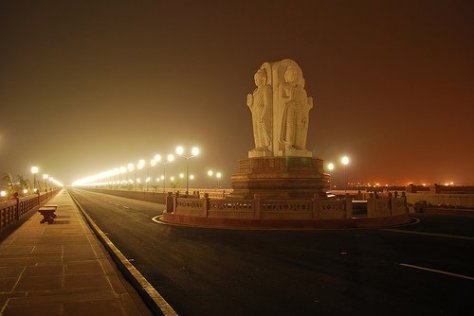
History in Stone and Metal

Photo by Bhanu Pratap Singh / Round Table India

A prominent Dalit academic once told me that when a Dalit entered the seminar room, the rest of them should feel uncomfortable. Given the monumental oppression Dalits face, this should be the least consequence of Dalits getting a voice.

I am reminded of this when I think of Mayawati’s gigantic Dalit memorials that have changed Lucknow’s landscape.

Continue reading History in Stone and Metal

Hallowed precincts: The Viceregal Lodge of Shimla

This slideshow requires JavaScript.

Text and photographs by Sohail Hashmi
First published in
Terrascape

Those driving to Shimla through National Highway 22, reach a bypass known as Tuti Kandi, it is here that one has to decide if one wants to continue uphill to the former summer capital of colonial India or to avoid the busy, traffic jammed Shimla and carry on ahead to Kufri and beyond.

Continue reading Hallowed precincts: The Viceregal Lodge of Shimla

‘Editors as Powerbrokers’?: Vinitha Mokkil

Guest post by VINITHA MOKKIL

The good news first. On the morning of November 26, the Foundation for Media Professionals (an independent, not-for-profit organization) decided it was time to break the polite silence and hold a panel discussion on the topic, ‘Editors as Powerbrokers’ at the India International Centre (IIC), Delhi. The Nira Radia tapes, whose transcripts were first published by Open magazine a week ago, was the trigger for the discussion. The panelists included editors from prominent print and electronic media houses.

The auditorium was packed. Clearly, the nexus between the media, politicians and PR honchos, as revealed by the transcripts, had shocked people enough to bring them out of the comfort of their homes to the venue.

Continue reading ‘Editors as Powerbrokers’?: Vinitha Mokkil

Asrar-ul-Haq MAJAAZ -1911-2011

Asrar-ul-Haq Majaaz was born in Radauli on the 19 October in 1911 or 1910 and died at 44 on 5 December 1955. After his initial education at Agra and Lucknow he came to Aligarh and completed his graduation in 1936. This was the year when Ali Sardar Jafri was expelled from AMU for indulging in political activities and also the year when the Progressive Writers Association (PWA), formed a little earlier in London, held its first conference under the chairmanship of Munshi Prem Chand at Lucknow, the city that Majaaz called his home. Continue reading Asrar-ul-Haq MAJAAZ -1911-2011

Protesting FTII students write to Ambika Soni

Studnets at the Film and Television Institute of India, Pune, have been protesting against the commercialisation of India’s best known film school. In letters to the Union Information and Broadcasting Minister Ambika Soni, they write:

In the proposal, made by Hewitt at the behest of your ministry for the ‘up-gradation of FTII to international standards’, refers to FTII as a ‘brand’. What this company fails to understand that this ‘brand value’ it refers to has come into being because of the diploma films that the students of the ‘3 year subsidized course’ have made it in the last 50 years. The other ‘self sustained courses’ that exist today (with its self sustainence) exists and has any value, if at all, because of these 3 year diploma courses. Continue reading Protesting FTII students write to Ambika Soni

Dilemmas of ‘Right of Nations to Self Determination’: Rohini Hensman

Guest post by ROHINI HENSMAN

The hectic discussion over the Kashmir meeting in Delhi in October entitled ‘Azadi – The Only Way’ has made it urgent to revisit the debate between Lenin and Luxemburg on the right of nations to self-determination. Lenin, starting from his experience in imperialist Russia, insisted on the right of nations like the Ukraine to self-determination (in the sense of their right to form separate states), contending that denial of this right would merely strengthen Great Russian nationalism. In a colonial situation, Lenin was surely right. When a country is under foreign occupation, all sections other than a very small number of collaborators want to be free of the occupiers, even if there are sharp differences between these sections. A striking example is RAWA (the Revolutionary Association of the Women of Afghanistan) which, despite speaking for a section of the population which is sorely oppressed by the Taliban, and continuing to fight against it, nonetheless shares with the latter the goal of ending the occupation by US and NATO forces. In such situations, the right of an occupied nation to self-determination makes sense.

Continue reading Dilemmas of ‘Right of Nations to Self Determination’: Rohini Hensman

Whose Dishonesty? Arundhati’s or Media’s?: Mahtab Alam

Guest post by MAHTAB ALAM

‘Vicharon ki Be-imani (Dis-honesty of thought) cries the heading of the lead article of Dainik Bhaskar’s editorial page on 1st November 2010. The article is written by Venkateshan Vembu, foreign correspondent of DNA English daily, a newspaper published by the same group of publications. It was originally published on 27th October with the headline reading ‘Arundhati Roy is dangerously wrong on Kashmir’. The writer of the article claims that whatever Arundhati has said is not only dangerously wrong and beyond the tolerance level of any law-abiding citizen but, it also has the potential to arouse feelings of anger and violence among the masses. “Yeh kuch is tarah ki beimani hai, jo janmanas me krodh aur aakrosh ki bhawna upjati hai (This is a kind of dishonesty which generates feelings of anger and violence among the people”). Ironically, this turned out to be a ‘prophetic’ disclosure, as right after four days of publication of the original version in DNA, Arundhati’s house in Delhi was attacked by the writer’s ‘Janmanas’, the BJP’s women wing ‘Mahila Morcha’.

Continue reading Whose Dishonesty? Arundhati’s or Media’s?: Mahtab Alam

Islam Colony Riders vs. Ward 2 Worriers [sic]

You are a young politician in Delhi and you want to make a mark in an area, in a seat. You want to be known, you want to be a leader, you want followers, you want to be taken seriously. You want votes. You have the right kind of Delhi first name – Mahender rather than Mahendra – and an even better surname – who better than a Chaudhary to be your leader? But there would be many Mahender Chaudharys. What can you do? You can get basic work done – permissions and pipelines and land conversions and garbage clean-up. But anyone with the right contacts can do that. Anyone can become a protege of a Congress leader like Yoganand Shastri. In a city like Delhi, in a city of migrants, in a city whose citizens think they have the right to be treated better than the rest of India, in a city that does not seem to be ‘politicised’ like the seemingly distant world of the ‘real’ India, in a city that is a state – how do you begin being taken seriously as someone with political ambitions? One Mahender Chaudhary has this poster put up all over Mehrauli (which was once all there was to Delhi). Check it out: Continue reading Islam Colony Riders vs. Ward 2 Worriers [sic]

The Return of Daya: Prasanta Chakravarty

Guest post by PRASANTA CHAKRAVARTY

A close friend of mine—a fine political scientist with nuanced literary sensibilities, once suggested that he is inherently suspicious of carefreeness and gaiety in relationships, friendships and in public exchanges. One must take time, let matters marinate (‘jaarano’ he proposed in Bangla) and not be prematurely upbeat and exuberant while forging bonds and taking actions. The deficient modes of resting and concealment are important preconditions in order to take on varieties of political manipulation, social one-upmanship and literary cleverness that besets our time.

Continue reading The Return of Daya: Prasanta Chakravarty

Bhagwat Purana of a Different Kind

(This post is by SUBHASH GATADE. It was initially inadvertently posted under Aditya Nigam’s name. The error is deeply regretted.)

I. Conflating Hinduism and Hindutva

Mr Mohan Bhagwat, the ‘young’ Supremo of an eighty plus year old exclusively male cultural organisation called Rashtriya Swayamsevak Sangh is in high spirits these days.

It is not very difficult to understand the glee on his face which has to do with the latest developments in the cause celebre of Sangh Parivar. One can even notice that every member of this different kind of ‘family’ also seem to be upbeat , whose representatives can be traced on neighbourhood playground in the morning doing drills, playing games or listening to ‘sermons’ of their seniors which they call Baudhik.

Continue reading Bhagwat Purana of a Different Kind

Let Delhi have its thali

Guest post by HILAL MIR

During the convention, Azadi the only Way, at LTG auditorium on Thursday, a potbellied man was standing on the aisle, listening intently to the speech of professor of history at Jadavpur University Sugata Bhadra. The man, I reckon, might be easily burdening earth with nearly 130 kilograms of his fair, north Indian bulk.  The professor was stripping the Indian state to its bare minimum and the audiences clapped. The man could stand it no more. I soon found out his voice was equally weighty, and gravelly—a cross between Shatrugan Sinha and Kulbushan Kharbanda. Quite audibly he said jis thali ma khatey hai usi main chaid kartey hain. In Bollywood films this saying condemning treachery is reserved for domestic helps who fall in love with the pretty daughters of their employers. Here, the context was different. A Maoist sympathizer was sharing the dais with a Kashmiri pro-freedom leader who was sharing the dais with a Sikh secessionist who was sharing the dais with a Naga human rights defender…A veritable thali of secessionism and dissent indeed. No wonder Arnab Goswami was hysterical. Continue reading Let Delhi have its thali

After the Games: Alok Rai

Shera

Guest post by ALOK RAI

I had imagined that there would be time after the Games. Kalmadi and his cronies would have to hang, of course, but it could have been done in a measured fashion. Now, it appears that there is no time to lose. The Shameless One has actually said something about bidding for the Olympics! And with the promise of enough money in the trough, we can expect the pigs to grunt their approval too – just like they did the last time. But in the name of all the people who have been uprooted, and had their livelihoods destroyed; the students who have been thrown out of their hostels; the long-suffering citizenry of Delhi that is currently undergoing the final stage of the insult and humiliation that has been heaped on them over the past year in the name of the Games, I say, enough! Hang the bastards, now!

But I should clarify quickly. I am not so naïve as to be outraged by the corruption. It is the stupidity I am particularly offended by. After all, corruption is only one half of the story. And, frankly, the corruption is hardly surprising. Corruption, to my lay understanding, is the whole point of these large “public” enterprises – it enables the crooks-in-power to get their hands on the money that has been gouged from the poor. That is exactly what everyone expects – the poor victims, the crooked beneficiaries. But surely the stupidity is gratuitous?

Continue reading After the Games: Alok Rai

Tehelka’s Populist Turn? Bobby Kunhu and Sudeep KS

Guest post by SUDEEP KS and BOBBY KUNHU

The magazine joins the Great Kerala Terrorist Hunt. This was sent as a rebuttal to Tehelka, but has not been published.

Kerala’s Radical Turn – cries the cover of the last issue of Tehelka (dated 9th October, 2010). The cover story by V K Shashikumar, that plays the familiar tunes of Islamophobia, hints at Tehelka‘s Populist Turn. It will be interesting to see where Tehelka goes from here, and what happens to its current reader base that distinguished the magazine from the likes of The Indian Express and The Times of India and India Today.

In the article, Here Come the Pious, Shashikumar lists some facts and his personal fears, on the eve of the Allahabad High Court judgment on the Babri Masjid land dispute. What is missing in the entire article is reason. The byline says that “A new Islamist body, the Popular Front of India, is causing alarm with its religious overdrive in the south.” After one goes through the article, however, what one gets is a glorified picture of the outfit. Whether the author likes it or not.

Continue reading Tehelka’s Populist Turn? Bobby Kunhu and Sudeep KS

Nirmohi Akhara and Ram Lalla Virajaman: Susmita Dasgupta

[In this guest post, Susmita Dasgupta throws light on some important aspects of the Ayodhya issue that have been misunderstood. First, she argues that there is an anomaly in treating the Nirmohi Akhara as a “Hindu” group, when in fact historically, akharas (aakhra in Bengali) were gymnasiums associated with sects that were usually opposed to organized and/or textual religions like Hinduism and Islam and claimed themselves to be non-Hindus. More importantly, she points out that the worship of the child-God – Ram Lalla, or Balkishan – was an important ingredient of defiance against organized religion. The Hindu appropriation of Ram Lalla, she argues, is therefore the greatest anomaly in the case, and this is the anomaly, she suggests, that historians should have focused on.]

Archaeologists are divided over the issue of whether a Ram Temple at all existed under the dome of the Babri Masjid and the Muslim theologicians are divided over whether the Babri is a legitimate mosque at all because in Islam if a mosque is built over a heathen’s structure of worship then it is not fit for prayers. Historians from JNU are almost universally concerned that whatever the archaeology is, the mosque should remain intact as a historical monument. The secularists are upset that the fictitious Ram Lalla be accepted as a party to a dispute and every structure of the Muslims could be pulled down on the flimsiest belief that the land archaeologically belonged to the Hindus. Such a judgment would then be a precedent in pulling down every mosque in the land and may even cast aspersions on the continued existence of the Taj Mahal and Red Fort !! I, too share similar concerns.

Continue reading Nirmohi Akhara and Ram Lalla Virajaman: Susmita Dasgupta

Opening Pandora’s box

Source: NDTV.com

The Ayodhya judgement is out; Pandora’s box has been opened and I suppose the hope fairy is fluttering amidst us all. That there haven’t been riots is being seen as a sign that “the country has moved on”.  My personal sense is that the absence of riots simply proves that riots are rarely spontaneous: adequate security has ensured an uneasy calm.

It’s still too early (at least for me) to make sense of this verdict, so I thought we could kick off the debate on Kafila by posting a list of links and resources and perhaps take the conversation forward as more and more information comes in.

To start off, the Judgements can be accessed at http://rjbm.nic.in/ . The top half of the page contains the gist of the judgments while your can find the entire judgement below the fold.

Continue reading Opening Pandora’s box

‘Shastra Pujas’ – What’s Religious About Worshipping Weapons ?

I.

Schools are meant for play and studies where kids slowly blossom into adolescents. Schools are meant for books, laboratories and other cultural activities which cater to the all round development of its students. Schools are meant for opening up of minds, inculcating inquisitiveness and curiosity, explain the wonder that is the world and lead the students towards further enquiries and promoting inclusiveness cutting across different ascriptive categories with which all of us are born with.

Of course, in emergency situations, schools even metamorphose into shelter homes for the victims of a natural calamity or a social catastrophe.

But certainly, no sane person can imagine that school premises can ever be used for worshipping deadly weapons – loaded pistols and illegal rifles. But it appears that on this count RSS – the all hindu male organisation – thinks differently. It is not for nothing that schools which run under the aegis of its affiliated organisation are freely handed over for such programmes under the specious reason that it is a religious programme. Any close watcher of the ground level situation can vouch that worshipping of weapons on Dusshera has nothing to with religion rather it is part of social tradition. Despite this reality organising of ‘shastra pujas’ has of late become a national phenomenon and hindutva organisations are known to play an important role in it. It serves a double purpose for them : consolidate their constituency by using religion as the legitimising force, terrorising the ‘others’ simply by taking out ‘religious processions’ brandishing weapons.

Continue reading ‘Shastra Pujas’ – What’s Religious About Worshipping Weapons ?