The 14 th Lecture in the Democracy Dialogues Series organised by New Socialist Initiative was delivered by Prof Irfan Habib, Famous Historian, Public Intellectual and Marxist Thinker, on Sunday 30 th January 2022 at 6 PM (IST). Prof Habib spoke on ‘Doctored History : From Ancient Times till Today’
About the Speaker :
Prof Irfan Habib ( Professor of History at the Aligarh Muslim University, Retd) is a well-known historian and author of the The Agrarian System of Mughal India ( 1963), An Atlas of the Mughal Empire ( 1982), Essays in Indian History : Towards a Marxist Perception ( 1985) , The Economic History of Medieval India : A Survey ( 2001) , Medieval India : The Study of a Civilisation ( 2008), a multivolume study titled ‘People’s History of India’ etc and has edited many books
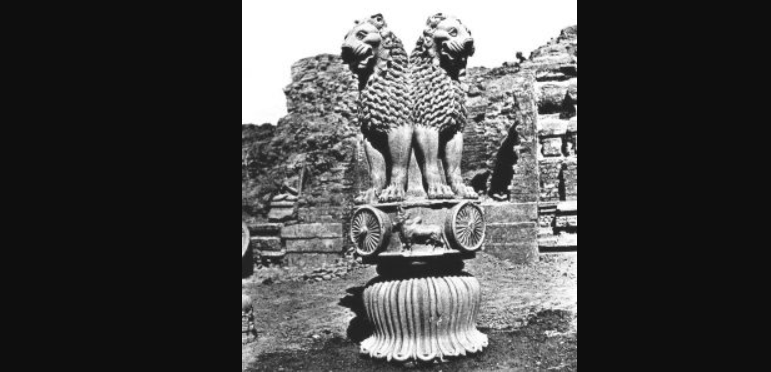
Ashokan lions adorn Indian currency and the Dharmachakra features in the tricolour. Neither symbol has any sanctity for the ideologues of the ruling dispensation.
Thousands of kings and emperors shone for a brief moment in history, then quickly disappeared. But in ‘The Outline of History: The Whole Story of Man’, H.G. Wells writes, “Ashoka shines and shines brightly like a bright star, even unto this day.” The famous British historian EH Carr also wrote, “What is history? It is a continuous process of interaction between the historian and his facts, an unending dialogue between the present and the past.”
Yet, history is a continuous ‘us versus them’ for some individuals and outfits in India. Their interaction with the past typically degenerates into a vicious monologue aimed to vitiate the present and control the future. Nowhere is their vandalism of history more visible than what the Hindutva brigade is doing to the last great Mauryan ruler, Ashoka (304-232 BCE). Often compared with a medieval Mughal ruler—whom the Hindutvadis detest and distort in equal measure—they are now transforming the Ashokan period beyond recognition into a symbol of cruelty and bigotry.
Ashoka is widely known to have filled with remorse after the tremendous bloodshed in the battle of Kalinga. After that, he is known to have devoted his life to “conquest by Dhamma or right/moral life”. It is less known that Ashoka was among the earliest rulers to launch public utilities such as hospitals, encouraged tree-plantation, dug public wells and ordered the construction of rest houses along roads. His commitment to public reason is considered phenomenal, as he, two hundred years before Christ, organised the earliest open general meetings in the world.
The second lecture in the ‘Sandhan Vyakhyanmala’ series – initiated by New Socialist Initiative ( Hindi Pradesh) will be delivered by Sanjeev Kumar, Well known Critic and Deputy General Secretary of Janwadi Lekhak Sangh on Saturday 15 th January 2022 at 6 PM (IST). He will be speaking on हिंदी की मार्क्सवादी बहसें : ‘विचारधारा’ से विचारधारा तक ( Hindi ke Marxwadi Bahasein : ‘Vichardhara’ se Vichardhara tak) The focus of this lecture series – as you might be aware – is on the Hindi belt, especially, on literature, culture, society and politics of the Hindi region where we intend to invite writers, scholars with a forward looking, progressive viewpoint to share their concerns. The inaugural lecture in the series was delivered by poet and thinker Ashok Vajpayi, where he spoke on ‘Thought and Literature”
सन्धान व्याख्यानमाला दूसरा वक्तव्य हिंदी की मार्क्सवादी बहसें : ‘विचारधारा’ से विचारधारा तक वक्ता : श्री संजीव कुमार आलोचक संयुक्त महासचिव, जनवादी लेखक संघ 15 जनवरी , शनिवार शाम 6 बजे
सारांश
क्या वजह है कि हिंदी में पिछली सदी के 40 और 50 के दशक में प्रगतिशीलों के बीच जितने मुद्दों पर मतभेद उभरे, उनमें वही मत संख्याबल से विजयी रहा (और कमोबेश अभी तक है) जो हिंदी लोकवृत्त की स्थापित मान्यताओं के प्रति पूरी तरह से अनालोचनात्मक था? क्या यह एक परिवर्तनकामी वैचारिकी का परचम लहरानेवालों के भीतर वर्चस्व की प्रदत्त व्यवस्था का पोषण करनेवाली विचारधारा की सुप्त मौजूदगी थी जो भक्ति आंदोलन की विभिन्न धाराओं के रिश्ते, कथित हिंदी नवजागरण में भारतेन्दु और उनके मंडल के योगदान, हिंदी-उर्दू और उनके इलाक़े की सभी भाषाओं के आपसी संबंध, साहित्य में यौन-नैतिकता जैसे तमाम मसायल पर सभी असहज करनेवालों सवालों को हाशिये पर धकेल रही थी? क्या प्रगतिशील और मार्क्सवादी होने में अपने ‘संस्कारों’ के साथ एक तकलीफ़देह लड़ाई लड़ने और उपलब्ध सहूलियतों-रियायतों का त्याग करने की जो अपेक्षा निहित होती है, यह उससे पल्ला छुड़ाना था? या कि यह प्रगतिशील आंदोलन को वर्चस्वशाली बनाने के लिए सबको अपने साथ ले चलने की एक कार्यनीतिक पहल थी जो कि शायद सफल भी रही?
एक आत्मावलोकन से शुरुआत करनेवाला यह पर्चा इन प्रश्नों की दिशा में एक प्रस्थान है।
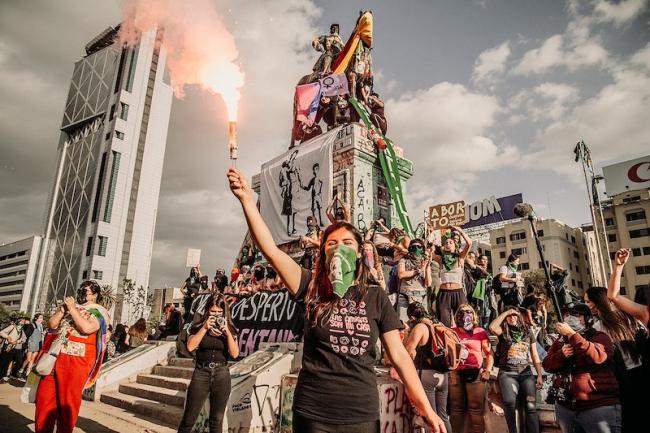
Feminist demonstration in Santiago – a crucial factor in the Boric victory, image NACLA
A New Left Resurgence
‘Leftists are Ascendant in Latin America as Key Elections Loom‘ announces a recent report in New York Times. And this report isn’t talking only of Leftist victories of the last two years but also of possible forthcoming ones in Brazil and Colombia, later this year. ‘Economic suffering, widening inequality, fervent anti-incumbent sentiment and mismanagement of Covid-19 have all fueled a pendulum swing away from the center-right and right-wing leaders who were dominant a few years ago’ underlines the report.
Close on the heels of the victory of Xiomara Castro as the first Left-wing, woman President in Honduras in the beginning of December 2021, came the news of the victory of Gabriel Boric in Chile (19 December). Unlike the socially conservative Left wing position of Peru’s Pedro Castillo, who stands opposed to abortion and same-sex marriage, the Chilean victory, in particular, has been strongly backed by the feminist and queer movements. Honduras’ Xiomara Castro too has legalization of abortion as one of her election planks, which is significant since it is one the few countries that has a complete ban on abortion as of last year.
The literary award must generate wider discussion in society on what plagues us. After all, the writer has always been outspoken against extremism.
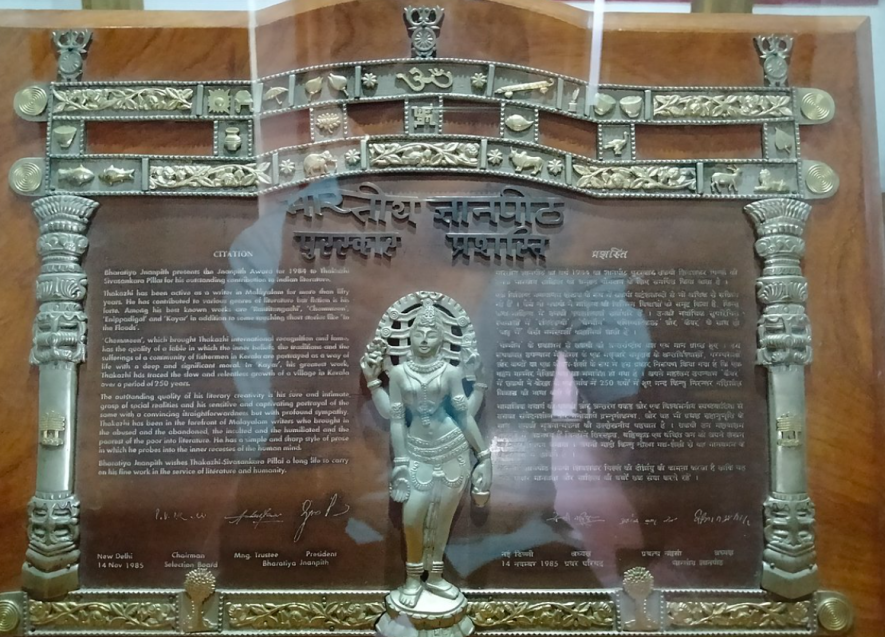
This year’s Jnanpith Award for best literature has gone to Damodar Mauzo, the famous Konkani novelist and short story writer. The great Assamese poetic talent, Nilmani Phookan Jr, has also been awarded the Jnanpith for 2020. Hopefully, as we celebrate “their outstanding contribution towards literature,” our discussions will not remain confined to the literary domain.
In his acclaimed novel, ‘Karmelin’ (1980), Mauzo writes about the abuse of women who go to work as housemaids in the Middle East. This novel came long before everybody started talking about this issue. His story, ‘The Burger’, is about two school friends, Irene and Sharmila, and the guilt little Irene experiences over ‘polluting’ Sharmila with a beef burger. Another story describes how cow vigilantes intimidated a Dalit youth long before others talked about the phenomenon.
Maybe Mauzo could see beyond the immediate and obvious, which prompted his social and political actions on issues of concern to all of society. That social engagement allowed him to observe the dangers that lurked in our society in the form of the right-wing, and gave him courage to never shy away from boldly speaking out against them.
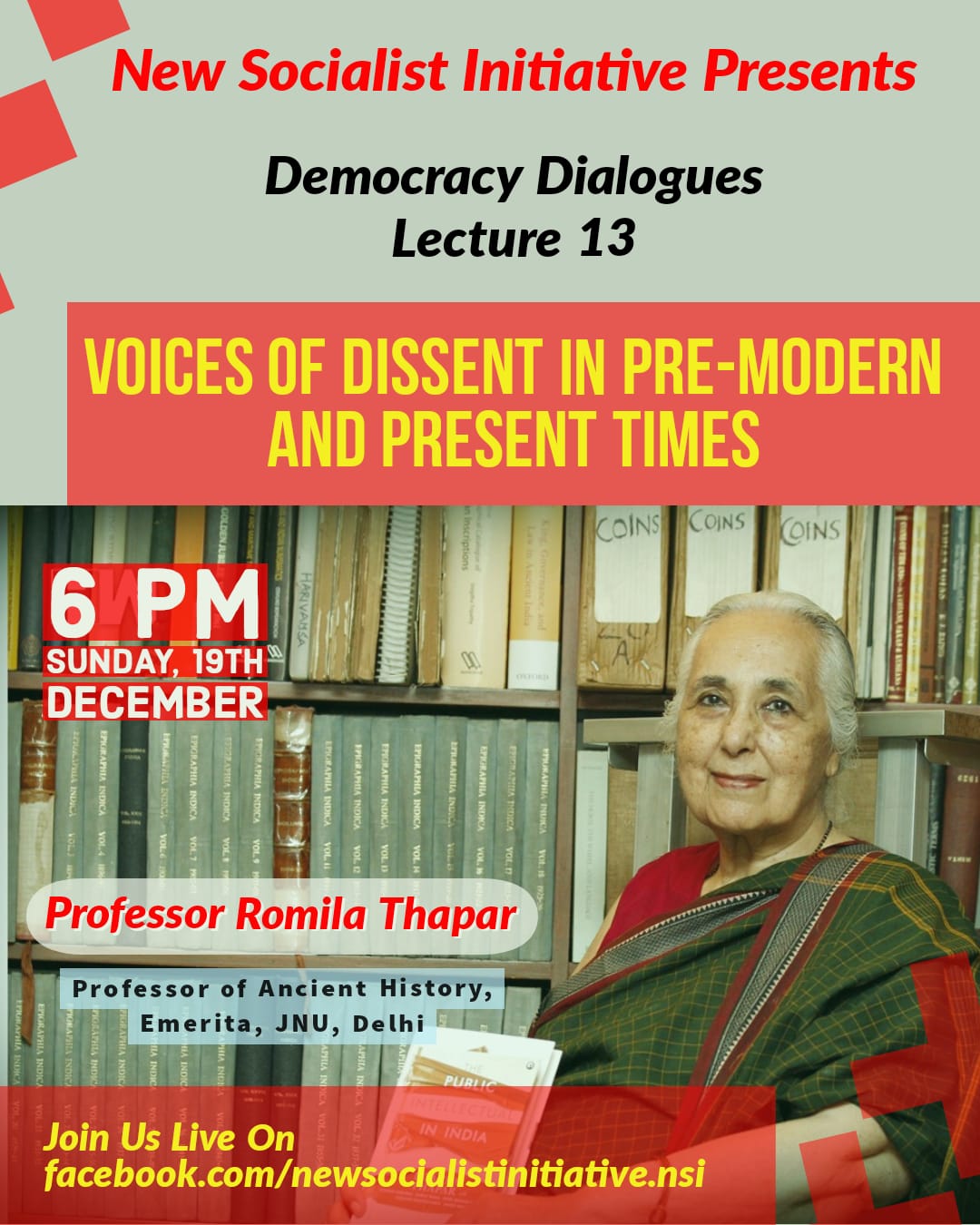
The13 th Lecture in the Democracy Dialogues Series organised by New Socialist Initiative will be delivered by Prof Romila Thapar, Professor of Ancient History, Emerita, JNU, author of many books and a leading public intellectual on Sunday 19 th December 2021 at 6 PM (IST). Prof Thapar would be speaking on ‘Voices of Dissent in Pre-Modern and Present Times‘
About the Speaker :
Internationally renowned scholar of Ancient History, Prof Thapar was elected General President of the Indian History Congress in 1983 and a Fellow of the British Academy in 1999. In 2008, she was awarded the prestigious Kluge Prize of the US Library of Congress which complements the Nobel, in honouring lifetime achievement in disciplines not covered by the latter.
Prof Thapar has been a visiting professor at Cornell University, the University of Pennysylvania, and the College de France in Paris and holds honorary doctorates from the University of Chicago, the Institut National des Langues et Civilisations Orientales in Paris, the University of Oxford, the University of Edinburgh (2004), the University of Calcutta and from the University of Hyderabad.
Here is a select list of Prof Thapar’s publications
Ashoka and the Decline of the Mauryas, 1961 ( Oxford University Press) ; A History of India : Volume 1, 1966 ( Penguin) ; The Past and Prejudice, NBT ( 1975) ; Ancient Indian Social History : Some Interpretations, 1978 ( Orient Blackswan) ; From Lineages to State 1985 : Social Formations of the Mid-First Millenium B.C. in the Ganges Valley, 1985 ( Oxford University Press) ; Interpreting Early India, 1992 ( Oxford University Press) ; Sakuntala : Text, Reading, Historie, 2002 ( Anthem) . Somanatha : The Many Voices of History, Verso ( 2005) ; The Aryan : Recasting Constructs, Three Essays ( 2008) ; The Past As Present: Forging Contemporary Identities Through History, 2014
For security reasons the zoom invite will be shared individually. Please write to us at democracydialogues@gmail.comif you are interested in attending the lecture
p.s. Here is a playlist of lectures in the series :
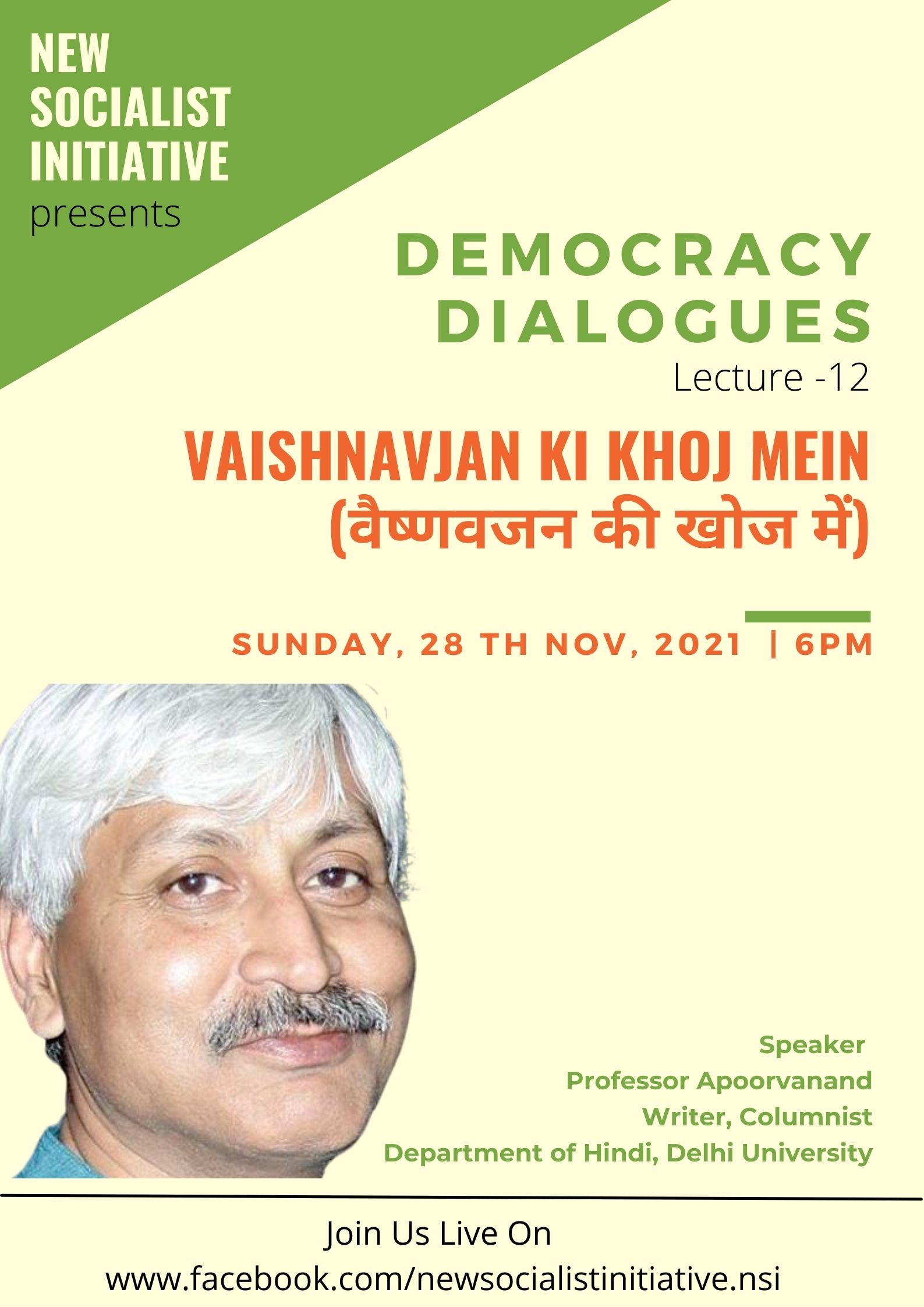
न्यू सोशलिस्ट इनिशिएटिव की तरफ से आयोजित ‘डेमोक्रेसी डायलॉग्स सीरीज ‘ का 12 वां व्याख्यान अग्रणी लेखक, स्तम्भकार, दिल्ली विश्वविद्यालय में हिंदी विभाग से सम्बद्ध प्रोफेसर अपूर्वानंद 6 बजे शाम, रविवार, 28 नवम्बर 2021 को प्रस्तुत करेंगे।
विषय : ‘वैष्णवजन की खोज में’
“वैष्णवजन की कल्पना को राजनीतिक और सामाजिक पटल पर स्थापित करने का श्रेय गाँधी को है। इस बात पर ध्यान जाना चाहिए कि उपनिवेशवाद विरोधी आंदोलन में या राष्ट्र की स्वतंत्रता के संघर्ष में गाँधी ने वैष्णवजन को संभवतः इस आंदोलन के लिए आदर्श आंदोलनकारी के रूप में पेश किया। वह कैसा जन है? पीर और पराई , इन दोनों से उसका रिश्ता क्या होगा? और क्यों एक सच्चा जनतांत्रिक जन वैष्णवजन ही हो सकता है? हमारे संविधान की प्रस्तावना में हम भारत के लोग जिस यात्रा पर निकले हैं क्या वह इस वैष्णवजनत्व की तलाश की यात्रा है?”
हिंदी तथा अंग्रेजी अख़बारों तथा अन्य प्रकाशनों में तथा टीवी की चर्चाओं में अपनी निरंतर सशक्त उपस्थिति दर्ज करते रहने वाले प्रोफेसर अपूर्वानंद सार्वजनिक जीवन में न्याय, समता और तार्किकता के पक्ष में अपने सक्रिय हस्तक्षेप के लिए जाने जाते हैं .
आप ने कई किताबें भी लिखी हैं, जिनमें से कुछ के शीर्षक इस प्रकार हैं : ‘सुंदर का स्वप्न ‘ ( वाणी प्रकाशन, 2001 ) , ‘साहित्य का एकांत’ ( वाणी प्रकाशन , 2008 ), The Idea of University ( Context, 2018 ) , Education at the Crossroads ( Niyogi Books, 2018 )
GR Santhosh Kumar captured the crux of the unbelievable denigration of democracy by the ruling CPM leadership who are out to defend their local level leaders guilty of the grossest patriarchy that rivals any khap panchayat misogyny. The context is the ongoing struggle by a couple, Anupama Chandran and Ajithkumar, to find their baby who was abducted by her parents, both influential local-level leaders of the CPM, last year and given away illegally for adoption. The story of Anupama’s experience of unspeakable death threats, physical violence, cheating, exposure to health risk, forced confinement, denial of vital information and means of communication, casteist insults, and on and on strips off the claims of women’s empowerment which the left in Kerala has claimed for so long. On social media, thousands of left supporters have literally rubbished women’s rights and the Indian Constitutional morality itself, even as the AIDWA in Kerala has been largely struck dumb.
The cartoon is a spoof on Raja Ravi Varma’ famous mother-and-child painting ‘Here Comes Papa’ in which an aristocratic woman dressed in a way identifiable as ‘traditional’ holds her baby and points to it the unseen ‘papa’ . Though the cartoon is captioned ‘Know the pain of the adopting mother’, an obvious reference to the cry by CPM sympathisers on social media that the child need not be returned, and that the adopting mother was fitter, and though the protagonists here are Pinarayi Vijayan and Anupama’s father, Peroorkkada Jayachandran, who he has been defending, it has layers. Ajithkumar’s dalit status and his earlier marriage has, in the eyes of CPM supporters, rendered him unfit for fatherhood — of a child by the daughter of an influential CPM family. Papa, then, and Papa’s coming, continues to be our favourite obsession.
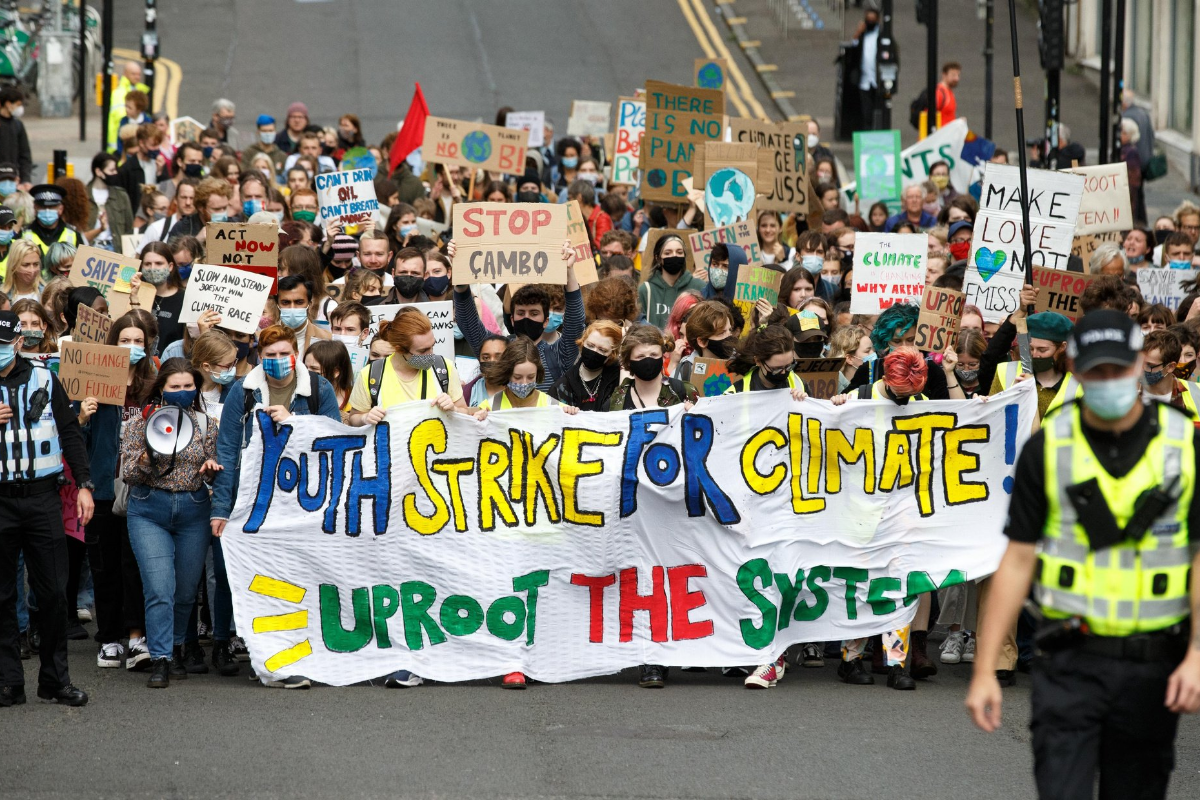
Demonstration in Glasgow during COP26, image courtesy The Herald
We are in the midst of a climate emergency – and this is no longer a secret. In fact, in November 2019, 11,000 scientists declared in a signed statement, in no uncertain terms that “planet Earth is facing a climate emergency.” “Scientists”, they said, “have a moral obligation to clearly warn humanity of any catastrophic threat and to ‘tell it like it is’.” They noted that even 40 years after the First Climate Conference attended by over 50 scientists (in Geneva in 1979) had agreed that there were alarming trends of climate change that made it necessary to act, the situation has only worsened. “Alarming trends” have since given way to a full-on emergency. Although the 2015 Paris Agreement arrived at in COP 21 is considered a paradigm shift in that it produced a legally binding international climate treaty (adopted by 196 parties), the change since then has not been significant.
हिन्दी इलाके को लेकर विचार-विमर्श के लिये “सन्धान व्याख्यानमाला” की शुरुआत इस शनिवार, 13 नवम्बर, को शाम 6 बजे प्रख्यात कवि और विचारक श्री अशोक वाजपेयी के व्याख्यान से हो रही है.
इस व्याख्यानमाला की शुरुआत के पीछे हमारी मंशा ये है कि हिन्दी में विचार, इतिहास, साहित्य, कला, संस्कृति और समाज-सिद्धान्त के गम्भीर विमर्श को बढ़ावा मिले. हिन्दी इलाक़े के सामाजिक-सांस्कृतिक विकास को लेकर हमारी चिन्ता पुरानी है. आज से बीस साल पहले हमारे कुछ अग्रज साथियों ने “सन्धान” नाम की पत्रिका की शुरुआत की थी जो अनेक कारणों से पाँच साल के बाद बन्द हो गयी थी. इधर हम हिंदी-विमर्श का यह सिलसिला फिर से शुरू कर रहे हैं. यह व्याख्यानमाला इस प्रयास का महत्वपूर्ण अंग होगी.
हममें से अधिकांश लोग “न्यू सोशलिस्ट इनिशिएटिव” नाम के प्रयास से भी जुड़े हैं. यह प्रयास अपने आप को सामान्य और व्यापक प्रगतिशील परिवार का अंग समझता है, हालाँकि यह किसी पार्टी या संगठन से नहीं जुड़ा है. इसका मानना है कि भारतीय और वैश्विक दोनों ही स्तरों पर वामपन्थी आन्दोलन को युगीन मसलों पर नए सिरे से विचार करने की और उस रौशनी में अपने आप को पुनर्गठित करने की आवश्यकता है. यह आवश्यकता दो बड़ी बातों से पैदा होती है. पहली यह कि पिछली सदी में वामपन्थ की सफलता मुख्यतः पिछड़े समाजों में सामन्ती और औपनिवेशिक शक्तियों के विरुद्ध मिली थी. आधुनिक लोकतान्त्रिक प्रणाली के अधीन चलने वाले पूँजीवाद के विरुद्ध सफल संघर्ष के उदहारण अभी भविष्य के गर्भ में हैं. दूसरी यह कि बीसवीं सदी का समाजवाद, अपनी उपलब्धियों के बावजूद, भविष्य के ऐसे समाजवाद का मॉडल नहीं बन सकता जो समृद्धि, बराबरी, लोकतन्त्र और व्यक्ति की आज़ादी के पैमानों पर अपने को वांछनीय और श्रेष्ठ साबित कर सके.
“सन्धान व्याख्यानमाला” का प्रस्ताव यूँ है कि हिन्दी सभ्यता-संस्कृति-समाज को लेकर हिंदी भाषा में विचार की अलग से आवश्यकता है. हिन्दी में विचार अनिवार्यतः साहित्य से जुड़ा है और हिन्दी मनीषा के निर्माण में साहित्यिक मनीषियों की अग्रणी भूमिका है. हम हिन्दी साहित्य-जगत के प्रचलित विमर्शों-विवादों से थोड़ा अलग हटकर साहित्य के बुनियादी मसलों से शुरुआत करना चाहते हैं. प्रगतिशील बिरादरी का हिस्सा होते हुए भी हम यह नहीं मानते कि साहित्य की भूमिका क्रान्तियों, आन्दोलनों और ऐतिहासिक शक्तियों के चारण मात्र की है. हम यह नहीं मानते कि साहित्यकार की प्रतिबद्धता साहित्य की उत्कृष्टता का एकमात्र पैमाना हो सकता है. हम अधिक बुनियादी सवालों से शुरू करना चाहते हैं, भले ही वे पुराने सुनायी पड़ें. मसलन, साहित्य कहाँ से आता है – ऐसा क्यों है कि मानव सभ्यता के सभी ज्ञात उदाहरणों में साहित्य न केवल पाया जाता है बल्कि ख़ासकर सभ्यताओं के शैशव काल में, और अनिवार्यतः बाद में भी, उन सभ्यताओं के निर्माण और विकास में महती भूमिका निभाता है. साहित्य के लोकमानस में पैठने की प्रक्रियाएँ और कालावधियाँ कैसे निर्धारित होती हैं? क्या शेक्सपियर के इंग्लिश लोकमानस में पैठने की प्रक्रिया वही है जो तुलसीदास के हिन्दी लोकमानस में पैठने की? निराला या मुक्तिबोध के लोकमानस में संश्लेष के रास्ते में क्या बाधाएँ हैं और उसकी क्या कालावधि होगी? इत्यादि. हमारा मानना है कि “जनपक्षधर बनाम कलावादी” तथा अन्य ऐसी बहसें साहित्य के अंतस्तल पर और उसकी युगीन भूमिका पर सम्यक प्रकाश नहीं डाल पातीं हैं. बुनियादी और दार्शनिक प्रश्न संस्कृतियों और सभ्यताओं पर विचार के लिए अनिवार्य हैं.
इस व्याख्यानमाला में हम विचार-वर्णक्रम के विविध आधुनिक एवं प्रगतिशील प्रतिनिधियों को आमन्त्रित करेंगे. ज़रूरी नहीं है कि वक्ताओं के विचार हमारे अपने विचारों से मेल खाते हों. हमारी मंशा गम्भीर विमर्श और बहस-मुबाहिसे की है.
प्रख्यात कवि और विचारक श्री अशोक वाजपेयी इस शृंखला के पहले वक्ता होंगे जिनका मानना है कि साहित्य की अपनी “स्वतन्त्र वैचारिक सत्ता होती है; उस विचार का सामान्यीकरण नहीं किया जा सकता; वह विचार अन्य विचारों से संवाद-द्वन्द्व में रहता है पर साहित्य को किसी बाहर से आये विचार का उपनिवेश बनने का प्रतिरोध करता है; साहित्य का विचार विविक्त नहीं, रागसिक्त विचार होता है.”
आप सभी इस शृंखला में भागीदारी और वैचारिक हस्तक्षेप के लिये आमन्त्रित हैं.
The 11 th lecture in the Democracy Dialogues Series organised by New Socialist Initiative was delivered by Ashutosh, TV anchor, columnist, author and co-founder of satyahindi.com at 6 PM ( IST), Sunday, 31 st October 2021.
Mr Ashutosh spoke on ‘Will India Survive as a Democracy ?’ A highly acclaimed journalist and TV News Anchor, a reputed Columnist, and a successful Author, Ashutosh was associated with AAP for a while but was soon disenchanted with this experiment and returned to journalism again with a new experiment in the form of satyahindi.com
He has many books to his credit, Anna – 13 days that awakened India, (2012) ; The Crown prince, The Gladiator & The Hope — Battle for Change ; Mukhaute ka Rajdharm ( 2015). In his latest book Hindu Rashtra published in 2019, he takes a hard look at the political reality of India and what its future may hold.
As the decisive battle of 2024 draws closer by the day and restiveness grows, alignments and realignments will also become more apparent. The tragedy is that while the image of Narendra Modi and his regime has taken a severe beating, there is still no visible alternative in sight. As a matter of fact, the entire opposition seems to be going from one crisis to another. A few state parties do give some hope and the possibility of a federal front with chief ministers of West Bengal, Tamil Nadu, Kerala and Maharashtra and possibly, a couple of Congress chief ministers making common cause, does hold some promise in the short run. The point though is, whichever way one looks at it, there is little doubt that in any future permutation and combination, the Congress may not have a leading role to play but it will still have a significant presence. Its present state of dysfunction, therefore, is a matter of worry and concern for a very large number of people outside the normal periphery of Congress supporters and traditional voters. A party without a President and without a functioning Working Committee is not likely to instill hope in its ability to provide any kind of leadership in the near future.
Modern-day Eklavyas are depriving students of their dues across the country. No government can compensate for robbing students from underprivileged backgrounds of their future.
In the 19th century, Chatra district in Jharkhand hosted the legendary Raja Rammohan Roy for a while. A memorial to Subedar Nadir Ali Khan and Jay Mangal Panday, martyred during the 1857 war of independence, is also here. Now, this district is in the news again, but for the wrong reasons.
A Comptroller and Auditor General (CAG) report tabled in the state Assembly has detailed the embezzlement of around Rs. 85 crore, meant to fund the scholarship of students belonging to the backward classes. The siphoning went on from 2013-18, says the CAG report for 2018-19.
The modus operandi of the scammers was simple. The money was not transferred to the accounts of beneficiaries, as the state department for Scheduled Caste, Scheduled Tribes, Minority and Backward Class Welfare says. Instead, it went into the bank accounts of other individuals.
The explanation offered by the concerned people was straightforward. They told the CAG that documents related to the transfer of Rs. 70 crore got destroyed in a fire. A significant portion of the Rs. 85 crore is yet to get recovered. The department never bothered to reconcile its accounts even after the fire incident.
A Decolonization mural in Oakland, USA, photo HiMYSYeD, Oakland Wiki
This post is prompted by a discussion that followed some remarks I had made on social media regarding the way in which a certain common sense that we may call ‘Hindu Nationalist’, had come to dominate the sensibilities of even those intellectuals in the Hindi world who otherwise might stand opposed to the Hindu Right. ‘Decolonizing’ has lately become a banner of the Hindu Right and for many otherwise secular Hindi intellectuals too, an occasion for an often strident anti-West rhetoric. Such a common sense assumes, simply by default, that the only “authentic” position of critique of the West is one framed by Hindu/ Indian exceptionalism. Needless to say, as I have argued at length in my recent book (Decolonizing Theory), the narrative that structures the imaginative world of many such modern Hindus is already a narrative produced by colonialism.
The BJP is imposing harmful dietary restrictions and refusing to accept that more Indians want to consume meat, fish and eggs for their nutritional benefits.
Representational use only
.
In 1902, the prolific British writer HG Wells delivered a philosophical speech titled “The Discovery of the Future” at the Royal Institution in London. Wells is often remembered for his “predictions”, for example, the approximate date when the second world war would begin. In this speech, he envisioned something else with equally significant ramifications—the collapse of the capitalist system. Wells also anticipated that a world of peace and plenty would follow in its wake.
What if someone, following Wells example, attempts a similar extrapolation for India? If anybody could foresee such things, what would they find lies ahead for the “biggest democracy” in the world?
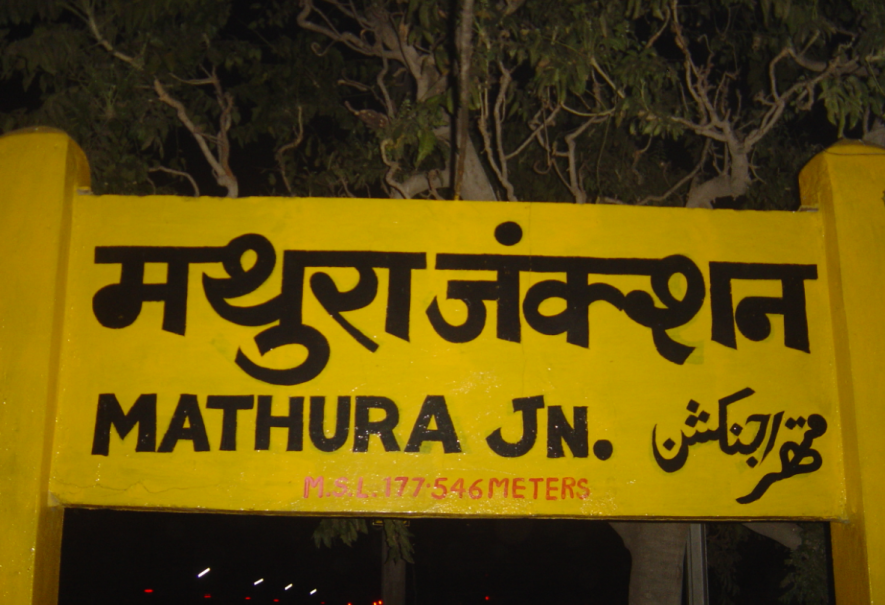
In the absence of Wells, perhaps present-day events can be a map or guide to the future. For example, during recent Janamashtmi celebrations, Uttar Pradesh, Chief Minister Yogi Adityanath announced that his government would ban meat and liquor in Mathura city. He said the meat-sellers and liquor dealers of the area could switch to selling milk. According to his government, a meat and liquor ban would help combine “modern technology” with the cultural and spiritual heritage of the region.
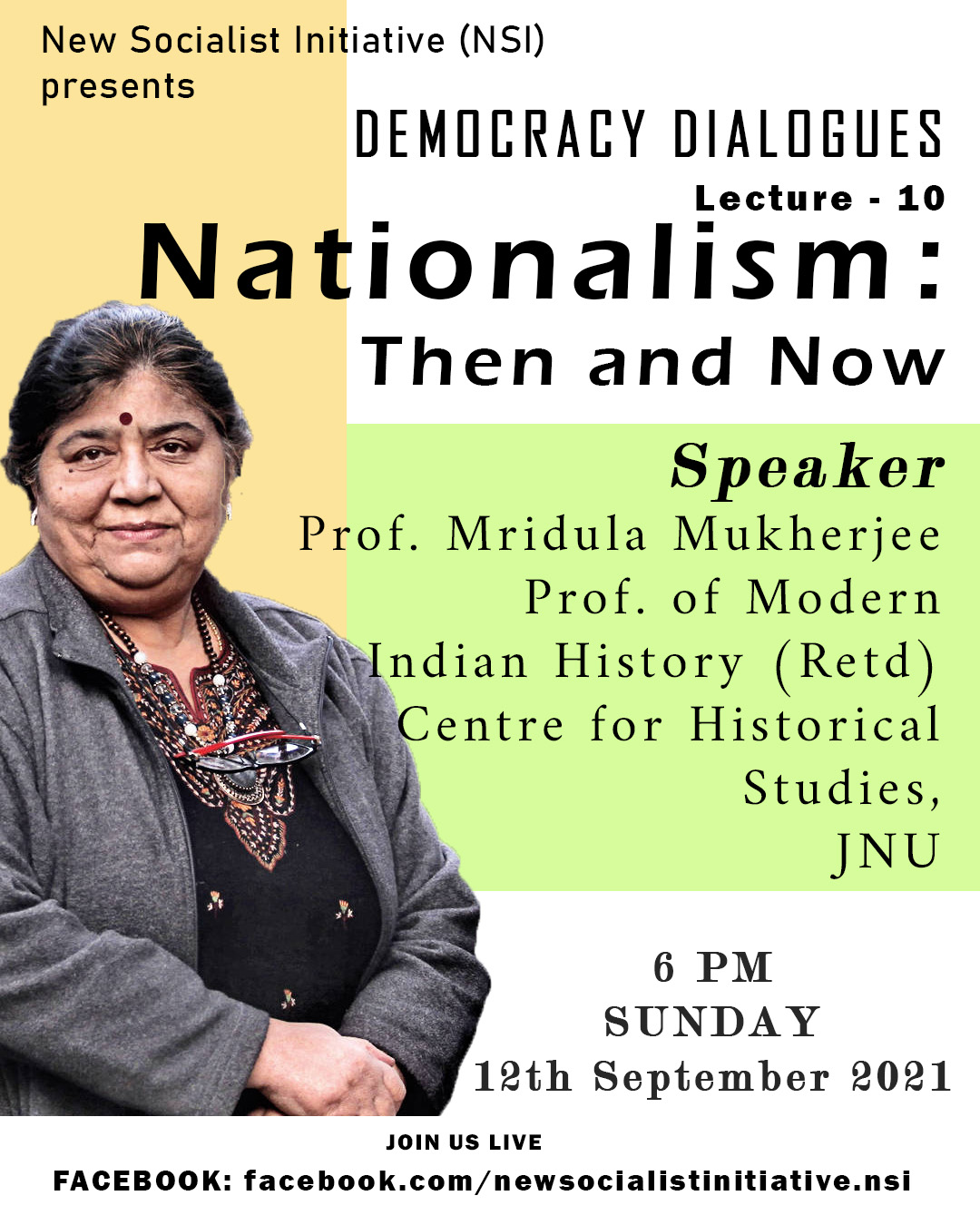
The 10 th lecture in the Democracy Dialogues Series organised by New Socialist Initiative was delivered by Prof Mridula Mukherjee ( Retd.) on Sunday, 12 th Sepember at 6 PM ( IST). She spoke on ‘Nationalism : Then and Now’
Prof. Mridula Mukherjee, was associated with Centre for Historical Studies, JNU for a long time and was also Director of Nehru Memorial Museum and Library, ( NMML), New Delhi.
Well known as a historian for her work on the role of peasants in the Indian independence movement, she has authored two important books on the theme, Peasants in India’s Non-Violent Revolution ( Sage 2004) and Colonising Agriculture : Myth of Punjab Exceptionalism ( Sage 2005). She has also coauthored books with Prof Bipan Chandra, Prof Aditya Mukherjee on ‘India’s Struggle for Independence’ ( Penguin 2000) and ‘India After Independence‘ ( Penguin 2008). The monograph ‘RSS, School Texts and Murder of Mahatma Gandhi‘ which she has coauthored with Prof Aditya Mukherjee and Prof Sucheta Mahajan has been widely appreciated.
In this lecture Prof Mridula Mukherjee discussed Nationalism and its origins as a modern ideology, how nations are historical constructs with each nation having its own distinctive historical evolution and the emergence of two kinds of nationalism and how the present notion of aggressive, chauvinistic nationalism is in sharp contrast to the once evolved by the freedom struggle and how the task of preventing the appropriation of nationalism and its creative linking to progressive agenda is the need of the hour.
Please write to us at democracydialogues@gmail.com if you are interested in getting upadates about the series.
This reflection has been long coming: the whole idea of women’s empowerment has been steadily deteriorating in Kerala since some years now. Actually, even from the side of the government, there is much less talk about it, even though it flowed into Kerala in the 1990s through the government, somewhat neoliberalized already, after the Beijing Conference. The national environment has of course been especially hostile with Hindu majoritarian conservatives in power whose ideas about ‘Indian culture’ do not offer any prospect of expanding the resonances and meanings of women’s empowerment — the opposite being more likely. But in Kerala too, interest in it has decidedly shrunk. Among its former constituents, especially the women’s self-help groups, it means little other than income-generation and entry into local politics.
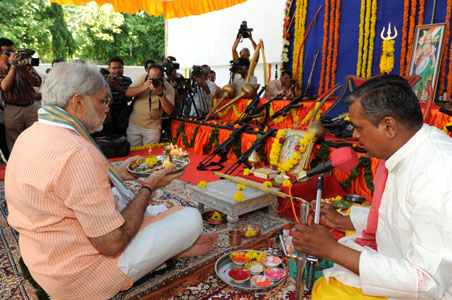
ये हिंदुत्व है हिन्दू धर्म नहीं! गुजरात के मुख्यमंत्री नरेन्द्र मोदी शस्त्र पूजा में मग्न. AFP PHOTO/ SAM PANTHAKY
[यह लेख पहले जनवादी लेखक संघ की पत्रिका नया पथ के जनवरी-मार्च २०२१ अंक में प्रकाशित हुआ था.आगामी 11-12 सितम्बर को अमेरिका में होने जा रहे Dismantling Global Hindutva सम्मलेन से उद्वेलित हिंदुत्व के प्रचारक अब इस सम्मलेन को रद्द कराने की मुहीम में उतर चुके हैं. उनका चालाकी भरा तर्क यह है कि यह सम्मलेन हिन्दू-विरोधी है. इस सन्दर्भ में यह दोहराना बेहद ज़रूरी है कि हिंदुत्व विस्तारवादी फौजी तसव्वुर से लैस एक राजनीतिक विचारतंत्र जो हिन्दुओं के नाम पर हिंसात्मक राजनीती करता है मगर इसका हिन्दू धर्म या जीवन शैली से कोई सम्बन्ध नहीं है. इस वजह से इस लेख को यहाँ साझा किया जा रहा है.]
“समस्त राजनीति का हिन्दूकरण करो और हिन्दूतंत्र का सैन्यीकरण करो – तब हमारे हिन्दू राष्ट्र (नेशन) का पुनरुत्थान होना तय है, उसी तरह जैसे अंधेरी रात के बाद सुबह का आना अनिवार्य होता है”। – विनायक दामोदर सावरकर, 25 मई 1941 को अपने 59 वें जन्मदिन पर हिंदुतन्त्र (हिन्दूडम) के नाम संदेश।
“हमारी भुजायें एक ओर अमेरिका तक फैली थीं – कोलंबस के अमेरिका ‘आविष्कार’ से बहुत पहले – तो दूसरी ओर चीन, जापान, कम्बोडिया, मलय, श्याम, इंडोनेशिया और समस्त दक्षिण-पूर्व एशिया तक फैली हुई थीं, और उत्तर में मंगोलिया और साइबेरिया तक। हमारा शक्तिशाली राजनीतिक साम्राज्य इन दक्षिण-पूर्व एशियाई क्षेत्रों तक फैला था और 1400 वर्षों तक जारी रहा, अकेले शैलेन्द्र साम्राज्य 700 वर्षों तक फलता फूलता रहा – और चीन के विस्तार के खिलाफ़ चट्टान की तरह खड़ा रहा”। – माधव सदाशिव गोलवालकर, राष्ट्रीय स्वयंसेवक संघ के दूसरे सरसंघचालक, बँच ऑफ थॉट्स, विक्रम प्रकाशन, बंगलोर, 1968, पृ 9
हिन्दुत्व-विचारतंत्र के इन दो महारथियों की ये उक्तियाँ पढ़ने के बाद आइए अब एक उद्धरण उस शख़्स का देखें जिसे हिंदुत्ववादी हड़पने की पुरज़ोर कोशिश किया करते हैं। ये शख़्स और कोई नहीं स्वामी विवेकानंद हैं। मुलाहिज़ा फरमाएं :
An upcoming conference in the USA, “Dismantling Global Hindutva”, organized by Indians in the USA, most of whom are legally “Hindus”, and supported by over 40 US universities, has provoked the ire of the Hindu Rashtravaadis there as well as in India. Conflating Hindutva with Hinduism is the first step. Based on this, the Hindu American Foundation claims this conference is “Hindu phobic”, that it will put the well-being of Hindu students and faculty at risk, and that “they may feel targeted or threatened, or face hostility or harassment” as a result of “the kinds of generalisations, misunderstandings, and ‘otherising’” the event will perpetuate.
Ho hum. Just another day in Hindu Rashtra-that-is-India then, for most of us “Hindus” who oppose the politics of Hindutva that promotes misunderstandings and otherises us, all the way to mob and media violence, lynchings and jail. It is from Hindutva that “Hindus” are most at risk in India today, not from any non-Hindu “Other”.
(Why these repeated quotation marks around “Hindu”? We will come to that).
An article in Firstpost uses words like “genocidal” and “xenophobic” to describe what this conference is going to be. The conference brochure shows “Rashtriya Swayamsevak Sangh (RSS) figures being uprooted, roots and all, with the claw end of a hammer”, and this is “genocidal” according to the author. Showing the German Nazi Party being uprooted would amount to genocide too, in this understanding, perhaps? Since Hindutvavaadis are actively seeking co-victimhood with victims of anti-Semitism, as another article explicitly states, they might want to reconsider this second conflation, of the neo-fascist RSS with “Hindu”. This second article says the conference will “dehumanize Hindus everywhere” and asks indignantly if a conference titled “Dismantling Global Jewry” would be acceptable. Continue reading If Hindutva is dismantled, whom will it harm?→
An upcoming conference in the USA titled Dismantling Hindutva is being attacked by the Hindu right-wing both in the US and India as “anti Hindu” and “racist”. See for example, this link and this and this.
This post is a letter sent to American Universities supporting the conference by US-based HINDUS FOR HUMAN RIGHTS.
To: All universities and departments co-sponsoring the academic conference on Hindutva (Hindu nationalism) on September 10-12, 2021
Re: We are Hindus who support academic freedom and the “Dismantling Global Hindutva” conference on September 10-12, 2021
We are writing to you on behalf of Hindus for Human Rights (HfHR), a two-year old advocacy organization that provides a platform for progressive Hindus to speak out in support of democratic freedoms and pluralism.
HfHR advocates for civil and human rights in South Asia and North America, rooted in the values of our faith: shanti (peace), nyaya (justice) and satya (truth). We provide a Hindu voice of resistance to all forms of bigotry and oppression based on one’s faith, color, caste, gender, or sexual orientation.
We also staunchly oppose the misappropriation of our Hindu faith by the ideology of Hindutva (also frequently referred to as Hindu supremacy, Hindu nationalism, etc.), whose foundational principle is to redefine over 200 million Muslim and Christian citizens of India as the ‘other,’ who do not legitimately belong and must therefore either accept second class citizenship or be displaced from their homeland. Continue reading Hindutva is not Hinduism: Hindus for Human Rights→
In the recent controversy over the arrest of the travel vloggers Ebin and Libin who rode high on popularity with lakhs of subscribers through their Youtube channel E Bull Jet, it is very hard not to side with the two young men. The flamboyant pair whose hugely popular travel — or ‘van life’ — videos have a massive following especially among male adolescents and youth — are school drop-outs and have a history of rising from severe social disadvantage — literally, of pulling themselves up by their own bootstraps. The two young men, despite their excesses, pull at your heartstrings. Their smile, their slang, their sense of excitement on the road, the innocent gawking — all of it looks disarmingly innocent. It is also true that the crime they committed was not major; nor is justice handed out evenly. That is, such crimes around vehicles and driving are not new and it is not at all clear if the powerful who commit such crimes are tackled in the same way. Therefore the video which showed the brothers being hauled into the police van was painful for many of us (including me) — Ebin wept aloud, “adikkalle saare! Njaan onnum cheithilla … kolapaathakiyeppole enne kondupokunnu….” (don’t beat me please, sir. I didn’t do anything wrong . … I am being taken away like a murderer). That despondent wail somehow refuses to get out of my head; that is why I need to write this.






 KAFILA - COLLECTIVE EXPLORATIONS SINCE 2006