Category Archives: Debates

Ezhuka Tamil – A Conversation about Democracy :Dharsha Jegatheeswaran and Gajen Mahendra

This is a guest post by DHARSHA JEGATHEESWARAN AND GAJEN MAHENDRA


On Saturday September 24, 2016, Ezhuka Tamil, organized by the Tamil People’s Council, became the largest rally to happen since the end of the war in the North-East of Sri Lanka. Over 10,000 people took to the streets to demand an end to ongoing human rights violations, particularly militarization and Sinhala-Buddhisization of the North-East,reiterate their demand for genuine accountability and justice and voice their expectations regarding the ongoing political processes. The political elite in Colombo and their supporters elsewhere have however chosen to read Ezhuka Tamil as an expression of ‘Tamil extremism’. This response requires us to critically interrogate the nature of democratic spaces in post-war Sri Lanka available to the numerically smaller communities and more largely what our understanding of democracy is. This is very necessary if we believe in the need for public participation in the constitutional and transitional justice process currently underway. Continue reading Ezhuka Tamil – A Conversation about Democracy :Dharsha Jegatheeswaran and Gajen Mahendra

Seven of Us – The Other Side of the Armed Forces: Sanjeev Kumar

Guest Post by SANJEEV KUMAR

Seven of us in my family including me, along with 90% of the young men from my village, have tried to join the army at least once in our lives. Here I am using the term ‘army’ to include all armed forces and paramilitary forces.

Three members of my family succeeded and are now in the army along with around a hundred others from my village. More than two-thirds of them gave bribes of 1-2 lakh rupees, either by selling land or using family savings, to join the army. There are others who were cheated by dalals.  Hardly any of them would claim that they joined the army to serve the nation; rather, they joined the army to bring some relief to their starving families. Most of them teased and molested girls while travelling ticketless in trains to army recruitment centres in different parts of the country. Most of them including my brother, took 7-12 lakh rupees as dowry for marriage. Hardly any one of them wants their children to be in the army in preference to other civilian jobs.

My father also tried once to join the Indian army in the early 1980s but my grandfather hid his joining letter from him because my grandfather believed farming was better for him and for the family. Whenever they quarrelled in the early 2000s, I always heard my father blaming his father for the poverty of the family, because he did not allow him to join the army. It was around the same time that I first heard of anyone giving a bribe to join the army. It was my own uncle who was barely 5 to 7 years older than me, who  sold his agricultural land to pay 1 lakh rupees to a dalal as bribe through his mamaji who was also in the army. I also heard of two young boys in my village who had earlier given around 40000 rupees as bribe to join Bihar Police but lost all their money to a  dishonest agent. It was courageous of my uncle to risk his money even though the news of how two other village boys were cheated was fresh in the air. He had the courage to do that because his secondary dalal was his own mamaji. He had the courage to do that also because he had no other alternatives.

Continue reading Seven of Us – The Other Side of the Armed Forces: Sanjeev Kumar

International Scholars Condemn the Attack on Faculty and Students of Central University of Haryana

Over 70 UK and Europe-based scholars concerned with South Asia have written a letter to the Vice Chancellor of the Central University of Haryana. They have condemned the September 21, 2016 attack on a group of staff and students of CUH who were involved in putting together a performance based on the award-winning writer Mahasweta Devi’s acclaimed short story “Draupadi”. The attack and threats of charges of sedition against those involved in the performance were instigated by the BJP-affiliated student group ABVP as well as by the local press, which has falsely and maliciously spread the view that the play is anti-national and represented an attack on Indian soldiers. The letter appeals to the Vice Chancellor of CUH to protect the freedom of expression of the university’s staff and students, and to encourage the democratic exchange of ideas through means of debate and discussion.


Dear Vice-Chancellor Mahendra Pal Singh,

We, the undersigned, strongly condemn the attack on faculty members and students of the Department of English and Foreign Literatures at your university by members of the Akhil Bhartiya Vidyarthi Parishad (ABVP) for the performance of a play on 21 September 2016. The play was based on a short story by the eminent Bengali writer Mahasweta Devi. We understand that the staff and students involved in the performance had sought and received all necessary permissions for the event, which was organized to commemorate the literary achievements of Mahasweta Devi, the recipient of some of the most prestigious Indian and international awards.

We write to express our serious concern over this attack on the freedom of academic expression of the staff and students at your university. Mahasweta Devi’s story “Draupadi” was written in 1971 and represents her creative expression of the exploitation of India’s tribals.  It is regularly taught as part of course syllabi all over India and the world, including at the universities of some of the signatories to this letter. The claim by the ABVP and the local press that the play is an attack on Indian soldiers is manifestly fabricated. As one of the faculty members involved in the production, Dr Snehsata, has explained, students and teachers saw the programme as an academic and creative pursuit and their intention was certainly not to hurt the sentiments of soldiers as the ABVP has claimed: “In this event, I read the epilogue of the play recounting the data about atrocities on tribal people, especially sexual crimes against women by the Indian army. How ordinary soldiers are used by the state as a tool against its own people and how the body, especially the female body, becomes the site of revenge in the hands of Indian soldiers by the same state. All the teachers and students who were present there came up and congratulated us.”

Continue reading International Scholars Condemn the Attack on Faculty and Students of Central University of Haryana

मज़ाक मज़ाक में : किशोर

Guest Post by Kishore
(Summary: Article is about recent  racial comments on a  actress  and channel’s response to it.Now a days there is increasing trend of serving any thing in the name of comedy. This article raises questions on comedy. Is purpose of comedy is just to make us laugh or it has any social resposibility)
 पिछले दिनों तानिष्ता चटर्जी के रंग पर की गयी टिप्पणी के बाद वह एक मशहूर कॉमेडी शो को बीच में छोड़ कर चली गयी. बाद में उन्होंने इस टिप्पणी को नस्लवादी करार दिया. दूसरी तरफ इस चैनल ने इस आरोप को गलत बताते हुए कहा है वह तो बस “रोस्ट” ( एक तरह की खिंचाई) कर रहे थे और रोस्ट करना उनके शो में व्यंग करने करने का तरीका है . साथ में यह भी कहा कि उन्हें पहले ही बता दिया गया था कि उन्हें “ रोस्ट” किया जाएगा. किसी के रंग पर उलटे सीधे व्यंग करना कैसी  खिंचाई है इसका कोई स्पष्टीकरण नहीं दिया गया.
इसके बाद मुझे ध्यान आया कि पिछले कुछ सालों में टेलीविजन पर कॉमेडी शो की बाढ़ सी आ गयी है जो खुद ही कुछ कह कर खुद ही हँसते है. इन शो में किसी का मजाक उड़ाना कॉमेडी समझा जाता और इनमे किसी स्थिति से हास्य पैदा करने का सामर्थ् नहीं है. इन शो में कई बार किसी व्यक्ति या समूह को नीचा दिखा कर मजाक उड़ाया जाता है. अगर मैं कॉमेडी को एक विधा समझता हूँ या मैं उस समुदाय से सम्बन्ध रखता हूँ तो इस व्यंग पर मुझे हंसी नहीं आएगी.
वैसे मुझ जैसे अज्ञानियो को इन जैसे कॉमेडी शो से ज्यादा हंसी ए इस पर दिखाए जाने वाले होरर शो पर आती है जो डराने के मकसद से बनाये जाते हैं. खैर यह दीगर बात हएै पर एक बात तो तय है कि यह शो  बहुत लोकप्रिय हुए हैं और इनको देखने वालों की संख्या लाखो में है. भले ही तानिष्ता को उनके व्यंग करने के तरीके पर एतराज हो पर लोग इस अंदाज को बहुत पसंद कर रहे हैं.
मुझे उन लोगों की बात भी याद आई जो, जो मन में आये वह कह देते हैं और फिर कहते हैं इस बात को इतनी संजीदगी से लेने की क्या जरूरत है , यह तो महज एक मजाक था. इसी तरह किसी खास समुदाय और औरतो को लेकर बहुत से चुटकले चलते हैं जिनमें बहुत खराब खराब बातें होती है, और लोग हँसते भी है . आलोचना करने  पर इतना कह  कर बात टाल देते हैं कि यह चुटकला ही तो है. आखिर हम लोग कब कॉमेडी को संजीदगी से लेना शुरू करेंगे.
कॉमेडी का एक साधारण सा नियम तो समझ आता है कि कॉमेडी में जो हंसी का पात्र बनता है या बनती है उसे खुद भी अपनी उस स्थिति पर वैसे ही हंसी आनी चाहिए जैसे  की किसी और को आ रही है.  अर्थार्थ हंसी उसके रंग रूप , आकार या नैन नक्श से निरपेक्ष उस कलाकार के हाव भाव या उस परिस्थिति से आनी चाहिए. यह स्पष्ट है कि हंसी का कारण रंग रूप , आकार या नैन नक्श नहीं है.
दूसरी बात कि हंसी का कारण किसी समुदाय विशेष के प्रति पूर्वाग्रह नहीं होना चाहिए. हम यह कह कर मुक्त  नहीं हो सकते कि यह तो एक मजाक है. वास्तविकता यह है कि इस तरह के मजाक पूर्वाग्रहों को मजबूती देते हैं. यकीन ना हो तो अपने आसपास नजर दौड़ा कर देख लो. क्या इन पूर्वाग्रहों के सुदृढ़ होने मैं इस तरह के मजाक का हाथ नहीं है? क्या औरतों और पत्नियों के प्रति होने वाले मजाक ने समाज में उनकी स्थिति को प्रभावित नहीं किया ?
इन शो में से अधिकतर शो में कलाकार अपने हाव भाव और बातों से हंसाया जाता है. अब कोई पूछ सकता है कि हाव भाव या बातों से हंसाने में बुराई क्या है. सभी महान हास्य कलाकार बातों और हाव भाव से ही तो हंसाते थे या हैं. तो यह शो उन हास्य शो या फिल्मों से अलग कैसे हुए?
अंतर है कि किन बातों या किस हाव भाव से हंसाया जा रहा है. उस बात की विषय वस्तु  क्या है. कोई हाव भाव या बात फूहड़ या अश्लील  भी हो सकती है और सौम्य  भी. अब प्रश्न यह उठता है कि यह कौन तय करेगा कि यह विषय वस्तु फूहड़ या अश्लील है या सौम्य? हर समाज में फूहड़ या सौम्य होने के कुछ मानदंड होते हैं और कॉमेडी शो कि विषय वस्तु भी उसी से तय होगी. पर यह कहने में मुझे एक खतरा दिख रहा है? जिस तरह से किसी भी चीज को अश्लील या अनैतिक बता कर उस पर हमले हो रहे और कलाकारों की अभिव्यक्ति की स्वतंत्रता पर रोक लगाई जा रही  हैं उसमे इन शब्दों का प्रयोग बहुत संभल कर करना होगा.
मैं इस बात से आश्वस्त हूँ कि “ जाने भी दो यारों” नामक फिल्म में जो हास्य था वह उच्च कोटि का था और सौम्य था और जो मैं आजकल टी.वी. शो में देख रहा हूँ वह फूहड़ है. पर मैं यहाँ अपना तर्क गढ़ नहीं पा रहा कि क्या चीज “जाने भी दो यारों” को इन टी.वी. शो से अलग करती है. मेरा इस बात पे भी दृढ विशवास है  कि किसी के रंग रूप, नैन नक्श या किसी समुदाय के आधार मजाक उड़ाना गलत है . मैं पूरी तरह से इस शो के खिलाफ तानिष्ता का समर्थन करता हूँ.
बस मुझे बस इस बात पर संशय है कि किस आधार पर किसी बात को फूहड़ कहा जाएगा और किस आधार पर सौम्य?
(लेखक डेवलेपमेंट प्रोफेश्नल के रूप में  में कार्यरत हैं  और पिछले कई सालों से बाल अधिकारों के क्षेत्र में काम कर रहे हैं।)

Ambedkar and the Environmental Tradition

The 125th birth anniversary of Ambedkar was celebrated in April 2016 all around, so much so that the United Nations, for the first time, observed this day with a focus on achieving Sustainable Development Goals (SDGs). As we know, the 17 goals along with 169 targets and 304 indicators, adopted in September 2015, aspire to transform our world by balancing the three dimensions of sustainable development: economic, social and environmental. The ‘plan of action for people, planet and prosperity’ has environment at its core, along with poverty and inequality: to ‘protect planet’, create ‘healthy environment’, and ensure equality, dignity and development ‘in harmony with nature’. And Ambedkar is found in this regard to be an apt and inspiring leader.

The world can see traces of Ambedkar’s vision in the SDGs and can find his views relevant for environmental sustainability, but not the Indian environmentalists! Indian environmental movements marginalize Ambedkar. From a historical past, environmental scholars have placed Gandhi at the apex of their inspiration. Recently, Nehru and Indira Gandhi too have been constructed through an ecological lens. However, Ambedkar’s engagement with the environmental question has been relatively unexplored, even when his thoughts and interventions on nature, village, land, agriculture, water, community, industry, technology and science are some of the enduring issues of India’s environmental and political traditions. In comparison with Gandhi, credited with having an intuitive critique of modern civilization, Ambedkar has often been criticized for his modernization vision, which it is argued, drew heavily on the west for inspiration (Nagaraj 2010: 56-7)

Continue reading Ambedkar and the Environmental Tradition

Press Club of India Elections 2016 – Prescription for a better soup: The Dissenters

[As the Press Club of India, Delhi, goes for its election today, with two left panels on offer, here is a note from THE DISSENTERS. We publish this as we think it raises some very important issues of larger importance.]

How to vote amidst false claims from Left, Right and Others

Journalism means expressing dissent and speaking truth to power. Alas! The Press Club Of India has lost this very essence. In the lust for power, all ethics and morality, even professional wisdom is being negotiated with in the current elections for PCI, New Delhi.

The recent move by one brave journalist to dissociate himself from his panel at the last moment exposes grave corruption embedded in the the moral sphere of scribes who have formed convenient rainbow coalitions, convenienty called panels, to grab the small power centre that operates from 1, Raisina Road, New Delhi. This election however was a farce from the very beginning. Let us take some time to read this before we go to vote on October 1st, 2016.

The outgoing panel was supposed to go out of office after completion of its one-year term and remain as a caretaker till the current elections. This never happened. There are many arguments for and against this immoral act but what has conspired in the meantime needs to be recalled.

The defining moment for this panel, named Nadeem panel after PCI outgoing Secretary-General, came in the Ali Javed episode. Let’s not forget that Ali Javed only booked the PCI hall  in his capacity as a member where the Kashmir-centric program was held and allegedly “anti-national” slogans were raised. Despite, this management committee involved Delhi Police instead of initiating a preliminary internal inquiry. A complaint was lodged in the midnight by PCI against Javed and others that led to prolonged harassment of this senior member who teaches in DU and is himself the General Secretary of Progressive Writers Association, the oldest organisation of writers in this country associated with the Communist Party of India (CPI).

A signature campaign was initiated against PCI’s move the very next day in favour of Javed that immediately tested the waters. The “official” panel (Gautam-Vinay panel) supported by outgoing GS Nadeem Kazmi is backed by so-called CPI-CPM affiliated journalists. These scribes not only refused to sign the petition rather disapproved of running any such campaign because “right-wing will benefit” from it. Later Javed was reinstated but when he arrived one fine evening in the club, he was forced to leave and even abused as “Pakistani agent” by some management committee members as well as others.  Continue reading Press Club of India Elections 2016 – Prescription for a better soup: The Dissenters

Ae Shareef Insanon – Sahir Ludhianvi Talks to Those Who Are Still Sane in India and Pakistan

Ae Shareef Insanon

(Sahir Ludhianvi)

khoon apna ho ya paraya ho,
nasl-e-adam ka khoon hai aakhir;

jang mashriq mein ho ya maghrib mein,
aman-e-alam ka khoon hai aakhir.

jang to khud hi ek maslaa hai,
jang kyaa maslon ka hal degi;

aag aur khoon aaj bakhshegi,
bhookh aur ehtiyaaj kal degi.

bartaree ke saboot ki khatir,
khoon bahana hi kya zaroori hai?

ghar ki tareeqiyan mitane ko,
ghar jalana hi kya zaroori hai?

Bomb gharon par giren ke sarhad par,
Rooh-e-taameer zakhm khati hai;

Khet apne jalein ke auron ke,
Zeest faaqon mein tilmilati hai.

Tank aage badhe ke peeche hate,
Kokh dharti ki baanjh hoti hai;

Fateh ka jashn ho ke haar ka soug,
Zindagi maiyaton pe roti hai.

Isliye ae shareef insanon,
jang taltee rahe to behtar hai;

aap aur ham sabhi ke aangan mein,
shama jalti rahe to behtar hai.


اے شريف انسانو !
(ساحر لدھيانوي)

خون اپنا ہو يا پرايا ہو
نسلِ آدم کا خون ہے آخر
جنگ مشرق ميں ہو کہ مغرب ميں
امنِ عالم کا خون ہے آخر
بم گھروں پر گريں کہ سرحد پر
روح تعمير زخم کھاتی ہے
کھيت اپنے جليں کہ اوروں کے
زيست فاقوں سے تلملاتی ہے
ٹينک آگے بڑھيں، کہ پيچھے ہٹيں
کوکھ دھرتی کی بانجھ ہوتی ہے
فتح کا جشن ہو کہ ہار کا سوگ
زندگی ميتوں پر روتی ہے
جنگ تو خود ہی ايک مسئلہ ہے
جنگ کيا مسئلوں کا حل دے گی
آگ اور خون آج بخشے گی
بھوک اور احتياج کل دے گی
اس ليے اے شريف انسانو !
جنگ ٹلتی رہے تو بہتر ہے
آپ اور ہم سبھی کے آنگن ميں
شمع جلتی رہے تو بہتر ہے
برتری کے ثبوت کی خاطر
خوں بہانا ہی کيا ضروری ہے
گھر کی تاريکياں مٹانے کو
گھر جلانا ہی کيا ضروری ہے
جنگ کے اور بھی تو ميدان ہيں
صرف ميدانِ کشت و خوں ہی نہيں
حاصلِ زندگی خِرد بھی ہے
حاصلِ زندگی جنوں ہی نہيں
آؤ اس تيرہ بخت دنيا ميں
فکر کی روشنی کو عام کريں
امن کو جن سے تقويت پہنچے
ايسی جنگوں کا اہتمام کريں
جنگ، وحشت سے، بربريت سے
امن، تہذيب و ارتقاء کے ليے
جنگ، مرگ آفريں سياست سے
امن، انسان کی بقاء کے لیے
جنگ، افلاس اور غلامی سے
امن، بہتر نظام کي خاطر
جنگ بھٹکي ہوئي قيادت سے
امن، بےبس عوام کي خاطر
جنگ، سرمائے کے تسلط سے
امن، جمہور کي خوشي کے ليے
جنگ، جنگوں کے فلسفے کے خلاف
امن، پُرامن زندگي کے ليے‘


Oppose the Communally Motivated Proposed Amendments to the Citizenship Act, 1955 : Delhi Action Committee for Assam

Guest Post by Delhi Action Committee for Assam

The proposed amendment to India’s Citizenship Act, 1955 has raised grave concern among democratic circles in Assam and in other parts of the country. The proposed amendment reads that “persons belonging to minority communities, namely, Hindus, Sikhs, Buddhists, Jains, Parsis and Christians from Afghanistan, Bangladesh and Pakistan, who have been exempted by the Central Government by or under clause (c) of sub-section (2) of section 3 of the Passport (Entry into India) Act, 1920 or from the application of the provisions of the Foreigners Act, 1946 or any order made thereunder, shall not be treated as illegal migrants for the purposes of this Act” and that for persons belonging to the aforementioned minority communities, “the aggregate period of residence or service of a Government in India as required under this clause shall be read as ‘not less than six years’ in place of ‘not less than eleven years’.” The proposed amendment which is being considered by a Joint Parliamentary Committee is indeed is a matter of grave concern for the whole of India. Government officials have claimed that the decision to grant Indian citizenship to the above mentioned discriminated religious communities in neighbouring countries is premised on ‘humanitarian grounds’. Notwithstanding this benevolent claim by the government, one needs to carefully place this proposed amendment in perspective.

The proposed amendment is premised on the religious persecution of non-Muslim minorities in neighbouring Muslim majority countries. While religious basis have ‘softly’ underlined India’s approaches to the issue of immigration since the Partition, what is alarming with the amendment proposed by the current government is its vehement attempt, in the garb of humanitarianism, to upturn the Constitution of India by slyly trying to introduce religious right-to-return. The current government displays zero or very little humanitarian concern for non-Hindu marginalised communities in the country and in neighbouring countries.

Unlike Israel, Korea (both South and North), and few other countries, Indian law and the Constitution till today doesn’t recognise any notion of ‘Right to return’. This is the first time, when a sort of religious ‘right to return’ – is being advocated by the law-makers. To reiterate, this runs contrary to the secular fabric of the Constitution.

Further apart from complicating the already vulnerable demographic cauldron of the state of Assam, the circumstances under which the amendment is sought to be carried out raise questions about the federal structure of the country. The proposed amendment overrides the Assam Accord of 1985 which sets the date of 24 March 1971 as the cut off date for categorisation of illegal foreign immigrants to Assam, irrespective of Muslims or Hindus. In 1986 the Citizenship Act was amended and Article 6A was inserted. Retrospectively Article 6A granted citizenship to all those who entered Assam on or before 24 March 1971. How many amendment to Citizenship Act is required? Ain’t the amendments made after the Assam Accord of 1985 not enough?

We strongly demand that the proposed amendment to the Citizenship Act 1955 be immediately withdrawn.

Join the Protest Demonstration Against Citizenship (Amendment) Bill, 2016, at 2 pm, 29th September, Jantar Mantar

A Fast That Ended in Hunger- Thoughts on Irom Sharmila and Hunger Strikes: Anirban Bhattacharya

Guest Post by Anirban Bhattacharya

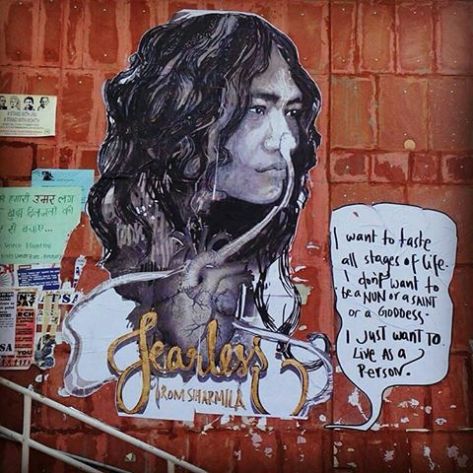
Iram Sharmila Mural at ‘Freedom Square’ JNU. Art by Shijo Suleman and the Fearless Collective. Photograph by Rebecca John. Image, courtesy, ‘The Great Walls of India’ blog on Graffiti and Wall Art

We may have differences in our political approach as to the way and means of the struggle, but what must be stated at the outset is the fact that Irom Sharmila has certainly been an icon of resistance and inspiration in the struggle against AFSPA.

Her 16 year long hunger strike has been a grim reminder of the crimes against the Manipuri people – rape, torture, fake encounters and massacres – committed by the armed forces with impunity under such draconian Acts like AFSPA. But her abrupt decision to end her fast accompanied with her willingness to contest elections in the upcoming assembly elections have met with a mixture of shock, scepticism, disappointment, puzzlement and even anger amongst her people in Manipur and even her close associates. There also seems to be a resentment against her being in a relationship and her plan to marry. Such scrutiny/dragging of her personal life are, however, quite deplorable. But overall, the disappointment with the decision of Irom to quit fasting and contest elections is so strong that, after breaking her fast in the hospital, when she tried to go to a local activist’s shelter, the locals disapproved. She had to seek temporary shelter in an ISKCON temple along with her police guards and then was shifted to a police station and finally she was forced to retreat to the same hospital that housed her for last 16 years. Now, this is telling. But what does it tell? The answer to this question would take us away from criticisms about any particular individual, but to the evaluation of the very method of struggle that she had been a part of, its scope, effectivity and limitations.

Continue reading A Fast That Ended in Hunger- Thoughts on Irom Sharmila and Hunger Strikes: Anirban Bhattacharya

The Orphaning of ‘Women’s Collective Interests’ in Kerala


There is considerable outrage in Kerala about how the accused in the murder of the young woman worker Soumya in 2011 has slipped the noose at the Supreme Court. There is considerable doubt remaining on how the murder of the young dalit woman student Jisha was handled by the present government. In both cases, the accused are not men who would earn the sympathy of the Malayali middle-class – in one case, a tamil homeless man, and in the other, a Muslim migrant worker. Not surprisingly, the cry for their blood has been particularly shrill. Outrage at the Supreme Court’s refusal to endorse the lower court’s judgment in the first case is particularly striking – not only because of its loudness, but also because one is unable to forget the Suryanelli case. The difference between the present cases and the Suryanelli case is that in the latter, the victim has been condemned to living death, though she has persistently fought to be heard as a survivor of the most horrific violence. Yet her pleas that the powerful Malayali politician P J Kurien be also tried never roused the kind of outrage was have heard recently. It appears that the Malayali public is kinder to dead violated women than women who survive violation; it also seems harsher towards abjected males than to .powerful males who occupy the pedestal of elite masculinity. Continue reading The Orphaning of ‘Women’s Collective Interests’ in Kerala

Self and Other : Indus Chadha

This is a guest post by INDUS CHADHA

The summer that I was 5-years-old, I took my first flight alone because I wanted to spend my holidays with my grandparents. My parents prepared me well—they even read aloud and recorded my favourite stories on an audio cassette which we put into our Walkman for my long solo journey. But there was one question they neglected to answer. “What should I do if the flight crashes?” I had asked. “It won’t…” they had brushed my question away. So when the flight attendant came out into the aisle and announced that one of our engines had failed and we would have to turn back to our point of origin to make an emergency landing—I wondered what I should do.

A man a few rows ahead of me got up from his seat and started shouting at the flight attendant. He was obviously afraid and seemed to hope oddly that he could frighten some comfort out of her. I remember him saying over and over again that he had a young child with him on the flight and that made me conscious of both the gravity of the situation and the fact that I was so young and all alone. I felt tears start to well up in my throat and took small sips of my orange juice to wash down the urge to cry. And then, out of the blue, the young man sitting beside me started talking to me. He asked me what I was studying at school and when I told him our theme for the last term had been pirates he exclaimed that he was a ‘shippie’ and knew all about them.

Continue reading Self and Other : Indus Chadha

On the Ongoing Debate in CPI(M): Dheeresh Saini

Guest Post by DHEERESH SAINI

“In India today, neither has fascism been established, nor are the conditions present — in political, economic and class terms — for a fascist regime to be established. There is no crisis that threatens a collapse of the capitalist system; the ruling classes of India face no threat to their class rule. No section of the ruling class is currently working for the overthrow of the bourgeois parliamentary system. What the ruling classes seek to do is to use forms of authoritarianism to serve their class interests,”

-Prakash Karat

When CPI(M) was under the stewardship of now deceased, voluntarily or forcefully retired leaders, young leaders-workers would say that when young leaders (who were actually middle aged then) like Prakash Karat and Sitaram Yechury take over, the party would zoom on to its real revolutionary track. Karat was always considered more principled and genuine between the two. Yechury has now succeeded Karat as the topmost leader. Meanwhile, the situation of the party that prided itself in waging nationwide struggle against the fascist forces went from bad to worse in West Bengal considered as its fort. In the present scenario, any party considered as progressive or secular, would be bound to face such situation. But it is disappointing to see CPI(M) hog the headlines, in such tough times, on account of constant tussle between its two stars considered most resplendent. Continue reading On the Ongoing Debate in CPI(M): Dheeresh Saini

The Left Non-debate on Fascism or How Not to Fight the Hindu Right

History never repeats itself. Neither as tragedy, nor as farce. Every historical situation is a singularity, a product of its conjuncture and the opening out of different possibilities – thus irreducible to any other. What becomes farcical is the attempt of historical actors to borrow their slogans, icons and ideas from specific pasts and their attempt to reenact them in conjunctures that are radically different. Indian communists, of course, have long had a penchant for re-enacting (or believing they are re-enacting) other histories and other revolutions. And yet, more often than not, they have simply operated on the margins, engaging in violent and heated debates, as if the course of history depended on how these debates were resolved – while other historical actors took centre-stage, actually steering the course of history.

For decades Indian communists debated the ‘class character of the Indian state’ and even though their descriptions of its effects often differed little (except for an emphasis here or an emphasis there), they themselves split many times over in trying to name the beast. They became one another’s bitterest enemies, throwing about labels like “revisionist”, “neo-revisionist”, “sectarian”, “adventurist” and so on. Ask the CPI, CPI(M) or CPI(ML) Liberation, who fought the 2015 Bihar elections together and are trying to come together on issues of common concern today, how invested they are in those characterizations and how relevant they find them for their joint activity today? The really honest answer would have to be that it is of no relevance, whatsoever,  whether the state is described as that of the national bourgeoisie, the bourgeois-landlord alliance or as a semi-feudal and semi-colonial one – especially where it concerns joint or common struggles. Indeed, many communists might cringe today if reminded of these characterizations over which not just barrels of ink but precious blood has been spilt in the past. And so it happened, that while communists occupied themselves with all this bloodletting, history passed them by. Not once or twice but repeatedly.

There is a sense of deja vu therefore, when the official Left (at least the CPI(M) and CPI) and many left intellectuals suddenly seem bent upon tearing each other to bits in simply trying to name the Modi/RSS/BJP phenomenon (hereafter referred to as Sanghism – a term I have explained elsewhere). It seems it is necessary to first “correctly” characterize the phenomenon before any fight can even be conceived – even though, I suspect, there will be little difference in the way the different protagonists actually describe it.

Kick-starting this great non-debate, former CPI(M) general secretary Prakash Karat wrote in The Indian Express, a piece so befuddling that it left many people gasping: The Sanghist/ Modi dispensation, according to him, is “right -wing authoritarian” but not “fascist” and hence there is no need for broader resistance against it (my paraphrase of what is in fact a simple question of whether or not to have an electoral alliance with the Congress!) What was worse, he referred to what he called the “classic definition” (yes, definition!) of fascism, in order to make his point. What was simply a formulation made by Georgi Dimitrov and the Comintern in a specific context, is turned into a definition. Here is Karat’s “definition”: Fascism in power is “the open terrorist dictatorship of the most reactionary, most chauvinistic and most imperialist elements of finance capital.” From this definition, he then proceeds to make his deductions about present day India:

In India today, neither has fascism been established, nor are the conditions present — in political, economic and class terms — for a fascist regime to be established. There is no crisis that threatens a collapse of the capitalist system; the ruling classes of India face no threat to their class rule.

Every bit of this statement is an instance of formulaic thinking. As Jairus Banaji pointed out in a sharp riposte, calling Dimitrov’s formulation a “classic definition” is merely a way of suggesting that it was a code graven in stone, and therefore, not open to any critical scrutiny or examination. After all, how can you debate a definition? Banaji, in fact, made an important point in his response: fascism is not merely a conspiracy of finance capital but as later Marxists like Arthur Rosenberg and Wilhelm Reich repeatedly insisted, it was, above all, a mass movement. If one seriously ponders the implications of this claim, fascism’s relationship to capital – finance or otherwise – can hardly be seen as simple and straightforward any more. We will return to this point later. Continue reading The Left Non-debate on Fascism or How Not to Fight the Hindu Right

Kashmir Issue – A Brief Report on Solidarity Actions in Punjab: Jagmohan Singh

Guest Post by JAGMOHAN SINGH

Clear Message from the Revolutionary Democratic Movement in Punjab

We Firmly Stand with the People of Kashmir

Once again, Kashmir is boiling with rage. The pent-up anger of the people of Kashmir against their brutal oppression by the Indian security forces has erupted in powerful massive protests in the form of gatherings, demonstrations and skirmishes and clashes with these forces, in which more than 75 people have been killed, many blinded and more than thousand injured so far. It is more than 60 days now since the cold-blooded killing of Hizbul commander Burhan Wani by the security forces on 8th of July. Yet the anger of the people is finding no let-up. Brave Kashmiris are valiantly fighting against the atrocities and brutalities of the security forces. They are coming out on the roads time and again, in large numbers, caring little for the restrictions, curfews and even firings. They deserve our salute.

The just and righteous struggle of the people of Kashmir has gained support from variety of sections of the people world over. In India too, the reports of such solidarity actions supporting the Kashmiri people are pouring in. In Punjab also some such actions have taken place. The solidarity activity in Punjab, scattered over a wide area and taking different forms such as conventions, public meetings, demonstrations and other forms of mass-propaganda, was chiefly organized by the communist revolutionary, revolutionary democratic and other pro-people forces active in the state. Almost all the sections of society such as peasants, workers, employees, intellectuals, students and youth participated in these solidarity actions; especially the leading sections and front rank activists and fighters of the revolutionary democratic movement of the state participated in considerable numbers and with a marked conviction.

Continue reading Kashmir Issue – A Brief Report on Solidarity Actions in Punjab: Jagmohan Singh

Historic Delhi High Court Judgement Dismisses Publishers’ Copyright Infringement Petition

In its much awaited judgment in the Delhi University photocopying case (The Chancellor Masters and Scholars of the University of Oxford v. Rameshwari Photocopy Services), the Delhi High Court has dismissed the copyright infringement petition initiated in August 2012 by three publishers (Oxford, Cambridge and Taylor & Francis) against a photocopy shop located in the premises of Delhi University. This case, which was being closely tracked by students, teachers and the publishing industry alike, was seen as one with immense significance for questions of access to knowledge. While initially involving only the publishers, the photocopier and the university, the case also saw intervention petitions being filed by a student group (Association of Students for Equitable Access to Knowledge) as well as by teachers and academics (Society for Promoting Educational Access and Knowledge). While the publishers made the argument that the creation of course packs and the photocopying of academic material for the same amounted to an infringement of the exclusive copyright of the authors and publishers, the defendants argued that the reproduction of materials for educational purposes fell within the exceptions to copyright under Section 52(1)(i) of the Copyright Act.

Not a moral right

In his considered and sharply reasoned judgment, Justice Rajiv Sahai Endlaw examines the gamut of arguments made by both sides and arrives at the conclusion that copyright is a statutory right and not a natural right, and hence any right that is granted to owners is also limited by exceptions carved out by law. The nature of Section 52 of the Copyright Act is such that any act falling within its scope will not constitute infringement. Section 52(1)(i) allows for the reproduction of any work i) by a teacher or a pupil in the course of instruction; or ii) as part of the questions to be answered in an examination; or iii) in answers to such questions.

Continue reading Historic Delhi High Court Judgement Dismisses Publishers’ Copyright Infringement Petition

Victory for Students and Access to Knowledge in DU Copyright Case :ASEAK

Guest Statement by Association of Students for Equitable Access to Knowledge (ASEAK)

Victory for Students and Access to Knowledge in DU Copyright Case : Corporate Publishers Market ends at the gates of the University

In a rare and incredible order today, the Delhi High Court has dismissed the copyright infringement case filed by Oxford University Press, Cambridge University Press and Taylor and Francis (Routledge) against Rameshwari Photocopy Shop in Delhi School of Economics and Delhi University. Justice R.S Endlaw in a 94 pages long judgment interpreted educational exception under section 52(1)(i) of the copyright act in broad enough manner to cover the acts of photocopying.

The publishers sought to claim damages to the tune of 60 lakh rupees from the shop citing infringement of copyright which the publishers claimed was happening through photocopying of parts of books published by them. However, the publishers themselves stated that this case, for them, was a test case where they wanted to introduce licensing systems across universities in India. These licensing systems intended to control the extent to which material could be photocopied and also direct a share of profit from these reproductions to the publishers. We, the Association of Students for Equitable Access to Knowledge (ASEAK) demanded to be made a defendant in this case as we believed that it is the rights of students to access reading material that was at stake in this case- “Association of Students for Equitable Access to Knowledge (ASEAK) filed IA No.3454/2013 for impleadment in the present suit and which was allowed vide order dated 1st March, 2013 and ASEAK impleaded as defendant No.3.” (from the judgment). Continue reading Victory for Students and Access to Knowledge in DU Copyright Case :ASEAK

State Violence against Peaceful Assemblies in Kashmir: JKCCS

Guest Post by Jammu & Kashmir Coalition for Civil Society (JKCCS)

Over the last week – August 29 to 5 September, of uninterrupted curfew in Kashmir, the government’s unbridled use of force on peaceful public meetings/rallies, which are either funeral processions of the civilians killed by government forces or peaceful political rallies where people demand their right to self determination, across Kashmir valley has resulted in injuries to 1215+ people, many of whom are injured by pellets shot guns. The violence used by government forces against un-armed peaceful rallies deflates its claims that its forces only resort to violence when they are pelted with stones. Contrary to government claims, the use of force against the peaceful demonstrators acts as a provocation to people and youth in particular who then retaliate by stone throwing on Indian forces. The sheer number of peaceful pro-freedom rallies held in the last week alone symbolizes the nature of the current anti-India uprising which has seen lakhs of Kashmiris on streets to voice their demand for right to self-determination. Such attacks are against the internationally, and domestically, recognized fundamental rights of peoples to peaceful assembly and association, and freedom of opinion and expression, including India’s obligation under the ICCPR. Continue reading State Violence against Peaceful Assemblies in Kashmir: JKCCS

Statement against All India Muslim Personal Law Board’s affidavit claiming triple talaq is Islamic: Bebaak Collective

Statement by Hasina Khan, Roshni Rina, Geeta Thatra, Shirin Dalvi  on behalf of Bebaak Collective (Voices of the Fearless).

Contact details: bebaakcollective@gmail.com/ 9870162113

We, as part of women’s movement and practising feminists working with Muslim community and the women of the community for years in India, take the liberty to write this statement condemning the recent affidavit posed by All India Muslim Personal Law Board (AIMPLB). The claims of this affidavit are:

First, abolition of triple talaq is (un) Quranic;

Second, since women lack decision making abilities, it is only men of the community who should have this right;

Third, polygamy is Islamic, though not promoted by Islam, and this practice ensures marital rights for Muslim women, banning of which will result in promiscuous sexual practices or murder of women at the hands of their husbands;

Fourth, the honorable Supreme Court of India has no right to intervene in the religious law of the community.

This statement has been issued by the AIMPLB in the context of the growing number of Muslim women’s petitions challenging the constitutionality of triple talaq in the apex court.

We strongly condemn this statement based on all the four premises.

Continue reading Statement against All India Muslim Personal Law Board’s affidavit claiming triple talaq is Islamic: Bebaak Collective

Kashmir Scholars Action Group Letter to the UN High Commission for Human Rights on the Situation in Jammu&Kashmir: KSAG

Guest Post by Kashmir Scholars Action Group

To Mr. Zeid Ra’ad Al Hussein

UN High Commissioner for Human Rights

Re: Urgent action needed to end state violence in Indian-controlled Kashmir

We are writing to you to express our concern about the situation in Indian-controlled Kashmir where the already subjected population is currently living in a state of siege due to the massive violence unleashed by the Indian forces. We appreciate your decision to create a fact-finding mission and deplore the refusal of the Indian government to allow access to UN human rights monitors (1). In the absence of such a mission, we feel it incumbent upon civil society groups to provide regular updates on the situation.

We, the Kashmir Scholars Action Group, are an interdisciplinary group of scholars of various nationalities engaged in research on the region of Kashmir. Our research on Kashmir, its history, its consequences for the region and beyond, and its possible resolution, delves into the implications for an internationally mediated political solution, and is of relevance to policy makers. Based on our long and active engagement with civil society groups in Indian-controlled Kashmir, we have undertaken to document and communicate the situation on ground since the Indian state’s violence against civilians has continued to mount from July 7th, 2016 onwards. Each of us has written about Kashmiri history, society and politics; and we are particularly concerned about the present conditions of violence. We write to you now as part of our urgent efforts to check the brutality of the state’s response to Kashmiris, scores of whom have mobilized in support of their demand for azadi (freedom). Even as we will go on to list some of the details of the humanitarian crisis, we wish to make clear that we are calling not only for the resumption of basic civil services, the rule of law, and the restoration of human rights in Kashmir, but, most importantly, for an internationally mediated political solution for this ongoing crisis. Continue reading Kashmir Scholars Action Group Letter to the UN High Commission for Human Rights on the Situation in Jammu&Kashmir: KSAG

The Singur Judgement, End of Neoliberalism and the CPI(M) Comedy Show

The Supreme Court verdict on Singur land acquisition that eventually signaled the beginning of the end of CPI(M)-led Left Front’s 34 year long rule in West Bengal, has come as a breath of fresh air. It is especially so, because the advent of the Modi government at the Centre had succeeded in reinstating the logic of corporate development, brushing aside all concerns regarding environmental clearances to land acquisition, despite its attempts to undo the provisions of the Land Acquisition Act 2013 (LARR 2013), being effectively rebuffed. The implications of the Singur judgement go far beyond West Bengal, for the argument made by Justices V. Gopala Gowda and Arun Mishra underlines one thing starkly: the “brunt of development” should not be borne by the “weakest sections of the society, more so, poor agricultural workers who have no means of raising a voice against the action of the mighty State government.” While the 204 page still waits to be read more closely, it is clear that the break that the Singur-Nandigram moment had already initiated in the neoliberal consensus among the political and state elite in 2006-7, continues to acquire legitimacy. Even the 2013 Act was a consequence of that break. The SC verdict recognizes that ‘growth’ and industrialization’ do not come without costs and who pays for those costs remains a key question at the end of the day.

Continue reading The Singur Judgement, End of Neoliberalism and the CPI(M) Comedy Show

The Surrogacy Debate and the Missing ART Bill: Chayanika Shah

Guest Post by CHAYANIKA SHAH

Altruistic. Meaning: showing a disinterested and selfless concern for the well-being of others; unselfish.

So once again the government is asking women to be unselfish and show selfless concern for the well being of others. The “others”, however, have been clearly marked. It has to be people within the close family. Women dare not feel selfless or altruistic concern for anyone other than those that are connected to them genetically or through marriage (since that is what defines a family by law and dominant customs). This concern should be so selfless that they should also not worry about their health after the pregnancy, they should not care for the loss of employment or any other changes that may happen in their lives as a result of this concern that they show for a family member. After all we are living in the “Indian ethos” where women are supposed to sacrifice for their “families,” and for none other. And in any case, till very lately, until all these new fangled ideas of women being natural guardians etc. came up, women were giving this altruistic services to their husbands. They are used to it and this is merely an extension of their familial labour. Simple!

It is such a waste of women’s reproductive potential that they bear children just for their husband. The family may as well benefit from the labour of the woman, and it be shared with other family members too. Especially for those who have married as per all the caste and community norms and have even stuck together for five years in spite of not having a child. Why should the hard earned money of “the family” be squandered on someone else? Is that not wasting the potential of women? After all why have we have saved the girl child? So that our boys can have the right girls to marry and also so that we can continue with our eugenic marriage and child bearing practices within the right caste and gotra unions.

Continue reading The Surrogacy Debate and the Missing ART Bill: Chayanika Shah