Category Archives: Debates

Farewell to Vidrohi: Pallavi Paul

Guest Post by Pallavi Paul

[ Rama Shankar Yadav ‘Vidrohi’, was a familiar figure for students, especially in Jawaharlal Nehru University in Delhi. He was a friend, a companion, a comrade, a mentor. Though rusticated many years ago from JNU, where he had been a student, for his participation in a  protest, he had never left the campus of JNU, and had become, over the years, a beloved feature of campus life. His visceral poetry, often heard at protest gatherings, was passed from person to person by word of mouth. A few days ago, he died while marching with his beloved student friends in a protest against cuts in education in Delhi.  Pallavi Paul, a filmmaker and artists, who made short films featuring Vidrohi, remembers him in this tribute..]

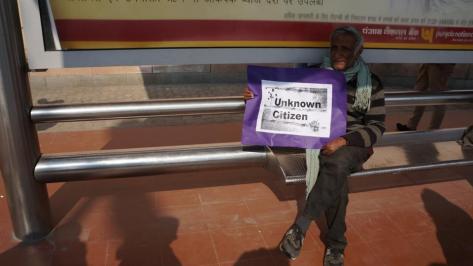
Unknown Citizen Vidrohi
Vidrohi as the ‘Unknown Citizen’ at a Protest to ‘Reclaim the Republic’ on 26 January 2013

Yesterday, as I was looking out a window of an old house in Ballygunge, Kolkata- my phone buzzed. I ignored it.  I was in the middle of telling a friend how happy I was to be away from Delhi for sometime. How the sights and smells of a different city were rejuvenating. The feeling of not having a ‘special connection’ with anyone or anything here felt liberating.

Much later, I opened the message from my friend Uday. ‘Vidrohiji passed away’, he wrote. Just three words.  In our conversations with him, Vidrohiji had often spoken about his death. We had revisited the scenario over and over again. Like a dream or a film – it had a grand setting. He had told us “Now that you are recording me, i know that i will say goodbye in the most glorious way possible. Very few people can say that about their death, while they are still alive.” On another day he had said to us, “As my fame has increased, so have the dangers. Now what i need is guarantee. Your records are guarantee against that largest threat of being killed. I say to my enemies, that if you want to kill me – then shoot me in the eyes. Because i will keep staring back at you till my last breath. Your records will help me stare back at them even after I am gone. “

Continue reading Farewell to Vidrohi: Pallavi Paul

The Pocso Act: A Quick Review: Srishti Agnihotri and Minakshi Das

Guest post by SRISHTI AGNIHOTRI and MINAKSHI DAS

On the 30th of November 2015, Shri Rajiv Chandrashekhar, a Member of Parliament, spoke at an Open House on ‘Why we need to start talking about Child Sexual Abuse and protect our children’. With the enactment of the Protection of Children from Sexual Offences Act in 2012, and rising awareness among civil society groups, there is an unprecedented momentum regarding protecting our children from sexual abuse. Issues that were earlier being brushed under the carpet, are now being openly addressed. We thought this was a good time to talk about the progress of the POCSO Act. Has it lived up to its promise? What more do we need to do to make this legislation effective in the fight against sexual violence?

The Protection of Children from Sexual Offences Act (‘POCSO Act’) was enacted in the year 2012 with the aim to protect children from sexual offences, such as, sexual assault, sexual harassment and pornography. This Act also provides for the establishment of special courts for trial of child sexual abuse matters. In the past decade, India has recorded an alarmingly high level of sexual assault cases on children. While, the Government of India has made a sincere attempt to address the issue of sexual exploitation of children through the POCSO Act, the impact of the legislation remains to be seen. Continue reading The Pocso Act: A Quick Review: Srishti Agnihotri and Minakshi Das

നഹാസ് മാളയ്ക്കു മറുപടി

ആദരണീയ നഹാസ് മാള

താങ്കളുടെ മറുപടി വായിച്ചു, സന്തോഷമുണ്ട്. അത് കാഫിലയിൽ പോസ്റ്റ് ചെയ്യുന്നില്ല. മറിച്ച്, ആ കത്ത് ഉണർത്തിവിടുന്ന ചില ചിന്തകൾ പങ്കുവയ്ക്കാൻ ഈ ഇടം പ്രയോജനപ്പെടുത്തുന്നു. Continue reading നഹാസ് മാളയ്ക്കു മറുപടി

Save Yo Drama for Yo Mama :യഥാർത്ഥരക്ഷകർത്താക്കളോട് കലിപ്പ് തീർത്തുകൊള്ളുക

എസ് ഐ ഒ നേതാവിനോട് ഒരു ചോദ്യം ചോദിച്ചതും, അതാ ‘നിങ്ങളുടെ രക്ഷാകർതൃത്വം ഞങ്ങൾക്കാവശ്യമില്ല‘ എന്ന ആക്രോശം മുസ്ലിം റാഡിക്കൽ സ്ത്രീപുരുഷ ആക്ടിവിസ്റ്റുകളിൽ നിന്നുമുണ്ടായിരുക്കുന്നു. അവരുടെ കൂക്കിവിളിക്ക് ആക്കം കൂട്ടാൻ ചില ദലിത് സിംഹങ്ങളും സട കുടഞ്ഞെഴുന്നേറ്റിരിക്കുന്നു. അവരുടെ തന്ത്രങ്ങൾ പരിചിതങ്ങളാണ് – മുൻപ് ചുംബനസമരം നടന്ന സമയത്ത് പയറ്റിയ ചില അടവുകളാണ് അവ. എന്നെ ‘അധികാരത്തെ മോശമായി പ്രയോഗിക്കുന്ന പവർഫുൾ സ്ത്രീ’ എന്നും, ഷാഹിനയെ ‘ചീത്ത മുസ്ലിം’ എന്നും, അരുന്ധതിയെ ‘സവർണ്ണസ്ത്രീശരീര’മെന്നുമൊക്കെ ആദ്യമായല്ല മുദ്രകുത്തുന്നത്. അങ്ങനെ ചെയ്താൽ ഞങ്ങൾ പറയുന്നതു മുഴുവൻ തെറ്റാണെന്ന് മറ്റുള്ളവർ ധരിച്ചുകൊള്ളുമെന്ന ശുദ്ധഗതി കലർന്ന പ്രത്യാശയിലാണ് ഇതു ചെയ്തു കൂട്ടുന്നത്. മുസ്ലിം സമുദായത്തെ ചില വാർപ്പു മാതൃകകളിലേക്കു ചുരുക്കുന്ന രീതി സ്വീകാര്യമല്ലെന്ന് വാതോരാതെ കരയുന്നവർ തന്നെയാണ് ഈ പണി ചെയ്യുന്നതെന്നത് തീർച്ചയായും കൌതുകകരം തന്നെ. Continue reading Save Yo Drama for Yo Mama :യഥാർത്ഥരക്ഷകർത്താക്കളോട് കലിപ്പ് തീർത്തുകൊള്ളുക

Of Flags and Fetishes – The Paris Attacks and A Misplaced Politics of Solidarity: Debaditya Bhattacharya

This is a guest post by DEBADITYA BHATTACHARYA

Megan Garber’s article ‘#PrayForParis: When Empathy Becomes a Meme’, published in The Atlantic (November 16, 2015) has claimed that Paris hashtags and French flag filters on Facebook make for an “act of mass compassion” – a “compassion that has been converted, via the Internet’s alchemy, into political messaging”.

flag filter2

I have absolutely no problems with flag filters on Facebook. Or for that matter, profile-picture revolutions that happen all too often. I’m not, in the least bit indignant about such a competitive exhibitionism of feeling – indexed through a currency of memes and emoticons. In an age of such mass-production of violence (‘terroristic’ or ‘humanitarian’), it is no surprise that the event of mourning must become a symptom of the incompatibility between ‘act’ and ‘response’.

A funereal Facebook must therefore bleed profile pictures, because that seems the only charter of our most intimate emotions. We naturally do not care if Facebook is using the Paris tragedy as a marketing platform, as long as it helps us reclaim a deeply ‘personal’ angst in the face of more-than-a-hundred ‘spectacular’ deaths.

Continue reading Of Flags and Fetishes – The Paris Attacks and A Misplaced Politics of Solidarity: Debaditya Bhattacharya

ചീത്തകളെ തള്ളിക്കള: നഹാസ് മാളയ്ക്ക് തുറന്ന കത്ത്

പ്രിയ നഹാസ് മാള

‘ഓൺലൈൻ പെൺവാണിഭം:  വിശദമായ അന്വേഷണം വേണം – എസ് ഐ ഒ’ എന്ന തലക്കെട്ടോടു കൂടി താങ്കളുടെ സംഘടന പുറത്തിറക്കിയ പ്രസ്താവന ഇന്നത്തെ മാദ്ധ്യമം പത്രത്തിൽ കണ്ടു.  അതിൽ പറയുന്നു:

“കേരളത്തിലെ ചുംബനസമരം അടക്കമുള്ള സമരങ്ങളിൽ മുഖ്യപങ്ക് വഹിച്ചിരുന്ന രാഹുൽ പശുപാലനും രശ്മി നായരുമാണ് റാക്കറ്റിൻെറ പിന്നിലെന്ന പോലീസ് ആരോപണം ഗൌരവമുള്ളതാണ്. കേരളത്തിലെ രാഷ്ട്രീയ മാധ്യമമേഖലയിലെ പ്രമുഖരുമായുള്ള ബന്ധങ്ങൾ ഇത്തരം റാക്കറ്റുകൾ മറയായി ഉപയോഗപ്പെടുത്തുന്നുണ്ട് … വിദ്യാർത്ഥികളെ അടക്കം സ്നേഹം നടിച്ചും പ്രലോഭിപ്പിച്ചും തങ്ങളുടെ വലയിൽ കുരുക്കി ഉഭയസമ്മതപ്രകാരമെന്ന് പറഞ്ഞ് ചൂഷണം ചെയ്യുന്ന ഇത്തരം റാക്കറ്റുകൾക്കെതിരെ സമൂഹം ജാഗ്രത പുലർത്തണം.”

കഴിഞ്ഞ ദിവസം മനോരമ ചാനലിൽ യുവ മോർച്ചാ നേതാവ് രാജേഷ് ചുംബനസമരത്തിനെതിരെ തൊടുത്തുവിട്ട പൊട്ടശ്ശരങ്ങളോട് നിങ്ങളുടെ പ്രസ്താവന അടുത്തസാമ്യം പുലർത്തുന്നു എന്നു കണ്ടതുകൊണ്ടാണ് നിങ്ങൾക്ക് കത്തെഴുതാൻ തീരുമാനിച്ചത്.

Continue reading ചീത്തകളെ തള്ളിക്കള: നഹാസ് മാളയ്ക്ക് തുറന്ന കത്ത്

Two Trees Don’t Make a Forest: Leave KOL Alone

The latest assault on the Kiss Of Love movement, the last in the long list of assaults against its activists over the past one year in Kerala, involves the arrest of two former KOL activists, Rahul Pasupalan and Resmi Nair, over sex trafficking charges. While the media has been mixing up this case with that of a pedophilia FB page in a rather unwarranted way , the media has been screaming about the pair’s connection with KOL and some reports almost imply that their actions were because of their associations with KOL. Others, including the arch-conservative newspapers, have asked whether the KOL was a cover for sex work markets! Continue reading Two Trees Don’t Make a Forest: Leave KOL Alone

New Epidemics in Kerala – Ephebiphobia and Losing-Control Anxiety

“Torture isn’t  new to us, ” quipped my seventeen-year-old daughter. We were discussing the future of Indian democracy.She had just quit regular school and got herself enrolled in the Kerala State Open School.

I turned to look at her, surprised. She held me in her gaze, questioning that surprise. “In school, we were watched constantly through CCTV cameras … We were summoned to the Principal’s room whenever they thought they saw or heard something wrong. My friend was questioned by nine people, teachers and non-teaching staff. They sat in a circle with her standing in the middle. The more she denied their accusations, the more they pressed charges, threatening and insulting her… So why should we feel illegal interrogation to be abnormal? It is utterly normal to us!”  I could only stare blankly. “And the punishments … do you know how humiliating they are? They even maintain ‘reports’ – gossip by teachers – which they pass on to the next school you’d join.” Continue reading New Epidemics in Kerala – Ephebiphobia and Losing-Control Anxiety

We agree passionately: one world, one struggle, education is not for sale!

Dangerous Vandals, Goths and Visigoths: Students Demanding the Impossible at #OccupyUGC

The Occupy UGC movement looks irrelevant or ridiculous to the middle and upper classes in India because it can be made to appear so by the media. Not surprisingly, television channels and leading dailies either ignored the protests altogether, or worse, focused on the apparently far more *critical* issue of the “vandalism” and “disfigurement” of the ITO metro station by the protesting students. Times of India said they were “brazening it out” after their acts of vandalism, and on social media including Kafila, these student vandals have been additionally belittled by some as misguided pawns in the hands of an apparent conglomerate of ambitious lefty professors from JNU! Basically, anything but a legitimate set of demands, some of which this poster from the movement tries to explain…

Dekh Bhai UGC
Translation: Look here UGC, if you don’t give us the scholarship, I will face marriage pressure, but you will have to face the pressure of the entire student population!!

(Incidentally, it was this image that was painted on the walls of the ITO metro station. Personally I found it cheerful).

Anyway, as Camalita Naicker reminded us in her excellent article on South Africa here on Kafila, student protests against rising student fees and shrinking scholarships and fellowships are no flash in the pan but a burgeoning worldwide phenomenon cutting across political affiliations. This is because you don’t need to be a leftist to understand that in contemporary conditions, pursuing a higher education is both the only guarantee to economic security, and the one thing that may be denied to you if you are from the wrong side of the tracks. 

We post below statements from #OccupyUGC and #Occupy SOAS in support of each other. These have been sent to us by Akash Bhattacharya, research scholar in history at JNU.

Continue reading We agree passionately: one world, one struggle, education is not for sale!

How the Hindutva Propaganda Machine Manufactures Lies

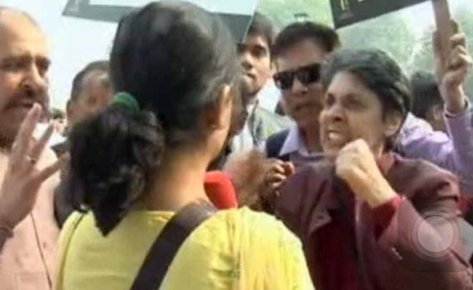
Did you know that the return of awards by writers, film-makers and scientists was a plot hatched jointly by the United States of America, Saudi Arabia and Pakistan? Well, if you did not, you will probably not ever understand why the ‘tolerant’ multitude that turned out at Anupam Kher’s March for India rally today, could so vilely abuse and attack NDTV’s Bhairavi Singh and Aaj Tak’s Mousmi Singh. After all, it is one thing for the netas to simulate their anger and laughter on TV channels and elsewhere, but how do you actually get ordinary people to go crazy? How and why does the ordinary Hindutva footsoldier act the way he or she does? Basically, he (and occasionally, she) is made to believe things that most people would know to be false. So why does as innocuous an act as the returning of awards by writers become such a big threat to India’s position in the world and to the very existence of the government of the day? Well, because, it is not a simple matter of some writers acting out of their conscience but already a part of an international conspiracy plotted by the US-Saudi Arabia-Pakistan nexus!

Defenders of the great tradition of tolerance, image courtesy Saikat Datta

Published below is the text of a note that has been circulating over different social media platforms. We have left the typographical and printing errors as they are in the original. Paranoid in its content, it is also illustrative of the way the RSS ‘rumour-machine’ works to produce lies. In earlier days, it used to start circulating from the morning shakhas via the shakha participants. Nowadays it moves from one social media platform to another, with lightning speed. Continue reading How the Hindutva Propaganda Machine Manufactures Lies

A Memory from the 1970s

This is from a long time back.

I was eight or nine, a child obsessed with day-dreaming and playing alone with the tiny grass-flowers that grew abundantly in our yard. Memories of those times are coloured a brilliant green because that was the colour that overwhelmed all the seasons of the year. Our home at Muthukulam in Kerala comes back to the mind’s eye in greens of all shades, browns, rich reds, bright blues, silver of the ponds,canals, and the lake, the  bright yellow of the mangoes and jackfruit, and innumerable flower- and fruit-hues. Continue reading A Memory from the 1970s

An ‘Anti National’ Response from JNU to the ‘Nationalist’ RSS: Pratim, Gargi and Lenin

Guest Post by Pratim, Gargi and Lenin.

As writers, historians, scientists, film makers, poets, actors and others return their awards in protest against the rising intolerance and anti-rational climate in this country, we in JNU keep stocking up accolades of a different kind. These accolades are ones which are very generously gifted to us from the RSS and its affiliates. These accolades come in more than fifty shades, only highlighting the deep seated trouble that these folks have in seeing this University up to them, despite their attempts to tarnish it. A few days back the ever-so-absurd/islamophobic/irrational Subramaniam Swamy endowed JNU students with the honours of being ‘Jehadis’, ‘Naxal’ and ‘Anti-National’.

Continue reading An ‘Anti National’ Response from JNU to the ‘Nationalist’ RSS: Pratim, Gargi and Lenin

Statement by Academics Against Intolerance

In light of the recent spate of killings of noted writers and intellectuals M M Kalburgi, Govind Pansare, and Narendra Dabholkar, and the Dadri lynching incident followed by forced nation-wide attempts at cultural policing, we feel that the current political dispensation headed by the Prime Minister is mandating an atmosphere of violence and fear. Continue reading Statement by Academics Against Intolerance

जो पहले नहीं हुआ: किशोर कुमार

Guest Post by KISHORE KUMAR

लगभग चालीस लेखकों के पुरुस्कार लौटाने के बाद अब फिल्म निर्देशकों ने भी पुरुस्कार लौटने शुरू कर दिए. यह पुरुस्कार बढती असहनशीलता और अभिव्यक्ति की स्वंत्रता के दमन के विरोध में लौटाए जा रहे हैं.

बी.जे.पी की राय में यह राजनीति से प्रेरित कदम है और यह सब बी.जे.पी के खिलाफ हो रही साजिश का हिस्सा है. बी.जे.पी के अनुसार आज कुछ ऐसा नया नहीं हुआ जो पहले ना हुआ हो और इन लोगों ने उस समय यह पुरूस्कार वापस क्यों नहीं लौटाए? बी.जे.पी. के अनुसार पुरुस्कार लौटना छदम धर्मनिरपेक्ष लोगों का नाटक है और  असहनशीलता इतनी नहीं बढ़ी और माहौल इतना ख़राब नहीं हुआ कि इतना शोर मचाया जाए. Continue reading जो पहले नहीं हुआ: किशोर कुमार

What Communal Attacks And Our Own Blindness have Cost Us: Thoughts for Malayalees on the Eve of Panchayat Elections

On the eve of the panchayat elections in Kerala, I can’t help noticing how different it has been this time. Every time, the build-up to voting day includes heated debates about the state of the local bodies and discussions on the promises made by political parties. Not that it was completely absent this time, but somehow it appeared that such questions were hardly on people’s minds. The coming of decentralized governance in the mid-1990s divided the political field in Kerala into two:  ‘local governance’ and ‘high politics’ involved very different conceptions of power, authority, and agency. Welfarism, now also reimagined in terms of self-help, was moved into the former, while the latter remained the more decisive arena of political activity and authority. However, given that the space on local governance was crucial to the poor in that welfare entitlements flowed through it, it remained a key area of public concern. Over the years, from Plachimada to Vilappilsala, the local bodies even seemed to form sites around which resistance to top-down destructive ‘development’ could take shape. Each election was an opportunity to take stock of this large network of institutions which despite all the flaws remained quite decisively important to the lives of the poor in Kerala. In fact, it is worth noting that the elections were the occasions in which the better-off sections paid relatively more attention to local bodies and even set aside their cynicism and reluctance to engage. Not so, this time, I can’t help feeling. Continue reading What Communal Attacks And Our Own Blindness have Cost Us: Thoughts for Malayalees on the Eve of Panchayat Elections

Can accessibility alone create an inclusive society for persons with disability? Tony Kurian

Guest Post by TONY KURIAN

Amidst the noisy campaigns of “Make In India and Digital India”, a campaign called “Accessible India” was launched by the Central Government recently and unsurprisingly this did not catch much media attention. Department of Persons with Disabilities, Ministry of Social Justice & Empowerment has launched the Accessible India Campaign (Sugamya Bharat Abhiyan), as a nation-wide flagship campaign for achieving universal accessibility for Persons with Disabilities.

The campaign is an extremely welcome initiative in a country like India which is home to more than 2.1 million officiallyrecognized disabled and a lot more who are not counted by the decadal exercise of census. While the campaign disserves much appreciation, it offers an appropriate opportunity for us to rethink some of our common sense, or at least that of majority about disability and disabled. Continue reading Can accessibility alone create an inclusive society for persons with disability? Tony Kurian

Why the Ban on Cow Slaughter is not Just Anti-Farmer but Anti-Cow as Well: Sagari R Ramdas

SAGARI R. RAMDAS writes in The Wire:

The recent killings of Mohammad Akhlaq, Noman and Zahid Ahmad Bhatt on the claim that they were slaughtering cows is not only an attack on the right to life, livelihood and diverse food cultures but an assault on the entire agrarian economy.

The cynical fetishisation of cows by Hindutva politicians is not only profoundly anti-farmer but, paradoxically, also anti-cow.

What these bigots fail to realise is that the cow will survive only if there are pro-active measures to support multiple-produce based cattle production systems, where animals have economic roles. The system must produce a combination of milk, beef, draught work, manure and hide, as has been the case in the rain-fed food farming agriculture systems of the sub-continent over the centuries.

In meat production systems – whether meat from cattle, buffaloes, sheep, goat, pigs or poultry – it is the female which is reared carefully in large numbers to reproduce future generations, and the male that goes to slaughter. It is only the sick, old, infertile and non-lactating female that is sold for slaughter. In every society where beef consumption is not politicised, farmers known that eating the female bovine as a primary source of meat will compromise future production, and hence they are rarely consumed.

Read the rest of this article here.

Knowledge and Innovation for a Better Society : Ravi Sinha

An Address to the Students of Gokhale Institute of Politics and Economics, Pune, India

Guest Post by Ravi Sinha

It should be a matter of no small comfort if, in today’s world and in today’s India, any discussion takes place anywhere about the relationship between knowledge and innovation on the one hand and the prospects for a good society on the other. It is greatly more satisfying and reassuring if this topic interests talented young minds such as present here, who, I hope, also nurse hopes for a better future, not only for themselves but also for the entire society and civilization. Yours is an esteemed institution with such a long history of cultivating and disseminating knowledge about society – about politics, economics and other related disciplines. I am sure this issue has been a core concern right from the inception of this institute, and I doubt if I will be able to bring in anything of added value. But, as I said, this is always a welcome topic for discussion. I am very happy for this opportunity to share some of my thoughts with you.

Today if one mentions these two words – knowledge and innovation – together, it is very likely that the image of a Mark Zuckerberg or Steve Jobs or Bill Gates will come to mind, even if such an association is not obvious to everyone. I, for one, often need to tell myself that I should not complain. After all, these gentlemen are symbols of one of the greatest technological revolutions humanity has experienced and we are living through. It has changed the way humanity works, communicates and lives, and it is not over yet. Unrealized potentials far outweigh the realized ones and far greater changes are in the pipeline. Physicists have recently discovered that the Universe now expands at an accelerated rate, but when it comes to accelerated expansion into the unknown, the Universe appears to be no match for technology.

For many the technological explosion is a cause for unadulterated excitement and a source of unbounded hope. For many others it is a cause for grave concern. There are yet others for whom it presents a mixed picture. In times of rapid and radical transformations, it is not unusual for many to have a sense of unease. Humanity has always innovated and created new ways and forms of life, and it has always found it difficult to adjust to its own innovations and creations. But the capacity to adjust improves with time. If the sense of unease or consternation appears widespread despite a greatly improved capacity for adjusting to the new, part of the reason lies in the break-neck speed of the current change. Continue reading Knowledge and Innovation for a Better Society : Ravi Sinha

Statement by Artists, Curators and Critics Against Rising Intolerance in India

Text of a Statement by Artists, Curators and Critics in India against a Climate of Rising Intolerance in India

(Followed by Names of the 300 + Signatories, in Alphabetical Order)

The artist community of India stands in firm solidarity with the actions of our writers who have relinquished awards and positions, and spoken up in protest against the alarming rise of intolerance in the country. We condemn and mourn the murders of MM Kalburgi, Narendra Dabholkar and Govind Pansare, rationalists and free thinkers whose voices have been silenced by rightwing dogmatists but whose ‘presence’ must ignite our resistance to the conditions of hate being generated around us.

We will never forget the battle we fought for our pre-eminent artist M.F. Husain who was hounded out of the country and died in exile. We remember the rightwing invasion and dismantling of freedoms in one of the country’s best known art schools in Baroda. We witness the present government’s appointment of grossly unqualified persons to the FTII Society and its disregard of the ongoing strike by the students of this leading Institute. We see a writer like Perumal Murugan being intimidated into declaring his death as a writer, a matter of dire shame in any society.

While the Prime Minister of the country has been conspicuously reticent in his response to the recent events, the reactions of BJP ministers in his government reveal their ignorance and prejudice. Mahesh Sharma, Minister of State for Culture, has made abhorrent comments about mob lynching and murder. His remarks suggesting that writers should stop writing to prove their point are alarming – empowered as he is to take policy decisions in the domain of culture. Arun Jaitley, Minister of Finance, Information & Broadcasting, has mocked the actions of our respected writers as a manufactured ‘paper rebellion’. He asks for scrutiny of the political and ideological affiliations of those who are protesting.

To these and other such provocations there is a clear answer: while the actual affiliations of the protesting writers and artists, scholars and journalists may be many and varied, their individual and collective voices are gaining cumulative strength. It is this that the ruling party will have to reckon with: the protestors’ declared disaffiliation from a government that encourages marauding outfits to enforce a series of regressive commands in this culturally diverse country.

The scale of social violence and fatal assaults on ordinary citizens (as in Dadri, Uttar Pradesh; Udhampur, Jammu and Kashmir; Faridabad, Harayana) is escalating. The contemptuous comments about the religious minorities and Dalits made by those within the government confirm that there is little difference between the RSS-BJP mainstream and supposed ‘fringe’ elements. The perfunctory warnings and regrets issued by ruling party ideologues – to defend the agendas of ‘development’ and ‘governance’ advanced by Mr Narendra Modi – are merely expedient. The Sangh Parivar and its Hindutva forces operating through their goon brigades form the support base of this government; they are all complicit in the attempts to impose conformity of thought, belief and practice. Continue reading Statement by Artists, Curators and Critics Against Rising Intolerance in India

The Move to Professionalise Research: Aswathy Senan

This is a guest post by ASWATHY SENAN

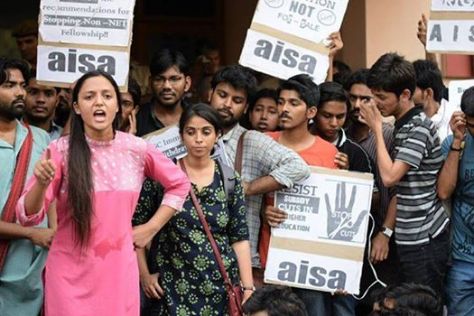
Researchers all over the country are protesting the move by the UGC to scrap the non-NET fellowship and students have gathered in hundreds to resume their agitation at the UGC office through OccupyUGC. it appears that one should be clear about what the student reaction means: it is much more than as a demand for monetary benefits. The student mobilization happened after the committee that met at the UGC office in Delhi to discuss and increase the non-NET fellowship, decided to scrap it. Following the protests that lasted through the nights from 21 October, the Minister of Human Resources Development tweeted that the fellowship shall be continued leaving out one crucial detail: its availability to new students. This decision to end all financial support of researchers doing their MPhil and PhD until they qualify NET or JRF is a huge threat for the research community in India as this is a clear move to professionalise research and make it a mere add on to teaching career. Continue reading The Move to Professionalise Research: Aswathy Senan

Students Occupy UGC to Defend the Right to Research in Universities Across India: Sucheta De

Guest Post by Sucheta De.

[ Videos by V. Arun, Om Prasad, Akhil Kumar, with Facebook Post Updates by Shehla Rashid and Akhil Kumar ]


#SaveNonNETfellowship: A movement for ensuring democratic, inclusive and pluralistic research in India

The ideas of the ruling class are in every epoch the ruling ideas, i.e. the class which is the ruling material force of society, is at the same time its ruling intellectual force.”

― Karl MarxThe German Ideology

JNUSU vice president Shehla Rashid addressing protestors at UGC
JNUSU vice president Shehla Rashid addressing protestors at UGC HQ, Delhi

On the afternoon of 21st October, students from several universities in Delhi began ‘Occupying’ the Delhi premises of the head-office of University Grants Commission (UGC) –  the government mandated body under the Ministry of Human Resources that is supposed to govern the functioning of universities across the country.  The occupation continued through the night of the 21st, the day of the 22nd, and is still currently in process. The students occupying the UGC premises have decided, as of now, not to let the UGC function. Goons from the BJP aligned students organization Akhil Bharatiya Vidyarthi Parishad (ABVP) have now reached the UGC and are continuously harassing and abusing the student activists who are in ‘occupation’ of UGC. There is heavy police presence. There is a state of near siege at the UGC head quarters near ITO Chowk in Delhi.

Continue reading Students Occupy UGC to Defend the Right to Research in Universities Across India: Sucheta De