
We the undersigned, from the India Chapter of the International Association of Women in Radio and Television (IAWRT), would like to place on record our solidarity with the students and teachers of the Jawaharlal Nehru University (JNU). We find the recent events that have taken place in JNU – arrest of the JNUSU President Kanhaiya Kumar on charges of sedition, and a lookout by the police for several other students who allegedly raised anti-national slogans – extremely disturbing. We also feel that the use of the sedition law, which was enacted by British colonial government, draconian and has no place in India. A fundamental principle in a democracy is the right to free speech. Article 19 of the Indian Constitution grants it as a fundamental right, and the Indian courts have recognised this in the past, including in the case of Balwant Singh vs. State of Punjab. In this context, the framing of charges against the students of JNU is unacceptable, and should have no place in a democratic society.
Category Archives: Debates
University of Minnesota Stands in Solidarity with Jawaharlal Nehru University
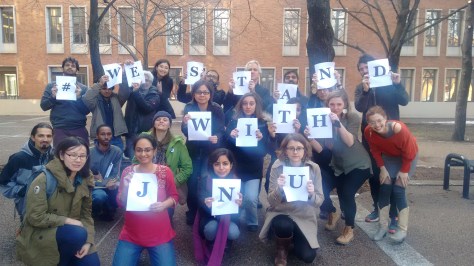
We, the undersigned at the University of Minnesota, strongly condemn the concerted attack on the students, faculty and academic culture of Jawaharlal Nehru University. At the behest of the government, the Delhi police has pressed sedition charges on unnamed students of the university. Reminiscent of the Emergency, the students’ union president Kanhaiya Kumar has been arrested, several students have been suspended and the Delhi police has been hounding students in hostels, homes as well as public spaces in the city. Sections of the mainstream media have launched a vicious campaign to declare JNU an “anti-national” university, and some journalists have gone so far as to spin lies about the “terrorist connections” of student activist Umar Khalid. As a consequence, mob violence against JNU students and faculty has spread across the city and even entered the courtrooms where the case against the JNU students’ union president was being heard. We strongly condemn this hate campaign and demand the immediate release of the JNU students’ union president. We also demand that the suspension of students is revoked and unsubstantiated sedition charges are withdrawn immediately.
Continue reading University of Minnesota Stands in Solidarity with Jawaharlal Nehru University
Sambit Patra Flying the Tricolour on Times Now, in JNU and on Iwo Jima – History Re-Imagined (Once Again) by the BJP
A recent ‘Newshour’ non-debate on Times Now on whether or not an order emanating from the Ministry of Human Resources Development to erect 207 feet high steel flagpoles and giant tricolour flags in Central Universities across India featured a wonderful intervention by Sambit Patra, BJP spokesman and digital magician extraordinaire.
#AssamwithJNU – Thousands take to the Streets in Assam: Bonojit Hussain
Last two days had seen several #AssamWithJNU #JusticeForRohith protests and rallies demanding justice for Rohith Vemula and against the assault on JNU, police crackdown and arrest of JNUSU President Kanhaiya Kumar under the charges of sedition, media trial of Umar Khalid, and the undeclared emergency in the country.
Continue reading #AssamwithJNU – Thousands take to the Streets in Assam: Bonojit Hussain
#StandwithJNU: Solidarity Statement from the Institute for Gender, Race, Sexuality and Social Justice at the University of British Columbia
We, graduate students and faculty at the Institute for Gender, Race, Sexuality and Social Justice and the broader University of British Columbia community stand in absolute and resounding support of the students, faculty, staff and allies at Jawaharlal Nehru University (JNU). We condemn the political and legal clout being exercised by the Indian government in Kanhaiya Kumar’s arrest and subsequent reaction to protests. Not only is Kanhaiya’s arrest erroneous and suspect to begin with, the consequent unraveling of systematic hatred towards these “anti-national” scholars creates an environment where anyone perceived to be against ‘Hindu’-hence-Indian culture is at risk of personal harm meted out by the State.
It is deeply disturbing to note public debate around this on mainstream Indian media and TV news channels. The contention is that universities should not be spaces of political engagement, but of quiet scholarly repose. As students and researchers committed to the principles of transnational social justice, it is distressing to note this attempt to depoliticize the university space by dismissing students as undeserving of their spot for being actively engaged in the future of their country.
To term universities and institutions that foster alternative spaces of being and thinking ‘anti-national’ is commandeering an invective that is untrue and wholly vicious. Moreover, the violence meted out to Kanhaiya as well as journalists at Patiala Court is horrifying, especially noting Delhi police’s inaction and complicity in this, despite tight presence. It is precisely this sort of unprovoked violence by the State apparatus that is undemocratic. It is baffling to note the Delhi police’s apparent inability to track down the people who attacked Kanhaiya, while at the same time it launches a now country-wide witch hunt for another JNU student leader Umar Khalid (who allegedly organized the protest in question), based on completely false Islamophobic allegations.
We believe that universities are sites of active engagement, and using an old colonial remnant that is the sedition charge betrays intent to suppress the voice of a democracy. To hold debates and discussions is not anti-national, even more so when there is overwhelming testimony that Kanhaiya Kumar was not involved in the particular sloganeering for which he was arrested. An active and thriving student body presence is what makes JNU one of Asia’s premiere institutions. It is deeply disappointing to note the efforts by the current government to clamp down on this. It is with rising alarm that we register the chain of events that connect other established institutions like the Film and Television Institute of India (FTII) and the University of Hyderabad (UoH).
UNIVERSITY OF ILLINOIS STANDS WITH JNU
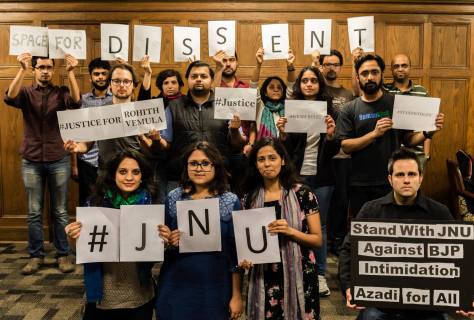
We, the undersigned students, faculty, staff, and other members of the University of Illinois community are in solidarity with students, faculty and staff at Jawaharlal Nehru University (JNU), India, against the ongoing anti-democratic actions by the Indian state. We demand an immediate end to the police action against students on campus, and withdrawal of all charges against Kanhaiya Kumar, President of the JNU Students’ Union. We unequivocally condemn the witch hunting of students, using archaic laws of sedition, who organized the cultural event questioning capital punishment and the deliberate vandalism and violence unleashed by those affiliated with Hindu Nationalist groups. We are also dismayed at the violence used by lawyers aligned with the government in their acts of vigilantism which are aimed at using the garb of patriotism to impose their ideology through violence.
We strongly believe that the charge of sedition against Kanhaiya Kumar, Umar Khalid and the other 6 students are based on spurious evidence. This arrest is an excuse for the state to root out dissenting voices on JNU campus, a move towards converting educational institutions like JNU into an arm of the authoritarian state. Attempts of a similar nature have been witnessed recently at other Indian educational institutions such as Film and Television Institute of India (FTII) and Hyderabad University. The growing threat to academic freedom and the practice of fundamental thinking and critique, posed by the current political climate is transnational, and extends beyond India to other parts of the world–it is a threat we face here in the United States, too.
Mea Culpa, Mea Culpa! : To A Student from CDS
Dear Student from CDS who pasted the posters criticising our collective effort to stand with JNU
I write in response to the views that you expressed on those posters. First of all, let me tell you how much I’d have appreciated if you expressed those views openly right from the beginning, so that we could have had a proper debate. I do wish we stopped scribbling comments on each others’ posters – this is an open campus, and surely, we don’t practice the Sangh Parivar’s intolerance of a contrary opinion. No one, I assure you, will harm you in any way, and I am sure all my fellow teachers, students, and non-teaching staff will join me in assuring you thus.
Continue reading Mea Culpa, Mea Culpa! : To A Student from CDS
ALL INDIA LAWYERS UNION RAJASTHAN STATE COMMITTEE: Solidarity Message to JNU
ALL INDIA LAWYERS UNION RAJASTHAN STATE COMMITTEE
Dated:18.2.2016
SOLIDARITY MESSAGE TO JNU
All India Lawyers Union (AILU), Rajasthan State Unit, strongly condemn the recent incident where individuals in uniform of Advocates misbehaved and assaulted Mr. Kanhaiya Kumar, the president of JNU Students Union, JNU faculties, Media persons on 15.2.2016 when Mr. Kanhaiya Kumar was produced in court before the magistrate is very serious issue and it became vigorous when the incident was repeated after two days, on 17.2.2016 despite of the actions given byHon’ble Supreme Court.
Further the AILU is of the view that the Jawahar Lal Nehru University is one of the institutions in the world where healthy atmosphere is developed over a time to discuss over the national and international issues. The students as well as the faculty members thereof is of the caliber to suggest a visionary and logical culmination, which not only important for individual but also for the nation and humanity as whole. Furthermore, University is a place where new ideas are developed, questions are asked and policies are praised or criticized. If any unwarranted incident is happened in the campus of the university, certainly an action has to be initiated against the responsible individual and for such action the university administration is having sufficient measures to act upon and no police action inside the campus was required at all. If the university authorities failed to take action or has shown its inability to restrict such activity, only then the police force may be used.
As such the police action in the university campus was absolutely unwarranted, unjustified and abuse of power by the state machinery.
Arrest of Mr. Kanhaiya Kumar and other students and treating them like hardcore criminals/terrorists, in the name of sedation without any substantial evidence, is not expected in a civilized society. The crime of sedation was inserted in IPC by the British rule in order to supress anyone who used to speak against the colonial rule. This term ‘sedation’ is obsolete and has no place in a democratic system like ours, especially in the educational institutions, having international reputation. Framing students in the name of sedation is clearly an attack on the fundamental rights, that is, of speech and expression.
Intentional avoidance of the Hon’ble Supreme Court instructions is apparently an act of contempt of court for which stern action has to be taken. AILU strongly suggests to take following actions against the responsible :
(i) Criminal case has to be registered against the advocates or the persons in the advocates’ uniform indulged in assaulting within the court premises;
(ii) Separate proceeding of criminal contempt is to be started against the persons involved in assaulting despite instructions of Supreme Court;
(iii) The police personals deployed at the court campus, in front of whom the act of assault was occurred has to be suspended henceforth and inquiry has to be initiated against them;
(iv) Mr. Om Prakash Sharma, the sitting MLA, who was apparently involved in the assaulting and to instigate others to involve in assaulting, his membership of Legislative Assembly is to be seized, proceeding of criminal contempt is to be initiated against him;
(v) The courts are the place where people come with the deep faith to get justice but such type of incidents not only deprive the people to avail justice but also diminish the belief in rule of law, and therefore, stern action has to be initiated against each and every responsible person whomsoever he is;
(vi) Code of conduct for advocates has to be reviewed and it may be inserted that any advocate, who involves in such incidents occured on 15.2.2016 and 17.02.2016, shall be restricted to appear in court as well as seize their auth of advocacy;
(vii) The magistrate, before whom the repeated disruption of court proceeding was occurred but no action against the responsible advocates/persons was taken, no FIR was lodged, stern action is required to be initiated against him.
The AILU condemn both the incidents, i.e. abuse of power by the police administration in the JNU campus and omission to prevent the assault on the students faculties and media persons in the court room /campus of Patiala House court. Our organization also demands for immediate release of Kanhaiya Kumar, president of JNUSU, so that normalcy can be restored.
(Dr. Vikram Singh Nain)
General Sectretary
General Secretary: Dr. Vikram Singh Nain Advocate Mobile No: +91 9414069959 Office: 0141-2810959 E-mail: nain_vs@yahoo.co.in
President: Sanjay Tyagi Advocate Mobile No.+91 9414048493 +91 9314013492
8, Nagaur Nagar, Nr. Kisaan Dharam Kanta Gopalpura Bye-pass Road, Jaipur-302019
STATEMENT OF SOLIDARITY WITH STUDENT ACTIVISTS IN INDIA: University of Pennsylvania & Philadelphia South Asian Collective
We, activists and academics in the Pennsylvania region, strongly condemn the attack on academic freedom at Jawaharlal Nehru University (JNU), New Delhi. The arrest of Kanhaiya Kumar, the President of the JNU Student’s Union, on charges of sedition has brought to light the intervention of the Union Government in the internal matters of the university. The repeated interference by police personnel at the behest of Vice Chancellors on university campuses is a draconian move. The charges against students were brought after an event organized by a section of students on campus premises to discuss the judicial execution of Afzal Guru. The JNU Students’ Union was subsequently held responsible for the “anti-national” slogans that were chanted by a group of students. We condemn these trumped-up and unconstitutional charges and stand in solidarity with the efforts to repeal capital punishment in India.
The events unfolding at JNU reveal disturbing similarities with instances of government repression on other campuses. We remember, with distress, the actions of the University of Hyderabad (UoH) administration in cahoots with the Central Government, actions that led to the death of a promising Ambedkarite student-activist, Rohith Vemula. The protests that arose indicted the discriminatory atmosphere prevailing in our universities as tantamount to the denial of the fundamental right to education to socially marginalized groups. Further, the murder of social thinkers like Govind Pansare and M.M. Kalburgi by hyper-nationalist elements under the tacit encouragement of the policies of the Central Government has shocked all advocates of free speech in India.
The charges of sedition against students participating in democratic discussion of public events is highly objectionable. The stifling of voices through intimidation and muscle power does not bode well for educational institutions.
Debate and dissent are integral parts of a strong democracy. Universities are critical public spaces that support these democratic practices to realize the values of social justice enshrined in the ideals of the constitution. International campuses like JNU, FTII and UoH bring together diverse group of students in the spirit of self-reflexive and deep intellectual engagement to ask fundamental questions of their social realities. An attack on these institutions is an attack on this precious pedagogical space. Student movements in India in alliance with other social movements in the country have historically been a resilient and sensitive force. The BJP government’s efforts to undermine them is nothing but an assault on Indian democracy. The government has failed to protect the rights of student bodies, and the highhandedness of the police highlights the insecurities of the present government.
In the United States during a presidential election year, we watch increasingly bigoted views against blacks, Muslims, and immigrants gaining ground. These events cannot be seen in isolation and we stand at the intersection of socio-political movements in the US and South Asia.
We stand in solidarity with students and faculty of JNU and demand the immediate release of the detained students. We appeal to all advocates for academic freedom in India and abroad to stand united against this state atrocity.
- Anannya Bohidar, Graduate Student, South Asia Studies, University of Pennsylvania
- Ammel Sharon, Graduate Student, South Asia Studies, University of Pennsylvania
- Meghna Chandra, Philadelphia South Asian Collective
- Ania Loomba, English, University of Pennsylvania
- Projit Mukharji, History and Sociology of Science, University of Pennsylvania
- Najnin Islam, Graduate Student, English, University of Pennsylvania
Solidarity Statement for JNU by IIT Scholars
This is a statement issued by the undersigned, scholars of Departments of Humanities and Social Sciences of IITs across the country.
We, the undersigned, scholars of Departments of Humanities and Social Sciences of IITs across the country, condemn the police action in JNU and the arrest of the JNUSU President Kanhaiya Kumar on the charge of sedition. We also denounce the repeated acts of violence unleashed by some lawyers and others at the Patiala House Court against faculty, students and the media, as well as police inaction regarding the same.
In addition, we appeal for media and public trials to cease and for civil society to instead focus on debating issues in an amicable and reasonable manner, without slandering JNU or questioning the academic integrity or patriotic fervour of JNU and its supporters. We criticise the general atmosphere of fear and intimidation that is being created to target the entire university. Given the fast polarizing political atmosphere in the country, we appeal to the media organisations to display greater responsibility and conduct television debates in such a manner that no prejudicial public opinion is created while there is an ongoing enquiry into the entire episode by the authorities concerned. Resorting to jingoism and sensationalism may cause avoidable hazards. Continue reading Solidarity Statement for JNU by IIT Scholars
#NoDissentNoCOUNTRY #StandWithJNU
As the People’s Republic of Delhi dances to freedom’s song, people from around the world liberate banned speech. Bol Ke Labh Azad Hain Tere!
Divya Cherian, (JNU 2008) Rutgers University
Dora Zhang and Damon Young, University of California, Berkeley
Greta LaFleur, Yale University
A full text of Kanhaiya Kumar’s speech and a video is available here:http://kafila.org/2016/02/15/jnusu-president-kanhaiya-kumars-speech-before-being-arrested/
A complete English Translation may be accessed here: http://www.telegraphindia.com/1160216/jsp/frontpage/story_69576.jsp#.VsMg17R97GL
As The People’s Republic of New Delhi Marches in the Free Air Students of Berkeley #StandWithJNU
As the people of Delhi march, sing, run and dance to freedom’s call, as they cock a snook at the shackles of nationalism, casteism and authoritarian stupidity, a gift of love from afar. Look at them standing in the free air! Look at them standing around a piece of earth unbound from the myopia of nationalism!
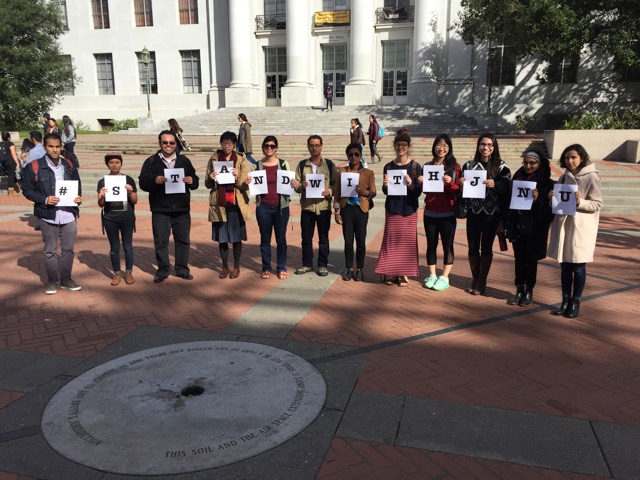
“This soil and the air space extending above it shall not be a part of any nation and shall not be subject to any entity’s jurisdiction,”
At the memorial to the 1964 Free Speech Movement on the campus of University of California, Berkeley, students and faculty stand in love and solidarity with JNU. #standwithJNU
The memorial the 1964 Free Speech Movement at the University of California, Berkeley, like the thing it celebrates, is both invisible and embattled. The monument appears to be a circle of concrete six feet in diameter, in the middle of the famed Sproul Plaza where thousands of students gathered to demand the right to free speech and academic freedom on one of America’s most prominent and celebrated public university campuses. But that monument is so much more than what can be seen. The concrete circle, bearing the inscription “This soil and the air space extending above it shall not be a part of any nation and shall not be subject to any entity’s jurisdiction,” encompasses a 6-inch wide indentation into the ground that reaches into the soil below and 60,000 feet upwards into the sky, to the limits of American airspace. That is, in fact, the monument to free speech at Berkeley: 60,000 feet and 6-inches of invisible insistence that to speak freely is not and cannot be a right granted by any sovereign, mandated by any state. The width of the depression in the ground is as large as a person’s two feet. The ground on which they stand. From which they speak. This is the lasting monument to free speech at Berkeley. From a space as wide as our stance, reaching in an unseeable column of air to the limits of the stratosphere. A monument of air that can never, like free speech itself, be contained, torn down, or granted by another. It lies, unassuming, built as it is out of the immateriality of inalienable rights, in the middle of a campus that grapples daily with the legacy of that now 50 year old fight for the right to claim the space of the university as one of protest, of politics, of resistance.
But Berkeley, we mustn’t forget, exists on occupied territory. Its celebrated monument digs into soil that was taken, without recompense or acknowledgement, from the Ohlone people who were stripped of their lands, their language, their culture, and their lives in what America today celebrates as its great westward expansion. Thus, the monument to free speech at the University of California, Berkeley, roots itself into a soil it claims belongs to no nation and also reifies centuries of the genocide of indigenous people and of settler colonialism. This too is the legacy of the Free Speech Movement. Of the student-led activism that created Ethnic Studies programs across California and the rest of the United States. To stand in the 6-inch wide memorial is to stand in land that is occupied and to nonetheless believe that no occupation, no nation, no state, mandates our ability and our right to speak, to protest, to imagine otherwise the world in which we live.
From Berkeley to JNU. With love and solidarity.
Poulomi Saha
University of California, Berkeley
Modi Govt. Stifles Dissent and Democratic Values – The real aim of the politics of ‘Desh-droh’ and ‘Gaddaar’ : NSI
Guest Post by New Socialist Initiative (NSI)
There is poison in the air. Loud abuses of ‘deshdrohi’, ‘gaddar’, ‘maaro maaro’ are rending the air. Angry men shouting these words have beaten up teachers and students of one of the best known universities in the country in the Patiala House Court of Delhi, barely three kilometers away from the seat of the national government. An elected MLA of the ruling party was part of the team of attackers. Women teachers of the university have publicly said that they were physically harassed by the mob, while the police looked the other way. This happened on 15th February. We can turn a day back.
The Home Minister of the country announced to the world that a protest by a handful of students at the Jawaharlal Nehru University was the handiwork of India’s ‘enemy number one’, Hafez Saeed of Lashkar-E-Taiba. The basis of his claim proved to be a fake tweet within hours. Three days before that, the elected president of JNU students union Mr Kanhaiya Kumar was arrested by Delhi police on charges of sedition, under the same clause of IPC which was used by the colonial rulers against Indian freedom fighters.
Solidarity with JNU and Conversations on Kashmir: JKCCS
Guest Post by Jammu Kashmir Coalition of Civil Society
Jammu Kashmir Coalition of Civil Society (JKCCS) expresses its solidarity with the striking students and teachers of Jawaharlal Nehru University, New Delhi. We have watched with a sense of horror and dismay, the violent criminalizing of student democracy and dissent, not just at Jawaharlal Nehru University but across Indian campuses in the recent past. Having long and intimate knowledge of violent repression and legalized impunity that Indian state is capable of, especially against those it considers ‘anti-national’ we are not surprised by these events, but have a special empathy with all who suffer its horrors. We demand the release of all student dissenters and political prisoners in the custody of the Indian state, and an end to acts of policing and surveillance on campuses, and targeting of students on the basis of political beliefs and speech.
The Kashmiri students in different colleges and universities in India, who have always faced discrimination and intimidation time to time, are now feeling the extreme regressive and oppressive means used by right wing groups and the government. After being hounded, Kashmiri students have begun leaving Delhi. There are several places where the landlords, in whose properties Kashmiri students were renting flats, have asked the students to vacate. These experiences of Kashmiri students are part of the larger reality faced by Kashmiri youth in Jammu and Kashmir and in India. The voices of dissent in Jammu and Kashmir have been dealt with administrative detentions under Public Safety Act, illegal detentions, torture, surveillance and killings by armed forces including the most recent one of Asif and Shaista at Pulwama on 14th of February.
We also view with alarm, the reports about the cynical use of Kashmiri students studying in Delhi as hostages in the politically illegitimate process of government formation in Srinagar.
We are dismayed that the public narrative about the recent events has often descended into disputes over Indian ‘patriotism’ and the shrill condemnation of a few ‘fringe’ ‘radical’ ‘traitors’ for ‘irresponsible’ slogans. These sentiments are neither mere slogans nor represent the ‘fringe’ in Kashmir, the very place they were made in reference to. As Kashmiris, we believe that the right to self-determination is inseparable from the right to political association, dissent and free expression, and these rights cannot be selectively asserted or upheld. In the competitive public proclamations of nationalistic credentials, what has been lost is that courageous act of defiant solidarity with the Kashmiri people’s struggle for justice and self-determination, that lies at the heart of these debates. Despite the disavowals and the state repression, the solidarity with the political rights of the Kashmiris is growing and spreading, as events in Jadavpur University demonstrate. We acknowledge the emerging spaces in Indian civil society to converse on the question of Kashmir, beyond nationalist framings. We hold out hope for future alliances with students, groups and individuals willing to engage in honest conversations, in which they alone do not determine the boundaries of what can or cannot be said, thought or felt.
Spokesperson
JKCCS
“A Glorious Thing Made Up Of Stardust:” What Pat Parker & Rohith Vemula Ask Us to Consider Lata Mani
This is a guest post by LATA MANI
The first thing you do is to forget that I’m black
Second, you must never forget that I’m black
Pat Parker (1978)
In these opening lines of her poem, For the White Person Who Wants to Know How to be My Friend, Pat Parker names a paradox at the heart of challenging socially produced difference. Parker is speaking not to diversity in nature, nor to the diversity of nature. Not to the variations of appearance – size, shade, height, foliage, texture; or mode of expression – hoot, howl, accent, gesture, cultural practices. Her lines address a uniquely human phenomenon: prejudice. They speak to the poignant difficulty of challenging a spurious and malevolent construction of racial difference in a society still in the grip of its miasma.
I have recalled Parker’s lines many times in the days of sorrow, tumult and righteous rage that have followed Rohith Vemula’s suicide. “Rohith Vemula’s suicide.” I am holding off from saying “Dalit scholar Rohith Vemula’s suicide.” Or, as is now being said with good reason, “Dalit scholar Rohith Vemula’s institutional murder.” I defer by a couple of sentences a description of him that refers to the caste into which he was born; to honour if only symbolically his anguish that the contingent facts of his birth had indelibly defined his life.
Solidarity Statement from Writers and Activists in Nepal
We stand with JNU From Nepal
We are deeply concerned by recent developments in one of India’s premier academic institutions, Jawaharlal Nehru University. The fact that Mr. Kanhaiya Kumar, JNUSU president, has been arrested and accused of sedition for a speech meant to promote more meaningful dialogue on civil liberties and freedom to dissent is an attack on the freedom of expression,a universal value which ought to be at the heart of any center of learning.
The Indian state apparatus has come out aggressively to demean and dismiss an institution’s independent practice of scholarship. This should be a cause of concern, not only to the citizens of India, but to each individual who envisions a more equal and just society. Because the impulse to stifle dissent begins incrementally, but then it becomes a barrage, a torrent, and an avalanche until it smothers every differing voice. Such attempts at stifling any voice at all should be condemned unequivocally.
We, the signatories from Nepal as listed below, unequivocally condemn the oppression of dissent at Jawaharlal Nehru University. We condemn in the clearest terms the actions of the Indian state and non-state mechanisms that have shown alarming vigor towards silencing dissent and curbing free speech.
Manjushree Thapa, Writer
Khagendra Sangraula, Writer
CK Lal, Writer
Kishore Nepal, Writer
Hari Roka, Writer/JNU Alumni
Continue reading Solidarity Statement from Writers and Activists in Nepal
#NoDissentNoCountry #StandwithJNU
Bol ke labh azaad hain tere: Speak for your lips are yet free
Partha Chatterjee, Columbia University and CSSS Calcutta
A full Hindi transcript of Kanhaiya Kumar’s speech is available here:http://kafila.org/2016/02/15/jnusu-president-kanhaiya-kumars-speech-before-being-arrested/
A full English translation can be accessed here:http://www.telegraphindia.com/1160216/jsp/frontpage/story_69576.jsp#.VsVc8HQrK8r
#NoDissentNoCOUNTRY #StandwithJNU
Bol ke labh azad hain tere: Speak for your lips are yet free
Eleanor Newbigin, SOAS, University of London
A full Hindi transcript and video of Kanhaiya Kumar’s speech is available here:http://kafila.org/2016/02/15/jnusu-president-kanhaiya-kumars-speech-before-being-arrested/
An English translation can be accessed here: http://www.telegraphindia.com/1160216/jsp/frontpage/story_69576.jsp#.VsVc8HQrK8r
Stand With JNU – SUNY College, Colgate and Syracuse Universities for Academic Freedom in India
Guest Post by Students and Teachers of Syracuse University, Colgate University and SUNY College of Environmental Science and Forestry
We, the undersigned at Syracuse University, Colgate University, and SUNY College of Environmental Science and Forestry, are in solidarity with our comrades at Jawaharlal Nehru University (JNU), India against the ongoing anti-democratic actions by the Indian state. We demand an immediate end to the police action against students on campus, and withdrawal of all charges against Kanhaiya Kumar, President of the JNU Students’ Union. We further demand that the Central Government put an immediate end to its prejudiced persecution of student activists on campuses across the country.
We strongly believe that the charge of sedition against Kanhaiya Kumar follows spurious claims. This arrest is an excuse for the state to root out dissenting voices on JNU campus, a move towards converting educational institutions like JNU into an arm of the authoritarian state. Attempts of a similar nature have been witnessed recently at other Indian educational institutions such as Film and Television Institute of India (FTII) and Hyderabad University. The growing threat to academic freedom posed by the current political climate is transnational, and extends beyond India to other parts of the world–it is a threat we face here in the United States, too.
For any word or action to qualify as being “seditious” under Indian law, it has to directly issue a call to violence. This was not the nature of the protest held by a group of JNU students against the judiciary’s decision regarding Afzal Guru, who was convicted of an attack on the Indian parliament. The peaceful protest held on February 9 on campus was not unlike other protests convened at the university over the last several decades. Dissent is an essential part of a healthy democracy. We therefore strongly condemn the Indian government’s response to the students’ protests and demand that the state refrain from authoritarian behaviour. In this spirit, we urge the Vice Chancellor of JNU to protect members of the university community and safeguard their democratic rights. Continue reading Stand With JNU – SUNY College, Colgate and Syracuse Universities for Academic Freedom in India
A letter to Umar Khalid: Pallavi Paul
Guest Post by Pallavi Paul
Dear Umar,
My name is Pallavi Paul and like you I am a PhD student at JNU.
I write this letter to apologize to you. What thoughts must be crossing your mind and that of your family, friends and comrades- as bloodthirsty, jingoist goons are on a shameless head hunt for you and your friends. I apologize to you for the poverty of imagination of a state that brands you as anti-national, while continues to trample on the rights and bodies of those living within its borders from Pulwama to New Delhi to Hyderabad. I apologize to you that you find yourself in a society where to echo the feelings of thousands of Kashmiris, to think of yourself as first devoted to the idea of justice before any arbitrary construct of the nation, to be moved by suffering, to critique capital punishment – is considered an act of terrorism. In a beautiful post on Facebook your sister lovingly called you a “communist paagal”. I apologize to you that this current oppressive climate is too cramped for your magical madness. The imagination of a beautiful world which has place not only for sangh certified, brahminically privileged, self- affirming ‘Indian-ness’, but for everyone who has found themselves left outside of this fold- the landless, the stateless, those without the protections of caste, class, religion, gender or nation.
What a wonderful name you chose for the event on the 9th of February – Country Without A Post Office. After, one of Agha Shahid Ali’s most haunting works, which references a time in the 1990s when no letters were delivered to Kashmir. There was no way for people to talk to or hear one another. You chose to think about the punishment accorded to Afsal Guru, along with this history. Your efforts to create a conversation, a debate on what it means to take a human life, is today being branded as evidence of your anti-nationalism. I apologize to you for the amnesia and the fragile ego of this country, which is unable to revisit its history without a shred of doubt or criticality. Where the only way to serve the cause of the country is by mouthing its praises and letting it rot in its own status quo and not by bringing to it newer questions, possibilities and challenges.
Many television channels like Times Now, News X, Zee have been ruthless and vicious in trying to establish links between you and terrorist organizations like the Jaish- e- Mohammad. I am sorry that you are living in a country where your name makes it so easy for this connection to be made. While comrade Kanhaiya is still in Police Custody fighting the preposterous charge of sedition, even as I write this to you- he has at the very minimum the assurance that he will not be linked to an Islamist Terrorist Organization. You, dear Umar do not even have that. Even that you are a self proclaimed atheist is not guarantee against prejudiced links being made between the religion you were born into and your political beliefs. That you made a choice outside of religion and the various forms of violence that its fundamentalist interpretations throw up, has been drowned in the noise being whipped up by vigilante, self proclaimed ‘nationalists’.
Like every storm this too will pass. The arrogance of this regime will be its undoing. Today there is a report in the Hindu, where the Central Government has denied receiving any report linking you to terrorist outfits. It is being widely shared on social media with the hashtag #weareumarkhalid. We know that your social media account has been hacked , but be assured that many voices are also rising in your support. I do not know when or whether you will be able to read this letter, but I hope that whenever we meet we will be able to celebrate freedom, justice and the spirit of critique. The seasons will change and the breeze will blow more merrily.
Take care of yourself dear comrade, the struggle is on.
Lal Salaam!
Pallavi Paul is a filmmaker and a PhD candidate at the School of Arts and Aesthetics, Jawaharlal Nehru University.
Break Down the Barriers: Reading Robin T, Bhimrao and the Nation State in JNU
Jai Bhim, Joy Guru, Lal Salaam
Two of the greatest, crazies, most beautiful minds produced by the Indian subcontinent in the Twentieth Century would have been arrested by the police and attacked by the RSS, as ‘Anti-Nationals’, perhaps rightly so, had they been alive today.After all, they never stopped being young.

One of them was tall, you know him – the big guy, with glasses, always dressed to the nines, (no itchy khadi or scratchy khaki would do for him) .

The other had long hair and a beard, and even became a contemporary artist in his old age.
The cops, or thugs-in-law of the RSS might even have said “saala JNU ka lagta hai” (looks like this ***** is from JNU).
So, here they are – Bhimrao Ambedkar (Baba Saheb), and Rabindranath Tagore.
Once again, Jai Bhim, Joy Guru. And pass the ammunition.
Continue reading Break Down the Barriers: Reading Robin T, Bhimrao and the Nation State in JNU
 KAFILA - COLLECTIVE EXPLORATIONS SINCE 2006