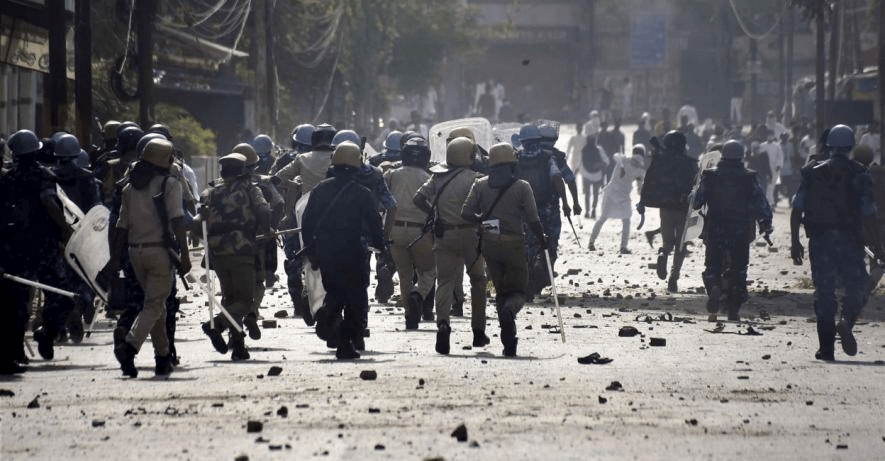
President Rajendra Prasad had written to Sardar Patel, flagging cases of Hindutva activists dressing as Muslims to foment communal trouble. That trend continues.
“…I am told Hindutva activists have a plan of creating trouble. They have got a number of them dressed as Muslims and looking like Muslims who are to create trouble with the Hindus by attacking them.. …The result of this kind of trouble amongst the Hindus and Muslims will be to create a conflagration.’’
[Extracts of a letter, written by Dr Rajendra Prasad on March 14, 1948, cited in Nehru-Patel: Agreement within Differences, Select Documents and Correspondence, edited by Neerja Singh, Page 43]
‘How Hindutva activists plan to foment communal trouble?’
It was the year 1948 and Dr Rajendra Prasad, who later became the first President of India, wrote a letter to the first Home Minister of independent India, Sardar Vallabhbhai Patel, about the plan of Hindutva activists to foment trouble in the newly independent country. As per reports that he had received from different sources, Prasad wrote how these Hindutva supremacists get dressed up as Muslims and ‘looking like Muslims’ create trouble with Hindus by attacking them.’
Much time has passed since the time letter was written, but every now and then, this template, created and developed by Hindutva Supremacist formations during the Partition violence and later, is active with the aim to communalise and polarise the society further. [ Read the full article here : https://www.newsclick.in/all-india-plan-underway-foment-communal-conflicts]
I am writing to you about the dire situation in Kerala with reference to the strike of the Kerala ASHA Health Workers’ Association for minimum wages and a five-lakh one-time retirement benefits, which has been continuing since the past two months.
[The following post by writer Sadique Hossain highlights the way in which with approaching state elections, Bengal’s Muslims are being increasing forced into silence, as contending political parties, especially the CPI(M) and the TMC, stake out their respective agendas. While the stance of all parties is telling, that of the Left is particularly myopic, argues Hossian. AN ]
2026-এ পশ্চিমবঙ্গে বিধান সভার নির্বাচন হতে চলেছে৷ বাকি প্রায় দশ মাস৷ কিন্তু এখন থেকেই মুখ্য দলগুলো তাদের ন্যারেটিভ কী হতে পারে – তা প্রায় স্পষ্ট করে দিয়েছে৷ তারা দৃশ্যত রমজান মাসটিকেই বেছে নিয়েছিল ভোটের দামামা বাজানোর কাজে৷
ইদের কিছুদিন আগে সেটা শুরু হল বিজেপির বিধায়ক শুভেন্দু অধিকারীকে দিয়ে৷ তিনি বিধানসভার বাইরে ঘোষণা করলেন – বিজেপি ক্ষমতায় এলে তৃণমূল থেকে নির্বাচিত মুসলিম বিধায়কদের চ্যাঙদোলা করে রাস্তায় ছুঁড়ে ফেলবেন৷ তাঁর বক্তব্য ধ্বনিত হতে থাকল বিজেপির অন্যান্য বিধায়কদের গলাতেও৷ ইদের পরেই রামনবমী ছিল৷ মাঝখানে ওয়াকফ বিল পাশ হয়ে গেল লোকসভা আর রাজ্যসভাতেও৷ এরমধ্যে তৃণমূলের হুমায়ুন কবীর শুভেন্দুর কথার প্রেক্ষিতে বললেন শুভেন্দুকে মুর্শিদাবাদে ঢুকতে দেওয়া হবে না৷ এমনকি জোর করে মুর্শিদাবাদে ঢুকতে এলে, দাঙ্গা বাধাতে এলে ভাগীরথের জলে ভাসিয়ে দেওয়া হবে৷ এক্ষেত্রে তৃণমূল অবশ্য তাঁকে থামাতে দেরি করল না৷ শো-কজ করা হল৷ এবং হুমায়ুন কবীর প্রথমদিকে ফোঁসফোঁস করলেও পরবর্তীতে চুপ করে গেলেন৷
There is a huge difference between democratic struggles outside Kerala, and those which unfold inside the state at the moment. While elsewhere they strive to make democracy integral to the system, in Kerala we are struggling desperately to keep alive, at least, the traces of something that we had, a fairly democratised society and a tolerably responsive state.
Land forms one of the most important planks of private property, because the appropriation of land (or ‘soil’ if one is to follow Karl Marx’s usage) forms the core of capitalist development, and since capitalism cannot sustain without the creation of class antagonisms and the appropriation of productive capacities of workers,[1] capital further uses the appropriation of land as a tool to exploit the non-capitalist classes. This results in the gradual separation of the worker from nature and thus eventually from the society itself, resulting in a state of alienation, which is used to create a ‘certain quantity of labour stocked and stored up’.[2] This stocked up/stored-up labour, as Marx explains, becomes capital. The relationship between manufacturing – the foundation of industrial capitalism – and nature – reflected in Marx’s usage of ‘soil’ – was an integral part of Marx’s definition of ‘capital’ under advanced capitalism. For example, in the discussion on ‘Bonds, or stock’, Marx had quite explicitly put up the relationship that capitalist development shares with the ecological world: ‘Bonds, or stock, is any accumulation of the products of the soil or of manufacture. [This] Stock is only called capital when it yields its owner a revenue or profit’.[3] The struggle for ecological justice thus constitutes an important aspect of the broader social justice movement because land relations constitute an integral part of the social relations, which in turn constitute the basis of not only capital but also the working class itself.[4] It is interesting to view the recent agitation against the auctioning of land within the campus of the University of Hyderabad (UOH), or the Hyderabad Central University (HCU), surrounding the proposed construction of IT parks by deforesting the Kancha Gachibowli Forest (KGF) in this context.
Kshama Sawant honoured in absentia by Canadian Radio station for standing up against caste-based oppression. Former Seattle City Councillor was presented with the annual Hands Against Racism award by Spice Radio at a well-attended event in Surrey on Sunday, March 30. Born and raised in India, Kshama Sawant was instrumental behind the historic anti-caste ordinance brought by the City of Seattle in 2023. Since then, she has been under attack from supporters of the right-wing Hindu nationalist Modi government in New Delhi. For doing that she had to pay a heavy price, as the Indian government denied her visa and an opportunity to go and see her ailing mother in Bengaluru. Sawant couldn’t make it to the event organized at Surrey City Hall, due to the current tensions between Canada and US caused by the trade war. Spice Radio broadcaster and her vocal supporter Gurpreet Singh accepted the award on her behalf. He earlier introduced her before her video message was played. In her greetings, Sawant revealed that because of the hostile political environment, including ongoing arrests of pro-Palestine activists in the US, especially those who are naturalized American citizens like her, she had been advised not to travel outside the country. However, she pulled no punches in criticising the Liberals and Democrats on either side of the border for their complacency and opportunism, enabling the extreme right wing forces to grow powerful. Her speech received a huge applause from the audience. Spice Radio CEO Shushma Datt started the campaign in 2015, on the birth anniversary of Martin Luther King Jr. It coincides with Holi, a Hindu festival of colours, and encourages participants to colour their hands and leave a palm print on a white sheet of paper with a message against racism. A practicing Hindu herself, she believes in diversity and inclusion and greeted everyone Happy Eid at the Sunday program. Every year, individuals are also shortlisted and awarded for their anti-racism work as part of this initiative. This year Sawant and Bob Rennie were honoured. Rennie is a famous art collector and a strong advocate against xenophobia and homophobia, besides gender discrimination. The very first recipient of the award, Senator Baltej Singh Dhillon, who served as the first turbaned Sikh Royal Canadian Police officer and faced racism from within the force, was also present and addressed the gathering. Other past recipients also spoke on the occasion, including Attorney General Niki Sharma, anti-racism educator Annie Ohana and prominent journalist Charlie Smith.
We write to you out of serious concern about the precarity of the lives of the Kerala ASHA workers on strike and the hostility shown to them by the elected government of Kerala. The ASHA workers’ strike has entered its 50th day and the twelfth day of their indefinite hunger strike. Hundreds of workers are outside the Secretariat building striking for the demands to be heard by the left-led State government, braving the heat stress, sporadic thundershowers, and the humiliation from the government and mainstream party workers.
They have been ridiculed and accused of being puppets of the “fascist, fundamentalist” right-wing trying to jeopardize the elections in 2026. Their backing from SUCI and AIDSO has provoked mainstream left politicians and intellectuals even further, accusing them of being too radical to understand the need to be united at this time. Yet the CPM and its allied organizations, unions have declared unconditional support to ASHA and Anganwadi workers in other states, declaring a nation-wide strike on 20 May.
We reject this apathy and accusations against the workers on strike. We also request that you sign-on to this petition to be submitted to the Chief Minister’s Office as a testament to the broader support that the workers have from the public and civil society in Kerala and across the country.
Please sign the petition for the workers demands to be accepted by the Kerala State Government and circulate this in your networks.
I read your post. It is hard to describe the rage that I felt at the colourist dismissal of your work that you called out. As someone who has closely observed your admirable work of saving Kerala ‘s Kudumbashree network meant for the support of the underprivileged from deteriorating into a bunch of crumb-seeking women, I can only say that the comment was also probably driven by sheer envy, and not just shallow thinking. It may be true that your efforts did not fructify everywhere. It is also true that much has regressed, but some aspects continue to endure despite determined push from the political class. No one can deny your exemplary achievements, rare among civil servants.
Indian federalism is on the verge of breakdown for multiple reasons. A crucial contributor is the collapse of the system of revenue sharing between the Centre and the States and the weaponization of vertical transfers as an instrument for political contestation.
The conflict over resources in India’s quasi-federal political structure is by no means new. Framers of the Constitution, who recognised that the division of taxation rights and spending responsibilities between the two principal tiers of government in India was asymmetrical, sought to partially resolve this problem by providing for a share for the States in a defined set of tax revenues garnered by the Centre, with the principles governing the share devolved and distributed to individual States recommended by successive Finance Commissions. But State governments have been increasingly disappointed with the actual experience with devolution, because of the concentration of resources mobilised in the hands of the Centre.
The issue, however, is not one of mere competition for resources between the Centre and the states. Having gained control over the Lok Sabha, the BJP has made it clear that it is keen on establishing an opposition-free political space. To realise this objective, it has not only sought to undermine the legitimacy of individual opposition politicians with charges of corruption or “anti-national” activity, but of opposition-ruled State governments by eroding their ability to adopt economic policy measures and initiatives that could win them political legitimacy. Expenditures on building State infrastructure or social expenditures on subsidised food provision, a modicum of social protection, and employment guarantee schemes, do contribute to winning a party in power in a State a degree of political legitimacy. The attack on the fiscal capacity of the State governments helps limit such expenditures, even while Central claims on expanding infrastructural investments and social sector spending are advanced, with an increase in ‘central’ schemes, especially those attributed to the patronage of the highest authority, the Prime Minister.
Speaker :
Prof C P Chandrasekhar
Prof C. P. Chandrasekhar is emeritus professor at the Centre for Economic Studies and Planning, Jawaharlal Nehru University (JNU), New Delhi. He has published widely in academic journals and is the coauthor of Crisis as Conquest: Learning from East Asia (2021, Orient Longman), When Governments Fail – A Pandemic and Its Aftermath (with Jayati Ghosh et al) , 2021 ; Interpreting the World to Change It – Essays for Prabhat Patnaik (with Jayati Ghosh), 2018 ; After Crisis : Adjustment, Recovery and Fragility in East Asia ( with Jayati Ghosh) 2009 ; The Market that Failed: Neo-Liberal Economic Reforms in India (2002, Leftword Books), and
He received his MA and Ph.D (economics) from Jawaharlal Nehru University, where he served as a professor from 1997 until his retirement. He is a member of the executive committee at International Development Economics Associates (IDEAs) and the World Economics Association, as well as a contributor to Frontline, Economic and Political Weekly, and Businessline.
Chandrasekhar received the Malcolm Adiseshaiah Award for 2009 for contributions to economics and development studies.
[This is my translation of the statement issued by Kerala’s People’s science /development movement, the Kerala Sastra Sahitya Parishat, about the ASHA workers’ strike, which is now in its forty-fourth day.]
The ASHA workers of Kerala have been on strike since forty-two day now, engaged in seeking an increase in honoraria and other benefits. The issue continues to remain unresolved. The ASHA workers comprise a sector in which 26,000 workers currently work. They are all women, attached to a Central scheme, and receive merely Rs 7000 per month as honorarium. For this reason, it is the duty of both Central and State governments to consider their demands in a democratic fashion and respond with sympathy. The very many struggles unfolding among Accredited Social Health Activists now must be developed into a people’s struggle against globalized economic policies, and the issue of their wage must be settled with Central and State governments working together. What we see in the ASHA workers’ struggle in Kerala is the crisis and tension emerging from the one-sided and top-down imposition of globalizing tendencies upon a society that had grown and developed within the framework of a welfarist state.
Kerala’s public health sector was well-coordinated and accessible to all since a very long time. It is marked by a pro-poor orientation. A large network of health experts and professionals, from doctors to public health nurses, work in it. They are all appointed officially and formally, and are regarded as workers and employees. Therefore, their remuneration and conditions of work are well-defined according to existing rules and laws.
The ASHA workers’ strike in Kerala is in the forty-third day today. It is the fifth day of their hunger strike — three women have been on hunger strike since the failure of talks with the government last week. Today, they have called for a mass hunger-strike at the protest site. ASHA workers who stand with the strike but are not able to reach Thiruvananthapuram have been requested to wear black at their workplaces and homes. The KAHWA has issued an open call to all women in Kerala to wear black and post pictures supporting the strike.
After the undeniably successful six-hour blockade of the Kerala State Secretariat in Thiruvananthapuram today, the ASHA workers’ struggle for fair remuneration and humane working conditions enters another phase. The whole morning today when more than a thousand workers blocked the main thoroughfare in front of the Secretariat, the heat was unbearable. Eight workers collapsed and had to be hospitalised. At noon, clouds gathered and there were heavy downpours. The workers persisted with umbrellas and holding tarpaulin sheets over their heads. More than eight hundred police personnel were deployed — almost the same numbers as the protestors, some said. TV channels interviewed the protestors non-stop — each and every worker said with unambiguous determination that they intended to return home only after their demands were met.
ASHA workers on strike for the twenty eighth day, sleeping in front of the State Secretariat in Thiruvananthapuram.
Happy Women’s Day from Kerala, the Land of Women’s Empowerment!!
On this day, true to the fighting spirit of the women workers who fought valiantly for their rights and who faced the tyrant’s bullets fearlessly, Kerala’s COVID-warriors, our ASHA workers, sleep on the rain-soaked pavement in front of the State Secretariat in the capital city of Kerala.
Happy Women’s Day, Pinarayi Vijayan and Veena George. You must getting ready for the day refreshed by sleep in your soft beds, in the mansions that we the citizens of Kerala have funded for the comfort of our rulers.
Happy Women’s Day, Com. Thomas Isaac. Yes, you wouldn’t have been so famous the world over, if not for ‘women’s empowerment’ and the whole local-level development jingbang! See how empowered they are now. I am sure you must be happy now.
Happy Women’s Day, all of you in the CPM who have fattened on the achievements of women development workers — T N Seema and others — and the CPM hanger-ons who have managed a ‘feminist look’. Those women have learned to resist power, what a shame! I can imagine you rolling your kohl-lined eyes, frown-lines creasing those big red bindis on your foreheads . Those who set out to empower Kerala’s poorest women are now truly EM-powered. What an interesting and convenient twist!
Happy Women’s Day to Kerala’s ‘development movement’, the Kerala Sastra Sahitya Parishat! But I did not know that a people’s science movement went into mauna vratas, en masse. There can be no other explanations for their stunning silence, for all their concern about Kerala’s local-level development and public health.
Happy Women’s Day, feminist development experts who have all got nice shares of glory, along with other resources, from the Kerala government’s propaganda upholding its commitment to women’s empowerment … you who have not bothered to utter a single word despite seeing this rank injustice unfold … Private expressions of shock are useless, you know?
The Kerala government’s mulish refusal to negotiate with the striking ASHA workers is baffling no matter what angle you may think of it. The promise of raising the ASHA workers’ daily pay to Rs 700 was an LDF election promise, part of the election manifesto — how can they call it unreasonable now? Raising the pay of ASHA workers would bring back to the well-feeling of twenty six thousand grassroots workers who are well-respected in their communities, but the CPM leadership does not bother, and the CITU studs seem determined to piss them off. In the legislative assembly, Veena George reels off breathtakingly false information, when anyone with access to the official website of the Sikkim government can read government orders that expose her.
But civil society now sees the hubris and expressions of support and anguish at the government’s apparent lack of grace and respect for life -saving labour are pouring in. I am posting here a particularly striking one, a poem by the well-known poet in Malayalam, Desamangalam Ramakrishnan. Aasha in Malayalam means a fervent wish; it also means hope. In this short poem, the poet uses the word to evoke a feeling for the crisis we Malayalis face — of hope in a system, that once swore by the values of care and social justice, intertwining it with the government’s deliberate cruelty to the striking workers. The poem is titled Aashaikku vakayundo?
Any chance of aasha?
Desamangalam Ramakrishnan
Any aasha? – is there any hope left, ask the mothers who wait with handfuls to line the pockets outside the hospital’s operation theatre.
Harassed travellers, waiting endlessly till the middle of the night ask: Any aasha left? Any hope that a bus, any bus, might come?
Any aasha, hope?
Caring-women, bringers of food, water, comfort, tell those who wait in terror, locked down at home: do not abandon hope, do not give up your aasha even if an elephant pins you on its tusk…
Any hope? Through steep and narrow paths the caring-women run, to knock on the door of a piteous scream and drive away the sickness with love. They say: abandon not your aasha; be not bereft of aasha, let the humble shoots of hope sprout.
Is there hope, is there aasha? Though it’s just a few paltry coins, when will it fill the waist-folds of one’s dignity and pride?
When it writhes its last writhing on the door step of the king of the land who tied its tongue and left it to beg, our pottan theyyams, oracles, leveller-spirits, will break their chains, swarm out of cellars, surely.
Or, has Power turned the one who once sprinted through these paths holding aloft the flag woven from the threads of our blood, into a mad brute?
The nauseatingly patriarchal attack by the CITU State Secretary K N Gopinath on the striking ASHA workers sets a new low, but it is not unexpected. K N Gopinath’s ugly, sexually-coloured remark was about the BJP MP Suresh Gopi’s visit to the protest site. After the police pulled down the did not allow the tarpaulin shelters, the striking workers continued the strike in the pouring rain. The MP distributed umbrellas to the workers. Gopinath said that he knew that the MP distributed umbrellas, but he did not know if “he distributed kisses” there. When questioned, he admitted that the reference was to a sexual harassment complaint against the MP. The man kept defending his offensive remark, in his own admittance a sexually-coloured one, even when questioned strongly by journalists.
How Hindutva Supremacists are engaged in ‘rewriting history’.
‘There are times when madness reigns
And then it is the best who hang’
– Albrecht Haushoffer
[January 7, 1903 – April 23, 1945, German geographer, diplomat, author, who faced martyrdom for his resistance to Nazism]
Uday Bhembre, the 87-year-old widely respected Konkani writer, son of legendary freedom fighter Laxmikant Bhembre, who has been a Sahitya Akademi awardee, is a worried man these days.
He has discovered to his dismay that his courage to speak the truth and challenge a narrative being peddled by the ruling dispensation in Goa, .. regarding well established facts of Goa’s own history, would lead to protests, led by Right-wing formations and many among them trespassing his house at night and pressuring him to issue an public apology.
Not very many people outside Goa know how this great writer – he was even a MLA (1984-89) — had neglected his literary career to fight for rights of Konkani language and has been against attempts to merge Goa into Maharashtra, to preserve its culture.
Thanks to the existence of powerful voices of resistance and a vibrant civil society in Goa, a significant number of people have publicly condemned these attempts to intimidate Bhembre and demanded strict action against the perpetrators and exposed the collusion of the Right-wing formations with people in power. Many even went to meet the noted writer to express solidarity with him. ( Read the full article here :https://www.newsclick.in/goa-who-fears-truth)
As the ASHA workers’ strike continues today despite pouring rain today, they have been subjected to a new line of attack. The BJP MP, Suresh Gopi, visited the protest site the other day. Nothing earth-shaking happened. No grand announcements of benefits were made; the striking workers did not hesitate to signal to him that he was speaking from a position of power, and hence the words offered were not enough.
The COVID-19 pandemic brought home that everything of value, beginning from the very regeneration of life, is entirely dependent upon human labour in all its diverse, productive and reproductive forms. Yet, this life-making regenerative labour is pegged at the lowest level when it comes to recognition, rights, entitlements, and status in the labour market. While this is a no-brainer when it comes to governments committed to capitalism that rely on women’s unpaid/partially paid labour to drive development schemes, one wonders how the government of Kerala, committed to a more egalitarian political economy, unleashes violence of such magnitude on grassroot women workers.
As the ASHA workers’ resolve continues to remain unbroken in the third week of their struggle, the CITU leadership in general and the CPM cyber spokesmen in particular are losing their cool completely. S Mini is a familiar figure to people in Thiruvananthapuram in the many battles for justice that we have witnesses over the past twenty years . She is among the few women in Kerala who have embraced a full public life without desire for power, status, or visibility. The organisation she is part of, the SUCI, has long suffered ridicule. The big bully of left politics in Kerala, the CPM, has long tried to pick on them. Like all bullies, the latter keeps talking of how small they are.
The Indian Community Activists Network (ICAN) extends it unwavering support to the striking ASHA workers led by the Kerala ASHA Health Workers Association (KAHWA).
ASHA workers, at the grassroots level, are the main workforce of the public health sector. However, the succeeding governments at the Centre and states have always refused to recognise their immense value to the poor and needy in the rural India. They serve village folk and carry the health messages to the doorsteps of every household.
Despite their great service they are the lowest paid employees who are euphemistically known as volunteer-workers. Using this title, the government has abandoned its responsibility to pay them a decent salary. We are dismayed to note that the situation is no better in a state like Kerala ruled by LDF which boasts of speaking for the poor.
Friends, your demand to raise your remuneration up to Rs. 21,000 is just in view of the minimum wage Rs. 18,000 of an unskilled industrial worker approved by the government. ICAN hopes that the LDF government sees merit in all five demands raised by you and act in a reasonable manner by accepting them. We are confident of your success.
Kerala’s public health system, the pride of the state, stands on the labours of many groups of people who are neither paid well nor recognized enough. The ASHA workers form one such important group who reach out to Kerala’ those sections of the lower middle class and the poor sections who cannot afford expensive private care. They are our vital health support structure in the event of pandemics and natural disasters, too. In Kerala, in the past decade we have known at least in two moments of crisis – the floods of 2018 and the pandemic – how crucial this force is in containing disease and keeping up the morale of people even in the remotest locations. As Kerala’s public health system gears up for further challenges, the workloads of these workers will only increase; the current workloads they carry, of carrying out numerous health surveys is already huge indeed.