We, the undersigned, unequivocally condemn the unwarranted attacks against Prof. Nivedita Menon by Zee News and IBN 7 and Mr. Gauhar Raza by Zee News. Prof. Menon is an acclaimed political scientist and writer whose work and integrity are respected all over the world. Her contributions to the women’s movement and gender justice through her writing and participation have been very significant. Mr. Raza is a reputed scientist, poet and filmmaker, who has worked in a sustained way for peace and amity. The two channels have engaged in irresponsible and unethical attacks based on video clips taken out of context, creating an atmosphere of threat, intimidation and incitement to violence. Three false cases have been filed against Prof. Menon in this media-created environment of shrill jingoism. We request the Press Council of India and the Broadcast Association to take necessary action against these channels for their unacceptable and unlawful reportage. We also demand that the two channels issue a public apology for their relentless and defamatory attacks against Prof. Menon and Mr. Raza.
Manu Joseph’s latest commentary regarding the ongoing crisis in Jawaharlal Nehru University (JNU) and the larger debate on Indian ‘nationalism’ smacks of crass elitism, as a journalist pithily pointed out online. If one were to use a ‘different term’, as Joseph himself keeps venturing to do in his writing, it is simply nauseating. This is for several reasons. To begin with, he harbours a convoluted understanding of what research in higher educational institutes entails, the nature of student politics, the lasting dangers of right wing assaults, and the pathetic misrepresentation carried out by the media, including himself, of the pressing issues in this country. Continue reading Of False Binaries and ‘Dirty’ Politics: Divya Kannan→
[An edited version of this post has been published in Scroll.in with a more extensive set of links. I recommend reading it here.]
Sudhir Chaudhary of Zee News has been spewing venom at students and teachers of JNU for some time now, and I have been informed by concerned friends that over the last two days there has been a concerted campaign against me personally. Since I do not watch “news” on a channel that brazenly doctors videos and seems ignorant of minimum levels of journalistic ethics, I am relying on links sent to me by well wishers.
Last evening I believe a clip from a video made in 2014 was circulated, in which I am heard saying that Hinduism is the world’s most violent religion, because its very foundation is the caste system.
I am told that Sudhir Chaudhary challenged me to prove the video was doctored. I am certainly not going to engage with an alleged criminal extortionist (more about his pleasant antecedents in a bit), but here let me say that the clip I have seen circulating on twitter which I assume is the one on Zee, is not doctored, but it is massively decontextualized. I post below the link to the entire event – which was not a classroom lecture, but a political meeting organized by a student group in 2014 after the Kiss of Love protest was attacked in Delhi by Sanghis.
The Supreme Court has time and again emphasized the significance of adducing reasons while rendering administrative and judicial orders. Indeed, a reasoned opinion is arguably the fullest expression of the principle of audialterampartem and is a sine quo non in the dispensation of justice. It appears, one might argue, that the Delhi High Court (hereinafter ‘Court’) in its order granting interim bail to Kanhaiya seems to have taken the dictate of the Supreme Court rather earnestly in what was, needless to say, a very ‘detailed’ and ‘incisive’ analysis of the bail application.
While poetic prose is neither repugnant nor unknown to our Court’s jurisprudence, and the present order is yet another captivating addition to that, it is when prose and poesy subsumes legal reasoning, one begins to wonder whether the rule of law would be better served without it. It is more worrisome however, when the judiciary sidesteps its role from enforcing a strict interpretation of criminal law in an attempt at articulating its own perceived sense of nationalism, loyalty and allegiance, wholly divorced from the Constitution and the laws.
[ Here are five joyous excerpts of recordings from a recent night on the JNU campus – after Kanhaiya Kumar came back – recorded by a young person called Veer Vikram. We do not know who Veer Vikram is, but came across his Youtube Channel, and were struck by the raw freshness of the voices and of the footage. So we are sharing them with you, saluting the generosity of Veer Vikram, who recorded these and uploaded them on to Youtube for everyone to enjoy. May there be many long nights of joy, music, dancing and poetry – in campuses, factories and neighborhoods – everywhere Think so what a beautiful sight a ‘vishaal jan jagaran’ (as distinct from a ‘bhagawati’ jagaran) can make in different corners of Delhi, and in every city and town where young people can no longer take the rubbish offered by TV channels and the Modi regime. The revolution will be danced, sang, dreamt, recorded, uploaded, downloaded, shared and enjoyed. No more words necessary ]
In response to JNUSU’s call for observing 2nd March as International Day of Protest and to demand justice for Rohith Vemula and the release of the then three arrested students, numerous organisations decided to gather outside Dadar station (E) and carry out a peaceful protest. Among them were All India Students’ Association (AISA), All India Students’ Federation (AISF), Students’ Federation of India (SFI), Democratic Youth Federation of India (DYFI), All India Youth Federation (AIYF), University Committee for Democracy and Equality (UCDE) and others. The protest was supposed to begin at 5pm. Continue reading Encounters With the State and Other Comedies: Asmit Pathare→
Kanhaiya Kumar, the president of the Jawaharlal Nehru University Student Union (JNUSU) in New Delhi, India, was arrested on Feb 10 on charges of sedition and criminal conspiracy. Kanhaiya was present at a meeting on the evening of Feb 9, where incendiary slogans were allegedly raised. Seven other students were also charged. Mr. Kumar is not accused of raising the slogans; indeed the identity of the person(s) who raised the slogans remains a mystery. Charging a student leader for sedition for another’s mere sloganeering is prima facie absurd. Further, the assault of Mr. Kumar, other students and faculty, and even journalists, in court premises by lawyers and others sympathetic to the government, do not inspire confidence in a fair judicial process. Continue reading St Louis Universities Stand With JNU: A Statement→
There has been a lot of talk about what exactly ‘Azadi’ (freedom) means, especially in the wake of Kanhaiya Kumar’s post release midnight speech at JNU on the 4th of March. So lets talk some more. No harm talking. If there is noise, there must also be a signal, somewhere.
Kanhaiya Kumar clarified in his electrifying, riveting speech that his evocation of Azadi was a call for freedom ‘in’ India, not a demand, or even an endorsement of a demand for freedom ‘from’ India.
This may come as a sigh of relief to some, – Kanhaiya , the man of the moment, proves his ‘good’ patriotic credentials, leading to an airing of the by now familiar ‘good nationalist vs. bad nationalist’ trope. And everyone on television loves a nationalist, some love a good nationalist even more.
[ P.S. : Since writing this last night, a more careful reading of the bail order has suggested to me that the actual terms of bail are not so bad after all. Bail is in fact granted, as far as I can see, fairly unconditionally. Kanhaiya is not asked, for instance, to step down from his position in the students’ union, nor are restrictions placed on his movement and activity. So in technically legal sense, the bail provisions need not be interpreted in a tightly restricted manner. The egregious political hortations, the references to infection, antibiotics, amputation and gangrene, which are over and above the legal instructions, are indeed terrible, but operationally, they have no executive authority backing them.]
But to say just that the text of the bail order is what shaped Kanhaiya’s midnight speech would be ungenerous, and miserly, especially in response to the palpably real passion that someone like Kanhaiya has for a better world, and for a better future for the country he lives and believes in. I have no doubt about the fact that coming as he does from the most moderate section of the Indian Left (the CPI – well known for their long term affection for the ‘national bourgeoisie’ despite the national bourgeouisie’s long term indifference/indulgence towards them), Kanhaiya is a genuine populist nationalist patriot [I have corrected ‘nationalist’ to ‘patriot’ here in response to the criticism and suggestion held out by Virat Mehta’s comment – see below in the comments section] and a democrat moulded as he says, equally by Bhagat Singh and Dr. Ambedkar. There is a lot to admire in that vision, even in partial disagreement. And while some may not necessarily share his nationalism, this does not mean that one has to treat it with contempt either. I certainly don’t.
Salute! Jai Bhim! Laal salam! We will win this war against sedition! March 3rd, International Sex Workers Rights Day, Zindabad!
We write from the sex worker’s rights movement to hail your struggle and to add to the discourse you have sparked. We would like to discuss why using the term sex worker in the alleged pamphlet in JNU on Mahishasura Martydom Day is a concept fraught with the Whore Stigma. The use of the politically correct sex worker instead of the commonly used `prostitute’ does not take away from the fact that it is used to depict an insalubrious deed. The use of this term has only led to more misunderstandings of the term itself.
Sex worker is the term used by the sex worker’s rights movement in order to claim dignity to the work adults do consensually by providing sexual services for money. The sex workers use this term to give dignity to those that exchange sexual services for money but the use here is to supposedly strip the `goddess’ in this instance, of any dignity. The term since then has taken a life of its own. From a politically correct term it is now being used to describe anti-nationals, anti-goddesses even anti- patriarchy! But the thinly veiled contempt for the sex worker is huge in every utterance, from the Hindu Goddess Durga to the `anti-national’ women students in JNU.Continue reading Sex workers demand Azadi from ‘Goddess’ Durga: Veshya Anyay Mutki Parishad, Muskan and Sangram→
A petition, signed by 132 “academics” asking Rohan Murty and Narayan Murthy to dismiss Prof Sheldon Pollock from his role as Editor of the Murty Classical Library Series, is receiving attention that the signatories did not anticipate. I put the word “academics” in quotes because the commitment of the signatories to an academic evaluation of Sheldon Pollock’s intellectual leadership is nowhere in evidence, since a quotation from Pollock was changed mid-way through the signature campaign. Nor does it seem as if the signatories have ever held any one of the hot- pink, beautifully produced volumes in their hands, where as much attention has been paid to looks and fonts, as to the quality of translations.
Had they done so, they too would have appreciated the significance of this effort, in bringing to the wider reading public the oceans of literary texts and traditions, in a mind-boggling array of languages, from a period covering two and a half millenia. The individual translators and editors are among the best in the field. Thanks to this series, so many more Indians and others will learn of the sheer beauty and anguish of Punna, a Therigatha poet (translated from Pali, 3rd century BCE). People of the south will hear the voice of Bulle Shah, translated from Punjabi, and those from other parts of India will read Allasani Peddanna, translated from Telugu. True we will miss the mellifluous chanting, or the energetic sounds of performance: for now, we will have to make do with the books on hand. Continue reading A historian’s response to the petition against Sheldon Pollock: Janaki Nair→
For the third time within a span of two weeks since the middle of February, thousands of people came out on the streets of Delhi to express their solidarity with the detained students of JNU (Kanhaiya Kumar, Umar Khalid and Anirban) and to voice their anger with the venal Modi regime.
Protest demonstrations (at least in northern India) tend to have something of the monotonous in them, the same cadence, the same rhythm and the same wailing, complaining tone. They tend to have an air of events staged by the defeated, for the defeated. But if we take the last three big protests in the city, and the many gatherings in JNU in the last two weeks or so, as any indicator of what the pulse of our time is, we will have to agree that there has been a qualitative transformation in the language, vocabulary and affect of protests. This afternoon, like the afternoon of the 18th (the first big JNU solidarity march), and of the 23rd of February (the Justice for Rohith Vemula March), was as much about the joy of togetherness and friendship as it was about rage and anger.
Submission by Concerned Teachers and Academics before the Roopanwal Judicial Commission at Hyderabad
(The Roopanwal Commission came to Hyderabad on 23-25th February to enquire into the facts and circumstances leading to the suicide of Dalit research scholar Rohith Vemula. The mandate of the Commission was to review the functioning of existing grievance redressal mechanisms in the university. Concerned with the absence of in-house redressal mechanisms for marginalized students, a joint submission was made by 88 concerned teachers drawn from the state and central universities in Hyderabad. The Submission sought for a rigorous implementation of the 2012 UGC Regulation as well as the setting up a Special Commission to review the major punishments passed by Universities in the case of marginalized students.)
The suicide of Dalit research scholar Rohith Vemula in Hyderabad Central University has brought to the fore the issue of caste discrimination in higher educational institutions. We believe that the suicide is only the tip of the iceberg of many problems that students from Dalit and other marginalized groups are experiencing. University administrations have generally attributed these deaths to personal psychology instead of initiating broad systemic and attitudinal reforms to prevent such suicides.
In 2012, in the wake of series of suicides by marginalized students in higher educational institutions, the University Grants Commission formulated two Regulations to ensure social equity and set in place grievance redressal mechanisms. In 2013, Andhra Pradesh High Court took suomoto notice of the student suicides in Andhra Pradesh in PIL No 106/2013 and issued several directives to the Universities to prevent the recurrence of suicides. However, neither the UGC Regulations of 2012 nor the Court directives have been implemented by the Universities. Continue reading Submission Before Inquiry Commission by Concerned Teachers and Scientists, Univ of Hyderabad→
Kafila posted a set of solidarity statements recently in support of the students, faculty and autonomy of JNU. We are posting another set, received from the following organisations:
First-Decade JNU Graduates and Other Graduates – 548 signatories.
Faculty, Staff and Students at the Indian Institute of Management, Bangalore.
California Students and Faculty. California, U.S.
Current Fellows of the Jawaharlal Nehru Institute of Advanced Study, JNU, Delhi.
Colorado College, Colorado, U.S.
Faculty at DePaul University, Chicago, U.S.
Faculty, Students and Staff, Brown University, Rhode Island School of Design (RISD) and University of Rhode Island, Providence, U.S.
McGill and Concordia Universities, Canada.
Canadian Academics from Various Universities.
Please click on Read More below for the statements and signatories:
लोकसभा में स्मृति ईरानी जी की सफाई उर्फ़ भाषण बहुत भावुक, मनोरंजक और प्रभावशाली था। लोग उन्हें ‘आयरन लेडी’ का खिताब दे रहे हैं- यह उनके तर्क के लिए या उनके तेवर के लिए, या फिर उनके यह कहने के लिए की वो अपना सर काट के मायावती जी के चरणों में रख देंगी, पता लगाना थोड़ा मुश्किल है । सोचा था स्मृति जी कुछ सवालों का जवाब देंगी पर असल में मिली एक लम्बी, मेलोड्रामाटिक सफाई जिससे उन्होंने अपनी सरकार की सारी गलतियों पे पर्दा डाल दिया।ऐसी स्तिथि में हम मजबूर हो गए हैं की स्मृति जी से जो सवाल पूछे जाएँ वो तथ्य-सम्बंधित होने के साथ साथ अति भावनात्मक भी हों।
स्मृति जी के अभिनय के सारे सालों का अनुभव उनके भाषण में साफ़ दिखाए दिया। लोकसभा में स्मृति जी के हाव भाव से आक्रोश टपक रहा था पर क्या उन्हें इतना क्रोधित होने का हक़ है? स्मृति जी का यह मानना है की उनके ऊपर काफी बेबुनियादी आरोप लगे हैं, पर यह मामला स्मृति ईरानी जी के बारे में नहीं है, यह मामला उन मासूम छात्रों के बारे में है जिनकी ज़िन्दगी को उन्होंने दांव पर लगा दिया है। आखिर उन ‘बच्चों’ का क्या जिनके ऊपर उन्होंने और उनकी सरकार ने पिछले कुछ दिनों में अनगिनत आरोप लगाये हैं? स्मृति ईरानी जी तो मंत्री हैं, अगर आरोप लगे भी, तो उनकी ज़िन्दगी बर्बाद नहीं होगी, पर जिस क्रूरता से सरकार और मीडिया ने छात्रों का चरित्र-हनन किया, वह कभी भी इससे उभर नहीं पाएंगे। कन्हैया, उमर और अनिर्बान न ही मंत्री हैं जिनके पास कोई राजनैतिक सहारा है और न ही उनके परिवार इतने धनी हैं की वह अपना जीवन, अपनी इज़्ज़त पुननिर्मित कर पाएं। स्मृति जी, आप तो सिर्फ अपने बारे में सोच रही थीं की आप पर और आपकी परफॉरमेंस पर क्या क्या सवाल उठाये गए, क्या आपने एक बार भी सोचा की इन छात्रों के पास आगे ज़िन्दगी में सफाई देने का कोई मौका नहीं होगा? क्या आपने, माँ होने के नाते, यह सोचा की यह छात्र अब कभी भी साधारण जीवन नहीं जी पाएंगे?
Triggered by the recent events at JNU, it is inspiring that the Left and genuine liberal voices in India are standing up to the Hindutva fascist onslaught. However, I find it very disappointing that the current Left leadership and some left intellectuals and sympathisers (especially belonging to the CPI and CPM) are succumbing to the pressure of chauvinist Indian nationalism. One would be shirking one’s responsibility if one were not to criticise that misguided and seemingly scared Left for its pitiable practice of for ever chanting mantra of ‘unity and integrity of the country’ in a self-defeating game of competitive Indian nationalism. The Left is beating its breast and going to the town chanting that we are ‘desh bhagats’ in a foolish retaliation against Sanghi’s charges of left being desh dirohi. Tomorrow, the Sanghis will say that you are ‘Ram dirohi’ when you oppose the building of the Ram Mandir. Would you then start saying: we are Ram Bhatkas? Let us not succumb to Sanghi’s brow beating tactics. Let us openly proclaim that India is not one nation but a historically determined territorial space of many nations, nationalities and emerging/potential nations and nationalities. As capitalism expands in India and the regional diversity of India flowers further, new voices of national self-determination would start becoming more articulated.
Like many others, I too have been anguished about the recent developments in JNU. Not only because the institution is my alma mater, but also because there has been a concerted effort now to frame the discourse in terms of nationalism and anti-nationalism. Sadly, in responding to the charge of anti-nationalism, defenders of free speech and other associated values of the integrity of the university are also participating in this discourse and arguing why dissent is not anti-national. While I agree with this latter point of view, I would like to join those voices that argue that the question of nationalism is irrelevant to the functioning of the state. The unity and integrity of India, understood in its territorial sense, is not strengthened by ideas of nationalism nor is it weakened by expressions of antinationalism.
In the context of the current debate about nations, nationalism, and anti-nationalism, an oft-evoked ally is the Indian constitution. Commentators across the board have praised the Indian constitution for either embodying an ‘idea of India,’ one that is noble and worthy, or praised the institutions that are sanctioned by the constitution, such as the Honorable High Courts and the Supreme Court. Strangely, across the ideological divides, it has become a commonplace perception that the nation as embodied in the Indian constitution has been violated, or at the very least not respected. Conversely, at the other end of the spectrum, it is believed that the Indian constitution expressly provides provisions to persecute individuals or groups for espousing ‘anti-national’ views. The belief among the latter group is that the constitution protects the idea of the nation, however it may be defined. This remarkable unity in such a divisive moment in Indian politics today is both a reason for pause and an invitation to at least cursorily reexamine the text and the history of this important document called the Indian constitution. Continue reading Does the Indian Constitution Speak for a Nation? Arvind Elangovan→
It is essential to find out how this university, created in 1966 by a special Act of Parliament, became a leftist bastion. The answer lies in its unique reservation system. In this university, from the very outset, aspirants from backward districts, women and other weaker sections were given preference in enrolment. Kashmiri migrants and wards and widows of defence personnel killed in action also get preference (see box). The nature of the questions in the admission tests of the university is such that only the ability to answer multiple-choice questions related to one’s discipline is not enough to see one through. Only those students who have, apart from command over their own subject, analytical skills and reasoning power get admission here. The undergraduate courses of foreign languages are an exception in this regard. But even here, once they have a bachelor’s degree, they can join an MA or an MPhil course only if they have the aforementioned skills. Thus, for years, JNU has been home to the finest and most fertile minds from economically and socially deprived sections of society. And when they analyze the hows and whys of their socio-economic background, they get drawn to Marxism.
This fully residential university, spread over 1000 acres and nestled in the lush green Aravalli Range, never attracted the elite class. The hostels serve plain food and residents drink from jugs – instead of glasses. Estimates suggest that at least 70 per cent students of the university come from either poor or lower-middle-class families…
After the enrolments last year, the percentage of students in JNU from SC, ST and OBC has gone up to 55. A large number of Muslims are enrolled in Arabic, Persian and other language courses in JNU. Data on them is not available. But if, along with them, the number of Ashraf Muslims and other minorities is added, it can be safely presumed that at least 70 per cent of the students in the university are non-Dwij. Note that the number of OBC students in JNU has gone from 288 in 2006 to 2434 in 2015, ie a tenfold increase in nine years. The number of women students has also gone up substantially (see chart)…
This article also points out uncanny similarities between the police report of February 2016 on the controversial cultural event at JNU and a Panchjanya editorial of 2015.
Guest Post by Shehla (Vice-President, JNUSU) and Rama Naga (General Secretary, JNUSU)
To all Friends (in Delhi, India and the World) who have Supported the Struggle of JNU students and students elsewhere in India in the past few weeks.
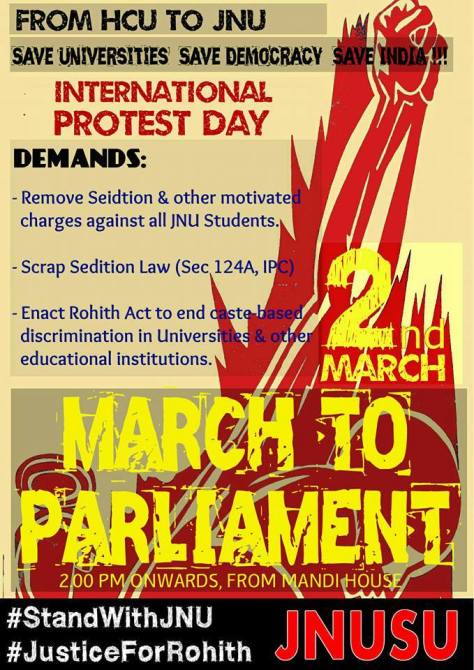
Thank you for your message of solidarity. In this hour of unprecedented attack on us, what has been a source of great strength are messages like these, which we have pasted all over the Administration Building. We have not been able to respond to each message because of being extremely overburdened. However, we are writing back today, in order to update you regarding the status of the struggle, and with a call to action on the 2nd of March, 2016 in your city.
Call for Global Day of Protest and March to Parliament for JNU – March 2nd, 2016
In a shockingly partisan statement that blatantly misrepresents events, the Bar Council of India has issued a report that justifies the well documented attacks by a mob of lawyers on JNU students, teachers and media at Patiala House Courts over two days (February 15 and 17, 2016) as ‘a reaction to the incidents, which are grave in nature and very dangerous for the country’. BCI Joint Secretary Ashok Kumar Pandey claimed that a large number of JNU teachers and students and others had arrived at the court in three to four buses and raised slogans and used ‘provocative words’. This led to the untoward incident in which ‘both the sides took part,’ said the report, adding that ‘any true citizen or a lawyer of India’ was supposed to react strongly to the ‘anti-India’ slogans.
We, the undersigned faculty members of Jawaharlal Nehru University, wish to set the record straight. Nine of us reached Patiala House Court No 4 between 1 and 1.15 pm on 15th February 2016 to attend the hearing on Kanhaiya Kumar’s bail plea. The sole objective of our presence there was that when Kanhaiya Kumar was produced he would see the faces of his teachers in the courtroom. At that time, a few students and other teachers of JNU, and some members of CPI, the parent organization of Kanhaiya’s student group, were already waiting silently outside, similarly wanting him to see friendly and familiar faces when he was produced. There were about 15 to 20 of them, hardly enough to fill 4 cars, let alone one bus.
The undersigned are university teachers and students concerned over recent events that point to a serious reversal of gains in democracy and academic freedom achieved over the last decades in many countries.
Three cases have been most prominent in that regard since the beginning of 2016: the crackdown by Turkish authorities on the more than 1200 signatories in Turkey of the petition by “Academics for Peace” criticizing the anti-Kurdish war drive launched by the Turkish government; the crackdown by Indian authorities on students involved in a non-violent campus protest against the death penalty at Jawaharlal Nehru University and Hyderabad University; and in Egypt an attempt to shoot and kill a professor by groups affiliated to the ruling party; and the savage torture and assassination in Cairo of Italian research student Giulio Regeni.
When they are not tacitly approving it, governments of countries where academic freedoms are better respected and which include most global powers have turned a blind eye and a deaf ear to calls on them to protest against this repression. The worst attitude has been displayed in Italy where the government kept stressing the importance of its economic ties with Egypt while a gutter press accused Giulio Regeni’s supervisors of letting him gather dangerous information, thus resorting to an old worn-out paranoid argument of all dictatorships and tacitly making the student himself responsible for his own atrocious death.
Academic freedoms are a key indicator of the overall status of political freedom and democracy. The acceleration of privatisation across the public higher education system is undermining these freedoms on a global scale. The events described above point to a much deeper and sweeping onslaught on democratic freedoms, which must be halted immediately lest it leads to increasingly tragic events and a most nefarious consolidation and extension of the authoritarian turn in global politics.
We call on the global community of teachers and students to join us in protesting against this most dangerous trend by signing, translating and circulating this statement, and organizing protest meetings in all universities.
संसद में दिए गए आपके भाषण को सुना. इससे पहले की मै अपनी बात रखूँ , यह स्पष्ट कर दूं की यह पत्र किसी “बच्चे” का किसी “ममतामयी” मंत्री के नाम नहीं है बल्कि यह पत्र एक खास विचारधारा की राजनीति करने वाले व्यक्ति का पत्र दूसरे राजनैतिक व्यक्ति को है. सबसे पहले मै यह स्पष्ट कर दूं कि मै किसी भी व्यक्ति की योग्यता का आकलन उसकी शैक्षणिक योग्यता के आधार पर नहीं करता हूँ बल्कि साफ़ साफ़ कहूं तो मै “योग्यता”(मेरिट) के पूरे कांसेप्ट को खारिज करता हूँ.
मानव संसाधन मंत्रालय का पद भार लेने के साथ ही यह अपेक्षा की जाती है कि आप इस देश के केंद्रीय विश्वविद्यालयों में उनकी ऑटोनोमी का सम्मान करते हुए उसके लिए उत्तरदायी होंगी. रोहित वेमुला के मामले में आपने क्या किया यह सबके सामने है कि किस तरह से वहाँ के प्रशासन पर आपने दबाव डाला जिसका नतीजा रोहित के institutional मर्डर के रूप में हमारे सामने आया. लेकिन मै इन सारी चीजो पर अभी बात नही करना चाहता. आप बार बार अपनी औरत होने की पहचान (आइडेंटिटी) को assert करतीं हैं और इसको करना भी चाहिए क्यूंकि नारी जाति उन ढेर सारे हाशिये पर किए गए लोगों में एक है जिनको सदियों से शोषित किया गया है. मै आपसे यह पूछना चाहता हूँ कि एक दलित स्त्री जो कि हर तकलीफ उठाते हुए अकेले अपने दम पर जब अपने बेटे बेटियों को इस समाज में एक सम्मानपूर्ण जगह देने के लिए संघर्ष कर रही थी तब एक नारी होने के कारण आप की क्या जिम्मेदारी बनती थी ? क्या आपको उस महिला के जज्बे को सलाम करते हुए उसकी बहादुरी के आगे सर झुकाते हुए उसके साथ नहीं खड़ा होना चाहिए था? हाँ, मै रोहित की माँ के बारे में बात कर रहा हूँ. जो महिला इस ब्रहामणवादी व पितृसत्तात्मक समाज से लड़ी जा रही थी, अपने बच्चों को अपने पहचान से जोड़ रही थी, उस महिला को आप व आपकी सरकार उसके पति की पहचान से क्यूँ जोड़ रहे थे? आपको भी अच्छा लगता होगा की आपकी अपनी एक स्वतंत्र पहचान है. लेकिन यह अधिकार आप उस महिला से क्यूँ छीन रहीं थीं? क्या आप भी पितृसत्तात्मक व ब्रहामणवादी समाज के पक्ष में खड़ी होती हैं? अपना पूरा नाम बताते हुए अपनी जाति के बारे में आपने सवाल पूछा और आपका भाषण खत्म होने के पहले ही लोगों ने आपकी जाति निकाल दी. मै आपकी जाति के बारे में कोई दिलचस्पी नहीं रखता हूँ और मै यह बिलकुल नहीं मानता हूँ की अगर आप उच्च जाति के होते हैं तो आप जातिवादी ही होंगे लेकिन आपके विभाग/मंत्रालय के तरफ से जो चिट्ठियाँ लिखी गई उसमे रोहित और उसके साथियों को जातिवादी /caste-ist बताया. मैडम क्या आप caste-ism और caste assertion का अन्तर समझती हैं? मै समझता हूँ की आप ये अन्तर भली – भाँति समझती हैं क्यूंकि आर एस एस जो आपकी सरकार और मंत्रालय को चलाता है, वह वर्ण व्यवस्था के नाम पर जाति व्यस्वस्था को भारतीय समाज की आत्मा समझता है और आर-एस-एस के एजेंडे को लागू करवाने की राजनैतिक दृढ़ता हमने समय समय पर आप में देखी हैं.




 KAFILA - COLLECTIVE EXPLORATIONS SINCE 2006