Category Archives: Everyday Life

Why so serious?: Anuj Bhuwania

Guest post by ANUJ BHUWANIA

Cellphone videos of the celebrations at India Gate after India won the semi-final against Pakistan


So cricket is the opiate of the Indian masses, and India’s left-liberals (henceforth LLs) can’t deal with it. Or with popular cinema or religion, for that matter. All of which are things that these oh-so-serious people can’t quite seem to fathom. The only cinema you should enjoy are art house/multiplex films with the right ‘social message’, the only religion you can profess is Sufism and the only cricket you are allowed to enjoy is West Indies winning a test match, because CLR James has apparently said it’s ‘empowering’ or  ‘anti-imperialist’ or some such. These trivialities – cinema, religion, cricket – are just there to distract people from the really important issues. We should all only obsess about ‘important’ topics like nuclear energy, the 2G spectrum scam or the UID. Continue reading Why so serious?: Anuj Bhuwania

Hundreds of lives reduced to rubble in Delhi: Paul Divakar

Guest post by PAUL DIVAKAR

This slideshow requires JavaScript.

This was written yesterday, 24 March 2011: Today we witnessed most humiliating, fascist nature of pulverising already vulnerable communities – most of whom are Dalits and backward castes in Gayatri colony near Faridpur of Baljit Nagar. Continue reading Hundreds of lives reduced to rubble in Delhi: Paul Divakar

Bhagat Singh and the Hindu Rashtra: Mahtab Alam

Guest post by MAHTAB ALAM

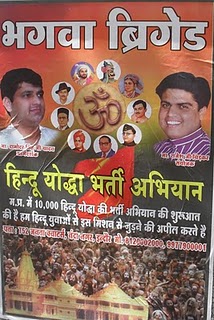
“The communists’ ideologues conveniently ignore the truth that the roots of Bhagat Singh’s ideology lie in the very concept of Hindu Rashtra,” claims an article by Dipin Damodharan, published on this day last year. Damodharan, as introduced at the end of the article, is a student pursuing Masters in Communication and Journalism (MCJ) at the Calicut University of Kerala. He argues: “To my knowledge, he sacrificed his precious life for a noble cause, for the liberation of Bharat from the invaders, for nationalism. Undoubtedly Bhagat’s legacy belongs to every Bharati. But for the communists (experts in transforming sheep to dog), he died for communism and not for nationalism. They are incessantly advocating Bhagat as their poster boy, for several years they have been using Goebalsian tricks to claim Bhagat’s legacy.” The author further argues, “They are injecting fake stories about Bhagat into the blood of youth who are ignorant about Bharat’s history. Discarding the historical facts, the communists become angry with the Sangh inspired organizations for propagating Bhagat’s ideals”. Continue reading Bhagat Singh and the Hindu Rashtra: Mahtab Alam

The Murder of Niyamat Ansari

In the video above, Niyamat Ansari, NREGA/RTI activist in Jharkhand, speaks of the threats to his life. Ansari was murdered on 2 March 2011. You can watch more videos of him here.

Given below are facts of how and why Niyamat Ansari was killed, and the follow-up threafter. You can follow the campaign to get justice for Niyamat Ansari on this Facebook page set up in his memory and in pursuit of justice for him. Please share these links widely, because Your Channel will not organise a candle-light vigil at India Gate. See this statement calling for justice.

The struggle of the NREGA is regularly chronicled at Nrega.net.in. NREGA, the world’s largest rural employment guarantee scheme, recently completed five years.

Continue reading The Murder of Niyamat Ansari

Stop gendering children: Urooj Zia

Image by Frank Baron / The Guardian

Guest post by UROOJ ZIA

A couple of months ago, I was given two books which I was asked to review. Published in India, both were compilations of abridged versions of popular children’s fairy tales and fables. One book, however, had a pink cover; the other was bound in blue. The former said clearly, on the cover, that it was meant for ‘little girls’, the latter was for ‘little boys’.

Having grown up surrounded by books, I wondered, when I saw these two copies, as to how one could tell which stories were meant for girls and which were meant for boys. As a child, I never saw the difference. Lo and behold, the tables of content in both books gave me my answer (and destroyed my peace of mind): the volume with the pink cover was full of stories about lost princesses and damsels in distress seeking saviours; the one with the blue cover had stories such as ‘the boy who cried wolf’. Continue reading Stop gendering children: Urooj Zia

You fill up my Census…

…quipped my brother Dilip in response to the following mail from my sister Pramada:

So the bell rings this afternoon. desperate clanging. i open the door and there is a man with forms in his hand and a general irritated demeanor. figured that this was the census man. he comes in and settles down. starts by wanting to know who the head of the household is. i say there is no one. he insists. i continue to say no one.

Census of India 2011 mascot

He proceeds to explain that if the parents live in the house, then they are the head of the household, if married then the husband is. I proceed to ask for definition and say that all three of us who live in the house are head of the household since we all earn and take decisions. he promises to erase what he has written since he was sure my mother was head of household.

He seemed to find my gender a bit dubious so questioned my mother if i was a boy or a girl and then repeatedly said “ladki” to me. having established that i indeed was a woman, he wanted to know date of birth, which was not difficult, but place of birth he found extremely challenging. he could not get his spellings right, or did not know districts or states in the country so tattamangalam in palghat district in kerala was as baffling as mysore in karnataka. calcutta was easy to deal with and he said calcutta was in calcutta!!! mother tongue caused him more angst because he had to write malayalam and again the spelling eluded him.

Continue reading You fill up my Census…

What do the Maoists want?

The media has by and large focused on the Maoist demand of release of some of their own in exchange of the Malkangiri collector and junior engineer. The list of the total 8 of 14 demands of the Maoists that the Orissa government has agreed to makes for interesting reading:

(1) Orissa government will write to Jharkhand and Chhattisgarh to take action on the extremists demand for release of Maoist central committee members Sheela di (jailed in Jharkhand) and Padma (in Chhattisgarh) owing to their ill-health; (2) ST status for the Konda Reddy and Nukadora communities categorized as OBCs; (3) stopping the multi-purpose Polavaram project of Andhra Pradesh; (4) ‘pattas’ (record of rights) to tribals dispossessed of their land in Malkangiri and Koraput; (5) irrigation in Maribada and Maniamkonda villages in Malkangiri; (6) compensation based on HC order to Tadangi Gangulu and Ratanu Sirika who died of disease allegedly due to torture; (7) relevant laws for mining operations in Mali and Deomali bauxite mines; (8) minimum displacement of tribals and adequate compensation. [ToI]

Teaching Harmony, Practicing Disharmony

This was presented as a paper at a symposium on Peace Education organised as part of National Conference on Indian Psychology, on 6 February 2011 at the India International Centre.

This piece seeks to underscore the cleavages that exist in our society, explore the foundations upon which the edifice of intolerance has risen and to look at the tools, like education for peace and harmony, with which we try to dismantle this citadel of intolerance.

Peace education, you would agree, cannot be confined merely to teaching the message of Love and brotherhood, our text books have been teaching this message for as long as I remember and my memories of our text books go back, at least to my senior school days in the mid sixties, almost 45 years ago.

If telling students in their classes that we should all love each other because we are all Indians and that we are all equal was enough then we would not have many of the problems that we are confronting today. Continue reading Teaching Harmony, Practicing Disharmony

The disappearing body and feminist thought

Presented at conference organized by  Department of English (Delhi University)  February 14, 2011. The title of the  conference was “Postfeminist Postmortems?  Gender, Sexualities and Multiple  Modernities”.
Cross-posted on Critical Encounters

To paraphrase Anthony Appiah’s famous and oft-quoted question – Is the post of postfeminist the post of postmortem? That is, as in postmortem, does “post” mean definitively over, after, having transcended, gone beyond? To those who would answer “yes”, those privileged young women who float through their empowered lives in the wake of over a century of feminist struggles but disown their own heritage, to them I can only say – I’ll be a post-feminist in post-patriarchy. Or – not for a long time yet, baby.

But my answer to that question is “no”. I understand the post of postfeminism in the sense that Laclau and Mouffe understand their postmarxism. That is, post-feminist as indicating “having passed through” that body of thought; having lived through, experienced, feminist theory and politics in such a way that the terrain one now inhabits has been decisively transformed; but also post-feminist in the sense that in the course of this passage new objects have been configured that the old feminism could not have seen, or recognized.

It is in this kind of postfeminist moment that I locate my presentation today.

Continue reading The disappearing body and feminist thought

Anbulla kaadu (My beloved forest): Madhumita Dutta

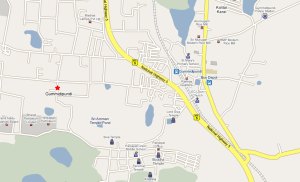
Thervoy Kandigai Industrial Complex. The Government issued orders alienating 1127 acres of poramboke land in favour of SIPCOT for formation of a new Industrial Complex in Thervoy Kandigai village of Gummidipoondi Taluk, Thiruvallur District. The land development work is in progress now.
From the website of Industries Department, Government of Tamil Nadu

What this “land development work” involves, and the price that will be paid in human and ecological costs is something that MADHUMITA DUTTA encountered recently.

“A forest that was once ours is now private, a land that was once green now stands barren, a forest where we played, where we wandered freely is now fenced, men in uniform now guard the forest which we protected for generations.”

Thervoy Kandigai. A small nondescript village in Gummidipoondi Taluk of Thiruvallur district, 50 kms north of Chennai.  Surrounded by dense shrubby forests, natural lakes, rice fields and undulating terrain with misty mountain range of Sathyavedu in Andhra as the back drop. This small dalit village of about 1000 families is in the eye of a storm.  A storm that can blow away the dreams of Tamil Nadu government to hand over hundreds of acres of land to French tyre company Michelin, a big ticketed investment worth Rs 4000 crore for the state.   Continue reading Anbulla kaadu (My beloved forest): Madhumita Dutta

The Virtues of Waiting Patiently: Arnav Das and Soumik Mukherjee

Guest post by ARNAV DAS SHARMA and SOUMIK MUKHERJEE. Photographs by SOUMIK MUKHERJEE

This slideshow requires JavaScript.

Peepalguda, Koraput, Odisha: “You see, for the bridge over that rivulet, forty thousand rupees were sanctioned”, the sarpanch of Mossigam gram panchayat starts off emphatically. It is only after a good amount of probing that he confesses that it was foolish of the Public Works Department (PWD) to sanction Rs 40,000 for a bridge when a similar bridge was built seven years ago in another village for Rs 43 lakh. In any case, a slight bureaucratic nudge resulted in even this amount to get diverted to another village in the Lima panchayat. Continue reading The Virtues of Waiting Patiently: Arnav Das and Soumik Mukherjee

Tragedy and Anguish: Can We Be True to Soumya?

There are no words to express the terrible anguish into which many of us have been plunged at the entirely-preventable fate of 23-year-old Soumya, raped and brutally murdered on her journey back home from work a week back. A criminal kicked her out of a slow-moving train between Shornur and Vallathol Nagar, robbed her, dragged her into the bushes, where he raped and wounded her fatally. After five days in hospital, she died. There were other passengers, men, who heard her cries. But none of them bothered to pull the chain, which would have saved her from both rape and murder.There are no words for anguish anymore in the Malayalam media. It has plenty of words to convey, to inspire craven fear and rancid sentimentalism, but none to express and pass on anguish. Continue reading Tragedy and Anguish: Can We Be True to Soumya?

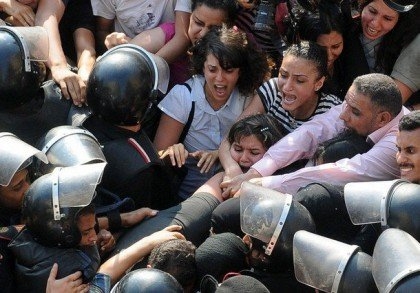
A Photo Album of Women of the Egyptian Revolution: Leil-Zahra Mortada

A photo collection by various photographers, compiled by Leil-Zahra Mortada

This is a homage to all those women out there fighting on the streets of Egypt, to those whose voices and faces were hidden from the public eye during the first days of the revolution! The album by now has traveled the world back and forth via online social networks, blogs and websites.
First and foremost the credit for this album goes to the courageous people of Egypt who are teaching us that freedom is taken and not given.
Second, to the women who by their courage, determination and strength are inspiring millions of us around the world.
Third to the photographers who took these photos and especially to those who have caused absolutely no problems when it came to copyright issues.


See the album and read more here

‘How Leaving the Internet Fueled Our Revolution’

For those who worry themselves sick about laptop radicalism, this is essential reading:

The web is in many ways a more modern, much larger version of the kinds of public spaces and forums that have made citizenship possible throughout history. Losing it for a week didn’t stop Egyptians from protesting or airing their frustrations; we still know how to use physical public spaces, after all. But it did remind us that a forum for the open exchange of words and ideas is central to any sustainable democracy; alternatively, we end up in a perilous cycle of control and chaos. Instead of expressing pent-up opinions with fists and bullets, as is happening now in the streets of Cairo, people who can express them freely in conversation, even in a virtual one, have a chance to hear one another and deliberate together about the future. Never mind the vacant symbolism of “Twitter revolutions” and Youtube activism: losing the Internet at the hand of our own government simply offers us a powerful reminder of why we actually want the Internet to begin with, and why we’re doing any of this. [Read the full article by Haisam Abu-Samra]

Excellent as the al-Jazeera coverage is, if you’re tired of it, see videos from Egypt on YouTube, created and uploaded by the people whose revolution it is. It will give you the closest possible feel of what it’s like to be there. Not even al-Jazeera can manage that!

And if you’ve been watching the events in the Arab world and consoling yourself that it’s not that bad in India, consider this: India recently gave Hosni Mubarak an award in Nehru’s name for ‘international understanding’ and Vice President Hamid Ansari addressed him thus:

Your support for regional and international efforts to promote and maintain peace in the West Asian region is eloquent testimony to your commitment to the promotion of international peace and goodwill. I feel deeply privileged to convey my warmest greetings to you. [Press Information Bureau]

Death of a River

This was first presented as a paper in a seminar on “The River” organised by the Max Muller Bhawan on 11 and 12 December 2010. Photo credits: Gigi Mon Scaria, Himanshu Joshi and Sohail Hashmi. Maps: The coloured map of Delhi is the restored version of an 1850 map; restoration is by E Ehlers and T Krafft. The black and white map is based on an 1807 map of the draingage of Delhi, made by a British cartographer. The three current three maps have been drawn by Shela Hashmi Grewal. You can stop at any image in the silde show above, by using the controls that you will discover once you hover the cursor over the slideshow.

This slideshow requires JavaScript.

The Final scene in the epic tragedy of the Jamna is being enacted at these very moments and the agencies that have wrought this havoc continue to initiate decisions that will permanently erase all signs of the river that has sustained the city that you and I call Hamari Dilli.

Before coming to my understanding of what needs to be done to save the Jamna, instead of what is being done to destroy it. I would like to draw your attention to certain geographical features of the land around Delhi, in order to better understand the factors that contributed to the location of the several Delhis and their relationship to the river. Continue reading Death of a River

The Republic of Exploitation

On this Republic Day, while armoured tanks muscle across Rajpath in New Delhi, little ossified museums of culture called tableaux charm the assembled pass-holding citizenry and the Prime Minister sits like a barely-sentient caricature of himself behind a bullet-proof screen, it may do well to think about the other republic that remains hidden within the bosom of Superpower India – the republic of unfree labour.

This is a world where the laws of the upside world are inverted – where the more you work, the less you are paid, the more your company profits, the poorer you end up and if you find yourself the victim of an injustice and god forbid complain about it, the police put your family in jail. It’s a great irony of our times that we believe the choice before us is between loving the Nation and loving the Corporation, not realising that most of the time its the same person wearing two grotesque masks.  All those who believe that the world begins with their newspapers and television sets and ends at their white picket fences (and all those who don’t), please take a minute to go through the excellent documentation of the war that is raging for workers in this country, put together by the Gurgaon Workers’ Solidarity Group, the Faridabad Mazdoor Sangathan and several other exemplary organisations.

GurgaonWorkersNews – Newsletter 35 (February 2011)

Continue reading The Republic of Exploitation

Sound Enough: How to Enjoy the Jaipur Literature Festival: Revati Laul

Guest post by REVATI LAUL

“Excuse me, Mr. Farooqui, I just need a sound byte from you,” said a young reporter from the fairly young news channel News X. He was talking to my friend Mahmood Farooqui, author of Besieged: Voices From Delhi 1857, co-director of the Oscar nominated film Peepli Live and founder-revivalist of Dastangoi – the rich, medieval art of storytelling. Seeing that the setting was the beautiful and quaint Diggi Palace in Jaipur with a substantial gathering of the world’s literati for the Jaipur Literary Festival, Mahmood was preparing to hold forth on storytelling, culture, 1857…when this completely unexpected gem poured forth from the fearless reporter’s lips.

“Can you sum up what you think of literature in one word?” Continue reading Sound Enough: How to Enjoy the Jaipur Literature Festival: Revati Laul

The New Cellu-lar Jail: Madhumita Dutta & Venkatachandrika Radhakrishnan

Guest post by MADHUMITA DUTTA and VENKATACHANDRIKA RADHAKRISHNAN
The writers are activists based in Chennai working on issues of land, labour, industry and SEZs.

Sriperumbudur grabbed media attention in 1991 when former Prime Minister Mr Rajiv Gandhi was assassinated during an election rally. Since then, this nondescript little village-town in west Chennai, dotted with paddy fields and large expanses of natural water-bodies, has transformed itself into a little ‘Shenzen’- world’s largest special economic zone in Southern China, which churns out one out of every eight mobile handsets sold anywhere in the world. Slated to attract investments worth $4 billion in electronics and automobile manufacturing, Sriperumbudur is now home to the largest mobile handset making factory of Nokia, a Finnish company that can churn out 7.5 lakhs handsets a day. This town and its neighbouring region is also known as the Detroit of India, churning around 12,80,000 cars every year. With a booming manufacturing industry and a promise of 2 lakhs jobs, Sriperumbudur is touted as the jewel in the industrial crown of Tamil Nadu. But of recent this seemingly success story has turned a little sour. Continue reading The New Cellu-lar Jail: Madhumita Dutta & Venkatachandrika Radhakrishnan

Ambika’s Death: Madhumita Dutta & Venkatachandrika Radhakrishnan

Guest post by MADHUMITA DUTTA and VENKATACHANDRIKA RADHAKRISHNAN
The writers are activists based in Chennai working on issues of land, labour, industry and SEZs.

A view of Nokia's Sriperumbudur plant. Photo credit: Economic Times

S Ambika, a 22 year old woman factory-worker, died in the middle of the night in a posh hospital in Chennai on 31st Oct. She was a permanent employee of Nokia Telecom Special Economic Zone (SEZ) in Sriperumbadur in Kancheepuram district of Tamil Nadu. Her agonising death was due to a fatal accident at a panel loading machine in the factory.

Continue reading Ambika’s Death: Madhumita Dutta & Venkatachandrika Radhakrishnan

“These are not stones these are my feelings”

An image taken in downtowon Srinagar.

Given below is a note written by a Kashmiri student from downtown Srinagar who calls himself ‘Kale Kharab’, meaning ‘hot headed’. Taken from his blog, the note reads like a personal manifesto, a statement of purpose, a testimony more telling than what the most patient interviewer can elicit. This note gives you more insight into what is happening in Kashmir than a lot of what you may have read or seen on TV news about the killing of 115 protestors across Kashmir in 2010 by Indian forces. This testimony, written early on during the uprising, on 30 August 2010, shows how irredeemably India has lost the plot in Kashmir all over again, with a new generation of Kashmiris.

How and why I became a stonepelter

by KALE KHARAB

I am from downtown srinagar born in 1991. I was admitted to one of the best school of valley. As a child I had dream to became engineer. Whenever somebody used to ask me about my aim I would proudly say engineer. As I started to grow up I started to became familar with many words which everyone used to talk about that among them few were “azadi” (freedom), “hartal” (shutdown) but I was unable to understand the meaning of these words. I loved the word hartal as it was holiday, so I always wished for hartal. As I grew up I came to know about mujahids. I used to listen stories of mujahids. I would oftenly ask my elders to tell me about mujahids. They told me stories of many mujahids like Issac, Ishfaq, Jan Malik which I liked to share with my friends.  Continue reading “These are not stones these are my feelings”

Democracy and the Politics Around NREGA: Ruchi Gupta

Guest post by RUCHI GUPTA

Subverting Democracy [1]

It took 47 days of a protest sit-in in Jaipur to make the State budge[2]. It’s notable that the objective of this protracted protest wasn’t to coerce the government for an extra share of State resources but to hold the government accountable to the Constitution and its own laws. The protest, “mazdoor haq satyagraha” was staged by workers employed under the National Rural Employment Guarantee Act (NREGA) to demand enforcement of their constitutional right to earn minimum wage. Even now after some initial encouraging signs, the matter seems to have stalled. Continue reading Democracy and the Politics Around NREGA: Ruchi Gupta