
Watching the world tumble down around us, the holy markets especially, what has amused and angered is the way in which the media refuses to let go of its Sunny Disposition on Life, the Universe and Everything. This would be pathetic if it wasn’t so rampant. The Times of India has plumped up its Delhi Times this weekend to ten pages filled with exhortations to shop and full-page ads on shiny commodities. Its spectacularly vacuous Sunday Times is bursting with stories about celebrities valiantly keeping up the Diwali spirit, and thumbing their noses at the looming depression by buying more Louis Vuitton bags.
Category Archives: Everyday Life
Durga Puja as a Homecoming Metaphor – Prasanta Chakravarty
(This is a guest post. It was also published in Hindustan Times, October 2, 2008)
Tagore’s short tale Kabuliwallah concludes right in the middle of autumn—saratkaal. Mini’s marriage takes place during the puja holidays, and Rahman’s own Parbati awaits her father’s return in her distant mountain home. Even as Mini prepares to initiate her journey to her in-laws, Rahman, having been released from his own figurative abode-of-the-in-laws, the jail, seeks home afresh in his “… mountains, the glens, and the forests of his distant home, with his cottage in its setting, and the free and independent life of far-away wilds.” Uma’s arche story is reinvented by Tagore and a secret bond is established between two fathers. But such weaving of the puranic akhyan as a homecoming narrative is realized, or used to be realized shall we say, at a different order where home is also a matter of participating in a certain generous spirit during the pujas. The essence of Kabuliwallah lies in basking in such an aura of human generosity. So, the fundamental question to me is whether such a spirit can be glimpsed during the pujas even today without being overly sentimental about it.
Continue reading Durga Puja as a Homecoming Metaphor – Prasanta Chakravarty
Phool Walon Ki Sair
Akbar Shah Saani (the second) ruled over a rapidly disintegrating empire between 1806 to 1837. It was during his time that the East India Company dispensed with even the fig leaf of ruling in the name of the Mughal Monarch and removed his name from the Persian texts that appeared on the coins struck by the company in the areas under their control.
Bahadur Shah Zafar who succeeded him was not Akbar Shah Saani’s choice as his successor, Akbar Shah was, in fact, under great pressure by one of his queens, Mumtaz Begum to declare her son Mirza Jahangir as the successor. Akbar Shah would have probably accepted this demand but Mirza Jahangir had fallen foul of the British and they will have none of this.
The Phool Walon Ki Sair or Sair-e-gul-Faroshan that is celebrated with much fanfare and official patronage had its beginning in a fracas between Mirza Jahangir and Sir Archibald Seton, the then British resident at Delhi. According to contemporary records of the event, Mirza Jahangir was extremely resentful of the manner in which the British threw their weight around the Red Fort and violated all customs and traditions. He was a strong man, moved around with a band of his followers and kept getting into arguments with the Goras. Continue reading Phool Walon Ki Sair
Buses, Bad Ideas and Bambi
Some say that if you give a man a long enough rope, he will eventually hang himself. Others say that when you’re in a hole; stop digging. Given the stubbornness of our friend from a 2.5 world country, chances are he will be one of the first to hang himself in a hole. A truly horrible image that – but worry not fair readers; he can still be saved yet.
Scrolling through his latest rejoinder appears frighteningly like watching your neighbour’s child – in the other building across the road – assemble a shaky platform of poorly imagined arguments, test the strength of his rope of ignorance, throw it about his neck in an attempt to force his parents to say they are sorry for screaming at him and then, just as he is getting what he wants – HORROR. The platform is shaking, the legs are trembling, the noose is tightening, are his parents even watching? And then suddenly you can almost hear this crack that makes you want to scream STOP!!!
Some images do not disturb
guest post by S. ANAND
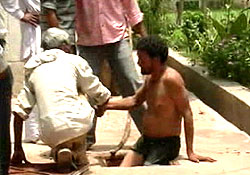
There are times when our critical antennae do not perk up. We do not wish to decode certain signs because we are all implicated in them. Following the 14 September blasts in Delhi, suddenly the media found a new value in ragpickers, street vendors, auto drivers and others who live on the fringes of the city and are generally looked down upon by people who inhabit apartments, blogs, cars (and autos, I must add).
Suddenly, by 15 September, ragpicker Krishna was canonized as a ‘hero’ by the media, the police and the state (the Delhi government claims credit for saving some lives with its ‘eyes and ears’ policy). Yet, Times of India prefaced its report about Krishna thus: Continue reading Some images do not disturb
Such absurdity on a Wednesday
Guest post by SHAHRUKH ALAM
On Wednesday, I met some young men from Dhule. I am not at all sure where Dhule is and I said as much to them. “There was some violence there. It has been in the news lately,” they said. “Did any bombs go off in Dhule?” said I. “No bombs, no. But there was communal violence. It was on the news.” “I only watch prime time news. I don’t usually manage to view the afternoon bulletins. Nor the eleven PM one (informative though they are),” I explained. “So where exactly is Dhule?” I persisted. “It is a district on the north-western tip of Maharashtra. It’s not so far from Malegaon.” Ah, Malegaon! Where the blasts occurred? Finally I had a co-ordinate. Continue reading Such absurdity on a Wednesday
Do gods and saints weep?
The star of fortune has risen for Malayali women, not in this world but in the next. Catholics in Kerala celebrated the canonization of Sr. Alphonsa, a young nun from Kudamaloor in Kottayam district, who passed away after a life of intense bodily suffering and prayer in 1946, as a ray of hope in hard times. Becoming a nun and leading a life of asceticism were never easy choices. That too, for a eligible, beautiful young woman in early 20th century Kerala, born in a small village, whose guardians were determined to see her respectably married. Given to excruciatingly difficult forms of prayer even as a child, Alphonsa resisted her maternal aunt’s plans dramatically by trying to disfigure herself. She jumped into a smouldering ash-pit; badly burned, she climbed out. The family was so taken aback that they gave in to her desire to become a nun. Continue reading Do gods and saints weep?
The Jamia Nagar Encounter: ‘Curioser and Curioser’
The well known journalist Praveen Swami, who is celebrated by some as an ‘encounter expert’ and ‘authority on terrorism’ has finally offered his comment on the Jamia Nagar encounter in the Hindu. See Behind the Batla House Encounter. It smells fresh.
Now, I really like Lewis Carrol, and am happy that Swami has invoked Carrol, Alice and Wonderland while criticising those (like me) who have chosen to take a skeptical stance towards the official handout of what exactly happened on the 19th of October in L-18, Batla House, Jamia Nagar. With due respect to Praveen Swami, lets read him in the spirit of Carrol and come to conclusions about who is Alice, who is the Red Queen and who is the white Rabbit, in due course.
It takes far more intelligence to read Swami than it must take for Swami to write like Swami. Which is disconcerting, given, that in Swamis case, he has a whole bureau full of intelligence to back him up, and all we have is the stuff between our individual ears, and occasionally our own eyes, our own ears and our own two feet. No wonder, we have to strain our credibility to believe the six and more impossible things that the police’s special cell, the intelligence bureau and its anointed experts would have us swallow whole for breakfast, with each morning’s headlines in the newspapers.
Continue reading The Jamia Nagar Encounter: ‘Curioser and Curioser’
Cities, Cars and Buses: The Modern, the Ideological and the Urban
[This post is a response both to Aarti Sethi’s post on the BRT, as well as to Aman Sethi’s posts recently and this one earlier and as well as to some of the comments it generated.]
In 1970, Henri Lefebvre wrote: “the invasion of the automobile and the pressure of the automobile lobby have turned the car into a key object, parking into an obsession, traffic into a priority, harmful to urban and social life. The day is approaching when we will be forced to limit the rights and powers of the automobile. Naturally, this won’t be easy, and the fallout will be considerable” (The Urban Revolution, 19).
Talking about the BRT corridor in Delhi, its worth remembering many other urban clashes – Hausmann’s broad and open ways that opened up Paris in the mid 19th century, Robert Moses in New York, and Corbu’s (failed but still so real) plans for just about everywhere outside Europe. Hausmann’s boulevards were about a new kind of street for a new kind of urban formation: the boulevard was part of the birth of the industrial, capitalist city, the city of Baudelaire’s Paris and the “Eyes of the Poor” – the city of the current version of the modern that still shapes/haunts us today. Continue reading Cities, Cars and Buses: The Modern, the Ideological and the Urban
On dealing with fuss-tration
So for those of us who thought that frustrated, naive and aggressive car drivers are a caricature, Hey we at Kafila found one just for our readers. He is loud, aggressive and fuss-trated as they come. Read on …
The wonderful thing about blogging, I am told, is that it allows everyone to publish their opinions. At times however, forgive me for saying this, I wonder if everyone should. My most recent reason for this harsh indictment of the blogging world, is based on this recent post titled “This is what the fuss is about (you twit)”. The title stems from a spot of witty wordplay on one of my recent posts.
The “you twit”, I might hasten to add, is not my addition. it is the author’s impression of my arguments. While his post is reasonably, if somewhat naively, argued; his frequent abuse stems, perhaps, out of the need to get his blog read. Or maybe it is a style that is much appreciated by his readers. I will however, thank him for his incisive – if somewhat excessively enthusiastic – critique of my work.
Of “Killer” Buses and Car Lobbies: The Coincidental Death of the BRT
The sustained campaign by the elite press to jettison Delhi’s first mas transit bus system has been remarked upon and documented on Kafila. Today morning’s newspapers carries news of an accident in which 32-year old Poonam Sharma was killed as she tried crossing the road and was hit by an oncoming bus. Delhi’s record when it comes to road safety is abysmal and this is yet another instance of the the terrible and tragic fate that befalls many pedestrians every year on Delhi’s roads. What is interesting though is the way in which accidents on the BRT are reported compared to the reportage of other road fatalities. Here are some headlines from the recent past:
BRT Corridor Claims One More Life
BRT Delhi: Death Toll Continues, Pedestrians Blamed
BRT Claims another Life: Woman run over by Bus
Continue reading Of “Killer” Buses and Car Lobbies: The Coincidental Death of the BRT
Converting lions to elephants
As the most hideous kinds of violence are unleashed on Christians in Orissa and Karnataka by proud Hindu terrorists, one issue that the liberal Hindu mind-set stumbles over is that of conversions. Of course, violence is bad, it bleats, nothing justifies killings, but mass conversions, you know…
Conversions. Images of Muslim hordes waving their fierce banners, sweeping across the North Indian plains; images of sly Christian missionaries swindling innocent tribals and dalits with food and education and social status, into accepting an alien god. The liberal Hindu, who would never dream of converting anybody to Hinduism, shrinks at these images.
Aditya has drawn our attention to Ambedkar’s clear-eyed insight into why Hinduism is not a proselytizing religion. Can you convert a non-Hindu into a Brahmin? Nope.
Some Questions About the Delhi Encounter
By Shabnam Hashmi, Satya Sivaraman, Manisha Sethi, Tanweer Fazal, Arshad Alam, Pallavi Deka
First published on Countercurrents.
A team comprising activists, academicians and journalists visited the site of the police operation against alleged terrorists staying in an apartment in Jamia Nagar in the afternoon of 20.09.2008 (Saturday). Two alleged terrorists Atif and Sajid, along with Mohan Chand Sharma, an inspector of the Delhi Police’s Special Cell died in the operation while a third alleged terrorist was arrested. Continue reading Some Questions About the Delhi Encounter
Random Thoughts on September 14; After 5 Bombings in Delhi
Driving through the city of New Delhi after midnight, in the early hours of the 14th of September, one could have easily mistaken the eerie calm in the broad avenues that skirt the hollow centre of Lutyens Delhi as the lull of a city tranquil and asleep to itself and the world. Continue reading Random Thoughts on September 14; After 5 Bombings in Delhi
Chengara: Letter to National Commission for Women by Delhi groups
The Chairperson
National Commission for Women
4, Deen Dayal Upadhyaya Marg,
New Delhi
Subject: Torture and Rape of Women and Other Incidents in the Land Struggle at Chengara, Kerala
Dear Chairperson,
We urge your attention to the following incidents in Chengara, Kerala as they require your urgent intervention.
In the ongoing struggle for land in Chengara, there is escalating violence against the peaceful and democratic protest of the people. Here women are the most affected as they are the targets of brutal attacks by the workers of trade unions affiliated to leading political parties and also other hired henchmen of Harrison Malayalam Ltd. Many women have testified that the attacks happened right in the presence of the police. All these events seem to indicate a total breakdown of the state’s administrative machinery to redress the situation, which makes the intervention of external bodies like yours crucial.
Continue reading Chengara: Letter to National Commission for Women by Delhi groups
Gun Salutes for August 15, 2008
Anniversaries are good opportunities for reflection. I write this in the early hours of 15th August, 2008, the 61st anniversary of Indian independence.
The events of the past few months, and the past few days, in the Indian administered state of Jammu and Kashmir have demonstrated how well and how equally (or not) the police, paramilitaries and armed forces of the Indian Republic treat different kinds of protesting crowds. The facts that I am about to discuss are good measures with which to think about the relationship between acts of power, different kinds of people, sovereignty, life and death in the Indian nation state as it has evolved over the past 61 years.
The region of Jammu in the province of Jammu and Kashmir has been caught in the grip of a fierce agitation against the revocation of the land transfer to the Amarnath Shrine Board. We have all seen footage of angry SASS (Shri Amarnath Sangharsh Samiti) activists brandishing trishuls, setting up roadblocks and burning tyres, the agitation has spread to different parts of India
Flashpoint Chengara: March Against Blockade Tomorrow
AN APPEAL from the PANCHAMI DALIT FEMINIST COLLECTIVE, Kottayam, to join the march on August 14th, against sexual harassment and human rights violations at the site of the struggle for land at Chengara, Pathanamthitta, Kerala.
[Below is an urgent appeal from Chengara, Kerala, where a land struggle has been on for the past one year. There seems to be a general elite consensus about refusing citizenship to the 7500 landless families that have occupied government land there; more ominously, there seems to be also the determination to punish them. Since early August a road blockade has been going on led by the united front of trade unions defending the right of (eighty) workers in the occupied Chengara plantation. Apparently, there are also ‘criminal elements’- the trade unions and the police, poor things, know nothing of them – who have been violently stopping activists from reaching the settlement.The CPM intellectuals in Kerala are patiently waiting for ‘more and accurate’ information, as they were when some of us approached them proposing a protest around Nandigram last year. Reports of starvation, sickness,and sexual assault are reaching us from Chengara but there is no way we can get there.Now, what is this? A new form of illegal custody? A new form of sexual harassment in custody? On 14 August, dalit activists and organisations are planning a march to Chengara, and hopefully food and medical supplies can be taken there. Please circulate this appeal widely – we have to stop another Nandigram– JD]
A historic land struggle has been unfolding at Chengara in Pathanamthitta district, Kerala, involving about 7500 families, Continue reading Flashpoint Chengara: March Against Blockade Tomorrow
A Tangential Addition to the Great Auto Debate
I want to go off on a bit of a tangent here. Just to open a different discussion in the spirit of thinking, and muddling along together. It seems to me that one of the axis on which the debate has turned is on the question of desire and its representation. Who is the desiring subject, towards whom is this desire directed, who represents this desire in what way, what are the slippages therein, who has the right to speak about whom.
I was wondering if we can approach this from a slightly different angle by taking this question of desire beyond the individual subject (variously defined). And in fact nameless did gesture to this in one of her responses where she raised the question of the appropriation of what she termed subaltern practices by elite intellectuals where certain practices and forms, in this case autos, are made to stand in for certain values – in this case progressive, ‘left” etc – which says more about the locations of the intellectuals and their insensitivity to their own class-caste positions, in a move which is patronizing at best and exploitative at worst. I think inherent in this critique is the shadow of a kind of objectification of a certain experience, so that a symbol becomes alienated from the actual life practices in which it is located to circulate as some empty signifier, to be appropriately filled as per requirement.
Continue reading A Tangential Addition to the Great Auto Debate
Quepem by the kilo: Hartman de Souza on Mining in Goa
I am posting below a requiem to Quepem by my old friend Hartman. It reads eerily like a companion piece to the curatorial essay to Manifesta 7 by Raqs, posted earlier on Kafila. Raqs wrote:
Mountains are flattened to mine bauxite, the main aluminium ore. Mountains of aluminium waste may eventually take their place…The “rest of now” is the residue that lies at the heart of contemporaneity. It is what persists from moments of transformation, and what falls through the cracks of time. It is history’s obstinate remainder, haunting each addition and subtraction with arithmetic persistence, endlessly carrying over what cannot be accounted for. The rest of now is the excess, which pushes us towards respite, memory and slowing things down.
And here’s Hartman:
As you read this, mourn the brutal rape and murder of half a dozen steep, thickly forested hills barely 12 kilometres from Quepem town in south Goa. These form an integral link of the magnificent Western Ghats that surround Goa, and as any schoolchild studying the environment will tell you, they play a crucial role in providing Goa its ecological wellbeing.
And yet, in blatant contravention of wisdom we purport to impart to children, hundreds of forests are being cut down around Quepem even as I write this. The denuded land turned inside out so fast, a hill can disappear in three months, leaving behind suppurating wounds that go down so deep the giant tipper trucks at the bottom look like the harmless toys little boys plays with.
Continue reading Quepem by the kilo: Hartman de Souza on Mining in Goa
The Rest of Now
My colleagues (Jeebesh Bagchi and Monica Narula) and I (as Raqs Media Collective) have been working over the last year on curating an exhibition titled ‘The Rest of Now’ which opened recently as part ofManifesta 7in the town of Bolzano/Bozen in northern Italy. Manifesta is an itinerant biennial of European contemporary art. I am posting below our curatorial essay, which may be of interest to some amongst you, and look forward to your responses.
–
The Rest of Now
by Raqs Media Collective
1.
A hundred years ago, Filippo Tommaso Marinetti, artist, poet and high priest of a muscular industrial aesthetic, was seriously injured in an automobile accident on the outskirts of Milan. Continue reading The Rest of Now
Death of the Author(-ized)?
Or it is just another case of planning paranoia?
Although commonly understood to be a city of traders, Ravinder Singh Chowdhary*, is adamant that Delhi be understood as the abode of farmers. Sitting adjacent to lush verdant fields of brinjal, rice, and spinach in the village Madapur Khadar in Delhi’s Badarpur Constituency, Chowdhary, explains how Delhi is paradoxically “a city of farmers.” “From Kilokri and Kotla Mubarakpur in the South-East, to Karol Bagh in Delhi’s North-West, almost every new colony post-partition has been settled on farm land. Those settled by the Government were given water, electricity and drainage and became proper colonies; those settled by private individuals were denied these basic amenities and termed ‘illegal’ or ‘unauthorised’.”
In its most recent and controversial policy announcement, Delhi Government and the Union Ministry of Urban Development seem to take cognisance of Chowdhary’s understanding of the city’s settlements and have begun the process of issuing provisional regularisation certificates to about 1,500 unauthorised colonies that are mostly settled on agricultural land; a move that they claim will benefit approximately 40 lakh residents.
Continue reading Death of the Author(-ized)?
 KAFILA - COLLECTIVE EXPLORATIONS SINCE 2006