Category Archives: Excavation

John Milton Takes a Stand? Prasanta Chakravarty

This is a guest post by PRASANTA CHAKRAVARTY

[Dissidence comes along with responsibility. If that sounds an utter sell out, one has to look back no further than the career and oeuvre of John Milton, whose 400th Anniversary is being celebrated around the world.]

Students of English literature usually do not prefer meddling too much with politics, especially if that comes in the way of appreciating the hermeneutics of the text, the lyricism set aside for the work of art. Sophisticated scholars have learnt to deftly negotiate and work with Marxism, new historicism and cultural criticism, without compromising on the finer points of close reading. They have also welcomed areas like textual studies and performance and newer genres like memoirs, broadsheets, travelogues, petitions, graphic fiction and so forth within the critical ambit with a careful eye that such forays do not destabilize the Great Book tradition. Students of politics and the political, on the other hand, have a certain distrust for soft aesthetic options. In one interesting recent interview, James Scott, who routinely uses Zola and Tolstoy in his classes and works, lamented in jest on his status at the Yale Political Science Department as an outlier, blaming it onto the ascendancy and monopoly of formal and rational choice models in the discipline.

Continue reading John Milton Takes a Stand? Prasanta Chakravarty
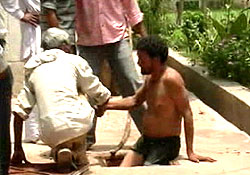
Some images do not disturb

CBI-employed manhole workers in Noida

guest post by S. ANAND

There are times when our critical antennae do not perk up. We do not wish to decode certain signs because we are all implicated in them. Following the 14 September blasts in Delhi, suddenly the media found a new value in ragpickers, street vendors, auto drivers and others who live on the fringes of the city and are generally looked down upon by people who inhabit apartments, blogs, cars (and autos, I must add).

Suddenly, by 15 September, ragpicker Krishna was canonized as a ‘hero’ by the media, the police and the state (the Delhi government claims credit for saving some lives with its ‘eyes and ears’ policy). Yet, Times of India prefaced its report about Krishna thus: Continue reading Some images do not disturb

Mother Kerala

Mother Kerala
Mother Kerala

Continue reading Mother Kerala

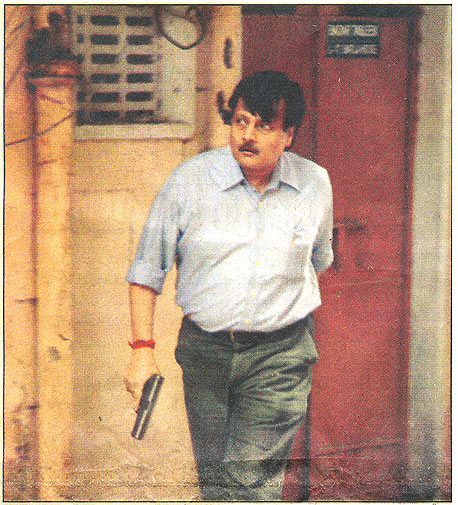
Was it a recce or a planned raid?

DCP Alok Kumar
DCP Alok Kumar

Guest post by AZIZ BURNEY, Editor, Rashtriya Sahara (Urdu), Delhi

It is a truth universally acknowledged that anything viewed from various angles presents various shapes. It is also a fact that your angle of view determines to a large extent the picture registered by your brain. An askew angle of view is bound to distort the picture. Reality defies comprehension without proper perspective. To date, we have not been able to understand what kind of picture the Delhi police is trying to draw in order to explain the incidents of September 19 as they happened. Continue reading Was it a recce or a planned raid?

‘The Best Form of Saying is Doing’ – Ravikumar on Che

Picture by Alberto Korda
This portrait of Ernesto ‘Che’ Guevara, titled "Heroic Guerrilla", is the most reproduced image in the history of photography. Taken in 1960, at the highpoint of the Cuban revolution, by Alberto Korda, it hung for years in his studio before it became the iconic figure of the rebel.

[This is a guest post by well-known Tamil writer RAVIKUMAR on the occasion of Che Guevara’s 40th death anniversary on 9 October. The article was written on the 9th. ]

Ernesto Guevara de la Serna popularly known as ‘ Che’ was born on June 14, 1928 in Argentina. A doctor by profession he involved himself in revolutionary activities from his student days. He was with the political activists of Guatemala when the elected government of Jacob Arbenz was overthrown by a CIA backed coup in 1954. He escaped to Mexico where he met the exiled Cuban revolutionaries led by Fidel Castro. He joined with them in their struggle to liberate Cuba from the Batista regime.

Che was the name his Cuban companeros gave him. It is a popular form of address in Argentina. He sailed with the Cuban revolutionaries in the famous yacht ‘Granma’ as a doctor. Later he was promoted as commander. Che played an important role in the success of the Cuban revolution. He led a guerilla column in the final battle. Finally, Batista fled the country on January 1, 1959.

Continue reading ‘The Best Form of Saying is Doing’ – Ravikumar on Che

Kitnay Mastermind Thay?

When a picture is worth a thousand words. From The Indian Express, 25 September 2008, "Delhi Newsline"
When a picture is worth a thousand words. The Indian Express, 25 Sept 2008, Delhi

While most of the Indian media has politely started using such words as ‘allegedly’ and ‘police officials claim’ Continue reading Kitnay Mastermind Thay?

On Tyranny and the Strauss-Kojeve Correspondences – Prasanta Chakravarty

On June 7, 2007 the opinion page of The New York Times carried a piece by Jenny Strauss Clay, daughter of Leo Strauss. With a candid fervor, she sought to distance her father’s legacy from the masterminds of the neo-conservative ideologues of the American foreign policy. She tells us that Leo Strauss believed in the intrinsic dignity of the political. He believed in and defended liberal democracy; although he was not blind to its flaws. He was an enemy of any regime that aspired to global domination. He despised unworked utopianism—in our time, Nazism and Communism—which is predicated on the denial of a fundamental and even noble feature of human nature: love of one’s own deepest concerns. And yes, Jenny Strauss reminds us that his greatest passions were to raise rabbits (Flemish Giants) and read Plato with his students.

The nephew of Wassily Kandinsky, Alexandre Kojeve/ Kozhevnikov’s seminars on Hegel from 1933-1939 at the Ecole Pratique des Hautes Etudes, as is well known, fundamentally influenced much of modern French thought, including that of Merleau-Ponty and Lacan, Bataille and Althusser, Breton and Queneau—all his students at some point. Kojeve’s thought also philosophically encouraged a different breed of social and political thinkers: Raymond Aron in France, Alan Bloom and Francis Fukuyama in the US, to name a select few. Kojeve himself spent the final 25 years of his life as a trade negotiator and civil servant under de Gaulle and helped establish the European Economic Community (now EU) as a model for his universal and homogenous state.

Continue reading On Tyranny and the Strauss-Kojeve Correspondences – Prasanta Chakravarty

“Madam, we know you’re leaving. Think wisely before coming back”

Continue reading “Madam, we know you’re leaving. Think wisely before coming back”

Under Development: Singur

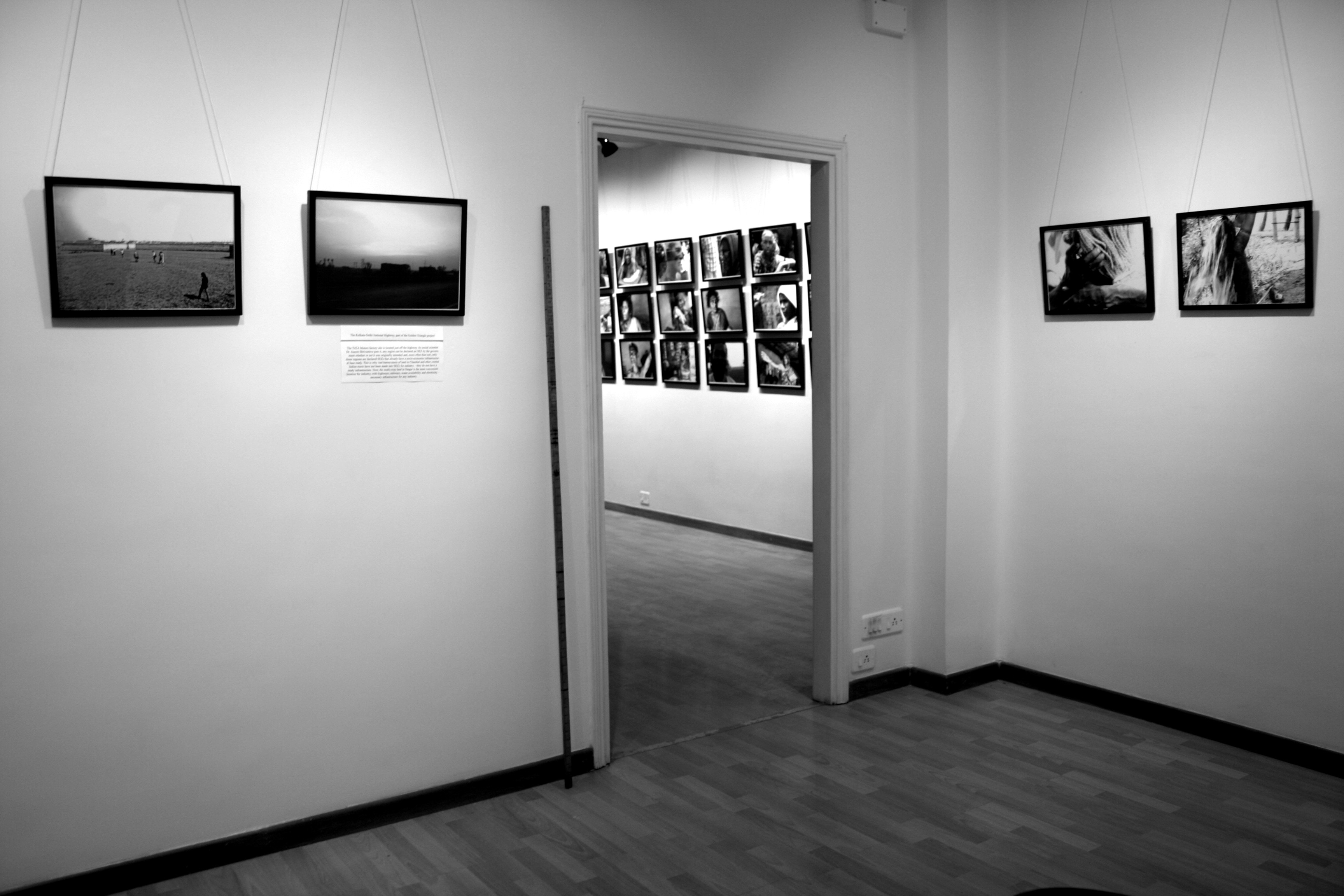
If you are in Kolkata between 27 June and 2 July, you may do well to visit the Seagull Arts and Media Resource Centre, Kolkata, for an exhibition of photographs of Singur. There will also be a panel discussion and a film festival. Continue reading Under Development: Singur

Gomti Nagar to Bundelkhand

It has been over a year since Mayawati came to power in UP and I am absolutely sick of seeing news reports beginning with the comment, “In a state ruled by a Dalit chief minister, a Dalit youth was killed…” This hostility towards Mayawati is ironically couched in the language of ‘Dalit empowerment’, the phrase used so loosely its is completely devoid of meaning. Where were all these reporters and their editorialising and their concern for Dalits when Yadavs were running the state?

What has Mayaywati been doing for Dalits? That question will be answered again and again without talking to a single Dalit. But if you do go looking for something, you will find it. The redoubtable Nilanjana Bose reports: Continue reading Gomti Nagar to Bundelkhand

Broken news

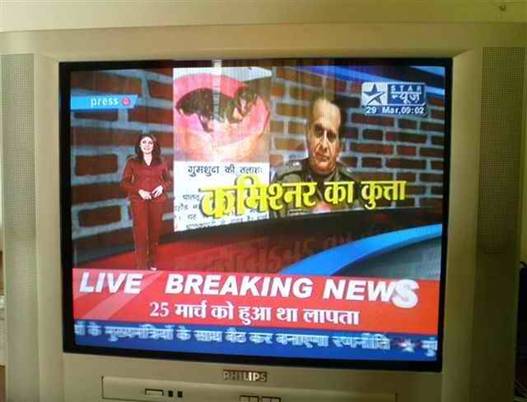
Got these from a friend. Enjoy.


Lost on 25 March, the Delhi police commissioner’s dog was soon found, giving star news an opportunity to ‘break news’ and do a special show replacing a news bulletin. Below: they continued flashing the news and calling it ‘breaking’ even when other news forced itself on to the screen.

Continue reading Broken news

Kavita Srivastava’s report on last year’s Gujjar confrontation in Rajasthan

[This detailed report was prepared by Kavita Srivastava, the Jaipur-based general secretary of the People’s Union for Civil Liberties. Posting this here to make it publicly available as it is not on the PUCL website. Please note that this was a rough draft. ]


State Violence and Caste Confrontation in Rajasthan

I. Outline of the week long movement for ST Reservation by the Gurjars

Soon after independence the Bhil Meenas got reservations in the Districts of Dungarpur, Banswara, Chittorgarh and Udaipur. At the time of 1931 census the Bhil Meenas were over 20, 000, however today they have reduced to half they are only 10,000 in number.

This was an issue of contention for the Meenas as they felt that they also deserved to be STs so they decided to raise their voice against this injustice as they called it. Under the leadership of Lakshmi Narayan Jhirwal they organized themselves.

11th June 1952: Meenas organized a sammelan near Dudu (Jaipur) district for the inclusion of the Meena community in the Schedule list for reservation. The Gurjars supported this wholly. Continue reading Kavita Srivastava’s report on last year’s Gujjar confrontation in Rajasthan

A little Biology, A little Arithmetic, A lot of Politics: Sudhanva Deshpande on Nandigram, again

Dear Sudhanva,

*A Biology Lesson*
The discussion on Nandigram is heading in interesting directions across lists and blogs, (even as the Army walks the talk in Kolkata tonight) and I find this situation of accumulating discursive intensity actually very productive. Let a hundred rejoinders blossom, and a few good schools of thought contend. So I welcome your rejoinder and criticism of my text. And I for one, stand chastised by your incisive criticism of my posts (responding to your earlier writing) on the reader-list, and on Kafila.

Continue reading A little Biology, A little Arithmetic, A lot of Politics: Sudhanva Deshpande on Nandigram, again

Decadent Delight

[Guest post by Gaurav Dikshit]

Sharab, shabab aur kabab. Of these three shauqs of Lucknow’s nawabs (as in the “nawabi by nature”) it is shabab – youth – that Lakhnavis cherish the most, for they know by instinct that it is fleeting. The sense of loss lies at the heart of Lucknow, and the subtitle of Veena Talwar Oldenburg’s anthology Shaam-e-Awadh – “Memories of a dying city” – captures the decadence that has defined the city for much of its existence. Continue reading Decadent Delight

The Lives And Times Of The Asokan Pillar At The Delhi Ridge

Tourists are people in a hurry; they want to pack-in a city in two days, even a city that has taken more than a thousand years to grow. Tourists see buildings as structures, frozen in time, standing aloof, without being part of the ebb and flow of life. Travellers on the other hand come searching for the feel and the spirit of the city. Looking for the lesser known the less explored and the uncelebrated, for it is here that one may find untold histories that lie sheltered under each stone that awaits the explorer.

Beginning with the story of a large piece of rock we launch into an exploration, or shall we say recapitulation, of the almost forgotten stories connected with the less touristy structures and ruins that have been witness to the unfolding of the many histories of Delhi. We begin this series with one of the Two Asokan Pillars erected at Delhi. The pillars were erected at Delhi, not by Asoka who commissioned them in 3rd Century B.C, but by a king who ruled Delhi in the 14th century.

Continue reading The Lives And Times Of The Asokan Pillar At The Delhi Ridge

The Hafta Bazaars of Delhi

The earliest known urban settlement in Delhi, aside from the mythological Indraprasth, called Inderpat by Sayed Ahmad Khan in his Asaar-us-Sanaadeed (1865) and by Bashir-ud-Din Ahmad in his Waqiyat-e-Daar-ul-Hukumat Dehli (1920) (probably to go well with Maripat, Sonipat, Panipat and Baghpat), is believed to have been at or near the present day Mehrauli.

The large number of exiting structures and ruins, both religious and secular, testify to rigorous building activity in this area going back to almost a thousand years or more and continuing during the colonial period. The Quila Rai Pithora, The Shrine of Qutub-ud-Din Bakhtiyar Kaaki, (disciple and successor of Moin-ud-din Chishti and the Peer of Baba Fareed Ganj-e-Shakar), whose presence in this area gave it the honorific Qutub Saheb, the Tomb of Altamash and of Balban, the Hauz-e-Shamsi, the Gandhak ki Baoli and the Rajon-ki-Baoli, Jamali-Kamali or the tomb and mosque of Jamal-ud-Din and Kamal-ud-Din, Adham Khan and Quli Khan’s Tombs, the Rang Mahal, the adjacent mosque and the large number of colonial structures, including several tehsil buildings, a municipal dispensary, the so called Tamarind Court and the Qutub Colonnade are evidence of a thriving Urban settlement.

Continue reading The Hafta Bazaars of Delhi

Shahid Amin on Memory, Media and the Historian’s Practice

[We bring you this piece by well known historian of the Subaltern Studies group, on the media’s hyperactivity on the ‘disclosures’ made by Lady Pamela Mountbatten, as he reflects on the historian’s responsibility. This article was first published in Daily News and Analysis.]

Publishing hype and a contentious presidential election have fortuitously brought two very dissimilar lady residents of the Viceregal House to media attention in the last week. On the same day when we read the details about Pratibha Patil’s victory, an interview was televised with the youngest daughter of Lady and Lord Mountbatten, the last Viceroy and Vicereine of Raisina Hill. Transcripts of the interview, occasioned by the publication of India Remembered: A Personal Account, co-authored by Lady Pamela Hicks, nee
Mountbatten and her daughter, have been carried in several newspapers.

Media-persons have been burning their phone lines trying to get sound bytes from historians about whether or not, ‘in actual fact’, the Edwina-Nehru intense, platonic relationship allowed the Last Viceroy to influence slyly our remarkable first PM. For there were moments, as the author recalls in the interview, when Panditji and the Lady were allowed by the Earl and his daughters to be left alone, “sitting on a sofa in the study or something”.

Continue reading Shahid Amin on Memory, Media and the Historian’s Practice

The Orkut Brahmins

This excerpt from a discussion on the message board of a ‘Brahmin’ community on the social networking site young people spend hours on these days, offered without comment:

T.U.»»: Why do we have Ram’s Picture ?
I know that Ram was one of the avatars of Lord Vishnu, but the thing is Ram was not a Brahmin, he was a Kshatriya..The Raghukul Gotra among Kshatriyas are from Ram’s descendants..So as a Hindu I respect Shri Ram, but as a Brahmin It is lord Vishnu we should worship..what say? Correct me if I am wrong ..

krishna: just a reply……..
well……there r lot many humans to bind in castism man…..keep LORD RAM separate from this stupid concept……GOD don’t have any cast they r above of all this…..
if u say ur a brahmin u shud keep this simple fact in mind that our GOD’s doesn’t come under the concepts of what we brahmins created as CAST………any correction of what ever i said always welcome….thanx
and one more thing LORD vishnu is neighter a kshatriya nor a brahmin…… Continue reading The Orkut Brahmins

We

We is a fast-paced 64 minute documentary that covers the world politics of power, war, corporations, deception and exploitation.

It visualizes the words of Arundhati Roy, specifically her famous Come September speech, where she spoke on such things as the war on terror, corporate globalization, justice and the growing civil unrest.

It’s witty, moving, alarming and quite a lesson in modern history.

We is almost in the style of a continuous music video. The music used sets the pace and serves as wonderful background for the words of Ms. Roy and images of humanity in the world we live all in today.

We is a completely free documentary, created (and released) anonymously on the internet. [www.weroy.org]

But who made it?

“We” is a free documentary produced by an anonymous student in New Zealand. He (or She) goes by the name “anon”. It was released for free on the Internet and first appeared at an Australian web site called resist.com.au.