Category Archives: Feminism

No to ‘Geri Route’, Bekhauf Azadi/ Reclaim the Night in Chandigarh: Janaki Srinivasan

Guest post by JANAKI SRINIVASAN

Reclaim the Night

If you are a resident of Chandigarh and came across pictures of the Bekhauf Azaadi Reclaim the Night and the Streets march of August 11 in the newspapers, it is most likely that you assumed it to be just another routine protest.  Protests in ‘the city beautiful’ do tend to follow a standard template. A small number gather in the Sector 17 plaza, banners are held, a few speeches made, photographs taken and a brief news report gets generated for the inner pages of the city supplement. In a small city, finding a mention in the newspapers is no indicator of the importance of one cause or one protest over others. Over the past decade, the administration has ensured this indifference, by physically redirecting political rallies- any event with the potential for large numbers- away from both government offices and public spaces to the outer perimeter of a severely gridlined map. The ‘Rally Ground’ neighbours the crematorium and the garbage landfill. Yet just as Le Corbusier’s monotonous plan and strict guidelines have been subverted by its residents to infuse vitality and uniqueness to the city, the protest template too sees a rare upheaval. Continue reading No to ‘Geri Route’, Bekhauf Azadi/ Reclaim the Night in Chandigarh: Janaki Srinivasan

Beneath the Veil – Lipstick Under My Burkha and Debates around the Uniform Civil Code (UCC): Debaditya Bhattacharya and Rina Ramdev

Guest post by DEBADITYA BHATTACHARYA and RINA RAMDEV

*Disclaimer: Even as news pours in of Pahlaj Nihalani’s ouster as CBFC chief, consider this essay an earnest tribute to the man who is ‘alleged’ to have beeped sense out of Indian cinema. We repeat, merely ‘alleged’ – since we go on to prove otherwise.*

Let us start out with a basic methodological premise – that forms and effects of ideological mensuration cannot exhaust the life of cinema, or even be adequate to an understanding of the ways in which a film-text lives. To that extent, the ferocious debates around how much or how little of Lipstick Under My Burkha qualifies as feminist material have only generated a fair share of readings. While acknowledging the need and value of these aligned readings, we would also urge a look at cinema’s ‘coming into being’ as something more than an image or a text or a performative medium. Often, in our haste for neat hermeneutic closures, reading a film as cognitive-critical material could tend to a negation of the very relationship between the cinematic object and the everyday. The site of a film’s meaning is necessarily in excess of its narrative unfolding as viewing experience. It lies in the negotiations of its object-world – which includes the plot, the actors, the techniques of representation, the exhibition-settings, the infrastructures of distribution and marketing strategies, discourses around its production and release, celebrity-scandals or pre-release promotions, box-office statistics, publicity routines and review ratings, as well as non-audience expectations – with the other object-worlds of thought, feeling and belief. With that note of ‘methodological caution’, as one might call it, we would argue that a movie like Lipstick is also more than just a story of four women as desiring subjects, grappling with their own bodies to secure the most intimately ‘fundamental’ right to dream.

Continue reading Beneath the Veil – Lipstick Under My Burkha and Debates around the Uniform Civil Code (UCC): Debaditya Bhattacharya and Rina Ramdev

हरियाणा की औरतें घूंघट को शान नहीं मानती: कशिश बदर

Guest post by KASHISH BADAR

हरियाणा सरकार को घू़ंघट पर कुछ बोलने से पहले इन महिलाओं की बात सुन लेनी चाहिए थी.

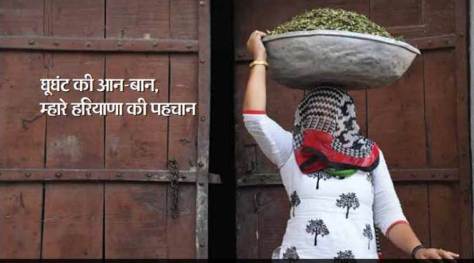
जब हरियाणा सरकार ने अपनी मासिक पत्रिका में एक घूँघट काढ़ी हुई औरत को राज्य की आन, बान और पहचान कहा तो मीडिया में इसका काफ़ी विरोध हुआ. फ़ेस्बुक पर लोगों का यह कहना था कि जब साक्षी मालिक, गीता फोगत, संतोष यादव और कल्पना चावला जैसी औरतें हरियाणा का नाम दुनिया भर में रौशन कर रही हैं, तब भी हरियाणा सरकार क्यूँ घूँघट वाली औरतों को ही अपनी शान समझती है. क्या उन औरतों की मेहनत, लगन और सफलता राज्य की शान नहीं है? क्या सिर्फ़ पुरुष खिलाड़ी ही राज्य को गर्व महसूस करवा सकते हैं?

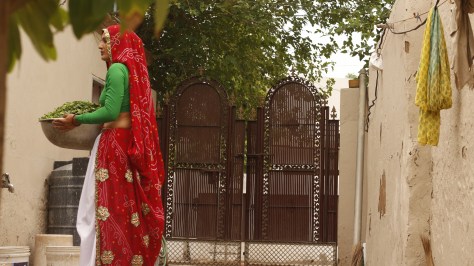
स्वयं हरियाणा की औरतों के इस विषय पर विचार लेने मैं रेवाड़ी ज़िला गयी. वहाँ कुछ औरतों से घूँघट के और उनकी शान के विषय में बात की.


ममता यादव, सेंतिस साल की शादी शुदा औरत हैं.

Continue reading हरियाणा की औरतें घूंघट को शान नहीं मानती: कशिश बदर

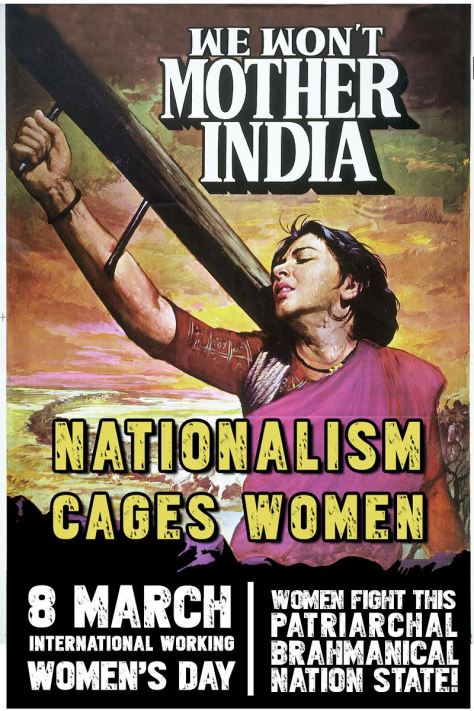
Bharat Mata and her unruly daughters

Bharat Mata’s daughter? But the Hindutvavadi motherland produces only sons – Hindu, savarna sons – to protect their mother’s ever fragile honour.

Let us begin these reflections with a moment from Nisha Pahuja’s disturbing film the World Before Her, which tracks two young women – Ruhi, a beauty pageant contestant and Prachi, a trainer with the Durga Vahini, women’s wing of the Vishwa Hindu Parishad.

While Ruhi and her fellow participants emerge as conventional and pallid, Prachi is fierce and questioning, independent minded. But towards the end of the film, you realize that for both women (and not for Ruhi alone), this period of training was only a small window that gave them a brief glimpse of broader horizons. It was only a brief moment of excitement and hope, and what seemed like freedom, before real life – the real lives of real women – closed in on them.

Throughout the film, Prachi has been telling the film-maker that she will never get married, she will live her life as a Hindutva activist. She emphatically rejects the ordinary life of a wife and mother. But towards the end, her father declares quite explicitly that this is out of the question. She can never be a full time activist. Of course she must get married. She has a womb, do men have wombs? Her responsibility then, is to bring up children. Initially in this sequence, Prachi argues against him vehemently, verges on the insolent, but gradually she falls silent. Her expression, still rebellious, but devastated, resigned, signals to us her recognition that the daughter of the Hindu nation is only in training to be a mother. That is the highest ambition she can have.

Continue reading Bharat Mata and her unruly daughters

A Non-believing Muslim’s Experience of Islamophobia

Guest post by SARAH ATHER

My life has revolved around the concept of God. I have been a Muslim, a theist, an agnostic and an atheist in all types of phases of my life. I am sure, I am still just growing and my perceptions will mature as I grow. My Muslim identity slowly faded when I picked Dawkins and Ayaan Hirsi Ali in my late teens. To put it simply I was a perpetually angry Muslim. Angry at Islam, angry at Wahabism, angry at imposed patriarchy in Islam. I believed religion was so bad for the world, so unscientific. And so I wrote and I discussed with my fellow Hindu friends. They opened their hearts out. A lot of them told me how Muslims were always cruel and misogynistic. And they told me how I was different to see the truth. I felt a sense of moral superiority, I felt I was so unbiased and rational that I could see faults in my own religion. Continue reading A Non-believing Muslim’s Experience of Islamophobia

Beyond Defeatism – Political Parties and the Fight Against Hindutva

The following, necessarily brief, reflections have been sparked off by two recent posts on Kafila – one by Biju Mathew published on 16 April, and the other by CP Geevan, published today. These reflections should not be seen as a response to the positions taken by Biju and/ or Geevan; they are, in fact, more in the way of addressing the central question raised by Biju Mathew’s piece – that of despondency and pessimism that has followed the UP elections and more importantly, the stealthy manner in which Adityanath was installed as the chief minister in the state. Stealthy, because after all, it was amply clear even to the decision makers in BJP, from the very beginning that if they had entered the election campaign with Adityanath as the chief ministerial face, it might have yielded very different results. It was too  big a risk to be undertaken.The real stroke of Modi-fascist genius lay precisely in keeping not just the electorate but also the organizational machinery in the dark and turning it into an advantage.

As it happens, despite the sharpness of Geevan’s comments, my sense, on reading the two pieces, is that there isn’t really as great a divergence on most issues as might appear at first sight.

Continue reading Beyond Defeatism – Political Parties and the Fight Against Hindutva

Scientism, familism and women scientists: V Sujatha

Guest Post by V. SUJATHA

That the first woman to win the Fields Medal for mathematics in 2014 was an Iranian is important to note. Not only because Maryam Mirzakhani is the first woman to make it in the field of mathematics which is considered to be a male bastion[1], but also because her Persian background deserves some attention. There are certain enabling factors in Eastern cultures that facilitate women excel in the hard sciences, in spite of entrenched patriarchy. The point is not that everything is great in the East versus the West, but that cultural stereotypes about women are not homogenous; they vary from culture to culture and produce gender asymmetries with different effects. This is a sociologist’s
delight; let me explain.

During a literature survey in sociology of science, I was pleasantly surprised to see that the figures on women’s entry and achievements in science and technology education (S&T) in the global south were not only not bad, but were better than the countries in the Anglo-Saxon world that offered better civil liberties for women (Sujatha 2015). While there were fewer women in apex positions in the S&T sector and even lesser numbers to receive prestigious awards everywhere in the world, it is a fact that women from erstwhile socialist countries and from Asian and Latin American societies enrolled in larger numbers in science and technology courses and also made it higher in the career ladder in S&T than their counterparts in western Europe and North America.  The literature on women in science however, attributed everything to the ‘glass ceiling effect’ i.e., soft variables like gender bias in the organisational processes. I do not deny it, but it seems to me that this does not explain why the glass ceiling worked differently in some countries. Continue reading Scientism, familism and women scientists: V Sujatha

Sterilization Death Camps in Bilaspur: An Open Letter to the Chhattisgarh Chief Minister by Concerned Citizens

[ This is a letter addressed to Raman Singh, the Chief Minister of Chhattisgarh by several concerned individuals and organizations regarding the impunity with which medical guidelines are put aside by professionals who enjoy the patronage and protection of the state government.]

We, the 138 undersigned individuals and organizations working across the country on health and women’s rights are shocked and dismayed that the case against surgeon Dr. R. K. Gupta has been dismissed by the Hon’ble High Court on grounds that “the alleged act committed by the petitioner was while acting in discharge of his official duty and admittedly no previous sanction was obtained before initiating prosecution case against him”.

The Anita Jha Judicial Enquiry Commission report has clearly pointed out that “It is evident from the facts that in the camps organized on 8.11.2014 and 10.11.2014 there was a breach in the important necessities hence the standard operating procedure were not followed. As a result of which the symptoms of infections were found in post operative female beneficiaries“. It further states that “On the background of deliberation of investigation point number 1 to 3, investigation committee has found following persons Guilty/responsible, functionary, during 08 and 10 November, 2014:- 4.1 For not following standard procedures and for medical negligence by immediate functionary Block Medical Officer, Takhatpur…………….and surgeon who conducted surgery in tubectomy camp at Sakri and Gaurella ( Surgeries were completed by the same surgeon in the both camps)”.

Continue reading Sterilization Death Camps in Bilaspur: An Open Letter to the Chhattisgarh Chief Minister by Concerned Citizens

Our “hormonal outbursts” will be your nightmare! Pinjra Tod

Statement and image by Pinjra Tod

On the eve of International Working Women’s Day, Maneka Gandhi has given a deeply patriarchal, casteist and classist statement to a media channel saying that hostel curfews are necessary as “laxman rekha” for controlling women’s “hormonal outbursts”, that the question of “women’s safety in colleges cannot be solved with just two Bihari guards with dandas”, that there should be separate days for men and women to go to the library at night.

Its clear to us that she has said this today in response to the fact that women students across the country from Benaras to Mumbai, Delhi to Patiala, Lucknow to Hyderabad, Chennai to Ludhiana, Roorkie to Cuttack have come out strongly to assert their presence in the university space and claim over public resources.

Continue reading Our “hormonal outbursts” will be your nightmare! Pinjra Tod

Longing for the Future – Two Days with Penkoottu and AMTU at Kozhikode, Kerala

Kozhikode, Hotel Alakapuri, 4-5 March, 2017.

Kozhikode has always upturned my feelings about the male gaze. It is of course a cheerful, bustling, place, full of fabulously good-looking people of all genders. The cheeriness has a certain effortlessly defiant quality – already evident when you look out of the window as the train from the south pulls into the railway station, and see bright, healthy, merrily-swaying wild flowers raise their heads undefeated by the ferocious summer sun– wild sunflowers in hundreds, magnificent vines of kulamariyan flowers ( literally, ‘over-the-top’ flowers, but known here also, interestingly enough, as Antigone vines), creepers happily, constantly, and untiringly winding over  little piles of rubbish and covering them with short-lived if emphatic trumpets of mauve, lavender, red, yellow, and white.  You pass this eternal artwork-in-progress of the flowers and vines and city trash and enter Kozhikode, but realise that it actually tells you a bit about the men there only when you meet them. Continue reading Longing for the Future – Two Days with Penkoottu and AMTU at Kozhikode, Kerala

March 10th Chalo Nagpur! Women against Manuvaad and Hindutva: Manjula Pradeep

MANJULA PRADEEP on Dalit Camera

http://https://www.youtube.com/watch?v=_vTq711Clc4

Gender Justice In Naga Society – Naga Feminist Reflections: Dolly Kikon

DOLLY KIKON in raiot.in

Dolly Kikon points out that Article 371 (A) is breached also in the ongoing coal mining operations and the oil exploration negotiations in Nagaland. Naga politicians, landowners, village councils, and business families have all interpreted the provision for their benefit to mine for minerals and not be held accountable for the environmental degradation. But it is only when women may enter the decision-making process (and potentially reverse such policies) that Article 371 suddenly becomes sacrosanct.

What is the meaning of gender? What is the meaning of Justice? Which comes first in Naga society and how do we understand it? Like many nationalist societies around the world, the issue of gender justice and rights have remained marginal for a long time. We were told that issues like women’s rights or gender justice could wait till the Naga people gained their freedom. In that context, what did it mean to bestow any kinds of rights on women in Naga society? When terms like gender ‘rights’ and ‘equality’ remains extremely resentful terms for a larger section of powerful Naga traditional bodies, they become meaningless words. I ask these questions in relation to the opposition against 33% reservation that escalated into a violent protest and brought the entire state of Nagaland to a standstill recently. If Naga customary law is seen as the foundation of justice, the exclusion of women from these powerful decision making-bodies negates the entire notion that these are pillars of justice. The Indian state and the male traditional bodies alike are responsible for excluding the Naga women from all spheres of representative political processes. Article 371 (A) is a prime example of the patriarchal nature of the Indian constitution that bestows the Naga male bodies to have full authority and power to interpret customary affairs covering social, religious, and criminal cases.

An Appeal to the Education Minister of Kerala and the Teachers of the University College, Thiruvananthapuram


We, the undersigned, wish to express our dismay and deep concern about the recent violent events at University College, Thiruvananthapuram, which seem to indicate that the rights of college students, especially women students, are seriously compromised in this venerable institution. As women researchers, academics and teachers of Malayali origin, we are deeply disappointed by the responses of the police, the concerned college authorities, and the teachers there. Continue reading An Appeal to the Education Minister of Kerala and the Teachers of the University College, Thiruvananthapuram

Feminists Condemn Opposition To Women’s Reservation In Nagaland Municipal Councils

We, the undersigned women’s organisations and concerned individuals take serious note of the fierce opposition to women’s reservation of 33% seats in Nagaland Municipal Councils by male dominated tribal bodies in Nagaland in the name of protecting their tradition and customary practices that bar women from participating in decision-making bodies. We strongly condemn this anti-woman position of Nagaland Tribes Action Committee (NTAC) that has been formed supposedly to “protect” Naga tribal practices. While NTAC quotes Article 371(A) of the Constitution to assert that they are empowered to make their own laws, they choose to ignore Constitutional principle of equality before law, thus denying the Naga women their electoral rights.

Time and again women’s movements in India have confronted issues of community identity vs the rights of women. In almost every instance, communities and their leaders have chosen to sacrifice the rights of women to safeguard patriarchal practices in the name of tradition and custom. In the present imbroglio NTAC has used threats and violence to prevent women from filing their nominations, or even to withdraw their papers. Through all this, the State government has remained silent spectator and tried to wash its hands off on the issue of women’s representation in local bodies by cancelling the elections to local bodies under pressure from these tribal bodies by merely citing law and order concerns. In the process, the State has become complicit in protecting patriarchal traditions to the detriment of principles of gender equality. What is not being asserted is that Urban Local Bodies are not traditional Naga institutions recognised by Article 371(A) of the Constitution but rather, Constitutional bodies under Part IX of the Constitution over which the traditional Naga bodies have no mandate. Continue reading Feminists Condemn Opposition To Women’s Reservation In Nagaland Municipal Councils

Didi, I Want to Learn the Harmonium and Roam Around Freely: Samhita Barooah

Guest post by SAMHITA BAROOAH

During a visit to the Kishori Mandal at Apne Aap Women Worldwide’s Uttari Rampur Centre in Forbesganj I met some lovely girls. They stayed in the community near the red light area. They were eager to learn new things. They asked me my story of life, “Didi aapki kahani sunao? Aapne kaise yaha tak sangharsh kiya?” I was again very surprised to encounter the subversion of queries. I should have been the one to ask those questions to the girls, but they wanted to know more about me. Perceptual understanding is a perspective rooted in feminist standpoint theory which could apply to any context from the onlooker’s context. For the young girls from the Red Light Area in Forbesganj, I was trapped in some realities which connected me to them. That was why she asked me to share my story of struggle. When I said education enabled me to survive the world around me, they laughed and said that was not their story. They said, “For us we have to get married as soon as we are 18 years old but sometimes even earlier. We just want to enjoy our freedom now in this centre till we get married. After that we do not know what holds true for us.” As women whether we are in the Nat community of Bihar or we are in the liberated spaces of North East India, our identities get defined by our marriage, cultural practices and socialisation. Unbound freedom for women seems to be a misnomer which should be forbidden for women as the evolved souls say.

Continue reading Didi, I Want to Learn the Harmonium and Roam Around Freely: Samhita Barooah

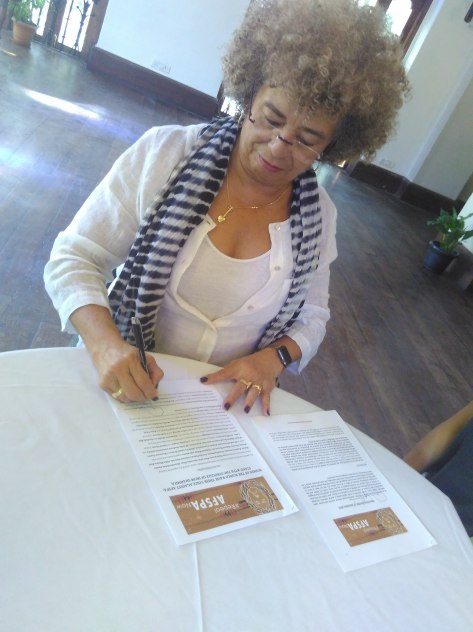
Angela Davis appeals to President to repeal AFSPA

img_20161217_105346

At an exclusive meet-the-press in Mumbai, American black feminist activist and human rights defender, Angela Davis joined feminists in India spearheading a global women’s campaign appealing to the President of India to use his Constitutional powers and repeal the draconian Armed Forces Special Powers Act (AFSPA). In doing so, she extends her solidarity to the struggles of women in India against the impunity granted to security forces under the AFSPA and the consequent widespread violation of rights in all areas where this law has been in force. In particular, Ms Davis salutes the historic struggle of Irom Chanu Sharmila whose 16 year long fast against the AFSPA helped foreground the issue both nationally, and internationally, saying “I am utterly inspired by Irom Sharmila’s strength and perseverance.”

There has been a global campaign of feminists seeking an end to AFSPA.

The full list of signatories can be seen here.

Infantilization of Women in Punjab’s Left: Nikita Azad

Guest post by NIKITA AZAD

It would be an understatement to say that apart from sexualization of young girls, society infantilizes women on a regular basis. Whether in domestic sphere where men decide what is best for the family and women, or office where men consider their women counterparts as less intelligent and inferior, such infantilization manifests itself in various forms and at various places. A similar trend can be observed in movies where men are usually portrayed as saviors whereas women are depicted as young ‘girls’ waiting to be saved. American TV serials from I Love Lucy onwards have routinely infantilized women, and contemporary Hindi soap operas too, represent and treat women as children to be taken care of by their families and husbands/lovers. Such an approach towards women not only reduces their value and identity as thinking, rational human beings, but it also provides men and the patriarchal structure an argument to justify their control over women. It strengthens the general belief that women are inferior, not only biologically but also mentally, and thus, it perpetuates male intellectual hegemony.

In recent times, many white-collar women employees and actresses have spoken against wage gap and workplace discrimination prevalent in their respective fields, which is as much a result of infantilization of women as it is that of gender discrimination. The work done by a woman, however good, is considered inferior as compared to that done by a man, based on the ground that women are more sensitive, emotional, and child-like; and are thus, there are more possibilities of their committing mistakes. Women feminists and non-feminists, who opine on social media on gender discrimination, are often seen as ones who are easily offended and are emotionally immature. Their responses are treated with sexism than with any serious arguments; the reactions are usually perceived as ‘angry’. Their Face Book and twitter accounts are filled with sexually abusive messages and their opinions are seen as having zero or less value when compared to their men counterparts. A good example would be a recent experiment done by a couple on Twitter, whereby a man and a woman, working for the same organization, The Washington Post, published two articles on similar issues but the responses they received were shockingly different. While the man’s inbox was crowded with racist comments, the woman’s inbox was filled with sexist and degrading names that the man could not bring himself to repeat on his post on Twitter.

While the consequences of the sexist practice of infantilization of women have been widely discussed in feminist circles, a study of its presence in otherwise democratic and progressive circles remains absent. Continue reading Infantilization of Women in Punjab’s Left: Nikita Azad

Memories of a Machine, or the Machine of Memory?


Watching the much-debated ten-minute-film ‘Memories of a Machine’, which has been accused of justifying paedophilia, I remembered this woman:

I met her, a young woman professional working at Technopark, Thiruvananthapuram – where else, in these days, but in the queue in front of an ATM . In response to my grumbling, she told me that she had never experienced any kind of power in her whole life.  She had not even been affected by demonetisation much, she insisted. ‘True, I couldn’t pay the dhobi and the ironing-man, but those were minor inconveniences,’ she quipped cheerily, quite convinced, of course, that the predicament of these two people, definitely as much professionals’ as her, was none of her concern. Indeed, her constant effort was to cheer people in the queue with her don’t-worry-be-happy body-language with which she slipped and slid between acting and sounding like a grown woman and chirping and giggling like a teenager or child. She was attracted to the BJP, she said, because she needed some ‘philosophy’ in her life, to balance the heavy workload she carried in her workplace. As far I could see, her life was such that the philosophy-lesson she would find useful could have been obtained from something as commonplace as a treadmill – start slow, peak up, take regular dips, continue for a spell sufficiently long, stretch after the workout. In other words, her life seemed to be just one long workout, with no indication of when it would end or yield result. But just the feeling that she was on her way was enough to make her cheery to the point of being silly. Continue reading Memories of a Machine, or the Machine of Memory?

A Pinjra Tod Winter Afternoon In Jamia Millia Islamia, November 17, 2016

http://https://www.youtube.com/watch?v=ywVKedoofcA&feature=youtu.be

Statement by Pinjra Tod on November 19, 2016

A fiery anonymous open letter by a women resident of Jamia Millia Islamia to the VC on the arbitrary cancellation of late nights in August last year, marks the inception of Pinjra Tod as a movement. It has been an incredible year of reaching out to each other, connecting, discussing and collectivising in Jamia. Overcoming our anxieties of a repressive state machinery intent on criminalising minority voices and institutions, conquering our fear of an administration that has repeatedly targeted students (especially women) for raising their voices, we came together in Jamia last Thursday (17th Nov), drawing confidence from our collective strength, to hold our first ‘public’ event: an exhibition celebrating the struggle of women for education, and a session of poetry, songs and sharing of experiences.

Women students reiterated that the UGC circular issued on 2nd May’16 is being shamelessly flouted by Jamia administration, as in all other Universities and colleges. There are no sexual harassment complaints committee (the program was conducted beneath a huge anti-ragging banner), libraries and other facilities on campus remain inaccessible to women students after 8 PM, random show-cause notices for ‘misconduct’ are a common practice, very little democratic space for women students to organise events/discussions/screenings within hostel spaces and continuous surveillance.

Continue reading A Pinjra Tod Winter Afternoon In Jamia Millia Islamia, November 17, 2016

Indian Muslim women – Caught between misogynists and hypocrites: Sanober Umar

Guest Post by SANOBER UMAR

The ugly patriarchal politics of ‘Triple Talaq’ or unilateral ‘instant divorce’ through which Indian Muslim men (specifically Sunnis who follow the Hanafi school of Islamic jurisprudence), can divorce their wives by pronouncing the word ‘talaq’ thrice in a single sentence, has appeared once again in mainstream politics. In this board game played over Muslim women, you have two main players. On the one hand you have the ever-so-vocal and self-proclaimed representatives of Muslims –  The All Indian Muslim Personal Law Board (AIMPLB) – and on the other hand, you have right-wing public figures of Hindutva, including our very own Prime Minister Mr. Modi, shedding tears of concern for Muslim women’s rights.

However Muslim women should not be deemed as agentless victims in this plot, and many are raising their voice against this practice by asserting their Koranic rights. Nonetheless, it is important to emphasize that while AIMPLB and Hindutva politics may seem to be polar opposites, the two have much more in common when it comes to curbing or denying Muslim women their rights. The male dominated AIMPLB is clearly vested in its project of misogyny even at the cost of denying Muslim women their Islamic right of longer procedures of divorce, that allow time and space for reasonable consideration before annulling a marriage. On the other hand, Hindutva men are no saviours of Muslim women either, as many instances both past and present have shown – including the recent spates of rape and murders (such as the Haryana rapes and murders by Gau Rakshaks and not to forget, the horrifying Muzaffarnagar violence not too long ago).

Continue reading Indian Muslim women – Caught between misogynists and hypocrites: Sanober Umar

The Orphaning of ‘Women’s Collective Interests’ in Kerala


There is considerable outrage in Kerala about how the accused in the murder of the young woman worker Soumya in 2011 has slipped the noose at the Supreme Court. There is considerable doubt remaining on how the murder of the young dalit woman student Jisha was handled by the present government. In both cases, the accused are not men who would earn the sympathy of the Malayali middle-class – in one case, a tamil homeless man, and in the other, a Muslim migrant worker. Not surprisingly, the cry for their blood has been particularly shrill. Outrage at the Supreme Court’s refusal to endorse the lower court’s judgment in the first case is particularly striking – not only because of its loudness, but also because one is unable to forget the Suryanelli case. The difference between the present cases and the Suryanelli case is that in the latter, the victim has been condemned to living death, though she has persistently fought to be heard as a survivor of the most horrific violence. Yet her pleas that the powerful Malayali politician P J Kurien be also tried never roused the kind of outrage was have heard recently. It appears that the Malayali public is kinder to dead violated women than women who survive violation; it also seems harsher towards abjected males than to .powerful males who occupy the pedestal of elite masculinity. Continue reading The Orphaning of ‘Women’s Collective Interests’ in Kerala