Category Archives: Feminism

Feminists Condemn Opposition To Women’s Reservation In Nagaland Municipal Councils

We, the undersigned women’s organisations and concerned individuals take serious note of the fierce opposition to women’s reservation of 33% seats in Nagaland Municipal Councils by male dominated tribal bodies in Nagaland in the name of protecting their tradition and customary practices that bar women from participating in decision-making bodies. We strongly condemn this anti-woman position of Nagaland Tribes Action Committee (NTAC) that has been formed supposedly to “protect” Naga tribal practices. While NTAC quotes Article 371(A) of the Constitution to assert that they are empowered to make their own laws, they choose to ignore Constitutional principle of equality before law, thus denying the Naga women their electoral rights.

Time and again women’s movements in India have confronted issues of community identity vs the rights of women. In almost every instance, communities and their leaders have chosen to sacrifice the rights of women to safeguard patriarchal practices in the name of tradition and custom. In the present imbroglio NTAC has used threats and violence to prevent women from filing their nominations, or even to withdraw their papers. Through all this, the State government has remained silent spectator and tried to wash its hands off on the issue of women’s representation in local bodies by cancelling the elections to local bodies under pressure from these tribal bodies by merely citing law and order concerns. In the process, the State has become complicit in protecting patriarchal traditions to the detriment of principles of gender equality. What is not being asserted is that Urban Local Bodies are not traditional Naga institutions recognised by Article 371(A) of the Constitution but rather, Constitutional bodies under Part IX of the Constitution over which the traditional Naga bodies have no mandate. Continue reading Feminists Condemn Opposition To Women’s Reservation In Nagaland Municipal Councils

Didi, I Want to Learn the Harmonium and Roam Around Freely: Samhita Barooah

Guest post by SAMHITA BAROOAH

During a visit to the Kishori Mandal at Apne Aap Women Worldwide’s Uttari Rampur Centre in Forbesganj I met some lovely girls. They stayed in the community near the red light area. They were eager to learn new things. They asked me my story of life, “Didi aapki kahani sunao? Aapne kaise yaha tak sangharsh kiya?” I was again very surprised to encounter the subversion of queries. I should have been the one to ask those questions to the girls, but they wanted to know more about me. Perceptual understanding is a perspective rooted in feminist standpoint theory which could apply to any context from the onlooker’s context. For the young girls from the Red Light Area in Forbesganj, I was trapped in some realities which connected me to them. That was why she asked me to share my story of struggle. When I said education enabled me to survive the world around me, they laughed and said that was not their story. They said, “For us we have to get married as soon as we are 18 years old but sometimes even earlier. We just want to enjoy our freedom now in this centre till we get married. After that we do not know what holds true for us.” As women whether we are in the Nat community of Bihar or we are in the liberated spaces of North East India, our identities get defined by our marriage, cultural practices and socialisation. Unbound freedom for women seems to be a misnomer which should be forbidden for women as the evolved souls say.

Continue reading Didi, I Want to Learn the Harmonium and Roam Around Freely: Samhita Barooah

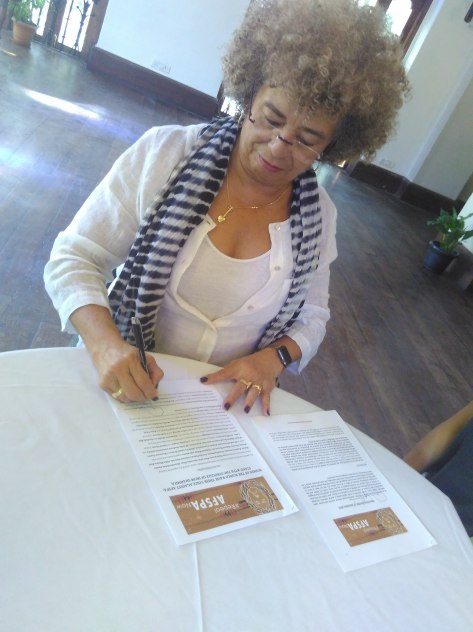
Angela Davis appeals to President to repeal AFSPA

img_20161217_105346

At an exclusive meet-the-press in Mumbai, American black feminist activist and human rights defender, Angela Davis joined feminists in India spearheading a global women’s campaign appealing to the President of India to use his Constitutional powers and repeal the draconian Armed Forces Special Powers Act (AFSPA). In doing so, she extends her solidarity to the struggles of women in India against the impunity granted to security forces under the AFSPA and the consequent widespread violation of rights in all areas where this law has been in force. In particular, Ms Davis salutes the historic struggle of Irom Chanu Sharmila whose 16 year long fast against the AFSPA helped foreground the issue both nationally, and internationally, saying “I am utterly inspired by Irom Sharmila’s strength and perseverance.”

There has been a global campaign of feminists seeking an end to AFSPA.

The full list of signatories can be seen here.

Infantilization of Women in Punjab’s Left: Nikita Azad

Guest post by NIKITA AZAD

It would be an understatement to say that apart from sexualization of young girls, society infantilizes women on a regular basis. Whether in domestic sphere where men decide what is best for the family and women, or office where men consider their women counterparts as less intelligent and inferior, such infantilization manifests itself in various forms and at various places. A similar trend can be observed in movies where men are usually portrayed as saviors whereas women are depicted as young ‘girls’ waiting to be saved. American TV serials from I Love Lucy onwards have routinely infantilized women, and contemporary Hindi soap operas too, represent and treat women as children to be taken care of by their families and husbands/lovers. Such an approach towards women not only reduces their value and identity as thinking, rational human beings, but it also provides men and the patriarchal structure an argument to justify their control over women. It strengthens the general belief that women are inferior, not only biologically but also mentally, and thus, it perpetuates male intellectual hegemony.

In recent times, many white-collar women employees and actresses have spoken against wage gap and workplace discrimination prevalent in their respective fields, which is as much a result of infantilization of women as it is that of gender discrimination. The work done by a woman, however good, is considered inferior as compared to that done by a man, based on the ground that women are more sensitive, emotional, and child-like; and are thus, there are more possibilities of their committing mistakes. Women feminists and non-feminists, who opine on social media on gender discrimination, are often seen as ones who are easily offended and are emotionally immature. Their responses are treated with sexism than with any serious arguments; the reactions are usually perceived as ‘angry’. Their Face Book and twitter accounts are filled with sexually abusive messages and their opinions are seen as having zero or less value when compared to their men counterparts. A good example would be a recent experiment done by a couple on Twitter, whereby a man and a woman, working for the same organization, The Washington Post, published two articles on similar issues but the responses they received were shockingly different. While the man’s inbox was crowded with racist comments, the woman’s inbox was filled with sexist and degrading names that the man could not bring himself to repeat on his post on Twitter.

While the consequences of the sexist practice of infantilization of women have been widely discussed in feminist circles, a study of its presence in otherwise democratic and progressive circles remains absent. Continue reading Infantilization of Women in Punjab’s Left: Nikita Azad

Memories of a Machine, or the Machine of Memory?


Watching the much-debated ten-minute-film ‘Memories of a Machine’, which has been accused of justifying paedophilia, I remembered this woman:

I met her, a young woman professional working at Technopark, Thiruvananthapuram – where else, in these days, but in the queue in front of an ATM . In response to my grumbling, she told me that she had never experienced any kind of power in her whole life.  She had not even been affected by demonetisation much, she insisted. ‘True, I couldn’t pay the dhobi and the ironing-man, but those were minor inconveniences,’ she quipped cheerily, quite convinced, of course, that the predicament of these two people, definitely as much professionals’ as her, was none of her concern. Indeed, her constant effort was to cheer people in the queue with her don’t-worry-be-happy body-language with which she slipped and slid between acting and sounding like a grown woman and chirping and giggling like a teenager or child. She was attracted to the BJP, she said, because she needed some ‘philosophy’ in her life, to balance the heavy workload she carried in her workplace. As far I could see, her life was such that the philosophy-lesson she would find useful could have been obtained from something as commonplace as a treadmill – start slow, peak up, take regular dips, continue for a spell sufficiently long, stretch after the workout. In other words, her life seemed to be just one long workout, with no indication of when it would end or yield result. But just the feeling that she was on her way was enough to make her cheery to the point of being silly. Continue reading Memories of a Machine, or the Machine of Memory?

A Pinjra Tod Winter Afternoon In Jamia Millia Islamia, November 17, 2016

Statement by Pinjra Tod on November 19, 2016

A fiery anonymous open letter by a women resident of Jamia Millia Islamia to the VC on the arbitrary cancellation of late nights in August last year, marks the inception of Pinjra Tod as a movement. It has been an incredible year of reaching out to each other, connecting, discussing and collectivising in Jamia. Overcoming our anxieties of a repressive state machinery intent on criminalising minority voices and institutions, conquering our fear of an administration that has repeatedly targeted students (especially women) for raising their voices, we came together in Jamia last Thursday (17th Nov), drawing confidence from our collective strength, to hold our first ‘public’ event: an exhibition celebrating the struggle of women for education, and a session of poetry, songs and sharing of experiences.

Women students reiterated that the UGC circular issued on 2nd May’16 is being shamelessly flouted by Jamia administration, as in all other Universities and colleges. There are no sexual harassment complaints committee (the program was conducted beneath a huge anti-ragging banner), libraries and other facilities on campus remain inaccessible to women students after 8 PM, random show-cause notices for ‘misconduct’ are a common practice, very little democratic space for women students to organise events/discussions/screenings within hostel spaces and continuous surveillance.

Continue reading A Pinjra Tod Winter Afternoon In Jamia Millia Islamia, November 17, 2016

Indian Muslim women – Caught between misogynists and hypocrites: Sanober Umar

Guest Post by SANOBER UMAR

The ugly patriarchal politics of ‘Triple Talaq’ or unilateral ‘instant divorce’ through which Indian Muslim men (specifically Sunnis who follow the Hanafi school of Islamic jurisprudence), can divorce their wives by pronouncing the word ‘talaq’ thrice in a single sentence, has appeared once again in mainstream politics. In this board game played over Muslim women, you have two main players. On the one hand you have the ever-so-vocal and self-proclaimed representatives of Muslims –  The All Indian Muslim Personal Law Board (AIMPLB) – and on the other hand, you have right-wing public figures of Hindutva, including our very own Prime Minister Mr. Modi, shedding tears of concern for Muslim women’s rights.

However Muslim women should not be deemed as agentless victims in this plot, and many are raising their voice against this practice by asserting their Koranic rights. Nonetheless, it is important to emphasize that while AIMPLB and Hindutva politics may seem to be polar opposites, the two have much more in common when it comes to curbing or denying Muslim women their rights. The male dominated AIMPLB is clearly vested in its project of misogyny even at the cost of denying Muslim women their Islamic right of longer procedures of divorce, that allow time and space for reasonable consideration before annulling a marriage. On the other hand, Hindutva men are no saviours of Muslim women either, as many instances both past and present have shown – including the recent spates of rape and murders (such as the Haryana rapes and murders by Gau Rakshaks and not to forget, the horrifying Muzaffarnagar violence not too long ago).

Continue reading Indian Muslim women – Caught between misogynists and hypocrites: Sanober Umar

The Orphaning of ‘Women’s Collective Interests’ in Kerala


There is considerable outrage in Kerala about how the accused in the murder of the young woman worker Soumya in 2011 has slipped the noose at the Supreme Court. There is considerable doubt remaining on how the murder of the young dalit woman student Jisha was handled by the present government. In both cases, the accused are not men who would earn the sympathy of the Malayali middle-class – in one case, a tamil homeless man, and in the other, a Muslim migrant worker. Not surprisingly, the cry for their blood has been particularly shrill. Outrage at the Supreme Court’s refusal to endorse the lower court’s judgment in the first case is particularly striking – not only because of its loudness, but also because one is unable to forget the Suryanelli case. The difference between the present cases and the Suryanelli case is that in the latter, the victim has been condemned to living death, though she has persistently fought to be heard as a survivor of the most horrific violence. Yet her pleas that the powerful Malayali politician P J Kurien be also tried never roused the kind of outrage was have heard recently. It appears that the Malayali public is kinder to dead violated women than women who survive violation; it also seems harsher towards abjected males than to .powerful males who occupy the pedestal of elite masculinity. Continue reading The Orphaning of ‘Women’s Collective Interests’ in Kerala

Statement against All India Muslim Personal Law Board’s affidavit claiming triple talaq is Islamic: Bebaak Collective

Statement by Hasina Khan, Roshni Rina, Geeta Thatra, Shirin Dalvi  on behalf of Bebaak Collective (Voices of the Fearless).

Contact details: bebaakcollective@gmail.com/ 9870162113

We, as part of women’s movement and practising feminists working with Muslim community and the women of the community for years in India, take the liberty to write this statement condemning the recent affidavit posed by All India Muslim Personal Law Board (AIMPLB). The claims of this affidavit are:

First, abolition of triple talaq is (un) Quranic;

Second, since women lack decision making abilities, it is only men of the community who should have this right;

Third, polygamy is Islamic, though not promoted by Islam, and this practice ensures marital rights for Muslim women, banning of which will result in promiscuous sexual practices or murder of women at the hands of their husbands;

Fourth, the honorable Supreme Court of India has no right to intervene in the religious law of the community.

This statement has been issued by the AIMPLB in the context of the growing number of Muslim women’s petitions challenging the constitutionality of triple talaq in the apex court.

We strongly condemn this statement based on all the four premises.

Continue reading Statement against All India Muslim Personal Law Board’s affidavit claiming triple talaq is Islamic: Bebaak Collective

The Surrogacy Debate and the Missing ART Bill: Chayanika Shah

Guest Post by CHAYANIKA SHAH

Altruistic. Meaning: showing a disinterested and selfless concern for the well-being of others; unselfish.

So once again the government is asking women to be unselfish and show selfless concern for the well being of others. The “others”, however, have been clearly marked. It has to be people within the close family. Women dare not feel selfless or altruistic concern for anyone other than those that are connected to them genetically or through marriage (since that is what defines a family by law and dominant customs). This concern should be so selfless that they should also not worry about their health after the pregnancy, they should not care for the loss of employment or any other changes that may happen in their lives as a result of this concern that they show for a family member. After all we are living in the “Indian ethos” where women are supposed to sacrifice for their “families,” and for none other. And in any case, till very lately, until all these new fangled ideas of women being natural guardians etc. came up, women were giving this altruistic services to their husbands. They are used to it and this is merely an extension of their familial labour. Simple!

It is such a waste of women’s reproductive potential that they bear children just for their husband. The family may as well benefit from the labour of the woman, and it be shared with other family members too. Especially for those who have married as per all the caste and community norms and have even stuck together for five years in spite of not having a child. Why should the hard earned money of “the family” be squandered on someone else? Is that not wasting the potential of women? After all why have we have saved the girl child? So that our boys can have the right girls to marry and also so that we can continue with our eugenic marriage and child bearing practices within the right caste and gotra unions.

Continue reading The Surrogacy Debate and the Missing ART Bill: Chayanika Shah

Regulating the Surrogacy Industry – A Feminist Perspective: Sarojini Nadimpally, Deepa Venktachalam and Sneha Banerjee

Guest Post by SAROJINI NADIMPALLY, DEEPA VENKTACHALAM and SNEHA BANERJEE of SAMA, a resource group for women and health.

The press briefing on commercial surrogacy by Minister of External Affairs Ms  Sushma Swaraj, on 24th August 2016,  did not come as a surprise to many of us who have been advocating for the rights of surrogate mothers and the regulation of the Assisted Reproductive Technology (ART) industry. Many of the points mentioned in her speech were already in the Draft Assisted Reproductive Technologies (Regulation) Bill 2014. Since 2015, the Ministry of Home Affairs (MHA) had stopped issuing visas to foreigners for commissioning a surrogacy. The Supreme Court of India is currently hearing arguments in a Public Interest Litigation (PIL) demanding a prohibition or ban on commercial surrogacy.  In a recent hearing, the Supreme Court asked the government to develop the framework for the regulation of the  ART and surrogacy industry in India.

The latest regulatory move extends prohibitions in place in the draft ART Bill of 2014, banning commercial surrogacy altogether, and permitting only altruistic surrogacy (without payment), and only for one category of people – heterosexual Indian couples who have been married for five years and do not have any children, specifically excluding NRIs. Only close relatives can be surrogates and there are penalties that are absent in the Draft ART Bill of 2014. The draft ART Regulation Bills (2010, 2014) mentioned marriage as a mandatory clause, with ‘couple’ who could access surrogacy arrangements, defined as a man and woman living in a marital relationship for two years; the current Surrogacy Bill says 5 years.

This approach obviously discriminates against queer couples whose marriage is not legal in India; and as for ‘single’ persons – they are persona non grata. This is highly problematic, moralistic and discriminatory. The briefing was an outpouring of the nation-family-culture rhetoric and patronizing morality. We have not read the current Surrogacy Regulation Bill yet as it is not available in the public domain and hence our concerns are based on the media reports.

Continue reading Regulating the Surrogacy Industry – A Feminist Perspective: Sarojini Nadimpally, Deepa Venktachalam and Sneha Banerjee

Statement Of JNU Faculty On Incident Of Sexual Violence On Campus

We, the undersigned faculty members of JNU, express deep shock and dismay at the news that a complaint of rape has been lodged against a JNU student Anmol Ratan (an activist of a left students organisation but since then expelled from it), by another student of JNU. We express our support and solidarity for the complainant and request the JNU community, the administration, and the GSCASH to ensure that the due process of law is allowed to proceed without any hindrance.

It is of primary importance that the health and safety of the complainant be at the centre of all that the university community and the JNU administration does. This necessitates swift action to ensure that the accused (or those acting on his behalf) do not have any opportunity to intimidate, slander, or harm the complainant or the complainant’s witnesses, tamper with evidence or testimony, or otherwise create a campus environment that indulges in victim blaming or casting aspersions on the motives of the complainant.

We are therefore extremely dismayed to know that more than 48 hours after the complaint has been lodged, the accused has yet to be suspended or declared out of bounds from the university, so that safe conditions of complaint and testimony for the complainant may be maintained. We demand that this be done forthwith. This failure to act has tarnished the image of the JNU administration quite severely.

We also recognize the manner in which over the decades, teachers and students have made JNU a space in which women generally feel safe, and also empowered to report cases of sexual violence when these occur. This atmosphere however, has been caricatured in the recent past by sections of the media and by right-wing individuals as one of irresponsible sexual license, which the JNU administration has done nothing to counter.

We are dismayed also by the instrumental use of this case by some organizations on campus to further their political ambitions.

The JNU administration must undertake to cover all medical and legal costs of the complainant. It must fully cooperate with the investigation. So must all other members of the JNU community, as they are likely to have information relevant to the case and conduct of the accused.

As JNU faculty, we reiterate our commitment to building a campus that is safe, democratic, secular and mindful of the dignity of all sections of our community.

 Signed:

Mohan Rao

Rohit

Ayesha Kidwai

Nivedita Menon

Madhu Sahni

Ranjani Mazumdar

V Sujatha

Ritoo Jerath

Supriya Varma Continue reading Statement Of JNU Faculty On Incident Of Sexual Violence On Campus

The Mahmood Farooqui Rape Conviction – A Landmark Verdict: J Devika & Nivedita Menon

This post is jointly written by J DEVIKA and NIVEDITA MENON

Bitter arguments rage within the community that we may term as broadly secular, leftist, even feminist, around the Farooqui judgement – in many ways, this judgement and the case itself, may be to Left politics in India with regard to sexual violence, what “Nandigram” was with regard to the question of land, agriculture and environmental costs of industrialization. That is, the dismantling of an older framework of ethics and politics and the painful emergence of what one hopes will be a new consensus on what constitutes rape, but more importantly, on what the harm of rape and sexual violence is.

The authors of this post have read the judgement and followed the case closely, and that is the basis of our analysis here.

We believe that the judgement and verdict in the Mahmood Farooqui rape case indicates an unmistakeable and important shift in the way in which rape is viewed in a courtroom.

“She was bitter against the accused for committing a sin and taking what was most precious to her i.e her control over her sexuality.”

Judgement in the Mahmood Farooqui rape case

This is a radical break from the dominant discourse on rape. It does not focus on loss of honour or physical hurt as the most deeply felt loss by a rape survivor. It recognises, instead, that “sin” of rape is that it robs a woman of what is most precious to her: control over her own sexuality. Continue reading The Mahmood Farooqui Rape Conviction – A Landmark Verdict: J Devika & Nivedita Menon

A response to “Kashmir is Feminist Issue” by Sonam Mittal: Tupur Chatterjee

Guest Post by Tupur Chatterjee

Sonam Mittal’s recent piece in Kafila, “Kashmir is Feminist Issue” draws upon an oft-cited gendered analogy to describe the Kashmir’s relationship with India and Pakistan. Though it makes a few pertinent points about the nexus of power and patriarchy and the urgent need for Indian feminist solidarity with the Kashmiri resistance, I found the analogy deeply problematic and strongly feel that it needs further unpacking to underline its worrying implications.

Continue reading A response to “Kashmir is Feminist Issue” by Sonam Mittal: Tupur Chatterjee

Where Judges Lead Societies Astray: Bobby Kunhu

This is a guest post by BOBBY KUNHU

Background

That subjective morality influences judicial interpretation of law is a given. But, this influence has to remain within the paradigm set by the law and cannot operate outside it or breaking it. So there are two moralities that effect the outcome of any case, one the morality of the law itself and second how the morality of the judge works in the interpretation of the law. It is in this context that judicial attitude towards sexuality has to be analyzed. And for this first the entrenched patriarchy of the legal profession has to be acknowledged. The best evidence for this is the representation of women at every level of the profession from the bench to senor advocates to advocates on record to the lowest echelons of the bar and judicial bureaucracy.
Indian law with respect to sexuality is in a Victorian time warp. It continues to criminalize any sexual activity that is not penile-vaginal penetration, so much so that till recently when the definition of rape was amended and the Protection of Children from Sexual Offences Act was enacted this was the paradigm of penalizing non-consensual sexual predation. Add to it the ingredients of individual judges’ patriarchy and accumulated religious and social conditioning.

Continue reading Where Judges Lead Societies Astray: Bobby Kunhu

Uniform Civil Code – Once again, where is gender justice?

This article appeared in The Hindu today

For nearly eight decades, the women’s movement has discussed and debated the desirability and feasibility of a Uniform Civil Code (UCC), and has ended up posing a simple question – what is the value of uniformity? Is it for the “integrity of the nation” that uniformity in laws is required, as some judicial pronouncements have suggested?  If so, who exactly is the beneficiary? Which sections of people benefit from “integrity of the nation”, that abstract entity which is not exactly at the top of your mind as your husband throws you out on the street?

Or are uniform laws meant to ensure justice for women in marriage and inheritance?

In that case, a UCC would simply put together the best gender just practices from all Personal Laws. So yes, polygamy and arbitrary divorce would be outlawed (a feature derived from Hindu Personal Law). But conversely, as feminist legal activist Flavia Agnes has often pointed out, a UCC would require the abolition of the Hindu Undivided Family, a legal institution that gives tax benefits only to Hindus, and all citizens of India would have to be governed by the largely gender-just Indian Succession Act, 1925, currently applicable only to Christians and Parsis.

Muslim Personal Law is already modern in this sense, since it has since the 1930s, enshrined individual rights to property, unlike Hindu law, in which the family’s natural condition is assumed to be “joint”. In the decades of the 1930s and 1940s, contrary to later discourses about Muslim law being backward, it was Hindu laws that were considered “backward” and needing to be brought into the modern world of individual property rights. Continue reading Uniform Civil Code – Once again, where is gender justice?

Moral Police-Police!


The Kerala police has once more revealed how utterly unreconstructed it is since colonial times, in their brutal attack on transgender people in the city of Kochi. Stuck in 19th century Victorian morality on the one hand, and in the unabashed sense of power that only colonial authority can bequeath, these policemen thought it perfectly alright to use violence to correct what they perceive as a ‘moral problem’, sex work and that too, by transgendered persons. Continue reading Moral Police-Police!

Love in the Time of Public Despair: Remembering Kamala Surayya

31 May passed like any day in present-day Kerala – filled with the cacophony of mediocrities and expressions of greed, envy, and hate which have become the new normal. No wonder, then, that most people did not remember that this was the poet Kamala Das/Madhavikkutty/ Kamala Surayya’s death anniversary. I cannot help recollecting that I had predicted that this would happen: that people here would celebrate her death, display sickening sentimentality, and then quickly forget. In life and in death, Surayya never received the critical attention that she deserved as a thinker, nor did those interested in progressive left politics take her forays into politics seriously. In these times of despair, one must, however, turn to her …

Read more on:

http://www.thehindubusinessline.com/blink/know/seeking-rhyme-in-reason/article8737506.ece


India vigils in memory of Orlando shooting victims

FROM ORINAM

The mass shooting in Pulse, a gay nightclub in Orlando, Florida, US, on the night of June 11, resonates with those of us who have faced intolerance, hatred and violence simply for being who we are. The lesbian, gay, bi, trans*, intersex, queer, ally and other (LGBTIQA+) communities in India stand in solidarity with the families, biological and chosen, of the victims of this senseless crime.

LGBTIQA+ people have always been at the receiving end of bigots from all faiths, and we register our protest against initiatives by ideologues of all stripes to use this incident to advance political and personal agendas of xenophobia and Islamophobia. Bigotry is a form of violence against a community, and we stand firmly against all attempts to make this part of a global anti-Islam narrative, just as we resist the dastardly celebration of this incident by homophobic groups.

We condemn all forms of hatred and violence, whether based on sexuality, gender, religion, caste or ethnicity.

Protests and vigils are being planned in the following cities and towns.

FOR DETAILS SEE ORINAM.NET

[Statement] Does the “Liberal Cause” need Tejpal? Complainant Responds

Earlier today, the Mid-Day newspaper carried a short piece arguing that the so-called “media trial” of Tarun Tejpal, for raping a junior colleague, had damaged the “liberal” cause, at a time when personal freedoms are under assault in India. The article concluded by hoping that Tejpal would make a “come back” – presumably to save us all from the Big Bad BJP.

The article is not just profoundly misogynist and ignorant, it also conflates all resistance to oppression in its many forms with Tehelka and Tejpal’s transactional and dubious politics.

Here we reproduce the complainant’s response to the Mid-Day piece:

Fighting patriarchy, sexual violence and harassment at the workplace should be the cornerstone of any progressive politics. For TT’s supporters to claim that all should be forgiven because the liberal cause needs him is completely bogus. There was nothing liberal about the source of Tehelka and Think’s funding, or the fact that stories in the newsroom were killed whenever they threatened the editor’s friends.

If Tehelka was so righteous and embattled, how did its editor in chief amass huge properties in Delhi, Goa, Mumbai and Nainital? If a media trial destroyed Tejpal, how does he continue to pay his huge and expensive battery of lawyers? Finally — whom does this delay in the ‘fast track trial’ benefit? What kind of justice should one hope for when wealthy and influential criminals are lobbying with journalists, politicians and industrialists to hold an international conclave under the guise of “liberalism”?


माँ, तुझे सलाम! कविता कृष्णन

अतिथि पोस्ट : कविता कृष्णन

“Scout,” said Atticus, “nigger-lover is just one of those terms that don’t mean anything—like snot-nose. It’s hard to explain—ignorant, trashy people use it when they think somebody’s favoring Negroes over and above themselves. It’s slipped into usage with some people like ourselves, when they want a common, ugly term to label somebody.”

“You aren’t really a nigger-lover, then, are you?”

“I certainly am. I do my best to love everybody… I’m hard put, sometimes—baby, it’s never an insult to be called what somebody thinks is a bad name. It just shows you how poor that person is, it doesn’t hurt you.” (To Kill A Mockingbird, Chapter 11)

‘Now, there is a long and honourable tradition in the gay community and it has stood us in good stead for a very long time. When somebody calls you a name – you take it. And you own it.’ (Pride, 2014)

‘टू किल अ मॉकिंगबर्ड’ उपन्यास 1950 के दशक के अमेरिका के दक्षिणी राज्यों में नस्लवाद की कहानी है. उसमें एक वकील जिनका नाम एटिकस है, एक काले नस्ल के आदमी की पैरवी करते हैं जिस पर बलात्कार का गलत आरोप लगाया गया है. एटिकस की 8 साल की बेटी स्कौट कहती है की गाँव के लोग कह रहे हैं कि मेरे पिताजी ‘हब्शी-प्रेमी’ है. वह पूछती है कि इसका क्या अर्थ है, सुनकर लगता है कोई गाली है, जैसे किसी ने मुझे ‘बन्दर’ कहा हो, पर इसका क्या मतलब है?

Continue reading माँ, तुझे सलाम! कविता कृष्णन