Category Archives: Feminism

Statement by feminists on Facebook campaign to “Name and Shame”

As feminists, we have been part of a long struggle to make visible sexual harassment at the workplace, and have worked with the movement to put in place systems of transparent and just procedures of accountability. We are dismayed by the initiative on Facebook, in which men are being listed and named as sexual harassers with no context or explanation. One or two names of men who have been already found guilty of sexual harassment by due process, are placed on par with unsubstantiated accusations. It worries us that anybody can be named anonymously, with lack of answerability. Where there are genuine complaints, there are institutions and procedures, which we should utilize. We too know the process is harsh and often tilted against the complainant. We remain committed to strengthening these processes. At the same time, abiding by the principles of natural justice, we remain committed to due process, which is fair and just.
This manner of naming can delegitimize the long struggle against sexual harassment, and make our task as feminists more difficult.
We appeal to those who are behind this initiative to withdraw it, and if they wish to pursue complaints, to follow due process, and to be assured that they will be supported by the larger feminist community in their fight for justice.

Ayesha Kidwai

Brinda Bose

Janaki Abraham

Janaki Nair

Kavita Krishnan

Madhu Mehra

Nandini Rao

Nivedita Menon

Pratiksha Baxi

Ranjani Mazumdar

Sabeena Gadihoke

Shikha Jhingan

Shohini Ghosh

Vrinda Grover


Violence against women – two patriarchal judgements: Gargi Mishra and Shreya Munoth

Guest post by GARGI MISHRA AND SHREYA MUNOTH 

Do a woman’s attire, appearance, sexual history or prior relationship with a perpetrator of sexual violence constitute a valid defence for a perpetrator of a sexual offence? Does the meaning of consent vary for educated women? The law, as it stands, doesn’t permit these factors to be taken into account while adjudicating crimes of violence against women nor does it prescribe varying standards. Unfortunately, however, deeply ingrained patriarchal mindsets rear their ugly heads ever so often flouting express statutory proscriptions, most recently demonstrated by two judgments delivered in the last fortnight dealing with rape.

The Punjab and Haryana High Court suspended the sentences of three students granted by the trial court for the rape of another student. The basis for this suspension, amongst others, was the victim’s “misadventures and experiments”, her “promiscuity” and the absence of brutal violence accompanying the sexual assault. Close on the heels of this, the Delhi High Court, on appeal, acquitted Mahmood Farooqui, a filmmaker, overturning the trial court’s verdict of finding him guilty of rape having performed forced oral sex on a visiting woman scholar.  While so doing, the Delhi High Court purposively misinterpreted the position of law on what constitutes consent and seems to have been largely influenced by the victim’s previous relationship with Farooqui, her being educated (a “woman of letters”), the supposed feebleness with which she said ‘no’ to the sexual act, and the fact of Farooqui’s bipolar disorder. Continue reading Violence against women – two patriarchal judgements: Gargi Mishra and Shreya Munoth

Defend the tradition of fighting for the oppressed: Sohail Hashmi writes to the Chief Minister of Kerala

(This is the text of the open letter written by the eminent left cultural activist Sohail Hashmi to Com. Pinarayi Vijayan on the Hadiya case)

Continue reading Defend the tradition of fighting for the oppressed: Sohail Hashmi writes to the Chief Minister of Kerala

Preserve Kerala as the Shining Example of Democracy for India : Prof. Satish Deshpande writes to the Chief Minister of Kerala

(This is the text of the open letter from Prof. Satish Deshpande to the Chief Minister of Kerala on the Hadiya issue. Satish’s work Contemporary India, translated as Samakalika India, has been hugely influential in shaping the progressive understanding of Hindutva nationalism and communal hatred in Kerala.)

<!–more–>

The Honourable Chief Minister of Kerala

Shri Pinarayi Vijayan

6th October, 2017

Respected Sir,

Ever since I first came to Kerala in 1981 to study at the Centre for Development Studies (CDS) at Thiruvanathapuram, I have been a committed supporter of everything that the left tradition of your great state has achieved by way of democratic innovations in governance and social practice. Even today, I believe that Kerala continues to be a shining example in many spheres where the rest of India lags far behind.

I was therefore shocked to read about the Hadiya case and the tacit and explicit state support that underwrite her virtual house arrest today. I am told that the man that Hadiya has chosen to marry and the organisation with which he is associated may have a questionable past. Whatever be the truth of this matter, the fact is that an adult citizen’s personal choices in matters like marriage cannot be undone by the state no matter how ill-considered that choice may appear to others. Moreover, in the current climate, it is surely not irrelevant that the religion in question is Islam – it is highly unlikely that this case would have attracted any attention if Hadiya had chosen to convert to some other religion.

It is highly embarrassing – to the say the least – that a government led by a party that can claim to have played a major role in transforming Kerala society for the better is today seen to be siding with the reactionary forces.

I appeal to you to use the power vested in you by the people of Kerala to end this travesty of justice and ensure that Hadiya is left free to live her life as she chooses.

With best wishes,

Satish Deshpande

(Professor of Sociology, Delhi University)

End the isolation and imprisonment of Hadiya: Feminists write to the Chief Minister of Kerala

[A version of this letter has also been sent to Com. MC Josephine, Chairperson, Kerala State Women’s Commission] Continue reading End the isolation and imprisonment of Hadiya: Feminists write to the Chief Minister of Kerala

Let us rise to the defense of the Indian Constitution: Letter to the Kerala Chief Minister from Prof. Amit Bhaduri

[This is the text of the open letter written by eminent economist and leading development activist Prof. Amit Bhaduri, to Com. Pinarayi Vijayan] Continue reading Let us rise to the defense of the Indian Constitution: Letter to the Kerala Chief Minister from Prof. Amit Bhaduri

Help us resist the Hindutva thought-machine: K Satchidanandan writes to the Chief Minister of Kerala

[This is the text of the open letter written by the eminent poet and public intellectual K Satchidanandan to Com. Pinarayi Vijayan] Continue reading Help us resist the Hindutva thought-machine: K Satchidanandan writes to the Chief Minister of Kerala

Restore Hadiya’s Dignity as an Adult: Prof. Samita Sen to the Chief Minister of Kerala

(This is the text of the open letter from leading women’s studies scholar and renowned feminist intellectual, Prof. Samita Sen, to the Chief Minister of Kerala on the Hadiya case) Continue reading Restore Hadiya’s Dignity as an Adult: Prof. Samita Sen to the Chief Minister of Kerala

Check Hindutva Patriarchy: Prof. Akeel Bilgrami writes to the Chief Minister of Kerala

 (This is the text of the open letter written by the eminent philosopher Prof. Bilgrami, who was honoured by the Government of Kerala a few years back, to Com. Pinarayi Vijayan, on the Hadiya case)
Dear Mr. Vijayan,

You may not remember me from a couple of years ago when you and Prof. Pannikar were kind enough to award me the Social Science Research Prize and attend my lecture on that occasion in Trivandrum. I write out of the blue now —an impertinent liberty— to urge you to intervene in the case of Hadiya where an important constitutional right to choose one’s religion is being violated since, as is well-known, there was absolutely no force exercised upon her in her conversion.   Both Hindutva mischief and patriarchal attitudes are at play in her plight and they need to be strongly resisted.  Moreover it seems to me that the NIA’s being allowed to play a role in this matter is a deplorable interference in the the state of Kerala’s autonomy in the federal system of governance to which our country is committed, and should also be resisted.
  Won’t you please lead the way on this  —your voice, speaking out on all these issues and your support of Hadiya from your position of authority as Chief Minister, will make all the difference.
With my very best wishes,
Akeel Bilgrami
Akeel Bilgrami
Sidney Morgenbesser Professor of Philosophy,
Professor, Committee on Global Thought,
Columbia University,
Tel: 212 316 3458
Fax 212 854 4986

The Left Must Fight for Human Rights: AIPWA to the Chief Minister of Kerala

This is the text of the open letter to Com. Pinarayi Vijayan from Kavita Krishnan, Secretary, All-India Progressive Women’s Association]

Continue reading The Left Must Fight for Human Rights: AIPWA to the Chief Minister of Kerala

Make your report on the human rights violations in the Hadiya case public: AIPWA to the Kerala State Women’s Commission

[This is the text of the open letter to M C Josephine, Chairperson, KSWC, from Kavita Krishnan, Secretary, All-India Progressive Women’s Association]

Continue reading Make your report on the human rights violations in the Hadiya case public: AIPWA to the Kerala State Women’s Commission

Free Hadiya March on 3 Oct: Citizens for Hadiya

On October 3, students, human rights activists, muslim-dalit-adivasi-bahujan organisations from all over India are converging in Thiruvananthapuram to march for the freedom of the twenty-four-year-old Hadiya, who is under virtual house arrest in the home of her father, Mr Asokan after the shocking annulment of her marriage to her chosen partner by the Kerala HC. The march will begin from the Martyr’s Column, Palayam, at 11 AM and end at the Kerala State Government Secretariat junction. Through this we hope to draw the attention of the public to the grave dangers posed by these decisions of the judiciary and by the shameful silence and criminal inaction of the Kerala government , which claims leftist and secular credentials. We invite all to participate in this march and strengthen the hands of those who are fighting to undo this unspeakable violation of justice to an Indian citizen and the gross attack on the fundamentals of Indian democracy. We also request you to kindly change your Facebook profile pictures to Citizens for Hadiya and/or write supporting posts.

Continue reading Free Hadiya March on 3 Oct: Citizens for Hadiya

Feminists say ‘NO’ to recent rape judgments: There is nothing feeble about it

The following is a statement by feminist organisations . To add your name to the statement, please sign in the comments section.

In the wake of the protests following the 2012 Delhi gangrape, India had witnessed a welcome sharpening of understanding around sexual violence and consent. Legal reform recognized the principle of affirmative consent – i.e the principle that consent must be nothing short of an unequivocal positive ‘Yes’ (whether through words or gestures) to engage in a sexual act.

In public discourse and popular understanding too, the understanding that ‘No means No’ had been strengthened. Recent Court verdicts and orders have however dealt a deep blow to this hard-won progressive advance.In the wake of the protests following the 2012 Delhi gangrape, India had witnessed a welcome sharpening of understanding around sexual violence and consent. Legal reform recognized the principle of affirmative consent – i.e the principle that consent must be nothing short of an unequivocal positive ‘Yes’ (whether through words or gestures) to engage in a sexual act. In public discourse and popular understanding too, the understanding that ‘No means No’ had been strengthened. Recent Court verdicts and orders have however dealt a deep blow to this hard-won progressive advance.

Continue reading Feminists say ‘NO’ to recent rape judgments: There is nothing feeble about it

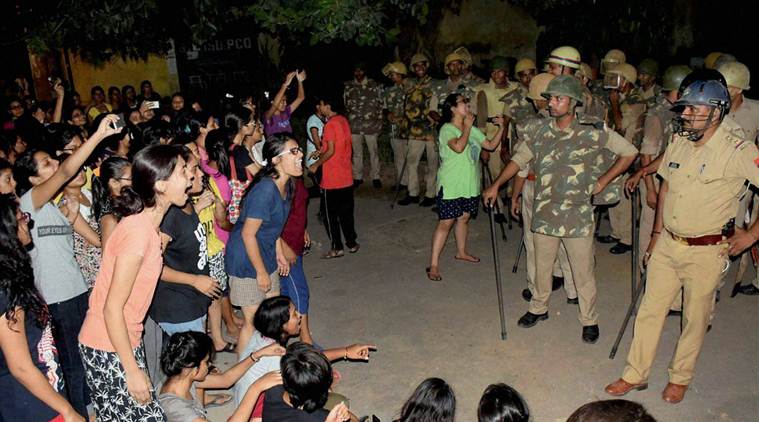
Petition to President of India, Visitor of BHU from Alumni of the University

BHU, Banaras Hindu University, BHU violence, BHU lathicharge, bhu female students protest, BHU lathicharge, Benaras Hindu University, yogi adityanath, bhu students beaten, indian express newsTo

The President of India

Visitor

Banaras Hindu University

Sub : On recent agonising developments in Banaras Hindu University

Dear Sir

We alumni of Banaras Hindu University would like to convey to you our sense of concern about the recent developments at our alma mater namely Banaras Hindu University. Developments which have brought forward the issue of safety and security of girl students on the campus and administrations callous attitude towards it. Continue reading Petition to President of India, Visitor of BHU from Alumni of the University

Cutting the nose to spite the face?

It looks like the CPM’s enmity towards the Muslim organizations is such that they do not mind sacrificing women’s human rights and reinforcing the patriarchal family just to teach them a lesson. So they are happy to stick with the Sanghi understanding of conversion as necessarily forced in some way, ideological or physical. Media One broke news yesterday about a Sanghi torture camp for Hindu women who marry Christians or Muslims concealed as a yoga center. A woman incarcerated there for marrying a Christian managed to escape and complain to the police. Sixty-five women were reportedly incarcerated there when she was an inmate (a later report, after the place was shut down today on the order of the High Court, said 22 women and 23 men were allegedly for reconversion) . The reconversion therapy includes physical assault and threats. This 28-year-old woman married a Christian man without converting and her family seems to have initially accepted it. However, she was taken to this yoga cum counseling center by her own family without her consent and they left her there to the mercy of the criminals who ran the place.  She also confirms that a  young woman, Athira from Kasaragod, who had chosen to convert to Islam on her own who recently ‘returned’ to ‘Sanatana dharma’ with much fanfare, was in this place for twenty-two days and that she had continued to insist on her preference for Islam.

This place is in Tripunithura, in the heart of urban Kerala quite near the High Court at Ernakulam, which damned Hadiya’s right to choose her faith and a partner. Apparently, it is the Sanghi gang from this place who visited Hadiya at her father’s house. Here is the story:

https://youtu.be/ea-rJmuba8I

So it appears that the Sangh is clearly seeking to reverse what is an outcome of long-term social processes shaped by increasing access to higher education for most social groups in Kerala. Women entered higher education here in larger numbers in the 1980s and Muslims, men and women, since the 1990s till now. The expansion of the media and cellphones is such that young people are not influenced solely by their parents or community. In other words, there is a greater livelihood of women and men choosing partners actors communities. Even sensible people here whisper about how zealous Muslims are about conversion away from Islam but the discourse of Hindu tolerance is so pervasive that it lets concentration camp proliferate in secret. The response of the CPM participant is truly revealing — indeed, this is cutting the nose to spite the face. Whatever be their position about welfare and economic development, the CPM in Kerala seems appallingly on the side of the Hindutva security state. And the questions this raises for the fabled autonomy of women here that the CPM ideologues never ceases to claim credit for, are huge.

This is probably the calculation of utility that underlies the chilling indifference/ outright contempt of the CPM leadership towards the plight of the Muslims:  the average CPM and CPI supporter is the middle-caste ex-avarna middle-aged male of the middle or lower middle class. This gentleman’s  preferences are such that his utility is maximised by staying with the organized dominant left in matters related to securing public resources to private ends (because the mobilization for that, given Kerala’s demographics and history needs to be necessarily by a multi-community mix) and by sticking to community/caste organizations for family matters. This choice has always been detrimental to women’s personal rights, particularly personal choices. The community/caste organizations of the 20th century are becoming more of economic institutions than social — and they manage the vast community assets once secured from governments for public ends now securing mainly the interests of the community elite. The social, however, is undergoing rapid transformation, and indeed, sections of the young now even dare to define the social for themselves. Into this gap steps the Sangh, desperate to make an entry, now that their efforts to secure the ex-avarnas have failed (because of their own irremediable casteism). The above-mentioned gentleman finds it prudent to use their services in making sure that the young stay under his patriarchal thumb. Especially young women, for they have nobody to really defend their rights. Thus arise the thriving if silent business of reconversion, well-protected from public view by the pervasive Islamophobia of the Right and Left, believers and rationalists. Also remember that in a post-demographic society, children are few and they are more akin to trophies that future labour for the family. The dominant left sees that as long as they don’t disturb this gentleman’s efforts to secure his patriarchal authority through whatever means, however violent, crude, and abhorrent to democracy they may be, they retain influence. In other words, the tattered influence of the dominant left — no longer hegemonic — endures through, among other things, looking away from the social and the familial as hierarchical institutions and the abuses. This is why a sexual attack on a film actor elicits a huge response from the feminist supporters of the CPM, while the unlawful confinement of a far less privileged young woman is largely ignored or supported ‘personally’.  The dominant left leadership reasons this to be its best strategy, since it loses nothing by letting the Sanghis handle family affairs. The presence of the Sangh works well for it too, since very many Muslims and Christians, who are sizeable in demographic and economic terms, will turn to it for protection from the Sangh!!  This strategy has worked hitherto, and the sole risk lies in the gentleman ceasing to remain a Rational Agent and joining the ranks of the Indo-Gangetic barbarians, essentially irrational in the Kerala context (I keep urging them to leave for Haryana in pursuit of what must be their choices if they choose to become such barbarians). But this has been largely limited to the upper caste Hindus and some sections of elite Christians who regret the loss of traditional power and hope that the Sangh will restore it. They are not the growing power, demographically or economically. Meanwhile, the effete rationalists generate a ‘secularised’ Islamophobia that serves as a neutral-sounding justification for the government’s inactivity.

There are very few moments in which I have felt so lonely. Almost everyone I know seems to be a player, a rational agent, in this game, either participating or creating justifications for the strategy or participating by simply looking away and remaining silent. But this loneliness is so much more dignified — and indeed, more human. I stand with the six young women who braved the Sangh and the police trying to reach Hadiya; I condemn those who serve up her father’s sickening sentimental patriarchal shit in the public in a way that renders them vulnerable. Hadiya’s father who had not the slightest compunction in approaching the High Court and painting his own daughter a potential terrorist such that her entire life promises to be hell (even if she escapes his confinement), is showered with sympathy by our critical intellects for being a poor worried father. Meanwhile, a radical student who claims to be on Hadiya’s side flings abuse on me for wearing a sleeveless blouse, for leaving my hair untied – she does not even notice that her tirade is so like a Brahmanical patriarch’s diatribe against the well-known signs of Kali — immodest women with their hair open — such missiles seem convenient for all, radical Ambedkarites even, to use against those they dislike.  The only silver lining in this mess is that it reveals with unprecedented and astounding clarity,  the enormous risks, dangers, and material losses ahead of anyone who wants to remain human, and not what is substitutable with Artificial Intelligence. And that in order to be popular, you must swim with some tide or the other.  But I’d rather be human than popular, still.

Shame on all of you — AIDWA leaders, Brinda Karat, M S Josephine, C K Asha, Geeta Nazir, Sreemathi teacher, Shylaja teacher — all of you women adherents of the CPM and CPI. If Hadiya dies in that horrible hell, her blood is on your hands. Her rights are already dead and you have done precious little.

 

Judicial Ghar Wapsi : Update on the Hadiya Case

If there is one thing, besides the pervasive Islamophobia in Kerala in both the Left and Right, that the Hadiya case reveals, it is the deeply entrenched commitment to patriarchy everywhere — on the Right, Left, the radical civil society, wherever. Continue reading Judicial Ghar Wapsi : Update on the Hadiya Case

Against the De-politicization of Mental Health- Harassment is Not a Myth: Simple Rajrah

Guest post by SIMPLE RAJRAH

This article is written in response to the article Activism as a blue whale challenge by Manu Joseph that first appeared in Livemint.

“Our love is constructed. Our beliefs colored. Our originality valid through artificial art. It has become truly difficult to love without getting hurt”

Dalit Scholar Rohith Vemula, who was institutionally murdered.

Often academic interests die a quiet death due to crassly political reasons but they die yet again, due to non-recognition and to their relentless reduction to the apolitical. Much as there must be emphasis on seeking solutions to the troubles that humanity is facing, it cannot be ignored that reducing the ‘root’ cause of everything to the realm of ‘apolitical’ can be academically simplistic and politically dangerous.  And why must there be an obsession with relegating everything to the ‘apolitical’ domain? Why do journalists who continually work within political systems still consider depression to be something external to the sphere of politics? Why must there be academicians who discount historicity and complexity by equating violence with counter violence? And why, similarly, must there be politicians who condemn violence on ‘both sides’? Because, even a simple reading of the political should reveal its association with power, challenge its centralization, and more importantly the show up the invisibilization that generates hegemony.

Continue reading Against the De-politicization of Mental Health- Harassment is Not a Myth: Simple Rajrah

Delhi University’s Students Union Elections and the Discreet Charm of Exceptionalism: Rina Ramdev

This is a guest post by RINA RAMDEV


Public discourse on Delhi University’s staging of student union elections typically picks the ubiquitary narratives of money, muscle power and its floutings of Lyngdoh guidelines, year after clamorous year. College campuses, arterial roads and their flooding by posters, both in excess of their expenditure limit (Rs 5000 per candidate) and their prescribed nature (printed, as against handmade), as also the prohibited yet brazen processioneering of SUV armies, are experiences annually played out in tedious familiarity. Mainly configured as a contest between the NSUI and the ABVP (even as the AISA has in its recent resurgence, negotiated a space for Left politics beyond the two party dominance), the Presidential wins and panel sweeps are usually congruent with the dips and surges experienced by their parent political party on the national stage. Continue reading Delhi University’s Students Union Elections and the Discreet Charm of Exceptionalism: Rina Ramdev

हिंदुत्व और निजता का अधिकार : वैभव सिंह

Guest post by VAIBHAV SINGH

सुप्रीम कोर्ट के द्वारा निजता के अधिकार संबंधी फैसले ने निजी बनाम सार्वजनिक, व्यक्ति बनाम समाज, सरकार बनाम नागरिक के द्वैत को फिर बहस के केंद्र में ला दिया है।ऐसा समाज जहां गली-मोहल्लों व गांव-देहातों में निजी जानकारी छिपाने की कोई धारणा न तो रही है, न उसका सम्मान रहा है, उसी समाज में बड़े कारपोरेशन, सरकारी तंत्र व राज्य ने जब निजी जानकारियों का दुरुपयोग करना आरंभ किया तो गहरी प्रतिक्रिया हुई। इसका मनोवैज्ञानिक कारण यह है कि राज्य व बड़े कारपोरेशन्स समाज के लिए ‘बाहरी शक्ति’ के रूप में रहे हैं। वे पराए, अजनबी और अनजान तत्व हैं जो मनुष्य की निजी सूचना जुटा रहे हैं। उनके बाहरी शक्ति और विशाल संरचना होने के बोध ने निजी जानकारी के मुद्दें पर लोगों को उद्वेलित कर दिया। आधार कार्ड, सोशल साइट्स, सरकारी स्कीम आदि कई चीजें ऐसी रही हैं, जिनका सहारा लेकर नागरिकों की निजी जानकारियों मे बड़े पैमाने पर सेंध लगाई जा रही है और उन जानकारियों को निहित स्वार्थ वाले बेचेहरा व अज्ञात समूहों में शेयर किया जा रहा है। ऐसे माहौल में सुप्रीम कोर्ट का ‘राइट टु प्राइवेसी’ को स्वीकृति देते हुए यह कहना काफी मायने रखता है कि अनुच्छेद 21 के तहत जीने के अधिकार की सार्थकता तभी है जब व्यक्ति की गरिमा और निजता की भी रक्षा की जाए। व्यक्ति को यह पता हो कि उसकी निजी जानकारियां किसे, कब और क्यों दी जा रही हैं। कानून या राज्य के पास निजता को समाप्त करने के मकसद से देश का विकास, प्रशासनिक मजबूरी या डेटा-कलेक्शन की जरूरत का तर्क देने का विकल्प नहीं है।कोर्ट ने अपने फैसले में ‘सेक्सुअल ओरियंटेशन’ के बारे में टिप्पणी करते हुए इसे भी निजता के दायरे में रखा है। Continue reading हिंदुत्व और निजता का अधिकार : वैभव सिंह

Women’s groups & concerned individuals welcome Supreme Court judgement on triple talaq

Endorsements are still pouring in for this statement, but we are posting it here with just the first names with which it was sent out.

22 august 2017

We wholeheartedly welcome the judgment of the Hon’ble Supreme Court in the matter of Triple Talaq brought before it by a number of Muslim women and Muslim women’s rights groups. In arguing that the practice of Triple Talaq is both, un-Quranic and Un-Constitutional, it is an important departure from earlier judgments on all women’s rights, because it is based on the tenets of equality, dignity and secularism as enshrined in the Constitution.

As women’s groups and individuals we recognise that the current political climate of communalisation and violence, when the entire Muslim community is under attack in India and much of the Islamophobic world today, makes the fight for minority and gender rights an even more uphill task. Hence we extend our solidarity and salute the courage of the Muslim women who have fought everyday patriarchy within, religious institutions and the family, as well as communal forces to seek justice and equality from the courts.

Even as we celebrate this victory as one that strengthens the fight for secular rights, we are aware that this is but one step in our continued battle against all kinds of patriarchal power and the prevailing political order that seeks to convert this into a majority-minority issue.

In our joint struggles for gender justice in all laws relating to marriage and family, beyond the religious framework, we believe that the Supreme Court judgment on Triple Talaq is an important affirmation of Constitutional values of equality, secularism, pluralism and dignity for all citizens. We hope that this will be the framework in all matters of justice for gender and minority rights.

Hasina Khan, Bebaak Collective
Awaz-e-Niswaan, Mumbai
Saba Khan, Parcham, Mumbai
Parwaaz, Amedabad
Sahiyar, Baroda
Janvikas, Ahmedabad
Hameeda, Sadbhavna Trust, UP
Shabina, Vanangana, UP
Muslim Mahila Manch, Nagpur
Sandhya Gokhale, Forum against Oppression of Women, Mumbai
Chayanika Shah, Labia – A Queer Feminist LBT Collective, Mumbai
Vani Subramanian, Saheli Women’s Resource Centre, New Delhi
Renu Mishra, Association For Advocacy and Legal Initiatives, Lucknow
Kavita Srivastav, Peoples’ Union for Civil Liberties, Jaipur
Rahana Adib, Astitva, UP
Razia Patel, Indian Institute of Minority Education, Pune
Meena Seshu, SANGRAM/Nazariya, Sangli
Swati Sanyal, Swayam, Kolkata
Malobika, Sappho for Equality, A queer feminist activist group, Kolkata
Shyamala Natraj, South India Aids Action Programme, Chennai
Arundhati Dhuru, National Alliance of People’s Movements
Mamata, Humsafar Trust, Lucknow

The Heavy Footsteps of Brahmanical Dandaneethi : The Hadiya Case


It appears that for women in India, the modern judiciary is fading and in its place, the terrifying face of Brahmanical Dandaneethi is emerging. A ten year old rape victim is denied abortion, women fleeing dowry harassment are to submit to the rule of local elders and leaders of ‘family welfare committees’, and now, in the Hadiya case, the judges declared that unmarried daughters should be under their parents according to ‘Indian tradition’.

Read more:   https://thewire.in/169543/hadiya-islam-conversion-supreme-court/