
The ZeTo campaign organisers responded to Althea’s concerns expressed in an earlier post. We are delighted by and thankful for their willingness to dialogue, for we do believe that such an exchange of views is absolutely necessary for common ground to evolve on this issue, precisely because our readings of the political and social present in Kerala, are different.
Continue reading Zero Tolerance or Restorative Justice? Althea responds to ZeToCategory Archives: Government
Response to the Zero Tolerance Campaign against Sexual Violence in Kerala: Althea Women ‘s Friendship
Althea supports DrAsha Achy Joseph’s efforts to oppose the shielding of powerful men so that they may get away with the most egregious sexual violence and harassment.
However, we are wary of the implications of ‘zero tolerance’, given its ambiguous global history. Zero tolerance is not the same as “ending gender-based violence.” It can very quickly devolve into a superficial checkbox for institutions that sounds good on paper and in theory.
Bangladesh in Transition – Understanding Election in the Aftermath of the July Uprising : Sohul Ahmed
Guest post by SOHUL AHMED
[We bring for our readers, this essay by Sohul Ahmed, which details the context and background of the recently held Bangladesh election. Though a cacophony of voices from the Right to the Left in India had already pronounced their shared judgement of an “Islamic takeover” of Bangladesh via the July Uprising, what this essay details the extremely significant political process through which the July Charter was formulated, signed on to by 33 parties, and how the most orderly and peaceful election was held in the country just two weeks ago. This article rebuts the general impression created by this Right-Left propaganda in India that supreme chaos reigns in Bangladesh. Since this article was written, a new government has been formed with a Hindu and a Chakma-Buddhist face each, in the cabinet. The main Islamic party has been trounced in the elections. So much for all the doomsday prophesies about post-July Bangladesh. That does not mean everything is fine – and Ahmed explains the complications that still exist. – AN]
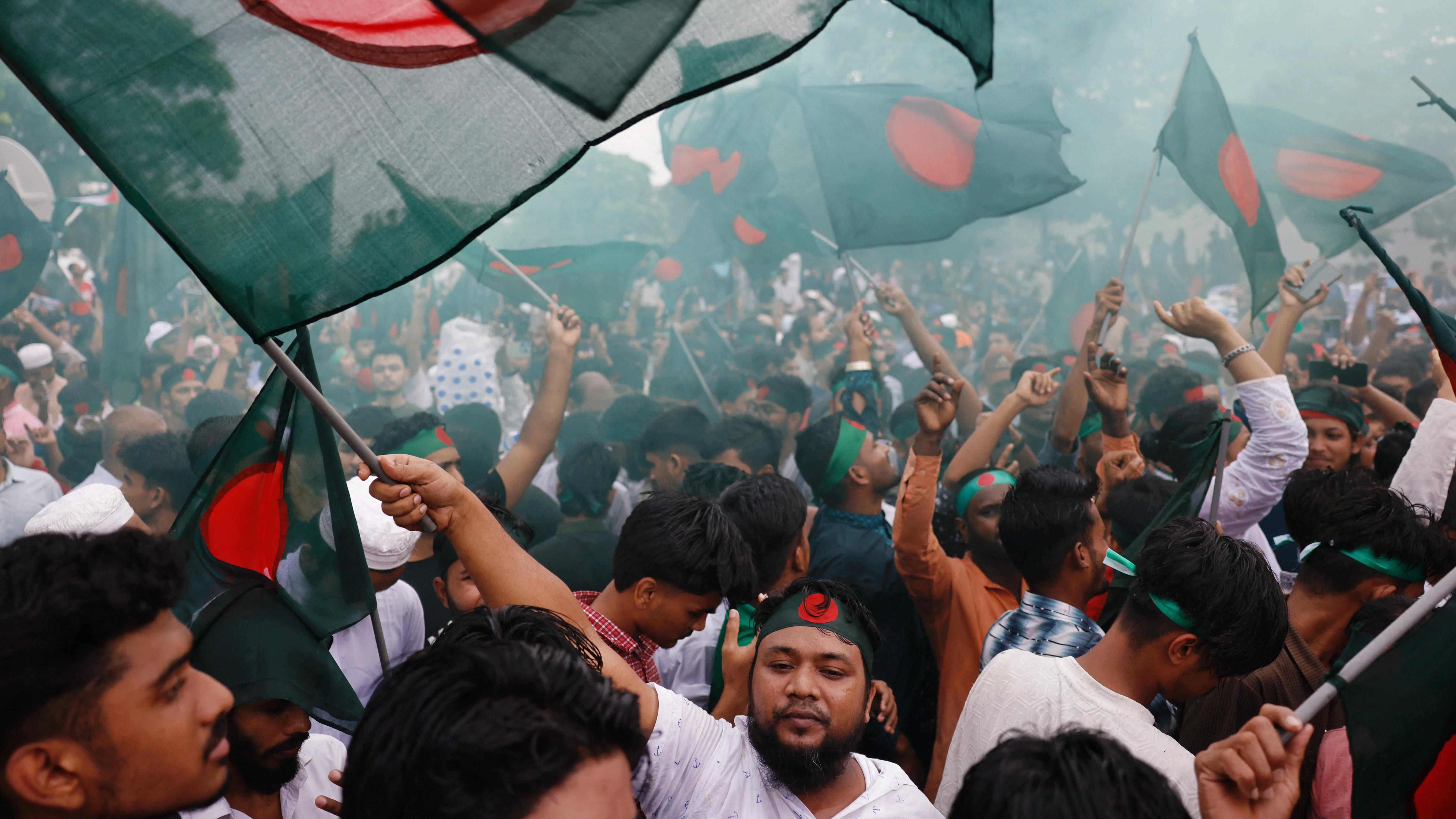
Bangladesh stands at a crucial juncture in its political transition following the July Uprising. The country witnessed its national election almost one and a half years after the ousting of Sheikh Hasina’s autocratic regime – an election widely regarded as one of the most consequential moments in the country’s political history. Our characterization of this election as “crucial” or even “historic” has deep roots in Bangladesh’s recent electoral experience. Continue reading Bangladesh in Transition – Understanding Election in the Aftermath of the July Uprising : Sohul Ahmed
Deal With the Problem, Not the Activists; Control Polluters, Not Those Demanding Accountability! – NACEJ
The National Alliance for Climate and Environmental Justice (NACEJ) strongly condemns the raids, searches, and intimidation of climate activists Harjeet Singh and Sanjay Vashisht by Indian enforcement agencies.
Recent actions by the Enforcement Directorate (ED) and allied agencies—reportedly based on alleged violations of foreign exchange regulations, vague claims of threats to “energy security,” and unsubstantiated intelligence inputs—have been carried out without transparency or disclosure of credible evidence. Public reporting indicates reliance on anonymous official briefings, rumoured intelligence reports, and speculative allegations, with officials unwilling to come on record. Continue reading Deal With the Problem, Not the Activists; Control Polluters, Not Those Demanding Accountability! – NACEJ
An Open Letter to Bhavana and Some Reflections on the Hostile Responses to it: Althea Women’s Friendship
[This letter was written by Gayatri Devi, as the opening segment of the series of analyses that Althea hopes to collectively publish in the wake of the atrocious judgement passed by the Ernakulam Principal Sessions Court, written by the controversial judge Honey M Varghese, exonerating Dileep aka Gopalakrishnan in the actor assault case of 2017. The reflections on Dileep-supporters’ responses to it were written by J Devika.
In 2017, a leading female actor was kidnapped on her way back from work and raped by six men in a moving vehicle on the roads of the city of Kochi. The lead-rapist claimed to her that he was hired to do it. The alleged role of the actor Dileep in commissioning the horrifying act of violence, which was also filmed, has been at the centre of public outrage from 2017 to this day. Dileep’s role seemed to be strongly indicated by circumstantial evidence, however in the course of the trial, the advantages that he enjoyed seemed to surface repeatedly. The whole trial appeared to be an extended punishment of the survivor, and the culmination of it therefore was hardly unexpected. Nevertheless, the public, overwhelmingly with the survivor, has not taken the judgment lightly.
We believe that it is our feminist political responsibility to develop a critical discourse on on the normalization in Kerala of the insecure masculine that Dileep and his supporters represent, over the past three decades. The material we hope to examine includes the judgement itself as well as the many films that Dileep starred in, from the so-called ‘serious’ film he acted in directed by Adoor Gopalakrishnan, to his many slapstick comedies which became popular. The series is anchored by Gayatri Devi, and others will also contribute. This is the first in the series.]
Dearest Bhavana:
When I first heard the verdict in your 2017 case, in my mind, I silently thanked the fortuitousness of your name, “Bhavana.” Your name “Bhavana” means “imagination.” I thanked your name, because I believed that the strength to process the disillusionment and dissatisfaction that beset you upon hearing the wrong verdict was contained in your name. You must remember this fact. You must not forget this fact. You own a precious name. Your name embodies a precious truth.
Continue reading An Open Letter to Bhavana and Some Reflections on the Hostile Responses to it: Althea Women’s FriendshipThe Elite Criminal Man and the Self-Curated Criminal Man: Criminality and Misogyny in the Dileep Case
The verdict in the actor-assault case of 2017, delivered a few day back in the Ernakulam Principal Sessions Court, did not surprise anyone, except the extremely naive. Not just because of the difficulties in proving conspiracies, but also because the trial court seemed so unbelievably biased against the survivor all through and actually in favour of the accused. The man accused of conspiring against the female actor and hiring a gang of thugs to abduct and rape her in a moving vehicle, Dileep aka Gopalakrishnan, is an actor in the Malayalam industry. But he is also accused of being a notorious fixer in the Malayalam movie industry, the go-to person for people who want to get things done — someone who bends things to their will, cuts through all institutional procedure and safeguards using invisible chains of influence and violence. The verdict convicted the six men who actually committed the crime – and declared that the prosecution had not proven Dileep’s involvement in the crime. In other words, the man escaped for entirely technical reasons — or the blind spots of the law.
Continue reading The Elite Criminal Man and the Self-Curated Criminal Man: Criminality and Misogyny in the Dileep CaseBeware of Aadhaar – A Warning on India’s Biometric Identity Model: Statement by Organizations and Concerned Individuals
Following is a statement issued on 10 December 2025, by over 50 organizations and 200 plus individuals on the reported adoption of the “Aadhar model” by some other countries.
We, concerned Indian citizens and organisations, are alarmed to note that efforts are being made to promote biometric identity systems similar to Aadhaar in other countries.
Aadhaar is India’s unique identity number, linked with a person’s biometrics (fingerprints, iris and photograph as of now). The number was rolled out with fanfare from 2009 onwards. The use of this number, and of Aadhaar-based biometric authentication (ABBA), was promoted to the hilt by the Indian government in close collaboration with the IT industry. Aadhaar was supposed to be voluntary, but it quickly became clear that living without it would be very difficult for most. Today, it is as good as compulsory. Most social benefits are out of reach without Aadhaar.
Aadhaar was rolled out in an explicitly “evangelistic” mode from day one. In recent years, it has been projected as a grand success by its promoters. Their friends in high places (like Davos, the World Bank, and the B&M Gates Foundation) are on board. There is an attempt, partly successful already, to project Aadhaar as a model and “export” it to other countries. Continue reading Beware of Aadhaar – A Warning on India’s Biometric Identity Model: Statement by Organizations and Concerned Individuals
Wildlife-Human Conflict – Non-intervention is No Longer a Choice: Sandeep Menon
Guest post by SANDEEP MENON
[Earlier this year, Kerala government sought the permission of the central government to kill wild animals that “post a threat to life and property”, declaring human-wildlife conflict a state-specific disaster. As wildlife-human conflicts rage with a new intensity across different parts of India, the author underlines the need to go beyond knee-jerk reactions and put in place proper policy measures. The issue itself is highly controversial and even emotive and we present this essay here to put things in perspective and proposes some measures that are currently being debated among wildlife enthusiasts. – AN]
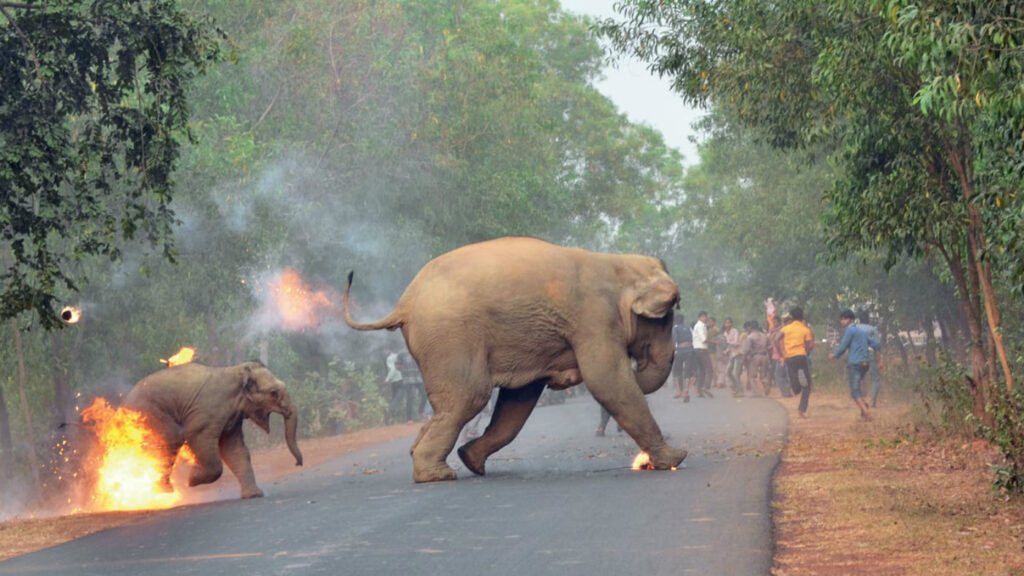
On the 24th of Nov 2025, a 70-year-old Adivasi woman was tending her goats on revenue lands near Masinagudi in Tamil Nadu, when she was killed and dragged into the bushes by a Tiger. It paid little heed to the shouts of witnesses who saw it moving the body to a nearby waterhole. Between late October and November, multiple attacks on people and livestock were reported from the Nugu region near Nagarhole in Karnataka, leaving 3 farmers dead and one critically injured. Including one farmer who had just recovered from a broken hip bone caused by an earlier elephant attack. In response to intense public pressure, over 23 tigers (including many cubs) have been captured from non-forest areas in a span of one month. A huge number for a small rural landscape around two sanctuaries. In many cases, operations were hindered by mobs, who screamed and pelted stones upon sighting the animal, leading to heightened aggression. One of the tigers was found to have a festering snare wound, while another was the mother of 5 healthy cubs. Things took an interesting turn, when experts found it hard to match one of the Tigresses to existing wildlife databases. Raising the possibility that she might have been completely raised outside protected areas. Nor were they all transitionary, weak or infirm animals. Some of them were found to be healthy individuals, simply finding new spaces to eke out a living. It is unclear what the department intends to do with all the captured tigers and cubs. If they end up in captivity, that would be a tragic outcome that serves neither the individual animal nor the species. Continue reading Wildlife-Human Conflict – Non-intervention is No Longer a Choice: Sandeep Menon
Remember the Children: The Palathayi Case in Kerala and the Need for Urgent Changes in POCSO laws: Althea Women’s Friendship
[The ‘Palathayi’ case refers to a shocking instance of child abuse — of a 10-year-old female child in Palathayi, Kerala, by her school teacher, K Padmarajan, a noted BJP leader. Not just the act, but also the way in which the police and the ruling CPM handled it contributed to the public outrage around it. Worse, the child counselors’ role in intimidating the child, bombarding it with invasive, sexualised and irrelevant leading questions, and the police’s long interrogations, revealed, once again, the terrible rot in Kerala’s child protection machinery. The police investigation proved extremely biased in favour of the accused, and the team had to be replaced after protests by activists including feminists, and the family’s pleas. Despite complaints by the child’s mother against the counselors, the higher authorities, including the much-romanticized Minister for Women and Children of that time, K K Shailaja, did little to deliver justice. The verdict of the court in this case which sentenced the accused to life imprisonment, condemned the counselors’ questioning and asked for immediate action against them. The counselor was suspended after the verdict, but suspension hardly suffices as a punishment form blatant verbal rape of a ten year old.
Althea has been raising concerns about the state of child welfare, especially of female children from historically-marginalized social groups and family circumstances in Kerala even before. It is apparent that we need to keep speaking about it, and we will. This statement appeared first in the Malayalam online journal Truecopy Think. This is a translation of the original Malayalam statement by Gayatri Devi, who is part of Althea.]
Continue reading Remember the Children: The Palathayi Case in Kerala and the Need for Urgent Changes in POCSO laws: Althea Women’s FriendshipWe Will Fight, We Will Win: ASHA Workers Vow to Continue the Protest
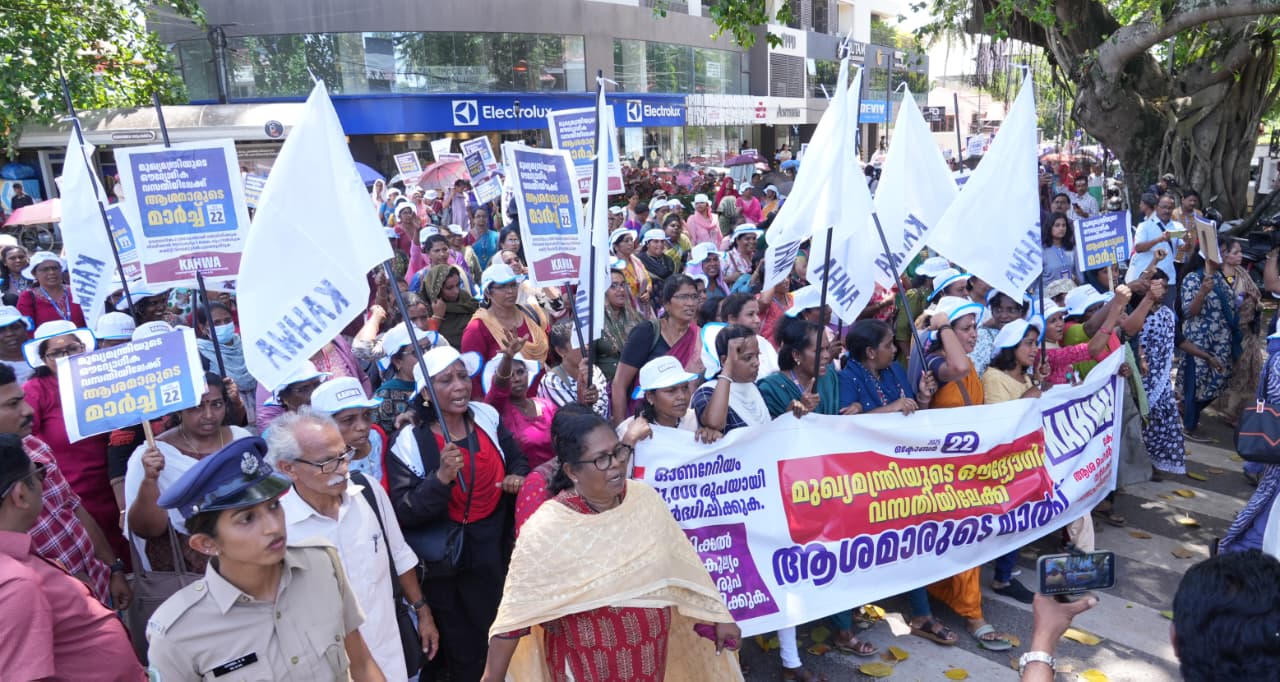
Today, exactly 266 days after it began, the ASHA workers’ protest led by the Kerala ASHA Health Workers’ Association vowed to continue the protest in a new form. Since the evening before, news channels and in the morning, newspapers, were claiming that the protest had ‘ended’ or was going to be ‘wound up.’ The meeting the KAHWA organised in front of the State Secretariat in Thiruvananthapuram was both a celebration of the victory the workers had secured over the hubris of the CPM and its lord and master, the Chief Minister of Kerala. But more importantly, it was a declaration of the workers’ determination to continue the struggle. The local body elections are imminent, and the protesting workers intend to turn their grievance into a campaign issue.
Continue reading We Will Fight, We Will Win: ASHA Workers Vow to Continue the ProtestIs Kerala a Destitute-free State or Extreme Poverty-free State?
[Below is the English Version of a Public Statement in Malayalam released by a group of concerned economists and social activists that appeared in the Malayalam and Kerala-based English Newspapers today (31 October 2025)]
Background: The Government of Kerala have been preparing to declare the State of Kerala as India’s First Extreme Poverty-Free State on 1 November, 2025 being the State formation day. Th government claims that this achievement was attained through sustained efforts to eradicate extreme poverty in the state since July 2021, with just 64,006 extremely-poor families identified through a survey conducted by the Kudumbashree Mission and the Panchayats and Municipalities. The criteria used, as the government claims, were (i) households with no income, (ii) not even food for two times a day, (ii) those unable to cook food even with food articles available from ration shops, and (iv) those with very bad health conditions. This makes Kerala the first state in India to attain the two Sustainable Development Goals of No Poverty and No Hunger. However, this raises a number of crucial questions. It is in this background the following public statement was issued.
Continue reading Is Kerala a Destitute-free State or Extreme Poverty-free State?Countering Propaganda against the ASHA Workers’ Struggle in Kerala: A Response by Anamika A. and others
Rejoinder written collectively by Anamika A, Archana Ravi, Ayana Krishna D, J Devika, Divya G S, Gayatri Devi, Shraddha Jain, Shradha S and Srimanjori Guha
[This piece was written in response to a flagrant misrepresentation of the ASHA workers’ ongoing struggle in Kerala, by Binitha Thampi and Varsha Prasad, which appeared in the Economic and Political Weekly early this month, titled “Labouring on the Margins: ASHA Workers’ Protests in Kerala and Working-class Solidarities” (Oct.4, 2025, LX, 40, 13-17). A group of us — scholars, activists, artists and others who have been closely following the struggle since its beginning — wrote a rejoinder to it. The EPW editor verbally agreed to consider it, but the edit desk insisted that it be subjected to the same peer-review process (as their special articles, it seemed). Commentary pieces, as those who have published in the EPW earlier know, were dealt with at the editorial desk, and the editor was back then obviously competent to judge whether a rejoinder to a commentary piece was a fair one or not. Now that seemingly requires a review process! That does not suit us simply because this atrocious piece of slander is aimed at an ongoing struggle, at the lives of struggling women workers, by other women steeped in academic, social, and political privilege. There is, then, the need to respond quickly, to defend the struggle from the verbal equivalent of a shower of stones thrown at it. At the same time, the very fact that B Thampi’s and V Prasad’s piece, which parrots the CPM troll position in each line and trips over themselves several times empirically and theoretically, has clearly not been subjected to peer-review by the same EPW editorial, for it would definitely would not have got published like it is now — biased in the extreme.
Continue reading Countering Propaganda against the ASHA Workers’ Struggle in Kerala: A Response by Anamika A. and othersRising international Student migration from India: ‘Mad rush’ or reflection of the domestic labour market situation? : Shraddha Jain
On 21 September 2025, The New Indian Express published an interview with Professor Irudaya Rajan about migration patterns from Kerala where the Professor characterised the rising trend of student migration from Kerala as a ‘mad rush’ and said that young people fail and don’t benefit much from migration. He also said that overseas employment as care providers, a growing form of employment in the developed countries, was a form of ‘slavery’.
Continue reading Rising international Student migration from India: ‘Mad rush’ or reflection of the domestic labour market situation? : Shraddha JainDo not Steal Our Voices, Mr Vijayan! The ASHA Workers’ March to the Chief Minister’s Residence
Dear Mr Vijayan
Yesterday, the protesting ASHA workers marched to your residence in the pouring rain, seeking to rouse you from your utterly inexcusable stupor. Yes, over the past eight months, you tried to first crush the strike, and then to kill it by ignoring it. Who does not know that the worst form of violence is indifference?
Photo credits : Shradha S, Harsh, Ashna Thambi, Santhosh Nilakkal.
Rotting Civil Society, Mounting Insecurity: Understanding Hijabophobia in Kerala
Last week, when most mainstream media was in the middle of yet another paroxysmal bout of Islamophobia over a thirteen-year-old child’s wish to wear the hijab to school, I was thinking: why is hijabophobia the most acceptable manifestation of the hatred of Islam in Kerala? Why is it that it seems to provoke many non-Muslim women to the point of anti-Muslim hysteria?
Continue reading Rotting Civil Society, Mounting Insecurity: Understanding Hijabophobia in KeralaFinally, an Answer to Why Kerala’s CPM-led Government is Determined to Break the ASHA Workers’ Strike
Finally, I am able to understand why the government of Kerala, led by a leading communist party, the CPM, is so doggedly against the demands of Kerala’s internationally-celebrated ground-level women health workers — the ASHA workers — who have been on strike since February 2025.
Continue reading Finally, an Answer to Why Kerala’s CPM-led Government is Determined to Break the ASHA Workers’ StrikeBooks as Crime ? – Whether J and K High-court Will End the ’Unprecedented Situation’ ?
‘So you are the little woman who wrote the book that made this great (American) civil war’
— Abraham Lincoln to Harriet Beecher Stowe, author of Uncle Tom’s Cabin
The Writers’ Police !
Bruno Fulgini, a nondescript employee at the French Parliament, would not have imagined in his wildest dreams that his tedious and boring job at the Parliament library would lead him to a treasure hunt of another kind.
Nearly two decades back one witnessed him metamorphose into an author and editor, thanks to the sudden discovery of old files of the Paris police, which provided details of its surveillance work done way back in 18 th century. A report filed by AFP then, quotes Fulgini tell us that ’Beyond criminals and political figures, there are files on writers and artists. In some cases, they go far in their indiscretions.’….
It was clear to these protectors of internal security of a tottering regime that the renowned literati then viz. Victor Hugo, Balzac or Charles Dickens, might be writing fiction, but their sharp focus on the hypocrisy of the aristocrats or the livelihood issues of ordinary people is adding to the growing turmoil in the country. They knew very well that they might be writing fiction for the masses but it is turning out to be a sharp political edge that hit the right target and is becoming a catalyst for change.
The Parisian police was engaged in tracking down the daily movements of the writers, was more subtle in its actions; its present-day counterparts in the West do not seem to have such patience.
The strongest democracy in the world namely the US has of late become a site of an ’unprecedented’ ’Multi-level barrage of US book bans’ as per PEN America [1]….
And now there are indications that the biggest democracy in the World namely India is keen to follow the footsteps of the strongest democracy ?
Or it is too early to say that .[ Read the full article here : http://mainstreamweekly.net/article16227.html
Punjab: Why Proposed ‘Law Against Blasphemy’ Needs to be Discarded
The CCG’s concern that the proposed PPOHS Act is ‘unconstitutional’ and is an ‘open invitation to ‘oppressive misuse’ needs to be heeded.
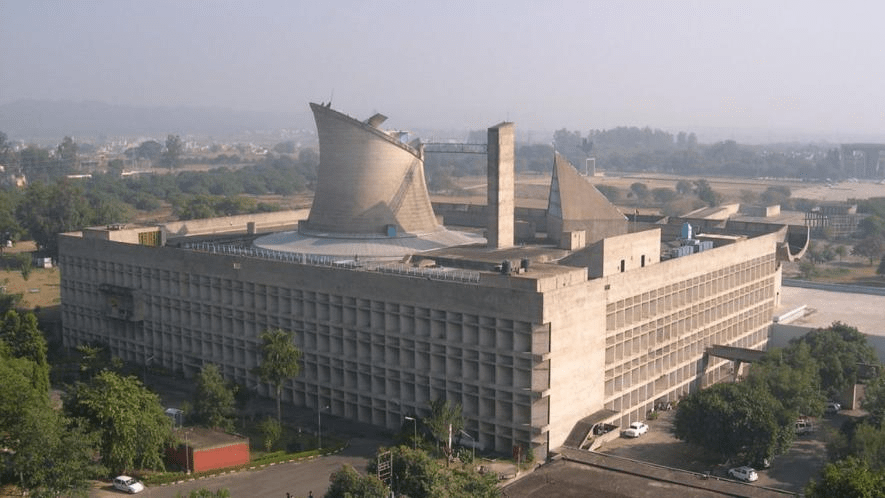
Image : Courtesy Fiickr
Whether history will repeat itself, that is the question being asked about Punjab government’s renewed attempt to enact a law supposedly against ‘sacrilege’?
Anyone who is a keen observer of the social-political developments in the state knows very well that it has a history of such efforts (2015 and 2018) where similar attempts were made to amend laws related to sacrilege, and both attempts proved unsuccessful as they failed on the yardstick of constitutionality.
As per reports, the proposed Punjab Prevention of Offences against Holy Scriptures Bill, 2025 (PPOHS Act), which was recently referred by the state legislature to a committee for further discussion, has come under the scanner of experts of the Constitution and concerned citizens.
A leading voice among them, namely the Constitutional Conduct Group (CCG) — a platform of retired civil servants and diplomats– has in an open communication underlined how Punjab government’s proposed ‘PPOHS Act’ is ‘unconstitutional’ and is an ‘open invitation to oppressive misuse’ .
[ Read the full article here : https://www.newsclick.in/punjab-why-proposed-law-against-blasphemy-needs-be-discarded]
Not Another Salacious Sex Scandal, Please: Althea Women’s Collective Statement on Mainstream Public Discussions of Complaints against Rahul Mankoottathil
[ A translation of the statement from the Kerala Feminist Forum is appended to ours. Both are translated by Gayatri Devi, a member of Althea.]
The way political parties and mainstream media in Kerala have framed the public discussion on the complaints against Rahul Mankoottathil comes as a real shock to anyone who sees Malayali women as citizens with equal rights and equal dignity, and to those who are committed to the welfare of children.
Continue reading Not Another Salacious Sex Scandal, Please: Althea Women’s Collective Statement on Mainstream Public Discussions of Complaints against Rahul MankoottathilWhen Police Comes Visiting Bookshops!
How saffron forces weaponise ignorance and stigmatise intellectauls

Silence gives consent
[Qui tacet consentire videtur – In Latin]
“Intellectual terrorists” are “more dangerous than cross-border terrorists”
These were the pearls of wisdom of the then Human Resource Development minister, who was addressing a conference of the Bharatiya Janata Yuva Morcha (December 19, 2001). Murli Manohar Joshi had even asked the ‘nationalist youths’ to counter ‘both types of terrorism effectively.’
…It would be 25 years soon since these objectionable remarks were targeted at India’s topmost historians, scholars, public intellectuals, even provoking followers to deal with them effectively’ like the way they deal with ‘cross border terrorists.’
Later commenting on these controversial remarks, the legendary historian Romila Thapar had famously said: ‘And then the government fell. But the books continued!”
Time for Thought Police?
As everybody can see, there is a sea change in the situation since the past more than a decade in this part of South Asia…
…..The target of attacks has now become broader, more expansive and more unpredictable. It is no longer restricted to ‘leftist’ ‘progressive’ writers, historians.
The recent move to ban 25 books on Kashmir history at a single go ‘for propagating false narrative and secessionism‘ — written by a spectrum of national and international scholars — which even do not share a similar world view, books which had been in circulation for years, even decades together is a case in point.
This list of authors includes, A G Noorani, Arundhati Roy, Anuradha Bhasin, Sumanta Bose, Victoria Schofield and several others… [Read the full article here : https://www.newsclick.in/when-police-comes-visiting-bookshops]
A Strategy for India’s Tryst with Its Destiny : Arun Maira
Democracy Dialogues Lecture 41
Organised by New Socialist Initiative
Title: A Strategy for India’s Tryst with Its Destiny
Speaker: Arun Maira, Author, Thinker, Former Member of the Planning Commission of India
Date and Time: August 31, 2025, 6 PM IST
The lectures are also live streamed at facebook.com/newsocialistinitiative.nsi
Abstract:
I will share what I have learned about the process of transforming complex systems, the changes necessary in ideologies, and in the way in which public policies are being made, for India to progress towards its vision of poorna swaraj. The following points indicate an outline of the argument I plan to make in the talk:
• Global governance has broken down. The world is in disorder.
• India is strategically vulnerable. It is a long way off from its ‘tryst with destiny’ of poorna swaraj.
• India must become much more self-reliant, and less dependent on the US and China to protect its strategic autonomy. It must find its own democratic path to strengthen its society and economy. The US (and the West) cannot provide a blueprint.
• Development and progress are processes of learning.
• Nations are complex ‘self-adaptive’ systems.
• Power and wealth in a system accumulate by a process of cumulative causation.
• The process of change must be democratic for new ideas to emerge.
I have explained such ideas in my book, Reimagining India’s Economy: The Road to a More Equitable Society, published this year, and in some previous books.
About the Speaker:
Arun Maira is an eminent author, a strategic thinker and a former member of the Planning Commission of India. He had joined the Commission at the invitation of then Prime Minister Dr Manmohan Singh himself. Mr. Maira has had a distinguished career as an enlightened business leader and management consultant. He worked as Executive Director on the Board of Tata Motors and later as the Chairman of Boston Consulting Group. He has authored many books including Transforming Systems: Why the World Needs an Ethical Toolkit; Transforming Capitalism: Improving the World for Everyone; Redesigning the Aeroplane While Flying: Reforming Institutions; Shaping the Future: A Guide for Systems leaders; and most recently, Reimagining India’s Economy: The Road to a More Equitable Society, published in June 2025.
 KAFILA - COLLECTIVE EXPLORATIONS SINCE 2006