Category Archives: Government

Sedition is a Shade of Grey or, Bharat Mata’s Smothering Embrace: Ankur Tamuliphukan and Gaurav Rajkhowa

The dominant narrative around the recent JNU incident has been that the unwarranted police action and the concerted acts of violence, incitement and misinformation that followed are all part of a determined push by the saffron brigade. After love jihad and beef, the story has it, it is “sedition” and “Pakistani agent” this time—we are living in a state of undeclared emergency. A sense of disbelief and apocalyptic doom seem to underpin these sentiments, along with a nostalgic optimism for a quick return to harmony and normalcy. But such things have happened far too many times, and far too often for us to harbour such illusions. For what we are going through is in effect a recalibration of that normalcy.

To read political slogans literally is an absurdity. But in the hands of the present government, it is a calculated absurdity that reads “Bharat ki barbadi…” as armed conspiracy against the state. The variables are many—arrests, fake tweets, rampaging lawyers, patriotic house-owners and now, open calls for murder. But the calculus resolves itself into the same formula every time: national/anti-national.

At the outset, the opposition to the attack on the university campus seems to have coalesced around two points—first, maintaining a safe distance from the “anti-India” slogans raised at the meeting; and second, showing themselves as the real nationalists, standing against the saffron thugs in patriot’s disguise. Partly in response to a vicious media campaign, videos of “real nationalist” speeches at the protest venue are being posted on social media everyday. We are told at length about the “real” Indian behind the deshdrohi, his credentials, and how he wants his India to be. Things reached a disturbing pitch when spokespersons of the traditional Left went on record to express their displeasure at the real culprits not being caught. Without doubt, the saffron brigade cannot be allowed the prerogative of deciding what “the nation” means. But why do so from the flimsy ramparts of sedition? Continue reading Sedition is a Shade of Grey or, Bharat Mata’s Smothering Embrace: Ankur Tamuliphukan and Gaurav Rajkhowa

Hate as Harmony – Law and Order under Saffrons


Muslims were equated to “demons” and “descendants of Ravana”, and warned of a “final battle”, as the Sangh Parivar held a condolence meeting here for VHP worker Arun Mahaur, who was killed last week allegedly by some Muslim youths. Among those present on the dais were Union Minister of State, HRD, and BJP Agra MP Ram Shankar Katheria as well as the BJP’s Fatehpur Sikri MP Babu Lal, apart from other party local leaders, who joined in the threats to Muslims. Speaker after speaker urged Hindus to “corner Muslims and destroy the demons (rakshas)”, while declaring that “all preparations” had been made to effect “badla (revenge)” before the 13th-day death rituals for Mahaur.

(http://indianexpress.com/article/india/india-news-india/muslims-warned-of-final-battle-at-sangh-meet-mos-katheria-says-weve-to-show-our-strength/#sthash.ZBMcpoFo.dpuf)


What does someone do in the winter of one’s own life when you discover that the values you cherished, the principles for which you fought for have suddenly lost their meaning and the world  before you is turning upside down ?

Perhaps you express your anguish to your near and dear ones or write a letter about the deteriorating situation around you in your favourite newspaper or as a last resort appeal to the custodians of the constitution that how you are ‘forced to hang your head in shame’.

Admiral Ramdas, who has served Indian Military for more than four decades and has remained socially active since then, followed his voice of conscience. Continue reading Hate as Harmony – Law and Order under Saffrons

Who were the masked slogan shouting men at JNU? Does the Delhi Police know?

Police plan Big-Brother cameras for JNU, we have learnt. A senior police official told The Telegraph that this measure would help in identifying

students who often raise anti-national slogans and stage protests. It will also help us in preventing clashes among students belonging to different ideologies – the Left, the far-Left and the ABVP.

Remember, dear citizens, the police were actually present at the event at JNU on February 9th. We will return to this point, but they don’t really need CCTV surveillance, they are physically present on JNU campus in civilian clothes, and with JNU ID.

This,  also recollect, is the very same police force that stood by while a mob attacked JNU students and faculty and assaulted Kanhaiya at Patiala House; the same police who cannot arrest the man who publicly, with name and phone number, offered a reward for killing Kanhaiya – they “booked him for defacing property”, and will “analyse the poster carefully” before deciding whether other provisions of the IPC apply.

When all the evidence is available – the name, picture and phone number of a man who issues a death threat, he cannot be booked for anything more serious than the actual pasting of the poster on walls, because “the posters have to be analysed”.

Violence unfolds before their very eyes, and the Delhi Police cannot act.

These guys need CCTV surveillance?

This entirely compliant police force, now acting as the private army of the BJP, is concerned about preventing clashes in JNU, which has never ever had violent clashes, when it cannot carry out the normal functions of a police force anywhere else in the city.

So what will a CCTV system establish that the Delhi Police don’t already know?

Consider the following facts, and do come to your own conclusions. We have. Continue reading Who were the masked slogan shouting men at JNU? Does the Delhi Police know?

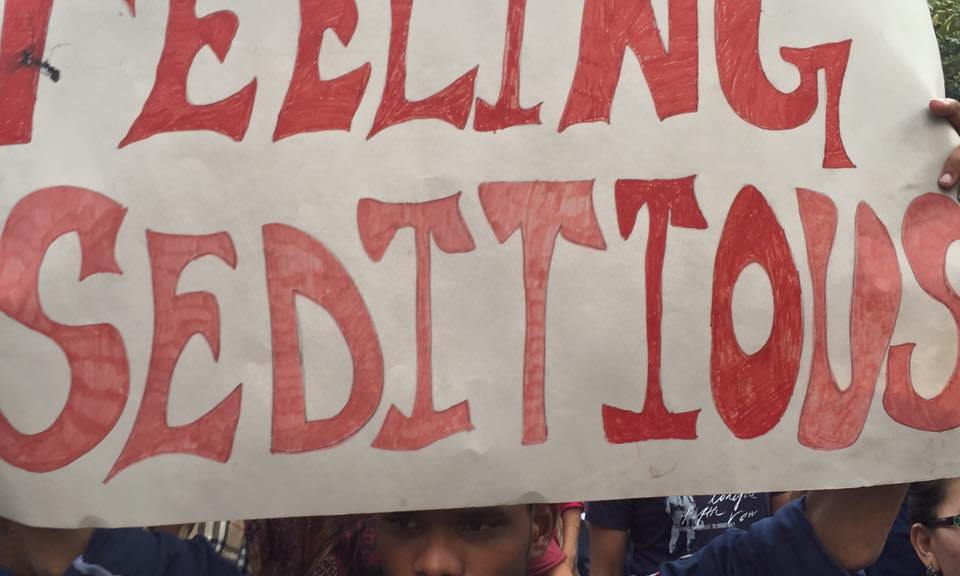
‘Feeling Seditious’: March on Parliament to #StandwithJNU

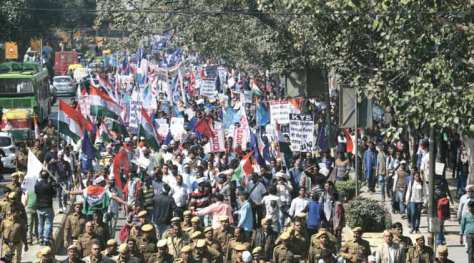
For the third time within a span of two weeks since the middle of February, thousands of people came out on the streets of Delhi to express their solidarity with the detained students of JNU (Kanhaiya Kumar, Umar Khalid and Anirban) and to voice their anger with the venal Modi regime.

Protest demonstrations (at least in northern India) tend to have something of the monotonous in them, the same cadence, the same rhythm and the same wailing, complaining tone. They tend to have an air of events staged by the defeated, for the defeated. But if we take the last three big protests in the city, and the many gatherings in JNU in the last two weeks or so,  as any indicator of what the pulse of our time is, we will have to agree that there has been a qualitative transformation in the language, vocabulary and  affect of protests. This afternoon, like the afternoon of the 18th (the first big JNU solidarity march), and of the 23rd of February (the Justice for Rohith Vemula March), was as much about the joy of togetherness and friendship as it was about rage and anger.

Continue reading ‘Feeling Seditious’: March on Parliament to #StandwithJNU

Submission Before Inquiry Commission by Concerned Teachers and Scientists, Univ of Hyderabad

Submission by Concerned Teachers and Academics before the Roopanwal Judicial Commission at Hyderabad

 (The Roopanwal Commission came to Hyderabad on 23-25th February to enquire into the facts and circumstances leading to the suicide of Dalit research scholar Rohith Vemula. The mandate of the Commission was to review the functioning of existing grievance redressal mechanisms in the university. Concerned with the absence of in-house redressal mechanisms for marginalized students, a joint submission was made by 88 concerned teachers drawn from the state and central universities in Hyderabad. The Submission sought for a rigorous implementation of the 2012 UGC Regulation as well as the setting up a Special Commission to review the major punishments passed by Universities in the case of marginalized students.) 

The suicide of Dalit research scholar Rohith Vemula in Hyderabad Central University has brought to the fore the issue of caste discrimination in higher educational institutions. We believe that the suicide is only the tip of the iceberg of many problems that students from Dalit and other marginalized groups are experiencing. University administrations have generally attributed these deaths to personal psychology instead of initiating broad systemic and attitudinal reforms to prevent such suicides.

In 2012, in the wake of series of suicides by marginalized students in higher educational institutions, the University Grants Commission formulated two Regulations to ensure social equity and set in place grievance redressal mechanisms.  In 2013, Andhra Pradesh High Court took suomoto notice of the student suicides in Andhra Pradesh in PIL No 106/2013 and issued several directives to the Universities to prevent the recurrence of suicides. However, neither the UGC Regulations of 2012 nor the Court directives have been implemented by the Universities.   Continue reading Submission Before Inquiry Commission by Concerned Teachers and Scientists, Univ of Hyderabad

Consolidated Solidarity Statements in Support of JNU

JNU Solidarity Poster

Kafila posted a set of solidarity statements recently in support of the students, faculty and autonomy of JNU. We are posting another set, received from the following organisations:

  1. First-Decade JNU Graduates and Other Graduates – 548 signatories.
  2. Faculty, Staff and Students at the Indian Institute of Management, Bangalore.
  3. California Students and Faculty. California, U.S.
  4. Current Fellows of the Jawaharlal Nehru Institute of Advanced Study, JNU, Delhi.
  5. Colorado College, Colorado, U.S.
  6. Faculty at DePaul University, Chicago, U.S.
  7. Faculty, Students and Staff, Brown University, Rhode Island School of Design (RISD) and University of Rhode Island, Providence, U.S.
  8. McGill and Concordia Universities, Canada.
  9. Canadian Academics from Various Universities.

Please click on Read More below for the statements and signatories:

Continue reading Consolidated Solidarity Statements in Support of JNU

जेनयू की सफाई पर स्मृति ईरानी की सफाई: नियति शर्मा

Guest post by NIYATI SHARMA

लोकसभा में स्मृति ईरानी जी की सफाई उर्फ़ भाषण बहुत भावुक, मनोरंजक और प्रभावशाली था। लोग उन्हें ‘आयरन लेडी’ का खिताब दे रहे हैं- यह उनके तर्क के लिए या उनके तेवर के लिए, या फिर उनके यह कहने के लिए की वो अपना सर काट के मायावती जी के चरणों में रख देंगी, पता लगाना थोड़ा मुश्किल है । सोचा था स्मृति जी कुछ सवालों का जवाब देंगी पर असल में मिली एक लम्बी, मेलोड्रामाटिक सफाई जिससे उन्होंने अपनी सरकार की सारी गलतियों पे पर्दा डाल दिया।ऐसी स्तिथि में हम मजबूर हो गए हैं की स्मृति जी से जो सवाल पूछे जाएँ वो तथ्य-सम्बंधित होने के साथ साथ अति भावनात्मक भी हों।

स्मृति जी के अभिनय के सारे सालों का अनुभव उनके भाषण में साफ़ दिखाए दिया। लोकसभा में स्मृति जी के हाव भाव से आक्रोश टपक रहा था पर क्या उन्हें इतना क्रोधित होने का हक़ है? स्मृति जी का यह मानना है की उनके ऊपर काफी बेबुनियादी आरोप लगे हैं, पर यह मामला स्मृति ईरानी जी के बारे में नहीं है, यह मामला उन मासूम छात्रों के बारे में है जिनकी ज़िन्दगी को उन्होंने दांव पर लगा दिया है। आखिर उन ‘बच्चों’ का क्या जिनके ऊपर उन्होंने और उनकी सरकार ने पिछले कुछ दिनों में अनगिनत आरोप लगाये हैं? स्मृति ईरानी जी तो मंत्री हैं, अगर आरोप लगे भी, तो उनकी ज़िन्दगी बर्बाद नहीं होगी, पर जिस क्रूरता से सरकार और मीडिया ने छात्रों का चरित्र-हनन किया, वह कभी भी इससे उभर नहीं पाएंगे। कन्हैया, उमर और अनिर्बान न ही मंत्री हैं जिनके पास कोई राजनैतिक सहारा है और न ही उनके परिवार इतने धनी हैं की वह अपना जीवन, अपनी इज़्ज़त पुननिर्मित कर पाएं। स्मृति जी, आप तो सिर्फ अपने बारे में सोच रही थीं की आप पर और आपकी परफॉरमेंस पर क्या क्या सवाल उठाये गए, क्या आपने एक बार भी सोचा की इन छात्रों के पास आगे ज़िन्दगी में सफाई देने का कोई मौका नहीं होगा? क्या आपने, माँ होने के नाते, यह सोचा की यह छात्र अब कभी भी साधारण जीवन नहीं जी पाएंगे?

Continue reading जेनयू की सफाई पर स्मृति ईरानी की सफाई: नियति शर्मा

Jat Quota Stir and Violence in Haryana: Satendra Kumar

This is a guest post by SATENDRA KUMAR


jaat-protest--_647_022016112612
IMAGE COURTESY: INDIA TODAY

There is an uncanny academic public silence over the Jat quota stir and the unjustified violence enacted during the stir in Haryana. The scale of violence and destruction is such that it competes for the worst instance of caste violence in Haryana’s post-Independence history. So far 30 people have lost their lives while over 200 people were injured in the nine-day violent Jat agitation demanding job quotas in Haryana. There is anger, fear and helplessness among those who lost their kin, homes, businesses and properties.At least 10 Haryana districts were severely affected by the violence. After such a huge loss, as if it was a routine, matter the Union Home Minister announced that a committee led by M Venkaiah Naidu will examine the demand by Jats for reservation in central government jobs.

In Haryana, the BJP’s government in the state has promised to bring a Bill granting OBC status to Jats in the upcoming assembly session. The Jats’ demand for reservations in the central OBC list is not new. Since 1995, Jats in Haryana have been demanding an OBC (Other Backward Class) status, which will help them secure the 27 per cent reservation in government jobs. Earlier in 1997, the Jats in Haryana, Uttar Pradesh and Madhya Pradesh had demanded themselves to be included in the central OBC list. It was rejected by the National Commission for Backward Classes. Subsequently UPA government’s decision to include Jats from 9 states in the OBC list was also rejected by the Supreme Court in March 2015. Despite all this, political parties such as Congress and BJP continue promising quota to Jats during election campaigns. These promises have encouraged the Jats to organize and agitate for quotas. However, their agitations for reservations have not been so violent. That is why the most pressing and important question that needs analyses is why has the current agitation by Jats been so violent? Perhaps three factors will help us to understand this severe violence and loss of property worth crores of rupees.

Continue reading Jat Quota Stir and Violence in Haryana: Satendra Kumar

Chalo Dilli! Report on 23 Feb Protest March for Rohith Vemula: Saagar Tewari

This is a guest post by SAAGAR TEWARI

Rohith Protest 3

rohith-vemula-protest 4
IMAGES COURTESY: INDIAN EXPRESS

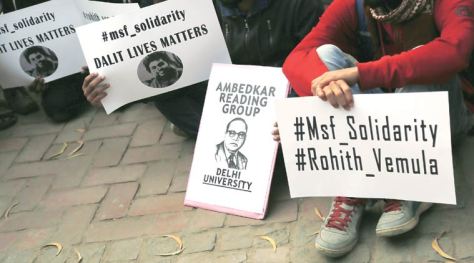
The call for a protest rally by the Joint Action Committee for Social Justice, constituted in the aftermath of Hyderabad Central University research student Rohith Vemula’s suicide galvanised large number of students and activists on 23rd February. On a bright sunny day, thousands descended on the streets of central Delhi marching from Ambedkar Bhawan to Jantar Mantar. The attendance was perhaps lower and the organization less cohesive than the JNU protest rally of 18th February. However, it trumped its predecessor in terms of attracting a far-wider political cross-section of the voices openly choosing to dissent against the current ruling establishment. The protestors proudly displayed anti-Brahmanism banners, flags, badges (featuring excerpts of Rohith’s suicide note) and even a radical inversion of Modi-style masks (featuring Rohith Vemula’s smiling face) thereby signaling that the same youth-brigade which was instrumental in BJP’s rise to political power in 2014 has started turning against it.

Continue reading Chalo Dilli! Report on 23 Feb Protest March for Rohith Vemula: Saagar Tewari

A Close Look at Certain Words Allegedly Shouted Recently in JNU and Their Impact on Our National Intelligence: Soumyabrata Choudhury

This is a guest post by Soumyabrata Choudhury

Polonius: “What is it you read, my lord?”

Hamlet in New Delhi, 2016: “India, Pakistan, security, sovereignty, nation, anti-national…words, words, words”

According to Sigmund Freud, when we dream, and when we suffer psychotic delusions, we treat words as pictures and things. A word’s meaning, in these conditions, becomes the shape of the word and its appearance is the same as feeling its physical impact, its blow. We cannot grasp anymore that a word refers to an object or idea outside in the world or that it can be used as a metaphor or an indirect analogy and image. We cannot even receive the rhetorical communication of words intended to persuade, exhort, transgress or insult. In each of these communications intended by an addresser we already feel physically, viscerally and as a consequence, mentally under the assault of the words of the addresser as if they are blows.

So in response we don’t persuade, exhort, transgress or insult back but instead, we curse (the upper limit of lucid  discourse in this state), punch, grab the addresser  by the throat, pull a knife or gun if we have any of these articles in our possession – or we cringe, weep, hold our heads in our hands and rock to and fro. Now it is very unlikely that in a real psychotic condition, we are able to invoke a particular law or clause of law in our favor, complain to the police and come up with a fluent image of language as justification for our actions. “We had no choice but to do what we did because the other(s) insulted our Mother India”. In a real psychotic condition, it is more likely we will be the ones to be taken away. Continue reading A Close Look at Certain Words Allegedly Shouted Recently in JNU and Their Impact on Our National Intelligence: Soumyabrata Choudhury

Does the Nation Really Even Want to Know? Shweta Radhakrishnan

This is a guest post by SHWETA RADHAKRISHNAN

I noticed yesterday, a tweet from Anupam Kher where he compared state action over the events of the last few weeks, as a kind of “pest control” – required, of course to keep the house clean. His exact tweet is – “Gharon mein pest control hota hai to cockroach, keede makode ityadi bahar nikalte hain. ghar saaf hota hai. waise hi aajkal desh ka pest control chal raha hai.”

The similarity of this thought to Hitler’s on ethnic cleansing hasn’t gone unnoticed (look at Rajdeep Sardesai’s tweet and this article – http://www.jantakareporter.com/india/anupam-kher-hitler-modi/38514) and I’m sure much more will be written about it in the days to come. Anupam Kher’s inability to develop a logical argument or even notice the illogicality of his own actions has never ceased to surprise me, but the casualness with which he endorses state violence is interesting. But mere tweeting is not sedition. Do I find this tweet distasteful, offensive and also legitimizing state and mob violence? Yes, I do. Am I worried by the sentiment expressed in this tweet? Yes, I am. Am I additionally worried because this is not a man, sitting in an obscure corner somewhere, just airing his views, but a well known personality whose words seem to garner some weird kind of legitimacy because of his status as a Hindi film actor? Yes, I am. Do I think he should be arrested? No. Continue reading Does the Nation Really Even Want to Know? Shweta Radhakrishnan

In the Name of the ‘Nation’: Vidya K. Subramanian and C. J. Kuncheria

This is a guest post by VIDYA K S and C J KUNCHERIA

“Don’t you dare speak over me when I am speaking of Lance Naik Hanumanthapa! We’re proud of him and we’re ashamed of you!,” screamed Arnab Goswami at Umar Khalid, the JNU student at the centre of unfolding events at the university. Hundreds of thousands of self-proclaimed nationalists cheered at that instant, and many more did as the clip went viral over social media. The death of the soldier, one of the 869 who have been killed in the last four years by the punishing weather on Siachen, had been conveniently used to invoke a cathartic nationalism. Continue reading In the Name of the ‘Nation’: Vidya K. Subramanian and C. J. Kuncheria

Statement of Solidarity with JNU: University of Exeter (UK)

We, the undersigned, stand in solidarity with the students, faculty and staff of Jawaharlal Nehru University in New Delhi, India in their ongoing struggle against the anti-democratic incursions of the Indian state. We appeal to the elected Prime Minister Narendra Modi to uphold the Indian constitution, cease the repression of democratic protest across university campuses in India, and withdraw the spurious charges of ‘sedition’ against JNU Students’ Union President Kanhaiya Kumar. Continue reading Statement of Solidarity with JNU: University of Exeter (UK)

Statement of Solidarity with the JNU Community, from the Students and Faculty at Princeton University


We, the undersigned, condemn the undemocratic and unconstitutional actions of the BJP-ABVP-Delhi Police on the JNU campus. Continue reading Statement of Solidarity with the JNU Community, from the Students and Faculty at Princeton University

Statement in Support of Students and Faculty at JNU From Faculty and Affiliates of the American Uniersity of Beirut, Lebanon

February 23, 2016

We, the undersigned faculty, students, staff, and affiliates of the American University of Beirut are highly concerned over the recent repression of free speech and undue police and legal interventions at Jawaharlal Nehru University (JNU), New Delhi. Continue reading Statement in Support of Students and Faculty at JNU From Faculty and Affiliates of the American Uniersity of Beirut, Lebanon

Statement on Behalf of Facultyand Students of O.P Jindal Global University in Solidarity With JNU


We, the undersigned Faculty and Students from the O.P Jindal Global University (JGU) in our individual capacity, condemn the police crackdown in Jawaharlal Nehru University- Delhi(JNU) and the apathy towards JNU demonstrated by State actors through their coercive actions. Continue reading Statement on Behalf of Facultyand Students of O.P Jindal Global University in Solidarity With JNU

Solidarity Statement from The International Institute of Social Studies (ISS) of Erasmus University Rotterdam in The Hague

We, the undersigned students, staff and faculty members at the International Institute of Social Studies (ISS) of Erasmus University Rotterdam in The Hague, support the right of students and teachers everywhere to a learning environment that is critical, engaging and respectful. In light of recent events and the slander campaign against the Jawaharlal Nehru University (JNU), we are disheartened and embarrassed that this is not the vision of the current Government of India, that they would rather create spaces of fear and control, by labelling all those that criticise their policies as anti-national and unpatriotic. Continue reading Solidarity Statement from The International Institute of Social Studies (ISS) of Erasmus University Rotterdam in The Hague

Statement of Solidarity FromFaculty and Graduate Students at the University of Hawai’i, Manoa Against Police Ation on JNU Campus


To: Prof. M. Jagadesh Kumar

Vice Chancellor

Jawaharlal Nehru University

New Delhi-110 067, India

Continue reading Statement of Solidarity FromFaculty and Graduate Students at the University of Hawai’i, Manoa Against Police Ation on JNU Campus

The New School in Solidarity with JNU


We, the undersigned, students, faculty, alumni, and staff at the New School University, New York, stand in solidarity with the students, staff, and faculty at Jawaharlal Nehru University, New Delhi, in their protests against the militarization of the campus and suppression of dissent by anti-democratic and divisive Hindu nationalist groups allied with the Modi government. Continue reading The New School in Solidarity with JNU

University of Texas Students and Faculty stand with JNU


We, the undersigned, students, scholars, and faculty of the University of Texas at Austin, stand in solidarity with the students, faculty, and staff at Jawaharlal Nehru University, New Delhi against the illegal and unconscionable crackdown by police. We demand an immediate end to all police action on campus, a withdrawal of all frivolous charges against the President of JNU Students’ Union, Kanhaiya Kumar, and other students, as well as an end to the campaign of harassment and intimidation against students at the university. With them, we affirm the autonomy of the university as a non-militarized space for freedom of thought and expression. Accordingly, we condemn police presence on campus and the harassment of students on the basis of their political beliefs.  Continue reading University of Texas Students and Faculty stand with JNU

Bangalore Research Network’s Letter of Solidarity with JNU


We, the undersigned members of the Bangalore Research Network and a consortium of academics and researchers from Bangalore, declare our solidarity with the students and faculty of the Jawaharlal Nehru University, New Delhi protesting the illegal police arrest of JNUSU president Kanhaiya Kumar on charges of sedition. We unequivocally stand by them in affirming that universities are autonomous spaces for the free expression of a plurality of beliefs and cannot become military spaces of thought control that go against the very grain of a democratic society.  With them, we condemn the blatantly authoritarian attempt by the police and the central government to witch hunt students on the basis of their political beliefs. We also condemn the unethical media trial of JNU students such as Kanhaiya Kumar and Umar Khalid. Continue reading Bangalore Research Network’s Letter of Solidarity with JNU