Category Archives: Government

House of Cards


Courtesy Indian Express
Courtesy: Indian Express.

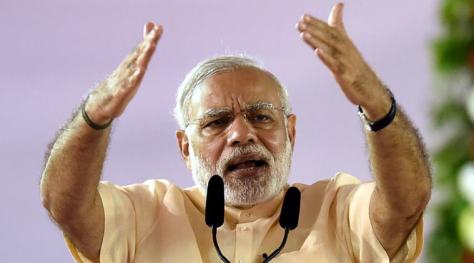
Anybody with a passing interest in consistency or coherence might be forgiven for being stumped at the political spectacle unfolding right now. Yesterday, Prime Minister Narendra Modi assured us that his government was committed to reservations. The statement was made at a ceremony to inaugurate the Ambedkar memorial at the Indu Mills compound in Mumbai. The fact that ordinary Dalits, in the habit of thronging any joyous celebration on Ambedkar in big numbers, were kept out of the ceremony, is possibly irrelevant. After all, officialese is officialese, and no political party – certainly not the BJP – has a monopoly on stiff-necked commemorations of people’s leaders that want nothing to do with the people. It is Modi’s commitment to reservations and the Indian constitution that is of interest. In some ways a statement of this nature made at the inauguration of an Ambedkar memorial, makes perfect sense. Apart from the occasion and locale, also not coincidental was the timing of Modi’s statement – one that he himself alluded to, when he referred to the bitterly fought Bihar elections now underway, “With a BJP government in power and polls getting under way, a malicious propaganda is being spread that the government is against reservation…”. The fact that the anti-BJP mahagathbandhan (grand alliance) in Bihar has made reservations one of their chief planks, with Lalu Prasad Yadav declaring in his inimitable style that he will kill himself if reservations are removed, is relevant.

Zooming back from the Ambedkar memorial event, the PM was clearly also responding to the threat to his Sabka Saath Sabka Vikas model begun a couple of months ago by the irrepressible Hardik Patel. Patel – erstwhile BJP supporter, self-styled Patidar-Patel revolutionary and a wild child in imminent danger of being silenced (or coopted) by the BJP – was temporarily subdued by the Gujarat administration following the wave of violence over his first call for reservation, but resurfaced a couple of days ago to be the nightmare Modi hadn’t dreamed yet – saying his aim was to expose the “Gujarat model of development”. This is for the current party nothing short of the youngest born of a rambling illustrious family running into the street from the family mansion saying our house is made of mud! our house is made of mud!

Continue reading House of Cards

Modi’s Speech, his Silence and Dadri Redux in Mainpuri

Every newspaper in India carried the same headline on Friday, the 9th of October: ‘Modi breaks silence on Dadri lynching.’ It says something about the breathless desperation of the Indian press to hear the prime minister say something, anything, that could be interpreted as his disapproval of political barbarism, that there wasn’t, in fact, a word in his speech about the Dadri lynching. – Mukul Kesavan in ndtv.com

You know what has been agitating the minds of millions of us, Indians — the future of our pluralism. You have stated your position in terms of ‘sabka sath, sabka vikas‘. And this is quoted and cited on your behalf repeatedly as a mantra. But, Pradhan Mantriji, this is certainly not adequate. We need to hear you, our Prime Minister, directly and clearly and with an urgent reference to the present situation, which is nothing less than a tragedy. Over the last few months we have had more than one tragedy. Can we really not see the connections between the so-called stray incidences all over the country, from the murders of Dabholkar, Pansare and Kalburgi to that of Mohammad Akhlaq. Your direct voice needs to be heard now, unless you do not consider this an event of significance. And now, the ambiguity of what you said yesterday only makes me send you this appeal for your truthful intervention. TM Krishna’s Open Letter to the Prime Minister

While Modi’s cheer leaders in the media were telling us that the prime minister had finally ‘broken his silence’ (see Apoorvanand’s piece on this here), there were others who read the meaning of his speech far more  accurately.They knew exactly what Modi was saying; they knew without having to do a content analysis of His speech that, if anything, despite being shamed to an extent by the President, Pranab Mukherjee’s statement the previous day, he actually refused to say anything about the Dadri incident let alone condemn the crime or its perpetrators. They understood clearly that his speech was merely a continuation of his sinister and devious silence. They understood like no media commentator or analyst did that what he said in Munger was a green signal for them to go ahead with their activities. Thus what happened in Mainpuri today is nothing to be surprised about.

Mainpuri: Police in action after villagers vandalised properties and resorted to arson in Mainpuri district on Friday over rumours of cow slaughter in the area. PTI Photo (PTI10_9_2015_000290B)

Continue reading Modi’s Speech, his Silence and Dadri Redux in Mainpuri

Another One Bites the Dust: “Cultural Pollution” and the Nehru Memorial Museum & Library: Niyati Sharma and Snigdha Kumar

This is a guest post by NIYATI SHARMA AND SNIGDHA KUMAR

Courtesy thequint.com.

The latest in a line of institutions to fall victim to the BJP government’s campaign against “cultural pollution” is The Nehru Memorial Museum and Library (NMML). The agenda is loud and clear – anything which ‘pollutes’ the current government’s preferred way of life and thinking will be done away with. Bans such as the recent ones on porn and meat are the most obvious instruments at the disposal of the government to achieve this goal. The more effective interventions, however, are not those which instantly deny people their choices and freedoms. Presented instead as minor improvements and renovations, interventions in art, history and academic institutions allow the government to introduce subtle long term changes – changes with the capacity to access and alter our very being.

Given the enormity of these interventions in the long run then, it is particularly curious how the clear recent attempts to take over academic institutions such as the ICHR, FTII and now NMML have managed to raise only a few eyebrows while the bans on porn (and meat to an extent) have met with much protest and were subsequently lifted. Perhaps this is because such spaces appear to be remote islands inhabited only by those interested in history, film and/or academic research. Only such an impression can explain the rather meek public debate and outcry that these clearly targeted changes have generated.

Continue reading Another One Bites the Dust: “Cultural Pollution” and the Nehru Memorial Museum & Library: Niyati Sharma and Snigdha Kumar

Dadri Beef Rumour and Lynching – A Report from Bisara village

The following is a report on the Dadri beef rumour and lynching, prepared by a fact finding team from NEW SOCIALIST INITIATIVE, PEOPLE’S ALLIANCE for DEMOCRACY and SECULARISM, SAHELI and DELHI SOLIDARITY GROUP, released in New Delhi on 05/10/2015

 The investigation team with the following members visited the village on 3 October 2015: Bonojit Hussain (New Socialist Initiative), Deepti Sharma (Saheli), Kiran Shaheen (writer and activist), Naveen Chander (New Socialist Initiative), Sanjay Kumar (People’s Alliance for Democracy and Secularism and New Socialist Initiative) and Sanjeev Kumar (Delhi Solidarity Group)

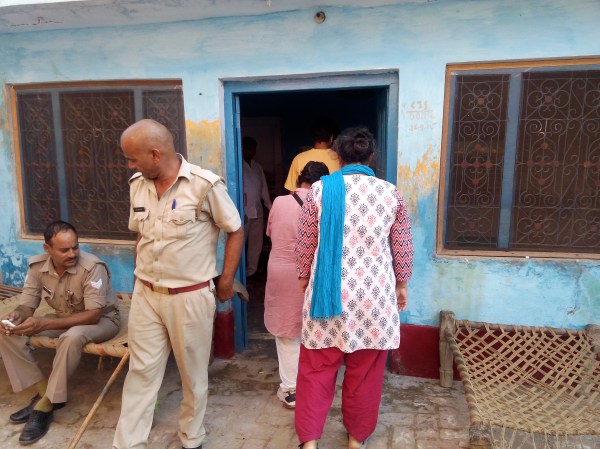
Akhlaq's house
Akhlaq’s house

On the night of 28 September, in a heinous instance of hate crime Mohammad Akhlaq a resident of Bisara village of Dadri in western Uttar Pradesh was lynched to death and his son Danish brutally assaulted by a mob of villagers over a rumour that Mr. Akhlaq and his family had slaughtered a calf and consumed its meat. Just before the lynching, an announcement was made from the local temple to spread the rumour, and within moments a mob constituted itself and attacked Mr. Akhlaq resulting in his lynching. Mr. Akhlaq’s son Danish has been in hospital since that night and despite undergoing two brain surgeries his condition is still said to be critical. Continue reading Dadri Beef Rumour and Lynching – A Report from Bisara village

NBA Welcomes SC Dismissal of MP Govt Application Denying Right to Land to Sardar Sarovar Oustees

We are publishing below the text of a statement issued by the NARMADA BACHAO ANDOLAN in New Delhi today following a significant Supreme Court order on the rehabilitation of Sardar Sarovar oustees

In a significant Order, the Social Justice Bench of the Supreme Court comprising Jst. Madan Lokur and Jst. Uday Umesh Lalit today dismissed an Application filed by the Government of Madhya Pradesh (GoMP) / Narmada Valley Development Authority (NVDA) seeking a ‘modification / clarification’ of the Apex Court’s previous judgements of 2000 and 2005, thereby denying right to land of a few thousand adult sons of the Sardar Sarovar Project (SSP) affected farmers.

The Hon’ble Court held among other things that the Application by State of MP suffers from gross delay / laches having being filed many years after the judgements were issued (upholding the right to land of the SSP adult sons) and the rights / entitlements already accrued to the oustees in principle cannot be taken away. The Bench also had to take note of the fact that while the entitlement of most of the adult sons have already been recognized many many years ago, one set of oustees have been offered land / Special Rehabilitation Package (5.5. lakhs for 5 acres) since the judgement of 15/3/2005 of the Apex Court and another set of oustees are being denied the same; this would result in a clear violation of Article 14 of the Constitution which guarantees a fundamental right to equality. Terming this “not to be good governance”, the Court summarily dismissed the Application.   Continue reading NBA Welcomes SC Dismissal of MP Govt Application Denying Right to Land to Sardar Sarovar Oustees

A Statement Protesting Approval to Introduce Injectable Contraceptives in the National Family Planning Programme

The following is the text of a letter written by activists and scholars working in the field of medicine, public health and women’s rights, to the Union Minister for Health and Family Welfare:

To

Shri Jagat Prakash Nadda,

Union Minister for Health and Family Welfare,
Ministry of Health and Family Welfare,
Nirman Bhavan, Maulana Azad Road,
New Delhi 110 011

22nd September 2015

Statement Protesting the Approval to Introduce Injectable Contraceptives in the National Family Planning Programme

We, the following health groups, women’s organisations, peoples’ networks and individuals are extremely disturbed by the news report published in the Times of India (dated 16th September 2015) that the Union Health Ministry has approved Depo Medroxy Progesterone Acetate (DMPA) for use in the National Family Planning Programme (FPP).

It may be re-called that following a Supreme Court case filed in 1986 by women’s groups regarding serious problems with injectable contraceptives like Depo and Net-En, the Court directed the government to monitor safety issues in use of injectable contraceptives but did not ban its use. While they are available in the private medical sector, the Drugs Technical Advisory Board (DTAB), the highest decision-making body on technical matters in the Ministry of Health &Family Welfare, in 1995 held that Depo-Provera is not recommended for inclusion in the FPP. Continue reading A Statement Protesting Approval to Introduce Injectable Contraceptives in the National Family Planning Programme

Workers right to unionize being trampled upon in yet another factory in Manesar: Report

Report on the protest by automobile workers in Manesar by BIGUL MAZDOOR DASTA AND AUTOMOBILE INDUSTRY CONTRACT WORKERS UNION


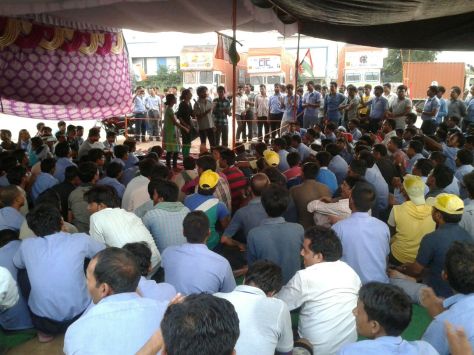
IMG-20150921-WA0005

On the morning of 18 September 2015 when the workers employed in the Bridgestone company reached their factory gates they were met with Police officers and hired bouncers at the gate. When the workers tried to enter the factory premises they were resisted by the uniformed and the non-uniformed goons of the Factory Management. The Police beat up the workers and prevented them from entering the premises of the factory in spite of having a court order for tool down and without any prior notice the workers were sacked by the company. More than 400 workers employed in Bridgestone Factory in Manesar have been unlawfully sacked by the Company authorities after the workers demanded to get their Union registered. The workers are currently protesting outside the factory and have gathered there to raise their voice against the injustice and oppression that they are facing at the hands of the factory management.

Continue reading Workers right to unionize being trampled upon in yet another factory in Manesar: Report

Cow Slaughter – Can a Directive Principle Trump Fundamental Rights of the Most Marginalized? Mariya Salim

Guest post by MARIYA SALIM

The debates and demands around the issue of the prohibition of cow slaughter in India are a highly volatile, political and contentious subject, with the cow being revered as sacred by most Hindus in the country. Although almost all the proponents calling for a national legislation for a total ban on slaughter of cow and other cattle today look to the directive principles of state policy and use an economic and agrarian argument to defend their demand, it is interesting to note that the constituent assembly debates around this directive principle clearly indicate that it was as much a religious issue, reasoned on science and agriculture instead however, for some of those who wanted it to be an integral part of the Indian Constitution.

After much debate and deliberation in the Constituent Assembly and a demand from a few members of the assembly, to include a total ban on the slaughter of cows as part of fundamental rights in the Indian Constitution, a compromise was reached and the protection of the revered bovine found place in the Directive Principles of state policy, which incorporates this Hindu sentiment in a somewhat guarded and hesitant form[1]. Most notable among the members raising the issue were Pandit Thakur Dass Bhargava and Seth Govind Das[2]. Syed Muhammad Sa’adulla, another member argued that he would rather have the insertion on the protection of cow slaughter as a religious ground, as, the argument on economic grounds will ‘create a suspicion in the minds of many that the ingrained Hindu feeling against cow slaughter is being satisfied by the backdoor’ and he went on to give facts and figures on how cow slaughter is not as bad ‘as it is being made out to be’ from the economic point of view. [3]  Continue reading Cow Slaughter – Can a Directive Principle Trump Fundamental Rights of the Most Marginalized? Mariya Salim

Kudumbashree in Chandydesham/Muneerland — In Three Parts

Part One: Prologue

In 2008, I reported the results of research on Kudumbashree women leaders at the village level, from seven districts in Kerala. Those were the days when Kudumbashree was being projected as the ultimate answer to all of women’s woes, and the chorus consisted of politicians, official feminists, researchers, bureaucrats, development experts – in other words, everyone, well, almost. What I had to say was not pleasant to their ears. However, implicit in my reporting was the essential changeability of Kudumbashree, which was after all a government programme. The discussions around the modifications of the Kudumbashree bye-law and its approval were on during our fieldwork, and even though we reported after it was finalised and approved, it was too early for us to assess its impacts.

Continue reading Kudumbashree in Chandydesham/Muneerland — In Three Parts

A Contested line – Implementation of Inner Line Permit in Manipur: Deepak Naorem

This is a guest post by DEEPAK NAOREM

Violence and the accompanying disruption of everyday life in Manipur is not a recent phenomenon. This year too, the state was plunged into a spiral of violence following demands for the implementation of Inner Permit Line, a law originating in the colonial period. This demand is based on real or imagined fears that Manipur, like Sikkim and Tripura, would be overwhelmed by the ‘outsiders’ and that the ‘indigenous people’ of Manipur would become a minority in their homeland. Such demands are neither new nor surprising in this part of the world, where a nearly-unfathomable ethnic, demographic and political jigsaw puzzle was created by British colonialism; one that was deepened by even more myopic and inconsistent policy in the post-colonial years. However, this year, following the death of a young student by police firing during a student protest in Imphal, the movement demanding the Inner Line Permit (ILP) gained considerable momentum in Manipur. Subsequently, the legislature was forced to introduce three bills in the Manipur State Legislative Assembly on 28th August, 2015, ensuring the implementation of Inner Line Permit in the state. This in turn triggered another wave of violence with the ‘tribals’ and tribal organizations opposing the three bills, eventually bringing life to a standstill in the state.

Continue reading A Contested line – Implementation of Inner Line Permit in Manipur: Deepak Naorem

The Woman Worker Re-emerges – Lessons from Munnar

For once, the praise of the mainstream media in Kerala does not sound like empty hyperbole or sickening sycophancy. More than six thousand women workers were on strike in the Kannan Devan tea estates of Munnar in defiance of their trade union leaders, seeking higher wages — and equal wages with men workers who are paid more though their work is lighter — and alleging that the trade union leaders were pocketing benefits due to them. The workers receive very low wages and live under truly despicable conditions not far removed from colonial conditions despite the fact that the Kannan Devan Plantations in now technically under the workers who own sixty per cent of the shares. The blather about losses in the tea industry conceals the enormous control over land that the Tatas hold for a trivial sum paid to the government. It also deflects attention from the serious charges of encroachment made against the Tatas, which our political class has not pursued much. Continue reading The Woman Worker Re-emerges – Lessons from Munnar

Elections, Politics and Tamil Nationalism: Hopeless Impasse and Strivings of the People

This article co-written by SWASTHIKA ARULINGAM AND AHILAN KADIRGAMAR was originally published in the September 2015 issue of Samakalam, a Tamil monthly magazine on contemporary affairs. A group of us have been writing a column every month titled ‘Dissent and Debate’. Samakalam is a unique effort to interpret the debates in the national press in Sri Lanka to the Tamil speaking audience and in turn also engage the rest of the country on debates in the North and East through a few articles in English.

The Tamil National Alliance (TNA) has swept the 2015 parliamentary elections in its Tamil constituencies. This victory further consolidates the power of the TNA and particularly the Federal Party (ITAK). However, this is also the weakness of Tamil nationalist politics. Historically, Tamil politics dominated by the Federal Party has done little other than win elections. Politics should be much more, building alliances with other political forces and mobilising society and finding solutions to people’s social, economic and political problems. Tamil nationalist politics neither seems to have the capacity to govern as with the Northern Provincial Council (NPC) nor does it seem to have a vision to recover Tamil society out of the post-war crisis in the North and East. This article addresses the future of Tamil politics given this problematic political trajectory. Continue reading Elections, Politics and Tamil Nationalism: Hopeless Impasse and Strivings of the People

Global Investors Meet in Chennai – Bargaining over the Bride: T Venkat

Guest Post by T VENKAT

The Government of Tamil Nadu organized a Global Investors Meet (September 9-10), on the lines of the now famous ‘Vibrant Gujarat’ model. GIM, as they call it, was touted as intending to attract thousands of crores of investment to Tamil Nadu. The main routes from the airport to the many different venues in Chennai were prepared to receive the corporate celebrities and the political heavy weights. For the past week, workers worked through the night getting the venue, the routes and the hoardings ready for this big day. As I was passing through the venue the day before the event began, watching all the meticulous planning, the overflow of cops and their blaring vehicles, the flood lights and the workers underneath them, the whole exercise seemed surreal.

The City is decked up for the great event. Continue reading Global Investors Meet in Chennai – Bargaining over the Bride: T Venkat

Statement Against Prof. Kalburgi’s Murder: Academics for Democracy, Chennai

The following statement against the murder of Professor Kalburgi was issued by Academics for Democracy, a forum of academics based in Chennai.

As a group of academics and scientists who are involved in various ways towards promotion of democratic values, we wish to condemn the murder of Prof. M. M. Kalburgi, who was shot dead by unidentified gunmen on August 30th , in strongest possible terms.

Prof. Maleshappa Madivalappa is a well known writer in Kannada and a former Vice Chancellor of Hampi university, who  raised his voice against religious malpractices and superstitious ideas on several different occasions. He is an authority on vachana sahitya, whose collection of research articles titled Marga were academically acclaimed. He was awarded the Karnataka Sahitya Academy Award in 2006 for Marga. Continue reading Statement Against Prof. Kalburgi’s Murder: Academics for Democracy, Chennai

Muzaffarnagar Baaqi Hai – Critical Readings Online and Offline: Akash Bhattacharya and Arif Hayat Nairang

These are guest posts by Akash Bhattacharya and Arif Hayat Nairang

The film Muzaffarnagar Baaqi Hai has been in the news recently, and not always for the right reasons, having attracted disruptive and abusive protest at some screenings. Following a day of counter-protest in which the film was screened all over the country, a friend teaching in a Delhi University college suggested screening it in her college, only to be told by the student representative that it would “cause trouble” (“bawwal mach jayega ma’am!!”). She asked what that meant and if he had seen the film, and he simply said, “nahin, bhaiyya logon ne kaha hai ki woh film bahut buri hai” (No, but our elder brothers have said it’s a bad film). 

In an atmosphere where political self-censoring comes as easily to the current generation of students as scouring the net for “blocked content” we present below two readings of the reception of the film, the first ruminating on whether the film addresses the complexities of communal mobilisation adequately; and the second inquiring in the context of social media and particularly Facebook, what constitutes the ‘liking’ of an image or idea. The idea of posting these comments is as much to give space to these arguments as it is to make a larger point that the ‘sickular left’ voices that are presumably behind the film love discussion, critique and disagreement. That to my mind is the way forward, not pre-empting the always-already hurt sentiments of the bhaiyya log whosoever they may be.

Continue reading Muzaffarnagar Baaqi Hai – Critical Readings Online and Offline: Akash Bhattacharya and Arif Hayat Nairang

Hindutva: A Political Theory of Nationhood?: Aman Verma

Guest post by Aman Verma

It is disheartening to see amongst supporters of Hindutva these days a silent acquiescence and at times even active support for extra-constitutional techniques being adopted by organizations like the RSS and its offshoots towards attaining the goal of Ram Rajya. An assessment is necessary of what would ultimately entail on the social, political and economic fronts if such a policy that envisages a supposedly ‘Hindu’ cultural and linguistic hegemony over cultures and languages represented by minority communities becomes reality. However, being a student of law what disturbs me more is the absence of any socio-political entity or civil society movement rooted in values of democracy that can effectively counter the impact of Hindutva organizations on the Indian social fabric. While the BJP has its RSS, every other political party claiming to be the upholder of secularism lacks its equivalent, or at the very least an effective social protégé.

Further, my personal interactions with supporters of BJP reveals that there is some deep sense of hurt and helplessness, part valid for the sake of argument, but for the most part carefully manufactured by Hindutva propaganda, which manifests itself in questions a friend recently put to me, “What are the other ways in which the Hindus can also claim their rights and send out a message that they have been too tolerant for too long?” and another which sounded like “How else to keep our dignity and identity alive in our land?”. These questions, based upon presumptions like those of “Hindu tolerance” of acts perpetrated by other communities supposedly only against Hindus and, protection of a completely vague concept of “Hindu identity” are clearly an outcome of a campaign strategy that relies upon upping the antics on the romantic-nationalist front.

Continue reading Hindutva: A Political Theory of Nationhood?: Aman Verma

Cheralam to Keralam to Ketta-idam – A Report on ‘Development’ from Trivandrum, Kerala: Sriranjini R

This is a guest post by Sriranjini R.

Cheralam Sriranjani

ISIS in Syria, Al Qaeda in Afghanistan, Taliban in Pakistan, Boko Haram in Nigeria, ecological problems, climate change … the list of the world’s ‘security’ problems seems endless. India has its own share of course – the India-Pakistan conflict, India-China problems, Maoism and so on. In Kerala, police have been desperate to find ‘security threats’ of their own. They first tried hunting down a ‘druglord’ whose picture was found on T-shirts of young people suspected of drug use. His name is Bob Marley. Please give the man up if you find him anywhere. Then they tried looking for Maoists. Every state has some, how come we have so few, was their complaint. After going after thin, dark-skinned, bearded fellows, Kiss of Love activists, and sundry others, hoping that one of these will be a Maoist, finally they caught one. And he didn’t look like any threat to most Malayalis.

Continue reading Cheralam to Keralam to Ketta-idam – A Report on ‘Development’ from Trivandrum, Kerala: Sriranjini R

Allahabad High Court Order on Government Schools in U.P: Devanik Saha

This is a guest post by Devanik Saha

The judiciary in India can be highly unpredictable. Either it is accused of not doing enough to provide justice to victims or it is hailed for giving landmark judgments. In a recent controversial decision, the Allahabad High Court ordered that all children of government servants and elected representatives in Uttar Pradesh should mandatorily send their wards to government schools. It noted that “Only then would they be serious enough to look into the requirements of these schools and ensure that they are run in good condition”.

While the decision has evoked sharp reactions from UP legislators, it has been fiercely debated in the media fraternity, with mixed responses. The wretched condition of government schools (in every state) in India isn’t a hidden fact. While India has achieved impressive rates of school enrolment – the quality of education and learning outcomes – have been extremely dismal.

An analysis by data journalism portal IndiaSpend revealed that Rs 5,86,085 crore has been spent on primary education in the past 10 years and 80% of the expenditure on education is spent on teachers, but the state of affairs continue to be dreary, which has led to the mushrooming of low income private schools. The number of students enrolled in private schools in UP has risen from 32.2% in 2006 to 52.8% in 2014, according to the Annual Survey Education Report (ASER) by Pratham, an education NGO.

Continue reading Allahabad High Court Order on Government Schools in U.P: Devanik Saha

A Consummate Hanging Bares Gaping Holes in Nation State’s Democratic Facade : Sanjay Kumar

Guest Post by Sanjay Kumar

At 7AM on 30 July, 2015, the Republic of India hanged a man named Yakub Memon. By all means, though without anyone’s planning, the hanging turned out to be the endpoint of a consummate exercise. Three judges of the highest court of the land sat through the night, right up to two hours before the execution to decide on the last petition of the condemned convict. The highest law official of the central government came to put forth arguments against the petition at two thirty in the morning, while some of the most respected and best legal minds of the country argued for it. Even before this post mid night hearing, the case of Mr Memon had been through more than one round of curative and review petitions in the Supreme Court, and mercy petitions with the President of the Republic. Much earlier, in fact more than twenty years ago, the Mumbai police had carried out perhaps the most painstaking, and detailed investigation of independent India into the 12 March, 1993 blasts; cracking the case within two days and filing a 10,000 page charge sheet within eight months. The trial involving 123 accused, 684 witnesses and voluminous material evidence ran for ten years. After Mr Memon’s guilt and conviction were established by the trial court, his appeals had gone on in the Supreme Court for nearly a decade. Two years ago the then Government of India had hanged Afzal Guru, a Kashmiri convicted in the Parliament attack case, without informing his family, and refused to hand his dead body to them. Nothing of that shameful behaviour was repeated this time. What more could the criminal justice system of the country have done in the case of Mr Memon! Yet, his execution has left behind more questions on the institutional biases, and ideological underpinnings of the Indian state, than perhaps any other execution. Continue reading A Consummate Hanging Bares Gaping Holes in Nation State’s Democratic Facade : Sanjay Kumar

India Census 2011 – Where are the Atheists?

The consternation witnessed around release of religious figures in Census 2011 has rather overshadowed an interesting fact which has emerged through this mammoth exercise. It tells us that India has 2.87 million people who have no faith in any religion, which is around 0.24 per cent of our population. Definitely it includes not only atheists, rationalists but all those people who do not believe in any faith but some ‘unknown’ force.

Definitely it is a welcome development that the state has finally acknowledged their existence and what Dravid Kazhagam leader K Veeramani said ‘recorded their voice for the first time in the census’. but a cursory glance at earlier surveys and studies makes it amply clear that the figures are on the lower end. Continue reading India Census 2011 – Where are the Atheists?

The Murky Fourth Estate: Asifa Zunaidha

This is a guest post by ASIFA ZUNAIDHA.

[Some time ago, I wrote on Kafila about my experience of attending a televised interaction with HRD Minister Smriti Irani. The audience, packed with supporters of the particular party Irani belongs to, was set up in that debate as the neutral ‘public’, thereby killing two birds with one stone – boosting the popularity of the Minister on news media, and legitimising the news channel as a site of punchy political debate. We have below a similar case of manipulation of the powerful medium of electronic news media, this time by another channel.] 

What is the role of the news media in a society if not to disseminate information and opinions as an impartial media(tor)? ‘Half truth is no truth’ is a popular aphorism, but ‘selective’ truth is also a lie and certainly does not befit the content of a news channel. It seems that in an age of corporate media, one would be foolish to expect impartial truths, let alone ‘undiluted or uncensored’ opinion of diverse groups. A recent episode inside the JNU campus shows how ‘news’ presented by News Channels can be easily manipulated and the opinion of a ‘select few’ is showcased as the ‘unanimous opinion’ emerging from the premier higher educational institute of the country.

Continue reading The Murky Fourth Estate: Asifa Zunaidha