Category Archives: Government

This is to clarify a small misunderstanding: Anusha Rizvi

Guest post by ANUSHA RIZVI

To,
Ms. Shiela Dixit, Chief Minister Delhi NCR
Mr. Sushil Kumar Shinde, Home Minister, India
Mr. Tejendar Khanna, Lt. Governor, Delhi NCR

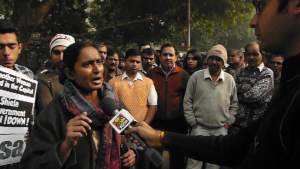
This is to clarify a small misunderstanding. I know a part of the protests made you believe that women in Delhi are asking to take policemen away from their VIP duties and put them on Delhi streets. This is incorrect. Many of the protestors are too young to understand
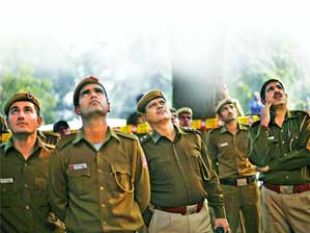
Ma’am and Sirs, the roads are unsafe enough. All Delhi women know – when you see a Delhi policeman, you run. This is what our mothers taught us. This is what we teach our children. I sincerely request you to increase VIP duties for all cops in the Delhi National Capital Region. Please don’t waste your time and energy transferring or suspending any of these gentlemen. All you have to do is ensure no cops are given non-VIP duties. Continue reading This is to clarify a small misunderstanding: Anusha Rizvi

A Government in Hiding

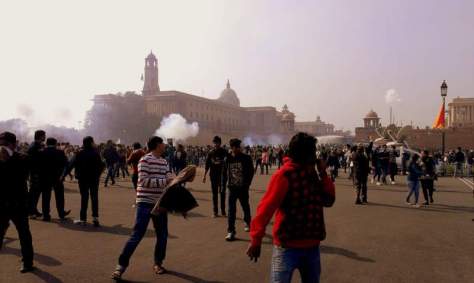
Protestors from Raisina Hill began to be forcibly removed late last night. The police action continued in the foggy cold of this December morning. Aghast at the violence on a completely peaceful gathering of students – some of them just school children – many of us too felt compelled to join the demonstrations. A number of left-wing student groups who have been part of the protests had called for collecting at the Neel Gumbaz at Nizamuddin. At 11 am, we all started collecting there – many of us older folk going there in solidarity with what has been one of the most unprecedented student-youth mobilizations in the city. Yesterday, there had been repeated rounds of  water cannons, tear-gas and brutal lathi-charge by the police of a government that has gone into hiding.

Finally, some 600-700 of us began moving in a procession from Nizamuddin to India Gate. When we reached there, we discovered that already large numbers of people had begun recongregating at ‘Rajpath’ – the Power Avenue where every January the Republic displays its military might to the world. The numbers were continuously swelling. A group of supporters of Arvind Kejriwal’s AAP – inclduing Kejriwal and other leaders – were squatting on one side, towards Hyderabad House. This was virtually on the margins of the area where the main crowds were. Apart from the group of people we had come with, there were hundreds who seemed to us to be completely unaffiliated ordinary students, contrary to some claims floating around in Facebook that these were ‘RSS crowds’. At one end a human chain had been erected and slogan shouting for justice continued. Around the Amar Jawan Jyoti, there were processsions of students still coming in. We were there till about 2 pm and there was no question of any violence at all – except for three unprovoked tear gas shells that had been lobbed by the police into the crowd. There had been some minor commotion as the police occassionally tried to push back students with a lathi charge of sorts.

By this time, however, it was apparent that the police was preparing for the offensive. Police briefings were taking place in different groups and gradually the crowd was being surrounded from all sides. And yet, till about 2.50 pm, despite twenty rounds of tear gas being fired by the police, as well as periodic lathi charges  – they did not manage to provoke violence from the crowd to justify a crackdown. But the crackdown had to take place. And lo and behold, the justifications for it materialized, suspiciously, very soon. Continue reading A Government in Hiding

A Day at Raisina Hill: Nilanjana Roy

Guest post by NILANJANA ROY

“We want justice! We want justice!”

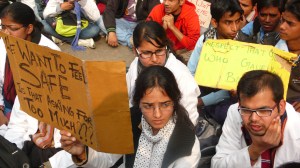
I went to the protests at Raisina Hill expecting very little. Despite the anger over the recent, brutal gang-rape of a 23-year-old by a group of six men, who also beat up her male friend, protests over women’s violence in the Capital have been relatively small.

But the crowds walking up the Hill, towards the government offices of North and South Block, from India Gate are unusual. It’s a young crowd—students, young men and women in their twenties, a smattering of slightly older women there to show their solidarity, and it’s a large crowd, about a thousand strong at the Hill itself. There are two small knots representing student’s politicial organisations, but otherwise, many of the people here today are drawn together only by their anger. Continue reading A Day at Raisina Hill: Nilanjana Roy

Passage of Amendments to UAPA – Further erosion of Constitutional Rights: JTSA

This release was put out today by the JAMIA TEACHERS’ SOLIDARITY ASSOCIATION

The pushing through of the amendments to Unlawful Activities Prevention Act (UAPA) in the Rajya Sabha, despite protests and calls for further discussion and deferment, indicates the consensus between Congress and BJP on the issue of civil rights. The passage of the amendments, which now bring economic offences under terrorism, and broaden the definition of person to an extent that will criminalize all forms of associations, will provide sweeping powers to the police and security agencies, and create a regime of suspicion.

False Claims of the Government:

Responding to the debate in the RS, Minister of State for Home stated that, “The Act does not give sweeping powers to the police and there are checks and balances that will prevent misuse of the Act.” He further assured the House that the law was “religion neutral” and would not target any particular community.

This is patently false. Continue reading Passage of Amendments to UAPA – Further erosion of Constitutional Rights: JTSA

An open letter to the President of India: G. Ananthapadmanabhan

Sri Pranab Mukherjee
President of India
Rashtrapati Bhavan
New Delhi – 110 004.
India

12 December 2012

Subject: Open letter regarding the resumption of executions in India

Dear President,

I am writing on behalf of Amnesty International regarding the recent resumption of executions in India after eight years, to urge the Indian authorities to immediately establish a moratorium on executions with a view to abolishing the death penalty. Continue reading An open letter to the President of India: G. Ananthapadmanabhan

Aam Aadmi party learns from aam mahila

This release was put out yesterday by the RIGHT TO FOOD CAMPAIGN

On the second day of the “Right to Food dharna” convened by the Right to Food Campaign, hundreds of poor women from across the country braved the morning cold and rain to assemble at Jantar Mantar and voice their concerns,  including the demand for a universal PDS, universalization with quality of ICDS, universal maternity entitlements, universal pensions for single women, and crèche facilities at the workplace.


Women living in urban slums, on the streets, working on construction sites, agricultural workers, single women, women with young children from different states shared their experiences of struggle for food security and access to the Public Distribution System and other food-related programmes. Continue reading Aam Aadmi party learns from aam mahila

Free the innocent undertrials and Jharkhand’s jails won’t be overcrowded: Stan Swamy

Guest post by STAN SWAMY

A Controller and Auditor General (CAG) report tabled recently in Jharkhand  Assembly says most of Jharkhand  jails are housing prisoners beyond their capacity by the end of 2010. Significantly, the most crowded jails are in Garwa, Latehar and Simdega districts where anti-naxalite operations by police and para-military forces are on. The basic question to ask is: are Jharkhandi adivasis & moolvasis increasingly taking to crimes or is the society labeling them criminals.
There are three basis on which young rural adivasi men & women are arrested: Continue reading Free the innocent undertrials and Jharkhand’s jails won’t be overcrowded: Stan Swamy

*hit still happens

“Approximately 13000 trains run daily out of which 9000 are Passenger trains and 13 million passengers traveling every day. As per Nanda report the railways have cited several reasons for the delay, including prohibitive costs, with one estimate pegging the amount required for bio-toilets at Rs.1,600 crore. Continue reading *hit still happens

Moditharam at IFFK 2012 : An Open Letter to the Young People Who Volunteered at IFFK

 Dear Friends

Writing this to you to share the pain, the insult, the deep sense of deprivation that I feel at the end of IFFK 2012.

I am sure many of you would be surprised by this statement. I expect a barrage of irritated questions: didn’t the IFFK 2012 present a most delectable selection of films, and that too, of impeccable political correctness? Weren’t the passes delivered promptly? Weren’t the theaters all spruced up and respectable? Were the loos great this time? So what more do you want, you crude, loud-mouthed female, who was shouting and protesting most of the time? And in any case, why should you write at all to the volunteers,  and not to the authorities if you plan to complain?

Continue reading Moditharam at IFFK 2012 : An Open Letter to the Young People Who Volunteered at IFFK

Why Pakistan Loves Turkey: Saim Saeed

Guest post by SAIM SAEED

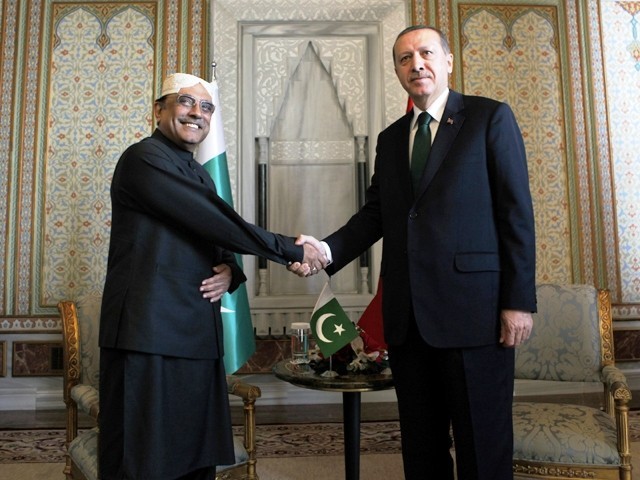
Pakistan's President Asif Ali Zardari with the Turkish Prime Minister Recep Tayyip Erdoğan. Reuters photo
Pakistan’s President Asif Ali Zardari with the Turkish Prime Minister Recep Tayyip Erdoğan. Reuters photo

Everybody loves Turkey. It’s where Pakistani families go for holidays, where students now go for education, where laborers go for work, where clerics go for counsel, and where both civilian and military officials and dignitaries go to find inspiration. Due to Turkey’s momentous economic and political rise, especially in the last decade, it is being held up to the rest of the Muslim world as a country worth emulating, and experts from everywhere have been referring to the “Turkish model” – an Islamic democracy with a robust economy – as the blueprint for a strong and stable (and still Muslim) country. Continue reading Why Pakistan Loves Turkey: Saim Saeed

Jharkhand, twelve years later: Mahtab Alam

Guest post by MAHTAB ALAM

The state of Jharkhand was created after several decades of struggle. On 15 November, the state  completed 12 years of its formation. The day is considered to be the birth anniversary of the legendary leader Birsa Munda. The state, famous for its rich mineral resources, occupies an area of 28,833 square miles (74,677 square km) and has a population of nearly 330 lakh people according to 2011 estimates. Like every year, the formation day was celebrated with the great pomp and show by the government and the political elite in the state capital Ranchi and elsewhere.

However, this year, greater effort was made to bolster its ever declining public image due to mass displacement, brutality by police and security forces and rampant corruption in the state over the years, by giving advertisements not only in local and Hindi newspapers but also in major national dailies. On 15th of November, in the Times of India (Delhi edition), a full page advertisement was published with smiling faces of Shibu Sonren, once a popular leader and referred as Dishom Guru or the Great Leader of Tribal, Jharkhand Mukti Morcha (JMM) chief and also head of the ruling alliance, along with chief minister Arjun Munda and his team, in Hindi with the heading, ‘Vikas ke path par agrasar Jharkhand: Zameen par utri Haqeeqat’ (Jharkhand on the path of Development: Reality on the ground), enumerating ‘landmark works of development’ of the government. I was also told by friends that similar advertisements appeared in other newspapers as well. Continue reading Jharkhand, twelve years later: Mahtab Alam

A Case of Dalit Assertion Over Adivasi Land: Agrima Bhasin

Guest post by AGRIMA BHASIN

“We won’t beat you at your house, we will beat you in the bazaar, in front of everyone!” A common caveat, often hurled at a dalit by an upper caste. But in this case, they were dalit men who spat this warning at a tribal family. A group of dalits in Alampur village, Sagar district, Madhya Pradesh are forcefully asserting their rights (since 2003) over a belt of forest land belonging to Balram, a tribal resident and his family. The family have farmed the five acres of land for 40 years and were finally awarded forest rights over it by the state government of Madhya Pradesh in 2009. Continue reading A Case of Dalit Assertion Over Adivasi Land: Agrima Bhasin

Reject amendments to UAPA – An appeal to members of the Rajya Sabha: JTSA

This release was put out by the JAMIA TEACHERS’ SOLIDARITY ASSOCIATION on 3 December 2012. Full list of signatories at the end.

It is saddening and surprising that at a time when more and more evidence is surfacing about the extensive abuse of anti-terror laws in targeting minorities, tribals, deprived sections as well as political activists, the government has chosen to move amendments in the present UAPA 2008. These amendments will make the law even more draconian and amenable to human rights violations.

 You will remember that the amendments in the Unlawful Activities Prevention Act 1967 were passed in December 2008 without any thoroughgoing debate in the aftermath of the horrendous carnage in Mumbai. The Bill was not referred to any Parliamentary committee despite calls by several members for such a scrutiny and consultative process. Whilst the widespread sense of shock and reprehension at the Mumbai killings may have been weighing on the minds of the Hon’ble Members of Parliament then, four years later, surely, there is no reason to push through the amendments without a wider debate.   Continue reading Reject amendments to UAPA – An appeal to members of the Rajya Sabha: JTSA

Save indie cinema in India

To:
Door Darshan India (Director General)
President of India (Shri Pranab Mukherjee)
Vice President of India (Shri Hamid Ansari)
Information and Broadcasting Minister (Manish Tiwari)

This petition is jointly filed by: Oscar Award and National Award winning sound engineer Resul Pookutty; National Award Winner and Oscar nominees Ashvin Kumar, Ashutosh Gowariker; National Award winning filmmakers Anant Mahadevan, Aparna Sen, Ashim Ahluwalia, Buddhadev Das Gupta, Girish Kasaravalli, Goutam Ghosh, Jahnu Barua, Janaki Viswanathan, Nila Madav Panda, Onir, Rituparno Ghosh, Sachin Kundalkar, Shivajee Chandrabhushan, Shyam Benegal, Sanjay Suri, Shonali Bose, Sooni Taraporevala, Sudhir Mishra, Suman Mukhopadhyay, Umesh Kulkarni, Vinay Shukla, Vishal Bharadwaj; Film makers Aamir Bashir, Amole Gupte, Anusha Rizvi, Bedabrata Pain, Homi Adajania, Kaushik Mukherjee (Q), Kiran Rao, Krishna D.K., Nandita Das, Rahul Bose, Samar Khan, Srijit Mukherji , Subhash Kapoor, Sudish Kamath, Vinta Nanda, Vipin Vijay, Zoya Akhtar; 5 time National Award winning actror, social activist and MP Shabana Azmi and actor/producer Juhi Chawla

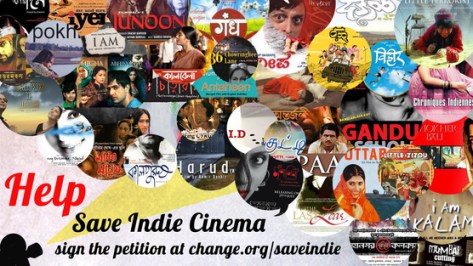
As the country celebrates 100 years of cinema we want to bring to your notice how New Wave Indie Cinema of India is under threat. Among the various challenges that we face as Indie film makers, the biggest is that of exhibition. The multiplexes which were given tax benefits to promote small budget content film have in fact been instrumental in destroying small cinema by only playing the box office game. Continue reading Save indie cinema in India

Dreamum Wakeupum, HRD Ministry!

Monobina Gupta, who writes on Kafila had a piece in Times of India recently on the ravages of restructuring at Delhi University. While researching this piece Gupta sent me and several others a list of questions about the reforms. I reproduce below her questions and my answers in full. If you’re convinced by what follows, please sign this petition.

  1. How has the academic culture/ environment changed over the last five years? Has it been a slow process of attrition or sudden negativity with Kapil Sibal getting more and more aggressive?

Interestingly, strictly speaking, we’ve seen not so much attrition as an acceleration of initiatives in the purely quantitative sense accompanied by academic chaos and a disturbing decline in intellectual input. It’s possible that we now have a greater variety of courses on paper, more research projects and more published papers by faculty, but the quality of each of these has to be questioned in the light of the pressure under which they are being produced. Intellectual activity, whether anybody likes it or not, cannot be compared to most other types of output or production. It requires a very different administration, temporality (like any creative activity) and support. It needs to be largely self-directed and self-motivated, with a few broad parameters set by authority. There can consensus on standards, but these need to be set by the academic community in a public and transparent way. They cannot be set by bureaucrats and administrators and enforced by the gun. What Sibal’s regime did, consciously or unwittingly, was to define the entire teaching class as enemies, at the administrative level. The effect was that Delhi University’s VC found it in himself to bypass established democratic and consultative procedures and ram through the proposed changes. Every time teachers asked that established norms be respected and we be consulted through due process or if we suggested that intellectual and scholarly processes take time, the administration stonewalled us and threw us out of the reform process. Under Sibal, decades of collegiate functioning was torn apart, and every fight got ugly. Suddenly, ‘debate’ and ‘democratic consultation’ became dirty words. It is to be expected that a change in the higher education policy of a country as massive as India would generate passionate debate. Since this debate was not taking place in the national media, we teachers should have been considered the most valuable interlocutors, but we were stunned by the speed and ferocity of the reform process, and the criminalisation of our right to dissent and ask questions. Who has decided what the time frame for reforms is, and why aren’t we involved in this decision? Ultimately, the administration might wish that we didn’t exist as the troublesome, questioning human element in the teaching learning process, but unfortunately this is not going to happen unless they invent androids!

  1. Can you outline the main points of difference in the way the education is perceived by the ministry/ policymakers and those who actually do the teaching?

Continue reading Dreamum Wakeupum, HRD Ministry!

The Power of Mercy: Yug Mohit Chaudhry on the execution of Ajmal Kasab

Guest post by YUG MOHIT CHAUDHRY

Under Article 72 of the Constitution of India, the President’s power to grant mercy comes into play only after the judicial system has confirmed the death sentence. Therefore, the confirmation of the death sentence by the highest court is a condition precedent to the grant of mercy. Judicial confirmation of the death sentence does not put the convict beyond the pale or disqualifies him from mercy; in fact it renders him eligible for mercy. Arguments that Kasab deserved no mercy once the Supreme Court confirmed his death sentence are misconceived.

It is only the rarest of rare crimes that shock the collective conscience of society and are truly unpardonable that are given the death sentence. In our constitutional scheme, it is therefore only persons committing such crimes that are eligible for mercy and pardon. If they are to be excluded from the ambit of mercy by the mere fact of having committed truly unpardonable crimes, the President’s power of mercy has no meaning. Paradoxically, the very fact that Kasab had indeed committed an unpardonable crime is what renders him eligible for mercy. Continue reading The Power of Mercy: Yug Mohit Chaudhry on the execution of Ajmal Kasab

A dangerous idea

For easy sharing, you can find this image on Twitter and Facebook.

Social Media Regulation vs. Suppression of Freedom of Speech: Pranesh Prakash

Guest post by PRANESH PRAKASH

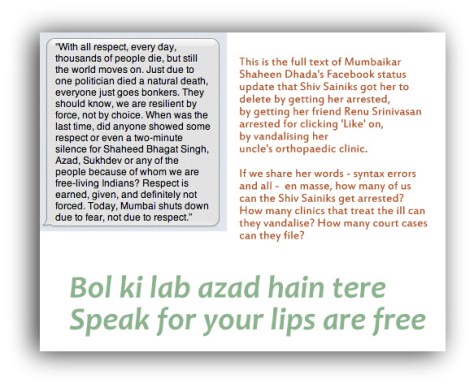
This morning, there was a short report in the Mumbai Mirror about two girls having been arrested for comments one of them made, and the other ‘liked’, on Facebook about Bal Thackeray:

Police on Sunday arrested a 21-year-old girl for questioning the total shutdown in the city for Bal Thackeray’s funeral on her Facebook account. Another girl who ‘liked’ the comment was also arrested.

The duo were booked under Section 295 (a) of the IPC (for hurting religious sentiments) and Section 64 (a) of the Information Technology Act, 2000. Though the girl withdrew her comment and apologised, a mob of some 2,000 Shiv Sena workers attacked and ransacked her uncle’s orthopaedic clinic at Palghar.

“Her comment said people like Thackeray are born and die daily and one should not observe a bandh for that,” said PI Uttam Sonawane.

What provisions of law were used?

There’s a small mistake in Mumbai Mirror‘s reportage as there is no section “64(a)”1 in the Information Technology (IT) Act, nor a section “295(a)” in the Indian Penal Code (IPC). They must have meant section 295A of the IPC (“outraging religious feelings of any class”) and section 66A of the IT Act (“sending offensive messages through communication service, etc.”). The Wall Street Journal’s Shreya Shah has confirmed that the second provision was section 66A of the IT Act.

Section 295A of the IPC is cognizable and non-bailable, and hence the police have the powers to arrest a person accused of this without a warrant.2 Section 66A of the IT Act is cognizable and bailable. Some news sources claim that section 505(2) of the IPC (“Statements creating or promoting enmity, hatred or ill-will between classes”) has also been invoked.

This is clearly a case of misapplication of s.295A of the IPC.3 This provision has been frivolously used numerous times in Maharashtra. Even the banning of James Laine’s book Shivaji: Hindu King in Islamic India happened under s.295A, and the ban was subsequently held to have been unlawful by both the Bombay High Court as well as the Supreme Court. Indeed, s.295A has not been applied in cases where it is more apparent, making this seem like a parody news report. Continue reading Social Media Regulation vs. Suppression of Freedom of Speech: Pranesh Prakash

The Uttar Pradesh administration has a prominent role in the burning of Bhadarsa: Rihai Manch

This release was put out by the RIHAI MANCH on 9 November

Jannatunisa, a victim of violence in Bhadarsa

Faizabad 9 November 2012: An investigation team of Rihai Manch visited the Bhadarsa village which was affected by communal violence during Dussehra celebrations. The team found out that the violence was well planned and was executed by communal elements in connivance with the administration. The role of the media in this incident is also suspicious. The team also found that the administration is forcing the affected families to erase any evidence of the incident and they have not even been compensated. No FIR has yet been registered yet. The team has also requested the Sheetla Singh Investigation Commission (constituted by the Press Council of India) to visit the area. Continue reading The Uttar Pradesh administration has a prominent role in the burning of Bhadarsa: Rihai Manch

भदरसा के जलने में प्रशासन की अहम भूमिका: रिहाई मंच

This release in Hindi about recent communal violence in the Bhadarsa area of Faizabad district of Uttar Pradesh comes to us from the RIHAI MANCH. Please help us translate this into English by translating just one paragraph in the comments

Jannatunisa

फैजाबाद, 9 नवम्बर 2012। रिहाई मंच के जांचदल ने दशहरा के दौरान हुयी साम्प्रदायिक हिंसा से प्रभावित भदरसा गांव का दौरा किया। जांच दल ने पाया कि भदरसा में हुयी हिंसा पूरी तरह सुनियोजित थी जिसे साम्प्रदायिक तत्वों और प्रशासन की मिलीभगत से अंजाम दिया गया जिसमें मीडिया की भूमिका भी संदिग्ध थी। जांच दल ने यह भी पाया कि प्रशासन की तरफ से आगजनी से पीडित परिवारों से घटना के साक्ष्य जबरन मिटवाए जा रहे हैं जबकि पीडि़तों को न तो उचित मुआवजा मिला है और ना ही एफआईआर दर्ज किये गये हैं। जांच दल ने प्रेस काउंसिल द्वारा गठित शीतला सिंह जांच आयोग से भी भदरसा जाने की मांग की है। Continue reading भदरसा के जलने में प्रशासन की अहम भूमिका: रिहाई मंच

Gujarat vs. Himachal Pradesh: Rahul Verma

Guest post by RAHUL VERMA

Himachal Pradesh Chief Minister Prem Kumar Dhumal at an election rally in Mandi. PTI photo

Even though Hiamchal Pradesh voted on November 4, Gujarat has been hogging all the limelight. The election in Gujarat is only in the third week of December. Gujarat captures our political imagination as a ‘role model state’ whereas Hiamchal Pradesh is just in our tourism agenda as a top holiday destination. It is hard for anyone to notice Himachal as a political entity among the big brothers like Uttar Pradesh, West Bengal, Bihar, Andhra Pradesh, Tamil Nadu, and Maharashtra. The irony is that some smaller states like Manipur and Nagaland still manage to get  some attention because of violent manifestations of political choices in these states. Himachal Pradesh is absent from our discourses as the state is just ‘small’ and ‘beautiful’. However, the great turn around in Himachal over last two decades demands that India at least recognizes the “Himachal Pradesh model of development”. Continue reading Gujarat vs. Himachal Pradesh: Rahul Verma