Category Archives: Identities

Reflections on the Bigots of Embedded Media: Biswajit Roy

Guest post by BISWAJIT ROY

Now that the xenophobic and paranoid big media clamour for slapping sedition charges against Arundhati Roy and others for speaking up their mind on Kashmir, has temporarily subsided, it is time for some reflection.  This clamour has only underlined the increasingly shrill bigotry of a section of Indian journalists who are deeply embedded in the right-wing statist mission, a la Arnab Goswami. Their stakes in the race for Padma awards or Rajya Sabha nominations may be one of their personal motives for behaving the way they do – baying for the blood of the dissenters and whistle-blowers while ignoring the ground reality in Kashmir valley today. But there may also be corporate institutional compulsions. However, they are espousing bigotry at the expense of the media’s role as the protector and disseminator of dissent in public life as well as watchdog against excesses and abuses of power by the government and other wings of the State in the name of national security and national interests. As a media professional, I would like to share some of my encounters with these self-proclaimed guardians of Indian nationalism in media and frontiers of mainstream journalism.

The Kargil War: the self-proclaimed guardians of national interests Continue reading Reflections on the Bigots of Embedded Media: Biswajit Roy
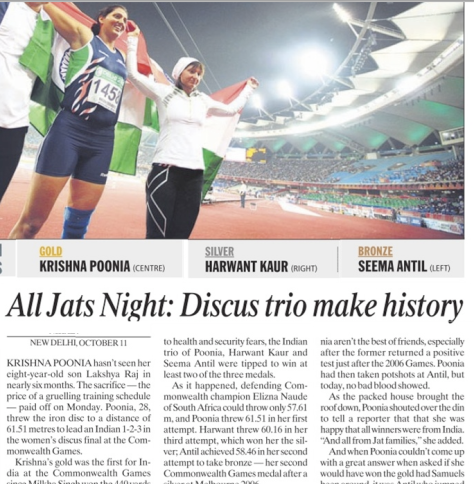
Jats rock, caste shocks

This post is dedicated to a Facebook friend who, when I asked her her caste, replied: “Now, now, now! In any case, with the brouhaha surrounding the census, what’s the proper form these days? Mention of caste in or out?”

I woke up to this headline in The Indian Express today. My reaction was to wonder what many others’ reaction would have been? Those who argue that reservation and ‘caste census’ and such measures serve to solidify caste identities rather than weaken them – I wonder what they would make of this headline?  Continue reading Jats rock, caste shocks

Reading the Ayodhya Judgement: Biswajit Roy

Guest post by BISWAJIT ROY

In this piece, I would like to share my reading of judgments on Ayodhya. I have only managed to go through the judgment of Justice Khan in detail and parts of justice Agarwal and Sharma’s expositions. Though the Lucknow bench of Allahabab High Court accepted the Hindu faith-based claims about Ram’s birth at the disputed site and the 2-1 verdict went for its three-way partition, all the three judges differed in their takes on the issues related to claims and counter-claims reflecting not only their individual subjectivity but also social loci. To be more candid, they hardly hide their community background and their stakes as insiders.

The bench has anchored its verdict it by referring to religious scriptures, medieval memoirs, foreigners’ travelogues, colonial records, and history books well as folklore and oral tradition. But the judges’ reading of these texts differed much less on legal nuances and more on interpretations and inferences based on their own religio-political understanding and beliefs.
Here is what I found interesting in Justice Khan’s judgment. He differed with other two judges on substantial points: the acceptance of disputed site, to be precise, the area under the central dome of the demolished mosque as Ram’s birthplace, Babar’s demolition of a pre-existing Hindu temple and the mosque’s validity as a proper mosque.

Continue reading Reading the Ayodhya Judgement: Biswajit Roy

Tehelka’s Populist Turn? Bobby Kunhu and Sudeep KS

Guest post by SUDEEP KS and BOBBY KUNHU

The magazine joins the Great Kerala Terrorist Hunt. This was sent as a rebuttal to Tehelka, but has not been published.

Kerala’s Radical Turn – cries the cover of the last issue of Tehelka (dated 9th October, 2010). The cover story by V K Shashikumar, that plays the familiar tunes of Islamophobia, hints at Tehelka‘s Populist Turn. It will be interesting to see where Tehelka goes from here, and what happens to its current reader base that distinguished the magazine from the likes of The Indian Express and The Times of India and India Today.

In the article, Here Come the Pious, Shashikumar lists some facts and his personal fears, on the eve of the Allahabad High Court judgment on the Babri Masjid land dispute. What is missing in the entire article is reason. The byline says that “A new Islamist body, the Popular Front of India, is causing alarm with its religious overdrive in the south.” After one goes through the article, however, what one gets is a glorified picture of the outfit. Whether the author likes it or not.

Continue reading Tehelka’s Populist Turn? Bobby Kunhu and Sudeep KS

Sri Lanka’s 18th Amendment: A Charter for Dictatorship: Rohini Hensman

Guest post by ROHINI HENSMAN

Different sections of Sri Lankans protest against the 18th Amendment

Sri Lanka’s claim to be a democracy has been tenuous for years, but the passing of the Eighteenth Amendment to the Constitution by parliament on 8 September 2010 dealt it a fatal blow. It changed Sri Lanka into a de facto dictatorship like Zimbabwe and Myanmar, where it is abundantly clear that elections alone cannot unseat Mugabe or Than Shwe.

Continue reading Sri Lanka’s 18th Amendment: A Charter for Dictatorship: Rohini Hensman

The Many Lives of Caste in Modern India

[Following my previous post, ‘We are Proud Hindus’, there has been an expected barrage of comments – all along very predictable lines. Most of them, characteristically, turn every critique of reprehensible caste practices of Hindu society into an expression of ‘casteism’ and immediately displace the criticism to their favourite enemy, Islam. For the benefit of readers who might be interested in a more reasoned debate, I post here an essay,  which was written some years ago and a version of which published in South Asian Journal. This is  just by way of making my own position clear. – AN ]

Politics in contemporary India is marked by the ‘resurgence’ of ‘caste politics’. In a sense, this is true. The past two decades have seen a dramatic collapse of the old political formations and parties, which had dominated the politics of the Nehruvian era.[1] Even the movements of that period, right up to the mid-1970s, were largely movements on economic issues and questions of corruption, black-marketing, hoarding and food shortages. Through the decade of the 1980s, there was a gradual erosion of the Nehruvian secular-nationalist imagination, and one of the factors responsible for it was the ‘re-emergence’ of caste in public discourse.

The watershed in this respect of course, was the famous ‘Mandal Commission’ agitation – which has become something of a metaphor in contemporary Indian politics. The Commission, which was instituted in 1978, during the Janata Party government, under the stewardship of B.P. Mandal, a socialist leader from a ‘backward caste’, was given the task of looking into the question of ‘backwardness’ of certain castes and suggest remedies for its redressal. For about a decade after it submitted its recommendations in 1980, it lay in cold storage after the Congress under the leadership of Mrs Indira Gandhi (subsequently taken charge of by her son Rajiv) returned to power. It was implemented under extremely contentious circumstances in 1990 under the Prime Ministership of V.P. Singh. As is well-known, its main recommendations included 27 percent reservations in public employment for these castes (known in India as the ‘Other Backward Classes’ or OBCs).

Continue reading The Many Lives of Caste in Modern India

We Are Proud Hindus!

The Times of India carried a story today that we are reproducing here in full. It is the story of a Rajput-owned dog who became outcaste because it was fed a chapati by a dalit woman.  Not only was the dog turned ‘out’  to live in the dalit basti, worse, the woman Sunita was fined Rs 15, 000/-  by the panchayat for the crime. But hold on, there is more: when Sunita and her brother went to lodge a complaint at the police station, the police officer asked her why she fed the dog? So, this is not really a matter of one mad, ‘illiterate’ individual (as if literates are by definition better): This incident reveals an entire structure of thought and belief that extends through from the panchayat to the police itself (which despite the Supreme Court’s directive has not yet filed an FIR). Here is the full report:

BHOPAL: A dog’s life couldn’t get worse. A mongrel brought up in an upper caste home in Morena was kicked out after the Rajput family members discovered that their Sheru had eaten a roti from a dalit woman and was now an “untouchable”. Next, Sheru was tied to a pole in the village’s dalit locality. His controversial case is now pending with the district collector, the state police and the Scheduled Caste Atrocities police station in Morena district of north MP.

The black cur, of no particular pedigree, was accustomed to the creature comforts in the home of its influential Rajput owners in Manikpur village in Morena. Its master, identified by the police as Rampal Singh, is a rich farmer with local political connections.

Continue reading We Are Proud Hindus!

Kashmir, September 2010. The Reichstag Fire (dispersed) Redux ?

(Apologies for cross posting on the Reader List)

As if by magic, those who had hidden themselves for the past few months in Kashmir are leading mobs and setting schools and public buildings on fire. And many more people have died tragic and unnecessary deaths. This time, unlike in the past, the blame must be squarely shared between those who fired the bullets, and some of those who led the incendiary crowds. Perhaps Kashmir has just entered a new and darker phase, brandishing a burning torch. This situation, in order not to be irreversible, needs the urgent and sane attention of Kashmiris themselves, and of all those who wish Kashmir and its people well.

We could do well by way of beginning by turning our attention to a surprising detail hidden within the reports of the recent events of arson. National Conference apparatchiks, who did not even dare appear in public till recently for fear of being attacked for their role in sustaining the occupation of Kashmir by India’s armed might, are now allegedly seen openly goading mobs of zealots to burn down a school in the name of the defence of religion. If this is true, the what we are witnessing is the realization by them of a wonderful opportunity to wear new costumes and speak new lines in the unfolding theatre of the moment.

Continue reading Kashmir, September 2010. The Reichstag Fire (dispersed) Redux ?

Dressing and Death-Threats in Kerala : Re-former Man’s Second Coming?

(cross-posted on www.countermedia.in)

Shamshad Hussain, J. Devika

The death threats received by a young woman student of engineering, Rayana R Khazi, a native of Cherkalam in Kasaragod, over a period of the past ten months, have been in the news in Kerala recently. The threats which were issued over the phone, on the streets, and by letters, have demanded just one thing: Rayana should comply with ‘Islamic dress-norms’; she should don the purdah. She has received four threatening letters. Of these, three issue death-threats, outright. The fourth is in the form of a warning that offers lengthy advice. One of these says: you have not heeded many warnings issued. We, Muslim brethren, will now decide your fate. This letter, which begins and ends in the name of Allah, is unsigned. Continue reading Dressing and Death-Threats in Kerala : Re-former Man’s Second Coming?

Why Kashmiris should speak to Indians, not India

On 28 May this year, the Economic Times, India’s leading business daily, carried a story titled, ‘Kashmir survey finds no majority for independence’. That is a curious headline. What is ‘no majority’? Either there is majority or there is not. Robert Bradnock conducted this survey for Chatham House, a leading British think-tank, Kashmir on both sides of the Line of Control. The survey was conducted in the autumn of 2009, and the copy mentioned that 44 percent in Azad Kashmir and 43 percent in Jammu & Kashmir favoured an independent Kashmiri nation state.

Similar was the reporting of the survey in other Indian papers. They omitted some details, though. They did not mention that the survey was conducted not just in Kashmir but also the Jammu and Ladakh regions. They did not mention that even after factoring in Jammu and Ladakh, the total support for India was 21 percent and for Pakistan 15 percent. So if there was a three-way poll, the whole region’s average figure of those supporting independence (43 percent) would win hands down. Most of the rest (14 percent) favoured making the LoC a permanent border, which means sealing the status quo, something India and Pakistan came very close to doing in 2007. This 14 percent comes only from Poonch (94 percent), Rajouri (100 percent) and Jammu (39 percent).

Further, they did not mention that in the district-wise results the greatest support for independence was in the Indian side of the Valley – an astounding 95 percent in Baramulla, 75 percent in Srinagar, 82 percent in Badgam, and 74 percent in Anantnag. Pulwama and Kupwara were not surveyed. The highest support for India was 80 percent in Kargil and 67 percent in Leh, 73 percent in Udhampur and 63 percent in Kathua. In Jammu district, it was 47 percent – ‘no majority’. In Azad Kashmir, 50 percent wanted to be with Pakistan.

Now read the ET headline again. ‘Kashmir survey finds no majority for independence’. The story does not tell us what they found a majority supporting. If we have to be polite, we can say that such manipulative reporting of a detailed survey amounts to the Indian media being in denial of the fact that Kashmiris don’t want to be with India. If we have to call a spade a spade, we can say that this amounts to telling us a lie. Read More

Have I Joined the Popular Front?

In the past few weeks, I have been asked over and over again, not always in jest, if I had joined the Popular Front. I am not surprised. The police investigation around the violence against the college teacher at Muvattupuzha has broken all previous records in not only the violation of human and civil rights, but also in the silence of Kerala’s enlightened intellectuals. If I recall right, only Nandigram evoked such a dense and deliberate silence from them. No wonder, anyone who speaks up against the manner in which the police is being armed and authorized against ‘bad muslims’ is immediately dubbed a supporter of the Popular Front. But I am intrigued by this simple question, by which the entire history of that person’s engagement with discussions around religion and the state is erased. Continue reading Have I Joined the Popular Front?

What Went Wrong in Kashmir? Rekha Chowdhary

Guest post by REKHA CHOWDHARY

This article was also published in Kashmir Times
What went wrong in Kashmir? This is one pertinent question that needs to be addressed seriously before any corrective measures can be applied. Situation would certainly normalise after some time, but apparently ‘normal’ situation in case of Kashmir does not indicate anything. The vibrancy of ordinary life and the day-to-day routine followed for days and even months, takes only moments to break. Underneath the normalcy, the turbulence is ever present and can surface at any point of time. Every turbulent period however provides clues to the real problem, and one should hold on to these clues, if one really wants to do something about it.

So what do we see in the present turbulence? Firstly, though the crisis revolves around the stone-pelting youth, one can clearly say that the real problem is not that of the stone-pelters. Neither the theory of LeT being responsible for it, nor the issue of money being paid to stone pelters, nor the vested interests making the most of the situation explains the crisis.

The Great Incendiary Hunt Takes Off in Kerala

I have been watching the whole drama that has been unfolding after the unspeakable and utterly condemnable act of violence at Muvattupuzha in central Kerala early this month, which has been widely interpreted as the first instance of ‘Talibanist’ violence here, with a sinking feeling in the pit of my stomach. A whole manhunt has followed it and this continues to be front-page news in many Malayalam newspapers, especially the Mathrubhumi. Continue reading The Great Incendiary Hunt Takes Off in Kerala

A Dialogue with God and Dialogues that go missing

Guest post by SUDEEP KS and BOBBY KUNHU

On Sunday 4 July 2010, T J Joseph, a college lecturer, was attacked by a group of people on his way back from the church in Muvattupuzha in central Kerala, and his right hand was chopped off. We believe this heinous act deserves to be condemned, and that such acts pose a major threat to the secular fabric of the Kerala society.

The attack has attracted immediate media attention, and it is said to be related to a recent controversy over a question paper. Joseph, in his Malayalam question paper, had asked one question that apparently hurt the religious sentiments of some people.

The Kerala society’s response to this whole episode has been equally disturbing. Pinarayi Vijayan, state head of Communist Party of India (Marxist), calls it ‘Talibanization of Kerala’. It has been made out to be a question of ‘freedom of speech’. The media, politicians and intellectuals are busy expressing serious concerns over a ‘religion’ that is intolerant and fanatic. The Police has also let out suspicions on some groups involved in this incident, and both the television and print media have been religiously reporting it. Continue reading A Dialogue with God and Dialogues that go missing

“Caste census will increase incidence of Japanese encephalitis”: Sociologist

Just four years ago, during “Mandal II”, everyone opposing the extension of OBC reservations to central educational institutions were saying we don’t even know how many OBCs there are. Now, when there is a proposal to count the OBCs, these voices are not to be heard. Just like “Mandal II”, a new term, “caste census” has been invented, as if the census already does not count the Scheduled Castes. The term “caste census” is used repeatedly in a way that suggests that a secular, progressive pro-development exercise is being sullied, polluted, by this monster of caste because of those uncouth cow belt politicians. Chee chee!

Obfuscation and intellectual dishonesty are in order. So, a lot of bullshit is being written about “caste census” to prevent us from knowing just how many of us are OBCs, to prevent the Other Backward Classes from entering the privileged spaces of the upper castes. This one takes the cake: Continue reading “Caste census will increase incidence of Japanese encephalitis”: Sociologist

Mohamad Junaid: What Does the Chatham House Poll in Kashmir Tell Us?

Guest post by MOHAMAD JUNAID

The Chatham House poll conducted in the autumn of 2009 in Jammu, Ladakh, Kashmir and Azad Kashmir has revealed an interesting pattern of opinions held across these regions on issues ranging from the perception of major problems people face to effective solutions to the Kashmir issue and the best means to achieve them. Robert Bradnock, under whose supervision the poll was conducted, however presented the results somewhat shoddily leading to confusion over the real import of the opinion poll. This confusion has prompted media in India and Pakistan to portray the polls selectively or in a self-serving manner, largely reflecting their nationalist stances on the Kashmir question. The poll, in reality, points to some interesting developments in Kashmir and indicates a way toward an eventual, mutually agreeable solution.

Consistent with every other poll on the issue, Chatham House poll has shown again that an overwhelming number of people (74—95 percent) in Kashmir region demand independence. This figure comes as no surprise because the support for independence for Kashmir over accession to Pakistan has been steadily growing over the last 20 years. This feeling is more concretely reflected in the fact that most Kashmiris (more than 90 percent) support withdrawal of Indian troops from Kashmir, while a similar figure (around 80 percent) want Pakistan to withdraw its troops from Azad Kashmir. Along with demilitarization, there is a clear demand for de-weaponization (more than 80 percent) and an end to militant violence (around 90 percent) in the Kashmir region. The Line of Control in its present form is uniformly rejected in both Kashmir and Azad Kashmir. Continue reading Mohamad Junaid: What Does the Chatham House Poll in Kashmir Tell Us?

‘The Moral Obligation of Indian Civil and Political Society’: Rekha Chowdhary on Fake Encounters in Kashmir

Guest post by REKHA CHOWDHARY

With another incident of fake encounters in Kashmir, it is a moment of introspection for the political and civil society of India. For all those who are proud of Indian democracy, it is a moment to reflect as to how this democracy fares for the people in Kashmir. It is important to note that democracy does not remain limited to the electoral choices and the extent and intensity of competition in the formation of government – it also involves the political and civil rights of people. Even when democracy has been restored in Kashmir in its procedural form and is kicking in the form of intensely competitive politics, its substantive effect is missing. The right to life is the minimum that is provided by any democracy, the range of rights however goes much beyond this and involves the basic civil liberties as well. However, the way the hapless innocent persons were cruelly murdered in Nadihal in north Kashmir and declared as militants – it is the denial of the minimum. It is not only the murder of three people, it is also the murder of Indian democracy! Continue reading ‘The Moral Obligation of Indian Civil and Political Society’: Rekha Chowdhary on Fake Encounters in Kashmir

Beware Bigotry – Free Speech and the Zapiro Cartoons: Mahmood Mamdani

Text of talk on receiving an honorary doctorate at the University of Johannesburg, 25 May, 2010

MAHMOOD MAMDANI, Makerere University, Kampala, Uganda

This text was sent to us by Sujata Patel

It warms my heart to see these flowing gowns. I congratulate you on work accomplished! For over a millennium, these gowns have been a symbol of high learning from the Indian Ocean to the Atlantic. Should anyone ask you where they came from, tell them that the early universities of Europe – Oxford, Cambridge, le Sorbonne – borrowed them from the Islamic madressa of the Middle East. If they should seem incredulous, tell them that the gown did not come by itself: because medieval European scholars borrowed from the madressa much of the curriculum, from Greek philosophy to Iranian astronomy to Arab medicine and Indian mathematics, they had little difficulty in accepting this flowing gown, modeled after the dress of the desert nomad, as the symbol of high learning. Should they still express surprise, ask them to take a second look at the gowns of the ayatollahs in Iran and Iraq and elsewhere and they will see the resemblance. Education has no boundaries. Neither does it have an end. As the Waswahili in East Africa, which is where I come from, say: elimu haina muisho. Continue reading Beware Bigotry – Free Speech and the Zapiro Cartoons: Mahmood Mamdani

Nandini Sundar – Will counting caste reduce inequality?

Nandini Sundar’s recent Op-Ed for The Hindu on caste-enumeration in the latest round of the census. Read the entire article here.

But come back with your comments – what do you think about caste–enumeration?

Yesterday when the census enumerator visited, I asked him how he felt about the current debate on counting caste in the census: “Not comfortable at all”, he said, “I don’t even like asking whether someone is SC/ST or Other, leave alone what their caste is.” But, he added, “caste is an inescapable reality of Indian society.”

The debate on counting caste in the census has not moved on from 2001, when opinion was equally divided. Supporters of caste enumeration argue that census categories merely reflect existing classifications, and that only the census can provide the figures necessary to map inequality by caste. Opponents argue that the census does not mirror but actively produces social classifications and ways of thinking. They point to the history of mobilisation around caste in the census and the consequent dangers of both distorted data and increased social tensions. In neither case has much thought been given to how the data might be used, the different kinds of figures needed for different purposes, or alternative ways of collecting the required data. Read the rest of the article here

Rahul Gandhi and the Dalit votebank in Uttar Pradesh

This article by me has appeared (.pdf) in the Economic and Political Weekly.

On 14 April this year party general secretary Rahul Gandhi launched the Congress’ biggest campaign to revive itself since 1989. The date was carefully chosen, Ambedkar Jayanti, because he is trying to win over dalit votes in Uttar Pradesh (UP). In 1989 the Congress’ support base in UP was made up of a rainbow coalition of brahmins, Muslims and dalits. The Congress has to woo these communities again to regain power in UP.

The brahmin community took to the now ruling Bahujan Samaj Party (BSP) in small numbers in the 2007 Vidhan Sabha election primarily because there was no strong brahmin leader after Bharatiya Janata Party (BJP) leader Atal Behari Vajpayee became politically inactive. Brahmins see in Rahul Gandhi a potential “brahmin” leader. The UP Congress president, legislative leader and Youth Congress president in the state are all from the brahmin community.

Muslim support is no longer enchained to the Samajwadi Party (SP) because their bete noire, the BJP, is powerless these days in both the centre and the state. As a result the Muslim vote is being fought for, as a three-way contest between BSP, SP and Congress. BSP head and Chief Minister Mayawati’s stratagem is to therefore change her party’s core support base constructed out of the “brahmin-dalit” alliance into a Muslim-dalit alliance.

The dalits, wooed away en masse by the Kanshi Ram-Mayawati duo of the BSP for years, would be the hardest to win back for the Congress. In fact, a year ago the very idea would have sounded ludicrous. But today, Mayawati’s angry reaction to the Congress’ bid to woo dalits is indication that the Congress may be winning over dalits. How is this happening? Continue reading Rahul Gandhi and the Dalit votebank in Uttar Pradesh

An election in Nottingham

This is a guest post by AMAN BHARTI on the elections in UK

I had nipped out during my lunch break to post my voting ballot. The route back took me past Nottingham’s speaker’s corner, where for the first time ever, I saw some speakers. They appeared to be two of the three main political party candidates.

Intrigued, I joined the small crowd for my first experience of local electioneering. A desi chap in his shalwaar-kameez (or is that only what women wear?), sleeveless jacket and one of those Ahmad Shah Masood caps (I know they are called something, but I forget what) was just about to ask a question. In broken, accented English, he talked about the Muslim community suffering due to anti-terror laws, and asked which party would bring in “transparency and accountability” in the exercise of anti-terror laws, and adhere to the European courts’ views on individual human rights?

The brown faces in the audience cheered loudly. The white faces were conspicuously (and a little worryingly) silent. Continue reading An election in Nottingham