
[This is the text of the open letter written by the eminent poet and public intellectual K Satchidanandan to Com. Pinarayi Vijayan] Continue reading Help us resist the Hindutva thought-machine: K Satchidanandan writes to the Chief Minister of Kerala
Category Archives: Identities
Restore Hadiya’s Dignity as an Adult: Prof. Samita Sen to the Chief Minister of Kerala
(This is the text of the open letter from leading women’s studies scholar and renowned feminist intellectual, Prof. Samita Sen, to the Chief Minister of Kerala on the Hadiya case) Continue reading Restore Hadiya’s Dignity as an Adult: Prof. Samita Sen to the Chief Minister of Kerala
Check Hindutva Patriarchy: Prof. Akeel Bilgrami writes to the Chief Minister of Kerala
The Left Must Fight for Human Rights: AIPWA to the Chief Minister of Kerala
This is the text of the open letter to Com. Pinarayi Vijayan from Kavita Krishnan, Secretary, All-India Progressive Women’s Association]
Continue reading The Left Must Fight for Human Rights: AIPWA to the Chief Minister of Kerala
Make your report on the human rights violations in the Hadiya case public: AIPWA to the Kerala State Women’s Commission
[This is the text of the open letter to M C Josephine, Chairperson, KSWC, from Kavita Krishnan, Secretary, All-India Progressive Women’s Association]
Free Hadiya March on 3 Oct: Citizens for Hadiya
On October 3, students, human rights activists, muslim-dalit-adivasi-bahujan organisations from all over India are converging in Thiruvananthapuram to march for the freedom of the twenty-four-year-old Hadiya, who is under virtual house arrest in the home of her father, Mr Asokan after the shocking annulment of her marriage to her chosen partner by the Kerala HC. The march will begin from the Martyr’s Column, Palayam, at 11 AM and end at the Kerala State Government Secretariat junction. Through this we hope to draw the attention of the public to the grave dangers posed by these decisions of the judiciary and by the shameful silence and criminal inaction of the Kerala government , which claims leftist and secular credentials. We invite all to participate in this march and strengthen the hands of those who are fighting to undo this unspeakable violation of justice to an Indian citizen and the gross attack on the fundamentals of Indian democracy. We also request you to kindly change your Facebook profile pictures to Citizens for Hadiya and/or write supporting posts.
Continue reading Free Hadiya March on 3 Oct: Citizens for Hadiya
Cutting the nose to spite the face?
It looks like the CPM’s enmity towards the Muslim organizations is such that they do not mind sacrificing women’s human rights and reinforcing the patriarchal family just to teach them a lesson. So they are happy to stick with the Sanghi understanding of conversion as necessarily forced in some way, ideological or physical. Media One broke news yesterday about a Sanghi torture camp for Hindu women who marry Christians or Muslims concealed as a yoga center. A woman incarcerated there for marrying a Christian managed to escape and complain to the police. Sixty-five women were reportedly incarcerated there when she was an inmate (a later report, after the place was shut down today on the order of the High Court, said 22 women and 23 men were allegedly for reconversion) . The reconversion therapy includes physical assault and threats. This 28-year-old woman married a Christian man without converting and her family seems to have initially accepted it. However, she was taken to this yoga cum counseling center by her own family without her consent and they left her there to the mercy of the criminals who ran the place. She also confirms that a young woman, Athira from Kasaragod, who had chosen to convert to Islam on her own who recently ‘returned’ to ‘Sanatana dharma’ with much fanfare, was in this place for twenty-two days and that she had continued to insist on her preference for Islam.
This place is in Tripunithura, in the heart of urban Kerala quite near the High Court at Ernakulam, which damned Hadiya’s right to choose her faith and a partner. Apparently, it is the Sanghi gang from this place who visited Hadiya at her father’s house. Here is the story:
So it appears that the Sangh is clearly seeking to reverse what is an outcome of long-term social processes shaped by increasing access to higher education for most social groups in Kerala. Women entered higher education here in larger numbers in the 1980s and Muslims, men and women, since the 1990s till now. The expansion of the media and cellphones is such that young people are not influenced solely by their parents or community. In other words, there is a greater livelihood of women and men choosing partners actors communities. Even sensible people here whisper about how zealous Muslims are about conversion away from Islam but the discourse of Hindu tolerance is so pervasive that it lets concentration camp proliferate in secret. The response of the CPM participant is truly revealing — indeed, this is cutting the nose to spite the face. Whatever be their position about welfare and economic development, the CPM in Kerala seems appallingly on the side of the Hindutva security state. And the questions this raises for the fabled autonomy of women here that the CPM ideologues never ceases to claim credit for, are huge.
This is probably the calculation of utility that underlies the chilling indifference/ outright contempt of the CPM leadership towards the plight of the Muslims: the average CPM and CPI supporter is the middle-caste ex-avarna middle-aged male of the middle or lower middle class. This gentleman’s preferences are such that his utility is maximised by staying with the organized dominant left in matters related to securing public resources to private ends (because the mobilization for that, given Kerala’s demographics and history needs to be necessarily by a multi-community mix) and by sticking to community/caste organizations for family matters. This choice has always been detrimental to women’s personal rights, particularly personal choices. The community/caste organizations of the 20th century are becoming more of economic institutions than social — and they manage the vast community assets once secured from governments for public ends now securing mainly the interests of the community elite. The social, however, is undergoing rapid transformation, and indeed, sections of the young now even dare to define the social for themselves. Into this gap steps the Sangh, desperate to make an entry, now that their efforts to secure the ex-avarnas have failed (because of their own irremediable casteism). The above-mentioned gentleman finds it prudent to use their services in making sure that the young stay under his patriarchal thumb. Especially young women, for they have nobody to really defend their rights. Thus arise the thriving if silent business of reconversion, well-protected from public view by the pervasive Islamophobia of the Right and Left, believers and rationalists. Also remember that in a post-demographic society, children are few and they are more akin to trophies that future labour for the family. The dominant left sees that as long as they don’t disturb this gentleman’s efforts to secure his patriarchal authority through whatever means, however violent, crude, and abhorrent to democracy they may be, they retain influence. In other words, the tattered influence of the dominant left — no longer hegemonic — endures through, among other things, looking away from the social and the familial as hierarchical institutions and the abuses. This is why a sexual attack on a film actor elicits a huge response from the feminist supporters of the CPM, while the unlawful confinement of a far less privileged young woman is largely ignored or supported ‘personally’. The dominant left leadership reasons this to be its best strategy, since it loses nothing by letting the Sanghis handle family affairs. The presence of the Sangh works well for it too, since very many Muslims and Christians, who are sizeable in demographic and economic terms, will turn to it for protection from the Sangh!! This strategy has worked hitherto, and the sole risk lies in the gentleman ceasing to remain a Rational Agent and joining the ranks of the Indo-Gangetic barbarians, essentially irrational in the Kerala context (I keep urging them to leave for Haryana in pursuit of what must be their choices if they choose to become such barbarians). But this has been largely limited to the upper caste Hindus and some sections of elite Christians who regret the loss of traditional power and hope that the Sangh will restore it. They are not the growing power, demographically or economically. Meanwhile, the effete rationalists generate a ‘secularised’ Islamophobia that serves as a neutral-sounding justification for the government’s inactivity.
There are very few moments in which I have felt so lonely. Almost everyone I know seems to be a player, a rational agent, in this game, either participating or creating justifications for the strategy or participating by simply looking away and remaining silent. But this loneliness is so much more dignified — and indeed, more human. I stand with the six young women who braved the Sangh and the police trying to reach Hadiya; I condemn those who serve up her father’s sickening sentimental patriarchal shit in the public in a way that renders them vulnerable. Hadiya’s father who had not the slightest compunction in approaching the High Court and painting his own daughter a potential terrorist such that her entire life promises to be hell (even if she escapes his confinement), is showered with sympathy by our critical intellects for being a poor worried father. Meanwhile, a radical student who claims to be on Hadiya’s side flings abuse on me for wearing a sleeveless blouse, for leaving my hair untied – she does not even notice that her tirade is so like a Brahmanical patriarch’s diatribe against the well-known signs of Kali — immodest women with their hair open — such missiles seem convenient for all, radical Ambedkarites even, to use against those they dislike. The only silver lining in this mess is that it reveals with unprecedented and astounding clarity, the enormous risks, dangers, and material losses ahead of anyone who wants to remain human, and not what is substitutable with Artificial Intelligence. And that in order to be popular, you must swim with some tide or the other. But I’d rather be human than popular, still.
Shame on all of you — AIDWA leaders, Brinda Karat, M S Josephine, C K Asha, Geeta Nazir, Sreemathi teacher, Shylaja teacher — all of you women adherents of the CPM and CPI. If Hadiya dies in that horrible hell, her blood is on your hands. Her rights are already dead and you have done precious little.
Judicial Ghar Wapsi : Update on the Hadiya Case
If there is one thing, besides the pervasive Islamophobia in Kerala in both the Left and Right, that the Hadiya case reveals, it is the deeply entrenched commitment to patriarchy everywhere — on the Right, Left, the radical civil society, wherever. Continue reading Judicial Ghar Wapsi : Update on the Hadiya Case
Statement Against Genocide and Deportation of Rohingya Muslims
Violence is sweeping Myanmar and in a short span of two weeks lakhs of ethnic Rohingya refugees have fled to Bangladesh and thousands have lost their lives. Satellite data shows, large parts of the Rakhine state, home to most of the Burmese Rohingya population have been set on fire, and murders, rape, arson, loot and forced displacement of the Rohingya population is taking place on a scale, that should be alarming for all humanity. Even the UN secretary general has called out to Mayanmar to end violence against the Rohingya and Nobel laureate Desmond Tutu has urged Mayanmar state Councillor Aung San Suu Kyi to speak out against the persecution of the Rohingya. The tragedy facing the Rohingya is of an unprecedented scale and needs to be addressed with a sense of utmost urgency.
As Indian citizens, we need to break the silence on ethnic violence against the Rohingya and the unconstitutional proposed deportation of a wide and long-residing Rohingya community from India, to certain death that awaits them in Myanmar. The Rohingyas have been living as a peaceful refugee community in various parts of India since the 1970s, with no criminal records or history of crime. Let us not be a part of this genocide. Let us stand up for justice and humanity, and raise our voice against the killings, displacement and deportation of the Rohingya!
Continue reading Statement Against Genocide and Deportation of Rohingya Muslims
Poo’, poo’ Dilip and his Valiant Knights
Poo’ poo’ Dilip is an effect of the discourse on the Malayalam cine actor Dilip , who is facing trial for his alleged involvement in the conspiracy behind the despicable attack on a young woman actor in Kochi in February 2017. Now, as his next bail plea (thrice refused) draws near, there seems to be a concerted effort to produce public sympathy for the jailed actor – which has produced its own discourse, much to the distaste of those who feel that the wronged actor, and not the one accused of wrong-doing, needs to be supported. Poo'(r) Poo'(r) Dilip is a direct (and feminist) translation of the funny distortion of the piece of sentimental shit going around social media on his behalf – Dilip paavamaa, eda (Dilip is a nice guy, bro). Continue reading Poo’, poo’ Dilip and his Valiant Knights
पाकिस्तान का वर्तमान अब भारत का भविष्य नज़र आने लगा है
शब्द और विचार हर किस्म के कठमुल्लों को बहुत डराते हैं. विचारों से आतंकित लोगों ने अब शब्दों और विचारों के ख़िलाफ़ बंदूक उठा ली है.

Gauri, you are more than a memory
You are a direction
For a world that should not be!
– K P Sasi
1
कुछ लोग जीते जी किवदंती बन जाते हैं. कन्नड़ भाषा के अग्रणी हस्ताक्षर पी लंकेश (जन्म 8 मार्च, 1935) ऐसे ही शख़्सियतों में शुमार किए जा सकते हैं. समाजवादी आंदोलन से ताउम्र सम्बद्ध रहे लंकेश, जो कुछ समय तक अंग्रेज़ी के प्रोफेसर भी रहे.
आज भी उनकी अपनी साप्ताहिक पत्रिका ‘लंकेश पत्रिके’ के लिए याद किए जाते हैं, जो उत्पीड़ितों, दलितों, स्त्रियों और समाज में हाशिये के तबकों का एक मंच बनी थी, जिसने कन्नड़ भाषा में आज सक्रिय कई नाम जोड़े, जो उसूल के तहत विज्ञापन नहीं लेती थी और एक समय था जब उसकी खपत हज़ारों में थी और उसके पाठकों की संख्या लाखों में.
लंकेश के बारे में मालूम है कि 25 जनवरी, 2000 को अपने साप्ताहिक का संपादकीय लिख कर सोने चले गए तो फिर जगे ही नहीं. कर्नाटक का समूचा विचारजगत स्तब्ध था. इसे विचित्र संयोग कहा जाना चाहिए कि दिल का दौरा पड़ने से हुई उनकी मौत के सत्रह साल आठ महीने और दस दिन बाद महज कर्नाटक ही नहीं, पूरे देश का विचारजगत स्तब्ध है, जब उनकी बड़ी बेटी गौरी लंकेश की मौत की ख़बर लोगों ने सुनी है, जो हत्यारों की गोलियों का शिकार हुईं.
( Read the full text of the article here : http://thewirehindi.com/18088/gauri-lankesh-murder-fundamentalist-dissent/)
A letter to Kummanam-ji, but also to all Pujya/Poojya/Poo Hindutva fanatics from Kerala, in the wake of revolution in the prasad-giving practices in Haryana
Dear Kummanamji
This is to let you know how the events presently unfolding in Dharmakshetra- kurukshetra (or at least its vicinity) are making even me, a lapsed sudrathy from Kerala, more and more creative about convincing your masters in Delhi that Hindutva fanatics in Kerala are no less worthy of kind consideration than their own home-grown fanatics. Actually, is this not the time you should be making a splash? Alas, despite your earnest efforts, these days, the Kerala police (and even your arch-enemies in Kerala, though they seem to be a bit less enthusiastic these days), take all the credit of minority-bashing and gender-criminalising. And the best you can do is go home to home telling Hindu women to cover up etc. and shout at Muslim groups doing the same, accusing them of nearly the same acts.
My ex-sudra blood boils perhaps when I notice how in the course of post-independence history, Kerala politicians in Delhi with the exception of a few of the likes of AK Gopalan, have performed mostly sudravritti especially after the 1980s even when they were in powerful posts (often clearing the shit your predecessors have made according to the instructions from above and to the extent to which they permit). Now is your chance, I think, to rise, or at least put your head above the ground. Continue reading A letter to Kummanam-ji, but also to all Pujya/Poojya/Poo Hindutva fanatics from Kerala, in the wake of revolution in the prasad-giving practices in Haryana
Committee for the Defense of Bhim Army Formed Amidst Continuing Repression
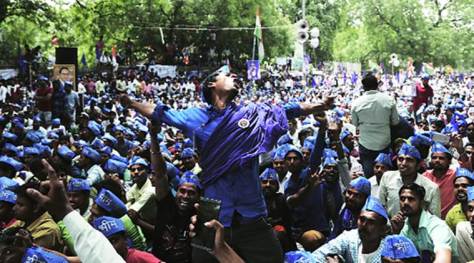
Even as the state government’s repression on Bhim Army continues, most of its leaders still in jail and some forced to leave Saharanpur, a committee has been formed for the defense of Bhim Army. (For background information, please see the ‘Note on Bhim Army’, appended at the end of this post, which carries links to informative videos as well). A group of activists and committed lawyers have been following up the legal struggle practically at their own expense – which at the moment involves getting the arrested activists, including the founder-President Chandrashekhar out of bail as the topmost priority. Some of the activists have started getting bail many still remain, including just ordinary people simply picked up by the people and framed by the police as Bhim Army activists.
However, getting the jailed activists out on bail is simply the first step in a long battle. The deliberate campaign of vilification that has been going on about Bhim Army has tried to paint the organization as ‘antinational’ and ‘instigators of violence’ who apparently have ‘Naxalite’ connections. Even though none of this could be substantiated and thus brought by the police into their charges against the jailed activists, the campaign of demonization has nevertheless continued through some sections of the media. Needless to say, such misleading campaign is meant to incite popular feelings against such groups who have been working mainly for education and self respect among the Dalit population in their area. Such a campaign of vilification cannot but affect the chances of wining the legal battle as well. It also ends up driving people who may have initially been sympathetic to their cause by sowing doubts about them in the popular mind.
It is with this concern in mind that a large number of citizens from different walks of life have come together to form the Committee for the Defense of Bhim Army, in order to mobilize all possible support for the embattled activists.
The Committee for the Defense of Bhim Army has been constituted comprising the following members from different walks of life:
Coordinators: Pradeep Narwal and Sanjeev Mathur
Treasurers: Presenjit Gautam and Nakul Singh Sawhney
- Anand Teltumbde, Civil rights thinker and activist, Mumbai
- Jignesh Mewani, Rashtriya Dalit Adhikar Manch
- Kancha Ilaiah, Political scientist, thinker and writer, Hyderabad
- Chandrabhan Prasad, Dalit thinker
- Radhika Ramaseshan, Senior journalist with Business Standard
- Harsh Mander, Human rights activist and Director, Centre for Equity Studies, Delhi
- Syeda Hamid, Former member, Planning Commission
- Om Thanvi, Senior journalist, former editor, Jansatta
- Sambhaji Bhagat, Cultural activist, Maharashtra
- Meera Velayudhan, Academic, Centre for Development Studies, Trivandrum
- Martin Macwan, Social activist, Gujarat
- Ratan Lal, Academic, Hindu College, Delhi University
- Sachin Mali, Cultural activist
- Sheetal Sathe, Cultural activist
- S.R Darapuri , Former IPS officer, social activist
- Colin Gonzalves, Lawyer
- Anand Patwardhan, Film maker
- Anil Chamadia, Journalist
- Subhash Gatade, Writer and social activist
- Akram Hassan, Social activist, Shamli
- Surender, Dalit youth activist, Delhi University
- N. Sukumar, Academic, Delhi University
- Rehana Adib, Social activist, Saharanpur
- Banojyotsna Lahiri, Academic and independent researcher
- Mohammad Zeeshan Ayyub, Actor
- Amar Singh, SC/ST Trade Union, Delhi University
- Dr. Mahesh Chandra, Bhim Army
- Sanjay Tegwal, Bhim Army
- Zakia Soman, Bharatiya Muslim Mahila Andolan
- Presenjit Gautam, Jati Todo Manch, Ghaziabad
- Pradeep Narwal, Dalit youth activist, Jawaharlal Nehru University
- Saroj Giri, Academic, Delhi University
- Tushar Parmar, IRS
- Sanjeev Mathur, Journalist
- Nakul Singh Sawhney, Film maker
- Praveen Verma, Research scholar, Delhi University
- Aditya Nigam, Academic, Centre for the Study of Developing Societies, Delhi
- Amar Paswan, Ambedkarvadi Chhatra Sabha, Gorakhpur
- Dhirendra, Poorvanchal Sena
- Anil Yadav, Rihai Manch
- Sagar Raghunath, Chhatra Bharati activist
- Dr J.K. Gautam, Doctor
- Dr. Sushil Kumar Gautam, Dalit Youth Activist, Chaudhary Charan Singh University, Meerut
- Subhashini Ali, Social Activist
- Mohinder Singh, Professor, JNU
- Prashant Nihal, Social Activist (Bihar)
- Atul Meena, Research Scholar JNU
Continue reading Committee for the Defense of Bhim Army Formed Amidst Continuing Repression
The Heavy Footsteps of Brahmanical Dandaneethi : The Hadiya Case
It appears that for women in India, the modern judiciary is fading and in its place, the terrifying face of Brahmanical Dandaneethi is emerging. A ten year old rape victim is denied abortion, women fleeing dowry harassment are to submit to the rule of local elders and leaders of ‘family welfare committees’, and now, in the Hadiya case, the judges declared that unmarried daughters should be under their parents according to ‘Indian tradition’.
Read more: https://thewire.in/169543/hadiya-islam-conversion-supreme-court/
When Charlatans Become Ideologues – The Real ‘Prisoners of the Binary’
Present day Hindus are probably the strongest opponents of Marxism. They are horrified at its doctrine of class-struggle. But they forget that India has been not merely the land of class struggle but she has been the land of class wars. – B. R. Ambedkar, Philosophy of Hinduism.
I often find myself in a bind over whether or not to respond to supposed RSS ideologues, given that they simply trade in lies and hatred with the supreme arrogance of ignorance. One such is the upcoming star on the RSS horizon, a gentleman called Rakesh Sinha, who like the rest of his pack (led by the supreme leader) is currently engaged in a cheap attack on the outgoing Vice-President, Hamid Ansari. His piece in the Indian Express today (linked above) is an instance of a combination of all these things. So, why should one bother about such a character? Why take him and his discourse seriously? Well, someone had better respond because, because, for one thing they are in power, and are going to teach generations of students that valorous ‘Hindus’ like Maharana Pratap won all the wars, though by some magic, ‘Muslims’ continued to rule for about 8 centuries! For another, there are enough gullible types who really think these people ‘have a point of view’, which should be debated.
As we have repeatedly seen, their ‘having a point of view’ has nothing to do with debate. It is to be enforced by gangs of gorakshaks, anti-romeo squads, hoodlums deciding what will or will not be taught in universities and schools, what will be written, how people should dress and love – and when nothing works, ‘win’ a ‘debate’ like Arun Jaitley claimed they did, by simply arresting the opponents and slapping sedition charges on them. Given this, I do not really address, in person, the ideologue, Rakesh Sinha, who has now made it a fine art to pick up some phrases from the toolkit of what is understood as ‘postmodernism’ by many. Wasn’t it postmodernism, one can hear them say, that said all viewpoints are equally valid and ‘everything goes’? Wasn’t it postmodernism that challenged the hegemony of Western thought, its logocentrism, its Rationalism (with a capital R) from within that very tradition? Wasn’t it postmodernism again, that by decentering West’s logocentrism, actually gave these RSS-type creatures the gumption to claim that their utterly unsubstantiated viewpoint about the past too was as valid as that of historians who struggled with evidence, painstakingly putting together texts, artefacts and procedures of dating in order to produce a plausible account of the past?
Continue reading When Charlatans Become Ideologues – The Real ‘Prisoners of the Binary’
Beneath the Veil – Lipstick Under My Burkha and Debates around the Uniform Civil Code (UCC): Debaditya Bhattacharya and Rina Ramdev
Guest post by DEBADITYA BHATTACHARYA and RINA RAMDEV
*Disclaimer: Even as news pours in of Pahlaj Nihalani’s ouster as CBFC chief, consider this essay an earnest tribute to the man who is ‘alleged’ to have beeped sense out of Indian cinema. We repeat, merely ‘alleged’ – since we go on to prove otherwise.*
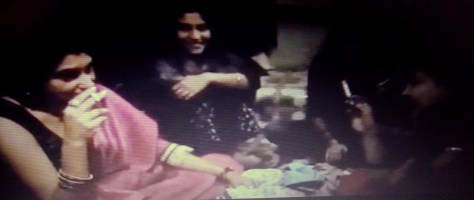 Let us start out with a basic methodological premise – that forms and effects of ideological mensuration cannot exhaust the life of cinema, or even be adequate to an understanding of the ways in which a film-text lives. To that extent, the ferocious debates around how much or how little of Lipstick Under My Burkha qualifies as feminist material have only generated a fair share of readings. While acknowledging the need and value of these aligned readings, we would also urge a look at cinema’s ‘coming into being’ as something more than an image or a text or a performative medium. Often, in our haste for neat hermeneutic closures, reading a film as cognitive-critical material could tend to a negation of the very relationship between the cinematic object and the everyday. The site of a film’s meaning is necessarily in excess of its narrative unfolding as viewing experience. It lies in the negotiations of its object-world – which includes the plot, the actors, the techniques of representation, the exhibition-settings, the infrastructures of distribution and marketing strategies, discourses around its production and release, celebrity-scandals or pre-release promotions, box-office statistics, publicity routines and review ratings, as well as non-audience expectations – with the other object-worlds of thought, feeling and belief. With that note of ‘methodological caution’, as one might call it, we would argue that a movie like Lipstick is also more than just a story of four women as desiring subjects, grappling with their own bodies to secure the most intimately ‘fundamental’ right to dream.
An Anthem for Kerala: Mojitopaattu
In these days in which Indo-Gangetic barbarians seethe with rage against Kerala and unleash all sorts of false propaganda about the state of affairs here, I have been thinking about my own love for and quarrels with this place. My relation to it has been largely critical, as a Malayali woman born and raised here who has endured, and continue to endure, much second-rate treatment. More than anyone else, I realize, it is Malayalis who have criticized Kerala. Not surprising, then, is the fact that one of the most ardently-discussed themes in public politics here in the past decades has been the critique of the entrenched imagination of Kerala, and its exclusions. Not for nothing, too, have the struggles of marginalized people here demanded not just material gains, but the reimagining of Kerala in more expansive terms. And newer and newer groups of excluded people keep renewing it – most recently, the LGBTIQ+ people.
Our love for Kerala is a cursing, stumbling love – but love above all.
That’s why I think Anitha Thampi’s poem Mojitopaattu (The Mohito Song) ought to be our anthem. Anitha is undoubtedly one of Kerala’s most perceptive poets of the present, capable of delving into the depths of the present cultural moment and surfacing with inscrutable yet pervasive feelings and moods and weaving these into words. Our crazy love of Kerala which cannot be but critical is brilliantly caught in this poem. In it, this love comes alive as moonlight falling on this place which illuminates erratically, sways madly, and disappears without notice; this loving looks as hard and risky as a drunk’s faltering steps along a rough bylane through treacherous yet playful moonlight; this love eddies through the blood of two and a half generations and comes awake even as the whole world sleeps. Long before the Indo-Gangetic barbarians even noticed us have we felt this mad love, and it will take more than vituperative slander to kill it.
Below is my translation of Mojitopaattu – and I take Anitha’s suggestion that it a song, and a drunken one, seriously. I hope someone sets it to music and it becomes the anthem of crazy-lovers of Kerala.
Four-five sprigs fresh mint
Two spoons sugar
Juice of three limes
Vodka, two measures and a half
Soda
IceHey you, swayin’-shakin’-rollin’
on night-time alley that’s runnin’
all o’er earth that’s green and shinin’
Banana-leaf-like, straight and gleamin’*
Hey sweet moonlight,
who you be,
you be man or you be woman?Hey you, fallin’ easy-loose-y
You for real, or just a feelin’?
Hey you singin’ , spreadin’-creepin’
Who you be to sunshine beamin’?Hey you lurchin’, fallin’, stumblin’
on each an’ ev’ry greenly leafling
Hey bright moonshine, distilled-dried blood, bluish,
two and a half generations bleedin’
Who be you?You be me, or you be you?
*Kerala, that lies at the foot of mountains like a bright green banana leaf beside the sea.
( Anitha Thampi , ‘Mojitopattu’)
And here is the original, much more terse and controlled in its use of language, but a paattu all the same:
മൊഹീതോപ്പാട്ട്
നാലഞ്ച് തളിർപ്പുതിന
രണ്ടു സ്പൂൺ പഞ്ചസാര
മൂന്നു നാരങ്ങാ നീര്
രണ്ടര വോഡ്ക
സോഡ
ഐസ്
നാക്കിലമണ്ണിൻ∗
രാവൂടുവഴിയൂടെ
ആടിയാടിപ്പോകുന്ന പൂനിലാവേ നീ
ആണാണോ പെണ്ണാണോ?
അഴിഞ്ഞഴിഞ്ഞു തൂവുന്ന പൂനിലാവേ നീ
നേരാണോ പൊളിയാണോ?
പാടിപ്പാടിപ്പരക്കുന്ന പൂനിലാവേ നീ
വെയിലിൻറെ ആരാണോ?
പച്ചിലകൾ തോറും തപ്പിത്തടഞ്ഞു വീഴും
രണ്ടരത്തലമുറ നീലിച്ച വാറ്റുചോരപ്പൂന്തെളിനിലാവേ നീ
ഞാനാണോ നീയാണോ?
∗കേരളം
Under the sign of security – Why the bogey of ‘the illegal Bangladeshi immigrant’ is so powerful across urban Indian homes: Sahana Ghosh & Rimple Mehta
Guest Post by SAHANA GHOSH & RIMPLE MEHTA
From the night of July 11 when Zohra Bibi did not return home to the evening of July 16 when union minister Mahesh Sharma, member of parliament for Gautam Budh Nagar, UP met with residents of Mahagun Moderne, much has transpired. Promptly after the minister’s assurances of ‘justice’ and even retribution to the flat-owners, the settlement of tin walled shacks in which Zohra Bibi and other workers like her lived with their families was demolished the next day. Many of the ‘facts’ of the matter remain disputed – while Zohra Bibi maintains that she neither admitted to the theft of cash nor hid in the basement of the building, the allegation that her employers Harshu and Mitul Sethi harassed and detained her, confiscating her mobile phone is denied by them. Meanwhile, thirteen men, a majority of them Bengali Muslims from West Bengal, arrested from the workers’ settlement are denied bail on the charge of attempted murder on the might of three FIRs filed by residents of Mahagun Moderne and languish in judicial custody. The Noida police are yet to commence any investigation of the Sethis as required by the FIR filed by Zohra Bibi and her husband Abdul Sattar. What does this language of the riot, of murderous mobs with which residents of the swanky apartment complex took to social media with #MaldainNoida accomplish? As security cards, required by domestic and other workers to enter the gated community, were revoked for 80-odd workers under the cry of ‘ban the Bangladeshi maid’, the bogey of the illegal Bangladeshi immigrant reared its ugly head. Continue reading Under the sign of security – Why the bogey of ‘the illegal Bangladeshi immigrant’ is so powerful across urban Indian homes: Sahana Ghosh & Rimple Mehta
Have Indian Muslims become the new ‘Make in India’ Punching Bag? Sabiha Farhat
Guest Post by Sabiha Farhat
[ A month ago from yesterday, a teenager called Junaid was lynched and murdered on a train in Haryana. Sabiha Farhat writes in the wake of visiting his house and meeting his family. The news cycles may have moved on to other stories, but we need to keep remembering Junaid, and why he was killed. – Kafila]
Once upon a time there was a 15 year old boy called Hamid, who went shopping on the day of Eid with his Eidi . A few days ago there was Junaid who went shopping on the eve of Eid. Premchand’s Hamid was an orphan and lived with his grandmother in extreme poverty. Junaid lived surrounded with love of his brothers, a sister, a doting mother, father and friends. Instead of the old, decrepit house of Hamid, Junaid’s house has two rooms, it is not falling apart but it’s size and unplastered walls, do speak about the economic condition of his family.
As we approached Khandawli, Junaid’s village in Ballabhgarh a fear gripped me. I did not have the courage to walk upto the house. Junaid was brutally murdered on 22nd and here I was on 25th. It was too soon, my mind said. I should have let Eid pass. But how could I have prepared Sewai in my house when a mother like myself had lost a young, healthy, happy child to hindutva fanatics? I am a mother, I was angry and ashamed at home. And here, standing outside Junaid’s door, I was weak and helpless. Useless too.
Continue reading Have Indian Muslims become the new ‘Make in India’ Punching Bag? Sabiha Farhat
Women’s Cricket – Rules Based Only on Gender Stereotypes Need to Go: Surabhi Shukla
This is a guest post by SURABHI SHUKLA
Playing for the Oxford University Women’s team and the Oxford Cricket Club, I have noticed three different rules for women’s cricket. These may be observed in other countries as well. I argue that these rules are based only on gender stereotypes about women’s inferior sporting abilities and even if were once instituted to encourage them to join the game, have now outlived their utility. 1. The women’s match ball is lighter than the men’s ball (also true at the international level). 2. The women’s match boundary is smaller than the men’s and; 3. One of my coaches here told me that the men’s bat is different from the women’s. This is incorrect, and the England and Wales Cricket Board (ECB) website states that both men and women are entitled to use Type A bats for one-day internationals. However, I include this point in my analysis because regardless of a rule, these kinds of statements from a coach translate into the lived experience of a female cricketer, and act as a rule for them. Continue reading Women’s Cricket – Rules Based Only on Gender Stereotypes Need to Go: Surabhi Shukla
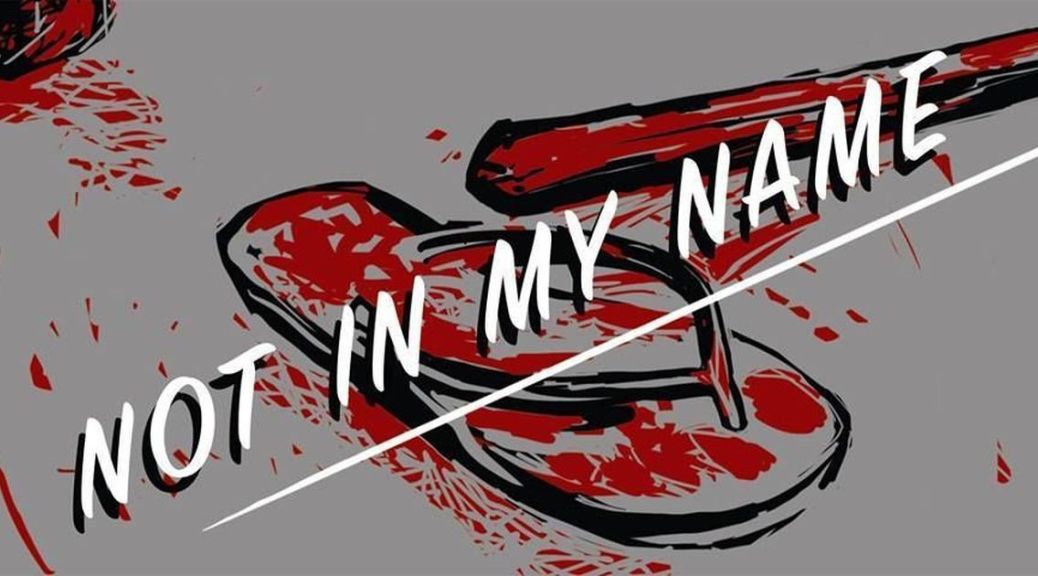
After #NotinMyName at Jantar Mantar on June 28: Sanjay Kak for NotinMyName, Delhi
Guest Post by Sanjay Kak, for #Notinmyname / Statement from Not In My Name, Delhi

Last evening’s (June 28th) spirited protest at Jantar Mantar, New Delhi, under the banner of Not In My Name, was an autonomous citizens protest against the recent spate of targeted lynchings of Muslims in India – the most recent of 16 year old Junaid, stabbed to death on 23 June 2017 in Delhi (NCR).
For an audience that was estimated to be 3500 strong, the torrential downpour at a little past 8 pm may have rained out a part of the programme. But something remarkable had already been achieved: the evening had washed away, even if temporarily, an almost overwhelming sense of despondency, of hopelessness, and of fear.
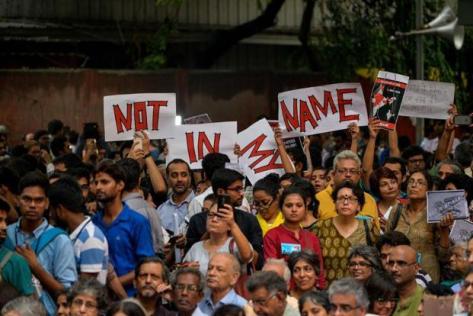
Since the Not In My Name protest had announced that the platform was not meant for political parties, and their banners and slogans, the stage saw the marked absence of the speeches (and faces) of routine protest meetings at Jantar Mantar. Rhetoric was displaced by feeling, and it was left to the poets and musicians to carry the sharp political messages of the day. On an evening that was often very emotional, the most difficult moments came when a group of young men from Junaid and Pehlu Khan’s extended families (and residents from their respective villages) came on stage and spoke to the audience.
When the call for a protest meeting went out last Sunday we were hoping that a few hundred people would gather to express their outrage at what is happening around us. For the attacks on Muslims are part of a pattern of incidents that targets Dalits, Adivasis, and other disadvantaged and minority groups across the country. In almost all these incidents the possibilities of justice seem remote, as the families of the victims are dragged into procedures they are ill-equipped to handle. Through all these heinous crimes the Government has maintained a silence, a gesture that is being read as the acquiescence of all Indians.
Not In My Name aimed to break that silence. But the scale and spirit of the protest meeting at Jantar Mantar became amplified many times over, as similar gatherings were spontaneously announced all over the country. As word spread through social media, groups in 19 other locations announced Not In My Name protests, and this phenomenal synergy inevitably drew media attention to all the events, and gave the protest a solidarity and scale that was truly unprecedented – there were at least 4 protests in cities abroad too. (And more protests have been announced for later this week…) The protest meeting ran on the shoulders of a group of volunteers who managed to put together everything in less than four days. No funds were received (or solicited) for the expenses from any political party, NGO, or institution. Instead volunteers worked the crowd and our donation boxes received everything – from Rs 10 coins to currency notes of Rs 2000, and everything in between.
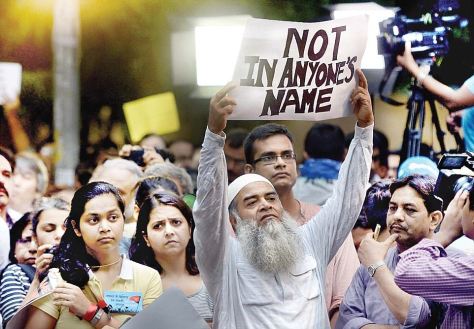
The impact of the Not In My Name protest at Jantar Mantar yesterday only points to the importance of a focused politics to deal with the crisis this country seems to be enveloped by. Less than a day after the protests Prime Minister Modi broke his silence on the matter of lynchings. It could not have been a coincidence: speaking in Ahmedabad he said killing in the name of gau bhakti is unacceptable. But to protect the life of a 16 year old being brutalised in a train needs more than a tweet, and we all wait and watch.
This fight has just begun. In the days to come the exceptional solidarity attracted by the protest in New Delhi will have to become less exceptional, and more everyday.
Sanjay Kak is a filmmaker and writer based in Delhi.
The #NotinMyName protests, which began in a response to a Facebook post uploaded by Delhi filmmaker Saba Dewan, have since taken place in more than twelve cities in India, and also in the UK, USA and Pakistan. More protests, under the #NotinMyName tag, as well as independently of it are being planned by citizens groups, organizations and individuals in many places.
Tomorrow, July 2nd, 2017 will see a sit in at Jantar Mantar from 11 in the morning, at Jantar Mantar, New Delhi called by families, individuals and panchayats from Nuh, Ballabhgarh and Faridabad, they will be joined by students, activists and other individuals.
 KAFILA - COLLECTIVE EXPLORATIONS SINCE 2006