Category Archives: Law

JKCCS welcomes Supreme Court order for disbanding SPOs

A press release from the JAMMU AND KASHMIR COALITION OF CIVIL SOCIETY
8 JULY 2011: Jammu and Kashmir Coalition of Civil Society (JKCCS), welcomes the recent judgment delivered by the Supreme Court of India in which it has struck down as ‘unconstitutional’ the practice of arming local tribal youth of Chattisgarh as Special Police Officers (SPOs) in order to fight the Maoists. It has asked the Chattisgarh state government to:
·         immediately stop using SPOs,
·         recall all firearms distributed to them,
·         desist from funding the recruitment of any other vigilante groups,
·         ensure the filing of FIRs into criminal activities committed by them, and
·         offer protection to those who need Continue reading JKCCS welcomes Supreme Court order for disbanding SPOs

A beacon of light in the heart of darkness: SC holds Salwa Judum unconstitutional

The Supreme Court has held that the use of extra-legal armed forces in Chhattisgarh is unconstitutional. Responding to a PIL filed by Nandini Sundar, Ramachandra Guha and E.A.S. Sharma, the court’s decision turns on the nature of the Salwa Judum and  the appointment of special police officers under the Chhattisgarh Police Act. But if it were a judgment that had merely ruled on the technicalities, it would have been a welcome and competent order, but would have missed its moment of constitutional greatness. This judgment attains such greatness by virtue of its deft combination of insightful legal analysis, the articulation of a moral vision of constitutionalism and development and its sharp invocation of rhetoric (in the best sense of the term) and fiction to buttress its arguments.

Fiction, William Gass reminds us is the figure of truth. Law has always produced and promoted legal fictions and the substantive interpretation of law often rests upon on a body of rhetorical figures and scenarios. The imaginative and moral character of legal fiction can often be found wanting, but there are times when the courts produce inspired moral visions that outdo even literature. Although fiction in the manner of its making, is pure philosophy, Gass says that no novelist has created a more dashing hero than the handsome absolute, or conceived more dramatic extrications- the soul’s escape from the body, for instance, or the will’s from cause. Nandini Sundar v. State of Chattisgarh is an excellent example of the ways in which the law can productively use metaphor as legal argument (‘our constitution is not a pact for national suicide’)

There will be time in the near future to examine all the nitty gritties of the judgment, but for now lets celebrate this amazing judgment. I am reproducing some extracts which may be of interest, and highlighting some of the key metaphors that the judges use in describing the state of affairs in Chhattisgarh and India more generally. (Full text available here; .pdf, 58 pages.) Continue reading A beacon of light in the heart of darkness: SC holds Salwa Judum unconstitutional

Mental Health Professionals Criticise Union Health Minister’s Statement on Homosexuality

PRESS STATEMENT: MENTAL HEALTH PROFESSIONALS CRITICISE UNION HEALTH MINISTER’S STATEMENT ON HOMOSEXUALITY

6 July 2011: We are a group of highly qualified mental health professionals who are practicing as psychiatrists, clinical psychologists and behavioural psychologists from across the country. We regret the statement made by Union Health Minister Ghulam Nabi Azad on Monday where he called homosexuality a “disease”, as being “unnatural”, and a having “come from western shores”. Scientific evidence shows that homosexuality is a natural variant of human sexuality and is not a mental disorder or disease. Homosexuality as a specific diagnostic category was removed from the World Health Organisation’s ICD-10 Classification of Mental and Behavioural Disorders published in 1992, and from the American Psychiatric Association’s DSM-IV Guidelines in 1973. Continue reading Mental Health Professionals Criticise Union Health Minister’s Statement on Homosexuality

Cities and Infrastructure – The Road Widening Saga in Bangalore

This evening, I was sitting in a coffee shop and writing about the sociology of information, how information is mired in relationships and how trust, suspicion and social relations develop in the course of circulation and exchange of information. As I was beginning to disentangle the complex web of legitimacy and regulations surrounding information, a friend called to inform that some activists and citizens had been arrested for protesting against the tree felling and road widening at Sankey Road in the northern part of Bangalore. In the last few days, the conflict regarding road widening and tree felling at Sankey Road got strong coverage in the media because citizens began gathering around the trees and the roads to prevent authorities from felling the trees. Despite this, the authorities went about felling the trees for widening the roads. The activists and protestors were clearly becoming a nuisance for the government officials and institutions who have not been able to execute the works. Hence, today, at some point, some of our activist friends were arrested on the false charges that they had assaulted public officials in their conduct of ‘government’ duty. The charges were filed under section 343 or 353 CrPC which also implied that the arrest was non-bailable. Over the course of the evening, news went about on FaceBook and Twitter about these arrests, and people from in and around Sankey Road were called to silently protest at the Aiyyappa Temple where the trees were being felled for enabling the road widening. The arrested activists and citizens were released from jail and all the charges against them were ‘dropped’ at about 6 PM. The court also granted a stay order on the tree felling around the same time, with further hearings and orders to arrive on Monday. Continue reading Cities and Infrastructure – The Road Widening Saga in Bangalore

Mediation, Middle Grounds and Meddling – The Medley of Middlemen

[Dedicated to Sankarshan Mukhopadhyay on account of “receiving ends”]

Couple of weeks ago, I was attempting to rent out the apartment that my mother and I own in an urban sprawl in South Bangalore. Among others, a broker – referring to himself as a ‘property consultant’ – approached me with a client. I met the client and conducted some negotiations. Eventually, however, I rented the apartment to persons who had approached me before the broker and his client saw our place. I politely refused the broker’s client. The broker contacted me soon thereafter and began issuing threats for not renting the place to his client. He threatened that it would be dangerous for me to spoil my business with him. Initially, I was also nervous and upset because I was unsure if the broker had an office in the neighbourhood and whether he was powerful enough to spread false rumours about our property which could potentially devalue the property and/or spoil my relations with the new tenants who had just come in. He then came to the apartment complex where the flat is situated and created a small ruckus. Finally, failing on all counts, he threatened to lodge a false police complaint against me for allegedly taking a deposit from his client without issuing a receipt. The broker’s threats turned out to be empty and damp squib as him. He never showed up after that dramatic afternoon of back-and-forth(s). Continue reading Mediation, Middle Grounds and Meddling – The Medley of Middlemen

The Singur Act and the Deontological Reaction: Prasanta Chakravarty

Guest post by PRASANTA CHAKRAVARTY

The remarkable Singur Land Development and Rehabilitation Bill, passed in the West Bengal Assembly on June 14 became an Act on June 20. The Act scrapped the previous Left Front government’s deal with Tata Motors and has provisions to return land to unwilling farmers. Consequently, Singur land was taken over by the State government prompting Tata Motors to legally challenge the whole Act and a judicial battle has ensued between them and the newly elected State government. The State government may continue to return land in right earnest since there is no legal bar to that as of now. One would think that by many standards, this is a landmark bill that challenges and confronts policy consensus in issues of land transfer, models of enclosing and a concomitant notion of development that marks our nation at this point of time.

Reactions to this enactment have been thick and fast—alarmist and cautious to generous and triumphant. Continue reading The Singur Act and the Deontological Reaction: Prasanta Chakravarty

Akhil Gogoi’s arrest smacks of vindictive attitude: NAPM

This release comes from the NATIONAL ALLIANCE OF PEOPLE’S MOVEMENTS

Akhil Gogoi’s arrest smacks of vindictive attitude of Assam Govt.

PUNISH THE GUILTY POLICE OFFICIALS FOR BRUTAL MURDER

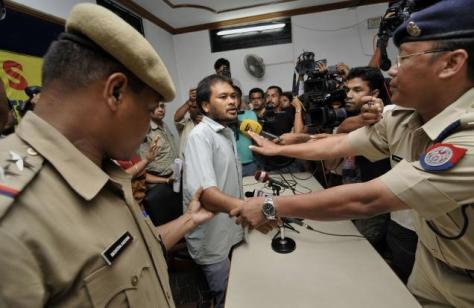
KMSS leader Akhil Gogoi was arrested by the city police from Guwahati Press Club for fomenting rioting on June 24, 2011. Photo: Ritu Raj Konwar / The Hindu

New Delhi / Guwahati, June 24th : As was expected, Akhil Gogoi, Genereal Secretary along with Mukut, Office Secretary, KMSS have been arrested by the Assam police from the Guwahati Press Club on the charges of arson, rioting and burning of government vehicles. It is ironical that there has been no action taken on Debasish Borah DSP, Dispur and other police officials responsible for day light murder of a nine year old child, Shiv Chauhan (40), and Viren Kolita (62) a rickshaw puller. Is this the rule of law? It is nothing but vindictiveness on part of the Congress Government in Assam against whom KMSS has been actively campaigning and exposing their corruption. Continue reading Akhil Gogoi’s arrest smacks of vindictive attitude: NAPM

Arindam Chaudhuri, Silchar

When I read The Caravan‘s cover story on Arindam Chaudhuri some months ago, I wondered when he was suing them. And he’s done it! While a court injunction has made The Caravan remove the story from theire wesbite, you can read it thanks to Google cache. No wonder Chaudhuri’s sued Google India as well! Given below is the full text of the press release put out by The Caravan. Unlike when Chaudhuri took on bloggers in 2005, I’m glad it is an organisation with the resources to fight the case and take him head on – not to say that requires some spine as well. After you’re done reading the release below, entertain yourself with all the Arindam jokes on Twitter.  

IIPM’s Rs500-million lawsuit against The Caravan
In response to our February profile of Arindam Chaudhuri, the IIPM has sued The Caravan. Here’s why we’re fighting the suit. Continue reading Arindam Chaudhuri, Silchar

Channel 4 documentary on war crimes in Sri Lanka

The Ice-Cream Flavour Mint’s Editors Don’t Like

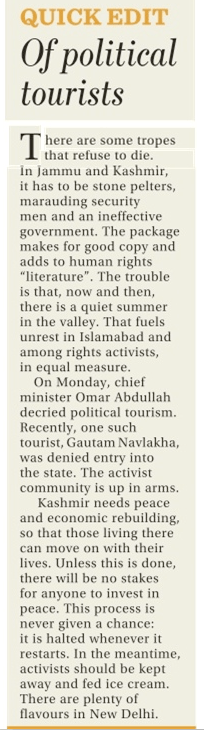
“There are some tropes that refuse to die,” said a “Quick Edit” titled “Of Political Tourists” in Mint on Tuesday, 14 June, “In Jammu and Kashmir, it has to be stone pelters, marauding security men and an ineffective government.” The edit forgot another trope there: the lies and obfuscation that the Delhi media indulges in when it comes to Kashmir. A good example of this is the “Quick Edit” itself, even if it was just 157 words long.

The “Quick Edit” derided human rights work as if it ‘human rights’ is an anti-national and unconstitutional ideology. It supported the Jammu and Kashmir government’s decision to disallow the journalist and human rights activist Gautam Navlakha into the Kashmir Valley. In doing so, it echoed the views of the Jammu and Kashmir chief minister, Omar Abdullah, that activists should be kept away from Kashmir in the summer as they cause political unrest. No wonder that Mr Abdullah recommended the “Quick Edit” on Twitter with a brief comment: “LOL. Short but says it all :-)”.

The edit derisively called activists like Navlakha “political tourists”; would the editors describe the security forces stationed in Kashmir as ‘military tourists’? The edit argued that allowing Navlkaha and activists like him into Kashmir would affect “peace and economic rebuilding,” and said that such people “should be kept away and fed ice cream. There are plenty of flavours in New Delhi.” This suggests that last year’s bloody summer in Kashmir was caused or at least aided by Mr Navlakha and other human rights activists. Perhaps Mint‘s editors were enjoying ice-cream in Delhi and did not want to indulge in conflict tourism. Ignorance, however, should not lead to lies. It is thus pertinent to recall what happened in Kashmir last year.

On 8 January 2010, Inayath Khan, 16, was returning from a computer coaching in Srinagar and was killed by CRPF personnel who were chasing away protestors. After the bullet hit his thigh, he was hit by a CRPF vehicle and eyewitnesses say, CRPF personnel trampled upon him with their boots and beat him with their gun butts.

On 31 January, a 13-year-old, Wamiq Farooq, was shot in his head by the J&K police with a tear gas shell. He was playing carrom in a room when this happened.

Continue reading The Ice-Cream Flavour Mint’s Editors Don’t Like

Dr Khaleel Chishty will finally be free

This note comes from KAVITA SRIVASTAVA of the People’s Union for Civil Liberties

An ailing Dr Chishty will soon be with his family

Dr. Khaleel Chishty, the 78 year old a renowned Virologist from Pakistan, will now go home very soon. A process that began on the 20th of April, 2011 will finally conclude at the Rajasthan end two months later precisely on the 20th of June, with the Governor signing the mercy petition that will let him go, once the MEA give their stamp.  Continue reading Dr Khaleel Chishty will finally be free

‘Locking up gods within caste’

This note comes via Malarvizhi Jayanth. Those in support can leave a comment saying so, and add their designations to their names, if they wish.

We call for all those who support democracy and free speech to express solidarity with Thirumavalavan, Meena Kandasamy and Samya.Kathavarayan and Madurai Veeran are among the gods who are acknowledged to be Dalit and are worshipped by many castes. Clearly, in the oral history of the people, the gods have castes and these castes are not determined by who worships them. The twin brothers Ponnar Shankar inhabit the realm between hero and deity. They have been fictionalised, recreated for the silver screen, and are worshipped across communities. Their origin myth remains contested territory – it is variously read as symbolic of the conflict between agriculturists/warriors and hunters, as part of founding tale of the land-owning agriculturist Kongu Vellala Gounder sub-caste and, in a textbook example of how Hindutva functions, have recently been claimed as reincarnations of the Pandavas. Like other deities of the people, they are firmly located in a historical imagination among a society of human beings, and not in a mythos of gods.

In a footnote in Uproot Hindutva: The Fiery Voice of the Liberation Panthers by Thirmavalavan, MeenaKandasamy describes Ponnar Shankar as dalit. M Loganathan, an advocate from Nanje Goundanpudur and Students Wing Convenor of the Kongu Nadu Munnetra Kazhagam (KMK), has been quoted in news reports as saying that there is evidence proving that Ponnar and Shankar are Kongu Vellala Gounders and claiming that depicting them as Dalits will lead to caste tension. Continue reading ‘Locking up gods within caste’

On Lathicharging a Satyagraha: Dilip D’Souza

Guest post by DILIP D’SOUZA

So what do you think happened when the police assaulted a gathering of satyagrahis with lathis? Here’s what happened to some people I met from such a gathering.

  • Tulsibai, 45+, was hit on her stomach and wrist.
  • Manglubai, about 40, was hit on her buttocks.
  • Rajkumaribai, who didn’t know her age, had a deep wound on the upper part of her thigh that she showed us shyly.
  • Jiggelal, 60, was hit so hard on his arms and legs that he blacked out. Continue reading On Lathicharging a Satyagraha: Dilip D’Souza

Commonwealth Games scam: Manmohan knew all, did nothing

RTI activist Subhash Agrawal has obtained correspondence between the then sports minister Mani Shankar Aiyar, and Prime Minister Manmohan Singh, that shows the PM was informed about the scam as early as October 2007. And did nothing. You can download here (.pdf, 4.2 MB) the 52 pages long RTI reply Agrawal got from the PMO.

Gautam Navlakha detained, denied entry into Kashmir: Press note from IPTK

Press Note: For immediate release
INTERNATIONAL PEOPLE’S TRIBUNAL ON HUMAN RIGHTS AND JUSTICE IN INDIAN-ADMINISTERED KASHMIR (IPTK)
www.kashmirprocess.org

From: Dr. Angana Chatterji, Convener IPTK and Professor, Anthropology, California Institute of Integral Studies; and advocate Parvez Imroz, Convener IPTK and Founder, Jammu and Kashmir Coalition of Civil Society

TRIBUNAL CO-CONVENER DENIED ENTRY INTO KASHMIR

Srinagar, May 28, 2011: On May 28, 2011, Mr. Gautam Navlakha, Convener, International People’s Tribunal on Human Rights and Justice in Kashmir (IPTK) and Editorial Consultant, Economic and Political Weekly, was stopped at Srinagar airport on his arrival from New Delhi, and asked to go back. Officials invoked Section 144 of the Code of Criminal Procedure. By the time the authorities finalized their decision regarding his return, there were no remaining flights out of Srinagar. Mr. Navlakha is being detained and taken to an undisclosed location until May 29, when he will be allowed to return home.

Mr. Navlakha is a noted public intellectual and peace activist. His denial of entry raises urgent concerns about the status of freedom of speech and movement in Kashmir. Given the egregious violence that was inflicted on people by state forces in the Summer of 2008, 2009, and 2010 in Kashmir, we are deeply concerned that state forces not suppress democratic activities in the Summer of 2011, and not isolate Kashmiris from human rights defenders that travel to Kashmir to bear witness to atrocities and speak for peace and justice.

We understand that harassment, intimidation, and threats to IPTK members or their families are acts aimed to target and obstruct the work of the Tribunal. In November 2010, Professor Richard Shapiro, an academic from the United States and life-partner of IPTK Co-convener Angana Chatterji, was denied entry into India without any charges or due process.

Earlier, in June 2008, IPTK Co-convener Pravez Imroz and his family were targeted and an explosive device was thrown at his home. Imroz has been denied a passport. In July 2008, a First Information Report charged Angana Chatterji and IPTK Co-convener Zahir-Ud-Din, then editor of Etalaat English Daily, with acting to incite crimes against the state, following his publication of an article on mass graves written by Chatterji. IPTK Liaison Khurram Parvez has been threatened and is extensively surveilled. All Tribunal communications and the movements of its members in India and abroad are monitored.

We remain gravely concerned about the physical and psychological safety and integrity of all Tribunal members. We remain gravely concerned about our ability to continue our work, and the ability of out-of-state Tribunal members to travel to Kashmir.

अफ्स्पा: एक काले कानून की आधी सदी: महताब आलम

Guest post by MAHTAB ALAM

आज  बाईस मई की सुबह जब ऑफिस या काम पर जाने की चिंता से बेफिक्र हम सोते रहेंगे, उसी समय नॉर्थ-ईस्ट और कश्मीर की जनता जो सुबह देखेगी, वह कानून के नाम पर बर्बरता की  53 वीं  सालगिरह होगी.  जी हाँ, मैं आर्म्ड फोर्सेस स्पेशल पावर्स एक्ट (अफ्स्पा) की  बात कर रहा हूँ. कानून के नाम पर, ला-कनूनियत नाफ़िज़ करने का घिनौना हथियार. जिसके खाते में अगर कुछ लिखा है, तो सिर्फ ला-क़नूनियत और बरबरियत की न खत्म होने वाली दास्तानें.

 बाईस मई 1958 को नागा लोगों को ‘नियंत्रित’ करने के लिए ये कानून अमल में लाया गया. नागा जनता के पुरजोर विरोध के बावजूद, अपनी आदत के मुताबिक भारतीय संसद ने 18 अगस्त 1958 को इस कानून पर अपनी मुहर लगा दी. पहले- पहल ये कानून  सिर्फ नागा जनता को ‘नियंत्रित’ करने के लिए बना और कहा गया कि जल्द ही हटा लिया जायेगा. पर ऐसा कभी हुआ नहीं. बल्कि धीरे-धीरे ये ‘कानून’ पूर्वोत्तर के 7 राज्यों से निकलता हुआ कश्मीर की घाटी तक पहुँच गया. आख़िरकार, कानून के हाथ लम्बे होते हैं. वैसे भी, अगर भेड़िये को एक बार खून का स्वाद मिल जाये तो फिर उसे कौन रोक सकता है और खासतौर पर खून ‘विदेशी’ या अलग नस्ल का हो. इस पूरे मामले में भी कुछ ऐसा ही दिखता है. Continue reading अफ्स्पा: एक काले कानून की आधी सदी: महताब आलम

Putting the “Jan” into the Lokpal Bill: Nikhil Dey and Ruchi Gupta

Guest post by NIKHIL DEY and RUCHI GUPTA

For many who quite rightly guessed that the Lokpal Bill drafted by the Government would be a non-starter, the alternative merited automatic support. However, little was known about the contents of the two Bills, except that the alternative being proposed by ‘India Against Corruption’ had the prefix of being a “peoples” Lokpal. The consequences are too important to leave to the expertise of the drafting committee. The people must comprehend, and play their part in ensuring that there will be an Act that will empower them to fight corruption- not make them surrender their hopes to yet another anti-corruption organization. How people-centric is the Jan Lokpal Bill (JLP)?

While the JLP is going through rapid revisions – 12 so far – the basic framework and some principles have remained constant. Broadly the Bill can be divided into four sections: the mandate and scope of the Lokpal; composition and selection of the Lokpal; powers of the Lokpal; and functioning of the Lokpal. The composition and selection of the Lokpal is substantively one of the least contentious sections – concerned largely with procedural matters and subjective preferences, rather than ideological or legal viewpoints. A discussion of the other three sections follows.

Continue reading Putting the “Jan” into the Lokpal Bill: Nikhil Dey and Ruchi Gupta

Young Women in Kerala : Between Empowerment and Death? — Part II

[With inputs from Sudeep K S]

Are there honour killings in Kerala? No, perhaps. However, like in everything else, Kerala has a way of telling the world that things can be done differently. Well, it appears that we can continue to claim another kind of exceptionalism — in national evils. Kerala has its own special way of ‘doing’ caste and patriarchy as well, which researchers and activists have forcefully argued recently. It is possible that the deadly consequences of stepping out of community-ordained boundaries in love and marriage can visit Kerala in  ways that we cannot really detect with our usual instruments.

Continue reading Young Women in Kerala : Between Empowerment and Death? — Part II

The Disappearance of Susheel Raina: APDP protests unabated disappearances in Kashmir

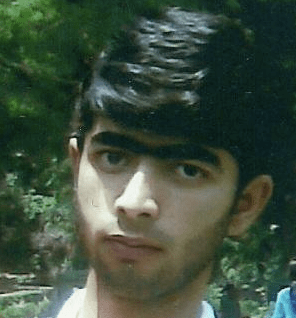
Susheel Raina

Press Release issued on 28 April 2011 by the ASSOCIATION OF PARENTS OF DISAPPEARED PERSONS, led by Parvez Imroz. The APDP also staged a protest in Srinagar. 

Susheel Raina, 21, son of Badrinath Raina disappeared from Chandergam, Aishmuqam in district Anantnag (Islamabad) on 4th April 2011. Susheel left his home to collect a certificate from Boys Degree College Anantnag (Islamabad) and since then never returned.

Police is said to be investigating, as they claim about hundreds of others who have disappeared in last two decades. These investigations either never begin or never end and in very rare cases where police investigations have indicted the perpetrators, no one has been prosecuted. Continue reading The Disappearance of Susheel Raina: APDP protests unabated disappearances in Kashmir

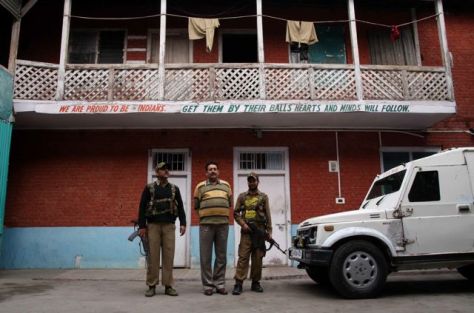
India’s Kashmir policy described in one photograph by Javed Dar

This photograph of an Ikhwani camp in south Kashmir was taken by JAVED DAR in 2008. Standing in the middle is a well-known ‘government gunman’, Jehangir Khan. Photo courtesy Conveyor.

He’s Out on Bail- Time to Think Again: Dilip D’Souza

Guest post by DILIP D’SOUZA

So you’ve been following the Binayak Sen case. What now? What are the aspects and implications of the case to consider now that he is out on bail?

Here are a few that come to my mind. Your mileage may vary.

*The suspicious things Sen is supposed to have done. For example, you have heard often that Sen visited Narayan Sanyal in jail multiple times. Why, you ask. Whatever the reason, think of this: In 2006, before the first time (and indeed before each subsequent time), he wrote to the Raipur Jail Superintendent asking for permission to visit Sanyal. After this request made its way through the police bureaucracy, senior police officials in Raipur wrote to the same Superintendent saying “Central Jail Raipur mein bandi Narayan Sanyal se bhent karne ke liye Dr. Binayak Sen jaata hai to is karyalay ko koi aapatti nahin hai.” (“This department has no objection if Dr. Binayak Sen goes to meet Narayan Sanyal who is detained in Central
Jail, Raipur.”)

If the police had no objection to the visits “at the time”, why was this later an issue at all? Why have learned commenters made so much of this, hinting at dark things Sen must have been doing? One example,  note how the author of the ‘report’ says “Admittedly, the meetings took place with prior permission from jail officials”, but has let stand the implication that there was something dark going on).

Continue reading He’s Out on Bail- Time to Think Again: Dilip D’Souza