Category Archives: Law

Mangalore – Hindutva in expansion mode

Broken limbs (by amathad)

Guest post by APURVA MATHAD Continue reading Mangalore – Hindutva in expansion mode

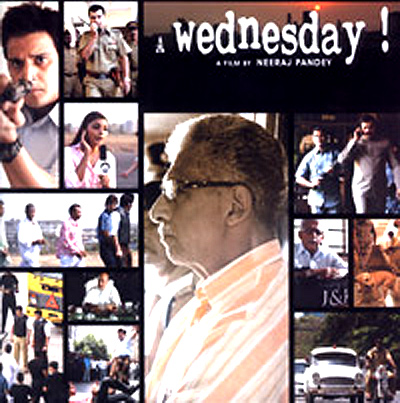
Such absurdity on a Wednesday

Guest post by SHAHRUKH ALAM

On Wednesday, I met some young men from Dhule. I am not at all sure where Dhule is and I said as much to them. “There was some violence there. It has been in the news lately,” they said. “Did any bombs go off in Dhule?” said I. “No bombs, no. But there was communal violence. It was on the news.” “I only watch prime time news. I don’t usually manage to view the afternoon bulletins. Nor the eleven PM one (informative though they are),” I explained. “So where exactly is Dhule?” I persisted. “It is a district on the north-western tip of Maharashtra. It’s not so far from Malegaon.” Ah, Malegaon! Where the blasts occurred? Finally I had a co-ordinate. Continue reading Such absurdity on a Wednesday

Was it a recce or a planned raid?

DCP Alok Kumar
DCP Alok Kumar

Guest post by AZIZ BURNEY, Editor, Rashtriya Sahara (Urdu), Delhi

It is a truth universally acknowledged that anything viewed from various angles presents various shapes. It is also a fact that your angle of view determines to a large extent the picture registered by your brain. An askew angle of view is bound to distort the picture. Reality defies comprehension without proper perspective. To date, we have not been able to understand what kind of picture the Delhi police is trying to draw in order to explain the incidents of September 19 as they happened. Continue reading Was it a recce or a planned raid?

Jamia Teachers’ Solidarity Group: Some Questions for the Delhi Police and Embedded ‘Journalists’

In the past few days, our favourite newspapers have been scrambling to counter the growing doubts about the supposed “encounter” at L 18. (See Indian Express and Times of India).

Jamia Teachers’ Solidarity Group responds to the latest claims by the police.

1) The police was caught by surprise. Or was it?

In its response to the questions being raised by the civil society, the police say, “the presence of armed terrorists took them by surprise.” “The police did not expect an encounter at L-18.” (Indian Express October 9)

Continue reading Jamia Teachers’ Solidarity Group: Some Questions for the Delhi Police and Embedded ‘Journalists’

‘Dhule was burnt after 40 years, despite its glorious tradition of communal harmony’

Aurangabad Times]
[This report about the recent riots in Dhule comes from from PRATIBHA SHINDE and AMBARISH RAI.] Continue reading ‘Dhule was burnt after 40 years, despite its glorious tradition of communal harmony’

“India’s Anti-Christian Violence Unparalleled Among World Democracies”

As Maoists confirm that they were behind the murder of Laxmananda Saraswati and give their reasons, two notes below from Madhu Chandra of the All India Christian Council.

Hi Friends,

Hindutva forces – Vishwa Hindu Parishad, Rashtriya Swayamsevak Sangh and Bajrang Dal knew very well that the Maoists have killed their Swami Lakshmanananda on August 23 but intentionally denied it and alleged Christians so that they could do what they have done to Dalit Christians of Orissa.

Orissa Government who runs on mercy of BJP and Hindutva forces believes the allegation and allowed the religious ethnic cleansing of Christians in Kandhamal district of Orissa. Continue reading “India’s Anti-Christian Violence Unparalleled Among World Democracies”

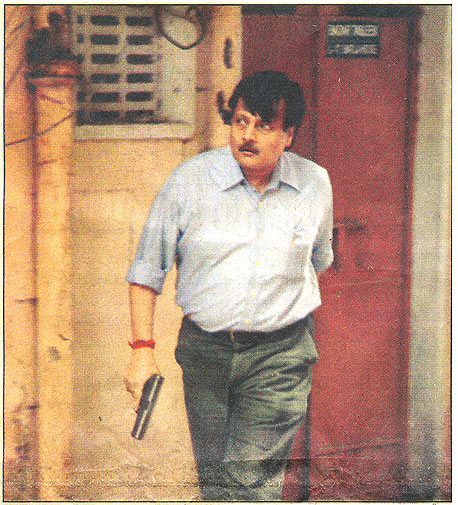
Kitnay Mastermind Thay?

When a picture is worth a thousand words. From The Indian Express, 25 September 2008, "Delhi Newsline"
When a picture is worth a thousand words. The Indian Express, 25 Sept 2008, Delhi

While most of the Indian media has politely started using such words as ‘allegedly’ and ‘police officials claim’ Continue reading Kitnay Mastermind Thay?

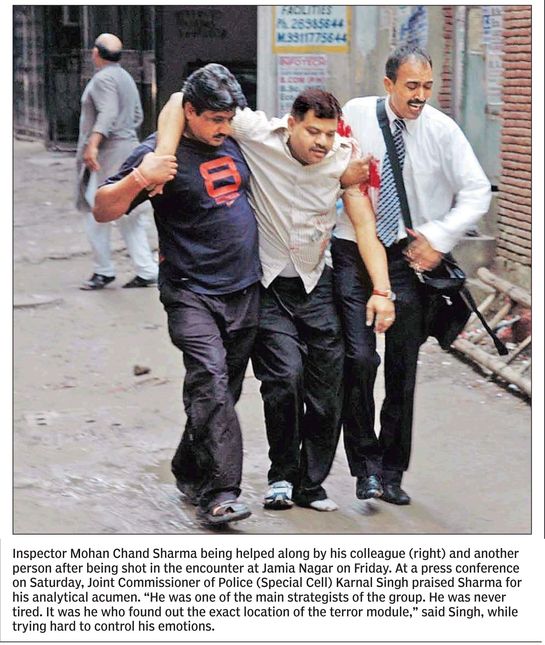
A Little Less Melodrama and a Lot More Forensics

On Looking at a Photograph taken on the Margins of an ‘Encounter’

From page 3, Sunday Hindustan Times, 21 September, 2008

  Continue reading A Little Less Melodrama and a Lot More Forensics

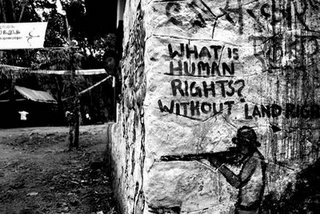
AFSPA – 50 Years of a Law

Come September 2008, and the Armed Forces Special Power Act (AFSPA) is now fifty years old in our country. It is a law in force in large parts of the northeast that gives armed forces special powers in a locality declared as ‘disturbed area’. However, while AFSPA is considered necessary by the state and army officials to protect the state against internal disturbances, to uphold the integrity of nation, to fight against terrorism and insurgency, and to protect sensitive border areas, it is being vehemently opposed and discarded by human rights groups, women’s organizations and political groups, as it is seen as facilitating grave human rights abuses, impunity, rape and torture, and silencing of democratic dissent. The Act has long been challenged internally through country-wide campaigns, coalitions, self-immolation, fast until death, and naked protests. It is also regularly referred to internationally, for example in the recently concluded UN Human Rights Councils’ Universal Periodic Country Review or in the previous Human Rights Committee, as an issue of serious concern.

Continue reading AFSPA – 50 Years of a Law

Images from Chengara


More.

[Via Anivar Aravaind]

Indians against Indian repression in Kashmir

Be there or elsewhere:

Janahastakshep, PUCL and PUDR  are holding a dharna on August 30 at jantar mantar from 11am to 1pm in protest against the crackdown on non violent people demanding ‘azadi’. Continue reading Indians against Indian repression in Kashmir

The Continuing Violence Against Christians in Orissa

From John Dayal and Madhu Chandra of the All India Christian Council, an update on the continuing violence against Christians in Orissa. Continue reading The Continuing Violence Against Christians in Orissa

Binayak Sen and the Right to a Fair Trial

The right to a fair trial is a cornerstone of democratic societies. How a person is treated, when accused of a crime, provides a concrete demonstration of how far a State respects human rights. Detention is ‘arbitrary’, where there are often grave violations of the right to a fair trial. Detention and imprisonment, which may be lawful under national standards, are considered ‘unlawful’ under international standards. A fair trial is indispensable for the protection of other rights, such as the right to freedom from torture, the right to life, and the right to freedom of expression. This right should never be compromised. However, throughout the country, people are being detained and imprisoned without a fair trial. In these circumstances, many face torture and other forms of ill-treatment. The continued detention of Dr. Binayak Sen, Vice-President of India’s leading human rights organization, the People’s Union for Civil Liberties (PUCL), should trigger a debate, not only in Chhattisgarh, but also around the country, about whether and to what extent the right to a fair trial may be compromised in the name of security.

Continue reading Binayak Sen and the Right to a Fair Trial

Breaking News – Shiv Sena’s secretly Maoist!

Narcoanalysis, it has been scientifically proved by Indian law enforcement agencies, is the final frontier of truth. What comes out of narcoanalysis is solid stuff, the real thing. Confessions and self-implications account for almost all the crimes the cops “crack” – when was the last time you heard of a revelation of who dunnit coming out of careful deductive reasoning based on evidence? Terrorists send emails that can be tracked to physical addresses (“the IP address led the police to B ek batta chaar, gali number 2, Balli Maran”), or they are caught bearing in their pockets, maps of sensitive border areas, scribbled over with little reminders like “death to hindus” in Urdu; or murderers confess under narcoanalysis, like Krishna the compounder in the Arushi murder case, that he and four other “servants” were responsible, thus freeing, thangod, all middle-class people so far involved, from the taint of suspicion. Without confessions no crimes would ever be solved, and narcoanalysis is the scientific, sophisticated, twenty-first century alternative to the “Abey bol, kaise nahin bolega, tera baap bhi bolega” school of confession extraction which has been the mainstay of coppery so far.

So narcoanalysis reveals the truth. And the truth is apparently, that the Shiv Sena and Bal Thackeray have funded Maoist activities. “Suspected naxalite” Arun Ferreira confirmed our deepest suspicions in his narcoanalysis test – while other political parties, bless their souls, will never fund maoist activities, he blurted out, Shiv Sena and the ABVP have always helped out the comrades with money.

Shiv Sena has issued a strong denial. It has in fact, “rubbished” these allegations, making the bizarre claim that “Naxalism is born out of a communist agenda” (oh come on!), and since the Shiv Sena is well known to be anti-communist, why would they pour money into naxal coffers? I don’t know, it all sounds very plausible to me, and anyway, it’s not up to us to decide whether the claim is false or not. This fact came out of narcoanalysis, let me remind you, and we HAVE TO TAKE IT SERIOUSLY.

To add to their cavalier disregard for truth, the Sena spokesperson further added, “a drugged person might talk any rubbish“.

I propose the Shiv Sena be immediately banned for its anti-national contempt for narcoanalysis, the unimpeachable symbol of the nation’s commitment to truth.

“Madam, we know you’re leaving. Think wisely before coming back”

Continue reading “Madam, we know you’re leaving. Think wisely before coming back”

Pride, Prejudice and Politics

Reproduced from the Indian Express this morning. Of course, I wrote it entirely with Kafila in my heart, the Express just got it first :)

___________

A gay man is given two years of electroshock therapy in a major city hospital to “cure” him — the National Human Rights Commission refuses to file a complaint. A 2004 book on queer politics sees 34 contributors write under their full names, many for the first time. Lesbian women continue to commit suicide rather than be forcibly married. Large sections of the media openly support campaigns against Sec 377 — the 1861 law that criminalises “unnatural offences” — and widely carry an open letter written by Vikram Seth and Amartya Sen against the law. The law still stands over the head of the gay community, but the challenge to it in the Delhi High Court inches towards a verdict. Meanwhile, aravanis (as hijras are known in Tamil Nadu) win a landmark battle for the legal right to have government identification cards and passports issued under “E” as their gender. Continue reading Pride, Prejudice and Politics

Kavita Srivastava’s report on last year’s Gujjar confrontation in Rajasthan

[This detailed report was prepared by Kavita Srivastava, the Jaipur-based general secretary of the People’s Union for Civil Liberties. Posting this here to make it publicly available as it is not on the PUCL website. Please note that this was a rough draft. ]


State Violence and Caste Confrontation in Rajasthan

I. Outline of the week long movement for ST Reservation by the Gurjars

Soon after independence the Bhil Meenas got reservations in the Districts of Dungarpur, Banswara, Chittorgarh and Udaipur. At the time of 1931 census the Bhil Meenas were over 20, 000, however today they have reduced to half they are only 10,000 in number.

This was an issue of contention for the Meenas as they felt that they also deserved to be STs so they decided to raise their voice against this injustice as they called it. Under the leadership of Lakshmi Narayan Jhirwal they organized themselves.

11th June 1952: Meenas organized a sammelan near Dudu (Jaipur) district for the inclusion of the Meena community in the Schedule list for reservation. The Gurjars supported this wholly. Continue reading Kavita Srivastava’s report on last year’s Gujjar confrontation in Rajasthan

The Patriot Act of Intellectual Property

I was at a meeting recently to discuss what is now being termed, as The Patriot Act of Intellectual Property. Some of the leading economic powers including the US, European Commission and Japan have been negotiating an agreement, the Anti Counterfeiting Trade Agreement (ACTA) which attempts to redefine IP enforcement. The Bush administration is particularly keen that they finalize this agreement before the end of his term. At the moment the substantive content of the agreement is not known, and the few details that are available are only because of a leaked document of the US government available in Wikileaks.

Continue reading The Patriot Act of Intellectual Property

Individuals at Risk

At the heart of all peoples’ rights work is the individual – as the person at risk of human rights abuses, as the survivor, as the partner in the defense of rights, and as the activist speaking out, and working with and for other individuals. Individuals, as part of the political, social and cultural collective and spread over the length and breadth of the country, lie behind much of the activism of Indian social-political groups, working at local, grassroots and community levels in India today. They try to change lives by acting on their own or with other people and political groups making the same demand – an end to injustice in all its forms.

These individuals are increasingly at risk in India today. We have witnessed the killings at regular intervals of activists like Safdar Hashmi, Shankar Guha Niyogi, Satyendra Dubey, Sarita and Mahesh, S. Manjunath, Mahendra Singh and Chandra Shekhar in the past two decades. We have had a series of cases of arrest and detention of people like Dr. Binayak Sen and T. G. Ajay. At a time when the patterns of human rights abuses against rights activists are becoming widespread and showing signs of further deterioration, with the governments showing their apathy, we need to draw attention to the situation, point to the concrete failures of the governments to live up to their obligations, and plan on some concrete actions, so that the human rights activists can carry out their important work free from attacks, fear or reprisals. Continue reading Individuals at Risk

State Repression In Chhattisgarh And Continued Detention Of Dr Binayak Sen

STATEMENT OF CONCERNED CITIZENS AND PEOPLE’S ORGANIZATONS

A group of former bureaucrats, academicians, lawyers and social activists visited Chhattisgarh from 18 – 22 January 2008 in connection with the prolonged incarceration of Dr Binayak Sen. The team met the Governor and Director General of Police and also met Dr Binayak Sen in the central prison at Raipur. Some members of the group also visited areas in the districts of Bastar, Dantewada and Bijapur.

In the light of the information gathered, the team is of the opinion that the charges filed against Dr Sen under the IPC, CrPC and the Chhattisgarh Public Safety Act (CPSA) are unwarranted and unconstitutional. The CPSA enables the government to interpret the rendering of simple humanitarian acts as unlawful The Act defines “unlawful activity” so broadly that every act of vigilant citizenship can be construed as unlawful and anti-national. Thus it is clear that Dr Sen is being targeted in his capacity as General Secretary of People’s Union for Civil Liberties, Chhattisgarh. The reports produced by the PUCL have highlighted the anti-constitutional violence legitimized by the state through the Salwa Judum campaign.

Continue reading State Repression In Chhattisgarh And Continued Detention Of Dr Binayak Sen

Quote of the day

“It hasn’t got any definite meaning,” CJI  K G Balakrishnan said today in response to a PIL that wanted ‘socialist’ deleted from the Constitution’s Preamble.

In a world where “comrades”  want to embrace capitalism, does meaning have meaning?