“The manner in which the state is intervening in higher education is causing concern and even alarm in the academic community. Both the unlamented UPA—II regime and the current NDA government have been remarkably similar in their authoritarian impatience to introduce wholesale changes without adequate or careful preparation. This position paper is the collective product of roughly six months of discussion among teachers of several central universities in Delhi. It is an attempt to participate in the process of critical self evaluation of the university system as it is today. It is also our considered response to the many policy statements and directives issued by the MHRD and the UGC recently”
Please click on the link below for the complete position paper on proposed reforms in higher education, prepared by Delhi-based Academics for Creative Reform and released at a press conference today:
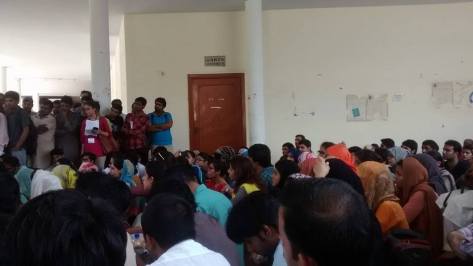
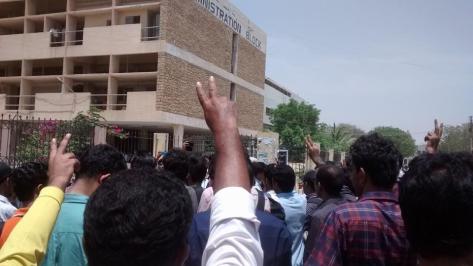
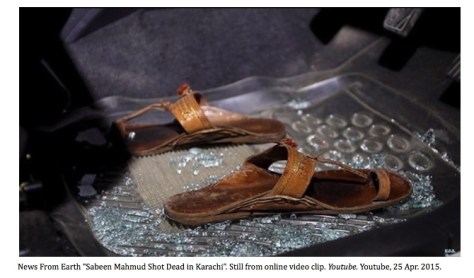
Sabin Mahmud was killed after organizing an event on Balochistan in T2F in Karachi, and more recently, Syed Wahidur Rehman, a Karachi professor was also shot dead. But far from being silenced, the resistance of democratic forces in Pakistan is growing. Today, Karachi University faculty organized a seminar on Balochistan missing persons to massive response, despite the administration refusing permission and locking the doors of the venue. The event was held in the Arts lobby, from where it seems to have spilt outside too.
A determined audience sits on the floor outside the locked room where it was to have taken place.
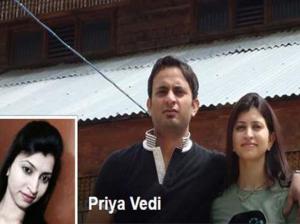
On the 18th of April this year, Dr. Priya Vedi of AIIMS tragically ended her life and left a Facebook note incriminating her husband—fellow doctor at AIIMS Dr. Kamal Vedi—for “torturing” her mentally, clearly implying that his homosexuality was the reason for her suicide. Her distress is apparent in the note as she recounts the lack of intimacy in her marriage and her discovery of the husband’s sexual activities as a gay man before and during the marriage. At the end she includes a plea to all gay men to not “marry to a girl to save yourself,” to not play with the emotions of a girl and her family. It should not be surprising that some condolent commentators have placed the blame specifically on Kamal Vedi’s alleged sexual orientation, even calling for legal action. Even within the LGBT community, the tendency has been to first put culpability on the man’s opportunistic participation in the institution of marriage. There is a sense that this incident ought to serve as a teaching moment for gay men, who are argued to require an ethical code, who need to fixate on the deliverance of their conscience, and whose rights—as Sandip Roy pointed out—”mean nothing without responsibility.” But despite Priya Vedi’s strongly felt sentiments, must we proceed as if the case of her fatal end is a logical and natural consequence of gay men’s irresponsible intrusions into the sanctum of marriage? After all, such intrusions are routine, and the ensuing heartbreaks are sometimes even known to be productive of powerful empathy between straight women and gay men.
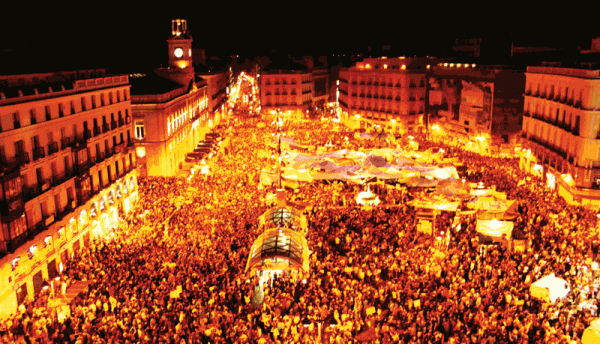
[Against the background of Spain’s recent criminalizing of public protests and the first ever hologram demonstration (see Kafila post by Geeta Seshu) against it, this article revisits the major eruption in 2011, that eventually laid the ground for the emergence of a new political force in Spanish politics]
15M, image courtesy El Tecolote
Spain, seems to be a country that is still shaping itself. Somewhat like a nation that wants to come to terms with its past, unlike many other countries that have gone through a traumatic history and have finally emerged through the political passions – admittedly misdirected – of their distant past. Spain seems like it is yet to come to terms with a civil war that forged its legacy in millions of Spanish minds and the future generations of the country. The fascist forces that staged a coup, and consequently, went on to purge about 150,000 of its citizens in summary executions, far surpassed some of the worst dictatorships that the world has witnessed, including that of Pinochet’s in Chile and of Videla’s in Argentina.
[ This is a post from two friends in Pakistan responding to the tragic assasination of Sabeen Mahmud, activist and director of ‘The Second Floor’ (T2F) – a space that hosted many wonderful conversations and brave events. Sabeen was killed as she was going home after an event dedicated to a public discussion of disappearances and human rights violation in Balochistan.]
A normally quiet and desolate gali is packed with camera crews and hundreds of attendees for the funeral of Sabeen Mahmud. While there is a steady trickle of mourners entering and exiting the premises of the vibrant community space Sabeen created, the crowd waiting in the gali outside seems to be arrested by a mixture of disbelief, anger and grief.
Similar emotions paralyze us as we write about Sabeen in the past tense. It is difficult to believe she is gone, infuriating to think about the way she went, and, perhaps, the hardest to accept the beginning of her absence.
While watching her interview with PBS NewsHour last month, one is struck by how her cavalier attitude to fear and security, reverberates eerily in the wake of her murder.
“I grew up playing cricket on the streets” she said, “I just feel when the time comes, the time will come”.
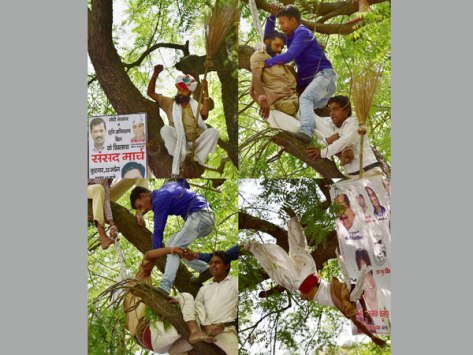
The tragic death of a farmer from Rajasthan occurs at a rally organized by the Aam Aadmi Party on 22 April 2015. The farmer, Gajendra Singh, hangs himself from a tree in full public view of the demonstrators, the media, the police. The electronic media had till then been barely covering the event, generally holding forth instead, in studio ‘debates’ among the opponents of AAP. Once this happened, the media spin doctors swung into action, and as Rajdeep Sardesai tweeted later, they seemed to work on an already decided script. Sardesai’s tweet said that there were clear instructions from the BJP to the media to focus only on the hung/ dying (or dead) man, and forget the rally. It seems, on a closer look, that the the second part of the instructions had perhaps already been given in advance – not to cover the rally and if at all, to attack it in sponsored studio debates. And of course, the BJP, which is the architect of the new Land Acquisition Ordinance, is an interested party in this game.
It is not entirely irrelevant to the overall politics of the media-BJP spin doctoring of ‘reports’ that the AAP government in Delhi was perhaps the first in the country to announce what is without doubt the highest compensation to farmers suffering crop losses – Rs 50, 000/- per hectare for all farmers who have suffered damage. Nor is it entirely irrelevant that the Delhi government had lent full support to the anti-land acquisition struggles and Kejriwal had himself joined in the rally held by Anna Hazare and had now taken up the land issue in all seriousness.
Thus it happens that between the BJP and the big media propaganda machine, which has on at least two previous occasions completely blacked out AAP, the stage was set. Also at work in the media-AAP relationship over a longer term now, is the role of Mukesh Ambani’s media empire, given that on a range of issues AAP has directly challenged the latter. As an aside, let me add that a very senior journalist told a friend at the height of the Delhi election campaign, that in CNN-IBN/ IBN7, clear instructions had been issued to the staff not to give more than 20 seconds exposure to Arvind Kejriwal under any circumstances. If AAP swept the Delhi elections despite that, it must say something about the limits of the media game, at least as far as the majority of the population is concerned.
Gajendra Singh being brought down. Image courtesy Oneindia.com
This time round, there was another constituency that was waiting to move into action – the Delhi elite, especially the radical elite whose hatred of Kejriwal is simply visceral, but which had been just about tempered by the presence in his team of People Like Themselves, darlings of the media. The latter had, to use an old Maoist expression, ‘wormed its way into the party’ and was intent on fighting an ‘ethical battle for inner party democracy’ against the ‘fascist Kejriwal’, a battle in which they were fully backed by the Ambani dominated media.
The move by the central government to freeze Greenpeace India’s bank accounts and block sources of funds, is a blatant violation of the constitutional rights to freedom of expression and association. It also seems to be an attempt to warn civil society that dissent regarding development policies and priorities will not be tolerated, even when these are proving to be ecologically unsustainable and socially unjust. These are dangerous signs for the future of democracy in India.
Specific allegations of legal violation contained in the Ministry of Home Affairs’ notice are aspects Greenpeace India needs to respond to. However, the notice also charges the organization with adversely affecting “public interest” and the “economic interest of the State”. These charges give the impression that Greenpeace India is indulging in anti-national activities, using foreign funds. However, dissenting from the government’s development policies, helping communities who are going to be displaced by these policies to mobilise themselves, and generating public opinion for the protection of the environment can by no stretch of imagination be considered anti-national, or against public interest. Quite the contrary, any reasonable policy of sustainable development (which the government claims to adhere to) will itself put into question quite a few of the mining, power, and other projects currently being promoted. ”
Civil society organisations in India have a long and credible history of standing up for social justice, ecological sustainability, and the rights of the poor. When certain government policies threaten these causes, civil society has a justified ground to resist, and help affected communities fight for their rights. This is in fact part of the fundamental duties enjoined upon citizens by the Constitution of India.
[Note: Recent events in South Africa – from raging student movements across university campuses to xenophobic violence in the streets of Durban – seem to echo so many struggles both inside and outside the university “here.” This is the first of hopefully several posts from South Africa, that seek to listen and travel across.]
Guest Post by RICHARD PITHOUSE
South Africa was supposed to be different. We attained our freedom, such as these things are, after everyone else but Palestine. It was late in the day but the afternoon sun was glorious and the best people, people who had passed through the long passage of struggle, told us that we would be able to avoid the mistakes made everywhere else.
There was a mass movement that, whatever its limits, had won tremendous popular support and carried some noble ideals through its travails. Its leaders cast long shadows. Our Constitution, we were always told, was as good as they get. Liberalism, apparently vindicated by history, had its evident limits but there was, it was said, lots of room for deft manoeuvre within those constraints. We were assured that there was room for everyone at what Aimé Césaire had called the ‘rendezvous of victory’.
For a long time the presence of all kinds of features of the past in the present was widely understood as something that would be resolved in time. Land would be redistributed, schools would flourish, houses would be built, there would be jobs – the kind of jobs that reward hard work – and universities would emerge, bright and bold, from their cocoons spun by settler culture. Time, it was generally believed, was on the side of justice and the eventual redemption of the suffering, striving and struggles of the past.
Two days ago, Finance Minister Arun Jaitley sought to make a special mention of “poor, dalits, tribals, backwards, those who are landless.” The occasion was the the Land Acquisition Bill, which,
“we are bringing, as per that the industrial corridors which would be set up in the country, those backward people, the 300 million landless people would get employment opportunities,”
First, Mr Jaitley, what exactly is the mechanism your government proposes by which the “backwards” released from the land will be absorbed into industry? Is there a guarantee by the industry owners? Is there a provision for skill training in the same industrial corridors? Are there ITI institutes being set up? Forget these, is even primary or secondary education going to be expanded so that farmers’ children, at some point in the distant future can take advantage of the supposed industrial boom? Continue reading “Those Backward People” – Arun Jaitley and a Long Ugly History→
SOME QUESTIONS IN THE CONTEXT OF MASS ORGANISATIONS OF CPI(ML)LIBERATION, CPI, CPI(M) & OTHERS INVITING CONGRESS, RJD, JD(U) TO DEFEND ‘SECULARISM, INDIAN CONSTITUTION, INDIAN NATIONALISM’
Janta Dal (United) leader Ali Anwar, in an ‘united’ program in Jantar Mantar on 19th March had a frank admission to make in the first 15 minutes of his speech: “Elections ki hi baat se shuru kare, to haan, hum sab milkar Modi ko harayenge” (“If we begin with the question of elections, yes, we will unite to defeat Modi together”). He was indicating a plain and simple ‘unity’ of convenience for elections, of a converging pole in Indian politics. He indicated: “Bihar assembly elections are waiting to happen.” He of course, remembered the theme of ‘secularism’ for the event and said, “now I will say a few ideological things” and did utter a few lines against the BJP-RSS.
Delhi’s Jantar Mantar on 19th March thus saw a (not very?) strange unity. Various “civil society and secular political parties, victims, artists, intellectuals” came together to organize an Exposing 300 days of Modi’s Rule program. Many of the organizers included mass organisations of the Left like AISA, AICCTU, AIPWA connected with CPI(ML)Liberation, and SFI, AIDWA, CITU, DYFI, AILU connected with CPI(M), and AITUC, NFIW, PWA related to CPI, among others. In these dark times of achhe din, where unity and collaboration of various left, democratic and progressive forces has come up with renewed necessity to fight the present regime, it becomes important for us to interrogate such attempts without any sectarianism. An important question that requires asking here is the basis of these ‘Unities’ and Forums being variously attempted. ‘Unity’ is definitely required in these times of combined attack of brutal neoliberal and communal attack, but standing on what ground, and in what direction?Continue reading While “Exposing 300 days of Modi’s Rule”, Let us not fall into the Trappings of Old Congress Style Politics: Nayan Jyoti→
For a child born in Kashmir, the chances of living a normal life and even survival vary greatly from one region to another. Suppose you are born in the seemingly volatile stretch of Downtown. You may well turn out to be someone whose pictures are flashed on social media as the epitome of bravery, someone whose demise is imminent, and someone ready to wear the ‘Shaheed’ label. I arrived at this place at 4:30 on a cold evening. The room was crowded by women sitting with only one recognizable face; Shehzaad’s mother, Rubeena Akhter. Nobody spoke. The air smelled like rain. After a short while, a tall man in a brown-checkered pheran appeared. Leaning on the walls, he helped himself to one corner of the dimly lit but spacious room. He did not want himself to be identified as a ‘victim of conflict’.
For Shehzaad, life had been altogether different before. He had spent happy summers with his family in the town where violence, as it existed, had never appeared to him naked. By now, he is 23. He has become larger and properly bearded. The one thing which you can’t miss about Shehzaad is that he has giant brown eyes like a dairy cow. That’s what prompts my most idiotic lines of inquiry. Could someone who looks like that really pelt stones on streets? Idiotic, I know. “Do I have to tell you how I was supposed to have been killed that day?” he says, sounding like a gull. I hear a slow whimpering strangled with ache. This soon changes into full-throated babbling—a cascade of terrible, terrified pleading wails as he continued naming those who had been killed during the 2010 agitations.
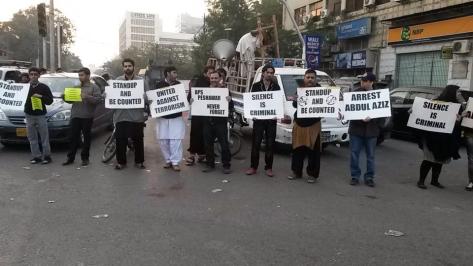
On the night of February 1st, Jibran Nasir Pakistan’s leading activist and a handful of peaceful protesters sat on a road in Karachi near the Sindh Chief Minister’s house for more than 24 hours, demanding the arrest of terrorists responsible for the January 30th Shikarpur attack which killed 65 Shias during Friday prayers, and demanding action against banned sectarian organizations. There were only 20 protesters, their average age 25, outnumbered it seemed by riot police with water cannon and batons at the ready.
Protest in Karachi against Terrorism and Secterian Violence
Guest post by RAMAPRIYA GOPALAKRISHNAN and BOBBY KUNHU
On January 2nd this year, management officials at the Sriperumbudur factory of NVH India Auto Parts Ltd, the Indian subsidiary of a Korean auto parts manufacturing company manhandled the company’s striking workers. The shocking visuals of the Korean managers of the company dragging workers on the floor and a manager standing over a worker holding him between his feet sparked outrage amongst civil society groups and caught the attention of the mainstream media.
Literally trampling workers!
The trigger for the strike was the suspension of 15 workers which their union alleges was without any reason. Several other issues festering for a long time also gave an impetus to the workers to go on strike. These include the lack of adequate toilet facilities. Apparently, there are only 6 toilets in a factory where more than 700 workers are employed of which only 4 are in usable condition. In a juvenile twist, the workers have to seek and secure the permission of the management officials each time they need to use the toilet. If this rule is violated in cases of emergency, warning letters are issued to workers alleging that they were found missing from their work spot. Another issue is the lack of a regular and sufficient supply of drinking water in the factory. The workers were also miffed at being under the glare of surveillance cameras all the time during their work hours. A very important issue that was a sore point was the management’s use of trainees and contract labour to perform production work of a regular nature. The workers were also upset at the attitude of the Korean management and the way they treat them. They allege that there are instances of physical abuse where the management officials hit and slap workers and spit on their faces. Over and above all this, the permanent workers in the factory were peeved at the failure of the management to grant recognition to the union they had joined in 2013 and negotiate with the union.
It’s the kind of moment that makes you reach for poetry, for words that convey what can scarcely be written. It’s the kind of moment where you must write for it is writing that is itself at stake.
The debates on Charlie Hebdo are wide and varied. There is, as Joe Sacco so beautifully drew, before anything else, a deep yet horrifically dull sadness. Few and fewer in the world have the privilege to still be “shocked” by violence, to not have its banality be its true horror. There is solidarity, some of the most meaningful of which comes from cartoonists in the Arab world. There is a wide agreement that no justification is possible for returning any measure of offence with death yet there is an insistence on the ability to critique even that which one defends. As Teju Cole eloquently argues: “moments of grief neither rob us of our complexity nor absolve us of the responsibility of making distinctions.” There are important, vital debates about what it means to “insult everyone equally” when everyone is not equal, reminding us that we must begin and ask our questions in place, in history; that we must remember that the power to criticise is a freedom but also a privilege. There are the universal debates on the limits to absolute speech, pointed to by Sandip Roy who reminds us that the French Government itself banned the earlier incarnation of Charlie Hebdo for printing a mock death notice of the then French PM De Gaulle. There are fears of the Islamophobia this violence will re-incarnate as, that Hari Kunzru argues is one intent of the attackers.
I write with a different intent today. I write not to enter these debates about Charlie Hebdo but to insist on what these deaths must provoke us to do: to translate our solidarity, our empathy, our fear, and our resolve into the real work of protecting the freedoms of speech, satire, offence, and expression in India. That is the tribute to Charlie Hebdo that matters, that transcends all our debates.
My arguments supporting young people in some recent debates, notably, the ones around the International Film Festival of Kerala and the ongoing Kiss protests, have apparently irritated a number of people, especially friends who belong to my own generation. From more than one source (hardly ever directly, though) I hear that they grumble that I am biased towards the young. That, apparently, is the latest fad. And Devika, it appears to them, has a tendency to support fads. Continue reading Is Standing with Young People Yet Another Fad? Reflections on the Young and Kiss Protests in Kerala→
Guest Post by Anshita & Arya (Krantikari Naujawan Sabha)
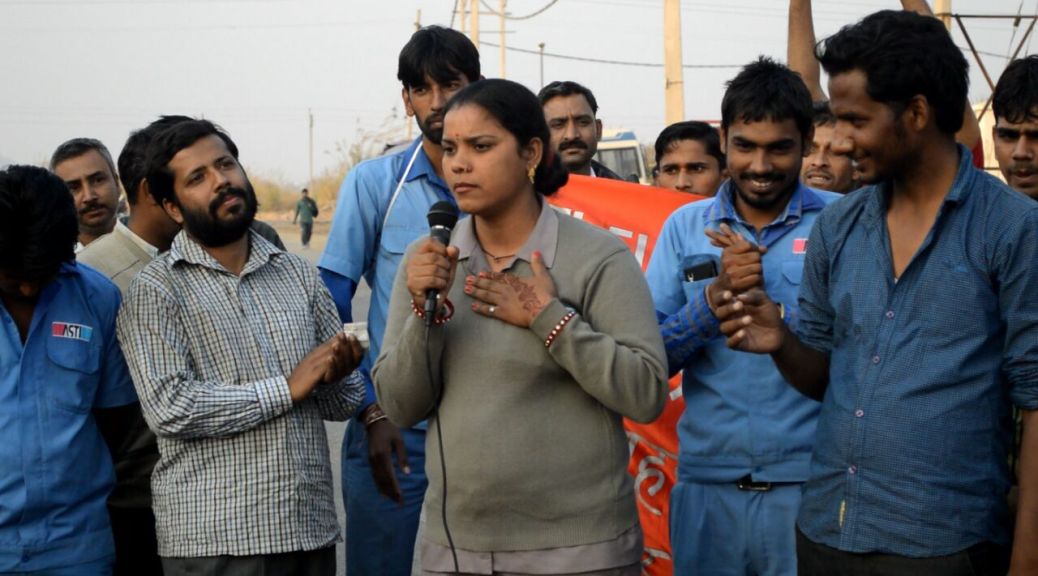
All 310 contract workers in ASTI Electronics factory in IMT Manesar in Gurgaon, Haryana have been on dharna since 3rd November 2014 after they were laid-off on 1st November 2014 citing low work demand. Seven of them are on fast-unto-death from 24th November, while ten workers and pro-worker activists each everyday sit on relay hunger strike.
In a context where contract workers, increasing exponentially as a demand of the capitalists gleefully forced down by the government through labour law reforms, are finding it ever harder to organize/unite and sustain spontaneous outburts of discontent, due to the precarious nature of their life and work conditions, workers at ASTI Electronics (as a continuation of the 60-70 strikes in various factories in the industrial belt of Gurgaon-Manesar-Dharuhera-Bawal in the last few months) are fighting back and keeping the flame of new emergent struggles alive.
These workers are raising important questions on contractualisation and informalisation within the organized sector which even Central Trade Unions have constantly avoided. Over 250 of these 310 workers are women whose militancy in struggle and leadership is redefining the overall struggle and changing the gender relations within the workers movement.
This struggle for work-livelihood-life is unmasking the heart of the developmental model on DMIC (see current projects in makeinindia.com) which Mr Modi under the supervision of the capitalist class is proposing as the solution to all ills before so-called ‘progress’ of the country.What follows is a short reflection from the factory gate on the ongoing struggle.Continue reading Days and Nights in Manesar – Reflecting on the ASTI Workers’ Struggle: Anshita & Arya→
Every time my girlfriend puts her arms around me while we are out on our terrace i end up first doing a quick scan of the windows that look down at us to see if we are visible to anyone, it’s almost an instinctive reaction. Mind you, one that doesn’t win me much affection from her ,understandably! It’s not that I care but I do notice them looking, and it’s always disapproving. Unfortunately, It’s not just my neighbours.
After the ‘Kiss of Love ‘ protests in Kochi and Kolkota it was Delhi’s turn and the few hundred who turned up to stand up for their right to not be morally policed did a fantastic job countering the right wing hooligans, for whom showing love or affection to one of our choosing is ‘immoral’. The police spent it’s time not allowing the peaceful protesters from marching to the RSS headquarters, their intended destination, pushing and shoving them. While pleading with, instead of arresting those who threatened and abused with impunity.
It’s not over of course, if it’s not a skirt wearing girl being stopped from entering a building or a cafe being trashed, there will be another reason to collect and be heard.
Maybe tomorrow we’ll give my neighbours a matinee to gawk at.Meanwhile, here are some pictures I took at the Kiss of Love gathering in Jhandewalan, Delhi.
One of the biggest and most visible problems plaguing the anti-capitalist social movements of today is the statist framework which conditions, shapes and governs their thoughts and actions. Thus the political praxis which should ideally be moored in a post-capitalist (hence post-state) vision of society, is seldom reached, and the movements are stuck in the morass of extremely limited actions informed by their purely normative and emotive thoughts about how the present society should function. The war-cry of justice is aired, millions take to the street demanding it, yet this ‘justice’ is rarely explained in terms of the real and the grounded. It is taken for granted that the state will be transformed from its overtly pro-capital avatar to a more radical one by this means or another because the movements want it to change: what is forgotten is that history has seen hundreds of experiments with such ‘changed’ states—each one of which failed in the long run, and led to a more coercive rule of capital.
Also, today’s social movements are non-violent and democratic, which in reality means that they prefer working within the framework of parliamentary democracy, and where that is absent, fight for it. Once again, the history of the institution of parliamentary democracy is forgotten: willy-nilly, it’s ignored that historically—more so going by today’s neo-liberal situation—such democracy is intrinsically linked with capitalist production systems and the hegemony of capital in both our societies and polities. Continue reading Whither Social Movements? Exploring the Problematic and Action Strategy: Soumitra Ghosh→
Guest Post by Vasundhara Jairath and Bonojit Hussain
In the first of its kind in India, youth in Kochi launched a campaign called ‘Kiss of Love’ to challenge the moral policing of the Hindu Right. While that protest was attacked by right wing thugs and suppressed by the police, this form of protest has since spread to different parts of the country like Hyderabad, Bombay and Calcutta. Today, the ‘Kiss of Love’ protest was held at nowhere short of the Rashtriya Swayamsevak Sangh (RSS) head office in New Delhi. A few individuals took the initiative and gave a call for this protest on Facebook with the title, ‘Sanghi Gunde Hoshiyar, Tere Samne Karenge Pyaar’ (Sanghi thugs beware, we will love in front you). Continue reading ‘Kiss of Love’ in Delhi, confronting the RSS: Vasundhara Jairath and Bonojit Hussain→





 KAFILA - COLLECTIVE EXPLORATIONS SINCE 2006