Category Archives: Politics

Kolkata Rally against Killings & Mayhem in Kashmir: Dwaipayan Banerjee

Guest Post by Dwaipayan Banerjee

Close to five hundred people came out in a rally yesterday, 15th July, to protest the ongoing killings and mayhem in Kashmir by the Indian State. The overwhelming majority of participants were students, but they were joined in good numbers by feminists, queer-activists, trade union activists, writers, journalists, academics, human rights activists, dalit rights activists, cultural activists, with many among them not affiliated with any organisation. Student and youth activists carrying flags and placards of PDSF (Progressive Democratic Student Federation), USDF ( United Students Democratic Front), AISA (All India Students’ Association), Progressive Youth League (PYL) and many from other student-youth organisations were present in good numbers, so were human rights activists from APDR (Association for Protection of Democratic Rights) and those from Bastar Solidarity Network (BSN). Many carried with them their own banners and posters. Like the rally in Delhi, protesters carried with them hand-written, hand-painted and printed placards with the names of civilians recently killed in Kashmir inscribed on it, and through those posters a connection of shared pain and solidarity flowed from the streets of Kolkata to the turbulent and stormy blood-stained streets in Kashmir. Those posters were reaching out to the people of Kashmir with messages that they were not alone in their hour of sorrow, anguish and mourning. Some of the protesters had written verses by the Kashmiri poet Agha Shahid Ali on their posters. One of those many posters summed up the mood of the rally, ‘Kashmir belongs to Kashmiris’.


[ Video by Peoples’ Camera]

Continue reading Kolkata Rally against Killings & Mayhem in Kashmir: Dwaipayan Banerjee

Kashmir – A lost battle: Amya

Guest Post by AMYA

What’s happening in Kashmir? Why are the people living in the valley so angry? Why are they mourning at the death of a militant? What is giving them so much courage to shout slogans against the Indian state, even at the cost of their lives? Why do they assemble in large numbers at the funeral processions of the men killed in conflict?

As an Indian have you ever thought about these questions? Have you ever wondered that there must be something seriously turbulent in their reality that they are so resentful? Or, like the majority, you find yourself defending the unity of the country and calling the people living in Kashmir “traitors” or “anti-India.” If each and every person assembled in the funeral processions is a traitor then the best solution for the state is to kill all of them, stay happy with that piece of land and preserve the Indian unity. Has Indian nationalism become so narrow? We are the supposed carriers of the legacy of nationalism that Tagore had envisioned. But it’s now getting distorted into a revengeful and inhuman nationalism. We have lived the ‘unity in diversity’ phenomenon by being accommodative towards different communities. Why are we then so intolerant towards the people of Kashmir? Just because it is a matter of honour and pride for us to possess the land of Kashmir and further to prove our might, we keep eliminating any dissenting voice?

Continue reading Kashmir – A lost battle: Amya

The ‘Congress Question’ in the CPI(M) and the Problem of Historical Relevance

The CPI(M) is currently being rocked by an internal ‘debate’ over what has emerged, to put it in somewhat old-style communist speak, the ‘Congress Question’. I put the word ‘debate’ in quotation marks because, there is a touch of innocence to the way positions in support of a possible alliance with the Congress are being expounded by respected, senior intellectuals like Irfan and Sayera Habib in their letter to the party politbureau or Badri Raina in his article in a leading newspaper. These statements follow the dramatic exit of another widely respected Central Committee (CC) member, Jagmati Sangwan, from the party for precisely the opposite reason – of the CC going soft on the Bengal CPM for having gone against the commonly arrived at understanding in allying with the Congress. There is undoubtedly a potential debate here but since the common reference point in both – the Habibs’ letter as well as in Raina’s article – happens to be the recent election in West Bengal, one cannot help feeling that it is either a  ‘debate’ over a non-problem or is, at best, a question badly posed.

I say this for two reasons. First, the West Bengal CPI(M) [henceforth CPM-WB] is not really fighting any principled battle – all its exertions in West Bengal, contra Irfan and Sayera Habib, are directed, not against the proto-fascist Modi regime but against the Trinamool Congress whose local party apparatus is substantially what it has inherited from the CPM-WB itself. In the present context of West Bengal, what is urgently required is a different Left platform (with different faces that speak a different language) that can take the place vacated by the CPM-WB. In the absence of any such alternative, nothing can prevent the BJP from emerging as the main opposition party – and if that happens, that will be the end of any kind of Left politics for a very long time to come. A ramshackle CPM-Congress alliance as the opposition to the TMC is the surest way of making the Left (even in name) irrelevant in the state’s politics. The CPM-WB’s desire for an alliance with the Congress is motivated not by the need to defeat the Modi regime’s incursions but rather to return to power any which way. This seemed such a distant dream before the elections that the latter was prepared to go into an alliance with the Congress and entertain the possibility of a joint Congress-CPM-WB ministry, even as junior partner, were electoral fortunes to be reversed by the coming into being of the alliance. Thankfully, this possibility seems ever so remote now, following the election results, despite the alliance that we need not worry about it anymore. Continue reading The ‘Congress Question’ in the CPI(M) and the Problem of Historical Relevance

Statement on Kashmir from concerned individuals

STATEMENT FROM CONCERNED INDIVIDUALS

We the undersigned, express our grave concern regarding the current state of affairs in Kashmir. The disproportionate use of state violence on unarmed protesters in Kashmir reflects severe human rights violations. Setting aside the paramount concerns in terms of continuous interventions in the normal lives of the people, the alarming loss of civilian lives and reports of serious injuries, including blinding from pellet wounds are deeply disturbing.

Attacking hospitals, ambulances, stopping funeral processions and even burning down residential buildings cannot be the response of a democratic nation. The attack on civilians and the ethical implications this has on our armed forces are not justifiable. Images of police, army and task force brutalities against women, children and youth are spreading across the social media. At the same time, partial and prejudiced reports on television and print are becoming the basis for racism, regionalism and religious intolerance among people who are not afraid to bully Kashmiris and other minorities.

We appeal to our government to consider the state of affairs in Kashmir democratically, prioritizing the right of Kashmiri citizens to normal lives. Continue reading Statement on Kashmir from concerned individuals

Citizens’ Protest in Delhi Against Killings of Kashmiris by the Indian State

Several hundred people from all walks of life (Civil Rights Activists, Labour Activists,  Peace Activists, Feminists, Queer Activists, Advocates, Students, Workers, Artists, Writers, Academics, Filmmakers,Independent Left Activists, and unaffiliated individuals across generations, from Jammu & Kashmir, from Delhi, and from other parts of India) gathered this afternoon (July 13, 2016) for a silent protest march and meeting at Jantar Mantar, to protest against the last three days of brutal assault by police, paramilitaries and armed forces in the Kashmir valley that have left 35 dead, several blinded (especially due to the indiscrimnate use of pellet guns) and scores of people critically injured over the last three days.

The protestors at Jantar Mantar wore black bands, and carried signs condemning the state’s violence. The protestors carried signs with the names of each of the thirty six individuals who have been identified as having died over the last three days. Each sign identified a deceased person by name, the town or village they were from, and asserted that they “will not be forgotten“. In this way, this corner of India’s capital bore witness to each person, man, woman or child killed by the Indian state since troops began firing into protests that began to mourn the extra-judicial assassination of Burhan Wani three days ago.

This slideshow requires JavaScript.

Continue reading Citizens’ Protest in Delhi Against Killings of Kashmiris by the Indian State

Terms of Endearment – Kashmir and the Possessive Cartography of the Indian Nation-State: Jhuma Sen

Guest Post by JHUMA SEN

Kashmir – the average Facebook trotting, Twitter wielding, middle-class Indian will assert – is an inalienable, inseparable part of Bharat Mata, the anthropomorphic representation of cartographic territorial sovereignty of India. Atoot Ang or inseparable organ. Yeh Fevicol ka majboot jod hai, tutega nahin.

The adhesive in this case is a deadly cocktail of an occupying power periodically using the spectacle of a ritualistic and performative violence to discipline and punish the colony, brutalizing every peaceful protest, responding to stone pelters with bullets, and prisoners with execution, to satiate some imagined collective conscience that sleeps like a baby when a three-year old is shot with his father, a ‘former terrorist’. But Kashmir belongs to India, in the same way Kiran belongs to Rahul in the famed Bollywood film of 1998, Darr: A Violent Love Story, the Wikipedia page of which describe it as a ‘romantic psychological thriller’. [i] The film traces the ‘romantic’ obsession of Rahul (Shah Rukh Khan) with Kiran (Juhi Chawla)—the serenading Rahul, the stalker Rahul, the fragile male ego Rahul, the violent Rahul, the abductor Rahul, the killer Rahul and a traumatized Kiran simply wanting to be left alone and desiring freedom from the wretchedness of Rahul’s ‘love’–Tu Haan Kar Ya Na Kar, Tu Hai Meri Kiran (Whether you agree to it or not, Kiran, you are mine’). The relationship between Rahul and Kiran (or for that matter any violent and delusional relationship) mirrors the relationship between the Indian State and Kashmir—the desire to control and the desire to be free. Continue reading Terms of Endearment – Kashmir and the Possessive Cartography of the Indian Nation-State: Jhuma Sen

Citizens’ Statement On Kashmir

Kashmir – Cry my beloved country: Gautam Navlakha

Guest Post by GAUTAM NAVLAKHA

burhan-wani-story_647_070916051953Image courtesy India Today

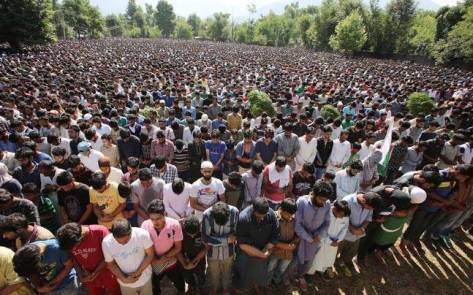
Burhan Muzaffar Wani and his comrades were born and died in the phase of militancy in Jammu and Kashmir that symbolizes the watershed in politics in J&K; pre and post ‘89-90. Unlike in the past, indigenous militants now neither travel to Pakistan for guns or for arms training. Armed resistance and its indigenous roots are etched on the faces of these young men.  Burhan’s killing on July 8 and following that, the turnout at his funeral as well as the protests that broke throughout the  state have rekindled memories of the early 90s, especially the death of Ashfaq Majid in 1990, which too had seen mass outpouring of rage.  Burhan and his comrades knew they would not survive for long; seven years is the average life span of a militant in Kashmir, as Burhan’s father poignantly stated long before his death.  Not because that was their own choice, but it was the only choice offered to a people by a ruthless military suppression by a state that has refused to recognize the popular demand for right of self determination.

Indians remain ignorant of the depth of the passion for ‘Azaadi’ from forced union with India, a union imposed in myriad ways. The policy of land grabbing to settle ex servicemen from outside the state (an old project of RSS); allowing non-state subjects unhindered access to land for industry, real estate, mining, for setting up fortified colonies for migrants; where control of the state government, especially Kashmir based ruling parties, over administration has always been circumscribed by New Delhi; and financial dependence  compounded by autonomy of the military from the purview of representative government – all of these point to the fact that the reins of government are held in New Delhi. Continue reading Kashmir – Cry my beloved country: Gautam Navlakha

पवित्र किताब की छाया में आकार लेता जनतंत्र

भारतीय लोकतंत्र: दशा और दिशा को लेकर चन्द बातें

Never Be Deceived That the Rich Will Permit You To Vote Away Their Wealth
– Lucy Parsons


..लोग सोच रहे हैं कि आखिर जनतंत्र हर ओर दक्षिणपंथी हवाओें के लिए रास्ता सुगम कैसे कर रहा है, अगर वह ‘युनाईटेड किंगडम इंडिपेण्डस पार्टी’ के नाम से ब्रिटन में मौजूद है तो मरीन ला पेन के तौर पर फ्रांस में अस्तित्व में है तो नोर्बर्ट होफेर और फ्रीडम पार्टी के नाम से आस्टिया में सक्रिय है तो अमेरिका में उसे डोनाल्ड ट्रम्प के नाम से पहचाना जा रहा है। वैसे इन दिनों सबसे अधिक सूर्खियों में ब्रिटेन है, जिसने पश्चिमी जनतंत्र के संकट को उजागर किया है।

ब्रिटेन को यूरोपीयन यूनियन का हिस्सा बने रहना चाहिए या नहीं इसे लेकर जो जनमतसंग्रह हुआ, जिसमें सभी यही कयास लगा रहे थे कि ब्रिटेन को ‘अलग हो जाना चाहिए’ ऐसा माननेवालों को शिकस्त मिलेगी, मगर उसमें उलटफेर दिखाई दिया है; वही लोग जीत गए हैं। और इस बात को नहीं भुला जा सकता कि जो कुछ हो हुआ है उसमें प्रक्रिया के तौर पर गैरजनतांत्रिक कुछ भी नहीं है। दक्षिणपंथ के झण्डाबरदारों ने ऐसे चुनावों में लोगों को अपने पक्ष में वोट डालने के लिए प्रेरित किया है, जो पारदर्शी थे, जिनके संचालन पर कोई सवाल नहीं उठे हैं।

( For full text of the article click here : https://sabrangindia.in/article/pvitra-kitab-ki-chaaya-mein-aakar-leta-hai-jantanta)


Assam Election Results 2016 – Challenges to Pluralist Ethos: Ram Puniyani

Guest post by RAM PUNIYANI

Assembly_2775927f

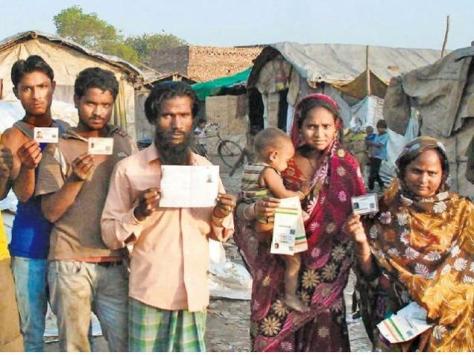
Once cut off from the electoral list, getting re-enrolled is a painful exercise for these migrants who work outside Assam. Fear of being struck off voters’ lists and branded Bangladeshis haunts them.

(Picture Credit – The Hindu)

This time around (2016 Elections) BJP has managed to come to power in Assam, though as a coalition with its allies. Its vote share this time came down to 29.5% from the earlier 36.5% (2014); still because of the strategically stitched alliances it beat the Congress in the number of seats won. BJP election appeal was centered on the divisive issue of Bangaldeshi immigrants. It took care to regard 3% native Muslims on the ground of ‘Native Assamese identity’ while the Bengali Muslims (32%) were singled out as immigrants; outsiders. The Bengali immigrant Hindus were projected as refugees. BJP’s propaganda was on the lines of Hindus versus Muslims. Cleverly it was presented as natives versus outsiders.

Elections 2016

Taking recourse to communal historiography the election was presented as the second battle of Saraighat, where Lachit Burfukan had defeated the Mughal army in 1671. As such the many commanders and soldiers of Lachit were Muslims also like Bagh Hazarika. Mughal army had many Hindu generals and soldiers. By spinning the tale directed against Mughals projected in the form of Badruddin Ajmal, who was the main target as he was presented as a symbol of Bengali Muslims. At electoral level the Muslims votes got split between Congress and Ajmal’s party. Now the new Government is planning to identify the Bangaldeshi immigrants and throw them out. As such Assam has been witnessing the harassment of Muslims and many of them have been denied voting right putting them in D Votercategory (D for doubtful). Continue reading Assam Election Results 2016 – Challenges to Pluralist Ethos: Ram Puniyani

Saffronization, Yoga and the Kerala Left: CP Geevan

Guest post by CP GEEVAN

There are many ways in which ‘saffronization’ is being carried out at various levels. It takes the form of virulent battles at one extreme and persistent soft-campaigns at the other. It really does not require deep skills in socio-political analysis to see this entire spectrum of insidious divisive politics – all of that are in the clearly visible band. Surprisingly, the CPI(M) seems to have taken the attitude of a friendly match when it comes to certain variants of soft-saffronization, pretending not to see what is going on behind often innocuous-sounding things like Yoga – the latest weapon being deployed in the saffronization campaign. Instead of questioning the premises of this misplaced ‘national celebration’ and its belligerent imposition that defines the Modi government move, the party has chosen to play a friendly match by wholeheartedly joining the soft-saffronization race.

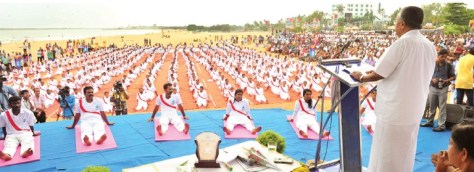
Pinarayi Vijayan at CPI-MK's Yoga event
Pinarayi Vijayan at CPI-MK’s Yoga event

The CPI(M, Kerala syndicate) has, in many ways, outperformed the RSS in Kerala so much so that the hyper-active media in Kerala had very little to report on how BJP and RSS celebrated yoga day in God’s Own Country. It seemed the Sanghis were pleasantly surprised at the saffronization of the CPI(M) itself! May be, the CPI(M) is gloating over how it out-smarted the Sanghis at their own game but that is not how it works in the world of everyday politics. For their part, the Sanghis could find nothing to object to in the way the new government in Kerala celebrated yoga. It seemed the Gods came to the CPI(M) party headquarters to pay obeisance to the newly enthroned in their glorious new clothes, new language, new style, new gait, new approach, and, of course, some inklings of a new, disquieting politics.

Continue reading Saffronization, Yoga and the Kerala Left: CP Geevan

Gandhi – A Religion of the Question: Ajay Skaria

[The following is the ‘Preface’ to AJAY SKARIA’s recent book, Unconditional Equality: Gandhi’s Religion of Resistance by Ajay Skaria. The preface raises interesting questions not only about Gandhi’s politics but also about the idea/s of secularism and religion in what we might call a postsecular world – a world that is, where the naive and uninterrogated binary between the two terms is constantly put into question. Also of interest to readers might be the attempt made by the author to read Gandhi’s writings as a long and ongoing struggle to articulate or ‘understand’ his own politics – a politics that Skaria claims is as much premised on equality among humans as it is on the equality of all being/s.]

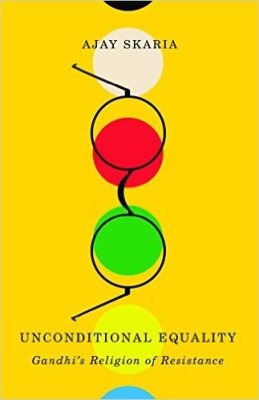
Unconditional Equality by Ajay Skaria

Somewhere in the early 2000s, while preparing to teach Mohandas Karamchand Gandhi’s English translation of Hind Swaraj to my undergraduate class, a passage about history in the text intrigued me. Since I happened to have the Gujarati version of that text at hand, I consulted it. The divergence is striking. The Gujarati text criticizes “history” (the English word occurs in the Gujarati text) and contrasts  it to itihaas [usually translated as “history”]. The English text criticizes “history,” but in it there is no equivalent for itihaas; the contrast between history and itihaas is thus obscured. The gap between the Gujarati and English texts, I have since come to realize, is symptomatic of Gandhi’s struggles to think his politics. What this politics involves is by no means clear to him; perhaps he writes so prolifically and indefatigably (his collected works run to ninety-eight volumes in English) precisely in order to try and understand his own politics. This politics becomes even more intriguing when we attend not only to Gandhi as an author or “intending subject,” but to his writing.[1] By dwelling in and on the gaps (between Gujarati and English and also within each of these languages) in his writing, this book tries to draw out his politics.

For me, writing this book has been difficult also because of another gap—that between Gandhi’s insistence that there can be “no politics without religion” and the secular inheritance that I have, as far as I know, no desire to abandon. Gandhi repeatedly describes satyagraha (his most famous neologism, which he coins initially as a translation of “passive resistance”) as his “dharma” or “religion,” even as the religion that stays in all religions.[2] Symptomatic of my difficulty with this religious politics was my inability for long to even recognize it. When Vinay Lal first asked me in 2007 to write an essay on Gandhi’s religion for a volume he was planning on political Hinduism, I protested that I was not interested in this aspect of Gandhi. But with his characteristic persistence, Vinay did not accept my protests, and I ended up writing that essay, which became a precursor of this book.

In the process, my own understanding of dharma and religion as “concepts” has been transformed.[3]

Continue reading Gandhi – A Religion of the Question: Ajay Skaria

Love in the Time of Public Despair: Remembering Kamala Surayya

31 May passed like any day in present-day Kerala – filled with the cacophony of mediocrities and expressions of greed, envy, and hate which have become the new normal. No wonder, then, that most people did not remember that this was the poet Kamala Das/Madhavikkutty/ Kamala Surayya’s death anniversary. I cannot help recollecting that I had predicted that this would happen: that people here would celebrate her death, display sickening sentimentality, and then quickly forget. In life and in death, Surayya never received the critical attention that she deserved as a thinker, nor did those interested in progressive left politics take her forays into politics seriously. In these times of despair, one must, however, turn to her …

Read more on:

http://www.thehindubusinessline.com/blink/know/seeking-rhyme-in-reason/article8737506.ece


Stop Trying to Portray Us as Extremists: Dalit Human Rights Movement

The police investigation about the bomb blast at the Kollam Collectorate on 15 June 2016 has now turned against us. Neither the organization nor its activists have any involvement in this incident. The accusation against us is just a ploy to use draconian laws such as the UAPA to destroy dalit-adivasi resistance.

The demeaning and enslaving social norms in Kerala have, since centuries, denied dalit people the most basic human rights such as the right to education, the right to decently clothe one’s body, the right to travel on public roads, and express one’s views. But India became a democracy that aimed for social democratisation, and Dr B R Ambedkar raised the possibility of social equality and reservations for the underprivileged groups through the Indian Constitution. Yet, sixty-five years later, the classes fundamental to this society have made no social, economic, or cultural progress and they continue to endure caste slavery and and exploitation in all areas of public life. The mainstream political parties who surfaced as the protectors of these classes have never offered them complete protection at any time. Though they have been faithful followers and workers of these parties, members of the disadvantaged groups have had little economic security; they have lacked social education; they have had to cry out for tiny parcels of land. Continue reading Stop Trying to Portray Us as Extremists: Dalit Human Rights Movement

Of men, women, caste and cinema: Rita Kothari

Guest post by RITA KOTHARI

 “Woh kam-jaat  ladka hai. Phir kaise uske saath bhag gayi?  Sochna tha na  pehle?”  (He is a low-caste boy, why did she elope with him then? Shouldn’t she have thought of this?”)

Vimala’s judgment was unequivocal. She was talking about Hansa, her neighbour  and my former ‘help.’  Hansa  is  a young girl , perhaps seventeen,  and she  recently eloped with a boy. I stopped myself from saying anything facile, as yet.

“Ab pyaar poochhke to hota nahin, “ I said to her.  Love seeks no permission.

To bhugatna bhi padta phir.”  Then be ready to suffer, Vimala quipped.

She went on to tell me about an incident she had witnessed in her village,  about 30 kilometers away from the big town of Dungarpur in Rajasthan. A Rajput girl and Sewak boy eloped. They settled down in some city, and ten years went by. Meanwhile the girl had a child and was carrying her second baby. Her family had managed to track her whereabouts and convinced that she would be welcome home. The couple returned to the village for a visit. One night the girl’s brother put out lights in the entire village. The young couple was killed.

Poore gaanv ki bijli band kar di, aur maar dala dono ko. Humne dekha apni aankhon se,” Vimala said.

I stood transfixed. What was more accurate here, fiction or life?  I had just returned from watching the  Marathi film, Sairat.

Continue reading Of men, women, caste and cinema: Rita Kothari

Resist the Modi Regime’s Assault on Students, Reject the Subramaniam Panel Report on Student Politics: Shehla Rashid

Guest Post by Shehla Rashid

When politics decides your future, decide what your politics should be !

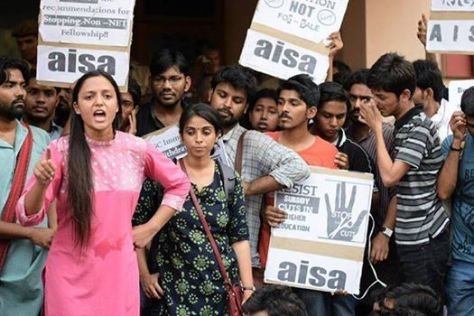
Shehla Rashid (AISA), Vice President JNUSU, speaks at a student protest, during the 'Occupy UGC' Movement
Shehla Rashid (AISA), Vice President JNUSU, speaks at a student protest, during the ‘Occupy UGC’ Movement

The recent government constituted panel‘s (headed by former cabinet secretary T.S.R. Subramaniam) report on student politics is unconstitutional, highly regressive and politically motivated, and signals the upcoming onslaught of total commercialisation of education and imposition of Hindutva ideology in universities. The TSR Subramaniam Panel’s report is the logical follow up to the Birla Ambani report (which was submitted in 2000), following which student unions across the country were banned. The Birla Ambani report had lamented that student unions are not allowing commercialisation of education: we accept the charge and take pride in it! We believe that education should be a right of everyone, not a privilege of a handful of people.

Continue reading Resist the Modi Regime’s Assault on Students, Reject the Subramaniam Panel Report on Student Politics: Shehla Rashid

An Open Letter to the DU Teachers from a DU Student – I Stand with You: Fatma M. Khan

Guest post by FATMA M. KHAN

Dear teachers,

After three years at the Delhi University, I have been disillusioned with a lot of things. But one thing which never ceases to surprise me is the tireless effort put in by a lot of you to create something better. It is often against the system, against the apathy of the students, against the examinations which reduce texts to regressive questions. This is for you.

This is for the teachers who hated the FYUP programme, but still tried hard to create meaningful project topics for the foundational courses out of the juvenile textbooks we had, not caring about the extra correction this created for themselves. This is for the teachers who went out of their way to conduct thought-provoking discussions on “Integrating Mind, Body and Heart”, a course which had no marking. Continue reading An Open Letter to the DU Teachers from a DU Student – I Stand with You: Fatma M. Khan

This Is Not Just About Kanhaiya Kumar & Delhi University Teachers: Mukul Mangalik

MUKUL MANGALIK in raiot.in

The Delhi University Teachers’ Association (DUTA) General Body Meeting (GBM) held on May 28, 2016 issued an appeal ‘to all students to support our struggle’ against the University Grants Commission (UGC) Notification 2016. The resolution passed by the DUTA GBM of June 2, 2016 ‘extends thanks to Jawaharlal Nehru University Students’ Union (JNUSU) for its support’ and to many other students’ organisations ‘which have expressed support for the ongoing struggle’. The DUTA Executive, in keeping with the letter and spirit of the sentiments expressed by successive GBMs invited representatives of teachers and students’ unions and organisations, including the JNUSU, to extend solidarity with the ‘khaali thaali’ (empty plates) dharna (sit-in) organized by the DUTA on 6th June outside the UGC compound. A section of Delhi University (DU) teachers did their best to prevent Kanhaiya Kumar, elected President of the JNUSU, from speaking on this occasion…

In trying to deny a student even a chance to speak, they have gone against everything that teaching should mean; in seeking to throttle words, speech and ideasinstead of countering them with other words, speech and ideas they, as university teachers have struck a blow against the freedom of expression that is the lifeblood of universities. They have gone against the idea of universities as potentially life-altering sites for students, places that encourage them to ask questions and speak freely; to read, write and think critically, analytically and with academic rigour, together and independently, in the endless pursuit of understanding and truth; to debate, disagree with, and discuss everything of consequence without fear of any forms of authority or power, but with respect for universal rights, ‘in the hope of creating a future in which liberty and human freedoms might be grounded in citizenship based on substantive equality’…

Let no one imagine that this moment of contestation in our history will spell political doom for the DU teachers’ movement. It shall not. If anything, we are likely to come out of this with an even stronger resolve, holding up a brighter flame of hope to all teachers and posing a more invulnerable front to Capital and State than has been the case thus far.

Read the whole article here.

Islamic Banking in India – For Financial Inclusion of Muslims or to squeeze them further ?


(Photo Courtesy : http://www.malaysiagazette.com)

Faith based banking in a country which has secularism enshrined in its constitution ! Does not it sound anachronous ?

Well, as far as the present dispensation at the centre led by BJP is concerned – which has an altogether different take on secularism – it does not seem to think so. And that’s why it has gladly accepted the proposal by the Saudi Arabia based Islamic Development Bank (IDB) – an international investment organisation – to start its operations here. In fact this proposal is considered a positive outcome of PM Modi’s visit to Saudi Arabia sometime back.( April 2016) Although a date has not been announced when the Bank would start its operations here, all the formalities regarding its launching have been completed and even the city for its first branch in India has been identified. Ahmedabad would see the first branch of this Bank. Continue reading Islamic Banking in India – For Financial Inclusion of Muslims or to squeeze them further ?

Statement Condemning the Persecution of Lawyers Collective and Indira Jaising and Anand Grover by Home Ministry, GoI

We, the undersigned, unequivocally condemn the efforts of the Ministry of Home Affairs to persecute the Lawyers Collective (LC), Indira Jaising and Anand Grover in order to obstruct the legal and human rights work being carried out by them.

We condemn the suspension of the FCRA registration of LC, as well as the mala fide and motivated manner in which the Ministry of Home Affairs, in a blatant violation of law, leaked the suspension notice to the press even before providing LC with a copy of the same.

There has been a systematic campaign and abuse of the legal process by the Central Government to malign Indira Jaising and Anand Grover as well as LC over the past six months. The suspension of LC’s FCRA registration is nothing but an escalation of the Government’s campaign to crush dissent and criminalise any person or organisation that questions or opposes the violation of fundamental rights and human rights by the State and its agencies.

The motivated campaign and actions against LC fit neatly into the present Government’s concerted campaign against marginalised and oppressed sections of society and any person, whether students, activists, academics or individuals who question the policies, actions and the abuse of power by the government.

Senior Advocates Indira Jaising and Anand Grover have an exceptional profile of public service, probity and personal and professional integrity as lawyers and as human rights activists. Their work has received global recognition.

Ms. Indira Jaising, has made an unparalleled contribution to law and jurisprudence on gender discrimination, whether relating to women’s right to property, sexual harassment at the workplace, domestic violence etc. She has also been a member of the CEDAW Committee. Anand Grover held the mandate of the UN Special Rapporteur on Right to Health between 2008 to 2014. He has made a tremendous contribution to the legal campaign against the criminalisation of homosexuality; rights of persons living with HIV; and access to medicine and healthcare. Ms. Jaising and Mr. Grover, through LC have and continue to advance the rights of the most vulnerable and marginalized sections of society, thereby upholding constitutional values. Instead of recognizing their invaluable contribution to the county and its people, the Government is making all efforts to obstruct their work.

Through the persecution and harassment of LC and Indira Jaising and Anand Grover, the present Government is sending a clear and chilling message to the citizens of this country that the inevitable consequence of questioning or criticising the present Government’s policies is repression and criminalisation.

LC has specifically and repeatedly countered and justified each of the bald allegations regarding misuse of funds that have been levelled by the MHA. However, the MHA has displayed an unusual vindictiveness by ignoring the official responses sent by LC and proceeding to suspend their FCRA registration. Continue reading Statement Condemning the Persecution of Lawyers Collective and Indira Jaising and Anand Grover by Home Ministry, GoI

Three Photographs, Six Bodies: The Politics of Lynching in Twos: Megha Anwer

This is a guest post by MEGHA ANWER


file-19-1458409803749044900
Mazlum Ansari and Imteyaz Khan, Jharkhand 2016.


The recent spate of vigilante attacks in India has lent a new, nearly domestic familiarity to the word “lynching”. This, though, is more than just a shift in language: the nation’s visual archive itself seems be shifting, towards instatement of a new normal. Inside just a year the “lynching photograph” has moved center-stage, filling mainstream news reportage and social media newsfeeds. The imagistic vocabulary of lynching has thus taken on a touch of mundane inevitability in caste and communal violence.

It began in March 2015, with the lynching of Syed Arif Khan in Dimapur, Nagaland. A couple of months later two teenage Dalit girls were raped, strangled and left hanging from a mango tree in Katra village in Uttar Pradesh. Then, on 28 September 2015, Mohammad Akhlaq was bludgeoned to death by a mob in his home near Dadri in what went on to gain spurious notoriety as a “beef-eating incident”. The following March, continuing with the logical rhythm of a scheduled sequel, the cattle herder Mazlum Ansari and his 14-year-old nephew Imteyaz Khan were lynched and hanged from a tree in Jharkhand. Most recently (on May 22) M. T. Oliva, a Congolese citizen, was beaten to death in the national capital of Delhi. This is an incomplete list: it includes only those incidents that resulted in fatalities. In the same timeframe there have been at least a dozen other cases in which the victims somehow survived the end-stage public shaming, torment and lurid physical violence, in short the ordeal of a completed lynching.

There is no lynching without its spectators. Continue reading Three Photographs, Six Bodies: The Politics of Lynching in Twos: Megha Anwer