The Parliament which has remained rather dysfunctional for different reasons all the year witnessed a strange bonhomie few days back. It was difficult to believe that they are the same representatives of people who could not see eye to eye on various issues of concern and were always keen to score their point over their political adversaries. Led by the likes of Laloo Prasad Yadav – interspersed with slogans of ‘Jai Krishna’ – the government’s alleged silence on the developments in a faraway court in Russia was called into question.
Interestingly, BJP the party which happens to be the chief opposition party, found itself playing second fiddle to the troika of Laloo, Mulayam and Sharad Yadav on this matter. The issue related to proceedings in a court in Tomsk which supposedly had found portions of ‘Gita’ objectionable and ‘extremist’ and was contemplating to ban it.
This guest post by HASEEB ASIF is in Urdu, in Roman script
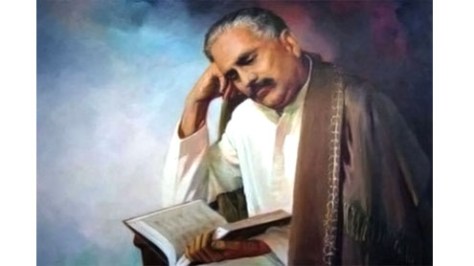
Allama Iqbal (1877-1938)
Islami Jamhooriya Pakistan ki tareekh Hindustan se bohut purani hai. Balkay Islam se bhi purani hai. Jab aathveen sadi mein Muhammad Bin Qasim Islam phelane bar-e-sagheer tashreef laye tau ye jaan ker sharminda huwe ke yahan tau pehle hi Islami riyasat maujood hai.
Yahan kufr ka janam tau huwa Jalaaludin Akbar ke daur mein, jo Islam ku jhutla ker apna mazhab banane ko chal diya; shayid Allah-ho-Akbar ke lughwi maani le gya tha.
Baharhal, in kafiron ne butparasti aur mehkashi jaisay gheir munaasib kaam shuro kerdiye aur apne aap ko Hindu bulaane lage. Sharaab ki aamad se Pakistan ke Musalmanon ki woh taaqat na rahi jo tareekh ke tasalsul se honi chahiye thi. Iski vaja ye nahin thi ke Muslaman sharaab peene lag paray the, balkay ye kay unki saari quwat-e-nafs sharab ko naa peene mein waqf hojati thi, hukmarani ke liye bachta hi kya tha.
Is ke bawajood Musalmanon ne mazeed do sau saal Pakistan per raaj kiya, phir kuch dinon ke liye angrezon ki hakoomat agayi (hamari tafteesh ke mutabiq yehi koi chalees hazaar din honge).
Well, Information and Technology Minister Kapil Sibal’s prickly suggestion to pre-screen content on social networks like Google, Facebook and Twitter, has invited such derision from the internet world that it has given him a tag to his name – Idiot Sibal. For iSibal, it’s not his status on Facebook that should bother him, but the ruinous unmasking of the minister in status-anxiety New Delhi. Sibal, after all, prides himself in belonging to the elite movers and shakers of the Capital – educated, connected, and gold card holder of the Stephen’s Old Boys Network. For the status seekers, this is a world of privilege and entitlement, cosmopolitanism and tolerance.
Now you would wonder what came over the blue-stockinged Technology Minister to make such an ill-thought out statement. Sibal’s liberal snobbery is not always what it seems to be, for there is a lurking autocratic and despotic streak, even archaic at times, that has surfaced time and again. And it is this aspect that has largely been ignored in the bedlam over his latest decree to social network companies.
“Then leave Complaints: Fools only strive
To make a Great and honest Hive.
T’enjoy the World’s Conveniences,
Be famed in War, yet live in Ease
Without great Vices, is a vain
Eutopia seated in the Brain.”
Bernard Mandeville (The Grumbling Hive, 1705)
Salutary falsehoods for a promising end, anyone? Try telling this to the ever righteous Anna Hazare or to the followers of Vaclav Havel, whose campaign assurance to ‘live in truth’ in the year 1989 so moved his virtuous flock. There is a politics of virtue and then there is realpolitik – or so we are told. Or is virtue above politics and vice below? What the deuce marks the ambiguous space in between?! That is what has been relentlessly, and ruthlessly, scanned by two masterful recent additions to the canons of contemporary Western political philosophy: Martin Jay’s The Virtues of Mendacity: on Lying in Politics and David Runciman’s Political Hypocrisy: the Mask of Power, from Hobbes to Orwell and Beyond.
At one level, both scholars acknowledge and emphasize the dangers of the ‘ethical turn’ in political studies.
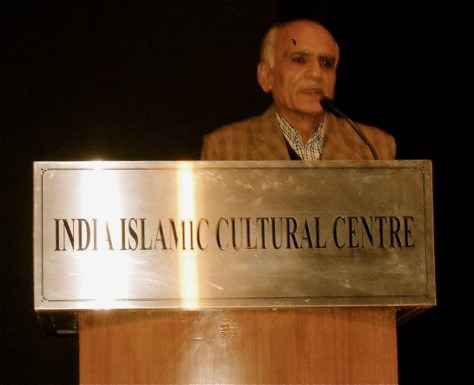
M. Saleem addressing the Maulana Jauhar Award ceremony at IICC in Delhi on 10 December 2011
Update on 11 December:
Twocircles.net reports:
“Zafar Agha was replaced by ex-MP and senior Journalist Santosh Bharatiya. However, M Saleem claimed that Sanjeev Bhatt could not attend the programme due to time constraint and the award may be given to him some other time. While referring to Santosh Bhartiya, being awarded in place of Zafar Agha, M. Saleem said that he has been nominated for the award and nobody has been replaced for the same. The organizer kept totally mum about both Zafar Agha and Jagdish Tytler. ” [Link]
*
On 3 December, an open letter signed by some of us, and posted here on Kafila, had appealed to seven distinguished individuals to not accept the Maulana Mohd. Ali Johar Award, to be given on 10 December at the India Islamic Cultural Centre. We had reasoned that since the eighth awardee was Jagdish Tytler, they should not share an award and a platform with someone accused of organising mass murder of Sikhs in Delhi in 1984.
Yesterday evening, the general secretary of the Maulana Jauhar Academy, M. Saleem, emailed one of the signatories, Mahtab Alam. The email contained a scanned copy of a letter sent by Jagdish Tytler to M Saleem, which said that Tytler would not attend the award ceremony so as to not embarrass the the other awardees and the organisers, because of this boycott campaign. He, however, stressed on his innocence in the 1984 anti-Sikh pogrom, and, notably, did not say that he would not accept the award. He would only not attend the ceremony. M. Saleem has also not announced whether he is withdrawing his decision to give the award to Mr Tytler. For more details on what has transpired in the last few days, please see Mahtab Alam’s article, Beware of the Sarkari Musalmaan.
In the current issue of the English fortnightly, Milli Gazette (1-15 December), it is reported that on 10 December 2011, former union minister Jagdish Tytler will be awarded with seven others in a function at India Islamic Culture Centre, Delhi, by Maulana Mohammad Jauhar Ali Academy. The other names were those of Dr. S Y Quraishi, Chief Election Commissioner of India; Sanjeev Bhat, Indian Police Service officer (Gujarat); senior journalist Zafar Agha; Mohd. Najeeb Ashraf Chaudhri, chief income tax commissioner; Maulana Mohd. Haseeb Siddiqui, chairman of the Deoband Nagar Palika Parishad; Nusrat Gwalliori, a Delhi-based Urdu poet, and Begum Rehana AR Andre, a social activist and educationist based in Mumbai.
The award has been named after Maulana Mohammad Ali Jauhar, a key figure of the Indian freedom movement, a leader of the Khilafat movement and one of the founders of Jamia Millia Islamia, a prestigious central university in Delhi. The award is given on his birth anniversary every year. Though the reasons for honouring these people were not mentioned in the Milli Gazette report, the Academy’s general secretary explained that every year, the academy honours individuals in recognition of their extra-ordinary contribution in the field of journalism, politics, social service and so on. This year they chose Jagdish Tytler for his contribution to politics! Continue reading Beware of the Sarkari Musalmaan: Mahtab Alam→
A few days ago a friend asked me if I knew someone who had the ability and inclination to help out a certain department of the central government with using social media. My friend did not name who the prospective employer was, but clearly, with even Digvijay Singh on Twitter, the Congress party is worried about social media. No surprise that this should happen in a year when the UPA government’s popularity has taken a nose-dive.
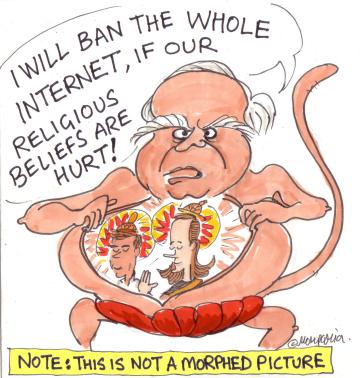
The New York Times revealed on 5 December that Kapil Sibal summoned Facebook officials and showed them a Facebook page that allegedly maligned Congress president Sonia Gandhi and said that this was unacceptable. While HRD officials refused to reveal much in that NYT copy, they must have realised that shit has hit the fan, because the next morning’s Indian Express the spin doctoring was clear: there was now a mention of allegedly derogatory pictures of Prophet Mohammed along with the Prime Minister and the Congress President (who are no doubt as sacred in his books as Prophet Mohammed).By the time he held his press conference yesterday, it became about things that Hurt Our Religious Sentiments. On the 19th anniversary of the Babri Masjid demolition, it is very interesting to see a Congress minister using religion to cover up power politics. Continue reading What Kapil Sibal does not understand: the internet→
This evening, Rasagy raised a question on twitter about whether the effort of a developer to make the database of the Indian railways downloadable is ‘official’ or not? As Rasagy later explained, the downloadable database is a list of trains, stations and the railway timetable. This list has has been made available in various downloadable formats (such as .csv, .pdf, etc) to encourage developers/interested persons to make web/mobile based applications. Rasagy’s question was more in the nature of checking the legality of the act of putting this information/database on another website when it is explicitly copyright of the Indian Railways (as declared on their website). He argued that cities such as New York and some countries across the world have made this information ‘open’, meaning available to the ‘public’. Hence, it is unreasonable for this government entity i.e., the Indian railways, to be ‘closed’ about reuse of this information by private entities and individuals.
You can add your name to this appeal in the comments section.
Delhi, 3 December 2011
According to a news report in the Milli Gazette of 1 December 2011, Jagdish Tytler, an accused in the anti-Sikh pogrom of 1984, will be awarded the Maulana Mohd Ali Jauhar Award on 10 December 2011 at the India Islamic Cultural Centre, New Delhi. Seven others will share this award. The undersigned appeal to the other seven awardees to not accept the award as a mark of protest against honouring Mr Tytler, whose contribution in the 1984 anti-Sikh pogrom has been recorded by several fact-finding reports, including those by PUCL and PUDR.
(नई दिल्ली का सौवां साल शुरू होने पर हिंदी साप्ताहिक आऊटलुक में यह लेख पहली बार प्रकाशित हुआ था.)
अब जबके हर तरफ यह एलान हो चुका है के दिल्ली १०० बरस की हो गयी है और चारों ओर नई दिल्ली के कुछ पुराने होने का ज़िक्र भी होने लगा है, इन दावों के साथ साथ के दिल्ली तो सदा जवान रहती है और देखिये ना अभी कामन वेल्थ खेलों के दौरान यह एक बार फिर दुल्हन बनी थी वगेरह वगेरह तो हमने सोचा के क्यों न इन सभी एलान नामों की सत्यता पर एक नजर डाल ली जाए, और इसी बहाने उस दिल्ली वाले से भी मिल लिया जाए जो इस अति प्राचीन/ मध्य कालीन/ आधनिक नगरी का नागरिक होते हुए भी वैशवीकरण के झांसे में इतना आ चुका है के वो अपने आप को २१वीं शताब्दी के पूर्वार्द्ध में आने वाले आर्थिक संकट को पछाड देने वाले चमचमाते भारत देश की राजधानी का शहरी होने का भरम पाले हुए है. Continue reading यहाँ से शहर को देखो…→
After armed forces, nuclear establishment is another holy cow in the post-independence India. Our media does not only outsources all final judgements on nuclear issues to the nucleocrats, but has also happily joined them in slanders against the grassroots anti-nuclear movements.
We have seen the media discourse on nuclear weapons being shadowed almost entirely by national security and nuclear deterrence arguments. On the recent upsurge of mass protests against nuclear energy projects across the country, media is playing the official tune where people challenging these projects are reduced to illiterate crowd, foreign-funded groups, religious identities and even anti-nationals. On 24th this month, the Tamil newspaper Dinamalar published a story titledTruth and hype behind the Koodankulam row. This report is nothing but an utterly malicious piece of journalistic writing with ugly slanders against the leading activists of the ongoing anti-nuclear movement in Koodankulam – S P Udayakumar, M Pushparayan and M P Jesuraj.
Iskander Mirza, Pakistan’s President between 1956 and ’58, is remarked to have said that democracy was ‘unsuited’ to the genius of the Pakistani people. Decades later, similar questions about democratic form of governance are being raised in Pakistan. Take any TV show, read the multitude of op-eds, or more worryingly, check what the youth have to say on Facebook or Twitter. The parameters of debate remain the same.
The urban Pakistani’s disdain for the ‘illiterate’, ‘rural’ politicians and their ability to rule the country is a long-running theme. More importantly, the duality of civil-military rule has generated a peculiar discourse: the weak and corrupt ‘civilians’ compromise national security as opposed to authoritarian regimes which guard ‘ideological’ and geographical borders of the country. Continue reading Pakistan 2012 – We Must Learn from History: Raza Rumi→
This guest post by ALIA ALLANA, a despatch for Kafila from Cairo, is the eleventh in a series of ground reports from the Arab Spring. Photos by Alia Allana
This slideshow requires JavaScript.
“Votes and rocks: just two ways to get heard,” said Salma.
Recent events in Kerala convince me that we need to think more closely about the ways in which our political public life is being slowly overwhelmed by something that is profoundly anti-public but somehow manages to resemble it — I’m tempted to call it the Mobpublic. I’m of course not referring to formal politics, where political parties and powerful communities continue to squabble without any serious difference in their programmes. Very little of either the political or the public survives in them; all one hears for most of the time are the tales of internal squabbling which is neither political (yes, despite all of V S Achuthanandan’s efforts to coopt oppositional civil social struggles) nor public. Perhaps the decline of the political is a condition for the rise of the mobpublic.
In a statement of apparent ‘self-criticism’, dated September 1 2011, the Communist Party of India (Maoist) has offered an apology for the posters threatening Aruna Roy, Jean Dreze, Gokul Vasant and Nandlal Singh and members of Gram Swaraj Abhyan. But they have not tendered an unconditional apology for the brutal murder of NREGA activist Niyamat Ansari and threat to Bhukan Singh for allegedly being ‘police informers’ and ‘cheating local people’ of their forest land.
86 families in Kope Gram Panchayat, including Bhukhan and Niyamat, were part of a larger movement to secure legal entitlements over forest land under the Forest Rights Act, 2006, which was opposed by the same corrupt contractors involved in committing malpractices in the NREGA Programme. His team exposed a scam involving Rs 2.5 lakhs leading to an FIR being filed against the local Block Development Officer. Within days after this, on 2nd March 2011, Niyamat was beaten to death. The fact finding report published by Gokul Basant- Nandlal Singh has hinted towards possible involvement of Maoist with corrupt middlemen, illegal contractors, forest department and local administration.
“Amar naam Chatterjee!” My name is Chatterjee! sounds like a proclamation from a fiery leader of the masses at a public rally, but it came from a rickshaw wallah plying his trade in the dusty bylanes of North Calcutta and addressed to no one in particular.
As I sat on his rickshaw, the frail old man launched into an indignant tirade against the ruling political party, whom he branded as a group of turncoats, insisting vehemently and repeatedly to nothing but the evening breeze that he had always been a Congressman.
Yes, he defended, petrol prices have been rising, but surely the bosses in Delhi would admit to that! What is the point of protesting about that in an insignificant meeting of rickshaw wallahs’ union? His tone of uncompromising understanding of world affairs drew me to listen to him, rather than plug in my earphones and switch off the world. Continue reading A Rickshaw Ride in Kolkata: Waled Aadnan→
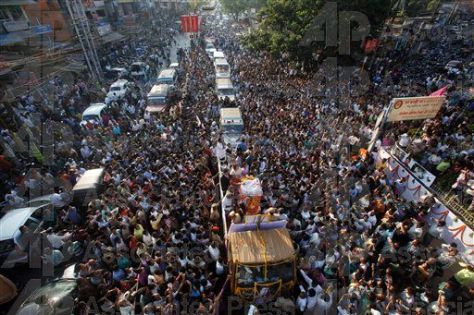
Mourning people from across Assam assemble in miles and miles of roads leading up to Bhupen Hazarika’s funeral. He’s a restless jajabor/wanderer no more. Paeans after paeans are being sung now after the ‘great cultural hero’, the ‘greatest Assamese’, the believer in ‘the power of the nation’ (the ‘nation’ being Akhand Bharat or Brihottor Axom, depending on whichever variety of nationalists sing). Bhupenda is dead. Assam is in despair.
A statement by theSOUTH ASIA SOLIDARITY INITIATIVE
SASI Calls for People-to-People Solidarity with Palestine and Condemns Duplicity of South Asian States in Palestine Bid for UN Recognition
The South Asia Solidarity Initiative (SASI) recognizes the importance and urgency of the Palestinian bid for recognition by the United Nations this September. Despite the threatened U.S. veto in the Security Council, all member nations have an opportunity to weigh in on the outcome through the General Assembly. We welcome the overwhelming support shown for Palestinian membership in the UNESCO. While noting the support for recognition of Palestine by South Asian states, SASI is dismayed by the duplicity of some of these states in continuing to build economic, military, and intelligence ties with Israel. SASI supports the efforts of all peoples movements in South Asia and elsewhere towards solidarity with the people of Palestine. Continue reading Statement by SASI on People-to-People Solidarity with Palestine and Duplicity of South Asian States→
Many of us who have been studying the political process in Assam were surprised when we received the news in December 2009 that Chairman Arabindo Rajkhowa and some of his colleagues of United Liberation Front of Asom (ULFA) had been arrested in Bangladesh. This moment had to come some day, but we were not prepared to face it. We were familiar with the brave and somewhat legendary image they had created for themselves and needed time to believe that they could be defeated. Continue reading My Days with Nationalism in Assam: Ankur Tamuli Phukan→
John Emerich Edward Dalberg Acton is said to have said in 1887, “Power tends to corrupt, and absolute power corrupts absolutely.” After 124 years it is being felt that Lord Acton could have added one more thing; Power gives you the exclusive right to define and redefine things according to your convenience. The ‘all-possible-awards-winner’ chief minister of Bihar Mr. Nitish Kumar could have prompted Lord Acton to enrich this famous quotation for a couple of reasons.



 You can add your name to this appeal in the comments section.
 (नई दिल्ली का सौवां साल शुरू होने पर हिंदी साप्ताहिक आऊटलुक में यह लेख पहली बार प्रकाशित हुआ था.)
 KAFILA - COLLECTIVE EXPLORATIONS SINCE 2006