Category Archives: Politics

Have I Joined the Popular Front?

In the past few weeks, I have been asked over and over again, not always in jest, if I had joined the Popular Front. I am not surprised. The police investigation around the violence against the college teacher at Muvattupuzha has broken all previous records in not only the violation of human and civil rights, but also in the silence of Kerala’s enlightened intellectuals. If I recall right, only Nandigram evoked such a dense and deliberate silence from them. No wonder, anyone who speaks up against the manner in which the police is being armed and authorized against ‘bad muslims’ is immediately dubbed a supporter of the Popular Front. But I am intrigued by this simple question, by which the entire history of that person’s engagement with discussions around religion and the state is erased. Continue reading Have I Joined the Popular Front?

Pushing the Kashmiri to the wall, again

[An edited, shorter version of this article by me appeared last week in The Friday Times, Lahore.]

In the first week of June, I sat at a shopfront with a group of shopkeepers of Kalarus, a small town in Kupwara district in north Kashmir. In 1999, they collected money and bought land for a martyrs’ graveyard, one of many such in Kashmir. Whenever the Indian army killed militants trying to infiltrate from Pakistan to the Indian side of the Line of Control, they would hand over the bodies to the Kupwara police, who would give it to these people to bury after the autopsy.

“Look up at the mountain peak,” said one of them, “It is snow clad all twelve months. It is the LoC, 70 kms from here. Do you think anyone would cross that wearing the traditional Kashmiri Khan dress?” And yet, most of the hundred odd bodies in the graveyard had come wearing clothes unfit for snow. And, most of them had so many bullet marks on the face that they were unidentifiable. Continue reading Pushing the Kashmiri to the wall, again

What Went Wrong in Kashmir? Rekha Chowdhary

Guest post by REKHA CHOWDHARY

This article was also published in Kashmir Times
What went wrong in Kashmir? This is one pertinent question that needs to be addressed seriously before any corrective measures can be applied. Situation would certainly normalise after some time, but apparently ‘normal’ situation in case of Kashmir does not indicate anything. The vibrancy of ordinary life and the day-to-day routine followed for days and even months, takes only moments to break. Underneath the normalcy, the turbulence is ever present and can surface at any point of time. Every turbulent period however provides clues to the real problem, and one should hold on to these clues, if one really wants to do something about it.

So what do we see in the present turbulence? Firstly, though the crisis revolves around the stone-pelting youth, one can clearly say that the real problem is not that of the stone-pelters. Neither the theory of LeT being responsible for it, nor the issue of money being paid to stone pelters, nor the vested interests making the most of the situation explains the crisis.

Pracharak as Terrorist – On the Bhasmasur of Hindutva Terror

I.

Hindu mythology with its plethora of gods and goddesses (which according to a conservative estimate numbers around 330 millions or 33 crores) has n number of stories supposedly to show the human face of the almighty. One such story talks of the creation of a demon called Bhasmasur by one of the gods himself. The said demon had the unique power of turning everything into ash if he could touch anybody’s head. The story goes that after ‘conquering’ the world the demon tries to attack his ‘creator god’ namely Shiva himself and then Lord Vishnu intervenes and manages to eliminate the demon itself.

Whatever might have been the significance of the story then, it bears striking resemblance to the plight of the RSS – the biggest fountainhead of Hindutva politics in the country – today. And this relates to the arrest of many of its senior wholetimers (called Pracharaks in its lexicon) for their role as masterminds, instigators or patrons of terrorist acts in the country and the ongoing questioning of many other senior leaders for their role in aiding and abetting such acts. Interestingly the parent organisation has till date not formally denied their role in all these acts and nor called it witchhunting as it did when investigations into the Malegaon bomb blast II (Sept 2008) were on and the likes of Sadhvi Pragya, Lt Col Purohit and others from the larger Hindutva family found themselves behind bars. In fact, this time it appears more cautious and according to a report it has even sent few of its leaders who supposedly played some role in these acts on a compulsory leave and has plans to send few more. (Bhaskar, 7 th July 2010).

Continue reading Pracharak as Terrorist – On the Bhasmasur of Hindutva Terror

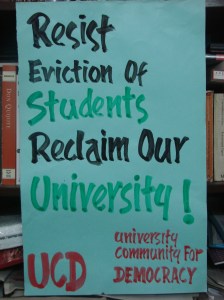
Down with Students’ Eviction from College Hostels!: University Community for Democracy

A Guest Post sent to us by BONOJIT HUSSAIN and NAINA MANJREKAR

[This is a leaflet issued by the University Community for Democracy which has come up in the wake of the arbitrary and authoritarian eviction of students from the hostels of Delhi University for the Commonwealth Games. Initially starting off as a facebook discussion among students, the anger has now snowballed into a movement that seeks to go beyond the immediate question of evictions. – AN]
Down with eviction of students from College Hostels!
Onwards to students self-activity!!
University Community for Democracy poster

The current administration of Delhi University has attempted to reshape the University through a series of sinister agendas – be it the introduction of semester system, the European Studies Programme or the biometric identification system. All of them have shared one thing in common: the thwarting of democratic debate on proposals for change, and the routine violation of regulatory protocols.

The latest episode has been the eviction of students (2,000 students according to reports) from a number of hostels in Delhi University in order to make them available for the Commonwealth Games. Hostels are being renovated and beautified for the officials and visitors of the Games, while students are scrambling around for their own accommodation. The students, like the 40,000 families on the Yamuna bank, are now among the many that have been displaced in the name of national glory. What comes into question is the fact that the University has agreed to avail of 20 crores of rupees from the Commonwealth Games project without taking any cognisance of how and where such resources are generated. It has thus become an accomplice in the larger process of reckless corporatisation that the whole city is undergoing in the bid of becoming a “global city”.

Birthday Wishes from the Hindustan Times

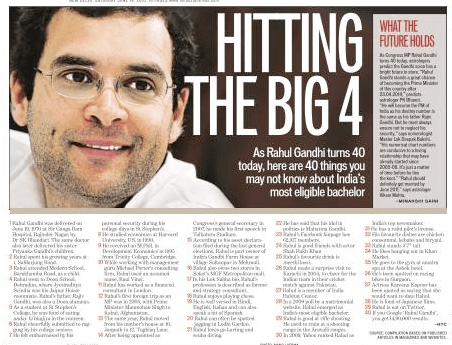
The Hindustan Times marked Rahul Gandhi’s fortieth birthday by tell us 40 things we “may” not know about “India’s most eligible bachelor”.

Nothing surprising about this. Why, don’t you remember how they told you 54 things about you didn’t know about Mayawati on Mayawati’s 54th birthday six months ago?

See also:
Why Hindol Sengupta Needn’t Fear Mayawati
Happy Ambedkar Jayanti

Mohamad Junaid: What Does the Chatham House Poll in Kashmir Tell Us?

Guest post by MOHAMAD JUNAID

The Chatham House poll conducted in the autumn of 2009 in Jammu, Ladakh, Kashmir and Azad Kashmir has revealed an interesting pattern of opinions held across these regions on issues ranging from the perception of major problems people face to effective solutions to the Kashmir issue and the best means to achieve them. Robert Bradnock, under whose supervision the poll was conducted, however presented the results somewhat shoddily leading to confusion over the real import of the opinion poll. This confusion has prompted media in India and Pakistan to portray the polls selectively or in a self-serving manner, largely reflecting their nationalist stances on the Kashmir question. The poll, in reality, points to some interesting developments in Kashmir and indicates a way toward an eventual, mutually agreeable solution.

Consistent with every other poll on the issue, Chatham House poll has shown again that an overwhelming number of people (74—95 percent) in Kashmir region demand independence. This figure comes as no surprise because the support for independence for Kashmir over accession to Pakistan has been steadily growing over the last 20 years. This feeling is more concretely reflected in the fact that most Kashmiris (more than 90 percent) support withdrawal of Indian troops from Kashmir, while a similar figure (around 80 percent) want Pakistan to withdraw its troops from Azad Kashmir. Along with demilitarization, there is a clear demand for de-weaponization (more than 80 percent) and an end to militant violence (around 90 percent) in the Kashmir region. The Line of Control in its present form is uniformly rejected in both Kashmir and Azad Kashmir. Continue reading Mohamad Junaid: What Does the Chatham House Poll in Kashmir Tell Us?

Don’t Treat us Like “Them”!

How inconsiderate of the Israeli spokesperson to club us, the self proclaimed largest democracy in the world and an atomic super power to boot, with the likes of failed states like Pakistan and with two others (Afghanistan and Iraq) that are currently being taught  the basics of democracy by  the marines of the most powerful  democracy in the world.

How  ungrateful of him,  considering the fact we are buying so many weapons from his country, have signed so many MOUs with her,   befriended her after betraying an entire people, who looked up to us because they thought that being founders and leaders of the Non Aligned movement we will stand with them .

We have done all this and more, in the weak -kneed statement protesting the attack on the freedom flotilla we did not even name the country that had perpetrated the crime

Despite all our most sincere efforts to accommodate them, this is how they treat us

Did the Israeli spokesperson think that we will not complain?

Did he really think that we will not seek to draw the attention of the comity of Nations and of Obama?

We will not be denied our democratic right to raise our voice of protest,

We will, with all the power at our command, appeal to world opinion and to the conscience of Benjamin Netanyahu and the entire Israeli cabinet not to club us with Pakistan, Afghanistan and Iraq.

We seek to inform Mr Yahu that we have no idea about the nature of his country’s relations with these three, what we do know is that we are friends of Israel. We have tried so hard to prove it to her and to her close ally the US, why does she not trust us. What more does she want from us? Why won’t she tell us?

Someone please help!

And Now, Fears of ‘Intellectual Jihad’!

Hameed Chennamangalur’s recent article in the Mathrubhoomi Weekly (16 May) in Malayalam seems to have set alight a new round of fears about the ‘hidden agenda’ of Muslim extremism . Over the past weeks many friends, mostly left-liberals, have been urging me to take heed of the warning issued by Chennamangalur, a well-known, long-time critic of Muslim identity politics.

The article that has sparked off such worries takes a line that is quite familiar: it accuses the Jamaat-e-Islami in Kerala of pursuing their ‘hidden agenda’ of establishing the dominance of radical Islam through secular means. Chennamangalur argues that the Jamaat has ‘penetrated’ the space of radical activism through its all-male youth organizations such as the Solidarity Youth Movement, and through setting the terms of radical activist debate through its popular weekly magazine, the Madhyamam. Its recent efforts at discussing such ideas as Muslim feminism, and Muslim feminist thinkers such as Amina Wadood and Fatima Mernissi can only be regarded as cover-ups for a strategy through which it seeks to displace the more liberal and plural Muslim League — something he finds worrying in the present context in which the Jamaat is making a bid to enter local governance through contesting the forthcoming panchayat elections in Kerala. He laments that the radical intellectuals in Kerala are becoming mere pawns of this strategy; they do not see, for instance, that despite all the support that the Madhyamam offers dalit intellectuals, it remains biased heavily towards upper-caste Muslims, unlike the Communist Party in Kerala, which, he claims, offered upward mobility and political presence to dalit leaders in its fold. Continue reading And Now, Fears of ‘Intellectual Jihad’!

The New ‘Bush’ Doctrine: Nirmalangshu Mukherjee

Guest post by NIRMALANGSHU MUKHERJEE

A well-known left intellectual in Delhi, belonging to one of the naxalite “splinter groups”–the term is Arundhati Roy’s to distinguish the maoists from everyone else in the naxalite movement–recently advised me that, whatever be the objections to the CPI (Maoist), we must side with them in their struggle against the state. The argument obviously is that the historical choice is binary is character: either you are with the state or against it. And the underlying assumption is that those who are against the state are somehow “with” the people. Since the maoists are (apparently) against the state, they must be viewed as “with” the people, warts and all. In not siding with the maoists then, intellectuals like Apoorvanand and others in the Kafila forum are actually siding with the state, according to the doctrine.
Continue reading The New ‘Bush’ Doctrine: Nirmalangshu Mukherjee

युद्ध के रूपक का जाल

अपने नए बंद के दौरान सी.पी.आई.( माओवादी) ने छत्तीसगढ़ और बंगाल में अर्ध-सैन्य बल के सदस्यों के साथ बस में सफ़र कर रहे साधारण ग्रामीणों की हत्या करने के बाद जो बयान दिया है उससे यह साफ़ है कि अभी शायद इससे भी क्रूरतापूर्ण कार्रवाइयां देखने को मिल सकती हैं. उनके प्रवक्ता ने कहा कि उन्होंने पहले ही छतीसगढ़ के ग्रामीणों को यह बता दिया था कि उन्हें इस युद्ध की विशेष परिस्थिति में क्या करना है और क्या नहीं करना है. मसलन, पुलिस या सैन्य बल के लोगों के साथ किसी भी तरह का कारोबार या सामजिक व्यवहार प्रतिबंधित है, उनके साथ किसी सवारी गाडी में सफ़र नहीं करना है. इसके आगे उनसे यह भी कहा गया है कि उन्हें पुलिस या सैन्य बल की गतिविधियों पर नज़र रखनी है, उनके पास हथियारों का अंदाज़ करना है और इसकी खबर जनता सरकार को देते रहना है. इस दल के प्रवक्ता ने कहा कि साधारण लोगों का मारा जाना अफसोसनाक है लेकिन एक तरह से वे खुद इसके लिए जिम्मेदार थे क्योंकि उन्होंने चेतावनी का उल्लंघन किया था. Continue reading युद्ध के रूपक का जाल

To P Chidambaram: Response from a member of civil society, by AK Agrawal

By ARUN K AGRAWAL

Dear Shri Chidambaram,

This is in response to your repeated taunts on NDTV that the civil society must respond to the wanton killing by the Naxals. It appears that the interview was tailor made for getting the consent of the Cabinet for more firepower and airpower to combat the Maoist. The diabolic support of Arun Jaitly, be it by describing you an injured martyr, was designed to achieve his ambition through the support of the mining barons of the BJP ruled states.

As a member of society I hope I am being civil in disagreeing with you on your hard line approach against the innocent tribal. I also hope you will not find it too shocking for being accused of being largely responsible for the rise and growth of Naxalism, as the following happened on your watch as Finance minister.

Continue reading To P Chidambaram: Response from a member of civil society, by AK Agrawal

On Regret and Control

As I get ready to mail this piece, I read the news of the killing of four CRPF men who were out on a patrol in an IED blast in Begal. I know that these deaths do not qualify as deaths of the ‘people’ since all the dead were ‘combatants’. I therefore do not expect any expression of regret from the CPI( Maoist). But the sheer lack of remorse with which the CPI( Maoist) has owned the land mine blast which killed more than 40 people travelling in a bus in Chhatigarh shows that the lives of the tribal people matter little for them. Their central committee member Azad told the reporters that it could not be helped. He said that since they had informed the villagers through circulars that they should refrain from travelling with the security persons, the Maoists cannot be blamed for these deaths. They paid the price with their lives for ignoring this warning. The circular issued by the ‘Janadhan Sarkar’ very clear forbids them from mixing with Jawans or police, inviting them to village for any event , providing them food or shelter, giving any service to the security persons , or travelling with them, including the police, CRPF , SPOs or the CRPF . They have also been asked to keep track of the number of policemen in their area and also the arms they carry and report to the ‘Janadhan Sarkar’ their movement and destination. Continue reading On Regret and Control

Why RSS Wants to Forget Pracharak Sunil Joshi’s Murder?

I.
It was a murder of an old activist, which the RSS would love to forget. It is a different matter that despite the innumerable ways in which it has tried to banish the memory of the whole incident it has found it very difficult to get away with it. And with the latest exposures in the Ajmer Dargah bomb blast case the whole issue has once again returned to haunt it.

“A former RSS pracharak, who was an accused in the murder of a Congress leader and his son, was shot dead in Dewas town, about 35 kms from Indore, late on Saturday.
Sunil Joshi, 45, was strolling in Chuna Khadan locality when assailants, who used a Maruti van and a two-wheeler, shot him thrice. He was declared dead on arrival in the district hospital.”
(Indian Express, Posted: Mon Dec 31 2007, 00:00 hrs) Continue reading Why RSS Wants to Forget Pracharak Sunil Joshi’s Murder?

‘An acceptance of Israel’s legitimacy does not imply an acceptance of all that it does’: Amitav Ghosh

Given the long discussion on an earlier post on this subject, I think it is important to post here Amitav Ghosh’s long, persuasive response to the campaign that requested him not to accept the Dan David Prize. I’m taking the liberty of copying this response from here.

May 14, 2010

Dear Signatories to the letter of May 7:

I am sorry I have been slow to respond to your letter expressing disappointment in my decision to to accept the Dan David prize. I will attempt to do so now. Continue reading ‘An acceptance of Israel’s legitimacy does not imply an acceptance of all that it does’: Amitav Ghosh

From Murder Mystery to Spy Thriller: Raveena Hansa

THE CONTINUING SAGA OF THE MUMBAI TERRORIST ATTACKS

This is a guest post by RAVEENA HANSA.

A great deal of new evidence concerning the 26 November 2008 terrorist attacks in Bombay has emerged over the past year. This includes the book Who Killed Karkare: The Real Face of Terrorism in India by S.M.Mushrif, a former police officer with a distinguished record, who uses news reports during and just after the attacks to question the official story; the book To the Last Bullet by Vinita Kamte (the widow of Ashok Kamte) and Vinita Deshmukh; revelations concerning Hemant Karkare’s bullet-proof jacket and post-mortem report; the David Coleman Headley trial; and the trial of Ajmal Kasab, Fahim Ansari and Sabauddin Shaikh. I do not include the Ram Pradhan Commission report on police responses to the attack, for reasons I will explain.
The Headley Affair
The Headley affair has, predictably, grabbed a great deal of publicity. The fact that the FBI had been investigating the involvement of this American in conducting reconnaisance for the 26/11 attacks seems to have come as a revelation to the Indian investigators, who had a chance to apprehend him but instead chose to detain two Indian Muslims, Fahim Ansari and Sabauddin Shaikh, for preparing maps of 26/11 targets.
It has been established that Headley was an agent of the US Drug Enforcement Administration, and his plea bargain leads us to conclude he was also a US intelligence agent: in other words, a spy. It is also known he was involved with the Lashkar-e-Taiba (LeT), and supplied information to them about targets attacked on 26/11. There are three possible explanations that would fit these facts:
1) He started off as a US intelligence agent, but was won over by the LeT, and was acting on their behalf.
2) The US intelligence agency employing him was complicit in the 26/11 attacks. Since the most likely fallout of such attacks would be increased tension and even armed clashes on the Pakistan-India border, and since it appears to be a priority of US foreign policy to reduce such tension, this would suggest that Headley was being handled by a rogue element in US intelligence.

Tactical Retreat?

The Maoist ‘postponement’ of the general strike has drawn diverse reactions. Ruling parties have projected it as a victory of democracy, constitutionalism, and law and a massive defeat for the Maoist ‘politics of blackmail’. Sections of the media and civil society that had urged the Maoists to pull back feel it is a result of popular pressure exerted by the peace rally on Friday morning. And while some Moist leaders and cadre are reported to be confused, demoralized, and angry at the leadership for letting go, others are hopeful that this will pave the way for an agreement on peace and constitution.

The responses are naturally shaped by one’s own location on the political spectrum. But what it ignores is that there is a complex set of factors that led to the Maoist decision. The non-Maoist euphoria also glosses over the fact that the strike was not the problem; it was only a symptom of the problem. And while the strike is off for now, those underlying issues remain unresolved.

The Maoists made four miscalculations. Continue reading Tactical Retreat?

In Search of Brahmeshwar Singh, ‘the Absconder’

The Myth of the ‘Misuse’ of Laws Meant for the Protection of Dalits and Tribals

Are the laws meant for the protection of Dalits and tribals are put to misuse?

It is a theme which recurs regularly in the discussions engaged in by the chattering classes of the country. While nobody can deny that frivolous cases are not filed under this act the manner in which the issue gets raised creates an impression that the only ‘use’ of this law is its ‘misuse.’ Neither the polity nor the articulate sections of our society seem ready to go for a reality check. In fact, as a marker of these classes’ ‘sensitivities’ towards this delicate issue, even Ms Mayawati in her earlier incarnations as Chief Minister of UP had cautioned the police about its ‘misuse’. She is also reported to have issued G.Os (government orders) to use this law only in cases of rapes and murders of the Dalits.
Continue reading In Search of Brahmeshwar Singh, ‘the Absconder’

Rahul Gandhi and the Dalit votebank in Uttar Pradesh

This article by me has appeared (.pdf) in the Economic and Political Weekly.

On 14 April this year party general secretary Rahul Gandhi launched the Congress’ biggest campaign to revive itself since 1989. The date was carefully chosen, Ambedkar Jayanti, because he is trying to win over dalit votes in Uttar Pradesh (UP). In 1989 the Congress’ support base in UP was made up of a rainbow coalition of brahmins, Muslims and dalits. The Congress has to woo these communities again to regain power in UP.

The brahmin community took to the now ruling Bahujan Samaj Party (BSP) in small numbers in the 2007 Vidhan Sabha election primarily because there was no strong brahmin leader after Bharatiya Janata Party (BJP) leader Atal Behari Vajpayee became politically inactive. Brahmins see in Rahul Gandhi a potential “brahmin” leader. The UP Congress president, legislative leader and Youth Congress president in the state are all from the brahmin community.

Muslim support is no longer enchained to the Samajwadi Party (SP) because their bete noire, the BJP, is powerless these days in both the centre and the state. As a result the Muslim vote is being fought for, as a three-way contest between BSP, SP and Congress. BSP head and Chief Minister Mayawati’s stratagem is to therefore change her party’s core support base constructed out of the “brahmin-dalit” alliance into a Muslim-dalit alliance.

The dalits, wooed away en masse by the Kanshi Ram-Mayawati duo of the BSP for years, would be the hardest to win back for the Congress. In fact, a year ago the very idea would have sounded ludicrous. But today, Mayawati’s angry reaction to the Congress’ bid to woo dalits is indication that the Congress may be winning over dalits. How is this happening? Continue reading Rahul Gandhi and the Dalit votebank in Uttar Pradesh

An election in Nottingham

This is a guest post by AMAN BHARTI on the elections in UK

I had nipped out during my lunch break to post my voting ballot. The route back took me past Nottingham’s speaker’s corner, where for the first time ever, I saw some speakers. They appeared to be two of the three main political party candidates.

Intrigued, I joined the small crowd for my first experience of local electioneering. A desi chap in his shalwaar-kameez (or is that only what women wear?), sleeveless jacket and one of those Ahmad Shah Masood caps (I know they are called something, but I forget what) was just about to ask a question. In broken, accented English, he talked about the Muslim community suffering due to anti-terror laws, and asked which party would bring in “transparency and accountability” in the exercise of anti-terror laws, and adhere to the European courts’ views on individual human rights?

The brown faces in the audience cheered loudly. The white faces were conspicuously (and a little worryingly) silent. Continue reading An election in Nottingham

The City Turns Red – Kathmandu on May Day

When Maoist Newa state in charge Hitman Sakya asked the assembled crowd at Khula Manch to silently honor martyrs, the moment turned somber. The leaders stood with their heads down on the stage, and on the ground, all one could see were thousands and thousands of fists raised up. There was pin-drop silence.

A bit later, members of the Maoist cultural wing sang and danced. The lyrics were deeply political, hitting out at the NC, UML and India, projecting the Maoists as the only people’s party, and wooing the security forces by showing uniformed personnel shaking hands with Maoists ‘to build a new Nepal’. The crowd was enthralled. Continue reading The City Turns Red – Kathmandu on May Day