Category Archives: Right watch

Why Modi and Sangh Parivar Want to ‘Disremember’ Golwalkar

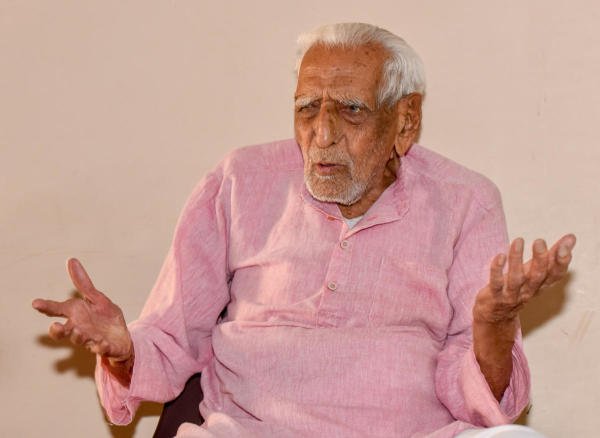
PM Modi didn’t mention former RSS chief Golwalkar on his recent 114th birth anniversary. The idea is to implement his ‘essence’ in private while not mentioning him in public.

Why Modi and Sangh Parivar Want

The 114th birth anniversary of Madhav Sadashiv Golwalkar went unnoticed. Barring a stray article by a second-rung leader of the saffron party in a national daily, none from the top hierarchy deemed it even necessary to remember the second chief of the Rashtriya Swayamsevak Sangh (RSS) who followed the organisation’s founder, KB Hedgewar.

Interestingly, while Twitter-savvy Prime Minister Narendra Modi found time to tweet about his litti chokha conquest at Hunar Haat in Delhi, there was not a single line about Golwalkar on his timeline that day. It appeared a bit strange because in his book titled ‘Jyotipunj’ on the “greatest social workers” who “burnt their lives to glow the Motherland”, Modi had devoted forty pages to Golwalkar. “The life of Golwalkar Guruji is a fine example of dedication. Guruji, possessed all those qualities which are expected of an individual who lives for his goal—patience, determination, perseverance,” he wrote.

Was Modi’s or his senior colleagues’ silence inadvertent, or deliberate?

( Read the full article here : https://www.newsclick.in/Modi-Sangh-Parivar-Want-Disremember-Golwalkar)


Apropos AAP Victory in Delhi: Satish Deshpande Responds

Guest post by SATISH DESHPANDE

[This post responds to the piece by Aditya Nigam on Kafila last week, which was partially in response to pieces by Satish Deshpande and Apoorvanand.]

Thanks for your response, which (despite its tone 😊) helps to underline the seriousness of our broader predicament today.

I readily concede that my article was not sufficiently respectful of AAP’s major achievement in winning a second landslide against heavy odds.  But I do not think – as you seem to do – that this lack of respect (even if it was ungenerous) was without any justification whatsoever.

The article expresses my frustration at the fact (yes, this is a fact and not just my opinion) that the most effective and astute non-BJP political party around today chose not to use even a small fraction of its proven on-the-ground capabilities to counter the poison being spewed daily.  I have no prescription to offer AAP, and I don’t know why you think I do – where have I said that or even implied it?  Though I had no specific acts in mind (such as AK visiting Shaheen Bagh, etc.) I did expect AAP to do something (in its own unique way) to take back at least an inch or two of the political ground that is being ceded every day.

Continue reading Apropos AAP Victory in Delhi: Satish Deshpande Responds

Towards BJP’s Hindutva Lite Template

BJP’s Delhi campaign was not divisive by sanyog or coincidence. That is its prayog or experiment. Which it will take to other elections.

BJP’s Delhi campaign was not divisive by sanyog

Kitney aadmi thhe—how many were there?

A meme based on this famous monologue from the highly successful film, Sholay (Embers), from the early seventies, started trending when “David” Kejriwal, leader of the Aam Aadmi Party (AAP), defeated “Goliath” Bharatiya Janata Party (BJP) in Delhi’s recent Assembly elections.

No doubt this election’s result has put paid to the efforts of Home Minister Amit Shah to retain his image as “Chanakya” of Indian politics, at least for now. The result is despite BJP’s desperate attempts to win Delhi, as part of which pulled chief ministers, former chief ministers, cabinet ministers and more than 240 Members of Parliament to campaign in the city. Blame it on the high stakes battle that allegations surfaced that they had distributed cash and liquor ahead of the polls.

The result is for everyone to see.

The most toxic electoral campaign, perhaps ever, in which leaders of the ruling dispensation even provoked violence through their hate speeches, did not work. The BJP’s seat tally rose by merely five and a bloody nose.

( Read the full article here : https://www.newsclick.in/Towards-BJP-Hindutva-Lite-Template)

Winning Delhi Elections – AAP, Gandhi and the Ideology Wars

What has Gandhi got to do with the recently concluded elections in Delhi? On the face of it nothing. But at another level, the election process, its campaign and its results – all invite us to revisit Gandhi’s stupendous moral-political project of cementing the Hindu-Muslim division with his own blood and his heroic failure. He could not prevent the Partition and ultimately fell to the bullets of a fanatic Hindu nationalist of the kind who are in power today.

I remember Gandhi today because gung-ho secularists (the political community that I inhabit, if very uncomfortably) are once again at their favourite occupation of daring Arvind Kejriwal and AAP to ‘prove’ their ‘anti-communal stance’ and all that it can mean today – as though they alone have the talisman to fight communalism. I am reminded of Gandhi because his was by far the most audacious  attempt to fight the communal menace but he too failed. He had no ready-made answers to it but had perhaps the best sense of what moved the masses of this country.

Secular warriors have been basically daring Kejriwal and AAP to do and say things that he had been avoiding doing or saying all these days. Just two instances – of the quotes below from two dear friends – should suffice to indicate what I mean.  The first is from Apoorvanand, writing in the Business Standard,

‘Voters in Delhi were confident that the AAP victory in the assembly elections wouldn’t so much as serve as an irritant to the BJP, let alone rock its boat, as the saffron outfit was firmly and safely ensconced in power. An efficient delivery boy is all the electorate wanted. In the Delhi voters mindset, an ideology-agnostic party that does not impede the BJP’s nationalist drive is tolerable.’

Continue reading Winning Delhi Elections – AAP, Gandhi and the Ideology Wars

Why Pakistan’s Islamists Don’t Want India’s CAA Repealed

Of all reasons to oppose CAA, NPR and NRC, most worrying is the Islamists across the borders feeling enthused.

Anti CAA Protest in India

Seattle City Council, one of the most powerful city councils in the United States, recently made history. It became the world’s first elected body to pass a resolution asking the Indian government to repeal the CAA, stop the National Register of Citizens and uphold the Indian Constitution. It also sought ratification of United Nations treaties on refugees. The said resolution is being seen to be “leading the moral consensus in the global outcry against the CAA”.

Seattle is definitely not an exception.

Many concerned voices have spoken against the highly controversial discriminatory Citizenship Amendment Act (CAA) 2019, which excludes Muslims [and Jews] and enforces a selective citizenship criteria based on faith. This new law effectively reduces the status of millions of Muslims in India to illegal migrants. A similar resolution was tabled by members of the European Union Parliament last month. It stands postponed right now, but that will be a short reprieve, for the members have resolved to take it up again shortly.

For the first time in independent India’s history the Indian diaspora—which is normally projected as pro-Prime Minister Narendra Modi and which does participate in rallies in his support—has been protesting against the bill along with Indian students studying in the West. These protests have been going on for close to two months in different cities and towns in different cities in the West.

Couple this development with the resistance within the country spreading to new areas and broadening to include more sections of society, as people gradually wake up to the CAA’s grim portents. Definitely, there is growing discomfort against the Modi-Shah regime. Perhaps it is a sign of desperation that in order to legitimise this law the government has been peddling half-truths even in Parliament. Prime Minister Modi quoted selectively from the Nehru-Liaquat pact to buttress his case. He used the same Nehru-Bordoloi letter to defend the CAA, which his party had earlier used to slam the Congress. Gopinath Bordoloi was the first Chief Minister of Assam after Independence.

( Read the full text here : https://www.newsclick.in/why-pakistans-islamists-dont-want-indias-caa-repealed)

Delhi Elections and the Difficult Terrain of Antifascist Struggle


Three incidents of firing in four days – two in Jamia Millia Islamia and one in Shaheen Bagh – quickly followed open calls to violence (‘goli maro saalon ko‘) by Union minister of State for Finance Anurag Thakur and the demonization of Shaheen Bagh protesters by BJP MP Pravesh Verma (‘the protesters will enter your homes and rape and kill your daughters’ if Modi and Shah aren’t there). In the case of the Shaheen Bagh shooter, Kapil Gujjar, the Delhi Police (which has till date not managed to find out the JNU attacker Komal Sharma’s affiliation) was quick to link him to the Aam Aadmi Party (AAP) – an allegation expressly denied by his father. All these episodes, so obviously set up, basically aimed at provoking the protesters into committing some violence that the lapdog television channels would then play up, in their usual hysterical style (some of them may even have appeared on air in police uniform!), to vitiate the atmosphere.

On the very first shooting, one such channel did indeed keep doing precisely that till long after the identity of the shooter (in the clip above) had been clearly established. The clips were circulating almost instantaneously and you can hear the gunman shouting Delhi Police zindabad, and there was little chance of mistaking him for an anti-CAA protester. The channel knew exactly what it was doing and at whose behest but kept on at it till 9 o’clock at night.

Continue reading Delhi Elections and the Difficult Terrain of Antifascist Struggle

Gandhi and the Hindutva Right

From Nehru to Patel and Ambedkar, the saffron party has appropriated freedom-fighters or tarnished legacies. Gandhi, however, poses a different problem.

Why BJP’s Subjugation of Gandhi

Death ends all enmity’ (Marnanti Vairani) goes a maxim in Hinduism.

The story also goes that when Ravana was on death bed, Ram had even asked Laxman to go to him and learn something which no other person except a great scholar like him could teach him, declaring that though he has been forced to punish him for his terrible crime, ‘you are no more my enemy’.

It is a different matter that Hindutva supremacists — who are keen ‘to transform Hinduism from a variety of religious practices into a consolidated ethnic identity’ — are believers in the exact opposite.

For them, once the enemy is dead, the enmity flares up without any limits. They have no qualms that their adversary is no more to defend himself/ herself.

It has been more than five and half years that they are in power at the Centre and we have been witness to complete vilification, demonisation and obfuscation of many of their adversaries, all great leaders of the anti-colonial struggle. Of course, few were found to be ‘lucky’ enough that were promptly co-opted/appropriated by them, of course, in a sanitised form.

( Read the full article here : https://www.newsclick.in/BJP-Subjugation-Gandhi-Legacy-Roadblock-Shaheen-Bagh

संशोधित नागरिकता-कानून, जनसँख्या-रजिस्टर एवं नागरिकता-रजिस्टर – एक तथ्यात्मक ब्यौरा : सप्तरंग व नागरिक एकता एवं सद्भाव समिति

[संशोधित नागरिकता-कानून, जनसँख्या-रजिस्टर  (एन पी आर ) एवं नागरिकता-रजिस्टर (एन आर सी ) पर  निन्मलिखित परचा रोहतक ज़िले के दो संगठनों  – सप्तरंग  व नागरिक एकता व  सद्भाव समिति ने शाया किया है. जनहित में इस सामग्री का किसी भी रूप में प्रयोग किया जा सकता है। ये सारी जानकारी सार्वजनिक तौर पर उपलब्ध सरकारी या भरोसेमंद प्रकाशनों से ली गई है न कि अपुष्ट स्रोतों से। ]

भाग 1            

आसाम समझौता, नागरिकता-कानून में संशोधन एवं आसाम का नागरिकता-रजिस्टर

  1. नागरिकता कानून में संशोधन एवं नागरिकता रजिस्टर का विरोध एक कारण से नहीं हो रहा। यह दो कारणों से हो रहा है – उत्तर-पूर्व में अलग  कारण से और शेष देश में अलग कारणों से । दोनों तरह की आलोचनाओं का समाधान ज़रूरी है।
  2. उत्तर-पूर्व के राज्यों में इस का विरोध इसलिए हो रहा है कि इस के चलते अवैध रूप से देश में 2014 तक दाखिल हुए लोगों को भी नागरिकता मिल जायेगी जब कि 1985 में भारत सरकार के साथ हुए आसाम समझौते के तहत केवल 1965 तक आसाम में आए हुए अवैध प्रवासियों को ही नागरिकता मिलनी थी। (मोदी सरकार द्वारा पिछले कार्यकाल में प्रस्तावित नागरिकता संशोधन कानून का उत्तर-पूर्व राज्यों में भयंकर विरोध हुआ था। इस सशक्त विरोध के चलते मोदी सरकार ने 2019 में पारित कानून के दायरे से उत्तर-पूर्व के कुछ इलाकों को बाहर रखा है पर इस से भी उत्तर-पूर्व के स्थानीय संगठन/लोग संतुष्ट नहीं हैं। वे इसे वायदा-खिलाफ़ी के रूप में देखते हैं।)
  3. आसाम (और तब के आसाम में लगभग पूरा उत्तर-पूर्व भारत आ जाता था) में अवैध प्रवासियों की समस्या बहुत पुरानी है। इस के नियंत्रण के लिए पहला कानून 1950 में ही बन गया था। इस का कारण यह है कि भारत-बंगलादेश सीमा हरियाणा-पंजाब सीमा जैसी ही है। कहीं-कहीं तो आगे का दरवाज़ा भारत में तो पिछला बंगलादेश में खुलता है। भारत के नक़्शे के अन्दर कुछ इलाके बंगलादेश के थे तो बंगलादेश के नक़्शे के अन्दर स्थित कुछ ज़मीन भारत की थी। (इन इलाकों का हाल में ही निपटारा हुआ है।) बोली, भाषा, पहनावा एक जैसा होने के चलते कलकत्ता में पहले-दिन-पहला-फ़िल्म शो देखने के लिए बंगलादेश से आना मुश्किल नहीं था। ऐसे अजीबो-गरीब तरीके से हुआ था देश का बंटवारा।

Continue reading संशोधित नागरिकता-कानून, जनसँख्या-रजिस्टर एवं नागरिकता-रजिस्टर – एक तथ्यात्मक ब्यौरा : सप्तरंग व नागरिक एकता एवं सद्भाव समिति

The Constitution as the ‘Social Contract’ of Modern India


The  Constitution of India should be seen as a work-in-progress – not because it has been amended ever so often by different governments but because it has been taken over by ‘we, the people’, repeatedly, especially since the 1990s. The ‘authorized’ interpreters of the Constitution and Law are no longer its sole interpreters. The continuous battles over its interpretation in the courts of law are only one way in which meaning is contested. But from the dalits reclaiming it as “Babasaheb’s Constitution” to the pathalgadi movement  of the Jharkhand adivasis and finally as the banner of citizenship movement today, its meaning has been contested time and again in the streets and in villages.

It is customary, in most secular-nationalist and left-wing circles, to invoke the “great values of the national movement”, which is seen as synonymous with the “freedom struggle”, which in turn is reduced to the “anticolonial struggle”. On 15 August 1947, India attained Independence from colonial rule and on 26 January 1950, “we, the people of India” gave to ourselves the Constitution of India. The anticolonial struggle came to an end in August 1947 but that did not mean that all the currents that  comprised the larger “freedom struggle” – the jang-e-azadi – got their freedom. We perhaps need to make a distinction today between the “freedom struggle” (that is still ongoing) and the “anticolonial nationalist” movement.

We need to state emphatically that the “freedom struggle” of different social groups is not – and never was – reducible to the “anticolonial struggle”. There were many different strands and currents that  either functioned at a distance from mainstream nationalism , or even worked in opposition to it.

Continue reading The Constitution as the ‘Social Contract’ of Modern India

How Hindutva Terror Outfits Hide in Plain Sight

The arrest of yet another alleged bomb-maker with right-wing links should lead to action at last.

The arrest of yet another alleged bomb

When Crimes shoot up, they become invisible.

When pain becomes unbearable, cries are no longer heard.’

—Bertolt Brecht

Can the provocations of a cabinet minister, who openly raises controversial slogans, be considered a “breach of peace” or are they merely attempts to “gauge people’s mood”, as the minister would have us believe? For more than a month, plenty of controversial slogans have been raised on the streets of India. People are being instigated to “kill the traitors to the country” by members of the ruling dispensation, who are issuing open threats in public as the masses are getting angrier against the CAA, NRC and the NPR.

As expected, till date, either no action has been taken by the law and order machinery or there is only an expectation of perfunctory action. This new normal is symptomatic of the rapid erosion of the rule of law in the country. A new normal wherein the chief minister of a state has no qualms in talking of taking “revenge” against protesters while his state’s police unleash unjustified violence on protesters and bystanders alike. Each of their tactics has, for this reason, received widespread condemnation. Even though the strong-arm tactics of the state are failing to pass the test of logic or reasonableness, there is still no change in the ruling dispensation’s attitude.

( Read the full article here : https://www.newsclick.in/Hindutva-Terror-Outfits-Hide-Plain-Sight)

The Ongoing Movement Against CAA and the ‘Political’ Question


The question that is uppermost on most people’s minds today is what will happen to the Citizenship Amendment Act (CAA) and how long will the protests continue? The home minister Amit Shah declaring that the Act will not be withdrawn and the government will not move an inch, regardless of the  protests, is a direct challenge to the people of India. With  the Supreme Court looking the other way, taking up challenge thrown by Shah can only mean one thing now: if the Act does not go, the regime must. Mass movements have been known to  bring down oppressive regimes, and even in the recent past, we have seen that happen in different parts of the world.

Subsequent developments, however, also indicate that often forces emerge that basically take advantage of the mass movements to hijack them and install equally unpopular regimes – a matter we need to discuss very seriously. I will briefly return to this ‘political question’ later as it is of utmost importance that we grasp the possibilities and dangers inherent in the present moment.

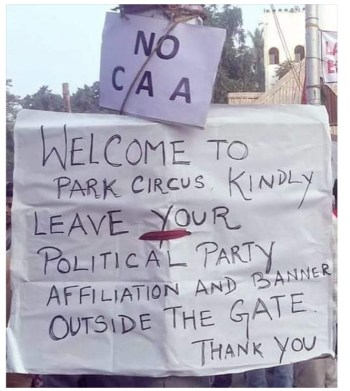
Notice outside the Park Circus protest venue

Continue reading The Ongoing Movement Against CAA and the ‘Political’ Question

Hindutva: Get Egg on Your Face and Say ‘I am Loving it’

Hindutva is being embarrassed by the very people it has wooed, by means fair and foul.

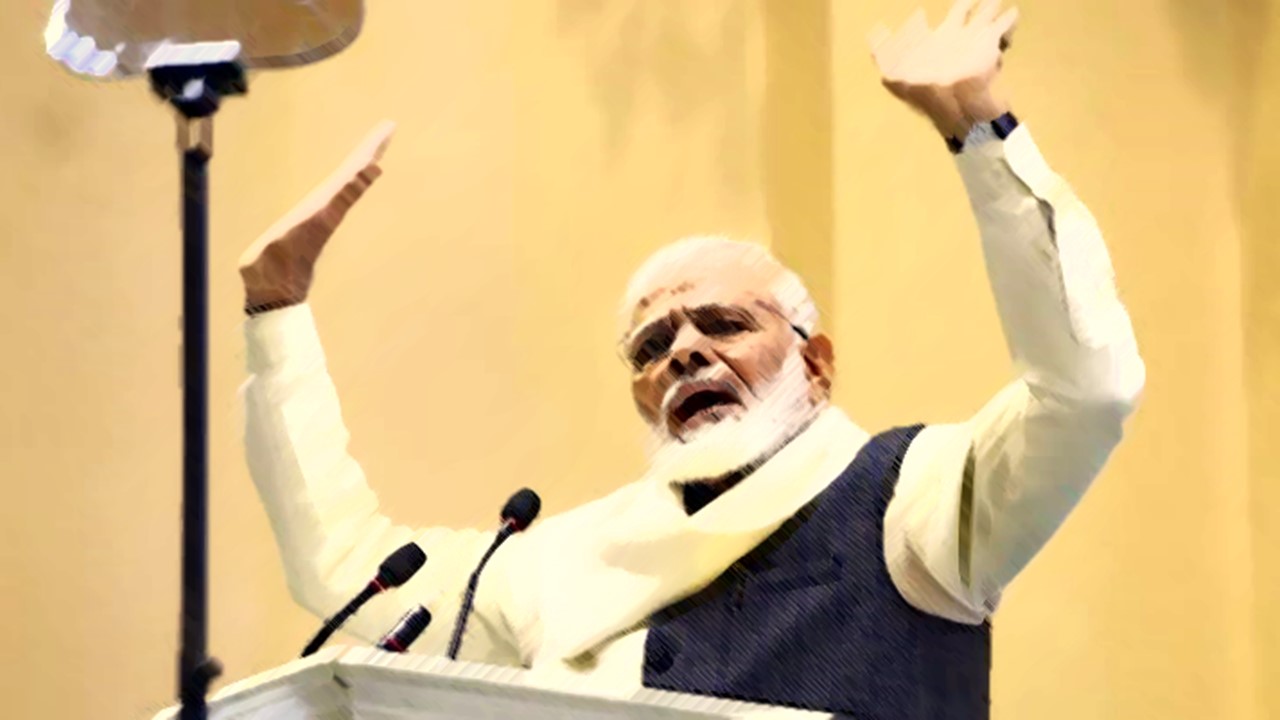
Narendra Modi

Prime Minister Narendra Modi’s attempt to further his deeply-sectarian and divisive agenda at Belur Math, global headquarters of the Ramakrishna Mission founded by Swami Vivekananda, has backfired. His controversial defence of the Citizenship Amendment Act (CAA) 2019 at the historic math in which he invoked Vivekananda himself has enraged a broad spectrum of people and formations. The CAA is, of course, the most contentious piece of legislation independent India has ever had, and it has sparked protests across the country.

What is rather noticeable is that not only the Opposition parties, but monks associated with the mission have also expressed tremendous displeasure over the political content of the PM’s speech. They have said that they found it “deeply hurtful” and they criticised it for tarnishing the “sanctity of the place”.

The very fact that Swami Suvirananda, general secretary of the Ramakrishna Math and Ramakrishna Mission, was constrained to say that “we could not have whispered into the Prime Minister’s ears to stop midway…” or his emphasising the inclusive nature of the “only organisation in the world, only order in the world” which has “monks from Hindu, Islam and Christian communities. We live like brothers of the same parents…” says something.

Nobody put it in as many words, but what perturbed people was how Narendra Modi’s speech complete erased Swami Vivekananda’s legacy. A great rift was evident between what Vivekananda had said in his historic speech at Chicago in 1892 and Modi’s espousal of a law passed by the government he heads, which creates a basis to discriminate on the basis of religion. Here is what Vivekananda had espoused before the world: “I am proud to belong to a nation which has sheltered the persecuted and refugees of all religions and all nations of the earth….”

Well, as far as close watchers of the Hindutva Right are concerned, they would underline that there was nothing unusual in Modi’s rather desperate attempts to appropriate Vivekananda and to recast him in the Hindutva mould.

( Read the full article here : https://www.newsclick.in/Hindutva-BJP-Narendra-Modi-Government-CAA-NRC-Belur-Math-Ramakrishna-Mission)

A Moment of Unprecedented Possibilities


Beginning this week, we are starting a column which will appear every Thursday. The name of this column, ‘Parapolitics’, is meant to indicate something that happens all the time, outside the formally designated sphere of politics, or what is sometimes called ‘the political’ by political theorists. As a matter of fact, most of such politics – parapolitics – takes place everyday and is deeply tied to our everyday lives. It is also what we may call ‘existential politics’:  the dalit boys flogged by upper caste men inside a police station in Una, the woman of Unnao, whose family is decimated by the rapist’s henchmen, the mob-lynching to which Muslims are subjected on a daily basis, the farmer or the unemployed who commits suicide, the displaced adivasis or the workers who fight back – all these are instances of things deeply political but occurring away from or beneath the ‘proper’ domain of politics. The ‘proper domain of politics’ – that of state/government, parties, elections, alliances and so on – has repeatedly historically revealed its fundamental disconnect with such existential politics. Indeed, whenever faced by mass protests, the first response by the political class is to reduce it to the purported machinations of ‘opposition parties’. It cannot think of people, ordinary people, coming out in autonomous action. We might recall the response of the UPA government, at the height of the anti-corruption movement, challenging the locus standi of the protesters with the questions: ‘who are you?’ or ‘who has authorized you?’ etc Parapolitics is that unauthorized politics of everyday life, which often bursts out into the open but may also simply go on under the surface without any necessary public manifestation.

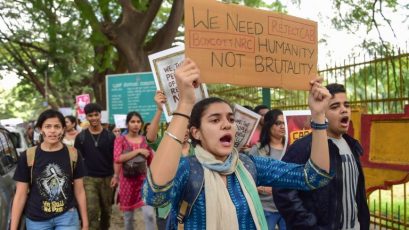
Students protest in Bengaluru, photo courtesy PTI

The most striking aspect of the present upsurge of popular anger around the Citizenship Amendment Act (CAA), as has been widely noticed, is the way defiant young women have become the face of the struggle. I am not referring here only to the women whose iconic images are circulating everywhere today, but also to the sheer number in which they have come out and the power with which they have been speaking their mind before the media. And they belong to all communities.

Continue reading A Moment of Unprecedented Possibilities

Muslims held hostage by a criminal state apparatus in UP – a report on Sambhal

Sustained reportage by dogged and principled journalists and investigation by citizens’ groups have gradually begun to illuminate the terrible darkness around anti CAA protests in UP over December 2019. Every single one of these has exploded the narrative fostered by the UP government, police and compliant local media, of violent mobs destroying public property and attacking police.

We have all noted that massive marches against the CAA have taken place all over the country, but have “turned violent” only in BJP ruled states. The various reports that are now emerging, reveal the extent to which the UP police either acted as a violent mob itself, or used police informers or local RSS organizations to start stone pelting and other such acts to disrupt non-violent marches, and to provide an excuse for violent police action.

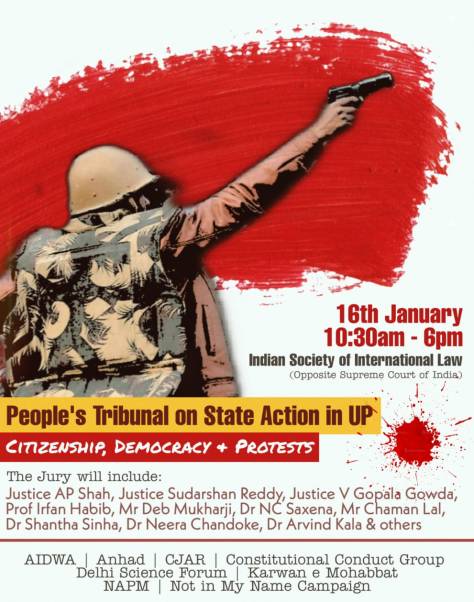
A public hearing on state action in UP will be held in Delhi on January 16th, 2020, bringing together all the information collected by different groups of people who have visited different parts of the state.

Here we present the report on Sambhal.

SAMBHAL

A team went to Sambhal from Karwan-e-Mohabbat on 2 January, 2020, consisting of Ayesha Kidwai, Farida Khan, Navsharan Singh, Nivedita Menon, Sandeep Yadav, Sumit Gupta, Tanika Sarkar and Varna Balakrishnan. Continue reading Muslims held hostage by a criminal state apparatus in UP – a report on Sambhal

Hope, solidarity and struggle in JNU: Women of Sabarmati

WOMEN OF SABARMATI WRITE:

The outpouring of solidarity and generosity on the JNU campus, since the attack of 5th January 2020 has been overwhelming.

Hostels have organised guerilla dhabas at Sabarmati. They have sung revolutionary songs while making pans of maggi and distributing jhal muri and peanuts.

Men from the hostel that distributed peanuts, worried about the mess of the peanut shells at our hostel entrance, even offered to sweep up the place, brooms at the ready.

Three women in the women’s wing in Sabarmati threw all the women in the hostel a party two nights ago.

During and after the events of the 5th, neighbours have become friends.

Our teachers have been coming to meet us every day. Some have brought bags full of snacks. Some have organised trauma sessions for us. Some have just held us.

And tonight Brahmaputra hostel organised a Sadbhavna mela for the campus. Free snack stalls all around, dholak music to dance to and a large Lohri bonfire.

As some of us women from Sabarmati were walking back towards Ganga dhaba tonight, discussing how this is the first time our hostel has no Lohri celebrations, the men from Kaveri stopped us to offer popcorn from their Lohri celebrations.

JNU was home, is home, and will remain home.

Wall of resistance at Brahmaputra

The Yogi and the Erotics of Violence: Jaya Sharma

Guest Post by JAYA SHARMA

This article that explores the enjoyment of violence, epsecially in the social media world, in the wake of the brutal violence perpetrated by the Yogi Adityanath regime in Uttar Pradesh. It should be read as a sequel to Jaya Sharma’s earlier article published in Kafila in June last year.

‘Maza aa gaya Yogiji mazaLathi aisi lagi ki maza aa gaya…’

Maza is a word used often in tweets in response to police attacks on CAA-NRC protestors in UP.  Unlike it’s staid, sanskritized counterpart anand, maza has a charge, a buzz and could translate into English as ‘thrill’.  ‘Thrilling Yogiji thrilling’… ‘The way the lathi struck…thrilling’.  I’ll return to such tweets to explore the following questions.

Might it be that there is an erotic charge to political violence?  Might it be that the erotic charge is not limited to those who perform the violence but also animates the millions who hear, see or read that such violence has been meted out?  Well beyond “not caring”, might it be that they “get off” on such violence?  Can the proactive, enthusiastic support for political violence be understood only in terms of “ordinary folk” being corrupted by evil leaders? Might we also need to see what within the collective psyche could be pushing them towards a terrible kind of enjoyment of such violence? Continue reading The Yogi and the Erotics of Violence: Jaya Sharma

Nationwide NRC -The Devil at the Heart of India’s Draconian Digitalization: CP Geevan

GUEST POST BY C. P.  GEEVAN

NPR and NRC – An Enigmatic Clarification

It was difficult to miss the smugness with which the Home Minister of India (HM) addressed a TV show he had orchestrated through one of the infamous godi (lapdog) media after the central cabinet had approved Rs 39.41 billion for updating the National Population Register (NPR) and Rs 85 billion for Census 2021 operations.The show was meant to dispel the misgivings about the link between NPR and the nationwide NRC—National Register of Indian Citizens (NRIC). In meetings across the country and within the Parliament, the HM had been proclaiming or rather threatening to carry out NRIC. However, his enigmatic statements did nothing to allay the grave fears people across India have about NPR, given the government’s obsession and resolve to identify what they call illegal residents. There is no doubt that instead of pressing concerns such as unemployment, alarming fall in per capita consumption and an extraordinary economic slump, of late the single-minded focus of the regime is on dividing the Indian people into different categories, branding, imprisoning and even throwing some out of India. Continue reading Nationwide NRC -The Devil at the Heart of India’s Draconian Digitalization: CP Geevan

Citizens Ask States to Boycott Republic Day Parade

With the central government denying three states’ – Bengal, Kerala and Maharashtra – tableaux proposals for Republic Day, politics has reached a new low.  There is no doubt that the current struggles against the CAA/NRC and the confrontational stance of the Centre with these governments has a lot to do with this denial. The following is a petition that was started by Not  in My Name Bangalore but it is a broad appeal to all chief ministers, minister and legislators, to boycott this farcical celebration of the Republic while destroying its very spirit.

You can sign the petition here

Dear Chief Ministers, Ministers and Legislators,

We, citizens of India, have watched with horror and no little terror the political developments since 2014, and especially since the elections of 2019. There has been a steady attack on, and erosion of, our constitutional rights in this time.

The Citizenship Amendment Act (CAA), in conjunction with the National Register of Citizens (NRC) and its precursor, the National Population Register (NPR), is a big blow to the Constitution of India. It is as disastrous and it is unconstitutional, and officially rings in the establishment of a Hindu Rashtra.

There has been staunch resistance to the CAA, most powerfully from student communities across the country. We wholeheartedly support them, in our words and on the streets. What was equally heartening was the pushback from the political establishment in a number of states – in varying degrees, it is true, but still truly a cause for hope. Continue reading Citizens Ask States to Boycott Republic Day Parade

Demonstration in Munich in Solidarity with anti CAA/NRC Struggles: Indians Against Fascism Munich

Guest post by Indians Against Fascism Munich

On Saturday (21st Dec), a crowd of around one hundred Indians residing in Munich and surrounding assembled at Geschwister Scholl Platz, a square in front of the Ludwig Maximilian University of Munich to protest against the Citizenship Amendment Act (CAA) and the National Register for Citizens (NRC). This place was chosen for its historical significance as it was from here that the White Rose resistance movement against the Nazi regime had started.

Continue reading Demonstration in Munich in Solidarity with anti CAA/NRC Struggles: Indians Against Fascism Munich

It’s We the People, not we the Citizens, of India!

Image courtesy News 18

People, Persons, Citizens

When the idea of citizenship is wielded like a deadly weapon to deprive people of basic rights rather than to empower them, it’s time to think about the basis of rights differently.  While in the Preamble to the Constitution, ‘we the people’ resolve to secure to all its ‘citizens’ justice, liberty, equality and fraternity; Article 14 of the Fundamental Rights ensures equality before the law to all “persons”, not only to citizens.

The people of a land precede the creation of “citizens”, and we the people of India must think seriously at this moment in our history, about how justice is to be secured to all persons, and whether citizenship is an emancipatory idea any longer.

Consider the revealing and tragic irony of one of the accused arrested for his alleged role in violence during protests against the Citizenship Amendment Act 2019 (CAA) , in East Delhi’s Seemapuri. Through his counsel, in a Delhi court, he claimed to be a juvenile, and to prove this, produced certificates from the madarsa at which he studies.

Delhi Police, however, claimed that these documents were insufficient to establish his age, and requested permission for a bone ossification test. The counsel of the accused argued that according to central government notifications, madarsa certificates are sufficient to prove age, but the Delhi court permitted police to carry out the ossification test.

Imagine the claim of such a person to  citizenship and to inclusion in the National Register of Citizens (NRC)! Continue reading It’s We the People, not we the Citizens, of India!

Concerned Delhi University Teachers In Solidarity with the Universities’ Struggles Against CAA/NRC

Teachers from different colleges and departments of the University of Delhi have expressed shock at the police repression on the struggles of the academic community across different universities in India and issued the following statement in support of the students.
We, concerned teachers of Delhi University, extend solidarity to the struggling academic communities of Jamia Millia Islamia (JMI), Aligarh Muslim University (AMU), Jawaharlal Nehru University (JNU), Delhi University (DU), and other central and regional universities that have borne the brunt of police excesses these past few days. We also express condemnation of the authoritarian and undemocratic manner in which the current dispensation is using all kinds of power to crush the basic rights of people to peacefully protest and question unjust laws. The closing off of metro stations, arterial roads, blocking of mobile networks, en masse detention of citizens who are peacefully gathering to protest, growing number of FIRs, 5000 plus preventive detentions, consistent heckling of protesters, including attack on public property during police raids, etc. are shocking and reflect blatant misuse of state power. The shameful act of interrupting media interactions / press briefings of vocal scholars/academicians through coercive police action is nothing short of sinister. The 25 plus and rising death toll of protesters, as well as the reports of police raids of Muslim localities, households and institutions is highly condemnable.

Continue reading Concerned Delhi University Teachers In Solidarity with the Universities’ Struggles Against CAA/NRC