Category Archives: Right watch

The Philadelphia Coalition Against Fascism in India Protest Against CAA and NRC


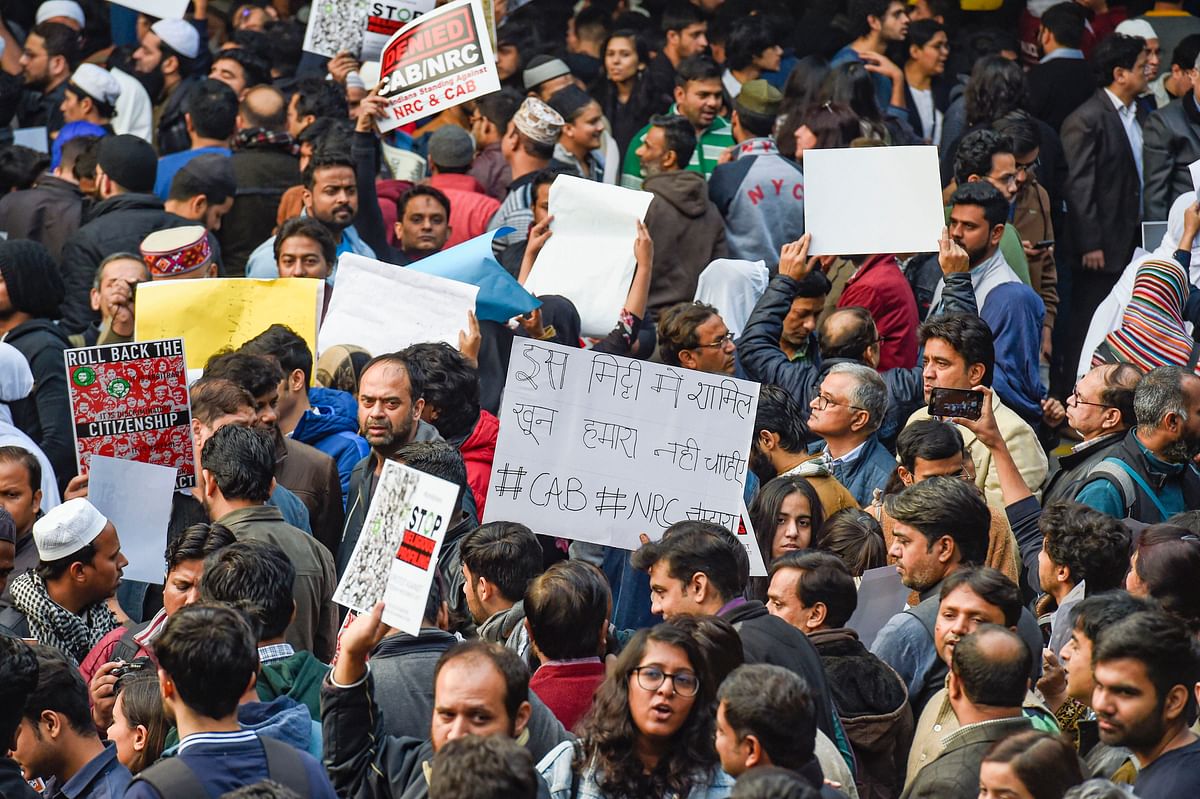
The Philadelphia Coalition Against Fascism in India held a protest
Against CAA and NRC on December 19, 2019. 

Students from several colleges in the Philadelphia area and beyond, including UPenn, Drexel, Temple, Villanova, and Rutgers; working professionals, and business graduates gathered in solidarity with student protests in India and against the imposition of the CAA and the NRC.

We read the preamble to the Indian constitution together and also took a pledge vowing to reject the CAA, the NRC, and the project of the RSS and BJP that seeks to turn India into a Hindu Rashtra.

Nearly 150 Philadelphians have signed this petition which affirms that

We will never accept these unconstitutional and unconscionable moves, and today join Indians from all over the country, and from every religion, caste, and region, to stand against any and all assaults on the idea of India as a secular, democratic republic.” It also points out that “there are many of Indian origin and heritage in the U.S. who are both concerned about events in India and condemn them. We have a responsibility to speak up in support of those resisting on the ground. … Those of us who live in Philadelphia, and believe in building a more free and just world, cannot stand by as fascist forces execute their programs of violence and exclusion. We stand proudly with the people of India against these excesses.

Two international statements in solidarity with anti CAA protests in India

  1. From UMASS and Five Colleges

We, the undersigned members and alumni of the University of Massachusetts, Amherst and the Five College Area write in solidarity and support of the protests in India and elsewhere against the Citizenship Amendment Act 2019, and express our complete rejection of this act.

We are deeply concerned about the violence against students in India’s universities, particularly at Jamia Milia Islamia, Delhi and at Aligarh Muslim University. The crackdown on universities has produced shocking images of violence, including tear-gassing hostel rooms and libraries, brutal and illegal violence in police detention, communally charged comments against students, and assault on female protestors. We condemn both the illegal crackdown on dissent, and the particularly communal and gendered nature of this crackdown, unequivocally support and admire the protesters who continue to take to the streets.

We are also extremely dismayed by the ongoing repression in the states of North-East India and Kashmir, and call on the Indian state to cease its internet shut-down. While this internet shut down has made communications and precise reports of the situation on the ground difficult, the news that has filtered through, regarding repression of protests in Tripura, Manipur, Assam, Meghalaya and Arunachal Pradesh is extremely troubling. In this light, we also express our serious concern over the recent detainment and torture of Assam activist Akhil Gogoi, a sustained and vocal critic of the Citizenship Amendment Bill/Act, under the UAPA and NIA acts.   

Read the full statement here.  

2. From students, faculty and alumni of Syracuse University, Hamilton College, Colgate University, SUNY College of Environmental Science & Forestry and Ithaca College, and the broader Central New York community.

As members of the Central New York community concerned about the brutal police violence against students at Jamia Milia Islamia and Aligarh Muslim University, two public universities with a predominantly Muslim minority student body, we join millions of students in at least 15 cities across India to express our solidarity with students protesting the Bharatiya Janata party’s
anti-Muslim Citizenship Amendment Act (CAA) 2019.

#SOSJamiaAMU and #RejectCAA represent the grassroots student movement protesting the CAA, recently passed by the upper and lower houses of the Indian parliament. The CAA grants
Indian citizenship to non-Muslim persecuted minorities seeking refuge in India from selected neighboring countries. This combined with the National Register of Citizens of India (NRC),
which is aimed at the disenfranchisement and detention of undocumented immigrants, equips the Hindu nationalist government to institutionalize ethnic cleansing of Muslim minorities. This systematic targeted violence is carried alongside increasing instances of lynchings of Muslims and caste-oppressed people. Further, the seemingly spontaneous resistance to the CAA out of Aligarh Muslim University and Jamia Millia Islamia must be understood with respect to the history of these two universities as post-Partition Muslim-serving institutions.

Read the full statement here.

Law Teachers and Researchers Condemn Police Brutality, CAA and the NRC

Law teachers and researchers from across the world have strongly condemned the recent police brutality against students of different universities struggling the recent changes in Citizenship law. They have also criticized the CAA and the NRC ideas as majoritarian and one that subverts our Consttitutional vision. Their statement:

We, the undersigned teachers and researchers of law, strongly condemn the police brutality on the peaceful protest by the students at Jamia Milia Islamia, Aligarh Muslim University and other universities.

On 15 December 2019 police entered the Jamia Milia Islamia and Aligarh Muslim University, and assaulted and detained the students. Students were dragged out of campus, and were paraded outside with hands raised. We believe that the action of the police is an attempt to suppress dissent and is an attack on the autonomy of the universities. The police action violates, inter alia, the right to peaceful assembly and freedom of speech and expression guaranteed under the Constitution of India and international law instruments to which India is a state party. We emphasize that academic institutions are an arena of discussion, debate and dissent, and the peremptory and ultimate objective of universities is to speak truth to power. By using force against the students, the government has struck at the heart of the culture of protests.

Continue reading Law Teachers and Researchers Condemn Police Brutality, CAA and the NRC

Health Workers, Health Professionals, Women’s Rights Activists Condemn Use of Force by Police against Students of JMI, AMU

Concerned health activists and health professionals and women’s rights activists have issued the following statement against the brutal use of force by the police against students, especially in Jamia Millia Islamia and AMU.

We, the health networks, health activists, health professionals, Women’s Rights Activists and concerned activists strongly condemn this abhorrent act by the police force on the students of Jamia Milia Islamia University, Delhi and  Aligarh Muslim University, Uttar Pradesh on 15th – 16th December 2019.

Following the protests against the Citizenship Amendment Act (CAA), violence was unleashed and Jamia and AMU were particularly targeted. According to the reports from JamiaMiliaIslamia on Sunday, the police force entered the premises, targeted individuals indiscriminately, used tear-gas shells and lathi charge against the students, along with the forceful entry in their university premises.  Continue reading Health Workers, Health Professionals, Women’s Rights Activists Condemn Use of Force by Police against Students of JMI, AMU

Support for Anti CAA/NRC Struggle from University of South Florida

Following is a statement by the faculty, researchers and students of the University of Southern Florida, USA, in support of the struggle of students across universities against CAA and NRC.

We, the undersigned, faculty, postdoctoral fellows, students, and alumni of University of South Florida (USF), in strongest possible terms,condemn the Citizenship Amendment Act (CAA) and assault and police crackdown on anti-CAA protests across India. We staged a protest on USF’s Tampa campus on December 19, the day widespread protests were organized across India on this issue. Even though our protest is India-specific, this is about protecting democracy and minority rights.

The Indian government recently passed the CAA, which we believe, allows for the first time in secular India, a citizenship provision based on religion. When combined with National Register of Citizens (NRC), and National Population Register (NPR), the CAA can strip Indian Muslims of their rights and citizenship.The NRC and NPR also threaten transgender communities, dalits, the homeless, indigenous communities, and others who will not be able to provide necessary documents.We believe that the Indian government’s actions are unconstitutional and fundamentally violate the principles of equality and non-discrimination in a democracy. Continue reading Support for Anti CAA/NRC Struggle from University of South Florida

Support for Struggling Students from University of British Columbia

Statements of support for the students’ struggle against the  CAA and NRC continue to pour in. We will try and keep publishing as many as we can. In this post is a statement from the University of British Columbia, Canada. 

We, the students, faculty, alumni and scholars of the University of British Columbia, and the South Asian community in Vancouver, strongly condemn the police violence unleashed on students protesting against Citizenship Amendment Act and National Register of Citizens of India, across universities in India. Specifically, we condemn the police brutality on Muslim students of Jamia Millia Islamia and Aligarh Muslim University where the excessive violence of police machinery is reflective of the Islamophobia of the present government. We strongly oppose the recently passed Citizenship Amendment Act which inherently discriminates citizenship for Muslims on religious grounds. The Act provides citizenship to six religious minority communities from Pakistan, Bangladesh and Afghanistan while it explicitly leaves out Muslims. Citizenship Amendment Act (passed on December 11, 2019) along with National Register of Citizens of India and National Population Register will bring about systematic displacement and dispossession of two hundred million Muslims in India as their citizenship will be put to test and they can be easily rendered stateless. Continue reading Support for Struggling Students from University of British Columbia

South Asian University Statement in Solidarity with Students and Citizens Protesting CAA and NRC

The following is a statement issued by faculty members of South Asian University on the recent police excesses against peacefully protesting students and other citizens.

We, the undersigned teachers of the South Asian University, New Delhi are deeply disturbed by the developments at the Jamia Milia Islamia and Aligarh Muslim University in the last few days.

As it is well documented now through the media reports and eye witness accounts of students, on 15 December 2019 police entered the Jamia Milia Islamia and Aligarh Muslim University and assaulted and detained the students who were peacefully protesting against the Citizenship (Amendment) Act, 2019 (CAA) and National Register of Citizens (NRC). Continue reading South Asian University Statement in Solidarity with Students and Citizens Protesting CAA and NRC

Another International Statement Condemning State Violence Against Students of JMI and AMU

Support for the students of Jamia Millia Islamia and Aligarh Muslim University is continuously pouring in from different of the world as people watch the horrors perpetrated by the Indian police on unarmed, peacefully protesting students. The following is yet another of an international statements of support.

We, the undersigned, condemn the recent spate of state violence unleashed against students of Jamia Millia Islamia (JMI) and Aligarh Muslim University (AMU) by the ruling BJP government. We are students studying in various universities and educational institutions outside of India, and are extremely appalled to see the brazen attack on the democratic rights of students across universities in India. Students of JMI and AMU have been protesting against the discriminatory Citizenship (Amendment) Act, 2019 (CAA), which enforces a highly selective citizenship criteria based on faith that excludes Muslims and effectively reduces the status of millions of Muslims in India to ‘illegal migrants’. The police have shown zero restraint in their attempt to suppress the agitations and it is clear that the students are violently targeted because of their Muslim identity. Continue reading Another International Statement Condemning State Violence Against Students of JMI and AMU

University of Warwick In Solidarity With Students Protesting the CAA in India

Following is a statement issued by current and former faculty members and students of the University of Warwick in solidarity with the ongoing struggle of the students against the new citizenship law.

As students, alumni and faculty members of the University of Warwick, we stand in solidarity with all students in India who are engaged in protests against the discriminatory Citizenship (Amendment) Act, 2019. We believe that the right to dissent, protest and demonstrate are fundamental rights integral to all democracies. Articles 19 (1) (a) and 19 (1) (b) of the Indian Constitution explicitly state that the right to protest is a fundamental right. Such a right is safeguarded in international human rights conventions as well.

The peaceful and non-violent demonstrations by students have been met with extraordinary police violence, particularly in Jamia Millia Islamia and Aligarh Muslim University, with recent reports from established media sources indicating that police and paramilitary forces entered university campuses and hostels by force and brutally attacked students. As a consequence, hundreds of students have been injured, some very seriously. Such police action contravenes both the Constitution of India as well as international human rights laws. We call for an immediate end to state-led violence and for proper action to be taken against the perpetrators of it. Continue reading University of Warwick In Solidarity With Students Protesting the CAA in India

Statement in Solidarity with Students, Against Police Excesses from Alumni of National Law University, Jodhpur

The following is a statement from the alumni of NLU Jodhpur, in solidarity with the students at the receving end of police brutalities in Delhi, Aligarh, Assam and other universities.

We, the undersigned alumni of National Law University, Jodhpur unequivocally condemn the police excesses in response to student protests at Jamia Milia Islamia University, Delhi University, Aligarh Muslim University, Dibrugarh University, Gauhati University, Cotton University, Assam and other universities across India. As persons with training in constitutional laws and values, we recognize the significance of dissenting speech and assembly, and the need to preserve academic spaces as free from State coercion and militarization and to uphold the values of secularism.

Continue reading Statement in Solidarity with Students, Against Police Excesses from Alumni of National Law University, Jodhpur

10,000 Academics, Students, Teachers and Civil Society Against Police Brutality at Jamia Millia Islamia and Aligarh Muslim University

We, the undersigned, condemn in the strongest possible terms the police brutality in Jamia Millia Islamia University, New Delhi, and the ongoing illegal siege and curfew imposed on Aligarh Muslim University, Aligarh. On 15th December 2019 Delhi police in riot-gear illegally entered the Jamia Millia campus and attacked students who are peacefully protesting the Citizenship Amendment Act. The Act bars Muslims from India’s neighboring countries from the acquisition of Indian citizenship. It contravenes the right to equality and secular citizenship enshrined in the Indian constitution.

On the 15th at JMIU, police fired tear gas shells, entered hostels and attacked students studying in the library and praying in the mosque. Over 200 students have been severely injured, many who are in critical condition. Because of the blanket curfew and internet blockage imposed at AMU, we fear a similar situation of violence is unfolding, without any recourse to the press or public. The peaceful demonstration and gathering of citizens does not constitute criminal conduct. The police action in the Jamia Millia Islamia and AMU campuses is blatantly illegal under the constitution of India.

We stand in unconditional solidarity with the students, faculty and staff of Jamia Millia Islamia and Aligarh Muslim University, and express our horror at this violent police and state action. With them, we affirm the right of citizens to peaceful protest and the autonomy of the university as a non-militarized space for freedom of thought and expression. The brutalization of students and the attack on universities is against the fundamental norms of a democratic society.

As teachers, students, scholars and members of civil society across the world, we are watching with extreme concern the situation unfolding at Jamia Millia Islamia and Aligarh Muslim University. We refuse to remain silent at the violence unleashed on our colleagues (students, staff, and faculty) peacefully protesting the imposition of a discriminatory and unjust law.

This statement with a full list of signatories is available here: Jamia Millia and AMU solidarity statement.

CAA-NRC: Turning India Into a Warzone of ‘Peace’

Is the Indian state turning into a religious dystopia, like some of its neighbours?

CAA-NRC: Turning India Into a Warzone of ‘Peace’

Image Courtesy: Free Press Journal

The Bharatiya Janata Party-led central government has pushed the Citizenship Amendment Act through, but it is struggling to manage its fallout and the national outrage that a related proposal to create a National Register of Indian Citizens or NRIC has generated. At first, BJP leaders desperately assured those who were excluded in the NRC, or national register of citizens, that was finalised in October this year for the people of Assam. Its pleas were meant to reassure the Hindus who were excluded in the state’s citizen-count that it would hold a fresh all-India count of citizens, in which they will be included. The reason for the BJP’s desperation was the outcome of the Assam NRC, which turned out to be contrary to its expectations: out of 19 lakh found “illegal” in the state, only about 5 lakh are Muslim, almost all the rest are Hindu.

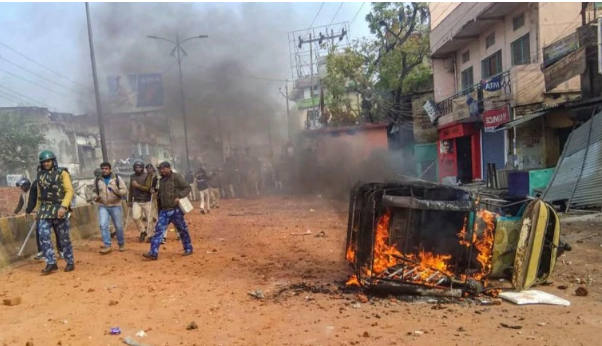
Yet, the fears of the citizenship law, combined with the resistance to an all-India NRC, have now given rise to tremendous mass resistance across India. There have been massive marches and rallies in many places, some of them culminating in aggressive confrontations with police and security forces. There is an ongoing massive crackdown on several universities, including in Lucknow, Aligarh, and Delhi where students were agitating against the new citizenship law and the all-India listing of citizens or NRIC.

( Read the full story here : https://www.newsclick.in/CAA-NRC-turning-india-earzone-peace)

Why the JNU #FeesMustFall is a Mass Intersectional Movement: Paresh Hate

Guest Post by PARESH HATE

It has been more than a month that students in JNU have been protesting against the new IHA Hostel Manual. The fight had initially begun against the exorbitant fee hikes, introduction of curfew timings and dress codes, lack of reservations and deprivation points in the manual, and the undemocratic manner in which the manual was passed. At this juncture, the movement has become broader, and articulates its resistance to the National Education Policy and its defence of the idea of public university and what it stands for.

While there have been many attempts to characterize the students’ movement as anti-national and free-loading as usual by the right-wing media, it is clear that the political articulation of students has managed to transcend these limited dimensions offered by the discourse set by the public perception. Even the propagandists are this time at a loss as to how to demonise the movement. All they have been able to come up with is that the protests ‘disrupted traffic’ and that the protests are ‘political’. One is unable to understand how the latter is a jibe, when protests are obviously always political in nature, especially this one. The demonization of JNU is not simply about the social sciences, or left-oriented student politics, but also a manufacturing of consent toward the commercialization and a legitimizing of this government’s agenda to destroy public avenues of welfare. However, due to the developments that have taken place in the last few weeks, politics itself of the campus is churning, wherein what is emerging is a cultivated intersectional discourse that has resulted in the breathing of new life into the campus. Continue reading Why the JNU #FeesMustFall is a Mass Intersectional Movement: Paresh Hate

Faculty Feminist Collective, JNU, condemns police violence on students

December 11, 2019

We, members of Faculty Feminist Collective, Jawaharlal Nehru University, condemn in the strongest terms the unprovoked police brutality on the peaceful protest marches of JNU students against the illegal adoption of a revised Hostel Manual by the JNU administration and the proposed steep rise in fees. Three times since November 11, 2019, the day of the JNU Convocation, the police have lathi-charged assembled and marching students. The first time, students were expressing a legitimate demand to meet the Vice Chancellor who now conducts all business outside the campus and has not met any member of the JNU community for some time now. On the second occasion it was a march to Parliament, to meet the elected representatives of this country; and the third time, to meet the President of India who is also the Visitor of JNU, to press upon them the urgency of the situation in which nearly half of the current students of JNU will not be able to come back next semester if the IHA Manual and the fee hike is not rolled back. Continue reading Faculty Feminist Collective, JNU, condemns police violence on students

Withdraw the Citizenship Amendment Bill! Not in My Name

JOIN THE PROTEST ORGANIZED BY ‘NOT IN MY NAME’ AGAINST THE CAB ON 14TH DECEMBER 3 TO 5 PM AT JANTAR MANTAR, DELHI.

WHAT IS THE CAB?

The Citizenship Amendment Bill proposes to offer Indian citizenship to Hindu, Sikh, Jain, Buddhist and Christian refugees from Afghanistan, Bangladesh and Pakistan. Muslims have been excluded. It is the Government’s argument that minorities of these three countries face persecution on the basis of religion.

WHAT DOES THE INDIAN CONSTITUTION SAY?

The framers of our Constitution made sure that religion and citizenship were delinked. Put together in the immediate aftermath of Partition, which witnessed the barbaric killing of lakhs of people and the uprooting of millions, the Constitution of India chose to strike out in a direction that surprised the world: our constitution guarantees citizenship irrespective of religion or any other identity. India was to be a country that belonged to all who were born here – and irrespective of their other identities. It is this sense of belonging that has kept India together.

WHY IS CAB DANGEROUS?

In the next few days Parliament will decide whether we continue to be an India that belongs to all. With the CAB we are being dragged back by more than seventy years, to follow the path of nations with a narrow minded view of citizenship, with the inevitable consequence of further divisions, partitions, enmity and violence. Continue reading Withdraw the Citizenship Amendment Bill! Not in My Name

We the people of India, Reject the Citizenship Amendment Bill

Remembering December 6 – A letter to the people of India: Constitutional Conduct Group

Statement by CONSTITUTIONAL CONDUCT GROUP

We, a collective of retired civil servants deeply committed to the values and guarantees of the Indian constitution, share with our fellow Indians our extreme grief and deep concern about where India stands today, 27 years after the demolition of the Babri Masjid in Ayodhya on 6 December, 1992.

We recall that 6 December is also the anniversary of the day on which the man who led the creation of one of the finest constitutions in the world, Dr Bhimrao Ambedkar, left this world.

The battle for the land on which the medieval mosque in Ayodhya stood was at its core a battle for the defence of the highest values of this constitution.

This was not simply a title dispute over a tiny piece of land in a dusty small town. It was not even a contest between a medieval mosque, now razed, with a grand temple, still imagined. It was a dispute about what kind of country this is and will be in the future, to who does it
belong, and on what terms must people of different identities and beliefs live together in this vast and teeming land.
4. We feel intense anguish because 27 years after the mosque was demolished, those who were responsible for this crime which tore India apart and led to the highest levels of communal bloodletting after the Partition riots, have still not been punished, even though
the Supreme Court directed that this criminal case be heard on a day-to-day basis. Instead, many of those who led and participated in this assault not just on a mosque but on India’s constitutional morality, have held some of the highest offices in this country.

We worry also that the recent judgment of the Supreme Court of India in effect rewards this grave crime. It also creates a false and illusory notion that a verdict favouring those who claim to speak for the majority community can result in peace and reconciliation and
everyone should move on, injustice notwithstanding. Continue reading Remembering December 6 – A letter to the people of India: Constitutional Conduct Group

Solidarity Statement by TISS Alumni with Students of JNU

We the undersigned, are alumni of the Tata Institute of Social Sciences.

We are appalled at the complete lack of sensitivity shown by the JNU administration and concerned government officials to the issues raised by the students on the recent proposal of irrational 999% hike in their fee structure. We also strongly condemn the inappropriate use of brute force by the police officials towards the peaceful protest of university students when they were demanding a roll back of this policy to keep higher education accessible for all, and to oppose imposing of regressive restrictions on the clothing and movement of students in the university.

Not just insensitive, the state has also used condemnable tactics to deal with the legitimate demands of the protesting students. Instead of using questionable means to stop students from peacefully protesting and approaching the policymakers, the government should have facilitated a dialogue with the students and paid heed to their demands. Continue reading Solidarity Statement by TISS Alumni with Students of JNU

Ayodhya: Can a Dispute Reach Closure if it Still Causes Pain?

The dispute will linger until India learns coexistence from history.

Ayodhya: Can a Dispute Reach

Coexistence between social groups was a social reality and a primary tenet of Indian life, long before the word secular was included in its Constitution in 1976. Now that a five-judge bench of the Supreme Court has delivered a “historic” judgement on the Babri Masjid dispute, there is a sense of disquiet. This is not just on account of the asymmetries and silences in the judgement that many writers have pointed out. It is because the court has ruled that the forces who brought down the Babri Masjid are entitled to the land on which it stood. The question remains whether there can be any real closure in a dispute if the pain it has caused continues to linger.


Against Aachaaram: Moorkothu Kumaran’s Dream of the Future

This is the fifth in a series titled Against Aachaaram: A Dossier from Malayalam on Kafila. The note below is by J Devika. The excerpt from the essay by Moorkothu Kumaran has been translated by K R GOPIKRISHNA.

Moorkothu Kumaran (1874- 1941) was one of Malayalam’s earliest short story writers, literary critics, and public intellectuals. Born in the avarna Thiyya community in north Malabar, he was educated at Thalassery and Madras and was closely associated with Sreenarayana Guru. He was active in the SNDP Yogam in its early years and highly influential through his pioneering journalism and contributions to modern Malayalam, as it was shaped in and through the new voices that were now heard in the emergent public sphere.

Below is an excerpt from an essay of his titled ‘Oru Pusrushasamajam’ (A Men’s Association), in which he indulges in a fantasy of a social event set in 2029. Written in the late nineteenth century, it imagines a world which women have taken over, and where the Manusmrithi is a long-lost and obscure text, while the writings of late-nineteenth century women authors, like Tottaikkattu Ikkavamma, are widely in circulation. In other words, a world in which the aachaaram of Manu has somewhat declined, though there are indications that it has not disappeared fully.

Reading this, one cannot help noticing the fallacy often shared, sadly enough, by reformers and conservatives, then and now: that empowered women will merely seize patriarchal-caste-heteronormative power and exercise it unchanged. And so their imagined utopias of gender equality inevitably look like the inverted version of patriarchal society. But perhaps Moorkoth Kumaran leaves us a clue about why this was so: as is evident from the extract below, caste seems alive and well despite the disappearance of Manusmrithi– the privileged sudra identity of Menon, Nair seem untouched, alongside upwardly mobile individuals born in lower castes aspiring to the new savarna status. It is not, however, clear that Moorkoth makes this gesture deliberately.

Sadly enough, this aspect of the emergent order of gender, in which the new empowered woman (irrespective of where she originates in the spectrum of castes sharing the renewed Brahmin-sudra social contract or among the avarna individuals who seek upward mobility into the savarna, partakes in the refurbished savarna power) was hardly ever discussed. In this fantasy, it is stretched to its maximum, and so the ‘oppressed’ men now complain of women inverting the order, in effect, behaving like upper caste men of the late19th century. Women have removed all portions of aachaaram that limit them and imposed those on men, but they have not delegitimised caste, one may suppose. In short,  women have managed to replace words like paativratyam with others like patnivratyam.

To avoid this  we have,  precisely, the insistence- still audible in left cultural circles as well  — that women are not interested in sameness,  only equality.  Sameness within  the new savarna order would mean that women may take caste power and that may even make them conspire to impose a cultural agenda in their favour, proscribing scriptural authority that sanctions make authority.  It is not merely the love of ‘Indian culture’, but also this fear that makes the Indian right wing  and the still-savarna reformers on the left embrace the infamous despoilation of women’s public voice – in two different ways-during last year’s  savarna mutiny against the Supreme Court’s verdict about  the entry of women of menstruating ages into Sabarimala.

Of course visions of feminist utopia  have been strikingly different in that they envisage the wholesale elimination of all forms of patriarchy, but then when both the really-existing left and the right both are interested only in demonising the feminists,  their protestations will be surely ignored.

_____________

A Men’s Association

A meeting that may be held a hundred years into the future
AD 2029 October 1, Tuesday, Kanni 15, 1205, the Kollam Era:  An important convention of Kerala Men’s Association is being held on the westside garden of Smt. VCR Amma M.A. M.L.C.’s house at Kozhikode (Calicut). Sri Narayanan Nambiar (husband of High Court judge L D Amma M.A. B.L.) was chosen to preside to over the meeting based on the suggestion of Smt. TKG Amma B.A. M.R.A.S.’s husband Sri Kannaran, which was seconded by Barrister Smt. B K Amma’s husband Sri. Gopala Menon. In his inaugural speech, the President spoke engagingly about men’s lack of freedom He essentially pondered how in the older times, men were free and were educated, and how they worked and earned when women engaged in domestic duties, serving their husbands, bearing and nurturing their children, and how peace prevailed in households and the society in those days. He spoke in detail, and with considerable poignancy, how, in contemporary times, women have attained education, entered into all government jobs, and become members of the governing bodies and legislatures t and how this has destroyed the freedom of men. Finally, he said, “Dear brothers, there are umpteen illustrations to prove that the brave men who were our ancestors enjoyed freedom in households and the country. I have found reasons to believe there existed a great scripture named Manu-Samhita. In it, it is stipulated that even education must be denied to women. Somewhere I have read that Manu-Samhita is the rule-book for the Hindus. I have been able to find documents proving that women were men’s slaves and women’s worlds were confined to the kitchen and bedroom only – cooking food and taking care of children. Women have destroyed Manu-Samhita completely, without sparing a single copy.
“Freedom is not for women
The Father will save her at adolescence
The Husband will save her at adulthood
The Son will save her at old-age.”

Thus states this scripture of antiquity. It appears that that this section has been redacted out from the edition of this scripture currently in publication. A drama written by a poetess who died 125 years ago is being circulated by the women of our times. Though it was an attempt to prove women were scholarly at those times, however, a sloka confirming that women didn’t have freedom at those times, was included in the print. Also, it can be understood that women wrote poetry rarely and men considered them incapable of it. This was that sloka:

“Didn’t Krishna’s beloved Bhama fight?
Didn’t Subhadra ride a chariot?
Isn’t all this world ruled by Victoria?
If the beauties can accomplish all these,
How will they be incapable to writing a poem?”

What can you decipher from this shloka? Does it not hint that women wrote poetry rarely? That they were considered inadequate to it? If these justifications were given for a woman writing a poem, doesn’t it mean that these were early attempts of women writing poetry? Now, we don’t blame women for being newspaper editors, poets or dramatists. We hinder do not them from being one. We don’t disapprove of them occupying any office, as much as they can. Our sole grievance is against reducing men to slaves capable of only doing domestic work. Is it fair that the burden of care and protection of children they bear is turned into a liability of ours?

They haven’t done enough to meet our educational needs. Despite our raising our need for exclusive schools and colleges many times, they have ignored us. Despite their decision that we are capable of only domestic work and after having forced us into it, they have not provided us with the necessary instruction in domestic work at school. We are being offered the same subjects and textbooks as them. Young women ill-treat youngsters who are forced to study in the same schools as them. Meanwhile, the infamous tale of how a young woman threw a letter at a high school-going youth and how he complained to the principal, and how she did not inquire into the matter at all against the offending woman has been in the news. Headmistresses also do not listen to the complaint that young women are spilling ink on the shirts of young men and bothering them thus! Though exclusive elementary schools have been established for us in a few places, it is a concern that it was all women who were appointed as teachers. Though a few amongst us has risen to become elementary level headmasters, they are harmed by transferring them off to faraway lands.

Apart from all this, women insult us claiming that our vows to our wives – our patnivratyam  – are insufficient and slander us in their newspapers. That few youngsters amongst us are living as ganikanmaar– prostitutes – in certain city houses that they have leased is indeed a great weakness on our side. But the responsibility to abolish it is on the women who rule and they have failed to act on it. A woman member has introduced a bill in the legislature to abolish the system of polyandry and it is deeply concerning that few other women members are opposing the bill. You all must be aware from the invitation that this today’s meeting is being heldwas convened to discuss this matter and send a joint-representation to the Lady Governor. As my time is limited, I conclude my address and request the subsequent proceedings to be held.

(Applause)
 (K R Gopikrishna is a Master’s student of Political Science at University of Hyderabad.)

Hunting with the Hounds: The Supreme Court (today) on Sabarimala

It is hard to describe the mood that the unbelievably timid judgment leaves me in.  One has to stop, really, hoping that some institution will be saved from the ongoing collapse of all decency in the country. My article in The Wire.