Category Archives: Right watch

Bread and Circuses? No sir, circuses alone will do.

Edited and updated version of the post.

I had the great fortune to be invited as an audience member to a live interaction with Union HRD Minister Smriti Irani last evening, televised live on Aaj Tak. I say “great fortune” because despite the fact that I walked out of this “interaction” in speechless disgust around an hour into the programme, I probably learned more about the state of politics and media in this country in one evening than I could have from years of academic study. And the irrelevance of academics was exactly what was on display last evening, never mind that the topic of the interaction was the state of higher education in the country.

I reached the venue – the auditorium of Khalsa College, Delhi University – at about 5.15 pm for a 5.30 pm programme. The mood was surprisingly charged, even electric for what I imagined would be a sober discussion on somewhat boring topics like syllabus formation, university infrastructure, promotions and pensions, the points system, and most importantly, the changes proposed under the Choice Based Credit System (CBCS). The auditorium was already packed – not so much with teachers and students – but with a large number of ABVP activists, BJP volunteers, and committed party supporters from within and outside the University. Nothing wrong with having a politically committed section dominating the audience of course. But if the resultant mix is innocently termed “the public” – the term the anchor used was “janta” – then that constitutes the first point of deception. I took a seat in the second row as instructed, surrounded by triumphant, pumped-up BJP supporters shaking hands with each other, suddenly feeling small and irrelevant, having come prepared with questions on Delhi University. At one point, turning to speak to the person next to me, I encountered a gentleman who introduced himself only as a “social worker” and asked me to elaborate on the problems with the university. As I began to list them however, he cut me short with a wave of a hand to say the government will prevail over all of them, and turned back to gaze admiringly at the life-sized posters of Modi all around us. I realised the person knew absolutely nothing about the University or teaching as a profession, and couldn’t care less.

Two anchors from Aaj Tak – Anjana Om Kashyap and Ashok Singhal – were on stage, interacting intermittently with the audience. At one point, Kashyap turned to the audience and said she was aware that there were many eminent professors in the first two rows who had been invited by Aaj Tak, but that she would begin the interaction with the Minister first with general questions on politics, and then move on to the topic of the evening – higher education. Nobody seemed happy with this, but having little choice, we vaguely nodded our assent. In walked Irani, striding up confidently on to the stage. Without so much as acknowledging the audience or making eye contact, she began to banter with the anchors, saying she only had half an hour and had not agreed to two hours, etc. While this time bargaining was going on, the crowd began to settle down somewhat, and the cameras began to roll. As planned and announced, Kashyap began with politics, asking Irani about her Twitter war with Rahul Gandhi and with her frequent visits to Amethi. As far as I or anybody who cares deeply about what is happening to Delhi University and other universities in the country was concerned, THAT WAS THE END OF THE EVENING.

Continue reading Bread and Circuses? No sir, circuses alone will do.

What’s wrong with these headlines? (Answer – It’s Election time, Stupid)

Another disputed mosque sparks Ballabgarh riots” (The Hindu)

Ballabhgarh Communal tension: At heart of dispute lie a temple and half-built mosque” (The Indian Express)

ballabgarh

Muslim families at Ballabhgarh city police station on Wednesday night after fleeing riots in their village.(Express Photo by: Gajendra Yadav)

This one image should be issued as a ceremonial postage stamp to commemorate one year of Modi’s rule. We have said it many times already, but here it is, once more, with feeling – this is a bloody, violent Hindutvavaadi regime, with a cool headed, coldly vicious master-mind at its head – he of the Swarovski eye glasses, the 10 Lakh Rupee Suit, the diamond Movado watch – he of the infinite silences on All That Matters.

Continue reading What’s wrong with these headlines? (Answer – It’s Election time, Stupid)

Position Paper on Higher Education: Academics for Creative Reform

“The manner in which the state is intervening in higher education is causing concern and even alarm in the academic community. Both the unlamented UPA—II regime and the current NDA government have been remarkably similar in their authoritarian impatience to introduce wholesale changes without adequate or careful preparation. This position paper is the collective product of roughly six months of discussion among teachers of several central universities in Delhi. It is an attempt to participate in the process of critical self evaluation of the university system as it is today. It is also our considered response to the many policy statements and directives issued by the MHRD and the UGC recently”

Please click on the link below for the complete position paper on proposed reforms in higher education, prepared by Delhi-based Academics for Creative Reform and released at a press conference today:

PositionPaper12May2015

Statement from Gulflabor.org in solidarity with artists denied entry into UAE for involvement with labour rights

Solidarity Statement
This week, Mumbai-based artist Ashok Sukumaran was denied a UAE visa to travel as an invited speaker and moderator at the March Meeting, an annual gathering of artists in Sharjah. Sukumaran has a long history of artistic work and commitments in the region including at the Sharjah Biennials (2009, 2011, 2013) and at events including Art Dubai and several prior editions of the March Meetings. His visa application by the hosts of this year’s March Meeting, to be held mid-May, was denied three times.While the official reason was given only as “security”, we believe this denial of entry is due to his association with Gulf Labor, a group of artists who have been boycotting the Guggenheim Abu Dhabi and asking for better conditions for the workers building museums on Saaidyat Island. Last month, another Gulf Labor associate NYU professor Andrew Ross was denied entry to the UAE for “security” reasons. We believe this is a negative and cynical trajectory in which artists and academics who have a stake in and long-standing concerns for the region, are being excluded from it.

Continue reading Statement from Gulflabor.org in solidarity with artists denied entry into UAE for involvement with labour rights

Delhi Police Blames AAP for Gajendra Suicide – Remember Constable Tomar’s Death?

Reports have it that Delhi Police has blamed the AAP for the death of Gajendra Singh at its rally recently – not surprisingly, as we had noted in our previous post on the suicide. We had suggested in that post there seemed to have been prior instructions to the Police from the Central government, under which it functions, not to act. And the reports today about Delhi Police reporting to their higher ups only confirm our suspicions.

Here is what one of the reports has to say:

In a letter to the Home Ministry, the Delhi Police has claimed that the mob including Aam Aadmi Party (AAP) workers incited Gajendra Singh to commit suicide at a party rally in Delhi. The letter also claims that untrained volunteers climbed the tree which led to Gajendra falling off.

The report states that AAP volunteers and leaders were clapping and raising slogans which incited him to engage in more dangerous acts. It also adds on to say that though police requested AAP volunteers to stop provoking him through clapping and solganeering, neither the volunteers nor the leaders present on the state acceded to the request info.

Another report in a channel known for its BJP connections, says:

As per the Delhi Police report, AAP leaders were making provocative speeches, and the crowd present at the rally venue instigated and provoked Gajendra to commit suicide. The report also alleged that AAP did not heed to the police’s request to change the rally’s venue to Ram Lila Maidan.

Continue reading Delhi Police Blames AAP for Gajendra Suicide – Remember Constable Tomar’s Death?

Gajendra’s Tragic Death, Media Spins and the Indignation Industry

Gajendra, BJP and the Propaganda Machine

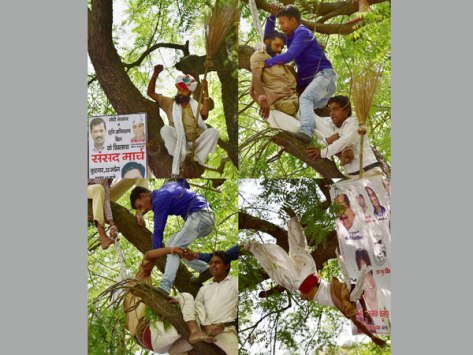
The tragic death of a farmer from Rajasthan occurs at a rally organized by the Aam Aadmi Party on 22 April 2015. The farmer, Gajendra Singh, hangs himself from a tree in full public view of the demonstrators, the media, the police. The electronic media had till then been barely covering the event, generally holding forth instead, in studio ‘debates’ among the opponents of AAP. Once this happened, the media spin doctors swung into action, and as Rajdeep Sardesai tweeted later, they seemed to work on an already decided script. Sardesai’s tweet said that there were clear instructions from the BJP to the media to focus only on the hung/ dying (or dead) man, and forget the rally. It seems, on a closer look, that the the second part of the instructions had perhaps already been given in advance – not to cover the rally and if at all, to attack it in sponsored studio debates. And of course, the BJP, which is the architect of the new Land Acquisition Ordinance, is an interested party in this game.

It is not entirely irrelevant to the overall politics of the media-BJP spin doctoring  of ‘reports’ that the AAP government in Delhi was perhaps the first in the country to announce what is without doubt the highest compensation to farmers suffering crop losses – Rs 50, 000/- per hectare for all farmers who have suffered damage. Nor is it entirely irrelevant that the Delhi government had lent full support to the anti-land acquisition struggles and Kejriwal had himself joined in the rally held by Anna Hazare and had now taken up the land issue in all seriousness.

Thus it happens that between the BJP and the big media propaganda machine, which has on at least two previous occasions completely blacked out AAP, the stage was set. Also at work in the media-AAP relationship over a longer term now, is the role of Mukesh Ambani’s media empire, given that on a range of issues AAP has directly challenged the latter. As an aside, let me add that a very senior journalist told a friend at the height of the Delhi election campaign, that in CNN-IBN/ IBN7, clear instructions had been issued to the staff not to give more than 20 seconds exposure to Arvind Kejriwal under any circumstances. If AAP swept the Delhi elections despite that, it must say something about the limits of the media game, at least as far as the majority of the population is concerned.

Gajendra singh being rescued, image courtesy Oneindia.com
Gajendra Singh being brought down. Image courtesy Oneindia.com

This time round, there was another constituency that was waiting to move into action – the Delhi elite, especially the radical elite whose hatred of Kejriwal is simply visceral, but which had been just about tempered by the presence in his team of People Like Themselves, darlings of the media. The latter had, to use an old Maoist expression, ‘wormed its way into the party’ and was intent on fighting an ‘ethical battle for inner party democracy’ against the ‘fascist Kejriwal’, a battle in which they were fully backed by the Ambani dominated media.

Continue reading Gajendra’s Tragic Death, Media Spins and the Indignation Industry

Letter of Solidarity with Greenpeace India: A Statement

The move by the central government to freeze Greenpeace India’s bank accounts and block sources of funds, is a blatant violation of the constitutional rights to freedom of expression and association. It also seems to be an attempt to warn civil society that dissent regarding development policies and priorities will not be tolerated, even when these are proving to be ecologically unsustainable and socially unjust. These are dangerous signs for the future of democracy in India.

Specific allegations of legal violation contained in the Ministry of Home Affairs’ notice are aspects Greenpeace India needs to respond to. However, the notice also charges the organization with adversely affecting “public interest” and the “economic interest of the State”. These charges give the impression that Greenpeace India is indulging in anti-national activities, using foreign funds. However, dissenting from the government’s development policies, helping communities who are going to be displaced by these policies to mobilise themselves, and generating public opinion for the protection of the environment can by no stretch of imagination be considered anti-national, or against public interest. Quite the contrary, any reasonable policy of sustainable development (which the government claims to adhere to) will itself put into question quite a few of the mining, power, and other projects currently being promoted. ”

Civil society organisations in India have a long and credible history of standing up for social justice, ecological sustainability, and the rights of the poor. When certain government policies threaten these causes, civil society has a justified ground to resist, and help affected communities fight for their rights. This is in fact part of the fundamental duties enjoined upon citizens by the Constitution of India.

Continue reading Letter of Solidarity with Greenpeace India: A Statement

Bangladesh – Stifling A Country: Mahmud Rahman

Guest Post by MAHMUD RAHMAN

Mahmud Rahman is a writer and translator from Bangladesh who lives in California. He is one of 23 persons  who are facing possible contempt of court charges from the International Crimes Tribunal 2 in Dhaka for having signed a statement expressing concern over the same tribunal’s contempt of court sentence on the journalist David Bergman for some of his blog posts.

When I think about the state of free speech in the land of my birth, my memories take me back to 1970-71 when I was a higher secondary student in Dhaka, a time of upheaval when East Pakistan was making its way towards independent Bangladesh. Officially we were still under martial law, Ayub’s decade-long dictatorship deposed in favor of Yahya’s rule that came with the promise of elections. Political parties could organize, detainees were set free, the press could publish with fewer restrictions, and people began to launch new magazines and newspapers.

Every stripe of opinion found expression in print. Pushing aside the go-slow conservatism of existing newspapers, new ones emerged. Bengali nationalism, socialism, communism of various hues – all found expression in print. The main Islamist party’s paper acquired a modern press. Books were not that widespread, but you could easily get your hands on Russell and English socialists, and Marx, Engels, Lenin, or Mao. I remember engaging in a mix of agnostic, atheist, socialist, and liberal discussions.

There is something in that sort of ‘spring’ that beckons the young to amplify their voice. Two friends and I wanted to publish a magazine. We came up with a name – The Rebel – and of course, a logo. We split the writing among us. I can’t remember much other than we were inclined towards independence for East Bengal. Our perspective was no doubt seditious but we couched our language with a bit of caution. Did we even know that British-era laws required that publications be registered? In that climate, we felt the state wasn’t looking all that carefully.

Continue reading Bangladesh – Stifling A Country: Mahmud Rahman

Ambedkar’s Ideology – Religious Nationalism and Indian Constitution: Ram Puniyani  

Guest Post by RAM PUNYANI

In order to gain larger legitimacy, RSS has been making claims of sorts. One of that which was made few months back was that Gandhi was impressed by functioning of RSS. Now on the heels of that comes another distortion that Ambedkar believed in Sangh ideology (Feb 15, 2015). This was stated recently by RSS Sarsanghchalak, Mohan Bhagwat. There cannot be bigger contrasts between the ideology of Ambedkar and RSS. Ambedkar was for Indian Nationalism, Secularism and social justice while the RSS ideology is based on two major pillars. One is the Brahmanic interpretation of Hinduism and second is the concept of Hindu nationalism, Hindu Rashtra.

Where does Ambedkar stand as for as ideology of Hinduism is concerned? He called Hinduism as Brahminic theology. We also understand that Brahmanism has been the dominant tendency within Hinduism. He realized that this prevalent version of Hinduism is essentially a caste system, which is the biggest tormentor of untouchables-dalits.

Continue reading Ambedkar’s Ideology – Religious Nationalism and Indian Constitution: Ram Puniyani  

हिन्दुत्व की प्रयोगशाला बनता दिल्ली विश्वविद्यालय: जीत सिंह सनवाल

Guest post by JEET SINGH SANWAL

केन्द्र में भाजपा के नेतृत्व में सरकार बनने के बाद से राष्ट्रीय स्वयं सेवक संघ का राजकीय शिक्षा नीतियों से लेकर शिक्षण संस्थाओं के क्रियाकलापों में बढ़ता हस्तक्षेप किसी से छुपा नहीं है। शिक्षा नीति में बदलाव लाने व इस बाबत मानव संसाधन विकास मंत्रालय को सुझाव व विश लिस्ट सौंपने में संघ ने काफी तत्परता दिखाई है। कई मीडिया रिपोर्टों के अनुसार संघ ने प्रत्यक्ष व अप्रत्यक्ष रूप से उनके लिए काम करने वाले तमाम लोगों की लिस्ट सरकार को भेजकर शैक्षिक व सांस्कृतिक संगठनों में उनकी नियुक्ति की मांग की। आशा के अनुरूप पिछले दस माह के भाजपा सरकार के कार्यकाल में विभिन्न संगठनों मेें कई सरकारी नियुक्तियां की गयी और संघ विचाराकों को अपेक्षा से अधिक सम्मान देकर ताजपोशी की गयी। नागपुर के एक प्रतिष्ठित संस्थान में डायरेक्टर पद पर नियुक्ति पाने के लिए तो एक व्यक्ति ने अपने संघ से जुड़े होने के प्रमाण प्रस्तुत करते हुए संबंधित मंत्री को नियुक्ति हेतु आवेदन किया। आशा के अनुरूप मंत्रालय ने भी उन्हीं की नियुक्ति की।

शैक्षिक व सांस्कृतिक संगठनों में इस प्रकार के हस्तक्षेप के पीछे संघ की बुनियादी रणनीति है। प्रख्यात मानवाधिकार कार्यकर्ता राम पुनियानी के अनुसार संघ पहले से ही प्रगतिशील शैक्षिक व सांस्कृतिक विमर्श को बदलकर अपना राजनैतिक आधार मजबूत करने में विश्वास रखता है। दिल्ली विश्वविद्यालय के प्रो0 अपूर्वानन्द के अनुसार संघ की यह रणनीति शिक्षा के अज्ञानीकरण की ओर जाता है। भा.ज.पा. को पूर्ण बहुमत मिलने व संघ के प्रचारक का प्रधानमंत्री बन जाना, उनकी इस रणनीति को आगे बढ़ाने के लिए मुफ़ीद है। विभिन्न शैक्षणिक व सांस्कृतिक संगठनों में पिछले कुछ महीनों से हो रहे इन बदलावों में दिल्ली विश्वविद्यालय का उदाहरण काफी अलग है। संघ दिल्ली विश्वविद्यालय में शोध, शिक्षण के साथ-साथ छात्रों के मोबिलाईजेशन के जरिये, अपने विवादास्पद एजेंडे को धार देने का प्रयास कर रहा है। संघ की विचारधारा व उनके कार्यक्रम पहले से ही विवादों में रहे हैं। उनके उग्र हिन्दुत्व व अल्पसंख्यकों से वैमनस्य किसी से छुपा नहीं है। ऐसे में दिल्ली विश्वविद्यालय में संघ की बढ़ती औपचारिक व अनौपचारिक सक्रियता, विश्वविद्यालय व बौद्विक जगत के लिए चिंता का विषय है।  Continue reading हिन्दुत्व की प्रयोगशाला बनता दिल्ली विश्वविद्यालय: जीत सिंह सनवाल

Land Acquisition and Delays Over Democracy: Shubham Jain, Sarangan Rajeshkumar, Dhruva Gandhi

Guest post by SHUBHAM JAIN, SARANGAN RAJESHKUMAR and DHRUVA GANDHI

The Right to Fair Compensation and Transparency in Land Acquisition, Resettlement and Rehabilitation Act, 2013 was passed with Objective to promote transparency and participative governance in the acquisition of land for industrialisation and urbanisation and to, thereby, ensure overall socio-economic development. In the pursuit of this objective, the law introduced mechanisms as Social Impact Assessment, Consent, and Rehabilitation et al.

This law, however, attracted widespread criticism from the industry on account of the supposedly time consuming barriers created for the acquisition of land. Accordingly, the Ordinance of 2015 was promulgated as a measure to hasten the process of Land Acquisition and to, thereby, contribute towards the economic development of the country. Unfortunately, most of the debate on this Ordinance has barely focussed on the problems it sought to address and, consequentially, there has been a dearth of an analysis of solutions proposed therein in the backdrop of these problems. Let us, therefore, contextualise the debate on the Ordinance and, then, examine the merits of the same. Continue reading Land Acquisition and Delays Over Democracy: Shubham Jain, Sarangan Rajeshkumar, Dhruva Gandhi

“Those Backward People” – Arun Jaitley and a Long Ugly History

Two days ago, Finance Minister Arun Jaitley sought to make a special mention of “poor, dalits, tribals, backwards, those who are landless.” The occasion was the the Land Acquisition Bill, which,

“we are bringing, as per that the industrial corridors which would be set up in the country, those backward people, the 300 million landless people would get employment opportunities,”

First, Mr Jaitley, what exactly is the mechanism your government proposes by which the “backwards” released from the land will be absorbed into industry? Is there a guarantee by the industry owners? Is there a provision for skill training in the same industrial corridors? Are there ITI institutes being set up? Forget these, is even primary or secondary education going to be expanded so that farmers’ children, at some point in the distant future can take advantage of the supposed industrial boom? Continue reading “Those Backward People” – Arun Jaitley and a Long Ugly History

Updating of “National Register of Citizens” and Recent Political Developments in Assam: Abdul Kalam Azad

Guest post by ABDUL KALAM AZAD

On 21st July, 2010 one of my close family relatives, Mydul Mullah (25) was one among the thousands of marginalized Muslims of Barpeta district who were demonstrating in front of Deputy Commissioner’s office at district headquarter demanding an error-free fresh NRC (National Register of Citizens). Eventually, police brutally cracked down on the picketers and fired upon them for the ‘crime’ of exercising their democratic right to peacefully protest. After the police firing Mydul Mullah along with his three comrades Khandakar Matleb (20), Siraj Ali (27) and Majam Ali (55) succumbed to the bullet injuries. The Tarun Gogoi led Assam government was forced to suspend the faulty NRC pilot project due to unprecedented public outrage.

The question of ‘illegal migration’ from Bangladesh has been one of the most significant and emotive topics in the political milieu of Assam for almost half a century now. .

The six-year long movement (1979-1985) against illegal immigration, popularly known as the Assam Movement, spear headed by All Assam Students Union claimed itself to be a secular and nonviolent new social movement of ‘indigenous’ people to drive out the illegal immigrants. But analyses of scholars and social scientists like Prof. Hiren Gohain, Prof. Monirul Hussain, Dr. Debabrata Sarma, Diganta Sarma etc. reveal that as soon as the Assam movement accommodated right wing RSS workers into its leadership, the whole movement turned against Muslims of Bengali origin in Assam. Heinous massacres like that of Nellie, Chaolkhuwa, Nagabandha etc. were orchestrated against Muslims of Bengali origin and in broad day light thousands of people were killed. After six years of deadlock, the movement culminated in the signing of the ‘Assam Accord’ with the Government of India in 1985. The accord says that the immigrants, who came to Assam after 25th of March, 1971 will be detected and deported from Assam. One of the mandates of the accord was to update the 1951 National Register of Citizen to facilitate identification of illegal immigrants from Bangladesh in Assam.   Continue reading Updating of “National Register of Citizens” and Recent Political Developments in Assam: Abdul Kalam Azad

Ban-man on the prowl again: Malvika Sharad

Guest Post by MALVIKA SHARAD on the recent call by Delhi University Students’ Union for a ban on the street play by Khalsa College theatre group, Ankur.

24lead6

Image courtesy rediff.com

One evening in 2013, a group of ‘street play seniors’ as we call them, visited us in the front lawns of my college, Lady Shri Ram College for Women. They were from various colleges across DU who had been actively involved in street theatre, and had been invited to give the newly formed street play team of that year, an introduction to the art form. Among those seniors was a dynamic young chap from Khalsa College, who reiterated several times that street theatre fills you with such immense courage that you end up doing things you never thought you would, for that courage comes from the sheer truth and brutal honesty that street theatre is based upon. He said that freedom of expression is taken to a whole new level when you perform amidst crowds, and state the truth looking directly into their eyes. A fire is born within you that cannot be extinguished, it burns brighter with every performance of the play. You become fearless in voicing your opinions and thoughts, so fearless that you don’t even realize how far you have pushed your own limits and emerged triumphant.

After a whole year dedicated to doing street plays in Delhi, I have learnt how right he was, that young student not much older than us. I find I have come out of my shell, shedding my inhibitions at a pace and scale I had never imagined. Torn chappals don’t bother me anymore, my sun-burned skin makes me look beautiful, I don’t flinch with embarrassment while sitting, sometimes lying, on the floor of the metro station out of sheer weariness, though co passengers stare at me with judgemental eyes, I can’t bring myself to stop romanticizing the mud and the dirt that hug me every time I wear my soiled street play kurta… But above all, I can articulate my thoughts properly now, I am not scared of speaking in public unlike the times when I was a meek docile person, cocooned in the comforts of home and parental pampering. I owe this change in my attitude and personality to street theatre, which taught me what it is to live confidently and fearlessly.

Continue reading Ban-man on the prowl again: Malvika Sharad

CPDR Statement on Maharashtra Cow Slaughter Ban

Committee for the Protection of Democratic Rights, Mumbai
THE MAHARASHTRA ANIMAL PRESERVATION (AMENDMENT) ACT, 1995
18 March 2015

As if the 1976 Maharashtra Animal Preservation Act banning the slaughter of cows, including the male and female calf of the cow, enacted by the Shankarrao Chavan-led Congress government during the Emergency was not enough, the Devendra Fadnavis-led Bharatiya Janata Party-Shiv Sena government is elated that the 1995 Maharashtra Animal Preservation (Amendment) Act, enacted by a previous BJP-Sena led by Manohar Joshi, that extends the ban to include slaughter of bulls and bullocks, has now received presidential assent. Despite the BJP’s claims justifying the ban on agro-economic grounds, among others, the driving force behind the prohibition is the ideology of Hindutva, presented as “a way of life” rooted in the central beliefs of neo-Vedantic Hinduism, of which cow slaughter and beef eating are supposedly anathema.

Continue reading CPDR Statement on Maharashtra Cow Slaughter Ban

People’s Union for Democratic Rights Condemns Bans on Cow Slaughter

Statement by People’s Union for Democratic Rights 
On March 16th 2015, the Haryana Government unanimously passed Haryana Gauvansh Sanrakshan and Gausamvardhan Bill with main opposition parties INLD and Congress supporting the Bill. The new bill passed by the Haryana Government bans cow slaughter and sale of beef and imposes a punishment of rigorous imprisonment of not less than three years extending up to 10 years and fines ranging from Rs. 30,000 to Rs. one lakh. The Haryana Government’s move comes just days after the President’s assent to Maharashtra Animal Preservation (Amendment) Bill 1995 early this month. Maharashtra Animal Preservation (Amendment) Bill 1995 not only banned beef but also extended the prohibition to slaughter of bulls and oxen. There was already a ban on slaughter of cows in Maharashtra since 1976.  The new amended act imposes a fine of Rs. 10,000 and a maximum prison term of five years for selling or even possessing beef.
What needs to be underlined here is that these bans on cow slaughter are not new; they were in existence in many of the states for many-many years. For example in Delhi, Bihar, Andhra Pradesh, slaughter of cows and calves is totally prohibited. In Goa and Andhra Pradesh, ‘cow’ is defined to include heifer, or a male or female calf of a cow under the Goa, Daman and Diu Prevention of Cow Slaughter Act 1978 and Andhra Pradesh Prohibition of Cow Slaughter and Animal Preservation Act 1977, respectively. In some states like Karnataka, Andhra Pradesh, Goa and Madhya Pradesh slaughter of bulls, bullocks and adult buffalos is permitted on ‘fit for slaughter’ certificate if the cattle is over 12 or 15 years of age, is not likely to become economical for draught, breeding or milk. Assam and West Bengal provides for slaughter of all cattle which includes bull, bullocks, calves, cows and buffalo on ‘fit for slaughter’ certificate. Meghalaya and Nagaland have no legislation to this effect.

Continue reading People’s Union for Democratic Rights Condemns Bans on Cow Slaughter

Dealing with ‘sexist pigs’? Reflections on the feminist protest against AIB’s Avish Mathew at National Law University, Delhi: A Statement

A statement from concerned students and teachers

What does one do sitting in the middle of an audience roaring with laughter at jokes that one might find downright humiliating? Laugh along, retire hurt, or ask people to stop? It’s a dilemma that many of us on the ‘wrong’ side of various lines of privilege (caste, class, gender, race) and those sensitive to these divisions often find ourselves in. Some students at the National Law University, Delhi seem to have been put in a similar situation when during their annual college fest, comedian Avish Mathew of AIB Roast fame would not stop amusing his audience with one offensive joke after another. They first decided to walk out and then came back with a placard saying, “Get out you sexist pig!”

Continue reading Dealing with ‘sexist pigs’? Reflections on the feminist protest against AIB’s Avish Mathew at National Law University, Delhi: A Statement

Justice for Hashimpura!

hashmipura killing Poster (1)

Widespread Protests in Dhaka Against Avijit Roy’s Killing by Muslim Extremists

Killing of Avijit Roy, image courtesy Sudin Chattopadhyay
Standing up to the killing of Avijit Roy, image courtesy Sudin Chattopadhyay


Soon after this brutal killing of the Bangladeshi-American atheist blogger, protests have begun across Dhaka. We extend our support to the struggle against the dangerous forces of religion-inspired extremism. See more detailed report in Al Jazeera here and The Guardian here.

B'desh protests against killing
B’desh protests against killing, image courtesy The Guardian

धर्म की आड़ में महिला अस्मिता पर प्रहार: जीत सिंह सनवाल

Guest post by JEET SINGH SANWAL

उन्नाव (उ.प्र.) से भारतीय जनता पार्टी के सांसद साक्षी महाराज ने पिछले माह हिन्दू धर्मावलम्बी महिलाओं को चार-चार बच्चे पैदा करने की सलाह देकर हिन्दुत्ववादी संगठनों की वर्षों पुरानी ख्वाहिश को मानो एक जीवनदान दे दिया। इस बयान के बाद तमाम हिन्दुत्ववादी संगठनों ने धर्म की दुहाई देते हुए महिलाओं को ज्यादा से ज्यादा बच्चे पैदा करने की सलाह देने के लिए मोर्चा संभाल लिया। कुछ लोगों ने तो आठ और कुछ ने दस-दस बच्चों को पैदा करने तक का आह्वान कर दिया। कई वर्षों से विश्व हिन्दू परिषद इस विषय को मुद्दा बनाये हुए है लेकिन साधारण जनमानस ने उसे कोई महत्व नहीं दिया। भाजपा के नेताओं द्वारा इस तिरस्कृत मुद्दे को उछालने के बाद इस तरह के तमाम संगठनों ने इसे हाथों-हाथ लेते हुए एक व्यापक मुद्दा बनाने का प्रयास किया।

महत्वपूर्ण बात यह है कि वी.एच.पी. से संबंधित साध्वियों को यदि छोड़ दें तो महिलाओं से संबंधित इस मुद्दे पर यह बहस पुरुषों ने शुरू की है। महिलाओं को संबोधित करने वाले ये बयान महिलाओं पर अधिकार जमाने वाले पुरूष मानसिकता का प्रतिरूप है, जिसमें महिलाओं की स्वतंत्रता, इच्छा, अधिकार, समानता व आत्मसम्मान की कोई जगह नहीं है।

इस मुद्दे की जमीनी सच्चाई तो यह है कि ऐसे  बयानों के बावजूद भारतीय महिलाओं ने प्रजनन दर को कम रखने को प्राथमिकता दी है। जनसंख्या निदेशालय के आंकड़ों के अनुसार भारत की कुल प्रजनन दर जो 1971 में 5.2 थी वह घटकर 2013 में 2.3 हो गई। धार्मिक भावनाओं केा भड़का कर इन महिला विरोधी बयानों को तूल देने की इस प्रक्रिया में चिंता इस बात की है कि इसमें धर्म के ठेकेदारों के साथ-साथ सत्ता पक्ष से जुड़े राजनेताओं ने भी मोर्चा संभाला हुआ है। छिट-पुट विरोधों के अलावा प्रगतिशील मंचों से इस तरह के बयानों की कोई खास आलोचना न होने से भी इन संगठनों व लोगों के हौसले बढे  हैं।  Continue reading धर्म की आड़ में महिला अस्मिता पर प्रहार: जीत सिंह सनवाल

A Chance for Social Change Like Never Before: Shankar Gopalakrishnan

Guest post by SHANKAR GOPALAKRISHNAN

For those who don’t like Modi-Sangh politics, February 10th was a day of joy. When this note was drafted a month ago, the provisional title was “This is No Time for Despair.” But last Tuesday has not only dented Modi’s invincible image – it has also dented the sense of being besieged. Since May 2014, almost every progressive force in the country has been on the defensive. The AAP’s politics and the popular tsunami that drove it to power have shattered this gloom.

But the key question at this point – is the eventual defeat of the NDA in an election the only goal? I argue that here that that is just the beginning. The end of this period – which, notwithstanding February 10th, is obviously some time away – will offer a space that has not existed in Indian politics in decades. Whether that space gets used or not will depend on how the struggle develops in the interim period.

The potential of this period is rooted in three basic flaws that the current ruling coalition (between big business and the Sangh) suffers from. First, its key forces are fundamentally myopic and delusionary in character. Second, it is internally contradictory – the two pillars of this formation will undercut each other in organisational (not just political or rhetorical) terms. Finally, it embodies a peculiar combination of organisational strength and political weakness. Continue reading A Chance for Social Change Like Never Before: Shankar Gopalakrishnan