Category Archives: Right watch

Swachchh Bharat – Beyond Charity and Symbolism to Legal Rights and Duties: Sujith Koonan

Guest post by SUJITH KOONAN

Sanitation and cleanliness seems to have become buzzwords. Celebrities and political leaders have started talking about sanitation. The call for Swachchh Bharat by the Prime Minister of India was welcomed by many taking brooms in their hands. Several institutions have uploaded prestigiously the photographs of its employees carrying brooms. All of a sudden, the sanitation consciousness seems to have increased in the country. Indeed, it is a good sign that we have started thinking and talking about the ‘unmentionables’ – shit and dirt.

Many of these actions and responses are symbolic and rhetoric in nature. While it may be acceptable to begin with symbolism, the seriousness needs to be demonstrated through concrete long term plans and actions. One can hope that the government will take such steps. One way to show that the ongoing sanitation talk is serious, and the state is sincere about it, is to recognise the legal aspects of sanitation. There are mainly three issues where the government has been a failure in fulfilling its constitutional and legal duties and these are supposed to be at the forefront of the Swachchh Bharat Mission (SBM). Continue reading Swachchh Bharat – Beyond Charity and Symbolism to Legal Rights and Duties: Sujith Koonan

Statement Against Continued Harassment of Teesta Setalvad, Javed Anand and others

The following is the text of a statement issued in Banaras on the 3rd January 2015, by a number of intellectuals 

In Support of Teesta Setalvad, Javed Anand and others

We are deeply shocked and outraged by the continuing attempts of the Modi government and the Gujarat police to somehow implicate the human rights lawyers and activists, Teesta Setalvad, Javed Anand along with three victim survivors of the state sponsored carnage in Gujarat in 2002 on patently trumped up charges.

This is another attempt to derail justice particularly Zakia Jafri’s appeal which is now before the Gujarat High Court where she has accused the then Gujarat chief minister, Narendra Modi, the home minister of Gujarat along with 59 others which include top politicians, civil servants of conspiracy for mass murder and other serious crimes.

It is extremely significant that the amicus curiae appointed by the Supreme Court, Mr. Raju Ramachandran  has told the apex court there was enough prima facie evidence to prosecute Shri Modi. Continue reading Statement Against Continued Harassment of Teesta Setalvad, Javed Anand and others

An old RC ruminates on his ‘Pseudo-Secularist’ roots: Hartman de Souza

Guest post by HARTMAN DE SOUZA

The background and context to this not-so-enigmatic title is very simple. By today’s standards, I am old – I get a hefty discount travelling by train which I am still hooked on, and I am still counting the years and sniffing my coffee. The ‘RC’ is a lot simpler:

Travelling by train from Mumbai to Delhi many, many moons ago, a man in the compartment, in his thirties, got into conversation with me. After I had answered his opening bullet shot questions – You are from? You are doing what? Your father is doing what? – he told me I spoke English like a ‘foreigner’.

I was still fresh from Kenya those days, where I was born, so I got a lot of grief from having a different accent that no one could place.

This was of course much, much before you could study for an undergraduate degree in India (where you were born) and then, if you had the means and the SATs, go and study in the US for a few years. There, in the land of beef and honey, as we now note with pride, many Indians also discovered the ‘free market’ and their ‘authentic’ Hindu roots – then came back to spew communal venom with a makeshift American accent and the dollars to back it.

As if it was stamped on my bloody forehead, he then asked: “You are Christian?” He pronounced this as “Kir-tchin’.

I pretended I hadn’t heard. So he repeated the question. I nodded, hoping he would disappear and let me get on reading my book.  He did not. Instead had a broad grin on his face, like he knew in which bag he could drop me in.  “You are RC!” he said, almost triumphantly.

For a few seconds, he almost had me stumped. I raised my eyebrows.

Ro-maan Catholic,” he offered.

I shook my head and smiled back. “No,” I replied “Retired Catholic…”

He didn’t get the joke. Guys like that still can’t. Continue reading An old RC ruminates on his ‘Pseudo-Secularist’ roots: Hartman de Souza

Anti-Conversion and Ghar Wapsi, Or Hindutva’s Doublespeak: Charu Gupta

Guest post by CHARU GUPTA

The synchronised vocabulary of anti-conversion by the BJP and that of reconversion by the VHP and Dharm Jagran Samiti, an RSS affiliate, reveals the intimate relationship between the two. Anti-conversion and reconversion are two sides of the same coin. Even though the Dharm Jagran Samiti dropped its plan to ‘reconvert’ 4000 Christians and 1000 Muslim families in Aligarh on 25 December, due to pressures from a parliament in session as well as other protests, the day has had strategic significance. Christmas Day has been given a different meaning by the Hindutva brigade — the birth anniversaries of Madan Mohan Malaviya, one of the stalwarts of the Hindu Mahasabha, and Atal Bihari Vajpayee, the eminent BJP leader. Equally critically, on 23 December 1926 Swami Shraddhanand, the leading ideologue of the shuddhi movement (purification; Hindu movement in the late nineteenth and twentieth centuries to reclaim those who had converted from Hinduism to other religions) was assassinated by a Muslim fanatic, and on 25 December, a condolence motion was moved at the Guawhati session of the Congress.

The twin strategies of anti-conversion and ghar wapsi have a long history and past, which saw its efflorescence in the shuddhi movement, but have become much more aggressive in the present context. As part of their community and nation making rhetoric, the Arya Samaj and the Hindu Mahasabha had launched the programme of shuddhi on a large scale in Uttar Pradesh in 1923. Though Arya Samaj had stronger roots in Punjab, shuddhi movement was more effective in UP. Various scholars have pointed to the communal character of the movement. A note prepared by the criminal investigation department at that time stated that though the movement had older origins, ‘its application to mass rather than individual conversion gave it a special prominence’ in 1923. Shuddhi came to be touted as a movement to reclaim the ‘victims’ and protect the ‘faithful’. Reconversion attempts have since been a part of agenda of various Hindutva outfits, and the present assertions should be seen in that context. Today, organisations like the VHP and Dharm Jagran Samiti have acquired a new importance and are emboldened to not only challenge conversions in an organised manner, but also to simultaneously aggressively campaign for reconversion. Just as shuddhi became an instrument for Hindu communal mobilization in early twentieth century, ghar wapsi is fulfilling the same role today. Continue reading Anti-Conversion and Ghar Wapsi, Or Hindutva’s Doublespeak: Charu Gupta

Celebrating ‘Good Governance’ : Mary E John and Satish Deshpande

Guest post by MARY E. JOHN AND SATISH DESHPANDE

It seems odd to associate words like ‘mean’ and ‘petty’ with entities like states.  But it is hard to avoid them when confronted by the despicable attempt of the Modi regime to cancel or restrict the holiday for Christmas.  On the other hand, these words are far too mild to capture the poisonous malice behind this small-minded act that, despite its clumsiness, is clearly part of a systematic campaign to cultivate a culture of vicious aggression towards select “minorities”.

How should one respond to such pettiness, knowing that it is only the surface of a deep reservoir of violent hatred?  One could light heartedly point to the irony that 25th December happens to be the birthday of not only Madan Mohan Malviya (1861) and Atal Bihari Vajpayee (1924), but also a certain Mohammad Ali Jinnah (1876).

Alternatively, one could argue, in a spirit of liberal reasonableness, that Christmas has for long been much more than a holy day for Christians.  The secularisation of Christmas is apparent not only in its relentless commercialisation (much like Deepavali), but also in its longstanding status as a broader symbol of festive good cheer marked by giving and sharing.   Continue reading Celebrating ‘Good Governance’ : Mary E John and Satish Deshpande

Peace on Earth and Social Justice – Christmas greetings!

images

Protest at Delhi Police Headquarters after the burning of St Sebastian’s Church in Dilshad Gardens/ Image from The Indian Express

We observe Christmas today under the ominous cloud of Hindutvavaadi violence against minorities, which began on the very day of the BJP electoral victory seven months ago, and their determined attempt to obliterate all religious identities other than their own narrow version of Hinduism, a Hinduism that brutally excludes even large numbers of people who would consider themselves Hindu. From burning churches to physically attacking ‘Muslim-looking’ men, to trying to erase Christmas under the banal bureaucratese of Good Governance Day – Hindutvavaad has never had it so safe, never has it been so arrogant, as under the protective gaze of Modi, a Prime Minister who produces reams of flowery prose in his speeches, but through his public silence on these atrocities, satisfies both Hindutvavaad and his neo-liberal supporters – the one recognizing his benign encouragement, the other fooling itself that his silence shows displeasure. Continue reading Peace on Earth and Social Justice – Christmas greetings!

Converting Religion, Converting law: Rajshree Chandra

Guest Post by RAJSHREE CHANDRA

The right to freedom of religion  (Art. 25 of the Indian Constitution) in a country like India has a burden so extensive and a content so capacious that the same right functions both as an instrument of individual liberty As well as a mode through which the state intervenes to discipline and curtail religious freedom. It has a history so diverse and conflicted that the right often become a mode of settling quid pro quo battles between religious publics, and law often becomes hostage to the principle of ‘historical correction’.

There have been various modes of historical corrections. If the demolition of Babri Masjid was one, ghar wapasi – a return home to one’s religion – is another. The recent ghar wapasi episode in Agra, where RSS affiliate Bajrang Dal converted 57 Muslims to Hinduism; the proposed and then withdrawn conversion of Muslims and Christians in Aligarh on 25th December 2014 by the RSS’s Dharm Jagran Samiti; and the scheduled holy dip of an expected 50,000 “reconverts” (of the last five years) in the Godavari during the Kumbh at Nashik next August are instances and signs of the “re-conversion” rhetoric steadily mainstreaming itself. The question is how does the state and law respond to this?

‘Re-conversions’ are not new in Indian history. Katju & Sikand document instances of mass conversions of Muslims into Hinduism from 1947 onwards, and more forcefully and openly from the 1990s onwards, as part of the Shuddhi (purification) movement. The VHP, an adjunct of the Sangh, extols the practice of ghar wapasi and had claimed that over 200,000 Christians had been converted to Hinduism. The re-conversion argument – of shuddhi and ghar wapasi – is invoked by the various factions of the Sangh Parivar as a modus that aims to correct the history of conversions away from Hinduism.  Continue reading Converting Religion, Converting law: Rajshree Chandra

A Massacre is a Massacre and There is no Good Taliban: S. Akbar Zaidi

Guest post by S. AKBAR ZAIDI [This post was sent to us by our friend S. Akbar Zaidi. Though published earlier in The International News of Pakistan, we are reproducing it here because it represents a position that is felt by many inside Pakistan but which right-wingers in India would love not to see. Like right-wingers and Talibanis in Pakistan, our very own Hindutvavadis too thrive on presenting a monolithic picture of something called ‘Pakistan’.]

This was a massacre, nothing less. We should call it that, nothing less. We may want to call the children ‘shaheed’, but they were not engaged in any war against anyone. They were too innocent and blameless for this. They were victims. Let us call them that. They were victims of our politics, of our opportunism, of hiding in the dark, and especially of protecting the murderers. Do we simply pray for innocent victims, and absolve ourselves of the crimes that we have allowed to persist which resulted in this massacre? As Mohammad Hanif has so eloquently argued, Pakistan’s civil and military leadership needs to examine their own bloodstained hands when they raise their hands in prayer. It was the bloody Taliban butchers who killed these children, not militants or some obscure, unspecific category called ‘terrorists’. Let us name them for who they are. We cannot hide away from this reality and unless we name names, we will not alter our political economy, our direction. If we are waiting for the good Taliban to emerge and denounce this massacre, we need to stop hoping. We must stop differentiating between different types of killers. There is no good Taliban, just one ideology represented and manifest in different groups and forms. Continue reading A Massacre is a Massacre and There is no Good Taliban: S. Akbar Zaidi

Statement on Peshawar Massacre: People’s Alliance for Democracy and Secularism, Delhi

People’s Alliance for Democracy and Secularism, Delhi, condemns the ghastly attack on school children in Peshawar (Pakistan) by Tehreek-e-Taliban in which over 140  innocent lives were lost. It is a plain case of murders by the people spewing venom in the name of religion and ideology with no regard for human life. PADS demands that such fundamentalist violence be dealt with firmly by the authorities in Pakistan and expresses its solidarity with the parents of the children whose lives were snatched away by the murderous gang which, only to hoodwink the people, claims to be fighting imperialism. By their act they have shown how dangerous they are for the common citizens of Pakistan.

It is also important to note that people in general in Pakistan have to stand up against all kinds of violence. There is no acceptable violence and unacceptable violence. Violence, under the illegitimate legal cover of Blasphemy Laws is being perpetrated, and celebrated in the name of religion in the country. Condoning any kind of violence against the innocent people in the name of religion, provides raison d’etre to the forces like TTP. The ghastly murders in Peshawar is a signal for the Pakistani society  to look inward and work in unison to keep religion away from State to avail the benefits of the democratic rule.

The Indian school children and Parliament have shown solidarity with people of Pakistan by keeping a two minutes silence, on the suggestion of Prime Minister Modi. Such solidarity, however, should be expressed not only at the moment of grave tragedies, but should become a normal state of affairs between the two countries. The political and military leadership of the two countries should avoid aggressive rhetoric and militarisation and peacefully settle all outstanding issues.

PADS notes with the sense of urgency that the Taliban-like Hindutva forces have grown in size, influence, and impact in India orchestrating killings and triggering mass displacement of the people. PADS would like to forewarn the people of India that communalists of any religion have the same traits and ultimately, it is the members of the same community, whose interests such groups claim to espouse, become their targets. This is the time for the peoples of India and Pakistan to unite against the use of religion for committing murders of the innocent.

18.12.2014

Remembering 1992: School of Media and Cultural Studies, TISS Mumbai

Dislocation

Hardening Divides

Remembering 1992 is a site that seeks to revisit and remember the violence that the city of Bombay/Mumbai experienced in December 1992 and January 1993. This site includes 6 films, video interviews and transcripts, news clippings, reports and other resources. The project started with the films that were made by students (Class of 2013) and faculty and used as a part of the campaign Bombay ki Kahani Mumbai ki Zubaani, held between December 2012 and January 2013.

In a political and social context where the memory of this violence has been rewritten and all but erased, it is crucial to remember, to explore the contours of normalised prejudice and to understand how the survivors have struggled with the denial of justice. It is also necessary to think about how and why the memory of such a watershed event gets erased and who benefits from this erasure.

The website explores different kinds of memory, organised around themes and uses a timeline and map to list the events of the 1992-93 riots,based on the Justice Srikrishna report.

Taliban Attack – the Limits of Savagery: Akhlaq Ahan

Guest post by AKHLAQ AHAN

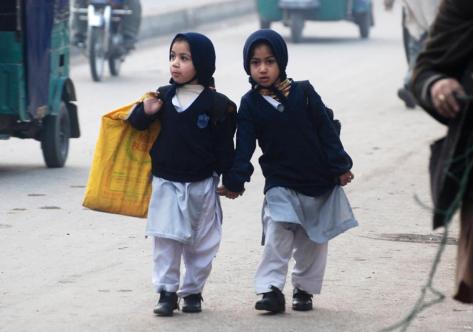
Every sane person is aghast to see what has happened in Peshawar, where Taliban’s attack on a school has crossed all limits of savagery and senselessness. They killed over 140 innocents mostly children, after taking them hostage, burned a teacher with gasoline and made the students watch the ghastly act.

Historically the area is part of the region known as ‘Khorasan e Buzurg’ or the greater Khorasan spanning over the so called North West Frontier, Afghanistan, North East Iran and erstwhile Emirate of Bukhara. The area, for thousands of years, has been the heart and mind of Asia; as this was the region where Gathas of Avesta and Vedas were compiled, Buddhist teachings flourished and survived, Persian traditions were revived, the seekers of truth flocked around Sufi masters to be enlightened. This is the land that produced personalities like Zarathustra, Panini, Alberuni, Khwaja Ansari, Data Ganj Bakhsh, Khwaja Gharib Nawaz, Rumi, Jami, Rahman Baba and hundreds of others. Scores travelled to the region to seek knowledge and training like Faxian, Xuanzang, Yijing, Shams Taprez (Tabrez), Amir Khusraw, Guru Nanak, Jamali and countless others. Though the region has seen occasional strife in the past too but the traditions of inclusion had continued to prevail till about a couple of centuries ago, when these values began to face systematic attacks. A few like Bacha Khan, in his autobiography, gauged the extent of the spread of these exclusionist ideas and warned against them. Continue reading Taliban Attack – the Limits of Savagery: Akhlaq Ahan

Human Rights Commission of Pakistan Condemns Killing of Children in Taliban Attack

The HUMAN RIGHTS COMMISSION OF PAKISTAN has issued the following statement on the Taliban attack on school children in Peshawar

December 16, 2014

Lahore, December 16: The Human Rights Commission of Pakistan (HRCP) has called the killing of more than 120 children in a Taliban attack on an army-run school in Peshawar a national tragedy which it said must open the eyes of anyone still harbouring any doubts that Taliban and Pakistan could coexist.

In a statement issued on Tuesday, the Commission said: “HRCP is deeply saddened by the large number of children killed in the Taliban attack on ArmyPublic School in Peshawar. This is a national tragedy of immense proportions, and an extremely sad day for Pakistan. Our heart goes out to the families of the children whose lives have been cut short by this abhorrent act of terrorism.

“The target was an army-run school, but it was a school nonetheless. It is not children who fight against the Taliban. And yet the choice of the target and the heavy casualties among the children leave no doubt that the massacre was aimed at killing as many children as possible.

“Nothing, including religion, norms of armed conflict or even common decency, justifies such brutal targeting of children. But it is no secret that the killers and those who dispatched them to attack the school have respect neither for religious commandments nor notions of civilised or decent behaviour. The targeting of children made sense to them because they stand for blood-letting and not much else.

“HRCP reiterates its firm belief that Taliban and Pakistan cannot coexist and anyone still harbouring any notions to the contrary is naive beyond belief.

“It had already been established, much before Tuesday’s massacre of children in Peshawar, where the Taliban stood in terms of education or value of children’s lives. Their actions today have shown once again that Pakistan will not know peace until this madness is taken on in all its manifestations and defeated. Continue reading Human Rights Commission of Pakistan Condemns Killing of Children in Taliban Attack

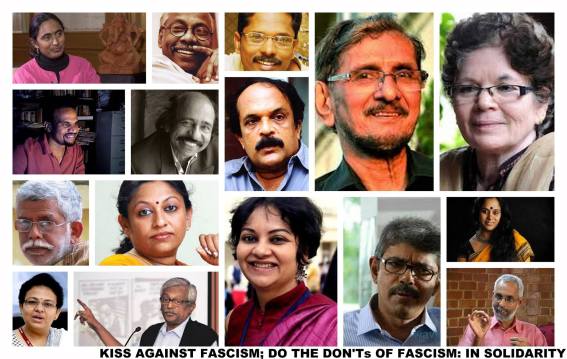
Wave after Wave, We Refuse to Die Down: Kiss Protest Against Fascism at IFFK

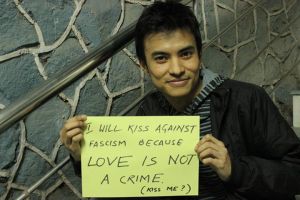
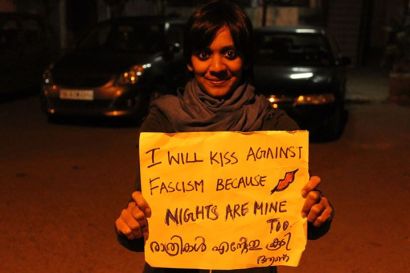
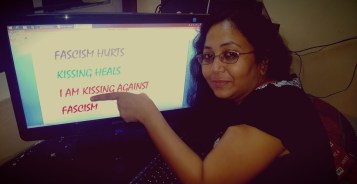
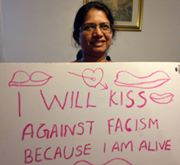
If you are in Thiruvananthapuram, please do join us at one o’clock at noon in front of the Kairali-Sree theatre complex at Thampanoor, the main venue of IFFK.

We do believe that the rising tide of fascism in Kerala, the creeping fear of the sheer violence of fascist goons, can be combated only through love, humor, and moral courage. The victory of Hindutva right wing forces in the national scene seems to have emboldened them in Kerala. They are attempting to import here the instruments of terror that they brazenly unleash on people in the states which have become laboratories of their hate-politics. We will not let their evil grow; we will fight it with love.

We will use as an instrument of self-defense precisely all that which fascist forces deny us in this society. We will reclaim that ultimate symbol of tender and intimate human contact, the Kiss; we will kiss against fascism.

And each of us has different, but interconnected reasons, for kissing against fascism.

sunilKissable boymikek edited 3aswatyrenuedited 2nisaaratrikasinghabipshaKAF solidarity


‘Law of the land’ on Kissing in Public: Sanjay Palshikar

SANJAY PALSHIKAR, Professor, Political Science department, University of Hyderabad, clarifies the ‘law of the land’ on kissing in public, to the Committee set up by the Vice-Chancellor to ‘look into the matter of the incident of November 2, 2014.’

Respected Members,

At the centre of the incidents of November 2, 2014, is the alleged act by some students to display demonstratively mutual affection in the form of kissing. Without going into the factual correctness of the charge, let me share with you what I have learnt from legal scholars and activists. I do so in the hope that this will help the Committee “ascertain” “the position of the law of the land” regarding kissing in public.

  1. Indian judiciary at the higher levels has not universally treated kissing in public as illegal. In appropriate context, spelt out variously by the relevant judgments, it has been seen as an expression of love, expression of love and compassion, and its artistic representation as defensible. Absent in all theses cases is the tendency to presume that every kiss is an act of sexual expression and that indulging in this act in public is always obscene. (A & B vs State Thr. N.C.T. of Delhi 2009; Friday vs K.J. Sebastian 2001).
  1. The Supreme Court has observed that the Indian Penal Code “does not define the word obscene and this delicate task has to be performed by courts….” If the Apex Court considers it a delicate task, how much more challenging it would be for university teachers and police officers to say if an act is obscene! (Udeshi vs State of Maharashtra 1965).

Continue reading ‘Law of the land’ on Kissing in Public: Sanjay Palshikar

We, or our Nationhood, Redefined.

A couple of weeks ago, filmmaker Anand Patwardhan was invited by the Editors’ Guild to deliver its annual lecture. Patwardhan’s speech, titled We or our Nationhood Redefined, was marked by his characteristically cool tone, systematically reassembling facts that have a tricky habit of leaking from national memory. Facts like the twentieth century’s worst genocidal dictator Adolf Hitler and his programme of racial cleansing has a respectable and massive following in India in the form of the Rashtriya Swayamsewak Sangh. That the RSS has at least 50,000 branches across the country with over 40 million members, and runs a network of 18,000 schools across India. That one such child, recruited from the age of 8 from a relatively poor family, is Prime Minister Modi; and another is Party Chief Amit Shah. That just before the recent reshuffle, 5 Chief Ministers and 17 of the 23 Cabinet-level senior ministers were current or former RSS members. That the assassins of Gandhi are really the RSS, not the lone lunatic Godse who merely carried out what others dreamed about. That RSS’s poisonous communal agenda was roundly condemned by Sardar Patel, of whom PM Modi has promised to build the world’s tallest statue. Or more obscure but equally revealing facts, like the letter written by RSS chief Balasaheb Deoras from jail during Emergency, praising Indira Gandhi and especially her programme of sterilisation of Muslims. And those truly mind-boggling-in-their-irony facts, like the widespread involvement of the RSS in the 1984 anti-Sikh pogrom, when the BJP cynically says “1984” every time somebody says “2002”.

On a day when the Nanavati Commission has termed the 2002 anti-Muslim pogrom in Gujarat as a purely communal reaction to Godhra, and cleared then Chief Minister Modi’s government of any wrongdoing, or even inaction, it is critical we re-read Patwardhan’s speech, to remind ourselves exactly what we are up against if we believe in a non-communal, non-divided, heterogenous India. As Patwardhan put it, given the history of the RSS in this subcontinent, if a Modi didn’t exist, he would have to be invented. Read more.

A kiss for your thoughts, University of Hyderabad: Anu K Antony, Mohan K Pillai, Sinjini Bhattacharya and Vaikhari Aryat

Guest Post by ANU K ANTONY, MOHAN K PILLAI, SINJINI BHATTACHARYA, VAIKHARI ARYAT 

HYD

The protest meeting organised by the students of the University of Hyderabad on the university campus

‘That is knowledge which liberates’, proudly proclaims the crest of University of Hyderabad, a prominent central university in our country. A University space has been traditionally seen as the vanguard of socio-cultural critique and change. Universities pride themselves in upholding the values of freedom of thought, expression and debate. And yet, the reaction of the administration of the University of Hyderabad (UoH) to a recent event, in an otherwise liberal-tolerant and progressive-leaning campus, leaves much space for thought.

On November 2nd, a group of students organised an event on campus in solidarity with the much discussed “Kiss of Love” protest in Kerala. Titled “UoH Against Moral Policing”, the on-campus event, publicised solely on online social media, was supposed to create a space to discuss issues surrounding moral policing and the chain of Kerala incidents, bring out narratives of moral policing, talk about morality and Indian culture, and recite poetry. Also planned was a symbolic act of kissing on a chart paper, with the slogan “Our lips don’t char”. However, some ABVP and BJYM activists, with the aim of saving the students and the Indian culture from Western “immorality”, barged into campus and tried to attack the student protesters. The Telangana Police and campus security, who had failed to stop the intruders, did later succeed in cordoning them off from the protesting crowd, while insisting that the students call off the protest and disperse.

Unaccustomed to Police chauvinism and empowered enough to insist on their rights, the students managed to continue with their planned activities, although once in a while some right-wing activists managed to break ranks and tried to incite violence. The campus community however showed great restraint and continued protesting peacefully.  In response to such moral policing inside campus, the 250-plus students spontaneously started hugging and kissing each other, before dispersing.  Continue reading A kiss for your thoughts, University of Hyderabad: Anu K Antony, Mohan K Pillai, Sinjini Bhattacharya and Vaikhari Aryat

The Class Politics of Blasphemy in Pakistan: Fatima Tassadiq

Guest Post by FATIMA TASSADIQ

The brutal murders of Shehzad and Shama, a Christian couple in the village of Kot Radha Kishan in Kasur district on 4th November, spawned predictable outrage in the press and social media. The rush of horror, the diagnoses and prescribed course of action against such violence involved the familiar paternalistic discourse of the ‘illiterate masses’ whose ‘ignorance’ evidently leaves them particularly vulnerable to the manipulation of the much maligned mullahs. Such a narrative serves the dual function of reducing religious violence to the faceless masses while at the same time reaffirming the educated urban upper class as the rightful custodian of Islam and Pakistan. This construction conveniently ignores the role played by the state and the elite in producing religious violence and feeds the class-based blind spots that exist in our understanding of what constitutes religious extremism.

Continue reading The Class Politics of Blasphemy in Pakistan: Fatima Tassadiq

Whatever happened to the great debate? Ankita Anand

Guest Post by ANKITA ANAND

On 6 November 2014 BBC World invited three panellists from different sectors to debate on ‘A New India: Free, Fair and Prosperous’ as part of the World Economic Forum. Issues of content and objectivity apart, one still has high expectations of a group like BBC when it comes to setting high standards of form. But this ‘debate’ fell flat on its face on all counts.

No rules of the game

One would think that in a discussion like this all three panellists would bring in varied viewpoints due to their specialization in their individual sectors. However, if one wants to quote either the minister or the corporate voice in the debate, it would require constant rechecking to distinguish who said what. Of course businnesses and governments need not always be in conflict with each other. But this smooth overlapping can be dangerous if those who are to be at the receiving end of this coalition between corporate bodies and governing bodies get completely left out. So for all practical purposes, instead of having three distinct voices, the format of the session (to keep calling it a debate would be to perpetuate technical erroneousness) was two against one. The yesmanship resulting out of this format naturally dulled the sparkling energy any debate worth its salt should have. Continue reading Whatever happened to the great debate? Ankita Anand

There is hatred in the air yet again: Preeti Chauhan

Guest Post by PREETI CHAUHAN on the recent communal tension in Noor e Illahi area of Delhi.

It was around 9 pm on Tuesday, November 11th, I was heading to my parents’ home to go with my sister for an interview the next morning, when my cellphone rang, my sister was asking me frantically where I was. I replied a bit anxiously but with irritation, ‘Kya hai? Pahunch jaaungi thodi der mein’. She said don’t come, turn back. I asked why, ‘yahan dange hone waale hain, saari dukaanein band ho rahin hain’, my sister replied. In those two-three seconds my heart skipped many beats, a strange fear about the safety of my family gripped me. I could for the first time feel what it is to live in fear of communal riots. I called up my close relatives who were out of home to ask where they are. There was such an uncertainty as to how will my sister go for the interview tomorrow? Would I be able to reach home tomorrow morning? Would my vehicle be attacked if I decide to go home now?

In those three- four minutes the world seemed to have taken a terrifying turn for me. Mundane, everyday things, everyday routes suddenly turned hostile and suspicious. I could feel the agony and fear so very close. Then there was a sudden burst of anger that I felt against the communal forces that are so hell bent on creating communal trouble everywhere in Delhi. I had not read the newspaper the whole day yesterday and hadn’t watched TV but just before I was leaving home my spouse told me that my native place is in the news and it was then that I had read about the communal tension and curfew in Noore-illahi. It’s the area, the vicinity of my childhood, adolescence and my adulthood too. It’s the area of the weekly bazaar for us, the Eid bazaar as well from which we had returned at 1 am at times. Noor Chicken is where Noor Jahan furniture once stood if I remember correctly; it belonged to the family of one of my classmates in school. I hear today that Noor Chicken’s owner and his son was badly beaten and the son is rumored to have succumbed to injuries. I shudder to think if he is my primary school classmate Shahnawaaz… Continue reading There is hatred in the air yet again: Preeti Chauhan

This is What Frightens Them….

And the struggle continues, image courtesy Manorama online
And the struggle continues…Kochi, image courtesy Manorama online
“If conservative elements can capture our public spaces and impose their diktat on us, we will do the same in retaliation. Our university spaces, parks and roads are not free any more. We are reclaiming them now. We live in an age where a Dalit man is hacked to 40 pieces because he fell in love with a woman from a higher caste. This Kiss of Love campaign is a defiance of moral policing and a struggle to uphold the spirit of love in all its forms and for everyone,” said Zareen, a campaigner.
Kiss of love Delhi, image courtesy, DNA

‘Downtown’ – Where the Kiss of Love Began: Sudha K. F.

Guest post by SUDHA K. F.

[This article was written in response to the recent incident of vandalism and violence meted out by BJP- affiliated Yuvamorcha activists against a restaurant called Downtown in Kozhikode, Kerala. This was the incident that led to the protest – the Kiss of Love at Kochi, Kiss of Love in Kolkata, and now, most audaciously outside the RSS Office in Jhandewalan. Wherever it goes, it acquires a flavour of its own. Thus in Kolkata, hokkolorob (let there be turmoil) mutated into another set of slogans – hokchumban (let there be kiss – or, let us kiss) and now, Sanghi gunde hoshiyar, tere saamne karenge pyar (beware Sangh goons, we will (make) love right before you. Sudha K. F. gives a sense of what it felt like after the goons attacked, the sense of indignation that subsequently burst forth.]

Kiss of love, Delhi
Kiss of love, Delhi, from the official facebook page

The now “notorious” Downtown restaurant is 5 minutes away by foot, from my home in my hometown Kozhikode. During my schooldays, that place was an old workshop. The restaurant came up after I had been away from my hometown for quite a while for my higher education. I remember being thrilled at the sight of this fine looking restaurant/coffee shop with glass windows, near my home during one of my visits. Earlier a few establishments had replaced the old workshop but didn’t do well commercially and closed down hastily. As I passed Downtown one evening, its busiest hour, my father remarked that this might have a longer life because it is so crowded with so many people frequenting the place for dinner. Still I remained a stranger to that place. Continue reading ‘Downtown’ – Where the Kiss of Love Began: Sudha K. F.