Category Archives: Right watch

No End to ‘Tamas’ ( Darkness) Around ?

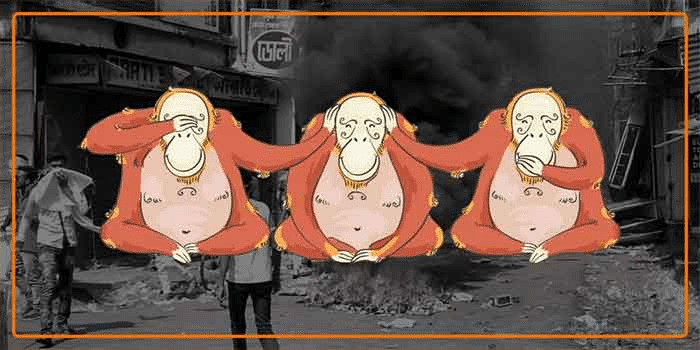
One can imagine that if the plan to provoke riots before Eid in Ayodhya would have been successful, how it could have easily spilled over to the other parts of the country.

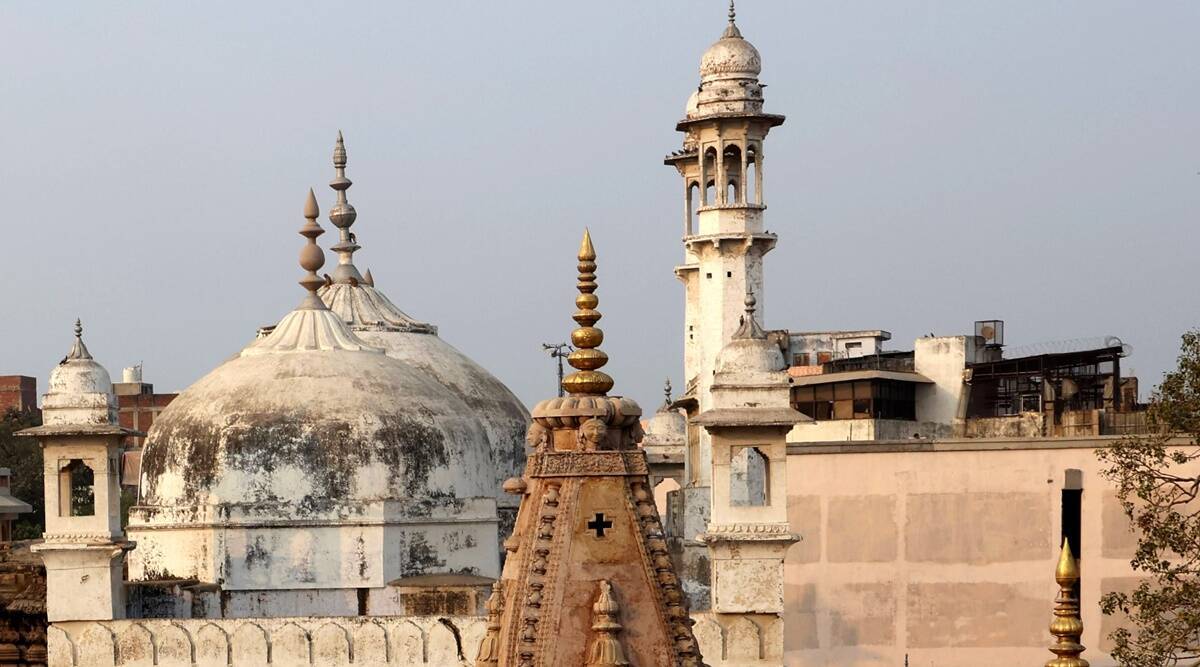
Image for representational purpose. Credit: Hindustan Times

It was the early 1970s when Bhisham Sahni, the legendary Hindi writer had penned the novel Tamas. It looks at the Hindu-Muslim riots in India in the backdrop of the Partition. Its central character is Nathu, who is Dalit and does the work of removing hides from dead animals. A local politician persuades Nathu to kill a pig; the act is later used to foment a riot in the city.

It has been more than 40 years since the novel was written, but it still resonates with today’s India as it throws light on the ‘fault lines’ of Indian society and shows the ease with which they can be weaponised.

A fortnight back, a similar attempt to provoke a riot was made in Ayodhya using a similar technique; however, prompt action by the district police averted a riot there.

( Read the full article here)

Academics and activists in solidarity with Dr Ravi Kant, Lucknow University

We, the undersigned academics and activists, express our deep concern regarding the public heckling, intimidation and abuse directed at Dr. Ravi Kant, Associate Professor of Hindi and well known Dalit intellectual, on the premises of Lucknow University by a mob allegedly comprising students of the university as well as outsiders. Highly divisive and incendiary slogans, which included threats to Dr Ravi Kant’s life, were raised, and the Dept of Hindi of the University was surrounded. Dr Ravi Kant was forced to take shelter in the University Proctor’s office for several hours. The ostensible reason for this protest were remarks that he made in a discussion in the well-known online channel Satya Hindi, about the Gyan Vapi Mosque in Varanasi, in which he cited a story about its origins narrated by Patabhi Sitaramaiya in his book ‘Feathers and Stones’. Dr Ravi Kant, while making this reference, was careful to emphasize that this narrative could only be called a ‘story’, as its author did not cite any source in support. Nevertheless, within less than twenty-four hours of these remarks, a maliciously edited extract of his comment was circulated online which, by the next morning, snowballed into a violent protest which has created a grave threat to Dr Ravi Kant’s safety.

Continue reading Academics and activists in solidarity with Dr Ravi Kant, Lucknow University

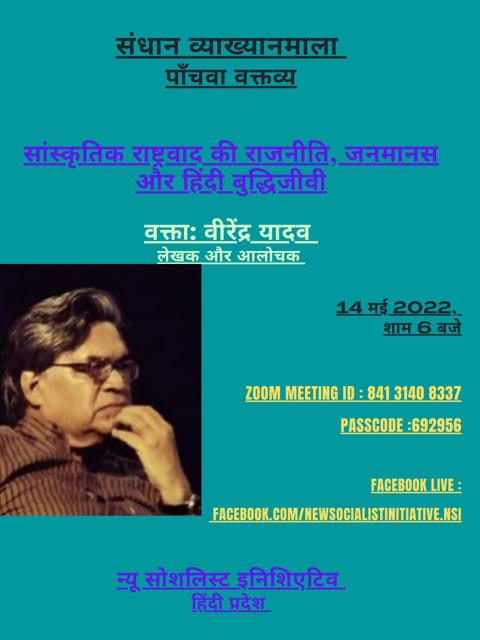
Politics of Cultural Nationalism, People’s Opinion and Hindi Intellectual : Virendra Yadav

Leading Writer and Critic Virendra Yadav will be delivering the fifth lecture in the ‘Sandhan Vyakhyanmala Series’ ( in Hindi) on Saturday,14 th May,  2022, at 6 PM (IST).

He will be speaking on ‘सांस्कृतिक राष्ट्रवाद की राजनीति , जनमानस और हिंदी बुद्धिजीवी’ ( Politics of Cultural Nationalism, People’s Opinion and Hindi Intellectual)

This online lecture would be held on zoom and will also be shared on facebook as well : :facebook.com/newsocialistinitiative.nsi

Join Zoom Meeting
https://us02web.zoom.us/j/84131408337?pwd=ZUp6eWg5WGdYVVY1ZkdzQ3ZzRnhoQT09

Meeting ID: 841 3140 8337
Passcode: 692956

Organised by :

NEW SOCIALIST INITIATIVE ( NSI) Hindi Pradesh

——–

संधान व्याख्यानमाला – पांचवा वक्तव्य

विषय : सांस्कृतिक राष्ट्रवाद की राजनीति , जनमानस और हिंदी बुद्धिजीवी 

वक्ता : अग्रणी लेखक एवं आलोचक वीरेंद्र यादव 

शनिवार, 14 मई , शाम 6 बजे 

सारांश :

1- ‘सांस्कृतिक राष्ट्रवाद’ मात्र एक राजनीतिक व्यूहरचना न होकर एक ऐसी अवधारणा है जिसकी गहरी जड़े पारम्परिक रूप से  हिंदू जनमानस में  मौजूद हैं।
2- 1857 से लेकर 1947 तक विस्तृत ‘स्वाधीनता’ विमर्श में इस हिन्दू मन की शिनाख्त की जा सकती है।
3- स्वाधीनता आंदोलन इस हिन्दू मन से मुठभेड़ की नीति न अपनाकर मौन सहकार की व्यावहारिकता की राह पर ही चला।
4- हिंदी क्षेत्र में तर्क, ज्ञान  व  वैज्ञानिक चिंतन की धारा भारतीय समाज की वास्तविकताओं में कम अवस्थित थीं, उनकी प्रेरणा के मूल में पश्चिमी आधुनिकता व वैश्विक प्रेरणा अधिक थी।
5- हिंदी क्षेत्र व समाज में ज़मीनी स्तर व हाशिये के समाज के बीच से जो तार्किक, अंधविश्वास विरोधी व विज्ञान सम्मत सुधारवादी प्रयास हुए उन्हें मुख्यधारा के चिंतन-विचार में शामिल नहीं किया गया।
6- ध्यान देने की बात है कथित ‘हिंदी नवजागरण’ विभेदकारी वर्ण-जातिगत सामाजिक संरचना की अनदेखी कर प्रभुत्ववादी मुहावरे में ही विमर्शकारी रहा।
7- संविधान सम्मत धर्मनिरपेक्ष आधुनिक भारत की परियोजना में    भारतीय समाज की धर्म व जाति की दरारों के जड़मूल से उच्छेदन को प्रभावी ढंग से शामिल नहीं किया जा सका।
8-सारी आधुनिकता के बावजूद हिंदी बुद्धिजीवियों का वृहत्तर संवर्ग वर्ण और वर्ग से मुक्त होकर   जनबुद्धिजीवी की भूमिका न अपना सका।
9- सामाजिक न्याय की अवधारणा का मन में स्वीकार भाव न होना, हिंदी बुद्धिजीवी की एक बड़ी बाधा है।
10- ‘सांस्कृतिक राष्ट्रवाद’ का प्रतिविमर्श रचने के हिंदी बुद्धिजीवी के उपकरण वही रहे जो हिंदू बुद्धिजीवियों के।
11- हिंदी बुद्धिजीवी के सवर्णवादी अवचेतन से उपजा दुचित्तापन ‘सांस्कृतिक राष्ट्रवाद’ का प्रतिविमर्श रचने में एक बड़ी बाधा है।

आयोजक : न्यू सोशलिस्ट इनिशिएटिव NSI  ( हिंदी प्रदेश)

STOP UNLAWFUL DEMOLITIONS IN DELHI: Women’s groups, other groups, and concerned citizens of Delhi

Letter of Deep Distress and Concern to
THE LG OF DELHI, CM OF DELHI, COMMISSIONER, MUNICIPAL CORPORATION OF DELHI

Stop Unlawful Demolitions in Delhi;
Compensate, Rehabilitate, Restore Livelihoods
of the Affected Immediately

We, the undersigned, wish to express our deep concern at the bulldozer-led demolitions carried out by various municipal corporations in Delhi. As is well known, the first round of demolitions was carried out by the North Delhi Municipal Corporation in Jahangirpuri resettlement colony on April 20, 2022, soon after the communal violence in the area just four days prior to that. The recent visits to and subsequent statement by the SDMC Mayor regarding areas earmarked for future demolition points to the real and present danger that the actions in Jahangirpuri and Kalyanpuri over the past week will be repeated in these areas that have already been named – Shaheen Bagh, Jasola, Sarita Vihar, Jaitpur and Madanpur Khadar.  It is deeply disturbing that demolitions in these areas have been put on hold only because the Delhi Police publicly asked for ten days’ notice in order to cooperate with the order. Massive presence of paramilitary forces in some of these areas as well as frequent processions of slogan shouting crowds led by BJP leaders are contributing to an overall climate of intimidation and terror.

It is appalling that the bulldozers hired by civic authorities are targeting temporary structures essential for livelihood such as handcarts and cycle carts, fruit stalls, gumtis, and wooden ‘shop’ tables. These structures are used all over the country by some of the poorest communities in the city – rickshaw pullers, fruit vendors, women running marginal and subsistence businesses, ragpickers, garbage sorters, vendors and hawkers. The brutality of the action to destroy the precious belongings of some of the poorest residents of the city is unprecedented in the history of Delhi. The affected are overwhelmingly unprotected informal economy workers who have already suffered sudden and severe destruction of their livelihoods during last two years of the coronavirus pandemic and lockdown.  Continue reading STOP UNLAWFUL DEMOLITIONS IN DELHI: Women’s groups, other groups, and concerned citizens of Delhi

Silence of the Powerful

Why the Corporate Czars are Silent over increasing attacks on Social Fabric and rising Communalism 

Celebrity actors and players share an interesting commonality in this part of South Asia.

Their moral compass normally veers towards the ‘righteousness’ of the rich, powerful and the influential.

Lynching of innocent people on the streets for their faith, social and governmental hounding of lovers belonging to different communities, call for genocide of religious minorities from public forums and similar hate filled acts, nothing normally impinges on their conscience.

Corporate elites are qualitatively no different.

Occasionally, there are feeble voices of disagreements also.

What Kiran Mazumdar Shaw – founder of India’s largest biopharmaceutical company Biocon – did was exactly this only. She expressed her indignation about growing religious divide in the country and underlined how it would be detrimental to India’s global leadership in ITBT ( Information Technology and Bio Technology)

Definitely her statement which was couched in ‘economic terms’ was very mild, but it did not stop attacks by right-wing trolls.

( Read the full article here)

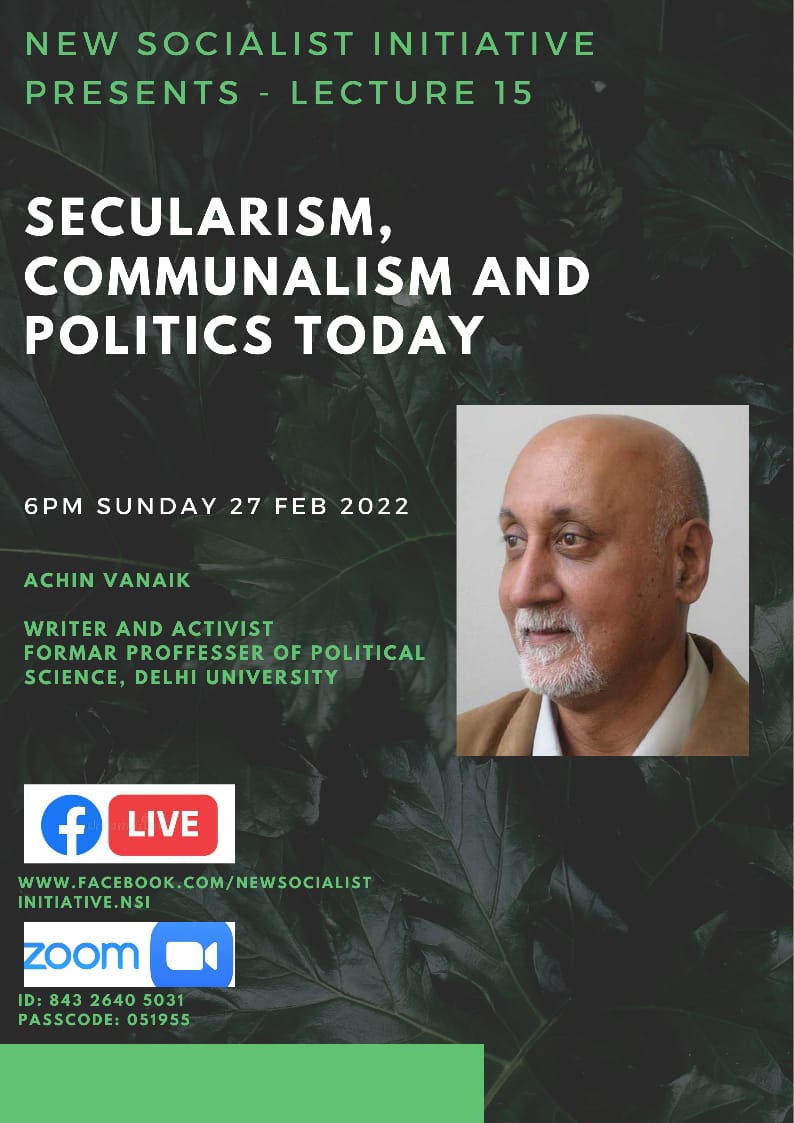
 Secularism, Communalism and Indian Politics Today : Professor Achin Vanaik

The 15 th lecture in the Democracy Dialogues Series will be delivered by Prof Achin Vanaik on Sunday, 27 th February at 6 PM (IST) 

He will be speaking on 

Secularism, Communalism and Indian Politics Today‘ 

Speaker 

Writer and Social Activist, Former Professor of Political Science at Delhi University Prof Achin Vanaik is a fellow of the Transnational Institute

He is author of numerous books including The Furies of Indian Communalism ( 1997) , The Painful Transition : Bourgeois Democracy in India ( 1990) , Hindutva Rising – Secular Claims, Communal Realities (2017), “Nationalist Dangers, Secular Failings:A Compass for an Indian Left”

Summary  : 

The presentation will start with a series of definitions of crucial concepts such as secular, secularization, secularism as well as distinguishing between religious fundamentalism, religious nationalism and communalism. This is important to get a handle on how the widespread Indian understanding of secularism as an ancient form of ‘tolerance’ is dangerously mistaken. Of course the rise of the political right and far-right is a global phenomenon in the last few decades giving rise to different forms of what can be called the ‘politics of cultural exclusivism’. So the first principle of explanation for this rise has also to be transnational. After this the question of the rise of the Sangh/BJP in the wider context of developments in India over time will be taken up. It is obvious that the Sangh/BJP is seeking to expand its existing power and influence i.e., to establish and expand its hegemony and this must be understood as well as what are the projects central to its efforts to establish a Hindu Rashtra or Nation. It should be obvious that its particular conception of how to secure a strong Indian nation/nationalism must be exposed and combated. The presentation will end with recognising that this is a long term struggle and how we must go about it.

New Socialist Initiative 

The psyche and the temptations of Hindu Rashtra: Jaya Sharma

Guest Post by JAYA SHARMA

How is it that even as Uttar Pradesh  goes to the polls, even as desperate youth go on a rampage to demand employment, their Chief Minister remains focused on evoking violent fantasies around the ‘M’ of the Mafia.  How is it that the facts of Kairana matter so little when Adityanath evokes the “Kashmir-like” Hindu exodus?  How is it that the CM’s followers on twitter express their adoration with descriptions of their “mazaa” – enjoyment – at the UP police lathi charge against anti-CAA protestors? [1]

The lethal absurdities of national politics that have liberals and progressives tied up in knots of despair do not belong to the territory of rationality. As we scramble to understand the appeal of Hindu nationalist leaders like Yogi Adityanath, in this article, I would like to draw your attention to the ‘psyche’ as a lens through which to understand the pull of ideologies embodied by such leaders. Might the lens of the psyche also help us consider whether followers of such hardline leaders are ‘zombies’ (as suggested by NDTV’s Ravish Kumar[i], whose fan I am, too) are not as different from us on the liberal or progressive end of the spectrum as we might want to believe?  Might it be, that the extent of difference between the progressive “us” and right-wing “them” is that they stand a much greater chance of enjoying that enviable and rare mix of safety and adventure so elusive in our lives?

Love, Sex Aur Politics

Walk with me for a moment into the territory of sex and love, another part of our lives where rationality seems to lose its grip. Continue reading The psyche and the temptations of Hindu Rashtra: Jaya Sharma

Doctored History : From Ancient Times till Today – Prof Irfan Habib

The 14 th Lecture in the Democracy Dialogues Series  organised by New Socialist Initiative was delivered by Prof Irfan Habib, Famous Historian, Public Intellectual and Marxist Thinker, on Sunday  30 th January 2022 at 6 PM (IST).
Prof Habib spoke on ‘Doctored History : From Ancient Times till Today’


About the Speaker :

Prof Irfan Habib ( Professor of History at the Aligarh Muslim University, Retd) is a well-known historian and author of the The Agrarian System of Mughal India ( 1963), An Atlas of the Mughal Empire ( 1982), Essays in Indian History : Towards a Marxist Perception ( 1985) , The Economic History of Medieval India : A Survey ( 2001) ,  Medieval India : The Study of a Civilisation ( 2008), a multivolume study titled ‘People’s History of India’ etc and has edited many books

The lecture was live on facebook.com/newsocialistinitiative.nsi.

Please write to us at democracydialogues@gmail.com if you are interested in getting updates about coming lectures.

– New Socialist Initiative

p.s. Here is a playlist of  lectures in the series :

 : https://www.youtube.com/playlist?list=PLtXBfoS5KZ78UFI_aYzROjUss8ZzhUKxy.

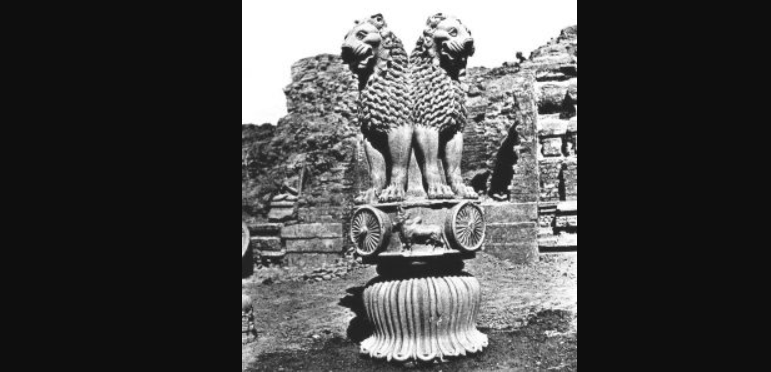
Why Hindutva Loves to hate Ashoka the Great

Ashokan lions adorn Indian currency and the Dharmachakra features in the tricolour. Neither symbol has any sanctity for the ideologues of the ruling dispensation.

ashoka

Thousands of kings and emperors shone for a brief moment in history, then quickly disappeared. But in ‘The Outline of History: The Whole Story of Man’, H.G. Wells writes, “Ashoka shines and shines brightly like a bright star, even unto this day.” The famous British historian EH Carr also wrote, “What is history? It is a continuous process of interaction between the historian and his facts, an unending dialogue between the present and the past.”

Yet, history is a continuous ‘us versus them’ for some individuals and outfits in India. Their interaction with the past typically degenerates into a vicious monologue aimed to vitiate the present and control the future. Nowhere is their vandalism of history more visible than what the Hindutva brigade is doing to the last great Mauryan ruler, Ashoka (304-232 BCE). Often compared with a medieval Mughal ruler—whom the Hindutvadis detest and distort in equal measure—they are now transforming the Ashokan period beyond recognition into a symbol of cruelty and bigotry.

Ashoka is widely known to have filled with remorse after the tremendous bloodshed in the battle of Kalinga. After that, he is known to have devoted his life to “conquest by Dhamma or right/moral life”. It is less known that Ashoka was among the earliest rulers to launch public utilities such as hospitals, encouraged tree-plantation, dug public wells and ordered the construction of rest houses along roads. His commitment to public reason is considered phenomenal, as he, two hundred years before Christ, organised the earliest open general meetings in the world.

( Read the full article here)

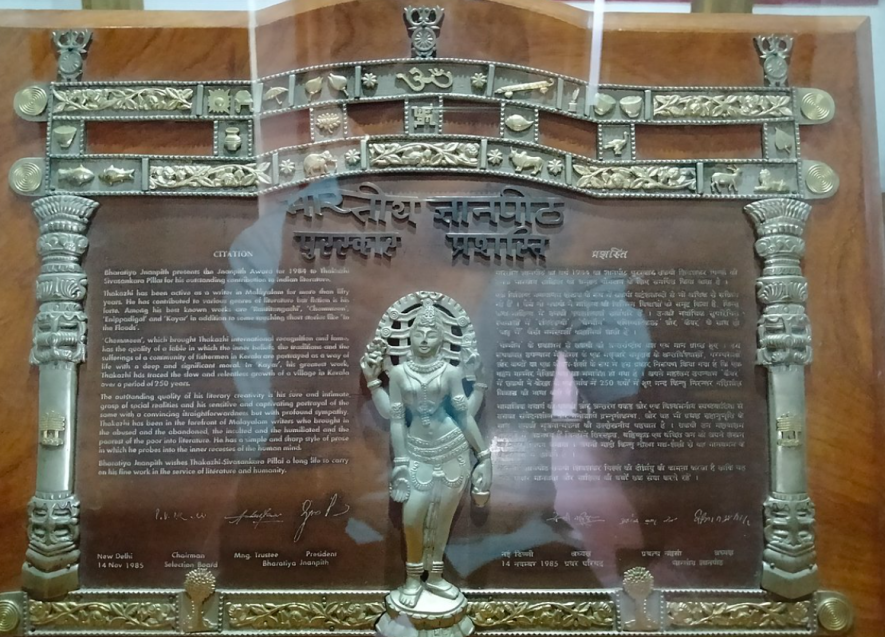
Jnanpith Award to Damodar Mauzo and Right-Wing Extremism

jananpith

The literary award must generate wider discussion in society on what plagues us. After all, the writer has always been outspoken against extremism.

This year’s Jnanpith Award for best literature has gone to Damodar Mauzo, the famous Konkani novelist and short story writer. The great Assamese poetic talent, Nilmani Phookan Jr, has also been awarded the Jnanpith for 2020. Hopefully, as we celebrate “their outstanding contribution towards literature,” our discussions will not remain confined to the literary domain.

In his acclaimed novel, ‘Karmelin’ (1980), Mauzo writes about the abuse of women who go to work as housemaids in the Middle East. This novel came long before everybody started talking about this issue. His story, ‘The Burger’, is about two school friends, Irene and Sharmila, and the guilt little Irene experiences over ‘polluting’ Sharmila with a beef burger. Another story describes how cow vigilantes intimidated a Dalit youth long before others talked about the phenomenon.

Maybe Mauzo could see beyond the immediate and obvious, which prompted his social and political actions on issues of concern to all of society. That social engagement allowed him to observe the dangers that lurked in our society in the form of the right-wing, and gave him courage to never shy away from boldly speaking out against them.

( Read the full story here)

Decolonizing Thought – Beyond Indian/ Hindu Exceptionalism

A Decolonization mural in Oakland, USA, photo HiMYSYeD, Oakland Wiki

This post is prompted by a discussion that followed some remarks I had made on social media regarding the way in which a certain common sense that we may call ‘Hindu Nationalist’, had come to dominate the sensibilities of even those intellectuals in the Hindi world who otherwise might stand opposed to the Hindu Right. ‘Decolonizing’ has lately become a banner of the Hindu Right and for many otherwise secular Hindi intellectuals too, an occasion for an often strident anti-West rhetoric. Such a common sense assumes, simply by default, that the only “authentic” position of critique of the West is one framed by Hindu/ Indian exceptionalism. Needless to say, as I have argued at length in my recent book (Decolonizing Theory), the narrative that structures the imaginative world of many such modern Hindus is already a narrative produced by colonialism.

Continue reading Decolonizing Thought – Beyond Indian/ Hindu Exceptionalism

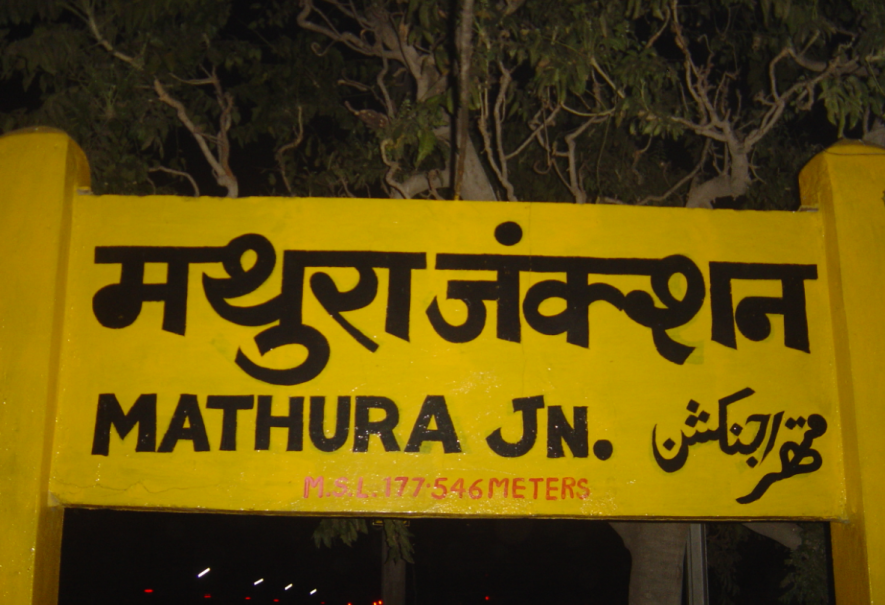
Why BJP Wants Meat Banned in Mathura

The BJP is imposing harmful dietary restrictions and refusing to accept that more Indians want to consume meat, fish and eggs for their nutritional benefits.

Mathura
Representational use only

.

In 1902, the prolific British writer HG Wells delivered a philosophical speech titled “The Discovery of the Future” at the Royal Institution in London. Wells is often remembered for his “predictions”, for example, the approximate date when the second world war would begin. In this speech, he envisioned something else with equally significant ramifications—the collapse of the capitalist system. Wells also anticipated that a world of peace and plenty would follow in its wake.

What if someone, following Wells example, attempts a similar extrapolation for India? If anybody could foresee such things, what would they find lies ahead for the “biggest democracy” in the world?

In the absence of Wells, perhaps present-day events can be a map or guide to the future. For example, during recent Janamashtmi celebrations, Uttar Pradesh, Chief Minister Yogi Adityanath announced that his government would ban meat and liquor in Mathura city. He said the meat-sellers and liquor dealers of the area could switch to selling milk. According to his government, a meat and liquor ban would help combine “modern technology” with the cultural and spiritual heritage of the region.

( Read the full article here)

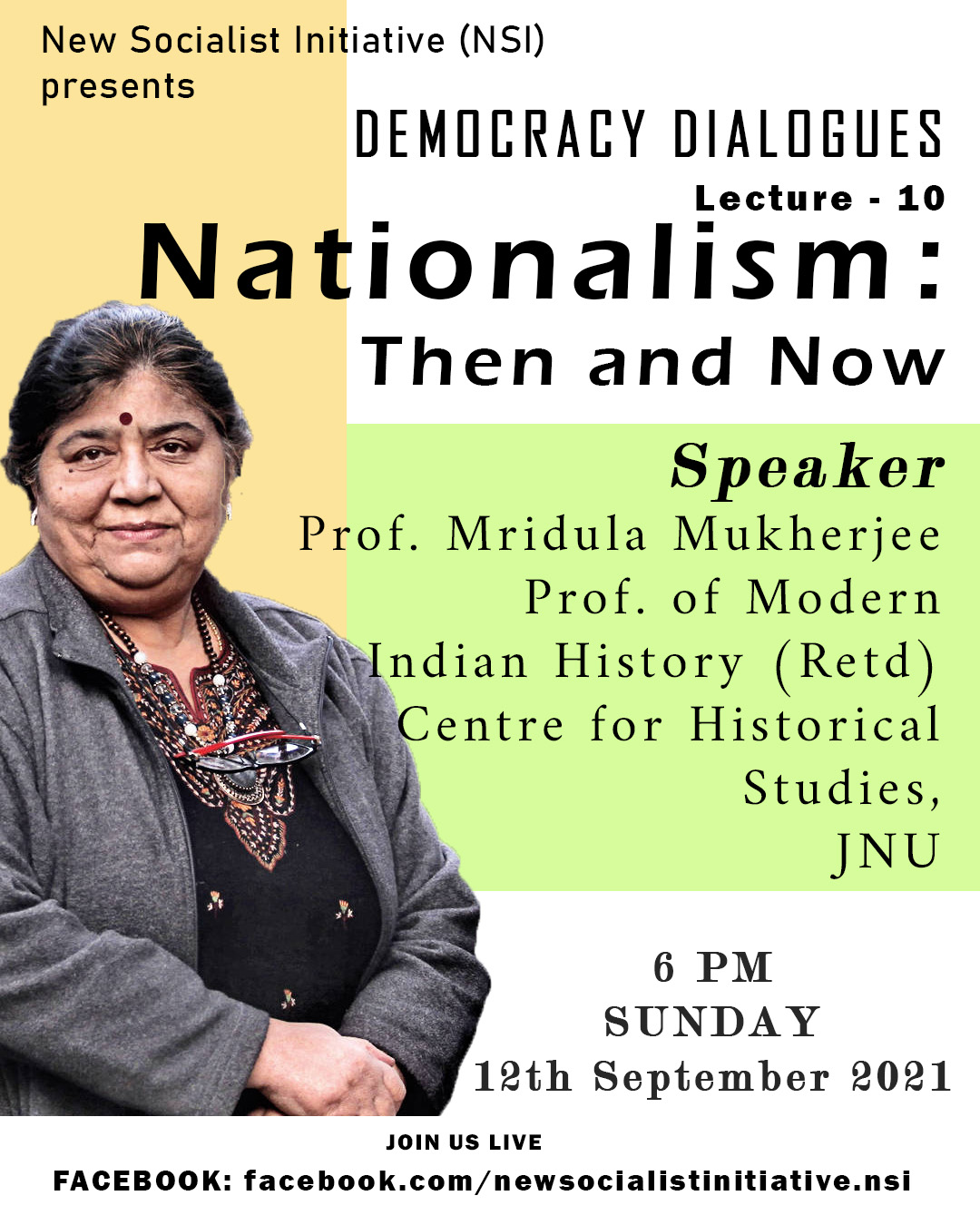
Nationalism : Then and Now – Professor Mridula Mukherjee

The 10 th lecture in the Democracy Dialogues Series organised by New Socialist Initiative was delivered by Prof Mridula Mukherjee ( Retd.) on Sunday, 12 th Sepember at 6 PM ( IST). She spoke on ‘Nationalism : Then and Now’

Prof. Mridula Mukherjee, was associated with Centre for Historical Studies, JNU for a long time and was also Director of Nehru Memorial Museum and Library, ( NMML), New Delhi.

Well known as a historian for her work on the role of peasants in the Indian independence movement, she has authored two important books on the theme, Peasants in India’s Non-Violent Revolution ( Sage 2004) and Colonising Agriculture : Myth of Punjab Exceptionalism ( Sage 2005). She has also coauthored books with Prof Bipan Chandra, Prof Aditya Mukherjee on ‘India’s Struggle for Independence’ ( Penguin 2000) and ‘India After Independence‘ ( Penguin 2008). The monograph ‘RSS, School Texts and Murder of Mahatma Gandhi‘ which she has coauthored with Prof Aditya Mukherjee and Prof Sucheta Mahajan has been widely appreciated.

In this lecture Prof Mridula Mukherjee discussed Nationalism and its origins as a modern ideology, how nations are historical constructs with each nation having its own distinctive historical evolution and the emergence of two kinds of nationalism and how the present notion of aggressive, chauvinistic nationalism is in sharp contrast to the once evolved by the freedom struggle and how the task of preventing the appropriation of nationalism and its creative linking to progressive agenda is the need of the hour.

Please write to us at democracydialogues@gmail.com if you are interested in getting upadates about the series.

The lecture series is available on  facebook.com/newsocialistinitiative.nsi as well.

( Here is a playlist of earlier lectures in the Democracy Dialogues Series :

किसे है बेनक़ाब होने का डर? हिंदुत्व बनाम हिन्दू ‘जीवन-शैली’

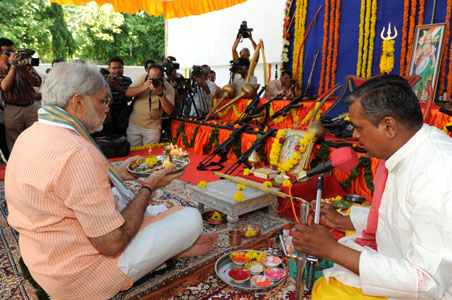
ये हिंदुत्व है हिन्दू धर्म नहीं! गुजरात के मुख्यमंत्री नरेन्द्र मोदी शस्त्र पूजा में मग्न. AFP PHOTO/ SAM PANTHAKY

[यह लेख पहले जनवादी लेखक संघ की पत्रिका नया पथ के जनवरी-मार्च २०२१ अंक में प्रकाशित हुआ था. आगामी 11-12 सितम्बर को अमेरिका में होने जा रहे Dismantling Global Hindutva सम्मलेन से उद्वेलित हिंदुत्व के प्रचारक अब इस सम्मलेन को रद्द कराने की मुहीम में उतर चुके हैं. उनका चालाकी भरा तर्क यह है कि यह सम्मलेन हिन्दू-विरोधी है. इस सन्दर्भ में यह दोहराना बेहद ज़रूरी है कि हिंदुत्व विस्तारवादी फौजी तसव्वुर से लैस एक राजनीतिक विचारतंत्र जो हिन्दुओं के नाम पर हिंसात्मक राजनीती करता है मगर इसका हिन्दू धर्म या जीवन शैली से कोई सम्बन्ध नहीं है. इस वजह से इस लेख को यहाँ साझा किया जा रहा है.]

“समस्त राजनीति का हिन्दूकरण करो और हिन्दूतंत्र का सैन्यीकरण करो – तब हमारे हिन्दू राष्ट्र (नेशन) का पुनरुत्थान होना तय है, उसी तरह जैसे अंधेरी रात के बाद सुबह का आना अनिवार्य होता है”। – विनायक दामोदर सावरकर, 25 मई 1941 को अपने 59 वें जन्मदिन पर हिंदुतन्त्र (हिन्दूडम) के नाम संदेश।

“हमारी भुजायें एक ओर अमेरिका तक फैली थीं – कोलंबस के अमेरिका ‘आविष्कार’ से बहुत पहले – तो दूसरी ओर चीन, जापान, कम्बोडिया, मलय, श्याम, इंडोनेशिया और समस्त दक्षिण-पूर्व एशिया तक फैली हुई थीं, और उत्तर में मंगोलिया और साइबेरिया तक। हमारा शक्तिशाली राजनीतिक साम्राज्य इन दक्षिण-पूर्व एशियाई क्षेत्रों तक फैला था और 1400 वर्षों तक जारी रहा, अकेले शैलेन्द्र साम्राज्य 700 वर्षों तक फलता फूलता रहा – और चीन के विस्तार के खिलाफ़ चट्टान की तरह खड़ा रहा”। – माधव सदाशिव गोलवालकर, राष्ट्रीय स्वयंसेवक संघ के दूसरे सरसंघचालक, बँच ऑफ थॉट्स, विक्रम प्रकाशन, बंगलोर, 1968, पृ 9 

हिन्दुत्व-विचारतंत्र के इन दो महारथियों की ये उक्तियाँ पढ़ने के बाद आइए अब एक उद्धरण उस शख़्स का देखें जिसे हिंदुत्ववादी हड़पने की पुरज़ोर कोशिश किया करते हैं। ये शख़्स और कोई नहीं स्वामी विवेकानंद हैं। मुलाहिज़ा फरमाएं :

Continue reading किसे है बेनक़ाब होने का डर? हिंदुत्व बनाम हिन्दू ‘जीवन-शैली’

If Hindutva is dismantled, whom will it harm?

An upcoming conference in the USA, “Dismantling Global Hindutva”, organized by Indians in the USA, most of whom are legally “Hindus”, and supported by over 40 US universities, has provoked the ire of the Hindu Rashtravaadis there as well as in India. Conflating Hindutva with Hinduism is the first step. Based on this, the Hindu American Foundation claims this conference is “Hindu phobic”, that it will put the well-being of Hindu students and faculty at risk, and that “they may feel targeted or threatened, or face hostility or harassment” as a result of “the kinds of generalisations, misunderstandings, and ‘otherising’” the event will perpetuate.

Ho hum. Just another day in Hindu Rashtra-that-is-India then, for most of us “Hindus” who oppose the politics of Hindutva that promotes misunderstandings and otherises us, all the way to mob and media violence, lynchings and jail. It is from Hindutva that “Hindus” are most at risk in India today, not from any non-Hindu “Other”.

(Why these repeated quotation marks around “Hindu”? We will come to that).

An article in Firstpost uses words like “genocidal” and “xenophobic” to describe what this conference is going to be. The conference brochure shows “Rashtriya Swayamsevak Sangh (RSS) figures being uprooted, roots and all, with the claw end of a hammer”, and this is “genocidal” according to the author. Showing the German Nazi Party being uprooted would amount to genocide too, in this understanding, perhaps? Since Hindutvavaadis are actively seeking co-victimhood with victims of anti-Semitism, as another article explicitly states, they might want to reconsider this second conflation, of the neo-fascist RSS with “Hindu”. This second article says the conference will “dehumanize Hindus everywhere” and asks indignantly if a conference titled “Dismantling Global Jewry” would be acceptable. Continue reading If Hindutva is dismantled, whom will it harm?

Hindutva is not Hinduism: Hindus for Human Rights

An upcoming conference in the USA titled Dismantling Hindutva is being attacked by the Hindu right-wing both in the US and India as “anti Hindu” and “racist”.  See for example, this link and this and this.

This post is a letter sent to American Universities supporting the conference by US-based HINDUS FOR HUMAN RIGHTS.

To: All universities and departments co-sponsoring the academic conference on Hindutva (Hindu nationalism) on September 10-12, 2021 

Re: We are Hindus who support academic freedom and the “Dismantling Global Hindutva” conference on September 10-12, 2021

We are writing to you on behalf of Hindus for Human Rights (HfHR), a two-year old advocacy organization that provides a platform for progressive Hindus to speak out in support of democratic freedoms and pluralism.

HfHR advocates for civil and human rights in South Asia and North America, rooted in the values of our faith: shanti (peace), nyaya (justice) and satya (truth). We provide a Hindu voice of resistance to all forms of bigotry and oppression based on one’s faith, color, caste, gender, or sexual orientation.

We also staunchly oppose the misappropriation of our Hindu faith by the ideology of Hindutva (also frequently referred to as Hindu supremacy, Hindu nationalism, etc.), whose foundational principle is to redefine over 200 million Muslim and Christian citizens of India as the ‘other,’ who do not legitimately belong and must therefore either accept second class citizenship or be displaced from their homeland. Continue reading Hindutva is not Hinduism: Hindus for Human Rights

Planted evidence and the Bhima Koregaon-Elgar Parishad 16 – Citizens’ statement demands immediate release

We, the undersigned, condemn the continued incarceration of the academics, cultural activists, human rights activists, lawyers, poets and trade unionists arrested in the Bhima Koregaon-Elgar Parishad case and unitedly demand their immediate release. After three years of media trial, harassment, raids and arrests of 16 persons, one of the arrested, Father Stan Swamy died on July 5th following wanton medical neglect in custody amounting to institutional murder.

Those who remain in custody include professors Anand Teltumbde, Hany Babu and Shoma Sen, cultural activists Jyoti Jagtap, Ramesh Gaichor and Sagar Gorkhe, writer and anti-caste activist Sudhir Dhawale, anti-displacement activist Mahesh Raut, lawyers Arun Ferreira, Surendra Gadling and Sudha Bharadwaj, human rights activists Gautam Navlakha, Rona Wilson and Vernon Gonsalves and poet Varavara Rao. Now, with the revelations in the Pegasus Project, it is clear that 8 of the 16 were under surveillance for several years before their arrest. Moreover, the Arsenal Consulting reports show how evidence was planted in the devices of at least two of the arrested. The revelations have unambiguously exposed the extent of illegal military-grade surveillance on the arrested, their families, colleagues and friends. Besides violating their privacy, the extraordinary measures taken to silence voices of dissent in the name of national security stands exposed.

Continue reading Planted evidence and the Bhima Koregaon-Elgar Parishad 16 – Citizens’ statement demands immediate release

Support Afghan women’s demand for a just peace guaranteeing the rights of all people

JOIN THE 1200 human rights and women’s rights defenders and civil society activists who have signed this petition.

Text of petition below. Link to sign the petition.

Women of Afghanistan demand a just peace that guarantees the rights of all people.

We, the true friends of Afghanistan and signatories of this open letter, declare our support for Afghan women’s demands expressed below, and join them to call on the United Nations, the government of Afghanistan and national and international actors to fulfill their obligations and undertake responsible measures that would lead to a just peace that protects the interests and rights of all the people of the country.

The women of Afghanistan have suffered through ruinous wars for more than 40 years. Their lives have been impacted by a war in which they have played no role, and which has resulted in in the loss of their human dignity, as well as their innocent sisters and mothers, spouses, children and young people, during a cycle of endless violence, sexual apartheid, kidnapping, rape, slavery, absolute poverty and injustice. Their houses have been destroyed, their children have become orphans and several generations of our people have been displaced in their own land, as well as in the regional states and the world-over.

Continue reading Support Afghan women’s demand for a just peace guaranteeing the rights of all people

Conceptualizing the Counter-Revolution in the Seventy-Fifth Year of Independence

[‘Parapolitics’ began on 16 January 2020 as a weekly column at the height of the anti-CAA movement. After eight weeks, it was made into a fortnightly column and now, eighteen months and 44 posts later,  beginning with this post, this column will now appear once a month, on the second Saturday of every month.]

The courageous National Dastak reporter Anmol Pritam was being forced by the demonstrators to chant their slogans. 
Image courtesy The News Minute


What happened at Jantar Mantar on 9 August – the anniversary of the Quit India movement – was not just violently anti-Muslim in the slogans raised; it was also symptomatic of the larger counter-revolutionary shift that has taken place in our politics. That Quit India or the ‘August revolution’ day was sought to be taken over as a final gesture of that grand victory that the Sangh Combine believes it has already won, is telling. It is telling also because it is a formation that studiously stayed away from the mainstream of the anticolonial struggle but now wants to take over that legacy and saffronize it. How the rally was organized and continued to be held despite the police claiming it had no permission to do so, does not remain so much of a mystery once you realize that the key organizers are Sangh/BJP leaders or parts of the larger network of terror associated with them. But that is another matter. It is important to recognize that incidents like these are but signs of a new stage in the ongoing counter-revolution where the Hindu Right is no longer content with claiming its own distinctiveness in opposing mainstream (Congress-led) nationalism but is out to make a determined bid to appropriate the entire legacy of that nationalism. The insistence, in recent times, on the national tricolour as a sign of its aggressive nationalism, is entirely of a piece with this attempt to occupy the mainstream.

Continue reading Conceptualizing the Counter-Revolution in the Seventy-Fifth Year of Independence

resisting the papa state? E Bull jet brothers or hadiya?

In the recent controversy over the arrest of the travel vloggers Ebin and Libin who rode high on popularity with lakhs of subscribers through their Youtube channel E Bull Jet, it is very hard not to side with the two young men. The flamboyant pair whose hugely popular travel — or ‘van life’ — videos have a massive following especially among male adolescents and youth — are school drop-outs and have a history of rising from severe social disadvantage — literally, of pulling themselves up by their own bootstraps. The two young men, despite their excesses, pull at your heartstrings. Their smile, their slang, their sense of excitement on the road, the innocent gawking — all of it looks disarmingly innocent. It is also true that the crime they committed was not major; nor is justice handed out evenly. That is, such crimes around vehicles and driving are not new and it is not at all clear if the powerful who commit such crimes are tackled in the same way. Therefore the video which showed the brothers being hauled into the police van was painful for many of us (including me) — Ebin wept aloud, “adikkalle saare! Njaan onnum cheithilla … kolapaathakiyeppole enne kondupokunnu….” (don’t beat me please, sir. I didn’t do anything wrong . … I am being taken away like a murderer). That despondent wail somehow refuses to get out of my head; that is why I need to write this.

Continue reading resisting the papa state? E Bull jet brothers or hadiya?

The Subjugated Subjects of a Free Country and The Creation of the New Colony: Dipankar Bhattacharya

Guest post by DIPANKAR BHATTACHARYA

This piece was originally published in Bangla in the Ananda Bazar Patrika and has been translated into English by Arundhati Ghosh

The 1857 Revolt, representational image courtesy TheHansIndia

“Freedom – you are a room in the garden, the song of the koel, the sun drenched leaves of the old banyan tree, the page of my book of poetry where I can write as I wish.” Poet Shamsur Rahman wrote this immortal poem Freedom You during the war of the independence of Bangladesh. It could be said that this poem that arose from deep within Bangladesh’s struggle for liberation is a universal manifesto of freedom. Bangladesh has crossed its 50th year of independence. And in India we are standing at the threshold of our 75th. But where is that song of the koel, that book of poetry where one can write anything one wants? The rally of death that we are witnessing during this Covid-19 era has left the koel woeful, the leaves of the banyan devoid of its sparkle and the pages of our book of poems imprisoned under the UAPA or sedition laws or subjected to the surveillance of the snooping Pegasus vision of conspirators passing for ministers.

Continue reading The Subjugated Subjects of a Free Country and The Creation of the New Colony: Dipankar Bhattacharya