Category Archives: Violence/Conflict

Citizens’ Protest in Delhi Against Killings of Kashmiris by the Indian State

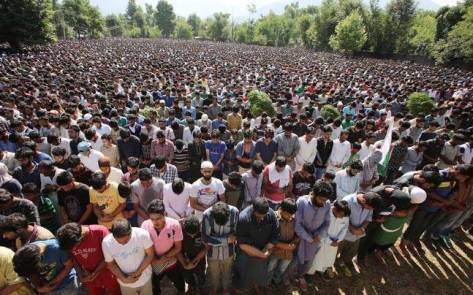
Several hundred people from all walks of life (Civil Rights Activists, Labour Activists,  Peace Activists, Feminists, Queer Activists, Advocates, Students, Workers, Artists, Writers, Academics, Filmmakers,Independent Left Activists, and unaffiliated individuals across generations, from Jammu & Kashmir, from Delhi, and from other parts of India) gathered this afternoon (July 13, 2016) for a silent protest march and meeting at Jantar Mantar, to protest against the last three days of brutal assault by police, paramilitaries and armed forces in the Kashmir valley that have left 35 dead, several blinded (especially due to the indiscrimnate use of pellet guns) and scores of people critically injured over the last three days.

The protestors at Jantar Mantar wore black bands, and carried signs condemning the state’s violence. The protestors carried signs with the names of each of the thirty six individuals who have been identified as having died over the last three days. Each sign identified a deceased person by name, the town or village they were from, and asserted that they “will not be forgotten“. In this way, this corner of India’s capital bore witness to each person, man, woman or child killed by the Indian state since troops began firing into protests that began to mourn the extra-judicial assassination of Burhan Wani three days ago.

This slideshow requires JavaScript.

Continue reading Citizens’ Protest in Delhi Against Killings of Kashmiris by the Indian State

Terms of Endearment – Kashmir and the Possessive Cartography of the Indian Nation-State: Jhuma Sen

Guest Post by JHUMA SEN

Kashmir – the average Facebook trotting, Twitter wielding, middle-class Indian will assert – is an inalienable, inseparable part of Bharat Mata, the anthropomorphic representation of cartographic territorial sovereignty of India. Atoot Ang or inseparable organ. Yeh Fevicol ka majboot jod hai, tutega nahin.

The adhesive in this case is a deadly cocktail of an occupying power periodically using the spectacle of a ritualistic and performative violence to discipline and punish the colony, brutalizing every peaceful protest, responding to stone pelters with bullets, and prisoners with execution, to satiate some imagined collective conscience that sleeps like a baby when a three-year old is shot with his father, a ‘former terrorist’. But Kashmir belongs to India, in the same way Kiran belongs to Rahul in the famed Bollywood film of 1998, Darr: A Violent Love Story, the Wikipedia page of which describe it as a ‘romantic psychological thriller’. [i] The film traces the ‘romantic’ obsession of Rahul (Shah Rukh Khan) with Kiran (Juhi Chawla)—the serenading Rahul, the stalker Rahul, the fragile male ego Rahul, the violent Rahul, the abductor Rahul, the killer Rahul and a traumatized Kiran simply wanting to be left alone and desiring freedom from the wretchedness of Rahul’s ‘love’–Tu Haan Kar Ya Na Kar, Tu Hai Meri Kiran (Whether you agree to it or not, Kiran, you are mine’). The relationship between Rahul and Kiran (or for that matter any violent and delusional relationship) mirrors the relationship between the Indian State and Kashmir—the desire to control and the desire to be free. Continue reading Terms of Endearment – Kashmir and the Possessive Cartography of the Indian Nation-State: Jhuma Sen

Citizens’ Statement On Kashmir

Kashmir – Cry my beloved country: Gautam Navlakha

Guest Post by GAUTAM NAVLAKHA

burhan-wani-story_647_070916051953Image courtesy India Today

Burhan Muzaffar Wani and his comrades were born and died in the phase of militancy in Jammu and Kashmir that symbolizes the watershed in politics in J&K; pre and post ‘89-90. Unlike in the past, indigenous militants now neither travel to Pakistan for guns or for arms training. Armed resistance and its indigenous roots are etched on the faces of these young men.  Burhan’s killing on July 8 and following that, the turnout at his funeral as well as the protests that broke throughout the  state have rekindled memories of the early 90s, especially the death of Ashfaq Majid in 1990, which too had seen mass outpouring of rage.  Burhan and his comrades knew they would not survive for long; seven years is the average life span of a militant in Kashmir, as Burhan’s father poignantly stated long before his death.  Not because that was their own choice, but it was the only choice offered to a people by a ruthless military suppression by a state that has refused to recognize the popular demand for right of self determination.

Indians remain ignorant of the depth of the passion for ‘Azaadi’ from forced union with India, a union imposed in myriad ways. The policy of land grabbing to settle ex servicemen from outside the state (an old project of RSS); allowing non-state subjects unhindered access to land for industry, real estate, mining, for setting up fortified colonies for migrants; where control of the state government, especially Kashmir based ruling parties, over administration has always been circumscribed by New Delhi; and financial dependence  compounded by autonomy of the military from the purview of representative government – all of these point to the fact that the reins of government are held in New Delhi. Continue reading Kashmir – Cry my beloved country: Gautam Navlakha

The Killings in Kashmir: Kavita Krishnan

Guest Post by KAVITA KRISHNAN

An appeal to the conscience of every Indian citizen – to tune down the shrill media noise for a bit, take a step back from the easy, packaged ‘discourse’ being dished out, and ask try and ask ourselves some uncomfortable but necessary questions. 

I am being asked by various persons in the media to comment on my apparently ‘controversial’ and ‘shocking’ claim that Burhan Wani’s killing was extra-judicial’ and must be probed. Let me begin with a few remarks about this issue.

For most Kashmiris, it may not matter all that much whether or not Burhan Wani was killed in a ‘fake’ encounter or a ‘genuine’ one. What matters is that the Indian State killed him – just as it has killed and is killing so many other Kashmiri youngsters. Their grief, their rage, does not depend on the authenticity or otherwise of the encounter. They have no expectations of due process or of justice from the Indian State. It it civil liberties activists who – in what sometimes feels like an exhausting, futile exercise – demand that due process be followed, that the mandates of the Indian Constitution be respected, that the armed forces in conflict areas be held accountable.

Continue reading The Killings in Kashmir: Kavita Krishnan

Kashmir Burns, Again

A hundred and twelve lives, most of them young, some very young, were lost in Kashmir when the army, paramilitaries and police forces opened fire on several occasions from June to September in 2010. That was only six years ago. The latest reports indicate that around twenty three lives have already been lost in the last two days alone, in the aftermath of state troopers, soldiers and paramilitaries firing at funeral protests, after Burhan Wani, a twenty two year old insurgent, who had acquired the aura of a folk hero in Kashmir, was killed in an ‘encounter’, along with two of his associates, on Friday morning in a village in Kokernag.

Several more people have sustained serious injuries. The body count is likely to rise. Curfews have returned, phone and internet links are suspended, but nothing seems to keep people from spilling out onto the streets, and unlike previous instances, the communications ban seems to be unworkable. No one can pretend that Kashmir is not in crisis, again, today.

The people in power, at the state and the centre, were different in 2010. Omar Abdullah, then chief minister of Jammu and Kashmir, was offering mealy mouthed rationalizations for killing kids then, while Mehbooba Mufti, was weeping crocodile tears. It is the other way round right now. Omar is being ‘sensitive’, Mehbooba, who the roll of the dice has placed in the position of chief minister now, is ’sullenly’ presiding over a badly timed by-election victory. Prime Minister Manmohan Singh was silent then, Prime Minister Narendra Modi is playing percussion instruments in Africa now. If Nero played the harp while Rome burnt, Modi beats drums while Kashmir goes up in flames.

Continue reading Kashmir Burns, Again

Kashmir Under a State of Emergency: JKCCS

Guest Post by JKCCS : Jammu & Kashmir Coalition for Civil Society

Since the extra-judicial execution of Commander Burhan Wani and two other members of Hizbul Mujahideen, Indian armed forces and Jammu and Kashmir Police have used excessive force to thwart the mourners from protesting and participating in the funeral processions of the slain militants. So far, around 17 civilians have been killed in Islamabad, Kulgam, Shopian and Pulwama districts, while as more than 350 people have been injured from across all districts of the Kashmir valley. There are reports that CRPF and Police have been involved in the destruction of movable and immovable properties. Curfew has been strictly imposed in all districts of Kashmir, but people are defying the curfew at various places.

It is shocking and painful that Indian armed forces have yet again unleashed terror on the mourners and protesters, resulting in massive civilian casualties. The police and armed forces appear to have free hand to kill, injure, torture and destroy property. The government of India and Jammu and Kashmir lack the will to institute a crowd control policy, which can ensure no or minimized civilian casualties. On the one hand armed forces are preventing the injured to be ferried to hospitals, at the same time senior police officials without any credible investigations have begun to accuse the dead and the injured for their own bloodshed. Additional Director General of Police, S.M. Sahai, yesterday in the press conference accused the protestors of looting the weaponry from the Police Station Damhal Hanjipora and then for using it against the police men. Government should reveal the names of those police personnel who were injured by the firearm used by the civilians and where are they being treated; otherwise Mr. Sahai claim is part of the regular government psy-ops. Continue reading Kashmir Under a State of Emergency: JKCCS

Moral Police-Police!


The Kerala police has once more revealed how utterly unreconstructed it is since colonial times, in their brutal attack on transgender people in the city of Kochi. Stuck in 19th century Victorian morality on the one hand, and in the unabashed sense of power that only colonial authority can bequeath, these policemen thought it perfectly alright to use violence to correct what they perceive as a ‘moral problem’, sex work and that too, by transgendered persons. Continue reading Moral Police-Police!

सी पी एम के भीतर जनतांत्रिक विरोध के अधिकार का प्रश्न – जगमती सांगवान के बहाने

सी पी एम या भारतीय कम्युनिस्ट पार्टी (मार्क्सवादी) पिछले दिनों अपनी एक सदस्य की वजह से खबर में रही. अनुशासनहीनता के कारण जगमती सांगवान को पार्टी से निकालने का निर्णय किया गया,ऐसी सूचना उसके वक्तव्य में दी गई है. जगमती पार्टी की केन्द्रीय समिति की सदस्य थीं.

जगमती सांगवान को पार्टी से निकाला बाद में गया, केन्द्रीय समिति की बैठक के दौरान ही पहले वे बाहर निकल आई थीं और प्रेसवालों के सामने पार्टी छोड़ने का ऐलान कर दिया था.लेकिन कम्युनिस्ट पार्टी में ही नहीं,किसी भी पार्टी में शायद ही किसी सदस्य को खुद पार्टी से अलग होने का गौरव लेने दिया जाता रहा हो! यह फैसला पार्टी ही कर सकती है कि सदस्य का रिश्ता पार्टी से कैसा और कितना लंबा होगा.इसलिए कम से कम इस आधार पर सी पी एम की आलोचना करने के पहले पार्टियों के तंत्र की आलोचना करने की आवश्यकता होगी. Continue reading सी पी एम के भीतर जनतांत्रिक विरोध के अधिकार का प्रश्न – जगमती सांगवान के बहाने

Hindutva Lands on Foreign Shores – A View from the Gallery: Rebecca de Souza

Guest post by REBECCA DE SOUZA

Recently, I received the opportunity of a lifetime when I was invited to attend Indian Prime Minister (PM) Modi’s address to the joint session of US Congress on June 8th, 2016. When I got the call from Congressman Nolan’s office, I was surprised to say the least. I am not involved in politics, I did not know Rep. Nolan personally, and have not made any significant monetary contributions to politics in either country. My first reaction was to say no, because PM Modi and I could not be further apart on the political spectrum. But soon the significance of what had happened dawned on me. I, an Indian American, an academic, had just received an invitation from a US Congressman who knew about my work and had picked me to be his guest. As a minority in both countries, a Christian minority in India and an ethnic/ racial minority in the US, I was invited to a place of power which typically would be inaccessible to a person like me. Ironically, as an Indian-American I had more access to a transnational political arena than as an Indian living in India. I arrived in DC with eager anticipation not knowing what would unfold.

Attending PM Modi’s address has provided me with unique insight into transnational politics and my own identity as an Indian-American and one who is “not a Hindu”. As I was sitting in the gallery with other Indian Americans, I realized that in a post-liberalization world where political contributions flow easily across borders, Indian Americans play a huge role in the political economy of India and the message of Hindutva has become the single most powerful way to unite this group.

The term Hindutva refers to a nearly hundred year socio-political project promoted by right wing Hindu nationalist groups, which redefines people living in India as “Hindu” based on geographic, racial, and cultural identity. The Hindutva project is centered on the “invention of archaic Vedic Hinduism” and Vedic Aryanism and the belief that “…it was in India that Aryans had either originated or achieved the pinnacle of their culture and civilization which they had then bestowed on the world”.  While Hinduism has been known for being a diverse religion, Hindutva’s project is to construct a homogeneous Hindu community through universalizing upper caste practices and values to all castes and classes. [1] Continue reading Hindutva Lands on Foreign Shores – A View from the Gallery: Rebecca de Souza

Stop Trying to Portray Us as Extremists: Dalit Human Rights Movement

The police investigation about the bomb blast at the Kollam Collectorate on 15 June 2016 has now turned against us. Neither the organization nor its activists have any involvement in this incident. The accusation against us is just a ploy to use draconian laws such as the UAPA to destroy dalit-adivasi resistance.

The demeaning and enslaving social norms in Kerala have, since centuries, denied dalit people the most basic human rights such as the right to education, the right to decently clothe one’s body, the right to travel on public roads, and express one’s views. But India became a democracy that aimed for social democratisation, and Dr B R Ambedkar raised the possibility of social equality and reservations for the underprivileged groups through the Indian Constitution. Yet, sixty-five years later, the classes fundamental to this society have made no social, economic, or cultural progress and they continue to endure caste slavery and and exploitation in all areas of public life. The mainstream political parties who surfaced as the protectors of these classes have never offered them complete protection at any time. Though they have been faithful followers and workers of these parties, members of the disadvantaged groups have had little economic security; they have lacked social education; they have had to cry out for tiny parcels of land. Continue reading Stop Trying to Portray Us as Extremists: Dalit Human Rights Movement

Crushing Dignity, Force-feeding Honour: The CPM is Back in Form Again!

The hunt, it seems, is on again. The CPM in power has begun to show its fangs again, and shamefully, they seem to threaten only dalit people who refuse and criticise their disciplinary/welfarist embrace.  In north Kerala, two dalit women were arrested for having allegedly attacked a DYFI leader who abused them in casteist terms. In the south, the persecution of the Buddhist Dalit Human Rights Movement (DHRM)seems to have begun afresh, with the police and the press foisting on them responsibility for the recent bomb blast at the premises of the Kollam Collectorate. The two women mentioned belong to the Congress party; as for the DHRM, the CPM has had a long-standing grouse against them, carried forward now from their last term in power. I am not sure, but the recent ouster of Laha Gopalan, the leader of the Chengara land struggle in the wake of the CPM’s return to power, could be part of this story too. I have no love lost for that man, who evoked the name of Ambedkar but ran the village set up by the landless in Chengara like a crude caste headman. But the timing of his expulsion and the way the village seems to be under the thumb of the police arouses discomfort. Continue reading Crushing Dignity, Force-feeding Honour: The CPM is Back in Form Again!

Of men, women, caste and cinema: Rita Kothari

Guest post by RITA KOTHARI

 “Woh kam-jaat  ladka hai. Phir kaise uske saath bhag gayi?  Sochna tha na  pehle?”  (He is a low-caste boy, why did she elope with him then? Shouldn’t she have thought of this?”)

Vimala’s judgment was unequivocal. She was talking about Hansa, her neighbour  and my former ‘help.’  Hansa  is  a young girl , perhaps seventeen,  and she  recently eloped with a boy. I stopped myself from saying anything facile, as yet.

“Ab pyaar poochhke to hota nahin, “ I said to her.  Love seeks no permission.

To bhugatna bhi padta phir.”  Then be ready to suffer, Vimala quipped.

She went on to tell me about an incident she had witnessed in her village,  about 30 kilometers away from the big town of Dungarpur in Rajasthan. A Rajput girl and Sewak boy eloped. They settled down in some city, and ten years went by. Meanwhile the girl had a child and was carrying her second baby. Her family had managed to track her whereabouts and convinced that she would be welcome home. The couple returned to the village for a visit. One night the girl’s brother put out lights in the entire village. The young couple was killed.

Poore gaanv ki bijli band kar di, aur maar dala dono ko. Humne dekha apni aankhon se,” Vimala said.

I stood transfixed. What was more accurate here, fiction or life?  I had just returned from watching the  Marathi film, Sairat.

Continue reading Of men, women, caste and cinema: Rita Kothari

India vigils in memory of Orlando shooting victims

FROM ORINAM

The mass shooting in Pulse, a gay nightclub in Orlando, Florida, US, on the night of June 11, resonates with those of us who have faced intolerance, hatred and violence simply for being who we are. The lesbian, gay, bi, trans*, intersex, queer, ally and other (LGBTIQA+) communities in India stand in solidarity with the families, biological and chosen, of the victims of this senseless crime.

LGBTIQA+ people have always been at the receiving end of bigots from all faiths, and we register our protest against initiatives by ideologues of all stripes to use this incident to advance political and personal agendas of xenophobia and Islamophobia. Bigotry is a form of violence against a community, and we stand firmly against all attempts to make this part of a global anti-Islam narrative, just as we resist the dastardly celebration of this incident by homophobic groups.

We condemn all forms of hatred and violence, whether based on sexuality, gender, religion, caste or ethnicity.

Protests and vigils are being planned in the following cities and towns.

FOR DETAILS SEE ORINAM.NET

Ashley Tellis ko Gussa Kyun Aata Hai? What makes Ashley Tellis so Angry: Pallavi Paul

Guest Post by Pallavi Paul.

[ This is a response by Pallavi Paul to a post by Ashley Tellis titled ‘Indians are racist, but Africans are not nice either’ that was published recently on the Daily O]

Let me, at the outset state that I feel almost bad taking on such a soft target . I say soft because there is nothing redeemable about Ashley Tellis’ hatred towards ‘dangerous’, ‘morally corrupt’, ‘threatening’ and most importantly ‘unfriendly’ Africans. However, because we are dealing with someone who stakes claim in political-critical thought (or so I am told), this is important to do.

While Tellis cursorily signposts the odd murder and some statements made by a few ministers, he dedicates the rest of the article to creating a portrait of these “Africans” (an all subsuming term that can accommodate an entire continent). By having been a resident of Kishangarh, a colony in Delhi where some ‘Africans’ also happen to live, he takes on the role of the expert in ‘African’ behavior. He produces eye witness accounts of the depravity of these people.

Continue reading Ashley Tellis ko Gussa Kyun Aata Hai? What makes Ashley Tellis so Angry: Pallavi Paul

The Bose Republic


The recent violent event in Mathura has  outraged many people. But more than anger, there is bewilderment. It is difficult for people to accept that right in the heart of a town like Mathura, part of the mainland, there existed and flourished  a liberated zone. Liberated zones in our imagination are created only by Naxalites or Maoists in the jungles of Chhattisgarh or Jharkhand. And they are inspired by ‘alien’ ideologies like Marxism or Maoism. This makes it easy for us to label them as ‘anti-nationals, conspirators’ who are out to dismember our nation. They have ‘collaborators’ hiding in places like JNU, masquerading as students and teachers. Continue reading The Bose Republic

Three Photographs, Six Bodies: The Politics of Lynching in Twos: Megha Anwer

This is a guest post by MEGHA ANWER


file-19-1458409803749044900
Mazlum Ansari and Imteyaz Khan, Jharkhand 2016.


The recent spate of vigilante attacks in India has lent a new, nearly domestic familiarity to the word “lynching”. This, though, is more than just a shift in language: the nation’s visual archive itself seems be shifting, towards instatement of a new normal. Inside just a year the “lynching photograph” has moved center-stage, filling mainstream news reportage and social media newsfeeds. The imagistic vocabulary of lynching has thus taken on a touch of mundane inevitability in caste and communal violence.

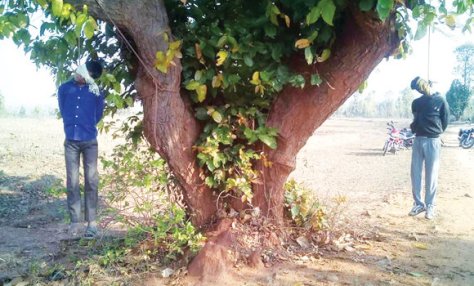
It began in March 2015, with the lynching of Syed Arif Khan in Dimapur, Nagaland. A couple of months later two teenage Dalit girls were raped, strangled and left hanging from a mango tree in Katra village in Uttar Pradesh. Then, on 28 September 2015, Mohammad Akhlaq was bludgeoned to death by a mob in his home near Dadri in what went on to gain spurious notoriety as a “beef-eating incident”. The following March, continuing with the logical rhythm of a scheduled sequel, the cattle herder Mazlum Ansari and his 14-year-old nephew Imteyaz Khan were lynched and hanged from a tree in Jharkhand. Most recently (on May 22) M. T. Oliva, a Congolese citizen, was beaten to death in the national capital of Delhi. This is an incomplete list: it includes only those incidents that resulted in fatalities. In the same timeframe there have been at least a dozen other cases in which the victims somehow survived the end-stage public shaming, torment and lurid physical violence, in short the ordeal of a completed lynching.

There is no lynching without its spectators. Continue reading Three Photographs, Six Bodies: The Politics of Lynching in Twos: Megha Anwer

Seven Years After the End of Sri Lanka’s Civil War: Mahendran Thiruvarangan

Guest post by MAHENDRAN THIRUVARANGAN

When the civil war came to an end in May 2009 I was still a final year undergraduate at the University of Peradeniya. Peradeniya was miles away from the war zone. The only venues that supplied us with details about the happenings in the war theatre were the television channels stationed in the South, self-censoring the civilian casualties incurred and feeding to the Sinhala nationalist jubilation of the times. And on the other side were websites like Tamilnet and Puthinam run by parties sympathetic to the LTTE releasing carefully filtered out reports singularly focusing on the deaths of civilians caused by the military leaving no trace about how the top leadership of the LTTE was recruiting children and adults, despite knowing so well they had already lost the battle or how the civilians who were trying to flee the war zone were shot down by the militants.

One had to work around these competing narratives to get at least a partial sense of the nature of the violence that the people ensnared in the No Fire Zone were exposed to. Some of us had friends whose relatives had been in the LTTE-controlled areas. When the guns breathed their last in Mullivaikal, some of them had already moved to hospitals and camps in Trincomalee and Vavuniya with their loved ones injured during the war. It was from these wounded men and women and their families that the harrowing experiences of the thousands of people inside the narrow battlefield trickled down to us in May 2009. The South erupted into celebrations when the re-unification of the island was announced via the media. As the former president in his televised address from Parliament was busy instructing the people of the country to annul the notions of ‘majority’ and ‘minority’ from their political discourses, fire crackers celebrating the military victory started to deafen the ears of those of us who were seated under the senate building of the University of Peradeniya—Tamils, Sinhalese, Muslims and Malays—pondering in groups what was awaiting us and the country in the days and years to come. Continue reading Seven Years After the End of Sri Lanka’s Civil War: Mahendran Thiruvarangan

The HLEC and the Aporias of ‘Committeed’ Enquiries: Rina Ramdev and Debaditya Bhattacharya

This is a guest post by Rina Ramdev and Debaditya Bhattacharya

Students of JNU have been on an indefinite hunger-strike for over 15 days now, and the administration’s only official response so far had been the Vice Chancellor’s May 4 statement invoking the vocabulary of the ‘lawful’ and the ‘constitutional’ — in ambivalences closer to threat than appeal. The subsequent May 10 Academic Council meeting has been historic, both for its 53 members’ overwhelming denunciation of the HLEC report, as also for the indelible image of a fleeing VC now forever etched in campus folklore. Further, the Delhi High Court’s stay on the fine imposed upon one of the students lends hope for similar stays with the remaining beleaguered students’ cases. The VC has consequently been referring to the enquiry mandate as being sub-judice, only to grant it an interim legitimacy that may symbolically defeat the stridency of student resistance. Letters have been sent out to the parents of striking students, in an attempt to re-route intimidation and pressure through other non-official means of paternalism. Given the conditions of duress being thus created, until the HLEC’s report is revoked in entirety, there is every reason to believe that the administration’s vindictive punitive designs will leech into the future of university freedoms and campus democracy irreversibly.

Continue reading The HLEC and the Aporias of ‘Committeed’ Enquiries: Rina Ramdev and Debaditya Bhattacharya

But She was a Law Student …


In a way that is perhaps unprecedented, today, a very large number of Malayalis feel connected to each other by a veritable tsunami of pain. No wonder perhaps, because the veils of our complacency have been ripped off too thoroughly. The immediate context is the gruesome murder of a young Dalit student in central Kerala, in the tiny, rickety squatter-shack that was her home, in full daylight.

At a single stroke, the incident fully exposed the dimensions of social exclusion in contemporary Kerala. Hers was an all-woman family among families deemed ‘properly gendered’, they were lower caste people trapped and isolated among upper and middle caste families, they were the working-class poor without property in an area full of propertied domestic-oriented bourgeois and petty-bourgeois families. Oppressed in all these ways, they were invisible to the state and the political parties. They possessed no form of capital that would have allowed them upward mobility. Yet, the young woman struggled on and reached the law college.

‘But she went to college’, some ask, ‘how could she have been so helpless?’

Read the rest of the article here 


जिशा, मेरी दोस्त, दलितों की जान इतनी सस्ती क्यों है? चिंटू

अतिथि पोस्ट : चिंटू

Josh
जिशा

जिशा, मेरी दोस्त मेरी यार, क्या कहूँ यार तुम्हारे साथ जो दंविये बर्बरता हुई उसके लिए मुझे  शब्द नहीं मिल रहे हैं कुछ कहने को. ये देश ये समाज हर रोज़ ऐसे झटके  देता रहता है और इतना देता है, इतना देता है, की हमारे लिए वीभत्स से वीभत्स घटना क्रूरतम से क्रूरतम घटना साधरण बन गई है और इन घटनाओं को पचाने की क्षमता में भी हम माहीर हो गए है. देखो न दोस्त, असाधारण कहाँ कुछ रह गया है. बचपन से आज तक तो यही सब देख- देख कर पले बढे हैं हम सब की, जो कुछ हो अपना हक़ मत मांगना, पढने लिखने की बात मत करना , बाप या भाई लात घूंसे  मार- मार कर तुम्हे अधमरा कर दे लेकिन एक शब्द भी उनके खिलाफ बोलने की गुस्ताखी मत करना, गाँव के उच्च जाति वर्ग के सामंती तुम्हे अगर छेड़े तुम्हारा बलात्कार करे तो उसका बहिष्कार मत करना कियोंकि ये तो उनका जन्म सिद्ध अधिकार है.

तुम्हारे लिए जो लक्ष्मण रेखा खिंची गई है उससे बाहर जाने की कोशिश की तो तुम्हारी शामत आना पक्की है. और शादी? ये तो दूसरी जात में तो दूर की बात अपनी जाति  में भी करने का अधिकार या आजादी की बात मत करना ये तय करना घर के बड़े पुरुषों के कंधे पर छोड़ो. सती सावित्री बनो, एक सद्गुणी बेटी, बहु और पत्नी बनो इसी में तुम्हारी भलाई है.


Continue reading जिशा, मेरी दोस्त, दलितों की जान इतनी सस्ती क्यों है? चिंटू