A Hindu View of Sanitation: Ardhendu Sen

Guest Post by ARDHENDU SEN

The Swachh Bharat Abhiyan has many components but the main thrust is on the building of new toilets, both public and private. Why is it that we have so few toilets so many decades after independence? Many would blame the policy paralysis of the UPA II government and there is no denying the truth in that charge. Many others would go back decades and ask if any government before the present one ever paid adequate attention to such important social problems. Looking back into our hoary past, we come across an important ancient cause of our present misfortune.

It is now a well-known fact that India had aircrafts and spacecrafts long before other nations could even conceive of flying. The western educated, liberal (meaning Nehruvian) sceptic has only to visit the official website of the Indian Science Congress to convince herself of this. We know about one of these crafts in some detail because the 1903 edition of an old paper by one Rishi Bhardwaj has survived. The paper describes a fairly large craft, sixty feet by sixty feet that could not only fly in air but was suitable for interplanetary travel. This huge flying machine like that must have carried hundreds of people.

It is logical to assume that these crafts were fitted with chemical toilets. An aeroplane may do without one for a while but a spacecraft cannot because there is no force of gravity to help us get rid of the stuff. Ask Sunita Williams and she would be happy to explain it to you.  Continue reading A Hindu View of Sanitation: Ardhendu Sen
Branding Mother India: Sarojini N, Anindita Majumdar, Veena Johari and Priya Ranjan

Guest post by SAROJINI N, ANINDITA MAJUMDAR, VEENA JOHARI AND PRIYA RANJAN

Indian motherhood is finally, officially being advertised. Recent news reports regarding the launch of the Japanese advertising conglomerate Dentsu Mama Labs in India, have left many of us working on women’s reproductive lives in a serious quandary. How does one explain the unthinking coverage that the firm has received?

This is their pitch (or ‘branding’, as the Corporation puts it):

Dentsu Mama Lab aims to be a thought leader on mothers, motherhood and mothering.

The beautifully shot launch advertisement of pregnant women in a scenic desert village in India, using Japanese products and living in evident prosperity belies the true nature of what Mama Labs is representing, or rather misrepresenting.

Continue reading Branding Mother India: Sarojini N, Anindita Majumdar, Veena Johari and Priya Ranjan

Remembering People’s Historian Amalendu Guha (1924-2015): Bonojit Hussain and Mayur Chetia

Guest post by BONOJIT HUSSAIN and MAYUR CHETIA

A Tribute and a Bibliography

স্বৰ্গত ৰুচি নাই, যাওঁ মই ভাটিখানালৈ

জুৱাৰী-মদপী-বেশ্যা-সিহঁতকো মেলত গোটাই

মনৰ চিতাৰ ছাই উৰুৱাই গাওঁ আশাবৰী :

আকাশত উৰা মাৰে জাকে জাকে ফিনিক্স চৰাই !

Amalendu Guha
Amalendu Guha

I have no desire for heaven,

Instead I go to the brewhouse,

Gamblers, drunkards, prostitutes – bringing them together

I sing of hope, sprinkling ashes from my soul’s pyre:

In flocks the phoenix flies to the sky.

  • “মোৰ কবিতা / My Poetry” Amalendu Guha 1960

Continue reading Remembering People’s Historian Amalendu Guha (1924-2015): Bonojit Hussain and Mayur Chetia

The Arrest of G. N. Sai Baba – Insane, Inhuman: Nirmalangshu Mukherji

Guest post by NIRMALANGSHU MUKHERJI

N. Sai Baba, an Assistant Professor of English in Ramlal Anand College of Delhi University was arrested by Maharashtra Police in opaque circumstances in May 2014. For the past year, there has been a small but sustained protest against Sai Baba’s arrest. Most recently, a day-long fast was held by some activists and university teachers in front of the Art’s Faculty in Delhi University. Despite impressive campaign in the social media by a group of dedicated individuals, just a few dozen well-known protestors showed up for the fast. The event was barely reported in the mainstream. In staying away from the event, the wider left-liberal fraternity in Delhi, and the rest of the country, has once again failed a vital democratic cause.

Sai Baba is one of those rare individuals in the current Indian academia—otherwise marked by its unconcealed opportunism and abject surrender to the establishment—who is at once a serious scholar, a dedicated and widely-popular teacher, and a death-defying political activist.

Sai Baba believes that Indian society must undergo an armed proletarian revolution along Maoist lines to usher in a new democratic republic as a step toward a classless egalitarian society. He has strengthened his beliefs with a deep study of Marxism-Leninism-Maoism and has advocated them in a variety of public forums. Continue reading The Arrest of G. N. Sai Baba – Insane, Inhuman: Nirmalangshu Mukherji

Nepal – An Earthquake Diary : Mallika Shakya

This is a guest post by MALLIKA SHAKYA

The earthquake in Nepal had been overdue for a while. At one level everyone knew that the 7.9 Richter scale jolt came from the continuing collision between the Indian and Himalayan plates. At another level, Nepalis internalized this seismic science by counterposing 2015 with personal memories of the 1934 earthquake which was the last big one in a seismic belt that shuddered every seventy or so years. Every family had stories about how some or other grand old person in the family perished under the rubble while someone else had a narrow escape, how a particular house needed to be rebuilt from scratch while another could be just mended in parts, or how one brave grand uncle mustered the courage to walk into the rubble to pull out a sack of rice so that the family could eat, so on and so forth Continue reading Nepal – An Earthquake Diary : Mallika Shakya

A Short Guide to Appropriate Behaviour in the Wake of A Judgement on Historically Respectable Personalities

[ This short guide is being released to the general public which is liable to fall into error and confusion in the wake of the recent Supreme Court judgement in Devidas Ramachandra Tuljapurkar vs. State of Maharashtra restricting freedom of speech and expression pertaining to what the Honourable Justices who have looked at this case call ‘historically respectable personalities’.]

1. Petition all history departments to start courses in historical respectability so that you know who is who and what is what.

2. Having carefully studied the history of respectability, separate out all historically respectable personalities. Genuflect.

3. Then, from those that remain, make a list of historically disrespectable personalities, starting with yourself.

4. Refer to a historically respectable dictionary of slang – for instance, ‘Cassell’s Dictionary of Slang’ by Jonathan Green, the works of William Shakespeare, or a set of curses of the historically respectable Muni Durvasa

5. Choose at least ten colorful insults, curses and terms of abuse, from the above. and construct a poem, written in the ‘voice’ of a historically disrespectable person.

6. Print in large characters, along with an image of a historically disrespectable personality.

7. Stand singly, or in groups, with the large character posters with the poems in the ‘voice’ of  historically disreputable personalities in meditative silence in front of the honorable Supreme Court of India, and in other public spaces, while considering the sagacious wisdom of our historically respectable judiciary.

8. Be ever grateful that you know now that you can always protect your constitutionally guaranteed and judicially protected freedom of speech by ventriloquizing to your hearts content in the abusive voice of a historically disrespectable personality.

9. And learn this formula by heart – “The dignity of historically respectable personalities cannot be protected without the self-flagellation and abuse of historically disrespectable personalities, which includes the majority of all populations, in all societies, in all times.”
10.  Never disobey a law, or a judgement. Only take obedience to its logical conclusion.

Position Paper on Higher Education: Academics for Creative Reform

“The manner in which the state is intervening in higher education is causing concern and even alarm in the academic community. Both the unlamented UPA—II regime and the current NDA government have been remarkably similar in their authoritarian impatience to introduce wholesale changes without adequate or careful preparation. This position paper is the collective product of roughly six months of discussion among teachers of several central universities in Delhi. It is an attempt to participate in the process of critical self evaluation of the university system as it is today. It is also our considered response to the many policy statements and directives issued by the MHRD and the UGC recently”

Please click on the link below for the complete position paper on proposed reforms in higher education, prepared by Delhi-based Academics for Creative Reform and released at a press conference today:

PositionPaper12May2015

बाल श्रम कानून में बदलाव का औचित्य :किशोर

Guest Post by Kishore

Photo courtesy : newznew.com

संसदीय कैबिनेट ने १३ मई को बाल श्रम प्रतिबंधन एवं नियमन कानून (CLPRA act) में संशोधन को मंजूरी दे दी. मुख्य सकारात्मक बदलावों में १४ वर्ष की आयु तक किसी भी व्यवसाय अथवा प्रक्रिया में बाल श्रम पर पूर्ण प्रतिबन्ध का प्रावधान किया गया है जो स्वागत योग्य है. साथ ही ज्यादा कठोर सजा एवं जुर्माने का प्रावधान भी किया गया है जो कि सकारात्मक है. हालाँकि अभी भी यह बाल अधिकार समझौते की कसौटी पर खरा नहीं उतरता क्योंकि इसमें १४ से १८ साल के बच्चों को गैर खतरनाक उद्योगों में काम करने की अनुमति दी है पर फिर भी चौदह वर्ष तक पूर्ण प्रतिबन्ध एक प्रगतिशील कदम है.

चौदह वर्ष तक पूर्ण प्रतिबन्ध के बावजूद पारिवारिक व्यवसायों में बच्चों के काम करने को छूट दी गयी है .बच्चे पारिवारिक व्यवसायों में काम कर सकते हैं बशर्ते यह काम बच्चे स्कूल जाने के बाद करते हों. सरकार इस छूट का मुख्य कारण यह बता रही है कि इससे बच्चों को अपने पारंपरिक काम सीखने का मौके मिलेगा.

आइये इस बात की समीक्षा की जाये कि यह कारण कहाँ तक तार्किक है. सरकार पारंपरिक कौशल को लेकर कितनी चिंतित है यह तो पिछले बीस साल में हथकरघा और अन्य पारम्परिक पेशों के लिए बनाई गई नीतियों से स्पष्ट है. कोई उनसे पूछे की पिछले बीस सालो में घरेलू उत्पाद में पारंपरिक व्यवसायों का योगदान किस दर से बड़ा है? अगर सरकार को पारंपरिक कौशल के लुप्त होने का इतना ही डर है तो क्यों नहीं इसे स्कूली पाठ्यक्रम में शामिल करती ? अगर इसे पाठ्यक्रम में शामिल किया जाये तो बच्चे पढाई के साथ साथ व्यावसायिक कौशल भी सीखेंगे जो उनके जीवन में काम आयेगा. साथ ही पढाई के साथ काम सीखने से पढ़े लिखे लोगों में श्रम को नीची नज़र से देखने के नज़रिए पर भी लगाम लगेगी और शिक्षा और शारीरिक श्रम के बीच का फासला घटेगा. Continue reading बाल श्रम कानून में बदलाव का औचित्य :किशोर

Statement from Gulflabor.org in solidarity with artists denied entry into UAE for involvement with labour rights

Solidarity Statement
This week, Mumbai-based artist Ashok Sukumaran was denied a UAE visa to travel as an invited speaker and moderator at the March Meeting, an annual gathering of artists in Sharjah. Sukumaran has a long history of artistic work and commitments in the region including at the Sharjah Biennials (2009, 2011, 2013) and at events including Art Dubai and several prior editions of the March Meetings. His visa application by the hosts of this year’s March Meeting, to be held mid-May, was denied three times.While the official reason was given only as “security”, we believe this denial of entry is due to his association with Gulf Labor, a group of artists who have been boycotting the Guggenheim Abu Dhabi and asking for better conditions for the workers building museums on Saaidyat Island. Last month, another Gulf Labor associate NYU professor Andrew Ross was denied entry to the UAE for “security” reasons. We believe this is a negative and cynical trajectory in which artists and academics who have a stake in and long-standing concerns for the region, are being excluded from it.

Continue reading Statement from Gulflabor.org in solidarity with artists denied entry into UAE for involvement with labour rights

Chal Chaliye – Majma

For Website

From the website of Majma

Majma is “a platform committed to creating and promoting progressive arts and media”.

Listen to the song Chal Chaliye, a stark, defiant, yet joyous indictment of the Indian “Republic” and the good times it’s going through.

Much Better to Run Over the Poor Than to Speak Up for Them

Yesterday, the 9th of May, one day after the court granted what must be the fastest bail and suspension of sentence in the history of India to India’s favourite Dabangg, a diminutive woman stood under the blazing Delhi sun and spoke of her husband who had been in jail for the past one year. In May 2014, lecturer in English at Ramlal Anand College, Delhi University, G. N Saibaba was returning home after evaluating answer scripts when he was abducted by unknown men, who later identified themselves as Maharashtra Police.

Professor Saibaba. Image Courtesy FRS Blog

Saibaba was not produced before a magistrate in Delhi but taken directly to Aheri, a small town in Maharashtra and then to Nagpur, to be put in solitary confinement in the famous anda cell of Nagpur jail. Let’s call this cell famous instead of the usual epithet “notorious” because all over the country, children are probably playing with each other right now saying to each other, “saale main tujhe anda cell mein daal doonga“, while their parents look on indulgently, congratulating themselves on the kid’s excellent G.K.

Continue reading Much Better to Run Over the Poor Than to Speak Up for Them

Cancer – getting the story right: Harmala Gupta

Guest post by HARMALA GUPTA

Despite the almost daily dose of information on some aspect of cancer or the other in the national and international media these days, the confusion around cancer persists. The reports and their headers are calculated to catch the public eye rather than inform: “tetanus shot may boost brain cancer survival”; “extra oxygen could help you fight cancer”, etc. The reality on the ground is far removed and infinitely more complex.

To begin with, cancer is one word used to describe a number of different diseases. Furthermore, despite the progress made, we are still far from curing a majority of cancers, from preventing them or finding them early enough to ensure long term survival. The progress that has been made is largely in the West and can be attributed to screening techniques which are able to detect cancers earlier than they did before. In fact, some would argue, too early.

The question being asked is: should we be meddling with pre- cancerous or early stage tumours that are unlikely to ever become life threatening?  Studies show that in some people, for no clear reason, these tumours do not progress. Once again, the baffling question is: Are these tumours best left alone? And if so, at what stage should we begin to engage with them? Only now are we learning that the mammogram touted as the gold standard for detecting breast cancer works best for women over 50 years of age. Before that age there are too may false positives with their attendant consequences to ethically warrant its regular use as a diagnostic tool. Shame that it took medical science so long to work this out. In the meantime, thousands of women have had surgeries and gone through emotional trauma they could have avoided.

Continue reading Cancer – getting the story right: Harmala Gupta

Bombay Pavement Dwellers and Olga Tellis – A Quiet Verdict in Ahmedabad: N. Jayaram

Guest Post by N. Jayaram

After the order in the case of film star Salman Khan over a 2002 hit-and-run case was delivered by Sessions Court Judge D.W. Deshpande on Wednesday, 6 May 2015, there understandably were divided opinions on whether he deserved to be handed five years in jail.

But the rather more shockingly breath-taking comments from some of his friends in the industry and his fans were to do with pavement dwellers, such as the victim Nurullah Mahboob Sharif.

“Kutta rd pe soyega kutte ki maut marega, roads garib ke baap ki nahi hai (If a dog sleeps on the road, he’ll die a dog’s death. Roads are not poor people’s property)…,” singer Abhijeet Bhattacharya tweeted. “Roads are meant for cars and dogs not for people sleeping on them…,” he said, appealing to the film industry to back the star, whose sentence has now been suspended by the High Court.

Designer Farah Khan Ali chipped in with this:  “No one should be sleeping on the road or footpath. It is dangerous to do that just like it is dangerous to cross tracks.” She quite rightly laid the blame on the state: “The govt should be responsible for housing ppl. If no1 was sleeping on d road in any other country Salman wuld not have driven over anybody.”

Perhaps she had read the International Covenant on Economic Social and Cultural Rights, to which India is a state party. Article 11.1 of the Covenant says: “The States Parties to the present Covenant recognize the right of everyone to an adequate standard of living for himself and his family, including adequate food, clothing and housing, and to the continuous improvement of living conditions. The States Parties will take appropriate steps to ensure the realization of this right…” Continue reading Bombay Pavement Dwellers and Olga Tellis – A Quiet Verdict in Ahmedabad: N. Jayaram

An Encounter in the Forest: Bharath Sundaram and Nitin Rai

Guest post by BHARATH SUNDARAM and NITIN RAI

The labelling of the Seshachalam incident as a ‘law and order’ problem by State actors obfuscates the larger underlying problem deriving from lopsided notions of the human-environment relationship, and flies in the face of ecological concerns and social justice

The massacre of twenty people in the Seshachalam forests in a joint operation by the Red-Sanders Anti-Smuggling Task Force (RSASTF) of the Andhra Pradesh Police and the Andhra Pradesh Forest Department is reflective of the hegemonic control of natural resources by an increasingly militarised state. It is particularly shocking that such a massacre occurred just as calls are being made nationally for a democratic forest management approach that gives local people more rights and powers to manage forests.

Encounter killings in Seshachalam forests
Encounter killings in Seshachalam forests, courtesy Hindustan Times

While the state has chosen to depict the killing of 20 people in the Seshachalam forests as a response to a law and order issue, such a draconian response to the cutting of trees by peasants is indicative of a much deeper malaise in the governance of natural resources in India. On the evening or night of 6th of April, 2015, twenty people, purportedly smugglers of red sanders, were shot to death by ten officials of the RSASTF and one official from the Andhra Pradesh Forest Department. The shooting and killing (using automatic weapons) was supposedly an act of ‘self-defence’ precipitated by an attack on the officials by more than 100 people who ‘rained stones and hurled sickles’ during the raid. Three days after the incident, ‘country weapons’ and ‘firearms’ were added to the list of weapons used by the smugglers. That would work in their favor, because who better than the smugglers to know where to buy AK 47 Rifles and assault weapons.

Observer accounts mention that several of those killed were shot in the face, chest, or back. Nobody was apprehended in an injured state. Official post-mortem reports of those killed remain unavailable. No government officials were reported injured immediately after the operation, although mysteriously, all eleven officials involved were placed in isolation in the A-Class ward of a government hospital four days after the incident occurred. Human rights activists, led by the Coordination of Democratic Rights Organization have labelled the incident as a staged encounter, questioned the use of brute force, and have pointed out several inconsistencies in the official version of events. Continue reading An Encounter in the Forest: Bharath Sundaram and Nitin Rai

Seminar on Balochistan Missing Persons at Karachi University despite administration refusing permission

mama3

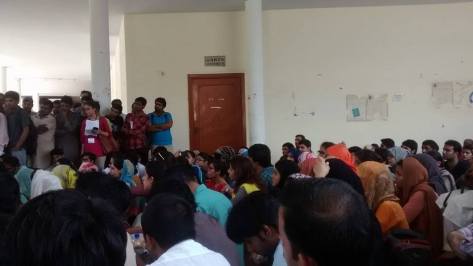
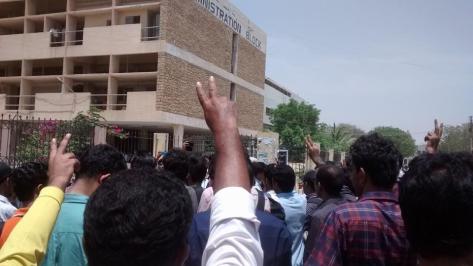
Sabin Mahmud was killed after organizing an event on Balochistan in T2F in Karachi, and more recently, Syed Wahidur Rehman, a Karachi professor was also shot dead. But far from being silenced, the resistance of democratic forces in Pakistan is growing. Today, Karachi University faculty organized a seminar on Balochistan missing persons to massive response, despite the administration refusing permission and locking the doors of the venue. The event was held in the Arts lobby, from where it seems to have spilt outside too.

11214139_10152694077270870_338189832357349941_n

A determined audience sits on the floor outside the locked room where it was to have taken place.

11019548_10152694076845870_5299594296544608541_n

Audience outside KU Administration Block

Read the report in The Tribune

Images sent by Nida Kirmani, Asst Prof at LUMS, Lahore, Pakistan, via Shipra Nigam

Jalsatyagrah at Omkareshwar MP – Appeal to PM: Narmada Bachao Andolan

Statement for wider endorsement, sent by Narmada Bachao Andolan

jalsatyagraha_650x400_61429559020

Ousted for Narmada’s Omkareshwar Dam, Farmers on Jalsatyagraha in Madhya Pradesh (NDTV)

The jalsatyagrah at Omkareshwar M.P. going on to its 26th day now, with around 24 people in water for 24 hours, under deteriorating health conditions, protesting the proposed raise in the height of the dam and the complete disregard of promised R&R policy by the authorities.

The situation at the Omkareshwar-dam site is very serious as the voices, land and and livelihood of the people are being drowned.

We urge you to pledge your support in a petition to Prime Minister Narendra Modi, as the project is a joint venture with 51% central government stake and 49% state control. Despite repeated attempts, we have not received any response from CM Shivraj Singh Chouhan.

Please send your endorsement to this email address nba.khandwa@gmail.com.

TEXT OF STATEMENT

The people of the Narmada valley are in battle once again, this time, for their land rights and against the forcible and illegal submergence being brought in the Omkareshwar dam by the Madhya Pradesh government and the project company NHDC Limited since the 11th of April 2015.

Continue reading Jalsatyagrah at Omkareshwar MP – Appeal to PM: Narmada Bachao Andolan

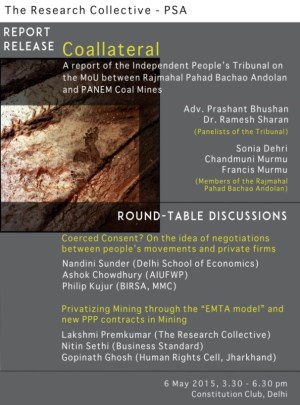
Coallateral: Research Collective of Programme for Social Action

Executive Summary by RESEARCH COLLECTIVE of Programme for Social Action, of the Report of the Independent People’s Tribunal on the MoU between Rajmahal Pahad Bachao Andolan and PANEM Coal Mines.

Press Invite

Release of the Report and Panel Discussion on May 6, 2015 at Constitution Club

The Independent People’s Tribunal, held on 16 November 2014 in Ranchi, established that PANEM Coal Mines repeatedly violated human rights of Adivasis, used violence against them to force their consent to operationalise the project, and has not adequately resettled and rehabilitated project affected families. PANEM Coal Mines, which acquired Adivasi lands in 2002 in Pakur district of Jharkhand, violated the Santhal Parganas Tenancy Act, 1949 and the rights of Adivasi (indigenous) people granted under the fifth schedule of the Indian Constitution.

PANEM Coal Mines, a Joint Venture company between Punjab State Electricity Board (now PSPCL) and EMTA Group, required land from Adivasi communities in Alubera and Pachwara panchayats in Pakur to operationalise the Pachwara Central Coal Block mining project. Fearing that the large-scale mining project would ultimately destroy their homeland, the Santhal and Pahadia people did not consent to the acquisition of their land. They organized themselves as the Rajmahal Pahad Bachao Andolan (RPBA) and militantly opposed the project between 2000 and 2006. In an unexpected turn of events, on 30 November 2006, RPBA signed a Memorandum of Understanding (MoU) with PANEM and allowed the company to acquire land and mine coal.

Continue reading Coallateral: Research Collective of Programme for Social Action

The Body-politic and Death of the Farmer: R Umamaheshwari

Guest Post by R. UMAMAHESHWARI

Until now suicides happened in an almost invisible ‘intimate’ ‘psychic’ space of the farmer and his (almost always it was a male) loneliness and pain and anguish; we only got to know of it after the act was committed. But for the first time, a farmer committed suicide in full public view, and his body was consumed by the world at that moment of his committing the act. In a leading Hindi newspaper, the following day, there was a photograph, on the front page. The images showed the gradual metamorphosis of a living man, with a profession (that of a farmer), with a history and a family turning into a mere dead body. The photographer had actually recorded this metamorphosis, image by image in sequence, second by second. Not a moment had been left out. (See Amar Ujala, dated 23rd April 2015) With one loop the man, named Gajendra, became yet another body; yet another dispensable body, to be consumed by the entire nation through photographs and TV images. It was the signifier of our times: an act in the theatre of the absurd that democracy has come to be. The farmer will increasingly be ‘seen’ when he dies. Continue reading The Body-politic and Death of the Farmer: R Umamaheshwari

The Priya Vedi Suicide: Diwas Raja Kc and Alston D’Silva

This is a guest post by Diwas Raja Kc and Alston D’Silva

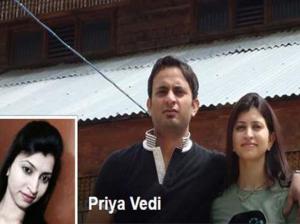
Image Courtesy: www.pardaphash.com
Image Courtesy: http://www.pardaphash.com

On the 18th of April this year, Dr. Priya Vedi of AIIMS tragically ended her life and left a Facebook note incriminating her husband—fellow doctor at AIIMS Dr. Kamal Vedi—for “torturing” her mentally, clearly implying that his homosexuality was the reason for her suicide. Her distress is apparent in the note as she recounts the lack of intimacy in her marriage and her discovery of the husband’s sexual activities as a gay man before and during the marriage. At the end she includes a plea to all gay men to not “marry to a girl to save yourself,” to not play with the emotions of a girl and her family. It should not be surprising that some condolent commentators have placed the blame specifically on Kamal Vedi’s alleged sexual orientation, even calling for legal action. Even within the LGBT community, the tendency has been to first put culpability on the man’s opportunistic participation in the institution of marriage. There is a sense that this incident ought to serve as a teaching moment for gay men, who are argued to require an ethical code, who need to fixate on the deliverance of their conscience, and whose rights—as Sandip Roy pointed out—”mean nothing without responsibility.” But despite Priya Vedi’s strongly felt sentiments, must we proceed as if the case of her fatal end is a logical and natural consequence of gay men’s irresponsible intrusions into the sanctum of marriage? After all, such intrusions are routine, and the ensuing heartbreaks are sometimes even known to be productive of powerful empathy between straight women and gay men.

Continue reading The Priya Vedi Suicide: Diwas Raja Kc and Alston D’Silva

Piketty and the Economic Crisis in the Euro Zone: Cenan Pirani

PikettyGuest post by CENAN PIRANI

Though the US has seemingly bounced back from the 2008 financial crisis, southern European countries like Portugal and Greece are currently dealing with debt situations that were once only characteristic of the “developing world”. In order to stabilize their economies after the 2008 crisis these European countries took on a series of IMF and European Central Bank loans in which rates of interest were higher than the countries’ rates of GDP growth, thus stagnating their economies for the foreseeable future.

This situation that currently befalls these countries’ economies was explained by Thomas Piketty in a recent interview he gave for the major Portuguese newspaper, PÚBLICO. Piketty, who has become a prominent public intellectual due to the popularity of his recent work, “Capital in the 21st Century”, was in Portugal this week in order to discuss the economic future of the country with some of its political figures. Besides outlining the problem, he discusses possible courses of action for the countries to release themselves from perpetual debt and austerity. These ideas ironically enough come out of the paths once carved by those now economically dominant countries in the Euro Zone, specifically France and Germany. Continue reading Piketty and the Economic Crisis in the Euro Zone: Cenan Pirani

Delhi Police Blames AAP for Gajendra Suicide – Remember Constable Tomar’s Death?

Reports have it that Delhi Police has blamed the AAP for the death of Gajendra Singh at its rally recently – not surprisingly, as we had noted in our previous post on the suicide. We had suggested in that post there seemed to have been prior instructions to the Police from the Central government, under which it functions, not to act. And the reports today about Delhi Police reporting to their higher ups only confirm our suspicions.

Here is what one of the reports has to say:

In a letter to the Home Ministry, the Delhi Police has claimed that the mob including Aam Aadmi Party (AAP) workers incited Gajendra Singh to commit suicide at a party rally in Delhi. The letter also claims that untrained volunteers climbed the tree which led to Gajendra falling off.

The report states that AAP volunteers and leaders were clapping and raising slogans which incited him to engage in more dangerous acts. It also adds on to say that though police requested AAP volunteers to stop provoking him through clapping and solganeering, neither the volunteers nor the leaders present on the state acceded to the request info.

Another report in a channel known for its BJP connections, says:

As per the Delhi Police report, AAP leaders were making provocative speeches, and the crowd present at the rally venue instigated and provoked Gajendra to commit suicide. The report also alleged that AAP did not heed to the police’s request to change the rally’s venue to Ram Lila Maidan.

Continue reading Delhi Police Blames AAP for Gajendra Suicide – Remember Constable Tomar’s Death?

DISSENT, DEBATE, CREATE