Democracy as Permanent Advertising – Indian Media and Elections : Irfan Ahmad

Guest post by IRFAN AHMAD

It was nothing short of a scandal. On 12 April, India TV, a Hindi channel, telecast 117-minute interview of the BJP Prime Ministerial candidate, Narendra Modi. Conducted by Rajat Sharma, it became, or was made, a mega hit. Tow days later, news director of Indian TV, Qamar Waheed Naqvi, resigned from his position alleging that the interview was ‘fixed’. Though Naqvi’s resignation was silenced in media, the fixed interview represents the dark and mutually constitutive relationships between media and politics.

Based on the analyses of select elections coverage by five television channels – India TV, NDTV, Aaj Tak, ANI, and IBN– I argue that:

  • The way journalists pose questions to their favorite politicians are often already answers;
  • In pursuing a storyline, journalists subordinate, even sacrifice, actual responses or events/facts to bolster their pre-determined narrative; and
  • Electoral polity like India is heading towards a designer democracy marked by permanent campaigning-cum-advertising.

In short, I caution against the use of widespread phrase: ‘media and politics’. It is more fitting to say: ‘media as politics’ or ‘politics as media’.

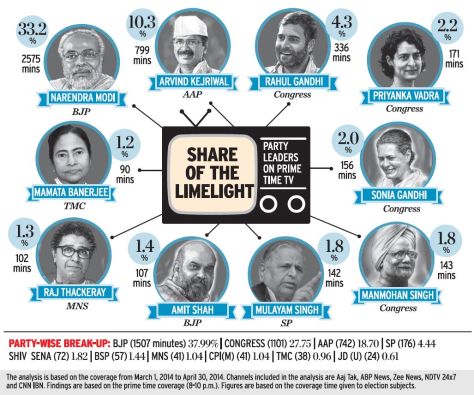
Share of prime time coverage, Image courtesy The Hindu

Modi’s ‘Fixed’ Interview: India TV Continue reading Democracy as Permanent Advertising – Indian Media and Elections : Irfan Ahmad

The curious case of Reliance Industries Ltd’s gravity defying stock price – Or, how you should learn to stop worrying about gas prices and buy RIL stock now: Vineeth Sukrithan

This is a guest post by VINEETH SUKRITHAN

The stark contrast between RIL’s latest march quarter performance and the almost- three-year highs that its stock price is perched on top, merits a deeper analysis. On April 18th, 2014, RIL released its quarterly data showing disappointing results that were entirely in line with industry expectations. Petrochemical business revenues fell 3.7%, while oil and gas turnover dropped 18.2% q-o-q. Net profit growth in its January-March quarter (Q4FY14) was at Rs 5,631 crore – only 0.7 per cent higher than Rs 5,589 crore it earned a year ago. The petrochemicals business’s Ebit was lower than in the December quarter and the company’s outstanding debt over shot its cash and equivalents. (Rs 89,968 crore against cash, and equivalents of Rs 88,190 crore.)

Yet, for a company that has always been known to be reticent about taking on high levels of debt, RIL has gone on what can only be called a remarkable splurge in capital expenditure. Its capital expenditure during the year was the highest ever. The company reported net addition to fixed assets of Rs 35,210 crore in FY14. In FY09, when the company commissioned its second refinery and K-G basin gas production, its capex was only Rs 24,907 crore. So, on all accounts, RIL’s actions and stock price seem counter to the predicaments of its current financial health, which begs the question, where does Reliance derive this level of confidence in its future profitability to be willing to take on tremendous amounts of debt?

Continue reading The curious case of Reliance Industries Ltd’s gravity defying stock price – Or, how you should learn to stop worrying about gas prices and buy RIL stock now: Vineeth Sukrithan

Should only Minorities be Worried over Mr Modi? Sanjay Kumar

(Photo Courtesy : ibnlive.in.com)

Guest Post by SANJAY KUMAR

By stealth, wealth, and media barrage a phalanx of powerful interests is trying to create a public opinion favourable to Mr Narendra Modi. It appears the entire privilegenstia of the country, the super rich capitalists, professional elites, entrepreneurs of the religion, top bureaucracy, including retired army men and police, upper castes, media pundits, even NRI academics, are united in their enthusiasm for Mr Modi. From Ratan Tata to Ramdev, people have been told how the man is the only saviour of a country in crisis. What exactly do this bunch of rich and privileged, but discontented people hope from Mr Modi as PM is important for the future of the country. The moot point here is the difference between declared intentions and actual motives. Perhaps even more important is the response of Mr Modi’s political opponents, because that indicates the kind of resources the country can fall back upon when confronted with the reality of him in power. The moot point here is a lack of understanding of the significance of the usual, non-Modi type politics for ordinary Indians. The stakes are high indeed. Far from what the phalanx and its ideologues claim, it is actually this politics which is their target, and which they wish to change under Mr Modi.

The most prominent charge leveled by Mr Modi’s opponents is that he is communal and divisive, and will alienate minorities. From Mr Lalu Prasad to Prof Amartya Sen, that appears to be the chief misgiving. If the charge against Mr Modi is so framed, then by implication it also appears to be asserting that if there had been no Gujarat 2002, Mr Modi and the kind of politics his party represents will be as good or bad as any other party politics. Are minorities’ misgivings about Mr Modi’s the only fact that the rest of Indians should worry about? Is the hesitation of minorities about him the only legitimate concern that may stop the man from reaching the PMO? Continue reading Should only Minorities be Worried over Mr Modi? Sanjay Kumar

बर्धन, ममता और मोदी

चुनाव के अनंतिम चरण के ठीक पहले भारतीय कम्युनिस्ट पार्टी के नेता ए. बी. बर्धन का बयान आया कि उनकी पार्टी नरेंद्र मोदी को सत्तासीन होने से रोकने के लिए ममता बनर्जी का साथ भी दे सकती है.बाद में इसकी कुछ सफाई भी दी गई लेकिन यह बयान अपने आप में बहुत महत्वपूर्ण है.उसके कुछ पहले कांग्रेस पार्टी की ओर से यह इशारा आया था कि चुनाव के बाद,ज़रूरी हुआ तो वह तीसरे मोर्चे की सरकार को समर्थन दे सकती है. बाद में उसके नेता राहुल गांधी ने इसका खंडन कर दिया. इन दोनों ही वक्तव्यों पर कुछ बात करने की आवश्यकता है.उसके पहले बनारस की कुछ बात कर ली जाए. Continue reading बर्धन, ममता और मोदी

Condemn the Gruesome Massacre in Bodoland (Assam) : Statement by New Socialist Initiative (NSI)

Text of a statement issued by New Socialist Initiative

New Delhi; 07/05/2014

New Socialist Initiative (NSI) strongly condemns the gruesome massacre of Bengali speaking Muslims in the Bodoland Territorial Autonomous Districts (BTAD) in Assam, which has witnessed the resurgence of the ugly head of ethnic violence. As per latest official reports, 38 people have been killed, the majority being women and children, while several have been injured and many are missing.

On the evening of 1st May at 7.30 pm, 8 armed Bodo youths riding on 4 bicycles entered a house in Narasinghbari village in Baksa District and fired gunshots. The next day (2nd May), allegedly 40 Bodo militants surrounded 77 houses in Narayanguri village in the same district and fired indiscriminately. Until now 30 dead bodies have been found. According to district administration 15 people are still missing, among them 12 children and 3 women. Simultaneously, in Balapara village in Kokrajhar district at around 12.30 am on 2nd May, armed Bodo youths killed 8 people. The survivors in Baksa district told that the death toll will substantially increase as the militants killed and threw the dead bodies into the Beki River that flows through the area. Continue reading Condemn the Gruesome Massacre in Bodoland (Assam) : Statement by New Socialist Initiative (NSI)

Universal Adult Francise? A Reality Check: Reena Gupta

Guest Post by REENA GUPTA

When polling began on the morning of April 10, our team coordinating the Aam Aadmi Party campaign in Bawal was expecting to respond to complaints of money and alcohol distribution. During the jan sabhas throughout the area, Yogendra Yadav, the AAP candidate for the constituency, had made it amply clear that, “na toh hum shraab bechenge, nah hum bikne denge.” We had spent days training booth volunteers who would be available to assist voters with information and monitor elections throughout the 200 odd villages in Bawal. Our mobile teams would document any violations of the electoral code and lodge complaints with the requisite authorities. Having campaigned in the Delhi elections for AAP, I knew firsthand that the secrecy of the ballot gave people the chance to rise above external pressures and inducements. After the hard yards of campaigning, voting day seemed set to be relaxing and I occupied myself with preparations for lunch for the numerous volunteers who were streaming in and out of our office.

Bawal is less than 100 kms from Delhi and is one of 9 legislative constituencies that comprise the Gurgaon Parliamentary constituency. In fact, Bawal falls within the National Capital Region and has been proclaimed as soon joining the constellation of Delhi’s satellite towns. There are already hi-tech factories strewn along the Delhi-Ajmer Highway and then there’s the buzz about the upcoming Delhi-Mumbai Industrial Corridor. Of course, the symptoms of lop-sided development are visible right behind the façade of big industrial complexes. With one quick turn off the highway, the roads fall apart and you are welcomed to villages with virtually non-existent education and public health infrastructure. However, I realized the extent of the distance between Bawal and Delhi only after our phones started ringing on the morning of 10th April and we set out to see for ourselves the manner in which citizens are allowed to exercise their electoral rights, in the world’s largest democracy.

Continue reading Universal Adult Francise? A Reality Check: Reena Gupta

EFLU Hyderabad Rusticates Students for Wanting to Keep Library Open: Sudha and Muhammad Afzal

Guest Post by Sudha K F and Muhammed Afzal P

The semester break seems to be the most active time for the English and Foreign Languages University (Hyderabad) administration. What are these activities that the administration invests so much of its energies in, when most students have left the campus for their vacation? It is sending memos, show cause notices and the latest: the RUSTICATION of two significant student leaders on the EFLU campus.

When the word ‘fascist’ has become an everyday term, to talk about the Modi nightmare and its anxieties, we have more to add to that list from EFLU, Hyderabad. Mohan Dharavath, President of Dalit Adivasi Bahujan Minority Students’ Association and Satish N, General Secretary of Telengana Students’ Association, have been rusticated from the University for two years, the latest in a series of draconian and undemocratic moves, on the part of the autocratic EFLU administration. The two students, along with another student, Subhash Kumar, were given show cause notices by the Proctor’s office on 24 March, to which they responded, denying the baseless charges levelled against them. The rustication is part of the disciplinary action against these students who were part of a massive protest that took place against the administration, called forth by the EFLU Students’ Union. This protest was against the absolute closure of the only 24-hour reading room, and library, on the small EFLU campus in the first week of March 2014.

Continue reading EFLU Hyderabad Rusticates Students for Wanting to Keep Library Open: Sudha and Muhammad Afzal

Some Reflections on the neutrality of political institutions and the project of making Modi more palatable: Moiz Tundawala

Guest Post by MOIZ TUNDAWALA

“ … . however good a Constitution may be, it is sure to turn out bad because those who are called to work it, happen to be a bad lot. However bad a Constitution may be, it may turn out to be good if those who are called to work it, happen to be a good lot. The working of a Constitution does not depend wholly upon the nature of the Constitution. The Constitution can provide only the organs of State such as the Legislature, the Executive and the Judiciary. The factors on which the working of those organs of the State depend are the people and the political parties they will set up as their instruments to carry out their wishes and their politics.”

[Dr. Bhimrao Amdedkar]

These observations of Babasaheb Ambedkar, made on the 25th of November, 1949, one day before the Constitution was finally adopted after three years worth of labour, should suffice for anyone who dismisses Modi skeptics as excessive scare mongers. As a second year law student in 2006-07, I couldn’t quite understand why our revered constitutional law teacher Prof. M.P. Singh would keep reiterating these sentiments in class, something which I thought was so axiomatic it did not need emphases. With only a few days left for the outcome of what is being called an election for the soul of India, I now realize the wisdom underlying those constant reminders, especially in a law school converted by the culture and priorities of its students into a factory churning out smart but unreflective products for the corporate sector. I think those of us who find Modi problematic, but would still vote him in for the lure of the promised economic miracle, while at the same time consoling ourselves with the talk of sufficiently robust political institutions capable of surviving any onslaught, must listen to Ambedkar carefully. The Constitution is an artefact, a human creation, constantly needing ‘good people’ at the helm to work it out. If nothing else, resistance to Modi’s rise to power is at least resistance against the enthronement of ‘bad people’, who deep down have only harboured contempt for the Constitution as a foreign document.

Continue reading Some Reflections on the neutrality of political institutions and the project of making Modi more palatable: Moiz Tundawala

Condemn the Massacre in Assam: A Statement by Civil Society Groups, Activists and Concerned Citizens

Text of a statement issued by Civil Society Groups and Concerned Citizens

5th May 2014

Condemn the Massacre in Assam, Demand immediate arrest of Pramila Rani Brahma; Ensure safety of Muslims in BTAD: A Statement by Civil Society Groups, Activists and Concerned Citizens

We, the undersigned, express our profound sense of grief and alarm over the gruesome massacre of Bengali-speaking Muslims on 2nd May. This most recent round of killings — in which 32 people, mostly women and children have lost their lives – is another link in the long and… bloody sequence of ethnic cleansing being carried out by tribal Bodo militant groups with impunity.

For years, Hindutva politics has successfully created the bogey of the ‘Bangladeshi’, rendering Muslims as suspects and targets, locked in a perpetual battle with the tribal Bodos. In his rally at Silchar, the BJP’s Prime Ministerial candidate reiterated precisely this. He said: “There are two kinds of people who came from Bangladesh to Assam: those brought as part of a political conspiracy for vote bank politics of a particular party (Muslims) and others who were harassed in the neighbouring country (Hindus). Those brought for vote bank politics and smugglers must be pushed back, while the second category must be accommodated.” (Silchar, 22nd February). Continue reading Condemn the Massacre in Assam: A Statement by Civil Society Groups, Activists and Concerned Citizens

India’s 16th Lok Sabha General Elections and Persons with Disabilities: Avinash Shahi

This is a guest post by Avinash Shahi

When the challenges and daily difficulties of approximately 70 million persons with disabilities in public life are not highlighted in political rallies and in the TV studios, it raises a serious question about an elite political class’s commitment to empower persons with disabilities. Do they consider persons with disabilities as India’s citizens to be taken seriously? Politicians of major political parties are crisscrossing India’s vast geographical terrain to address voters. But neither Narender Modi nor Rahul Gandhi have ever bothered to utter a single word about their plan for voters who are persons with disabilities in their campaigns. Continue reading India’s 16th Lok Sabha General Elections and Persons with Disabilities: Avinash Shahi

नरेंद्र मोदी और मुसलमान

कुछ दिन पहले तक माफी की माँग की जा रही थी. पिछले कुछ सालों से नरेंद्र मोदी से बार बार अनुरोध-सा किया जा रहा था कि वे मुसलमानों से माफी भऱ माँग लें,बात रफ़ा दफ़ा हो जाएगी।मुसलमानों को सुझाव दिया जा रहा था कि वे माफी की सूरत में इंसाफ की अपनी जिद छोड़ दें.  ऐसे मुसलमान खोज लिए गए हैं जो यह बता रहे हैं कि इस्लाम में तीन दिन से ज़्यादा शोक की इजाजत नहीं है,अब तो बारह साल गुजर चुके हैं. यह भी कहा गया कि 2002 के बाद गुजरात में जो सामान्य विकास हुआ है, उसका लाभ आखिर वहाँ के मुसलमानों को भी हुआ है. मानो हत्याओं और बलात्कार की भरपाई उस विकास के माध्यम से कर दी गई है.

अब पिछले कुछ वक्त से यह कहा जाने लगा है कि नरेंद्र मोदी तो अपने अतीत से आगे बढ़ जाना चाहते  हैं, ये तो उनके निंदक हैँ जो उन्हेँ आगे बढ़ने देना नहीं चाहते. इस तर्क से नरेंद्र मोदी प्रगतिशील, भविष्यद्रष्टा और उनके आलोचक प्रतिक्रियावादी व शिकायती दिखने लगे हैं. मुसलमानों को पहले से ही कहा जाता रहा है कि उन्हें पीड़ित-ग्रंथि से बाहर निकलने और आगे देखने की आदत डालने की ज़रूरत है. इस प्रकार का सुझाव कई बार दबे-ढँके तरीके से और अब तो खुले आम दिया जाने लगा है कि उन्हें यथार्थवादी होना चाहिए. मतलब मान लेना चाहिए कि भारत में यह सब कुछ बीच-बीच में उनके साथ होता रहेगा. अगर वे इंसाफ वगैरह की जिद पर अड़े रहे तो उनकी बाकी जिंदगी का क्या होगा ! क्या वे तमाम ज़िंदगी रोते-कुढ़ते ही गुजार देंगे? Continue reading नरेंद्र मोदी और मुसलमान

Two days with AAP in Banaras

‘Varanasi’ is only the official name. Sometimes, to make a poetic point, someone may say Kashi.   But ‘Banaras’ is how Banarasis refer to their city.

Banaras ki parampara, they say. Or hum Banaras ke musalman.

Kaal Bhairav Banaras ke kotwal hain, says the mahant of the Shitala Mata temple. Kaal Bhairav (Shiva) is the keeper of the gates of Banaras.

And of course, Banaras ki chaat khaayi hai aapne? Banaras ka paan nahin khayenge?

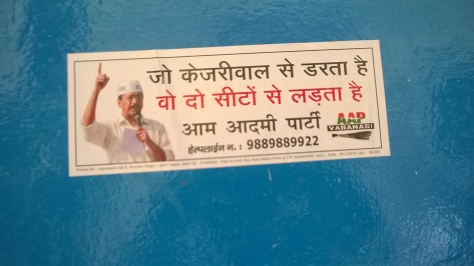
do seet

Sticker on wall of home in Rajmandir, a Hindu locality (All pictures by JAMAL KIDWAI)

My old friend and comrade Jamal Kidwai and I were in Banaras to observe the AAP campaign, being supporters of AAP (me) and of Arvind Kejriwal in Banaras (Jamal), and to hang out with the (largely young) volunteers who have landed up – from IT and advertising, from colleges and small government jobs, from Bangalore and Mumbai, from Madhya Pradesh and Arunachal Pradesh – to map Banaras with their feet. So this does not purport to be an objective account – unlike journalists’ accounts of the ‘Modi wave’, which do claim to be purely factual. As Professor Randhir Singh is fond of reminding us – in Paris in 1968, the first question the students would hurl at all speakers was always – “Where do you speak from?” Continue reading Two days with AAP in Banaras

The Carnage in Kokrajhar: Saba Sharma

Guest post by SABA SHARMA

Since the evening of the 1st of May, it has been reported that at least 23 people have been killed in Kokrajhar and Baksa districts in Assam, administered under the Bodoland Territorial Council. All the victims were from the Muslim community, and were allegedly shot by the militant Bodo group, the National Democratic Front of Bodoland (Songbijit), named after its ruthless leader Songbijit, from the Karbi Anglong area in Assam. Indefinite curfew has been imposed here and in neighbouring districts as well, as rumours of other killings and beatings filter in, impossible to separate from facts in the atmosphere of panic that currently prevails.

Polling ended in the Kokrajhar constituency in Assam on the 24th of April, ending a temporary sense of calm and normalcy. Ethnic violence between Bodos and Bengali Muslims took place in July 2012, majorly affecting Kokrajhar, Chirang and Dhubri district. Nearly 5 lakh people were displaced from their homes, and most did not return until January 2013, staying in relief camps, too afraid to return. Once the camps were formally shut down and people returned to their homes, normalcy was still a distant reality. An economic boycott imposed by Bodo leaders on the Bengali Muslim community meant that agricultural labour, a primary occupation for Bengali Muslims, was all but non-existent. In the last year, this economic boycott has slowly been relaxed in some areas, while in other areas, it prevails as strongly as ever. In most areas, markets were among the first spaces to become mixed again, an almost neutral zone where people began to interact with one another again. But in other markets, like Koila Moila bazaar in Chirang, Muslims are still ‘banned’. Continue reading The Carnage in Kokrajhar: Saba Sharma

Professors of Political Science and the Modi Phenomenon

Ashutosh Varshney has written yet another piece on the Modi phenomenon. This time he has invoked “the discipline of political science”, which he has “taught for two decades”, and underlined that it fundamentally disagrees with an “institutions-free” view of the rise of Narendra Modi. [See my response to his earlier piece here.] Before I examine Varshney’s ‘arguments’ about present politics, let me cite the following from nothing less than the American Political Science Review – a revealing chapter from the history of the discipline that he and I share:

Following World War I came the turbulence of the 1920s and 1930s. Communism and fascism rose to prominence as the world’s great powers fell to deflation and imperialism. Yet during this time of great political upheaval, political science became a study in irrelevance. Perhaps as a result of no longer sharing common theories and assumptions, the discipline fragmented and retreated inwards. Scanning the American Political Science Review from 1923 to 1936 for any sustained analysis of the great events of the day such as Mussolini’s march on Rome, Japan’s occupation of Manchuria, or even the Great Depression, one will come up empty. What one does find are, for example, reports of constitutional change in Estonia (Roucek 1936), predictions that the German administrative structure would stop Hitler becoming a dictator (Friedrich 1933), and analysis of the legal monism of Alfred Verdoross (Janzen 1935). [Mark Blythe, ‘Great Punctuations, Randomness, and the Evolution of Comparative Political Science’, APSR, Vol. 100, No. 4, November 2006. All emphasis added]

Perhaps this delusional business of waxing on the strength of institutions has been a professional pastime in the discipline but one could excuse the political scientists of the 1920s and 1930s, insofar as they were making the mistake for the first time. What do you say of someone who repeats the same error with ever greater self-righteousness, eighty/ ninety years down the line? And if this business of repeating the same error over and over again is something more than a pastime, if it is integral to political science, then all one can say is, so much the worse for political science! Continue reading Professors of Political Science and the Modi Phenomenon

What is ‘communal’? The problem of false equivalence: Sheba Tejani

Guest post by SHEBA TEJANI

Although the BJP has attempted to build a campaign around the issue of “vikas” during this election, the hate filled fumes of “communalism” keep slipping through the cracks. Last week, we heard Ramdas Kadam say that Modi would find a permanent solution for recalcitrant Muslims and ship them off to Pakistan, which he would also incidentally destroy in six months. Giriraj Singh wanted to send everyone who opposed Modi to Pakistan. A video clip showed Praveen Togadia inviting his audience in Bhavnagar to evict Muslims and forcibly occupy their homes, openly encouraging criminal activity. FIRs have been filed against Kadam and Togadia after the Election Commission took note of their speeches while Singh has been barred from campaigning.

But then some would say other candidates and parties are no better and make similarly incendiary remarks: Shazia Ilmi, AAP’s candidate from Ghaziabad recently urged a group of Muslims to be more “communal” and less “secular” in deciding whom to vote for. She urged them to defend their own interests and to vote for one of “their own”, including Arvind Kejriwal in that category. Continue reading What is ‘communal’? The problem of false equivalence: Sheba Tejani

Anatomy of a Rape and Its Immediate Aftermath – A Report from Kolkata: Kasturi

Guest post by KASTURI

Time flew fast. Over the last two days and sleepless nights. A girl I knew, a cheerful bubbly college first-year, eyes wide open with dreams, has been subjected to sexual violence. We had walked together in many marches against injustice, oppression, gender violence. I remember the day I first met her, several months back. It was opposite the Indian Coffee House on College Street. She had become an activist of the radical left students’ organization AISA by then. After that I met and chatted with her on many occasions. On the very day she was raped, she had participated in a students’ demonstration against the corporate-communal onslaught personified by Narendra Modi. She was slated to participate in another program the very next day. When night struck.

The night that rolled on to dawn
Continue reading Anatomy of a Rape and Its Immediate Aftermath – A Report from Kolkata: Kasturi

A Wave is a Dangerous Thing: R. Umamaheshwari

This is a guest post by R. Umamaheshwari

A wave, as in, something that engulfs, leaving you to suffocate and die, is a dangerous thing. It smothers to the point of numbness, listlessness, leaving the subject of that smothering out of synch with even a basic natural harmony of simple breathing. So, if at all, as the mainstream TV media brands are shouting at us to believe (all brands are included in this, with little difference in terms of projection of images or blaring of sounds couched in very urbane elite language of ‘dialogue’ that essentially means shouting down or politely stating the bias towards that so-called ‘wave’) that the idea of Modi is a ‘wave’, and if it indeed is a ‘wave’, then it is indeed dangerous. If the current spate of interviews with Modi are analysed, what I see is a man with the craftiness of a character playing with and teasing and flirting with the media, and making them hear just two words (to the exclusion of all else) – “good governance” and “development” (not necessarily value-less, non-problematic, opaque terms by themselves). He sits there pontificating to the journalists interviewing him about these two terms as if they existed in a vacuum; he is perpetually in a teaching mode to the journalist in question who is either listening in awe or seems to beam in a strange elite, urbane, civility and sometimes veneration and respectability even as he or she asks him questions on the Muslim massacres of Gujarat, almost empathising with him even as he plays ‘victim’ with such panache. This Modi cannot be a cruel perpetrator of crimes against humanity, it seems, from the image constructed through advertising and clever make-up and PR (obviously by industry that truly wants him to win for a never-before free-market loot that is expected from him as a token of appreciation post-elections, if at all he wins, which at the moment, is a mere idea, or a prediction based on the construct of the ‘wave’). Continue reading A Wave is a Dangerous Thing: R. Umamaheshwari

Petromax Light in Modi’s Gujarat? Sanjeev Kumar

Guest Post by SANJEEV KUMAR 

Electricity Guj Kafila

The most visible hype that Modi and his supporters have been generating is over their claim of supplying round-the-clock electricity all over Gujarat. There is no doubt that Gujarat has almost doubled its electricity production between 2001 and 2011. But in the same period Haryana has tripled its generation [1]. Moreover, during Modi’s period (2000’s) the total installed capacity in Gujarat increased by only 44% when during the 1990s it had increased by 73%.

Consider now the consumption pattern. In a state which has been increasing its electricity production rapidly in the recent past, it is expected that the consumption of the electricity must be relatively higher than other states. But here’s what the figures show.

Gujarat claims that they are giving 24 hour electricity to villagers but if we examine the comparative figures with other states, the per capita consumption of electricity in Gujarat (15.547 Kwh per month) is much less than the per capita consumption of electricity in nine states or union territories while  there are five states that are only marginally behind Gujarat. Moreover, the growth in consumption of electricity in Gujarat was less during the Modi regime than in the decades before it – 143.97% during 1990s while during the decade-long rule of Modi, the growth was only 59.97% [2].

What is the reason for low consumption of electricity in Gujarat? The duty on use of electricity which is the highest in India. The tariff rate on electricity in rural areas is 20% if the consumption is less than 40 units per month,and 25% to 30% if the consumption is more 40 units [3]. Continue reading Petromax Light in Modi’s Gujarat? Sanjeev Kumar

Tsundur Massacre – Normalising Injustice the Judicial Way

Tsundur, Guntur, A.P. which had made headlines way back in 1991 when eight dalits were lynched by a 400 strong armed mob of Reddys is again in the news. The recent judgment of the A.P high court has overturned the judgment of the Special courts and has acquitted all the accused involved in the case for ‘want of evidence’.

As rightly noted by Human Rights Forum (HRF) the judgment is ‘brazen injustice’ and is ‘reflective of upper caste anti-dalit bias’ and ‘betrays insensitivity in the judiciary to an inhuman caste atrocity.’ It is expected that the state does not waste time in moving the Supreme Court to get this retrograde judgment overturned and render justice to the families of dalits.

What is more disturbing and shocking is the fact that when the Special Court formed to deliberate on the case had finally given its verdict seven years back, it was considered a ‘historic’ in very many ways. The conviction of the perpetrators – twenty one of the accused were life imprisonment and 35 of the accused were asked to serve one year rigorous imprisonment – was considered a significant milestone in the ongoing dalit emancipation movement. Continue reading Tsundur Massacre – Normalising Injustice the Judicial Way

Modi Thugs on the Rampage – Where is the EC?

UPDATE on yesterday’s news

BJP's lie exposed

Reports of Modi Thugs on the rampage in Benaras: Over the last few days, as the days of the election appraoch, Modi supporters have become more and more desperate and violent. This is just one in a long series of disruptions of meetings and attacks that has been meted out by the goon squad to AAP volunteers.

जिन्हें नाज़ है हिन्द पर वो कहाँ हैं? उन्हें  ये गलियाँ, ये कूचे, ये मंज़र दिखाओ…

AAp activists attacked by Modi Thugs

Continue reading Modi Thugs on the Rampage – Where is the EC?

पार्टी विहीन गठबंधन का दिल्ली फतह ! संजीव कुमार

Guest post by SANJEEV KUMAR
अभी अभी सत्तरहवीं लोकसभा (2019) के चुनाव परिणाम आये है, देश की कोई भी पार्टी खाता भी नहीं खोल पाई है, जनता ने सभी सीटों पर निर्दलीय उम्मीदवार को चुनकर संसद का रास्ता दिखाया है। हमारे राष्ट्रपति महोदय सरकार बनाने के लिए आमंत्रित करें तो किसे करें? देश को इस संवैधानिक और क़ानूनी संकट से बाहर निकालने के लिए राष्ट्रपति ने सर्वोच्च न्यायलय के न्यायधीश को ख़त लिखा और दोनों ने मिलकर ये फैसला लिया कि सभी नव-निर्वाचित सांसदों को दिल्ली बुलाया जाय और उन्हें समग्र रूप से अगली सरकार बनाने का आग्रह किया जाय।

इधर हमारे सभी नव-निर्वाचित सांसदगन कन्फ्यूज्ड भी है पर दिल्ली के लिए अपना बोरिया बिस्तरा भी बाँध रहे है, आखिर महामहिम का आदेश जो है। दिल्ली पहुँचाने पर सभी सांसद जब राष्ट्रपति भवन में पहुंचे तो राष्ट्रपति ने सदन के दोनों सभाओ के संयुक्त बैठक को संबोधित कर सरकार बनाने की प्रक्रिया का ढांचा प्रस्तुत किया जिसमे सबसे पहले सभी नव-निर्वाचित सांसदों को एक एक कर देश की समस्याओं और उसके समाधान के उपाय पर बोलने की अनुमति दी जाएगी और उसके बाद उन सांसदों को प्रधान मंत्री बनाने का दावा पेश करने के लिए सामने आने को कहा जायेगा जिनको कम से कम 60 सांसदों का समर्थन प्राप्त हो। 60 सांसदों का समर्थन जुटाने के लिए उन्हें एक हफ्ते का समय दिया जायेगा और फिर उसके बाद संसद में प्रधानमंत्री पद के लिए अनुपातिक मतदान पद्धति से चुनाव होगा और हमारे प्रधान मंत्री को चुना जायेगा। उसके बाद ठीक इसी प्रकार से देश के अन्य मंत्रालयों के मंत्रियों का भी चुनाव होगा। सभी सांसदों को सभी मंत्रालयों को चलाने की क्षमता को संसद में सांसदों के सामने प्रकट करने का सामान अधिकार होगा। Continue reading पार्टी विहीन गठबंधन का दिल्ली फतह ! संजीव कुमार

DISSENT, DEBATE, CREATE