The Batla House Judgement and the Impossibility of Closure

The word ‘closure’ has a reassuring, comforting resonance, particularly when it comes to matters of death. One achieves closure. It is granted.  Those who are fortunate receive it as recompense for the necessary tasks of grief and mourning. We move on.

On the 25th of July, last week, after Rajender Kumar Shastri, 2nd Addiitional Sessions Judge of the South East (Saket) Court in New Delhi announced in open court that a young man named Shahzad Ahmad of Khalispur village in Uttar Pradesh’s Azamgarh Disttrict was guilty of causing the death of Inspector Mohan Chand Sharma of the Special Cell of the Delhi Police in Flat No. 108, L-18, Batla House, in South Delhi’s Jamia Nagar on the 19th of September, 2008, the word ‘closure’ began to ring out on prime time television.  We were given to believe that the infamous ‘Batla House Encounter’ case had finally achieved closure. That the ‘martyrdom’ and sacrifice of Inspector Mohan Chand Sharma had now been vindicated. That all unseemly controversy could now be put to rest. We were told that it was time to move on.

Continue reading The Batla House Judgement and the Impossibility of Closure
आतंकवादी कविता के विरुद्ध युद्ध: अपूर्वानंद

‘शिक्षा बचाओ आन्दोलन’ ने आतंकवाद के खिलाफ अंतर्राष्ट्रीय युद्ध में नई जीत हासिल की है. वह कालीकट विश्वविद्यालय के स्नातक स्तर की  अंग्रेज़ी की पाठ्यपुस्तक –‘लिटरेचर एंड कंटेम्पररी इश्यूज’ से ‘अल कायदा से जुड़े एक आतंकवादी’ इब्राहिम अल रुबाईश की कविता ‘ओड टू द सी’ को निकलवा देने में सफल रहा है.  आन्दोलन की केरल इकाई के सचिव ने इस कविता को पाठ्यपुस्तक में शामिल करने को ‘गंभीर मामला’ बताते हुए कहा था कि किताब को वापस लेने और विश्वविद्यालय द्वारा माफी माँगने के बाद इसकी जांच होनी चाहिए कि ‘बोर्ड ऑव स्ट्डीज़’ और अकेडमिक काउन्सिल’ में आतंकवादियों के समर्थक कौन हैं जिससे इस तरह की सामग्री के चुनाव के पीछे की साजिश का पर्दाफ़ाश हो सके.

कुलपति ने फौरन अपने डीन प्रोफ़ेसर एम.एम. बशीर को मामले की जांच करने को कहा. उन्होंने कहा कि ऊपर से निर्दोष लगने वाली इस  कविता में रुबाइश ने अत्यंत अर्थगर्भी प्रतीकों का इस्तेमाल किया है जो खतरनाक भी हो सकते हैं.मसलन, उसने ‘फेथलेस’ शब्द का प्रयोग किया है जो अरबी शब्द ‘काफिर’ का अंग्रेज़ी अनुवाद है. फिर जैसा आज का अकादमिक रिवाज है, वे इंटरनेट पर गए और पता किया कि इस कवि  ने अमरीका के खिलाफ जंग का आह्वान भी किया था. भला इसके बाद और सोचने की ज़रूरत ही क्या रह जाती है?पाठ्यपुस्तक के संपादकद्वय में से एक ने लगभग माफी माँगते हुए कहा कि डेढ़ साल पहले इसे संपादित करते वक्त रुबाइश के बारे में ज़्यादा सामग्री ‘ऑनलाइन’ मौजूद न थी. अगर उन्हें कवि के  राजनीतिक रुझान  का जरा भी अंदाज होता तो वे इसे कतई न चुनते. Continue reading आतंकवादी कविता के विरुद्ध युद्ध: अपूर्वानंद

GUANTANAMO II : K Satchidanandan

This is a guest post by K SATCHIDANANDAN

A poem by Ibrahim al-Rubaish, a Guantanamo Bay prisoner written in the tragic circumstances of illegal incarceration  has given rise to a baseless controversy in Kerala as it was included in a section titled ‘Literature and Contemporary Issues’ of the English  text book for the third semester undergraduates in the University of Calicut. The poem was recommended for inclusion by the Board of Studies chaired by Dr K. Rajagopalan, and rightly so as the section dealt with creative writing based on contemporary issues including the issue of human rights. The poem goes like this: Continue reading GUANTANAMO II : K Satchidanandan

The BJP’s very own Stalin

Yashwant  Sinha is a worried man these days. He is apprehensive of his leader Narendra Modi being taken for a ride by the Congress party. He says that the Congress party is laying a trap for him, a trap of the binary of Communalism and Secularism and  fears that his upward looking Narendra Modi might fall in it. So, well  wisher that he is of Narendra Bhai, he wants to alert him: do not get  entangled in the conspiracy of the wily Congress. He appeals to Narendra Modi to stick to people’s issues and not let the political discourse  shift to the terrain of the Secularism  versus Communalism debate. Continue reading The BJP’s very own Stalin

Lok Sabha elections, software imperialism and the Urdu language: Anant Maringanti

Guest post by ANANT MARINGANTI. Kapil Sibal may have unwittingly erased a whole historical geography of pre-windows software development in India. If the Times of India report on the release of Urdu fonts developed by National Council for Promotion of Urdu Language ( NCPUL) last week is accurate,  Sibal said that India developed Urdu Software and fonts and thereby ended a longstanding dependency on Pakistan. This, according to him is beneficial to the 15 crore Urdu language users. There is a  ‘pre-election Muslim wooing’ feel to the story which nicely blends with the  ‘massaging of Indian (read Hindu) nationalist pride’ feel.  The sense of triumph and pride at this historic achievement by Indian programmers would have been justified even if it could be read as symptomatic of the postcolonial condition that Amitav Ghosh captures in his recounting of the breakdown of conversation between himself and the Imam of Lataifa and Nashawy.  Unfortunately however, Urdu language users in India were never dependent on Pakistan for software and fonts.  This can be said in two different senses: first that Indian Urdu language computing originated in Hyderabad almost 25 years ago and has contributed significantly to local cultural economy. Second, to the extent that there has been exchange between India and Pakistan in Urdu language computing, the participants in that exchange have seen it primarily in terms of exchange. Afterall, people cannot help making language tools even if nation states do not pay them much attention.    Continue reading Lok Sabha elections, software imperialism and the Urdu language: Anant Maringanti

मुकदमा क्या सिर्फ मीना कुमारी पर चले ?: अपूर्वानंद

मीना कुमारी पुलिस हिरासत में हैं.उन पर भारतीय दंड संहिता की धारा 302 और 120 के तहत मामला दर्ज किया गया है. यानी उन पर छपरा के गंडामन गाँव के नवसृजित प्राथमिक विद्यालय में पढने वाले तेईस बच्चों की ,जो स्कूल का मध्याह्न भोजन खाने के बाद मारे गए, इरादतन ह्त्या और उनकी ह्त्या के लिए आपराधिक षड्यंत्र का आरोप है.उन पर मुकदमा चलने और साक्ष्यों के स्थापित होने के  पहले ही बिहार के मुख्यमंत्री ने अपने दल के कार्यकर्ताओं के समक्ष शिक्षा मंत्री के षड्यंत्र के सिद्धांत को दुहराया है. आज , जब मैं जनसत्ता में छपी अपनी टिप्पणी को देख रहा हूँ, मुख्यमंत्री ने इसे दुर्घटना मानने से इनकार किया है. लेकिन वे इसे बाहरी साजिश का नतीजा मानते हैं. पहले ही इशारे किए जा चुके हैं. मीना कुमारी के पति के राष्ट्रीय जनता दल से सम्बन्ध की बात बार-बार कही जा रही है. कहा जा रहा है कि दुर्घटना वाले दिन वह स्कूल आया था और यह भी कि भोजन सामग्री की खरीदारी वही किया करता था. पहले यह खबर लगातार चलाई गई कि भोजन-सामग्री उसकी दुकान से खरीदी जाती थी. सच यह है कि उसकी कोई दुकान नहीं है. यह भी कोई  नहीं पूछ रहा कि आखिर मीना कुमारी का पति  सामान न खरीदता तो और कौन था यह काम करने वाला? क्या यह काम भी मीना कुमारी को ही करना चाहिए था?

मीना कुमारी की तस्वीर खलनायिका की बन चुकी है: रसोई बनाने वाली के संदेह के बावजूद  खाना उसी तेल में बनाने और फिर बच्चों की हिचक के बाद भी उन्हें खाने को मजबूर करने वाली औरत हत्यारी नहीं तो और क्या हो सकती है! Continue reading मुकदमा क्या सिर्फ मीना कुमारी पर चले ?: अपूर्वानंद

The media monster of the juvenile offender: Enakshi Ganguly and Anant Asthana

This is a guest post by ENAKSHI GANGULY and ANANT ASTHANA

July 17 was an important day. Supreme Court announced its judgment refusing to interfere with the Juvenile Justice Act. This was with respect to the eight petitions that were filed in the wake of the alleged involvement of a juvenile in the rape and murder of a 23 year young girl on December 16, 2012. The boy, who was found to be below 18 years, was described by the media as the most heinous of the rapists, a monster and a beast, and even the main accused—and this even before the police had filed the charge –sheets based on statements of the witnesses and evidence gathered. Should there be a fair judicial process that decides the case based on scrutiny of relevant facts or should we let media undertake a trial? Continue reading The media monster of the juvenile offender: Enakshi Ganguly and Anant Asthana

The buck should not stop with Meena Kumari

Let us recount some facts to understand the circumstances that led to the death of 23 children at a primary school at Gandaman, Chapra . First, some micro-facts :

  • The primary school struck by the  tragedy  is  a NAV SRJIT VIDYALAYA, a  newly created school. In fact, it is a break away from an earlier existing middle school   in the village.
  • This school, if you care to call it by this name, is a single room structure  with a floor full of potholes.
  • There is neither a kitchen nor a   facility to store the raw food-items in the school.
  • There is no source of clean drinking water in the school. There is a hand pump there but you get hard water from it.
  • Meena Kumari was NOT the headmistress of the school . She was only the teacher –in-charge of the school.
  • The school has two women teachers including Meena Kumari. The other one was on maternity leave  at the time of the incident. Meena Kumari was the only teacher left to look after more than 60 children, from class one to five who study there , a duty which includes teaching, supervising Mid-Day Meal (MDM) and other administrative duties. Continue reading The buck should not stop with Meena Kumari

Fear and the Predicament Facing Muslims in Sri Lanka

A Muslim lecturer friend some time ago described a troubling moment. The incident took place when he pulled into the parking lot of a supermarket with his wife few weeks ago. As they got out of the car, a group of men standing by first stared at his wife, who was wearing a headscarf, and then looked intently at him. In a split second, his day was disturbed; he reflected on this moment for quite some time. Was this a harmless gaze or did it reflect a change in attitude towards Muslims? My friend described his own reaction to that momentary stare as one that brought on fear. What did he fear? And why?

The Muslim community is in a state of fear in Sri Lanka. That is what many Muslim intellectuals, activists and community leaders have been saying in recent months at various forums. Do they fear the fringe groups mobilising Sinhala Buddhist nationalism against the Muslim community? Or is it the reception of anti-Muslim rhetoric by broader sections of the Sinhala community? Or is this fear rooted in the support given to such extreme forces by the ruling regime? Or is it fear of the Sri Lankan state itself, responsible for the security of its Muslim citizenry? Continue reading Fear and the Predicament Facing Muslims in Sri Lanka

Boyalagudem’s Search for Water: Rajendran Narayanan

Guest post by RAJENDRAN NARAYANAN. Boyalagudem – The name sounds like one of those nondescript railway stations in south India that an express train whizzes by in utter condescension of its portly status. Except that in this case it is much worse. There are no railway tracks in a 50 kilometre radius of this village, tucked away in a corner of Mahabubnagar district in Andhra Pradesh. The landscape here is various hues of brown with not even a pretension of greenery anywhere, barring a few adamant shrubs as if standing up for their fraternity.

A not so covetous claim to fame of this region is its proneness to drought. People here spend each year in the hope that weather cannot play a prank every year. Prayers are offered each year in the second week of June to please the rain gods so that the chosen gods can have mercy this time around. But, the gods in turn haven’t been too pleased with the prayers so offered for the past few years.

Boyalagudem's scramble for water
Boyalagudem’s scramble for water

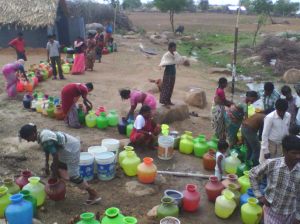
To cut to the chase, water is scarce in this region and so is electricity. Most villages in this part of the district have a central water pump connected to a storage tank that gets water when the State takes pity and provides electricity. Thus, no electricity implies no water. Electricity comes and goes at random times of the day and consequently there is no fixed schedule regarding the availability of water. Some desperate villager wakes up at 4 AM and rushes to the water pump in the hope of getting water. Another sleepy villager  walking out to take a leak at that hour observes an active man with four colourful pots running to get water and rushes back to his house to join the early riser in the daily water fetching ritual. News of water availability spreads and within 30 minutes one can see majority of the villagers, from 6 year olds to70 year olds, wiping their sleep off their face, walking, running or cycling, each with four to six bright colourful plastic pots to the solitary water pump. Multicoloured fluorescent pots form a long and winding queue to usher in the day. The chaotic queue naturally lends itself to quarrels and verbal skirmishes about who came first and why somebody has come with eight pots to hoard water.

Continue reading Boyalagudem’s Search for Water: Rajendran Narayanan

Kathikudam – Rabid War on the People: Faizi S

Shri Oomen Chandi

Chief Minister of Kerala

Dear Shri Oomen Chandi,

I am shocked to hear from colleagues in Kathikoodam of the brutal attack by the police on the people peacefully removing the illegally laid effluent pipe of the Nitta Gelatin Company. The people were discharging the legal responsibility of removing the pipe laid through a private citizen’s land without his consent and through the Panchayat land against the order of the Panchayat. While it was the natural duty of the police to support the Panchayat and the people in enforcing the Panchayati Raj Act of Kerala, they launched a rabid war on the people. Continue reading Kathikudam – Rabid War on the People: Faizi S

We do not want to see a repeat-performance of Muthanga: Appeal against Police Violence at Kathikudam

[When he finished recounting a glorious story of struggle by fisher folk against an obnoxious, oppressive feudal lord in a coastal village in Kerala, a senior activist told me: “But we can’t rest … the places where the poor live in Kerala are being taken over again … this time to be waste-dumps of the rich. This village can’t be an exception.” He was referring to the heavy pollution caused by the high-end pleasure resorts mushrooming around the village. Indeed, in all districts of Kerala, local struggles are becoming all the more frequent against the pillage of the earth to satisfy consumerist greed of the predatory rich and the shameless dumping of waste in areas where the poor live. The people of Kathikudam have been fighting a long battle — not just against the Nitta Gelatine factory’s heavily polluting practices which have nearly destroyed the Chalakudi river, wetlands in the area, extracting a huge toll on animal, and plant life in the region  and causing immense difficulties to local people there.  They are also condemning the company’s stealthy attempts to dump waste in distant border adivasi areas. Yesterday the police unleashed bestial violence against protestors, which has been widely condemned in the state.

Below is an appeal in protest signed by concerned intellectuals and activists. If the present UDF government considers itself to be above being a bunch of wheeler-dealers whose sole interest is grabbing the crumbs that fall from the table of predatory capital, they must act decisively and justly against this wanton disrespect to democracy on the part of the police they control. Those who wish to endorse the appeal may please indicate so in the comments]

We, the undersigned, are shocked to hear and read about the unfortunate and avoidable response of the police in the handling of the peaceful protest against thee pollution by Nitta Gelatin Company Limited has been creating in the village of Kathikudam in Thrissur District of Kerala.
The police attack on the protest has been brutal and the violence is against the people of the village who have been denied justice in the wake of insufferable pollution, which has been causing severe damage to the air, water, soil and agriculture of this region for three decades. This is what prompted the protestors to take action in the form of removing the pipe that carries effluents to the river. Continue reading We do not want to see a repeat-performance of Muthanga: Appeal against Police Violence at Kathikudam

Still No Justice for Khalid Mujahid : Country Be Not Proud !

 Image

Lucknow, July 19: Frustrated with the continuation of Rihai Manch’s indefinite dharna demanding justice for Khalid Mujahid, the Uttar Pradesh government last night removed the tent at dharna site, forcing the protestors into the open sun. Today braving incessant rain, the rights activists continued their protest.

Rihai Manch started the dharna on 20th May, demanding arrest of the officers named accused by Mujahid’s family in the FIR and action on the recommendation of the RD Nimesh Commission. Mujahid was killed in police custody on 18th May. He was abducted by police in Dec. 2007 and later implicated in a terror case. The RD Nimesh Commission appointed by the previous state government of Mayawati declared Mujahid’s arrest as fake and illegal.

(http://muslimmirror.com/eng/up-govt-removes-tent-rihai-manch-continues-dharna-under-open-sky/)


Wily strategists meet their nemesis at relative strangers hands. This old dictum is getting once again vindicated in the supposed ‘heartland’ of India namely UP.

A dead Khalid Mujahid, who lies buried in his native village, is proving to be the undoing of the mighty Mulayam Singh Yadav ‘led’ government. It has been more than two months that Khalid Mujahid – who along with Tariq Qasmi was languishing in jail for more than five years, for a ‘crime’ he never committed, as proved by the state government appointed Nimesh commission itself – died a mysterious death in police custody, (18 th May 2013) but this issue is still hogging headlines in a section of the regional media. Continue reading Still No Justice for Khalid Mujahid : Country Be Not Proud !

What Indian school children learn about the Partition

I wrote recently about the surprising political maturity with which NCERT textbooks teach Indian students about the Partition. These textbooks were prepared under the National Curriculum Framework of 2005. This is of course not limited to the Partition chapter or indeed just the history textbooks. But I was particularly moved to see the Partition chapter. As you read it you realise what school textbooks can do in shaping how future generations see themselves, their own history and identity. I think a lot of people in both India and Pakistan would like to read it. Here it is:

E-book: Sibaji Bandyopadhyay Reader

In the hope that more writers will make their books available online for free, Kafila is publishing an e-book version of Sibaji Bandyopadhyay Reader: An Anthology of Essays, published last year.

The Reader is an anthology of eight essays. The anthology focuses on a myriad of themes: politics of performance; nationalist appropriation and re-constitution of non-dualist Vedanta s tenets; double-take on remembering and forgetting; elusiveness of sexual identities; differences that engender terror. The essays take as their point of departure: a number of pre-modern Indian texts; a late nineteenth-early twentieth century archive of philosophical-cum journalistic writing in English published from Kolkata; specific art-works of Vivan Sundaram, Satyajit Ray, Ritwik Ghatak; the Pandora s Box that gets opened with the release of the film Fire ; Sigmund Freud s protracted struggles to establish fear, fright and anxiety as distinct conceptual categories; the grammar of terror that may be retrieved from the Mahabharata. Continue reading E-book: Sibaji Bandyopadhyay Reader

Katiyabaaz – the grid thief of Kanpur

Katiyabaaz Loha Singh in a still from the film

By SHIVAM VIJ: A new documentary film, Katiyabaaz, presents a problem that I’ve been struggling with. Although the film is set in Kanpur, it’s a problem that faces many parts of South Asia. The film-makers, Fahad Mustafa and Deepti Kakkar, obstinately refuse to offer possible solutions. With catchy lyrics and music, the film celebrates Kanpur, its people, and this messed-up system. It’s a snapshot of who we are. It’s when you think about the film that it disturbs you.

The film’s anti-hero is a thief — Loha Singh helps a lot of people steal electricity in Kanpur. He connects the illegal wire that is known in north India as katiya. Katiya is the sort of simple solution to life’s problems that South Asians feel very smart about. It’s an example of jugaad, the shortcut to problem solving that’s now integral to pop management theories. Continue reading Katiyabaaz – the grid thief of Kanpur

Pabnava to Natham: Whatever Happened to the Struggle for Annihilation of Caste!

ImageDalit residents of Pabnava, district Kaithal, Haryana would never be able to forget this year’s birth anniversary of Dr Babasaheb Ambedkar. The intervening nights of April 13 and 14 would forever remain etched on their minds. They still shiver when they remember how a four hundred strong mob of the local landowning community called Ror Marathas, armed with spears, batons and other sharp edged weapons, attacked the basti and ransacked more than 200 houses and left 6 dalits injured. It was supposedly to avenge the ‘dishonour’ wrought on them by a dalit youth who had dared to marry one of ‘their girls’.

To quote Raji, one of the victims, ‘..they came like a tornado’.

One could easily notice simmering tension in the village since a few days, as news had come in that Meena (21) daughter of an influential Ror Maratha from the village called Pirthi Singh had married a dalit boy Suryakant s/o Mahendra Pal and had eloped with him. Continue reading Pabnava to Natham: Whatever Happened to the Struggle for Annihilation of Caste!

The David Headley Lies Continue: There is Nothing ‘New’ About It

This release from the JUSTICE FOR ISHRAT JAHAN CAMPAIGN comes to us via Manisha Sethi.

“If you tell a lie big enough and keep repeating it, people will eventually come to believe it.” This is a quote often misattributed to the Nazi propagandist Joseph Goebbels. So widely is it believed to have been the key to Goebbelsian propaganda that it often employed by those whose politics is inspired by Goebbels’s Feuhrer.

This is exactly what we are seeing in this frenzied rush to pronounce Ishrat Jahan as a Lashkar operative by a section of media and commentators friendly to the ‘IB sources’.

Knowing full well that CBI’s mandate is only to enquire into the nature of the encounter – to probe whether Ishrat Jahan and three others were killed in cold blood – and realizing increasingly that the CBI investigation is leading to the unraveling of a plot so sordid that serious questions are going to be raised about the manner in which certain elements within the IB and agencies cynically used national security issues for vested interests, there is an attempt to pop up red herrings. False questions, planted stories, lies, fabrications – anything that will take the focus away from the guilt of those who conspired to abduct, drug and kill a teenaged college girl.

Continue reading The David Headley Lies Continue: There is Nothing ‘New’ About It

The BJP’s 2014 bid: A state-wise look and three key states where Modi may be risking party fortunes : Manish Dubey

This is a guest post by MANISH DUBEY: The Bharatiya Janata Party (BJP) lacks effective presence in several States, including large ones such as Andhra Pradesh (AP), Kerala, Tamil Nadu (TN) and West Bengal (WB) and others in the North-east (NE) barring Assam to an extent, and is unlikely to mount a credible challenge in the 168 Lok Sabha (LS) seats these account for.  Its 2014 tally from these States will remain in the lower single digits, as it was in 2004 and 2009. Odisha and Punjab, with 34 LS seats between them, are unlikely to add substantially to the party’s tally either. In Odisha, the ruling Biju Janata Dal (BJD) and the Indian National Congress (INC) are better entrenched. In Punjab, seat sharing arrangements with the locally dominant partner, the Shiromani Akali Dal (SAD)- Badal, will limit potential (individual) pickings for the party. Pickings are also likely to be limited from Jharkhand (14 LS seats) where besides the INC, a number of regional parties, each with strong local bases and candidates, would be in the fray. Till recently, even Karnataka (28 LS seats) would not have provided much hope but things may look up a trifle with Yeddyurappa reportedly negotiating a return or at least some kind of electoral understanding.

The small States and UTs, i.e., those with 10 LS seats or lesser, account for 40 LS seats and the BJP has a mixed LS election record on these, a record much dependent its performance in Delhi’s 7 LS seats.  Of the 284 LS seats (over half the 543 LS seats) accounted for by all the above mentioned States and UTs, a realistic tally for the BJP would be about 40, similar to that of the LS elections of 2004 (40 LS seats, including 18 from Karnataka) and 2009 (again 40 LS seats, including 19 from Karnataka) with potential gains in some places offset by a reduced tally in Karnataka (Yeddyurappa’s return or even an electoral understanding with him will reverse the misfortune of the recent Assembly elections only partly for the BJP). No Narendra Modi Magic is likely to boost the BJP’s tally here given mainly the state of the party itself.  Continue reading The BJP’s 2014 bid: A state-wise look and three key states where Modi may be risking party fortunes : Manish Dubey

Ilavarasan: At a deadly new junction of caste and electoral politics: Rajan Kurai Krishnan

ilavarasan_divya-350_070513040519This is a guest post by RAJAN KURAI KRISHNAN
The gruesome death/alleged murder of Ilavarasan, a Dalit youth, at the outskirts of Dharmapurai on the afternoon of 4th July has come as a shock to all those who have heard of his case. Murders, ironically called honour killings, and socially abetted suicides as outcomes of inter-caste marriages are of course as common as catching cold in most parts of India. However, what has made Ilavarasan’s case something that could penetrate the armour of the middle class everyday plated with trained nonchalance to extract a possible expletive under their breath is the fact that his case has been in the limelight for more than eight months now.

It was a few weeks after his marriage with Divya, a girl belonging to the caste of Vanniars, a Most Backward Caste in the official description of Tamil Nadu Government,  in October 2012, Divya’s father was found dead allegedly having committed suicide due to the “dishonour” caused by his daughter’s marriage. Making the suicide an excuse, the Vanniyars organized riots in which three Dalit hamlets, about 250 houses, were destroyed. The scale of violent destruction caught the national attention and so did the love story behind the riots. The young couple earned a media profile while trying to live in peace beyond the reach of the raging Vanniyar caste men. It was fated that was not to be. The Vanniar caste leaders used Divya’s mother to temporarily separate Divya from Ilavarasan by using the well known tactics of emotional blackmail. They then broke the communication link between Ilavarasan and Divya. When Ilavarasan saw Divya in the court on the first of July, Divya told the court that she would live with Ilavarasan after convincing her mother. Divya’s lawyer, however, managed to make her tell the press that she is separated from Ilavarasan forever. Ilavarasan, on the other hand, told India Today, that he was highly hopeful of re-uniting with Divya. After two days, he was found dead near a railway track in broad daylight. Given this history, the news had some potential to shock people. Continue reading Ilavarasan: At a deadly new junction of caste and electoral politics: Rajan Kurai Krishnan

The shameful role of the Indian Supreme Court in the Emergency of 1975: Rajinder Sachar

This guest post by RAJINDAR SACHAR comes to us via the PEOPLE’S UNION FOR CIVIL LIBERTIES.

Lewiston Morning Tribune - Google News Archive Search - Mozilla Firefox_2013-07-14_19-25-11

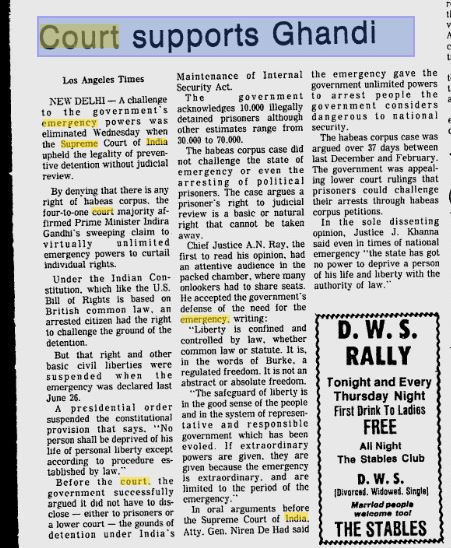
Nations which do not remember their immediate past are in danger of repeating their tragic mistakes. This thought came to me on June 26th, 2013 (the Emergency day of 1975) when on random questioning of age group of 35 in the country (who are said to make up about half the population) I found that most of them did not know of any particular significance of the day – and more tragic, fairly large number of people above the age of 35 fared no better. Continue reading The shameful role of the Indian Supreme Court in the Emergency of 1975: Rajinder Sachar

DISSENT, DEBATE, CREATE