Of Cloaking, Colouring and Varnishing: Prasanta Chakravarty

Guest post by PRASANTA CHAKRAVARTY

“Then leave Complaints: Fools only strive
To make a Great and honest Hive.
T’enjoy the World’s Conveniences,
Be famed in War, yet live in Ease
Without great Vices, is a vain
Eutopia seated in the Brain.”

Bernard Mandeville (The Grumbling Hive, 1705)

Salutary falsehoods for a promising end, anyone? Try telling this to the ever righteous Anna Hazare or to the followers of Vaclav Havel, whose campaign assurance to ‘live in truth’ in the year 1989 so moved his virtuous flock. There is a politics of virtue and then there is realpolitik – or so we are told. Or is virtue above politics and vice below? What the deuce marks the ambiguous space in between?! That is what has been relentlessly, and ruthlessly, scanned by two masterful recent additions to the canons of contemporary Western political philosophy: Martin Jay’s The Virtues of Mendacity: on Lying in Politics and David Runciman’s Political Hypocrisy: the Mask of Power, from Hobbes to Orwell and Beyond.

At one level, both scholars acknowledge and emphasize the dangers of the ‘ethical turn’ in political studies.

Continue reading Of Cloaking, Colouring and Varnishing: Prasanta Chakravarty
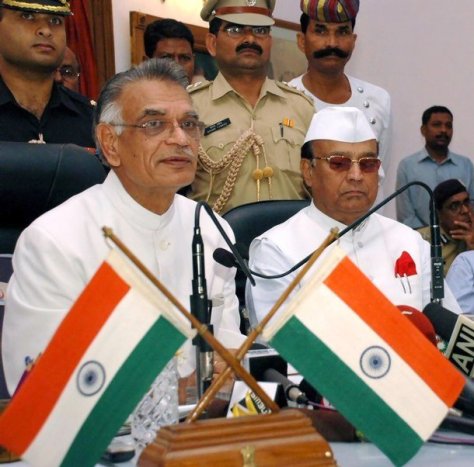
Shivraj Patil hath no mercy! Why could he not pardon an old, ailing Ram Kumar?: PUCL

This statement has ben issued by the PEOPLE’S UNION FOR CIVIL LIBERTIES

Ram Kumar died of cancer in Jaipur Central Jail, waiting for the Governor to grant him mercy and Dr. Khalil Chishty waits in Ajmer Jail while his file sits with the Governor for several weeks now!

The Governor of Rajasthan Sh. Shivraj Patil’s attitude towards exercising his powers of granting mercy to convicted prisoners is absolutely negative. Article 161 of the Constitution of India confers “on the Governor of a State the right to grant pardons, remissions, reprieves or commute the sentence of any person convicted of any offence against any law relating to a matter to which the executive power of the State extends.” Continue reading Shivraj Patil hath no mercy! Why could he not pardon an old, ailing Ram Kumar?: PUCL

Jagdish Tytler will not attend the Maulana Mohd. Ali Jauhar Award ceremony

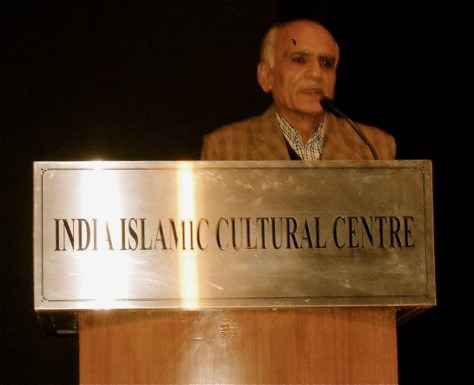
M. Saleem addressing the Maulana Jauhar Award ceremony at IICC in Delhi on 10 December 2011

Update on 11 December:

Twocircles.net reports:

“Zafar Agha was replaced by ex-MP and senior Journalist Santosh Bharatiya. However, M Saleem claimed that Sanjeev Bhatt could not attend the programme due to time constraint and the award may be given to him some other time. While referring to Santosh Bhartiya, being awarded in place of Zafar Agha, M. Saleem said that he has been nominated for the award and nobody has been replaced for the same. The organizer kept totally mum about both Zafar Agha and Jagdish Tytler. ” [Link]

*

On 3 December, an open letter signed by some of us, and posted here on Kafila, had appealed to seven distinguished individuals to not accept the Maulana Mohd. Ali Johar Award, to be given on 10 December at the India Islamic Cultural Centre. We had reasoned that since the eighth awardee was Jagdish Tytler, they should not share an award and a platform with someone accused of organising mass murder of Sikhs in Delhi in 1984.

Yesterday evening, the general secretary of the Maulana Jauhar Academy, M. Saleem, emailed one of the signatories, Mahtab Alam. The email contained a scanned copy of a letter sent by Jagdish Tytler to M Saleem, which said that Tytler would not attend the award ceremony so as to not embarrass the the other awardees and the organisers, because of this boycott campaign. He, however, stressed on his innocence in the 1984 anti-Sikh pogrom, and, notably, did not say that he would not accept the award. He would only not attend the ceremony. M. Saleem has also not announced whether he is withdrawing his decision to give the award to Mr Tytler. For more details on what has transpired in the last few days, please see Mahtab Alam’s article, Beware of the Sarkari Musalmaan.

Given below is the final list of 150 names who signed the original appeal.  Continue reading Jagdish Tytler will not attend the Maulana Mohd. Ali Jauhar Award ceremony

Harvard does the right thing: drops Subramanian Swamy

The Harvard Crimson reports:

Faculty members chose to remove two summer economics courses at the Summer School taught by Subramanian Swamy, a controversial Indian political figure. Over the summer, Swamy published an op-ed that advocated for the destruction of hundreds of Indian mosques and the disenfranchisement of non-Hindus in India.

Chief Information Officer for the University Anne H. Margulies concluded the meeting by updating faculty on the newly-created Harvard University Information Technology system and its future vision, which included greater collaboration with the library and further digital pedagogy. [Link]

Although DNA never apologised for publishing “How to wipe out Islamic terror,” Swamy’s hate-filled column, (and Kapil Sibal thinks Facebook will cause riots), Harvard University has done the right thing. Continue reading Harvard does the right thing: drops Subramanian Swamy

Beware of the Sarkari Musalmaan: Mahtab Alam

Guest post by MAHTAB ALAM

In the current issue of the English fortnightly, Milli Gazette (1-15 December), it is reported that on 10 December 2011, former union minister Jagdish Tytler will be awarded with seven others in a function at India Islamic Culture Centre, Delhi, by Maulana Mohammad Jauhar Ali Academy. The other names were those of Dr. S Y Quraishi, Chief Election Commissioner of India; Sanjeev Bhat, Indian Police Service officer (Gujarat); senior journalist Zafar Agha; Mohd. Najeeb Ashraf Chaudhri, chief income tax commissioner; Maulana Mohd. Haseeb Siddiqui, chairman of the Deoband Nagar Palika Parishad; Nusrat Gwalliori, a Delhi-based Urdu poet, and  Begum Rehana AR Andre, a social activist and educationist based in Mumbai.

The award has been named after Maulana Mohammad Ali Jauhar, a key figure of the Indian freedom movement, a leader of the Khilafat movement and one of the founders of Jamia Millia Islamia, a prestigious central university in Delhi. The award is given on his birth anniversary every year. Though the reasons for honouring these people were not mentioned in the Milli Gazette report, the Academy’s general secretary explained that every year, the academy honours individuals in recognition of their extra-ordinary contribution in the field of journalism, politics, social service and so on. This year they  chose Jagdish Tytler for his contribution to politics! Continue reading Beware of the Sarkari Musalmaan: Mahtab Alam

High theory, Low ‘Kolaveri Di’: Why I am a Fan of this Flop Song: AS Ajith Kumar

Guest post by AS AJITH KUMAR

YouTube’s search results for the `Kolaveri di ’ song are amazing. It is hard to pick the `original’ from the plethora of `kolaveri di ’ songs -the `reply cover version’, kids version by Naveen Nigam, the damn version, and many more. I was very excited to find this possibility-a song has initiated a dialogue, and that too a musical engagement. This I think are the new possibilities that the new media has brought into the field of music. Here  is not the two- way process that we are familiar with, between the music and the listener, but a number of activities in multiple tracks.

The ‘listener’ is more visible  now, and has more powers. He/she shares, likes, comments, makes his/her own videos and broadcasts them by herself/himself. I am not trying to jump into a sort of technological determinism, but approaching the shifts in the music field – in the making, listening, broadcasting and sharing of music. I would say that it is within this context that we have to reflect on the popularity of the `kolaveri di ’ song.

Continue reading High theory, Low ‘Kolaveri Di’: Why I am a Fan of this Flop Song: AS Ajith Kumar

A woman in Delhi Metro, two women in a bus

Many years ago, I was travelling in a DTC bus – or was it a private-run Blueline? – in which the usual sense of calm-with-commotion was disturbed by a sudden act of strategic, small-scale violence, followed by a moment of stunned silence, then some bickering.

Two women were travelling in a bus full of men, and one of them had slapped a man. The man tried to argue and claim innocence, but to no avail. It was obvious to everyone in the bus that the woman would not slap him without a reason. He must have molested her. Most passengers watched silently, eager to closely observe the tamasha so they could relate it to others, like I’m doing now. But quite a few voiced their support of the women, and the bus conductor asked the man in question to get down at the next stop, returning his entire fare. Continue reading A woman in Delhi Metro, two women in a bus

What Kapil Sibal does not understand: the internet

A  few days ago a friend asked me if I knew someone who had the ability and inclination to help out a certain department of the central government with using social media. My friend did not name who the prospective employer was, but clearly, with even Digvijay Singh on Twitter, the Congress party is worried about social media. No surprise that this should happen in a year when the UPA government’s popularity has taken a nose-dive.

The New York Times revealed on 5 December that Kapil Sibal summoned Facebook officials and showed them a Facebook page that allegedly maligned Congress president Sonia Gandhi and said that this was unacceptable. While HRD officials refused to reveal much in that NYT copy, they must have realised that shit has hit the fan, because the next morning’s Indian Express the spin doctoring was clear: there was now a mention of allegedly derogatory pictures of Prophet Mohammed along with the Prime Minister and the Congress President (who are no doubt as sacred in his books as Prophet Mohammed).By the time he held his press conference yesterday, it became about things that Hurt Our Religious Sentiments. On the 19th anniversary of the Babri Masjid demolition, it is very interesting to see a Congress minister using religion to cover up power politics.  Continue reading What Kapil Sibal does not understand: the internet

Mining Poisons South Goa Waters: Devidas Gaonkar

A Video Volunteers story on mining in Goa:

Salaulim reservoir, situated in the Sanguem taluka, is the largest dam in Goa. It supplies water to almost entire South Goa, comprising 55% of the state’s population. Although Devidas’s video mentions that there are 8 mines that operate near Salaulim, other sources suggest that there are as many as 15 mining leases within the catchment of the reservoir. This proves to be a grave danger to the dam, the water that flows through it, as well as the people who consume this water.

Continue reading Mining Poisons South Goa Waters: Devidas Gaonkar

Transnational Torture by Jinee Lokaneeta reviewed with Prachi Patankar

There are few books as exhilarating as one by a comrade that is intellectually engaging and speaks to the current context. I was invited by 3rd i NY to a Conversation titled ‘Torturing Democracies: Past and Present’, where Jinee and I discussed her new book at Alwan for the Arts. The conversation came to life with the audience which included many of our comrades from the South Asia Solidarity Initiative (SASI) including Prachi. After that wonderful conversation, Prachi and I decided to delve further into the book and write a review. This was an exercise very different from what we normally engage with in SASI around our solidarity campaigns, but it was also a wonderful way to see another side of Jinee. That is the theoretically rich research of someone whom we relied on as a solid activist. I feel we should be doing more of reading, writing about and debating the work of our activist friends. A shorter version of this review has been published by Himal. Perhaps some of the themes in the book can be debated here with this longer review. Continue reading Transnational Torture by Jinee Lokaneeta reviewed with Prachi Patankar

Kapil Sibal is an Idiot

I urge you to write KAPIL SIBAL IS AN IDIOT as your Facebook status message, use the hashtag #IdiotKapilSibal on Twitter, and write a blog post with the above title, because there may soon be a day when he may prevent you from doing so.

The New York Times reports:

The Indian government has asked Internet companies and social media sites like Facebook to prescreen user content from India and to remove disparaging, inflammatory or defamatory content before it goes online, three executives in the information technology industry say.

Top officials from the Indian units of Google, Microsoft, Yahoo and Facebook are meeting with Kapil Sibal, India’s acting telecommunications minister, on Monday afternoon to discuss the issue, say two executives of Internet companies. The executives asked not to be identified because they are not authorized to speak to the media on the issue.

[…]

About six weeks ago, Mr. Sibal called legal representatives from the top Internet service providers and Facebook into his New Delhi office, said one of the executives who was briefed on the meeting.

At the meeting, Mr. Sibal showed attendees a Facebook page that maligned the Congress Party’s president, Sonia Gandhi.  “This is unacceptable,” he told attendees, the executive said, and he asked them to find a way to monitor what is posted on their sites. [Link]

Continue reading Kapil Sibal is an Idiot

हिन्दी फ़िल्म अध्ययन: ‘माधुरी’ का राष्ट्रीय राजमार्ग

(ये लेख स्रोत-चिंतन जैसा है, जिसे पीयूष दईया के कहने पर मैंने लोकमत समाचार, दीवाली विशेषांक, 2011 के लिए लिखा था। अपनी आलोचनात्मक टिप्पणियों से नवाज़ेंगे तो अच्छा लगेगा।)

This slideshow requires JavaScript.


बहुतेरे लोगों को याद होगा कि टाइम्स ऑफ़ इंडिया समूह की फ़िल्म पत्रिका माधुरी हिन्दी में निकलने वाली अपने क़िस्म की अनूठी लोकप्रिय पत्रिका थी, जिसने इतना लंबा और स्वस्थ जीवन जिया। पिछली सदी के सातवें दशक के मध्य में अरविंद कुमार के संपादन में सुचित्रा नाम से बंबई से शुरू हुई इस पत्रिका के कई नामकरण हुए, वक़्त के साथ संपादक भी बदले, तेवरकलेवर, रूपरंग, साजसज्जा, मियाद व सामग्री बदली तो लेखकपाठक भी बदले, और जब नवें दशक में इसका छपना बंद हुआ तो एक पूरा युग बदल चुका था। [1] इसका मुकम्मल सफ़रनामा लिखने के लिए तो एक भरीपूरी किताब की दरकार होगी, लिहाजा इस लेख में मैं सिर्फ़ अरविंद कुमार जी के संपादन में निकली माधुरी तक महदूद रहकर चंद मोटीमोटी बातें ही कह पाऊँगा। यूँ भी उसके अपने इतिहास में यही दौर सबसे रचनात्मक और संपन्न साबित होता है। Continue reading हिन्दी फ़िल्म अध्ययन: ‘माधुरी’ का राष्ट्रीय राजमार्ग

Release Abhay Sahoo Now: People’s Union for Civil Liberties

This press release comes from the PEOPLE’S UNION FOR CIVIL LIBERTIES

Bhubhaneshwar / Delhi
5th December, 2011
PRESS RELEASE

• Appeal to the Odisha Government to withdraw the frivolous cases and RELEASE ABHAY SAHOO NOW!

• WITHDRAW ALL THE CRIMINAL CASES LODGED AGAINST THE ANTI POSCO ACTIVISTS and put a stop to repressive measures.

• PUCL APPEALS TO OTHER ORGANISATIONS TO COME TO TOGETHER AND INITIATE A NATIONAL CAMPAIGN FOR THE RELEASE OF ABHAY SAHOO AND SUPPORT OF THE POSCO PRATIRODH SANGRAM SAMITI.

The People’s Union for Civil Liberties, represented by its National Secretary Kavita Srivastava and Odisha Convenor, Pramodini Pradhan visited the area in and around Dhinkia Panchayat in Jagatsinghpur district on 1st December, 2011, where the struggle against the proposed POSCO steel plant is taking place for the last seven years. We also went to Choudwar Jail in Cuttack District on 2nd December, 2011 to meet Mr Abhay Sahoo the leader of the POSCO Pratirodh Sangharsh Samiti, who has been arrested against FIRs motivated by the administration under sections causing sexual assault, wrongfully confining somebody and causing atrocities under the SC & ST Act. Continue reading Release Abhay Sahoo Now: People’s Union for Civil Liberties

Why This Kavala-Worry Kavala-Worry Di?

As somebody recently said about the Mumbai flash mob video, if you haven’t seen it, you probably don’t have internet. I’m speaking of the recent ‘Tamil’ hit song of course, ‘starring’ Dhanush.

The one with the catchy tune and simple ‘lyrics’? See, this is what worries me, the fact that I have already used so many quotation marks – for ‘Tamil’, ‘starring’ and ‘lyrics’. Which is why I titled this piece “why this kavala-worry kavala-worry di”. “Kavala” means worry in Tamil (without quotes). So kavala-worry really means worry-worry, which should be nonsense, but it isn’t, given the massive ‘success’ (can’t keep away from the quote marks sorry) of the original ‘Kolaveri’ song, full of double-double words, because this is how we speak in soudh indiya. “Kolaveri”, for those suddenly-uncool nordh indiyans who don’t understand ‘Tamil’ or even plain old Tamil, means ‘murderous rage’ – kolla (murder) + verri (rage).

Continue reading Why This Kavala-Worry Kavala-Worry Di?

Hindi and Urdu: Sa’adat Hasan Manto

This is MUHAMMAD UMAR MEMON‘s translation of an article by SA’ADAT HASAN MANTO. The translation first appeared in The Annual of Urdu Studies.
The Hindi-Urdu dispute has been raging for some time now. Maulvi Abdul Haq Sahib, Dr Tara Singh and Mahatma Gandhi know what there is to know about this dispute. For me, though, it has so far remained incomprehensible. Try as hard as I might, I just haven’t been able to understand. Why are Hindus wasting their time supporting Hindi, and why are Muslims so beside themselves over their preservation of Urdu? A language is not made, it makes itself. And no amount of human effort can ever kill a language. When I tried to write something about this current hot issue, I ended up with the following long conversation:

Munshi Narain Parshad:  Iqbal Sahib, are you going to drink this soda water?

Mirza Muhammad Iqbal: Yes, I am.

Munshi: Why dont you drink lemon?

Iqbal: No particular reason. I just like soda water. At our house, everyone likes to drink it.

Munshi: In other words, you hate lemon. Continue reading Hindi and Urdu: Sa’adat Hasan Manto

Oxford University Members Demand that OUP-India Stand by Ramanujan Essay

Shahid Amin has earlier written about the role of the Oxford University Press (India) in the censorship of AK Ramanjuan’s essay on the Ramayana. This press release, signed by a group of Indian scholars at Oxford University, comes to us via Agrima Bhasin.

Press Statement
Oxford, England
Date: 30 November 2011

A petition by members of Oxford University has condemned Oxford University Press (OUP) India’s unflattering role and its deafening silence on the controversy surrounding Delhi University’s recent decision to drop A.K. Ramanujan’s essay (Three Hundred Ramayanas: Five Examples and Three Thoughts on Translation). This petition has gained the abounding support of Oxford intelligentsia across 15 departments and 20 constituent colleges. Signatories include distinguished faculty members, senior academics and students.

In 2008 OUP India unceremoniously decided to stop publication of the only two books (Paula Richman’s Many Ramayanas and Vinay Dharwadker’s The Collected Essays of A.K. Ramanujan) containing Ramanujan’s essay. This happened to coincide with legal proceedings instituted inter alia against OUP India by fringe religious and cultural groups. OUP India’s prolonged subsequent silence on this matter lent widespread credence to the contention that OUP India caved in to external pressure thereby compromising its stated goals of “…[furthering] excellence in research, scholarship… by publishing worldwide.”

Continue reading Oxford University Members Demand that OUP-India Stand by Ramanujan Essay

When Openness is Unfreedom (alternatively, when data is unfreedom) – Part II

This is the second post in the series that I began in October. I want to thank Rasagy Sharma for prompting me to put down the second post in this series.

This evening, Rasagy raised a question on twitter about whether the effort of a developer to make the database of the Indian railways downloadable is ‘official’ or not? As Rasagy later explained, the downloadable database is a list of trains, stations and the railway timetable. This list has has been made available in various downloadable formats (such as .csv, .pdf, etc) to encourage developers/interested persons to make web/mobile based applications. Rasagy’s question was more in the nature of checking the legality of  the act of putting this information/database on another website when it is explicitly copyright of the Indian Railways (as declared on their website). He argued that cities such as New York and some countries across the world have made this information ‘open’, meaning available to the ‘public’. Hence, it is unreasonable for this government entity i.e., the Indian railways, to be ‘closed’ about reuse of this information by private entities and individuals.

Continue reading When Openness is Unfreedom (alternatively, when data is unfreedom) – Part II

An appeal to seven distinguished individuals to decline the Maulana Mohd Ali Jauhar Award

You can add your name to this appeal in the comments section.

Delhi, 3 December 2011

According to a news report in the Milli Gazette of 1 December 2011, Jagdish Tytler, an accused in the anti-Sikh pogrom of 1984, will be awarded the Maulana Mohd Ali Jauhar Award on 10 December 2011 at the India Islamic Cultural Centre, New Delhi. Seven others will share this award. The undersigned appeal to the other seven awardees to not accept the award as a mark of protest against honouring Mr Tytler, whose contribution in the 1984 anti-Sikh pogrom has been recorded by several fact-finding reports, including those by PUCL and PUDR.

The seven names are:

Continue reading An appeal to seven distinguished individuals to decline the Maulana Mohd Ali Jauhar Award

यहाँ से शहर को देखो…

(नई दिल्ली का सौवां साल शुरू होने पर हिंदी साप्ताहिक आऊटलुक  में यह लेख पहली बार प्रकाशित हुआ था.)

अब जबके हर तरफ यह एलान हो चुका है के दिल्ली १०० बरस की हो गयी है और चारों ओर नई दिल्ली के कुछ पुराने होने का ज़िक्र भी होने लगा है, इन दावों के साथ साथ के दिल्ली तो सदा जवान रहती है और देखिये ना अभी कामन वेल्थ खेलों के दौरान यह एक बार फिर दुल्हन बनी थी वगेरह वगेरह तो हमने सोचा के क्यों न इन सभी एलान नामों की सत्यता पर एक नजर डाल ली जाए, और इसी बहाने उस दिल्ली वाले से भी मिल लिया जाए जो इस अति प्राचीन/ मध्य कालीन/ आधनिक नगरी का नागरिक होते हुए भी वैशवीकरण के झांसे में इतना आ चुका है के वो अपने आप को २१वीं शताब्दी के पूर्वार्द्ध में आने वाले आर्थिक संकट को पछाड देने वाले चमचमाते भारत देश की राजधानी का शहरी  होने का भरम पाले हुए है. Continue reading यहाँ से शहर को देखो…

When Media is Nuked!: PK Sundaram

Guest post by PK SUNDARAM

After armed forces, nuclear establishment is another holy cow in the post-independence India. Our media does not only outsources all final judgements on nuclear issues to the nucleocrats, but has also happily joined them in slanders against the grassroots anti-nuclear movements.

We have seen the media discourse on nuclear weapons being shadowed almost entirely by national security and nuclear deterrence arguments. On the recent upsurge of mass protests against nuclear energy projects across the country, media is playing the official tune where people challenging these projects are reduced to illiterate crowd, foreign-funded groups, religious identities and even anti-nationals. On 24th this month, the Tamil newspaper Dinamalar published a story titled Truth and hype behind the Koodankulam row. This report is nothing but an utterly malicious piece of journalistic writing with ugly slanders against the leading activists of the ongoing anti-nuclear movement in Koodankulam – S P Udayakumar, M Pushparayan and M P Jesuraj.

Continue reading When Media is Nuked!: PK Sundaram

The need to influence the trajectory of one’s own life: Ruchi Gupta

Guest post by RUCHI GUPTA

The Arab Spring demonstrations in Tunisia, Egypt, Libya, Bahrain, Yemen, Syria, Jordan, Morocco were hailed in much of the democratic world. However the Occupy Wall Street protests, which till date have spread to 100 cities in the United States and 1500 globally have met with mixed response.

The Arab people are fighting for democracy, and thus their resistance must be respected and supported. But the OWS folks, proudly leaderless and having framed no concrete demands are vulnerable to all manner of criticism, even from those expected to be supportive. Bill Keller, the former editor of arguably one of the most influential newspapers in the world, the ostensibly liberal, New York Times derides,  “the Occupiers have been pandered to (“Love your energy!”); patronized (“Here, I’ve drafted you a list of demands …”); co-opted by unions, celebrities and activists for various causes; demonized by the right; arrested and tear-gassed in some cities; and taken lightly by the likes of me”.

However the uprisings in the Arab nations, the OWS demonstrations and even the wave of anti-corruption protests that swept India this year are all ultimately an expression of people’s resistance to disenfranchisement. Whether it’s those fighting for democracy or those who find themselves powerless in face of a system that’s been hijacked by the illegitimate nexus between the financial and political elite (the metaphorical 1%), the underlying sentiment is a demand for fair play and the right of self-determination. Continue reading The need to influence the trajectory of one’s own life: Ruchi Gupta

DISSENT, DEBATE, CREATE