आज़ादी की एक लड़ाई चम्बल की घाटी में : अंकित झा

Guest post by ANKIT JHA

आज़ादी किसे पसंद नहीं है? सभी मनुष्यों कीआत्मा में निहित एक अधिकार आज़ादी. सभी बंधनों से मुक्ति, ना कोई शासक ना कोई शासन. स्वयं का स्वयं पर अधिकार. एक आज़ादी की लड़ाई चम्बल से.जाति संघर्ष के परे,वर्ग संघर्ष के परे. परन्तु सब को समाहित किये एक अनोखा संघर्ष. मध्य प्रदेश के चम्बल संभाग में स्थित जिला श्योपुर.और सतत चला आ रहा ज़मीन संघर्ष.  इस देश में किसी गरीब व वंचित वर्ग के लिए ज़मीन का अधिकार पाना कभी आसान नहीं रहा.हालाँकि समय-समय पर सरकार, समाजसेवी संगठन तथा कुछ आन्दोलनों द्वारा इसका भरसक प्रयास किया गया है कि समाज में सभी के पास सामान रूप से ज़मीन हो. लेकिन हर बार यह प्रयास किसी न किसी कारण से असफल रहा.इन असफलताओं का कारण अधिकाँश समय उच्च वर्ग का अपनी ज़मीन से मोह तथा वंचित वर्ग का निरंतर शोषण रहा है.सरकार हो या अधिकांश समाजसेवी संस्थाएं, इसी ख़ास वर्ग की नुमाइंदगी करते रहे हैं. ना ही संघर्ष को सफलता मिली और ना ही कोई रास्ता. अब जिस व्यक्ति को अपनी जीविका हेतु संघर्ष करना पड़ता हो, उसके अन्दर ऐसी संघर्ष की चाह पैदा करना पाना मुश्किल कार्य है. फिर यदि शोषित वर्ग वनों में रहने वाले आदिवासी वर्ग हो तो कार्य नामुमकिन सा प्रतीत होता है.यह नामुमकिन ही है, जबतक इच्छा शक्ति एकता परिषद सी ना हो.
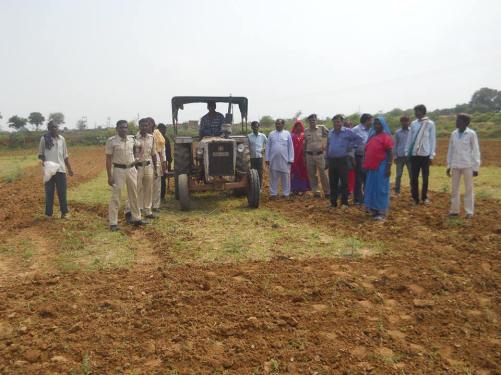
Ekta parishad leaders & administration demarcating formerly land for giving possession to the Sahariya tribal people

विगत 10 वर्षों से भी अधिक से श्योपुर में ज़मीन माफियाओं ने जबरन आदिवासियों की ज़मीन पर कब्ज़ा कर रखा था और कईयों ने तो इन ज़मीनों को हरियाणा, पंजाब तथा उत्तरी राजस्थान से आये बड़े किसानों को बेच दिया था. इन बाहरी किसानों ने आदिवासियों को उनकी ही ज़मीन पर मजदूर की नौकरी प्रदत्त करवा के उनपे शोषण का नया तरीका अपनाया.यह कतई किवदंती नहीं है कि खेत में कार्य कर रहा मजदूर उन बड़े किसानों के गुलाम से भी बदहाल स्थिति में कार्य करते हैं. ये दिहाड़ी मजदूर किसी संघर्ष की लालसा में अपने एक दिन के आय को नहीं खो सकते. ऐसे समय में एकता परिषद् ने संघर्ष को नया नाम दिया.उन्होंने इसे आज़ादी के लिए किये जाने वाला संघर्ष कहा. अपनी ज़मीन वापस पाने की आज़ादी. अपना अधिकार वापस लेने की आज़ादी.एकता परिषद् एक गांधीवादी संस्था है जो वंचित वर्ग के जल, जंगल व ज़मीन के लिए संघर्ष करती है. विगत 2 दशकों से भी अधिक समय से शोषित व वंचित वर्ग की सेवा तथा उनके सशक्तिकरण के लिए संस्था कार्यरत है.संस्था ने सबसे पहले ज़मीनी हकीकत पता किया तथा सभी जानकारी लेने के पश्चात सभी आदिवासी जिनकी ज़मीन पर कब्ज़ा था उन्हें आगे आने के लिए प्रेरित किया. जब आदिवासी तैयार हुए तो उन्होंने जिला कलेक्टर को तुरंत कार्रवाई तथा अपने स्वामित्व को पुनः प्राप्त करने हेतु ज्ञापन सौंपा. इस ज्ञापन का असर यह हुआ कि प्रशासन तुरंत हरकत में आया.

Continue reading आज़ादी की एक लड़ाई चम्बल की घाटी में : अंकित झा

Whose Terror, Whose Powerlessness? Milind Wani


Guest post by MILIND WANI

On January 7 a car bomb at a Libyan police camp in the town of Zilten killed 60 people and wounded 200 more.  On January 11, bombs in three cities in Iraq, including Baghdad, killed over 130 people. On January 16, ISIS forces attacked the Syrian town of Deir ez-Zor, killing Syrian army members as well as women and children. Death toll estimates range between 130 and 300 people.  On February 1, a suicide bomber detonated a vest outside Afghanistan’s national police headquarters in Kabul, killing 20 and injuring 29. On February 8, ISIS executed approximately 300 activists, police, and military personnel in Mosul, Iraq. On February 21, ISIS detonated car bombs in two Syrian towns heavily populated with Shi’ite Muslims, killing between 140 and 270 people, and wounding over 300 more. In March this year, a car bomb detonated in a busy public square killed at least 37 people in the Turkish capital of Ankara. The same month, on a street filled with shops and cafes in Istanbul, Turkey’s largest city, a suicide bomber killed five people. On March 27, seventy-two people, including 29 children, were killed in a suicide bombing at the largest public park in Lahore, Pakistan. In May Baghdad attacks, at least 69 to 90 were killed in suicide attacks and car bombings in Iraq capital. On June 28, a trio of suicide bombings at an airport in Istanbul killed 45 and injured 200 more. On 3rd July 2016, coordinated bomb attacks were carried out in Baghdad, resulting in mass civilian casualties. A few minutes after midnight local time, a suicide truck bombing in the district of Karrada killed more than 300 people and injured hundreds more. This list is not exhaustive.

In the above backdrop of terror attacks in middle east by the ISIS or groups associated with it, that Pratap Bhanu Mehta should be impelled to write a passionate piece only after the horrendous truck rampage which left 84 dead in Nice says much about how even the most sympathetic of commentators have become party to selective amnesia. But if that was his only sin, one could just put it down to the times we live in where even the most informed ones are not free of ideological biases. However there is much that can be considered as problematic, either in terms of his analysis or the solutions he proposes or the stand he takes and would want us to take. Continue reading Whose Terror, Whose Powerlessness? Milind Wani

Slow Rendering of an Ache & Mahesh Verma’s Translation : Prasanta Chakravarty

This is a guest post by PRASANTA CHAKRAVARTY


“If the translation of poetry is impossible, then the translation of poetry is a genuine art.”

~Nasos Vayenas, Eight Positions on the Translation of Poetry


Translation is an act in the wake of literature. Both the languages – source and target – are variations on literary themes, with neither having priority. But translation depends on an essential paradox: a collision between restlessness and poise, detachment and recreation. In the best translations of poetry this paradox turns into a synthesis that must remain unfinished. Continue reading Slow Rendering of an Ache & Mahesh Verma’s Translation : Prasanta Chakravarty

Civil War in Hindu Society – Happy Independence Day!

UPDATE FROM UNA :  THIS IS FROM TEAM UNA

Received August 15th evening

Violence broke out this morning on the highway.

We’ve been at Una Police Station since afternoon. The Una victim families, Balubai Sarvaiyya and others who feel threatened want police to escort them back to their villages after violence broke out on the highway today morning. Two cars have been burnt, vehicles are being stoned, roads are blocked. They also want police to put up a post in their villages. But the police is keeping mum. The families continue to agitate in whatever ways they can to express their anguish but the police is clearly indifferent. The Yatra came to an end today on a high note but how much has anything changed?

As Dalits march in hundreds of thousands in the Dalit Asmita Yatra from different places to Una, where four Dalits were flogged for skinning dead cattle, one contingent was physically attacked by ‘upper’ caste villagers at Samter village yesterday. A Bolero with 8 people inside was attacked, the vehicle was damaged and petrol was poured on the vehicle

(Video courtesy Dalit Camera)

Here is the route of this extraordinary journey covering 81 kilometers

Continue reading Civil War in Hindu Society – Happy Independence Day!

What exactly happened in Jamia Millia Islamia on 13th August? Jamia Millia Islamia Students

Guest Post by Jamia Millia Islamia Students

What exactly happened in Jamia Millia Islamia on 13th August?

The sequence of events:

Just two days before Independence Day, all the hostel residents were informed personally by the administrative authorities to be careful as there may be some raid by IB or CBI or Delhi Police. Students were instructed not to keep any non-resident student in the hostel.

While it is okay to instruct students not to keep any non-resident student in the hostel, what is problematic is the atmosphere of fear that was created among students. Many of the students were told to be careful regarding ‘KASHMIRI STUDENTS’ in particular.

The hostel authorities repeatedly instructed the students not to come out of their rooms and to be careful.

On the 13th of August, at around 3 p.m., two police constables in uniform and around 15-20 officials in plain clothes were seen sitting just outside the hostel gate. Two constables came inside the gate and started having conversation with the guards while around 10 officials were sitting in their cars inside the hostel campus.
Continue reading What exactly happened in Jamia Millia Islamia on 13th August? Jamia Millia Islamia Students

The Mahmood Farooqui Rape Conviction – A Landmark Verdict: J Devika & Nivedita Menon

This post is jointly written by J DEVIKA and NIVEDITA MENON

Bitter arguments rage within the community that we may term as broadly secular, leftist, even feminist, around the Farooqui judgement – in many ways, this judgement and the case itself, may be to Left politics in India with regard to sexual violence, what “Nandigram” was with regard to the question of land, agriculture and environmental costs of industrialization. That is, the dismantling of an older framework of ethics and politics and the painful emergence of what one hopes will be a new consensus on what constitutes rape, but more importantly, on what the harm of rape and sexual violence is.

The authors of this post have read the judgement and followed the case closely, and that is the basis of our analysis here.

We believe that the judgement and verdict in the Mahmood Farooqui rape case indicates an unmistakeable and important shift in the way in which rape is viewed in a courtroom.

“She was bitter against the accused for committing a sin and taking what was most precious to her i.e her control over her sexuality.”

Judgement in the Mahmood Farooqui rape case

This is a radical break from the dominant discourse on rape. It does not focus on loss of honour or physical hurt as the most deeply felt loss by a rape survivor. It recognises, instead, that “sin” of rape is that it robs a woman of what is most precious to her: control over her own sexuality. Continue reading The Mahmood Farooqui Rape Conviction – A Landmark Verdict: J Devika & Nivedita Menon

Open Letter against Raids in Jamia Millia Islamia University Hostels: Protesting Students from Jamia Millia Islamia

Guest Post by Jamia Millia Islamia Students, Delhi

At the stroke of midnight Jamia Students are leading a massive protest against the administration at Jamia Millia Islamia university and while the concerned authorities are no where to be seen. The protests erupted following the intrusion of Delhi police personnals and some unknown people in plainclothes within the hostel premises. The proctor and the provost of Boys hostel who visited the protesting students stated that they had no information about any such “surprise raid” as it is being reported by a section of media. However, the same media reports are categorically mentioning that the Jamia administration says it was a routine exercise. The students who reside in the hostels are contradicting the administrations claim of being in no knowledge of the so-called “surprise raids” as they were warned by their care-takers that there will be a raid or search soon.

The proctor and the Provost along with other university officials came and assured the students that they are writing a letter to the DCP of Delhi police urging him to take cognisance of the matter and inquire into it. The students demand that the university officials shall call a press conference and tell the media that how without their permission the Delhi police entered the hostel premise. The students have vowed not to disperse from the main gate of the university as a mark of protest until the administration acts on the demands of the protesting students.

The students are articulating this incident with the larger attacks by the cohorts of this government and its various institutions upon universities and students. This incident has raised a plethora of question among students of the university. This institution on account of being a minority institution has been a target of this government and the party in power. Why only Jamia comes under the scanner? Why not such “surprise raids” in the premises of Delhi University, Jawaharlal Nehru University, Ambedkar University and scores of private institutions located in the NCR region? What makes Jamia, its hostel and students so suspicious elements that Delhi police needs to intrude into the premise without taking prior permission?
We students of Jamia Millia Islamia do not wish to be misquoted or misrepresented into the media therefore we take the onus upon ourselves to spread our word and request all democratic and progressive forces to stand with us. 
(A copy of this letter has been sent to Kafila, Wire, The Citizen and others)

एक विद्रोहिणी का अकेलापन

इरोम हम जैसा होना चाहती है ?
Image result for irom sharmila
(Photo Courtesy : Times of India)
कुछ कुछ तस्वीरें ताउम्र आप के मनमस्तिष्क पर अंकित हो जाती हैं।
चंद रोज पहले टीवी के पर्दे पर नज़र आयी और बाद में प्रिन्ट मीडिया में भी छायी उस तस्वीर के बारे में यह बात दावे के साथ कही जा सकती है। इस फोटोग्राफ में इरोम शर्मिला – जो आज़ाद भारत के सबसे खतरनाक दमनकारी कानून सशस्त्र बल विशेष अधिकार अधिनियम (Armed Forces Special Powers Act) के खिलाफ संघर्ष की एक प्रतीक बनी रही हैं – अपना सोलह साल से चल रहा अनशन तोड़ती दिख रही हैं। उन्हें एक चम्मच में शहद आफर किया जाता है और वह बेहद भावुक हो जाती हैं, महज एक बंूद लेकर उसे लौटा देती हैं।
ईमानदारी की बात है कि इस तस्वीर को कई कोणों से पढ़ा जा सकता है – एक कोण हो सकता है कि एक किस्म का हताशाबोध कि दुनिया के पैमाने पर ऐतिहासिक कही जा रही इतनी लम्बी भूख हड़ताल के बावजूद इस खतरनाक कानून को टस से मस नहीं किया जा सका, एक अन्य कोण हो सकता है इस एहसास का कि यह सरकार इस कदर संवेदनाशून्य हो चुकी है कि उससे लड़ने के लिए एक नयी किस्म की रणनीति की जरूरत है – बेकार में जान देने के बजाय, अपनी उर्जा को नए सिरेसे एक नए किस्म के संघर्ष मंे लगाने का – तीसरा कोण यह भी हो सकता है कि  महामानव या महामानवी घोषित किए गए किसी व्यक्ति का उस आरोपित प्रतिमा से तौबा करते हुए यह बताने का कि वह भी एक साधारण मानवी है, जिसके अन्दर बाकी लोगों जैसा जीवन जीने की हसरत है।

Continue reading एक विद्रोहिणी का अकेलापन

Not Pakistan, but Modi has pushed Kashmir on the Brink : Ashok Swain

This is a guest post by ASHOK SWAIN

Since the death of a young and charismatic separatist named Burhan Wani, Kashmir has erupted into violence and chaos. Weeks of violent protests in the Valley have resulted in the deaths of at least 50 people and over 5,000 injuries. Kashmir is not new to violent protests and civilian deaths, but this time the intensity of the protest and the passion of the protesters is unprecedented. Continue reading Not Pakistan, but Modi has pushed Kashmir on the Brink : Ashok Swain

Statement against RSS attack on journalist Neha Dixit and press freedom

UPDATE: The statement now includes below, 31 endorsements received from Gujarat as of 19 August 2016

This statement is being posted with the hundred-plus signatures received between 1 pm and 8 pm today. Please endorse in the comments section if you wish to do so.

We, the undersigned journalists, activists and academics, condemn in the strongest terms, the brazen attack launched by RSS organizations and individuals on journalist Neha Dixit and Outlook magazine for a thorough investigative report by Dixit based on three months of field work. This report revealed how different Sangh outfits trafficked 31 tribal girls, some as young as three years, from tribal areas of Assam, to Punjab and Gujarat. Orders were issued to these organizations by the Assam State Commission for the Protection of Child Rights, the Child Welfare Committee (Kokrajhar), the State Child Protection Society, and Childline (Delhi and Patiala), to return the children to Assam. These orders were violated with impunity by Sangh-run institutions with the help of the Gujarat and Punjab governments.

On the publication of this report in Outlook, a police complaint was lodged at Latasil Police Station on grounds of inciting communal hatred, and the police registered an FIR against Indranil Roy (Publisher), Krishna Prasad (Editor) of Outlook and Neha Dixit, writer of the story. The complainants are Bijon Mahajan (BJP spokesperson and Gauhati High Court advocate), Mominul Awwal (BJP Minority Cell) and Subhash Chandra Kayal (Assistant Solicitor General).

Instead of launching an investigation into the trafficking, the police have chosen to act on a frivolous and motivated complaint against those who exposed the crime.  We demand that the police immediately file charges against those who conduct child trafficking.

In addition, RSS organizations have started a campaign targeting Neha Dixit and Outlook in social media, claiming “defamation”, and we can expect more trumped up police complaints and legal interventions. We are also aware that these Hindutva brigades often take the law into their own hands, unleashing violence with impunity, emboldened by the current regime.

RSS organizations and individuals have long used the law and police machinery to hound artists and intellectuals from MF Hussain to Ashis Nandy, invoking the legal section of “inciting communal hatred” to stifle freedom of expression, using it whenever their own communally violent and hate-inducing tactics and actions are revealed and made public. Journalists are particularly vulnerable, as their investigative reports that reveal RSS organizations’ strategies to attack minorities, Hinduise tribals and created hatred between communities, are themselves targeted as “inciting communal hatred”. Continue reading Statement against RSS attack on journalist Neha Dixit and press freedom

नामवर सिंह का जन्मदिन: कुछ सवाल

नामवर सिंह के नब्बेवें जन्मदिन के उत्सव को लेकर विवाद चल रहा है. यह आयोजन इंदिरा गांधी राष्ट्रीय कला केंद्र में, उसके द्वारा आयोजित किया गया.केंद्र राष्ट्रीय महत्त्व की संस्था है. लेकिन आजतक उसने किसी जीवित व्यक्ति का जन्मदिन मनाया हो,इसके उदाहरण नहीं हैं. यह असाधारण अपवाद नामवरजी के लिए किया जा सकता है क्योंकि वे हैं भी असाधारण व्यक्तित्व.तकरीबन सत्तर साल तक वे हिंदी साहित्य के केंद्र में बने रहे हैं.हिंदी ही नहीं,अन्य ज्ञानानुशासनों के बीच भी उनकी प्रतिष्ठा है. वे जैसे लेखक हैं, वैसे ही प्रखर वक्ता.कोई राष्ट्रीय संस्था उन्हें सम्मानित करे,इसमें क्या विवाद हो सकता है?

सामान्य समय होता तो न होता. लेकिन हम असाधारण समय में रह रहे हैं.भारत को अघोषित लेकिन निश्चित रूप से हिन्दू राष्ट्र में बदला जा रहा है.शायद ही कोई दिन जाता हो जब किसी देश के किसी हिस्से में गाय या किसी और बहाने से मुसलमानों पर हमला न हो रहा  हो या उन्हें अपमानित न किया जा रहा हो. दलित अब हमलों के नए शिकार हैं.लेकिन इसमें कोई शक नहीं कि निशाने पर मुसलमान हैं.गाय के नाम पर हमलों को सड़क छाप गुंडों की हरकत मानकर नज़रअंदाज नहीं किया जा सकता. सरकार बनने के तुरत बाद सीमा सुरक्षा बल की तारीफ़ करते हुए गृह मंत्री राजनाथ सिंह ने कहा कि उन्हें इसलिए शाबाशी दी जानी चाहिए कि उन्होंने सीमा पर चौकसी इतनी सख्त कर दी है कि बांग्लादेश को गायों की तस्करी रुक-सी गई है.उसी भाषण में उन्होंने कहा कि इससे उस देश में गोमांस की कीमत बहुत बढ़ गई है. फिर उन्होंने जवानों का आह्वान किया कि वे ऐसा उपाय करें कि पड़ोसी देश के लोग गोमांस खाना ही भूल जाएँ. Continue reading नामवर सिंह का जन्मदिन: कुछ सवाल

Democratic centralism – ‘freedom of thought (sic.) and unity in action’? Rajinder Chaudhary

This is a guest post by RAJINDER CHAUDHARY; you can view his previous post on democratic centralism, on Kafila here.

The title of this note uses a quotation from ‘On Democratic Centralism’ by Com Prakash Karat carried in The Marxist, XXVI, 1, January-March 2010. This piece by the then General Secretary of the CPI(M) and the constitution of CPI(M) available on its official site (as updated in October 2015) throws interesting insights into operationalisation of the principle of democratic centralism, which recently once again came into public view in the Jagmati Sangwan episode. (All quotations henceforth are from either of these two documents.)

            Prima facie ‘unity in action’ appears quite desirable but is it really so in all situations? Does it require to ‘bind the entire collective into implementing that decision’ in all situations as Karat argues, or ‘the individual shall subordinate himself to the will of the collective’ as article XIII 1(b) of party constitution requires? Do all actions-decisions that a communist party undertakes in a parliamentary democracy like ours are of the war like situation requiring marshalling of all resources without exception? Obviously, all organisational decisions cannot be equally crucial to require binding the whole organization to it. Why can’t there be freedom of action where some members or units decide to focus on health issues and others on educational issues, and some may refrain from either? Why can’t some members/units try particular tactics of organization, follow a calendar of their own and others a different one? If it sounds that one is stretching the centralism aspect a bit too far, it may be noted that Karat points out that the ‘democracy is practiced, before the conference when the political line is being formulated. Centralism comes in when the line is being implemented’, ‘when the party is formulating its policies, at the time of conferences etc., there will be democracy in action, free discussions within the party forums. Once a call for action is given, the aspect of centralism will predominate’. As if defining the political line once in three years, clinches everything and thereafter, on no other issues independent and dencentralised decisions can be taken. In fact article XXXIII of the party constitution, makes it explicit that democratic centralism means “the centralised leadership based on inner-Party democracy under the guidance of the centralised leadership”. There is a whole article on “Inner-Party Discussions” (article XXI) which states thatState Committee can initiate inner-Party discussion on an important question of Party policy concerning that particular State… with the approval of the Central Committee” (emphasis added). So, even discussion at state level on state issues can only be initiated with the approval of the Central Committee (and off course format has to be approved too). This amply clarifies the meaning of ‘freedom of thought (sic.) and unity in action’ and where emphasis lies in ‘democratic centralism’. No wonder many times one has come across situation where Party members are just curious to know what the party line on particular issue was and not the detailed arguments and would not speak on a current issue until unless party line was clear.

Continue reading Democratic centralism – ‘freedom of thought (sic.) and unity in action’? Rajinder Chaudhary

Cow-Gangs of Akhand Bharat and the Dalit Revolt – Hindutva Unravels

As the cow-gangs of Hindutva go on a rampage and the the prime minister, Narendra Modi, adopts a posture of strategic silence, the country is rapidly being pushed to the brink of a civil war. This might sound a trifle far-fetched but classically, when large numbers of people begin to believe that there is no government for them, the time is not far when they will start making preparations for defending themselves. It started with the attacks on Muslims but soon enveloped the Dalits as it was bound to. The Una incident, which sparked off a veritable revolt, was followed up by subsequent attacks in Lucknow. The Progressive Dairy Farmers’ Association in Punjab, involving large number of Sikh farmers, has also been fighting continuing harassment and violence by cow-gangs of Hindutva in Punjab for some time now. The PDFA president has also stated that they might be forced to act in self-defense. The president Daljit Singh Gill, in fact, reportedly told mediapersons that “(I)f someone attacks the farmers, we will stop them now,” and “(I)f something goes wrong, it is the government’s responsibility.”

Even as the cow-gangs continue with their vigilantism unrestrained and unchecked, a large demonstration yesterday at Jantar Mantar by Samta Sainik Dal, actually sent out yet another signal. It spokespersons said in so many words that they were now prepared to take on the cow-gangs physically, if and where necessary.

Tracing SSD’s lineage back to Dr Ambedkar’s initiative in the 1924, the President of the organization openly blamed the ‘Manuvadi’ forces, in cahoots with the police and bureaucracy, backed by the government. He was candid that it is not the Sikhs or Muslims or Christians who are attacking the Dalits today but the Hindus who are doing it in the name of nationalism and that people were now in a mood to fight back unitedly together.

Not only is Modi’s deafening silence now coming to be seen as a sign of encouragement and complicity, with BJP leaders like Hyderabad MLA Raja Singh openly justifying the Una attack, and no action being taken against him by the party yet, it is clear that this vigilantism is endorsed by the highest quarters in the party. For those who may have missed seeing Raja Singh’s video, this is what he said:

“Jo Dalit gaye ke maas ko le ja raha tha, jo uski pitai hui hai, woh bohut hi achhi hui hai (Those Dalits who were taking the cow, the cow meat, those who were beaten, it was a very good thing to happen).

Continue reading Cow-Gangs of Akhand Bharat and the Dalit Revolt – Hindutva Unravels

A response to “Kashmir is Feminist Issue” by Sonam Mittal: Tupur Chatterjee

Guest Post by Tupur Chatterjee

Sonam Mittal’s recent piece in Kafila, “Kashmir is Feminist Issue” draws upon an oft-cited gendered analogy to describe the Kashmir’s relationship with India and Pakistan. Though it makes a few pertinent points about the nexus of power and patriarchy and the urgent need for Indian feminist solidarity with the Kashmiri resistance, I found the analogy deeply problematic and strongly feel that it needs further unpacking to underline its worrying implications.

Continue reading A response to “Kashmir is Feminist Issue” by Sonam Mittal: Tupur Chatterjee

सात-वर्षीय विश्वविद्यालय का हाल-ए-दिल: युगांधर

GUEST POST by YUGANDHAR

2009 ई. में भारत सरकार ने देश के उन राज्यों में एक-एक केंद्रीय विश्वविद्यालय की स्थापना की जहाँ पहले से कोई केंद्रीय विश्वविद्यालय नहीं था | इसी प्रक्रिया में बिहार में भी एक केंद्रीय विश्वविद्यालय की स्थापना हुई | तत्कालीन केंद्र सरकार और राज्य सरकार के बीच प्रस्तावित विश्वविद्यालय के स्थायी परिसर को लेकर खींचातानी शुरू हुई | लगभग तीन साल की कशमकश के बाद यह फैसला हुआ कि बिहार में दो विश्वविद्यालय स्थापित किए जाएँगे | इसकी भी औपचारिकताएँ पूरी करते-करते सन् 2014 आ गया | कुल मिलाकर यह कि गंगा नदी के उस पार मोतिहारी में ‘महात्मा गाँधी केंद्रीय विश्वविद्यालय’ और गंगा के इस पार गया जिला के पंचानपुर-दरियापुर में ‘दक्षिण बिहार केंद्रीय विश्वविद्यालय’  की स्थापना का निर्णय लिया गया |

चूँकि ‘दक्षिण बिहार केंद्रीय विश्वविद्यालय’ स्थायी परिसर गया में बनना था इसलिए तत्कालीन कुलपति ने 2013 ई. में कुछ विषयों की पढ़ाई गया में आरंभ की | जुलाई 2013 ई. से नए सत्र की शुरुआत हुई | मार्च 2014 ई. में संस्थापक कुलपति का कार्यकाल समाप्त हो गया | भारत सरकार की लेटलतीफी के कारण लगभग डेढ़ साल यह विश्वविद्यालय प्रभारी कुलपति के सहारे चलता रहा | अभी आलम यह है कि कुछ विषयों का पठन-पाठन  पटना में और कुछ विषयों का अध्ययन-अध्यापन  गया में किराए की जगह में चल रहा है | विश्वविद्यालय के स्थायी परिसर के निर्माण का काम भी चल रहा है |  Continue reading सात-वर्षीय विश्वविद्यालय का हाल-ए-दिल: युगांधर

The Gurgaon Deluge Is Only A Taste Of Things To Come

This article was first published in The Huffington Post.

What happened in Gurgaon two days ago is only a foretaste of what is going to befall Delhi. The same fate awaits all other regions surrounding Delhi in the broader National Capital Region, if we refuse to draw appropriate lessons from the deluge that short-circuited the virtual dreams of those who had bought the chimera of the Millennium City.

 A short recap of what led to the deluge will help place the entire issue in perspective. The low-lying plains of the area receive precipitation run-off from the Aravalis and the Chhattarpur area of Delhi. All this run-off used to flow through the Badshahpur Nala.
Map: Shehla Hashmi Grewal Drainage pattern of Delhi
Map: Shehla Hashmi Grewal
Drainage pattern of Delhi

An Example of the Liberal Media Defending Powerful Neoliberal Elites: Aditya Velivelli

Guest post by ADITYA VELIVELLI

A wife’s career taking a backseat due to her husband’s work is no trivial issue. However, Outlook magazine used this issue to defend a powerful couple who had giant conflicts of interest among them.

In the recent cabinet reshuffle, Minister of State for Finance, Jayant Sinha, was shifted out of the finance ministry. A few news articles came out speculating that Sinha’s transfer was due to his wife Punita Sinha’s conflicts of interest and because a Tea party organised by Jayant Sinha involved schmoozing between Corporates and bank officers. Jayant Sinha was in the process of organising a bailout fund for the bad corporate loans at that time. This bailout fund would be paid for by the tax payers.  Continue reading An Example of the Liberal Media Defending Powerful Neoliberal Elites: Aditya Velivelli

Relaa – Singing in dark times

mynah-1-768x328

RELAA is a collective of cultural activists and independent artists across the country, on an ongoing journey to keep the space for dissent alive, for diverse understandings, imaginations and embodiments of resistance. Relaa does not wish to use the arts as an instrument for politics, but to create forms with rigour, passion, boldness and conviction – forms that can haunt, move, disturb and provoke people to think beyond facts.

Here is a song from them

FOR MORE SONGS AND INFORMATION ABOUT RELAA, VISIT THEIR WEBSITE.

Operation #BetiUthao – How the Sangh Parivar Hinduises tribal girls: Neha Dixit

An investigative report by NEHA DIXIT in Outlook on how the Sangh Parivar has flouted every law, to traffic 31 young tribal girls from Assam to Punjab and Gujarat to ‘Hinduise’ them, leaving their parents forlorn. In a three-month-long investigation, Outlook accessed government documents to expose how different Sangh outfits trafficked 31 tribal girls as young as three years from tribal areas of Assam to Punjab and Gujarat. Orders to return the children to Assam—including those from the Assam State Commission for the Protection of Child Rights, the Child Welfare Committee, Kokrajhar, the State Child Protection Society, and Childline, Delhi and Patiala—were violated by Sangh-run institutions with the help of the Gujarat and Punjab governments.

Excerpts from Neha Dixit’s five part story:

“I never wanted to send my daughter so far. What if she fell sick? What if she needed me? Where will I go looking for her? But this guy forced me,” says Adha Hasda, his eyes bloodshot with anger.

Mangal Mardi, his neighbour and a Rashtriya Swayamsevak Sangh (RSS) worker, stood by the barbed-wire fence marking out the small cowdung-plastered patch on which Adha Hasda’s house stood. He got me to meet Adha to hear for myself about the excellent welfare work that the RSS was doing in Bashbari village of Gossaigaon area in Kokrajhar district. Adha’s unexpected outburst has stunned him. He uttered something in Assamese but Adha was undeterred.

“Then where is Srimukti? Tell me? You sent her!” says Adha, breaking down. His wife Phoolmani consoles him.

“Do you plan to send the other three children too, like Srimukti?” I ask.

“No,” he says, looking up in anger. “Not even if they pay me money.”

Mangal smirks at this exchange, kneeling by the pillar of house as he twirls a smartphone in his hand.

Continue reading Operation #BetiUthao – How the Sangh Parivar Hinduises tribal girls: Neha Dixit

The Gaze of the Developmental State and the Narmada Action Plans: Ashwin V.S

Guest Post by ASHWIN V.S

Malud-Jal-satyagrah

Jal Satyagraha in Narmada valley 2013

The years following the Second World War were characterized by a renewed focus on the ‘Modernization’ of nation-states. While the constant feature of the post-war years was the high-stakes rivalry and arms race between the USA and the USSR; both tread a common ground as regards high-modernization and ‘development’. ‘Development’ fuelled growth was considered a panacea to all ills and soon became dominant across the post-colonial world. WW Rostow’s The Stages of Economic Growth was a significant work which argued for five stages of growth in which “traditional societies” could transform themselves into the “age of high mass-consumption”. It was no wonder therefore as to which nation-states were characterized as ‘traditional’ under this rubric and pushed towards ‘development’.

A standard feature of ‘development’ in India has been the showcasing of large scale industrial and apparently ‘public purpose’ projects; an instance of this is seen in the construction of large dams. As much as ‘modernization’ or ‘development’ can be witnessed through the industrial or ‘public’ projects themselves; the ambition of the ‘developmental state’ and its vision can certainly be understood through the one-constant feature of the bureaucratic machinery – paperwork.

Therefore, for the purposes of this essay, I attempt to evaluate the ambition of the post-colonial ‘developmental state’ in India by analyzing the language of a few planning documents. In this case, I consider the Narmada Valley Development Authority’s (NVDAs) Action Plans prepared in the years 1991, 1993, 1995 and 2000 for the Resettlement and Rehabilitation (R&R) of Sardar Sarovar Project ‘oustees’ in Madhya Pradesh. These Documents are revealing in aspects of the modern state’s enterprise and it’s most significant undertaking, planning.

The State’s gaze and legibility:

James Scott’s magnificent work Seeing Like a State characterizes a crucial difference between the pre-modern state and the modern state: while the former “was in many crucial respects, partially blind” and “knew precious little about its subjects”, the modern state is consumed by a desire to know. Armed with statistics and other tools of ‘accuracy’, the modern state stakes its claim to the accurate depiction of the social world, which it then tries to alter in accordance to its designs of ‘development’. Continue reading The Gaze of the Developmental State and the Narmada Action Plans: Ashwin V.S

In Solidarity With Irom Sharmila – Repeal AFSPA: Forum Against Oppression of Women

Statement issued by FORUM AGAINST OPPRESSION OF WOMEN

index

Let Us Work Together To Create New Strategies Of Struggle Against Armed Forces Special Powers Act (AFSPA)

We wholeheartedly support the decision of Irom Sharmila to withdraw, her fast of nearly 16 years for the revocation of AFSPA, we salute Irom Sharmila for her undying spirit, heroic struggle and undeterred determination in struggle against AFSPA.
It is our responsibility to take the struggle further and also support Irom Sharmila in her continuing struggle against AFSPA.
 
The history of post-Independence India is also the history of subjugation of the citizens of the North-eastern region. There has been a systematic crushing by the Indian state of their aspirations, and a consistent betrayal of promises made. The Armed Forces Special Powers Act (AFSPA) was enacted as long ago as 1958, in order to suppress the genuine protests of the region’s inhabitants.
 
What is essentially a political issue has been treated simplistically as a law and order problem. AFSPA gives unbridled powers to the army and airforce. (Mizoram is the only part of India where the air force has actually bombed its own people.) The original Act allowed state governments to declare an area to be ‘disturbed’ and to call in the army. A 1972 amendment further allowed the central government to override state governments in order to do the same in any area.
 
AFSPA gives army officers the power to arrest without warrant, to shoot and kill on mere suspicion, to destroy property, and many other such draconian powers. The armed forces are required to act “in aid of” civilian authorities, but that caveat exists only on paper. In reality the army has virtually taken over large areas for decades together now, becoming a force unto itself, answerable to none. No army personnel may be prosecuted without permission from the central government – a permission hardly ever granted. Even bodies like the National and State Human Rights Commissions have little jurisdiction when it comes to human rights violations in the context of AFSPA.
 
What might have served at best as a short-term measure has become a permanent feature in Manipur and most of the North East (except Tripura where AFSPA was withdrawn in May 2015) and some parts of Kashmir. Yet the AFSPA is in violation of various international instruments that India has ratified, such as the Universal Declaration of Human Rights (UDHR), the International Covenant on Civil and Political Rights (ICCPR), the Convention Against Torture, the UN Code of Conduct for Law Enforcement Officials, the UN Body of Principles for Protection of All Persons Under Any Form of Detention, and the UN Principles on Effective Prevention and Investigation of Extra-Legal and Summary Executions.  It is patently unconstitutional, which makes it all the more unfortunate that the Indian Supreme Court got carried away by security concerns and upheld the constitutional validity of the Act.
 
In Manipur there has been widespread unhappiness, with the continuing abuse of human rights by the armed forces under cover of AFSPA causing bitter grievances to surface. Protests against these abuses are a constant feature. In one unique protest in 2004, angered by the custodial rape, torture and killing of 32-year-old Manorama who was picked up from her home on “suspicion”, a number of women paraded naked in front of an army base in protest against the army’s atrocities against women. The other unique and non-violent protest has been that of Irom Sharmila, poet and activist from Manipur. In what has possibly been the longest fast-unto-death anywhere, she has spent more than fifteen years now refusing food and demanding the repeal of AFSPA. For these fifteen years she has lived under arrest and been kept alive through intravenous force-feeding by the authorities.

Continue reading In Solidarity With Irom Sharmila – Repeal AFSPA: Forum Against Oppression of Women

DISSENT, DEBATE, CREATE