Tag Archives: AAP

लोकतंत्र का अंतिम क्षण

कैमरा बार बार जा कर उसी क्षण पर टिकता था.मेरी बेटी ने विचलित होकर कहा, “चैनल बदल दो, अच्छा नहीं लग रहा.” लेकिन चैनल उस थप्पड़ की आवाज़ न सुना पाने की लाचारी की भरपाई उस दृश्य को दुहरा-दुहरा कर कर रहे थे. उन्हें सोलह साल की मेरी नवयुवती बेटी की तड़प क्योंकर सुनाई दे? चैनल बदलते अधीर दर्शक इस दृश्य से वंचित न रह जायें, इस चिंता के मारे उसे हथौड़े की तरह बार-बार बजाया गया.

यह हमला था. लेकिन हिंदी में हमला कहने पर हिंसा का बोध अधिक होता है,सो अखबारों ने ‘केजरी को थप्पड़’,‘पहले माला फिर थप्पड़’, ‘केजरीवाल को फिर थप्पड़’ जैसे शीर्षक लगाए. भाषा का अध्ययन करने वाले जानते हैं कि शब्दों के चयन के पीछे की मंशा उनका अर्थ तय करती है. ‘थप्पड़’ कहने से हिंसा की गंभीरता कम होती है और हिंसा के शिकार की कमजोरी ज़्यादा उजागर होती है. थप्पड़ से किसी की जान नहीं जाती, उसकी निष्कवचता अधिक प्रकट होती है. उसमें किसी योजना की जगह एक प्रकार की स्वतःस्फूर्तता का तत्व होता है. कहा जा सकता है कि थप्पड़ मारने वाले की मंशा सिर्फ नाराजगी का इजहार था.अंग्रेज़ी में भी ‘स्लैप’ शब्द का ही इस्तेमाल किया गया, यह भी लिखा गया, “केजरीवाल स्लैप्ड अगेन”. इसमें हमला करने वाले से ज़्यादा हमले के शिकार की ही गलती नज़र आती है, मानो उसे मार खाने की आदत सी पड़ गई हो. आदतन मार खाने वाला सहानुभूति की जगह हास्य का पात्र बन जाता है. Continue reading लोकतंत्र का अंतिम क्षण


Muslims Will Consider Supporting AAP, if it Offers Concrete Programme for Them: Jamaat-e-Islami

An Interview with the Jamaat-e-Islami Hind Amir (National President) MAULANA JALALUDDIN OMARI conducted by MISHAB  IRIKKUR, MOHAMMAD RAGHIB and ABHAY KUMAR

Amid the talk of communal forces emerging stronger, India is going to polls. The fear of BJP’s prime ministerial candidate Narendra Modi is perhaps more felt by the Muslim minority than anyone else. The “secular” Congress—charged with corruption and misrule—does not seem much energetic and confident at this moment. At this crucial juncture what strategy should the largest religious minority community of the country adopt in the upcoming General and assembly elections? What are the options available for them? To learn about this and more, Mishab Irikkur, Mohammad Raghib and Abhay Kumar interacted with Maulana Jalaluddin Omari, the Amir (national president) of Jamaat-e-Islami Hind (JIH) last week at its New Delhi headquarter. The seventy-nine year old Amir–who is an Islamic scholar and author of dozens of books–spoke on a host of issues such as elections, politics, the social and economic problems of Muslims, reservation, framing of innocent Muslim youth on terror charges etc. The JIH—which came into existence soon after the Jamaat-e-Islami had split into two separate organisations at Partition–is one of the most influential Islamic organizations among Muslims that mainly does “intellectual” work and carries out welfare activities as well. The excerpts are as follows.

Amir_JIH_Omari
Amir_JIH_Omari

What are the major concerns of Muslims ahead of the upcoming elections?

Omari: Our Constitution does not discriminate any citizen on the basis of caste, colour, religion, region, sex etc. It has also given minorities some special rights related to their personal laws and culture. Muslims, therefore, should vote to power those forces, which are committed to upholding democracy, secularism and the principles of Indian Constitution. At the same time we should defeat the parties which are opposed to diversity. The very language of cultural assimilation is a threat to the spirit of our Constitution and interests of people. Continue reading Muslims Will Consider Supporting AAP, if it Offers Concrete Programme for Them: Jamaat-e-Islami

Naked Bias Threatens Media’s Credibility – A Statement by Some Mediapersons

An Appeal to Indian Journalist Fraternity by a Group of Media persons, released in Chandigarh, 16 March, 2014

In a terse comment, Aam Aadami Party leader Arvind Kejriwal said that a part of the media, particularly some TV channels “sold itself to Bharatiya Janta Party (BJP) and is indulging in running a propaganda spree in favor of BJP’s Prime Ministerial candidate, Narendra Modi”. As has happened earlier in many cases relating to deprived and unprivileged sections of the Indian society, that section of media took an undue offence to the comment that was completely out of proportion, and it launched a virulent campaign against AAP. This section of media is peeved at Arvind Kerjriwal’s remarks that if his party came to power, a punitive action would be taken against those media outlets which have been biased in their news coverage and suppressed the anti Modi news stories projecting his false claim to an ‘unparalleled development of Gujarat’.

During his field tour to Gujarat, Kejriwal started taking on Modi , attempting to expose the chinks in ‘Gujarat Vikas’, which according to him, is a ‘hollow projection’ made with ‘active support’ of a section of media. In what could be called an overreaction, a naked anti-Kejriwal slant became a routine affair in the coverage of some media outlets. It is not difficult to smell from the reports and debates of these media outlets that their journalists (by order from above or own their own) have shamelessly started walking in the footsteps of Hitler’s notorious spin doctor Joseph Goebbels, who also did a stint in journalism. Continue reading Naked Bias Threatens Media’s Credibility – A Statement by Some Mediapersons

Crafting the Modi Mask – India Inc and the Big Media

AAP Rally in Gujarat. Courtesy Mukul Sinha

Two things stand out for their sublime quality in the current round of pre-election campaigning. First, the danger to Indian democracy has assumed unprecedented proportions, and there is a clear sense of desperation in the air. The threat emanates, you guessed right, from a group of anarchists who are poised to take over Indian democracy.  This is perhaps the dirtiest and most dangerous election that India has ever seen – what with the bunch of anarchists ‘fixing the media‘, ‘spreading anarchy‘, ‘hijacking democracy‘, ‘taking foreign funds‘ for their election campaign (while the others, the impeccable democrats of the BJP and the Congress have to make do with ‘local’ capitalists like  Mukesh Ambani). What’s more, these people are ‘political mercenaries‘,  urban Maoists in disguise and they want to wreck the neatly and painstakingly built edifice of our hallowed democracy. This widespread love of democracy is touching. For someone like me who has closely watched (and participated in) politics from the mid 1970s, the panic evident in the tone of those attacking AAP is as unprecedented as it is revealing. It is revealing of the fact that the political class is thrown into disarray by this new way of doing politics that AAP represents. In BJP’s case, in particular, one can discern complete befuddlement – neither its hope to reap the benefit of the mass anger against the Congress, nor its tried and tested polarizing communal vocabulary seem to have any meaning any more.

Thus, during the days of AAP rule in Delhi, the official BJP state executive resolution came up with this claim:

“Delhi is currently being ruled by a bunch of political mercenaries hired, supported and controlled by Congress party. The words and action of AAP leaders expose the fact that it is a Maoist outfit.”

Of course, the Maoists are “hired, supported and controlled by the Congress”!

Continue reading Crafting the Modi Mask – India Inc and the Big Media

Of Khap and AAP: Eight Myths about Culture and Caste : N. Balmurli

Guest Post by N. Balmurli

Delhi chief minister Mr. Kejriwal’s claim that “khaps serve a cultural purpose” reproduces some popular myths about culture and caste. These myths predate AAP and have been put into place over the last few years by official and expert statements in public discourse such that they are now part of a “commonsense” of worldviews about caste and culture.

Consider two other statements made by political figures whose parties are at pains to show how retrograde AAP’s statements are.

Continue reading Of Khap and AAP: Eight Myths about Culture and Caste : N. Balmurli

In Defense of the ‘Post-Ideological’ Aam Aadmi – Yet Again!

On the morning of 17 January, the very day after Somnath Bharti carried out his vigilante act – and I maintain, despite Arvind Kejriwal and Yogendra Yadav, that it was a vigilante act – I wrote a post relating to the dangers of xenophobia, racism and vigilantism that this act portended. I felt called upon to write that post because one of the valuable political lessons I have learnt over the years is that there can be no unconditional support for any political formation. Every support must be is contextual and conjunctural,  never for all eternity. My criticism was therefore of someone who is invested in the process that AAP and Kejriwal have unleashed and I want it to succeed. In invoking xenophobia and racism, my point, however, was that the leadership of the party has a role to play in relation to political education and cannot simply flow with the local sentiment.

I have always maintained, right from the days of the anti-corruption movement led by the IAC, that the movement and its later avatar, the AAP, had opened out a space of new possibilities. The mass support that the movement and now AAP is drawing is primarily, in my view, a function of the fact that it can mean many things to many people. ‘Clarity’ on every issue concerning the world is not its agenda. This is why some of us have been arguing that the movement/ party is still taking shape. It does not yet have a ready-made, given ideological form. This is why it can be shaped. Its future is radically open. I see no reason to change that position yet. Yes, it is in the design of things that there are Kumar Vishwases and Somnath Bhartis in that formation, and it disturbs our sensibilities no end. But that is precisely the challenge – if we cannot deal with them, we cannot deal with ordinary folk either. Moreover, everybody can change and it is simply arrogant upper class presumptuousness to mock at the ‘uncouthness’ of someone or hold their past against them (in the case of Vishwas). In any case, for anyone seriously interested in changing the existing state of affairs, it should be quite clear that the entire business is about changing ‘common sense’, to put it in Gramscian language. We don’t live in an already transformed universe. Continue reading In Defense of the ‘Post-Ideological’ Aam Aadmi – Yet Again!

The English Media and AAP – Should One Rush to Endorse the Party: Shankar Gopalakrishnan

Guest post by SHANKAR GOPALAKRISHNAN

Over the last few weeks, the blizzard of news about the Aam Aadmi Party – and the move of many independent intellectuals and some activists into the party – has seemed like a roller coaster ride. One week we were told the world had changed, the following week that it had collapsed, and now we have no idea what next week is going to bring. But the roller coaster should not blind us to the deeper dynamics at work. In particular, there’s one that is uncannily familiar – the role being played by the English media. Those rushing to endorse and celebrate AAP should pause to consider recent events before they do so.

A good place to start is the India Against Corruption protests, which were clearly a media mobilisation. It was the media – particularly the English and Hindi electronic media – that called people on to the streets, that announced the locations and demands of the protests, and that consistently described the movement as being “universal” and about “ordinary people” (for examples, see the paragraph in this article on Times Now’s role in April 2011; or The Hoot’s analysis of TV coverage). Social media, the Sangh Parivar and the IAC’s local committees did so too, but they all jumped in after the mainstream media did, and they continued to rely on it. No other mass mobilisation of recent times, except the anti-rape protests, has received this kind of treatment at the hands of the media. Continue reading The English Media and AAP – Should One Rush to Endorse the Party: Shankar Gopalakrishnan

AAP, Racism and Delhi – Perspective from a ‘North Eastern’ Citizen of Delhi: Anuraag Baruah

Guest Post by ANURAAG BARUAH

The recent ‘AAP’ state of affairs in the National Capital brought about by a dharna led by the Chief Minister Arvind Kejriwal has indeed shaken up the nation. Instead of judging and delivering a verdict on this so called ‘anarchism’, I stress upon something else here. The inherent racism prevalent in the mindset of our people actually found a shameless outlet through the antics of the new law minister of Delhi. The minister’s actions and words only reflect the mindset of the people of the concerned neighbourhood. His own words confirm that he was acting upon their complaints. This particular neighbourhood again reflects the mindset of any middle class neighbourhood in Delhi.

Continue reading AAP, Racism and Delhi – Perspective from a ‘North Eastern’ Citizen of Delhi: Anuraag Baruah

The Politics of Raid Governance – Aam Aurat v. Khas Aurat: Pratiksha Baxi

Guest Post by PRATIKSHA BAXI

Following the terrible gang-rape of a Danish woman in Delhi, Chief Minister Mr Kejriwal castigating the police for dereliction of duty pronounced his theory about how rape tendencies form. We are told that rape tendencies flow from drug and sex rackets; and when police corruption sustains these rackets, rates of gangrape are bound to escalate. Rape in this formulation is not an expression of sexualized power or preferred and targetted male violence against women. Rather it is linked to a series of vices located in certain geographies, circuits, substances and bodies, which produce a specific form of sexual venality. And, the technique of “raid” is a privileged form of sexual governance.

To sustain the technique of raid (or sting operations) as the privileged form of governance to stem sexual violence, a certificatory genealogy is instituted. A leader of AAP recites his gender credentials by tracing raid governance to the “damini” protests and experiences of state violence during these anti–rape protests. Mallika Sarabhai’s gender credentials are now interrogated by citing her purported absence from the “damini” protests. Some of us who did not experience police violence during the protests are now vulnerable to the charge of faking our commitment to the anti–rape movement, since certification comes from one kind of participation in the “damini” protests. However, can the badge of being invested in the kind of transformative politics required to challenge rape culture be so easily earned? When men participate in anti–rape protests, we are expected to applaud them and not feel offended when they deride women like Mallika Sarabhai who risked their being to speak against rightist manifestations of sexual impunity and immunity in Gujarat. Continue reading The Politics of Raid Governance – Aam Aurat v. Khas Aurat: Pratiksha Baxi

Why AAP’s Stance on Somnath Bharti Is Disturbing, Whether He is Eventually Sacked or Not: Kavita Krishnan

Guest Post by KAVITA KRISHNAN

AAP’s official position is: we’ll sack Bharti IF judicial probe finds him guilty. But what AAP leaders are saying about Bharti’s ‘version’ on TV is as disturbing as Bharti’s own actions and words.

Continue reading Why AAP’s Stance on Somnath Bharti Is Disturbing, Whether He is Eventually Sacked or Not: Kavita Krishnan

Of AAP, dreams and nightmares: Nityanand Jayaraman

Guest post by NITYANAND JAYARAMAN

I am avowedly anti-police. I am only half-convinced when I say that they are a necessary evil. The “necessary” part is what I get doubtful about. This last Saturday was different. I found myself uncomfortably on the same side as the police as I read the newspapers about Somnath Bharti’s self-righteous and racist escapades. To tell the truth, I did not immediately believe what I read. That was not because I had some personal knowledge of Bharti’s antecedents. But because, AAP was a phenomenon that I wanted to work.

These last few weeks, ever since AAP’s dramatic rise to power, I have been wafting in and out of mental states, between dreams and wakefulness. Dreams are fragile things. For me, AAP’s upsurge was a dream coming true. I come from a generation of Tamils that takes joy no matter whether AIADMK or DMK wins as long as the ruling party loses horribly. Ditto with Congress and BJP.
Now, this AAP thing was an early morning dream. I could see it, feel the joy of seeing disbelief and confusion writ large in the faces of BJP and Congress wallahs. I loved it. I did not know whether I liked AAP or not. But I liked what they did, how they did it. In terms of what they proposed to do, I had questions, suggestions and critical comments. To me, the stated lack of ideology – to begin with – was both an opportunity and a challenge. Continue reading Of AAP, dreams and nightmares: Nityanand Jayaraman

Open Letter to Delhi CM Demanding Action Against Racist Minister: Concerned Citizens

Guest Post by a group of Concerned Citizens

Open Letter by Citizens to Delhi CM Demanding Action Against Racist Minister

To 
Shri Arvind Kejriwal, 
Founder, Aam Aadmi Party and 
Chief Minister, Delhi


CC: Shri Yogendra Yadav, Shri Prashant Bhushan 


Our Demands


1. Remove Somnath Bharti from his position as Law Minister immediately


2. Punish all those, including Somnath Bharti, guilty of instigating and perpetrating racist and sexual violence on African women


3. Delhi Police must come under Delhi Government, but Delhi Police must be accountable to Constitution and not to the bidding of Ministers and mobs 


4. Meet and apologise to the Ugandan women who have complained of racist, sexual violence Continue reading Open Letter to Delhi CM Demanding Action Against Racist Minister: Concerned Citizens

Notes of Dissent on the AAP Dharna

I have no issues with anyone using dharnas as a political strategy, whether or not they are the Chief Minister. The “inconvenience” and “dignity of office” arguments being made by some also hold little truck with me. I write here then to mark my dissent on three specific fronts against the recently concluded AAP dharna from a different vantage point. As with all thoughts on things emergent, they are offered in the making with all their attendant uncertainties.

Continue reading Notes of Dissent on the AAP Dharna

सतत क्रान्ति की पैरोडी

पिछले कुछ समय से नागार्जुन और हरिशंकर परसाई की याद बेइंतहा सता रही है: भारतीय राजनीति के इस दौर का वर्णन करने के लिए हमें उनकी कलम की ज़रूरत थी !

क्रान्ति सतत चलने वाली प्रक्रिया है और असली विद्रोही वह है जो छह महीने बाद अपनी कुर्सी खुद उलट दे. आम आदमी पार्टी और दिल्ली सरकार के मुखिया ने केंद्र सरकार के खिलाफ़ बगावत की शुरुआत की,तो ऐसा ही लगा. दिल्ली के केंद्र में रेल भवन के पास दिल्ली की पूरी सरकार  अपने समर्थकों के साथ दस दिनों के धरने पर बैठ गए. उन्होंने धमकी दी कि वे राजपथ को लाखों लोगों से पाट देंगे और केंद्र सरकार की नींद हराम कर देंगे.किसान और सैनिक जब मिल जाएं तो क्रांति शुरू हो जाती है. इसकी पैरोडी करते हुए अरविंद ने दिल्ली के पुलिसवालों को वर्दी उतार कर धरने पर शामिल होने का आह्वान किया. कुछ लोगों को जयप्रकाश नारायण की याद आ गई. एक साथ लेनिन, लोहिया,क्रोपाटकिन और जयप्रकाश का तेज अरविंद केजरीवाल के रूप में पुंजीभूत हुआ. गांधी का आभा वलय अन्ना हजारे से हट कर अरविंद के माथे के पीछे पीछे तो तब ही लग गया था जब उनका भरपूर इस्तेमाल कर ठिकाने लगा दिया गया. क्या यह 2014 का भारतीय तहरीर चौक होने जा रहा है?

दिल्ली के मुख्य मंत्री ने एक बार फिर  आज़ादी की  नई लड़ाई की घोषणा की.यह दृश्य क्रांतिकारियों,समाजवादियों,अराजकतावादियों, सबके के लिए एक पुराने सपने के  पूरा होने जैसा ही था. एक पुरानी, दबी हुई इच्छा के पूरा होने का क्षण!यह आज़ादी झूठी है वाले नारे , वंदे मातरम और भारत माता का जयकार से रोमांचित होने का सुख!! Continue reading सतत क्रान्ति की पैरोडी

Somnath Bharti and the Terrible, Everyday Racism of a South Delhi Mohalla: Aastha Chauhan

This article by AASTHA CHAUHAN was originally published on the Yahoo! News India web site. It is being republished  here so that it reaches a different audience because there is an urgent necessity to widen the discussion on racism in India. 

In the decade that I’ve been working in Khirki Extension in south Delhi, I’ve known it as a neighborhood in a constant state of flux.

When I first began working at KHOJ, an international artists’ association located in Khirki Extension in 2004, the neighborhood was home to architects’ studios, a theatre studio and various offices, followed by a wave of musicians and artists. It was a locality comprised mainly of houses, some built by well-known architects such as Ramu Katakam and Ashok B Lall. Even Jaya Jaitly had a house there. Soon enough, these large plots were sold to builders, who put in apartments that could accommodate more people. But given the terrible infrastructure in the area, with its poor roads and drainage and its tendency to get flooded, many of its earlier residents moved out. Continue reading Somnath Bharti and the Terrible, Everyday Racism of a South Delhi Mohalla: Aastha Chauhan

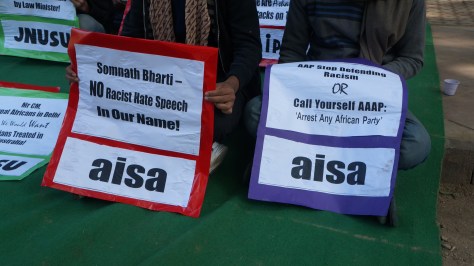
The Savage Greed of The Civilized – AAP, Moral Posturing and Ordinary Racism

The savage greed of the civilized stripped naked its own unashamed inhumanity’

Africa, Rabindranath Tagore

SIGNS AT ANTI RACISM PROTEST IN JANTAR MANTAR

Delhi Law Minister and Aam Aadmi Party leader Somnath Bharti’s midnight raid in Khirki village, during which he ordered policemen to search and enter houses, arrest people without warrants, and allegedly said that “black people, who are not like you and me, break laws” –  strips naked the unashamed inhumanity of the Aam Aadmi Party regime’s moral posturing. Underneath the holier-than-thou mask of that moral posture lies the unmistakably horrible sneer of the ordinary racist thug. This is the real face of Somnath Bharti. I hope it is a face that the Aam Aadmi Party can turn itself away from.

Continue reading The Savage Greed of The Civilized – AAP, Moral Posturing and Ordinary Racism

Why I joined AAP and Quit the CPI: Kamal Mitra Chenoy

Guest post by KAMAL MITRA CHENOY

I first became conscious of politics as a student of economics in Kirorimal College, Delhi University in 1969 when I was elected to the students union executive committee. The same year I was persuaded by a senior to stand for the Delhi University Students Union’s Supreme Council. The latter body elected the DUSU office bearers. These were heady days with some of the leading pro- Naxalites students, students like Avdesh Sinha, who later became a highly respected IAS officer, and Rabindra Ray now a sociology professor in Delhi University. Another leading star who has written on his experiences was Dilip Simeon. I also became Left but did not agree with armed struggle. At this stage I watched the mainstream Left parties and along with Marxist texts read some Left Party pamphlets.

However, a deeper and much more expansive debate was snowballing where I joined in JNU in 1972. Prakash Karat who had earlier written a thought provoking book on the nationality and language question in India was widely respected as a political leader of the JNU students and a formidable theorist. In 1973, the Student Federation of India and the All India Students Federation of which I was the unit secretary aligned for the first time after the split in the communist movement in 1964. We called the alliance progressive democratic front. We were also attacked by an extremely erudite Trotskyist Jairus Banaji who considered us revisionist and quoted extensively from Marxist classics as well as literature, philosophy and the social sciences. Because of this challenge all of us had to do our readings. Continue reading Why I joined AAP and Quit the CPI: Kamal Mitra Chenoy

Xenophobia, Racism and Vigilantism – Danger Signals for AAP

The bizarre drama yesterday, involving one of the Aam Aadmi Party ministers, Somnath Bharti, should make the AAP leadership sit up and think. Here is a brief extract from a report:

Less than 24 hours after he led a midnight raid and tried to bully police into arresting some “Nigerians or Ugandans” who he alleged were members of “a prostitution-and-drug ring”, Delhi Law Minister Somnath Bharti returned to the very spot on Thursday and asked residents to draw up a list of houses where “such people” live and said he would personally check each one.

The minister got embroiled in a full-scale confrontation with the ACP, BS Jakhar, who insisted, correctly that the police were not legally empowered to do this. According to the same report, Jakhar said, “The minister told me that the women inside are part of a drug racket and that we should conduct a raid in all houses in the area. I told him that the law does not permit us to barge into someone’s house, so late in the night, without a search warrant.” But to not effect. The minister was not only unfazed; he even went on say that he had “received a lot of complaints from women in this locality against foreign nationals, yeh hum aur aap jaise nahin hain (They are not like you or me).” Continue reading Xenophobia, Racism and Vigilantism – Danger Signals for AAP

The Party Left and Aap: Satya Sagar

GUEST POST by Satya Sagar

“Comrade! There is a man dying of thirst at the door. What is the Party line on giving water to thirsty people?”

There was a moment’s silence at the other end of the telephone and then the Great Ideologue said, “That is reformist activity. Tell him we can give our lives for the Revolution but cannot- as matter of policy- give water to the thirsty”

“But Comrade, he will die at our doorstep if we don’t give him water. Think what the bourgeois media will say then”

“You are right. Positive media coverage is important as that is the only way we reach the masses these days. But before you give him water to drink first ask him whether he believes in public or private supply of water” Continue reading The Party Left and Aap: Satya Sagar

AAP and the Ideology Warriors

If ideology-warriors had their way, they would rather have Narendra Modi as the next prime minister than have their ideological purity compromised. Soon after AAP’s victory, many secularists rushed to declare, on Facebook and elsewhere, that they do not and will not partake of the AAP euphoria. ‘What is their stand on communalism?’, they asked indignantly. Some other friends insisted that Muslims need an assurance about AAP’s position on communalism and it should clarify its stand if it wanted the Muslim vote.

So what do the ideology warriors want? Just when the political agenda for the elections has decisively changed, throwing the BJP into a complete quandary, upsetting its strategic plans, they want the old familiar, secular/ communal divide back in place, opening up the political field once more to the same Hindu-Muslim polarization that we are so used to. The secular/ communal divide has been the millstone around our neck, preventing any other issue from being brought into public debate at election time and effectively preventing the emergence of any new force or formation. And let there be no mistake that in a communal polarization of Hindus and Muslims, secular forces will always, in the on-going drama of secular masochism, have to deposit themselves tied hand and foot, into the Congress party’s dungeon. The Amit Shahs will have a field day, creating one Muzaffarnagar after another, and erstwhile secular mascots like Mulayam Singh Yadav will vie with them in further entrenching the Hindu-Muslim divide. In all of this, the Congress will present itself as the saviour of Muslims.

The Congress, the BJP, the imaginary ‘third front’ – all have been able players and winners in this game. Continue reading AAP and the Ideology Warriors

Condemn Attack on AAP Headquarters, Defend Freedom of Expression, Oppose Politics of Hurt Sentiments : New Socialist Initiative

New Socialist Initiative Condemns Attack on AAP Headquarters

New Socialist Initiative condemns the attack on the headquarters of AAP (Aam Aadmi Party) office at Kaushambi, Ghaziabad by vigilantes of the Hindutva Brigade and demands stern action against the culprits. Given the inordinate delay by the police in reaching the place and nabbing the hooligans in the case of an emergent political party and high-profile politicians, one can only imagine the safety and security of common citizen under such dispensation.

It is distressing that each time any individual or group has expressed views on the violation of human rights by Armed Forces protected by the draconian Armed Forces Special Powers Act, frenzied jingoism by the rightwing forces as well as by the print and electronic media turn to the rhetoric of hurt sentiments. It is equally distressing that the Aam Aadmi Party too succumbed to such jingoism, found it necessary to distance itself from Prashant Bhushan and turned the question of human rights violation by the armed forces into a question of national integrity. Continue reading Condemn Attack on AAP Headquarters, Defend Freedom of Expression, Oppose Politics of Hurt Sentiments : New Socialist Initiative