Tag Archives: Hindutva

Stepping Back/Stepping Forward – Thinking Past the BJP Victory in UP: Biju Mathew

Guest post by BIJU MATHEW

The BJP’s appointment of Adityanath to the post of UP CM once electoral victory was secured has left many angry, sad and frightened. Already the ominous signs of inhuman mass violence are accelerating across UP. A more brazen Sangh will pivot off UP to spread terror and hatred across the country.  And yet, we must guard against an excessive pessimism and guide the anger and the sadness in productive directions.  The 2014 Lok Sabha, 2015 Delhi and Bihar and 2017 UP elections together are indicative of an evolving structural logic in Indian politics and show telltale signs of irresolvable contradictions that the Sangh is faced with. Modi and the BJP are riding a wave that is not entirely of their own making – a wave that will necessarily crest, break and crash in the not too distant future. How soon this wave can be interrupted, and what happens after that, does not depend on them, but on the rest of us.

So here then is the puzzle: Why do so many people support what is both an absurd and an unrealizable ideology? Absurd, because poverty, caste discrimination, corruption and government failures are not due to “enemies” or “enemy communities”- Muslims or Leftists, LoveJihadis or Beef eaters; and unrealizable because with over 400 million minorities and oppressed castes who will not fit into Hindu Rashtra, the saffron brigade can only deliver a horrific civil war. Does UP mean that, despite all this absurdity, this ideology has nevertheless triumphed in the Indian mind? Continue reading Stepping Back/Stepping Forward – Thinking Past the BJP Victory in UP: Biju Mathew

The Left Non-debate on Fascism or How Not to Fight the Hindu Right

History never repeats itself. Neither as tragedy, nor as farce. Every historical situation is a singularity, a product of its conjuncture and the opening out of different possibilities – thus irreducible to any other. What becomes farcical is the attempt of historical actors to borrow their slogans, icons and ideas from specific pasts and their attempt to reenact them in conjunctures that are radically different. Indian communists, of course, have long had a penchant for re-enacting (or believing they are re-enacting) other histories and other revolutions. And yet, more often than not, they have simply operated on the margins, engaging in violent and heated debates, as if the course of history depended on how these debates were resolved – while other historical actors took centre-stage, actually steering the course of history.

For decades Indian communists debated the ‘class character of the Indian state’ and even though their descriptions of its effects often differed little (except for an emphasis here or an emphasis there), they themselves split many times over in trying to name the beast. They became one another’s bitterest enemies, throwing about labels like “revisionist”, “neo-revisionist”, “sectarian”, “adventurist” and so on. Ask the CPI, CPI(M) or CPI(ML) Liberation, who fought the 2015 Bihar elections together and are trying to come together on issues of common concern today, how invested they are in those characterizations and how relevant they find them for their joint activity today? The really honest answer would have to be that it is of no relevance, whatsoever,  whether the state is described as that of the national bourgeoisie, the bourgeois-landlord alliance or as a semi-feudal and semi-colonial one – especially where it concerns joint or common struggles. Indeed, many communists might cringe today if reminded of these characterizations over which not just barrels of ink but precious blood has been spilt in the past. And so it happened, that while communists occupied themselves with all this bloodletting, history passed them by. Not once or twice but repeatedly.

There is a sense of deja vu therefore, when the official Left (at least the CPI(M) and CPI) and many left intellectuals suddenly seem bent upon tearing each other to bits in simply trying to name the Modi/RSS/BJP phenomenon (hereafter referred to as Sanghism – a term I have explained elsewhere). It seems it is necessary to first “correctly” characterize the phenomenon before any fight can even be conceived – even though, I suspect, there will be little difference in the way the different protagonists actually describe it.

Kick-starting this great non-debate, former CPI(M) general secretary Prakash Karat wrote in The Indian Express, a piece so befuddling that it left many people gasping: The Sanghist/ Modi dispensation, according to him, is “right -wing authoritarian” but not “fascist” and hence there is no need for broader resistance against it (my paraphrase of what is in fact a simple question of whether or not to have an electoral alliance with the Congress!) What was worse, he referred to what he called the “classic definition” (yes, definition!) of fascism, in order to make his point. What was simply a formulation made by Georgi Dimitrov and the Comintern in a specific context, is turned into a definition. Here is Karat’s “definition”: Fascism in power is “the open terrorist dictatorship of the most reactionary, most chauvinistic and most imperialist elements of finance capital.” From this definition, he then proceeds to make his deductions about present day India:

In India today, neither has fascism been established, nor are the conditions present — in political, economic and class terms — for a fascist regime to be established. There is no crisis that threatens a collapse of the capitalist system; the ruling classes of India face no threat to their class rule.

Every bit of this statement is an instance of formulaic thinking. As Jairus Banaji pointed out in a sharp riposte, calling Dimitrov’s formulation a “classic definition” is merely a way of suggesting that it was a code graven in stone, and therefore, not open to any critical scrutiny or examination. After all, how can you debate a definition? Banaji, in fact, made an important point in his response: fascism is not merely a conspiracy of finance capital but as later Marxists like Arthur Rosenberg and Wilhelm Reich repeatedly insisted, it was, above all, a mass movement. If one seriously ponders the implications of this claim, fascism’s relationship to capital – finance or otherwise – can hardly be seen as simple and straightforward any more. We will return to this point later. Continue reading The Left Non-debate on Fascism or How Not to Fight the Hindu Right

Not Pakistan, but Modi has pushed Kashmir on the Brink : Ashok Swain

This is a guest post by ASHOK SWAIN

Since the death of a young and charismatic separatist named Burhan Wani, Kashmir has erupted into violence and chaos. Weeks of violent protests in the Valley have resulted in the deaths of at least 50 people and over 5,000 injuries. Kashmir is not new to violent protests and civilian deaths, but this time the intensity of the protest and the passion of the protesters is unprecedented. Continue reading Not Pakistan, but Modi has pushed Kashmir on the Brink : Ashok Swain

Cow-Gangs of Akhand Bharat and the Dalit Revolt – Hindutva Unravels

As the cow-gangs of Hindutva go on a rampage and the the prime minister, Narendra Modi, adopts a posture of strategic silence, the country is rapidly being pushed to the brink of a civil war. This might sound a trifle far-fetched but classically, when large numbers of people begin to believe that there is no government for them, the time is not far when they will start making preparations for defending themselves. It started with the attacks on Muslims but soon enveloped the Dalits as it was bound to. The Una incident, which sparked off a veritable revolt, was followed up by subsequent attacks in Lucknow. The Progressive Dairy Farmers’ Association in Punjab, involving large number of Sikh farmers, has also been fighting continuing harassment and violence by cow-gangs of Hindutva in Punjab for some time now. The PDFA president has also stated that they might be forced to act in self-defense. The president Daljit Singh Gill, in fact, reportedly told mediapersons that “(I)f someone attacks the farmers, we will stop them now,” and “(I)f something goes wrong, it is the government’s responsibility.”

Even as the cow-gangs continue with their vigilantism unrestrained and unchecked, a large demonstration yesterday at Jantar Mantar by Samta Sainik Dal, actually sent out yet another signal. It spokespersons said in so many words that they were now prepared to take on the cow-gangs physically, if and where necessary.

Tracing SSD’s lineage back to Dr Ambedkar’s initiative in the 1924, the President of the organization openly blamed the ‘Manuvadi’ forces, in cahoots with the police and bureaucracy, backed by the government. He was candid that it is not the Sikhs or Muslims or Christians who are attacking the Dalits today but the Hindus who are doing it in the name of nationalism and that people were now in a mood to fight back unitedly together.

Not only is Modi’s deafening silence now coming to be seen as a sign of encouragement and complicity, with BJP leaders like Hyderabad MLA Raja Singh openly justifying the Una attack, and no action being taken against him by the party yet, it is clear that this vigilantism is endorsed by the highest quarters in the party. For those who may have missed seeing Raja Singh’s video, this is what he said:

“Jo Dalit gaye ke maas ko le ja raha tha, jo uski pitai hui hai, woh bohut hi achhi hui hai (Those Dalits who were taking the cow, the cow meat, those who were beaten, it was a very good thing to happen).

Continue reading Cow-Gangs of Akhand Bharat and the Dalit Revolt – Hindutva Unravels

Cow Vigilantism as Terror : New Socialist Initiative

Guest Post by  New Socialist Initiative

Can the Saffron Establishment ever wash its hands of the growing menace?

(For Hindi version, click the link http://nsi-delhi.blogspot.in/2016/07/blog-post_26.html)

( Courtesy : Cartoonist Satish Acharya, https://www.facebook.com/cartoonistsatishacharya/)

Cow vigilantism which has received tremendous boost since the ascendance of BJP at the centre got its first fitting reply in Gujarat recently. The way in which a self-proclaimed Gau Rakshak Dal – owing allegiance to Shiv Sena – attacked a group of Dalits in Una (11 th July 2016) who were skinning a dead cow, publicly flogged them, led them to the police station charging them with cow slaughter and even circulated a video of the whole incident on social media to spread further terror, has caused tremendous uproar. Continue reading Cow Vigilantism as Terror : New Socialist Initiative

Statement On the Unfolding Situation in Kashmir : NSI Delhi Chapter

Guest Post by New Socialist Initiative, Delhi Chapter

The valley of Kashmir is on the boil again. Forsaking the so-called normal routines of their lives, people are on the streets. Not just young men, but even children and women are out, challenging the military might of the Indian state. Any fear of the police and army appears to have been discarded. Police stations and even CRPF camps have been attacked. A popular upsurge, it is energised by mass fury. Forty people have lost their lives in one week at the hands of the Indian security establishment. Hundreds of others have suffered serious eye and other injuries from presumedly ‘non-lethal’ pellets used by the police. While people are out confronting the police, para-military and army, the other organs of the Indian state in Kashmir, the elected government and its bureaucracy, elected members of the legislature, panchayats, etc. are in a rathole, fearing public appearance. It is just the people of Kashmir valley versus the institutions of organised violence of the Indian state.

While the immediate cause of popular anger is the killing of Hizbul Mujahideen militant Burhan Wani, reasons for this anger go much deeper and have a longer history. The stifling and repression of the Kashmiri people’s right to self-determination stands at the root of this conflict. This repression has taken on extreme violent forms. For twenty five years now, the Kashmir valley has been among the most militarised places in the world. More than half a million troops of Indian army and para-military forces have been stationed in the state and its border with Pakistan. Rashtriya Rifles and CRPF camps dot the land scape. Highway checkpoints and random searches are part of everyday life. Thousands of men have disappeared, been picked up by security forces, thrown in the black hole of interrogation camps, often ending up in unmarked graves. The hated AFSPA gives Indian security forces legal cover to assault basic rights of Kashmiris to live a life of elementary dignity. If an average valley resident is alienated from the normal practices of the Indian state such as elections and its administrative initiatives, s/he harbours deep resentment against the presence of Indian security forces in their homeland. This resentment has erupted in mass protests again and again.

Continue reading Statement On the Unfolding Situation in Kashmir : NSI Delhi Chapter

Ambedkar Cannot be Adopted or Appropriated by Hindutva: K Satyanarayana

Transcript and translation of lecture  by Prof. K.SATYANARAYANA, speaking at the launch of book, Ambedkar Can Neither Be Adopted Nor Appropriated by The Hindutva Elements. The book, authored by Bojja Tharakkam, K. Satyanarayana, K. Laxminarayana and K. Y. Ratnam. It was launched in Hyderabad in July last year and is a reply to RSS’ Organiser special edition on Ambedkar. The text and video of the original Telugu lecture received by us via DALIT CAMERA.

All the friends who gave me this opportunity, to the many Ambedkarites present in this hall and to the very senior members, activists and intellectuals, I thank you all. After Anand Teltumbde has spoken, there isn’t much left to speak because he covered all the information in this book and also described completely about a lot of aspects about Maharashtra, about Ambedkar’s like and his work. Therefore there might not be much new information in my speech, but while writing this book, the distortions they made, or the attempts of RSS in relation to Ambedkar, as there is a need for historical context, I will speak about some of those issues. Firstly what Respected Mr. Tarakam has said is, to read some of the names of essays in the Organiser as the book is not available to everybody. When this book Organiser came out, generally RSS-BJP, when they talk about Ambedkar or about Babri-masjid, what we think is that they speak lies, false words, and mistruths and therefore there isn’t any danger as nobody will believe in their load of rubbish and lies. We think that way and if people understand the lies and if they don’t follow those words, there is no danger, but with this same type of propaganda, they completely changed the normal common-sense of the people and today Modi, as a K.D (drawn from an old colonial police/ legal category, it has become a Telugu expression that suggests a person with undesirable traits), as our brother has sung, is sitting in power.

Continue reading Ambedkar Cannot be Adopted or Appropriated by Hindutva: K Satyanarayana

Statement of Solidarity with Kancha Ilaiah

[The following is a statement in support of scholar-activist Prof  Kancha Ilaiah, who is under attack from a number  of Hindutva organizations and  against whom the Hyderabad police recently registered a case for ‘hurting religious sentiments’. The tendency to  resort to police cases, in order to stifle any criticism of Hindutva and the regime has assumed menacing proportions, against which we stand  firmly with Kancha Ilaiah. Those who wish to add their names to the statement and express solidarity may do so by adding them as comments.]

We, the undersigned, strongly condemn the continued harassment, attacks on and intimidation of Prof Kancha Ilaiah at the hands of various Brahmin / brahminical organizations, police and the state administration of Telengana for his political writings and views.  We also hold responsible for this intimidatory environment, the Telugu media that reportedly published distorted and misleading reports of Prof Ilaiah’s speech.

While speaking at the Centre of Indian Trade Unions, a wing of the Communist Party of India (Marxist) on May 14, 2016, at Vijayawada (Amaravathi), Prof. Ilaiah had  said: “The Brahmins as a community have not contributed anything to the production process of the Indian nation. Even now their role in the basic human survival based productive activity is not there. On the contrary, they constructed a spiritual theory that repeatedly tells people that production is pollution.” Continue reading Statement of Solidarity with Kancha Ilaiah

Condemn the Attack on Kancha Ilaiah for asking, ‘Is God a democrat?’

[We at Kafila condemn the repeated  attacks on scholar activist Professor Kancha Ilaiah by the Hindu Right and  the recent case registered against him by the Hyderabad police. According to a Times of India report, Ilaiah had on May 14 delivered a lecture in Vijayawada in a programme entitled `Nationalism and Divergent Views’ organised by CITU where he reportedly criticised Hindu gods and scriptures, according to the police. Following this an advocate filed a private petition in the court of the XI Metropolitan Magistrate court, Ranga Reddy , requesting to register an FIR under relevant sections of IPC. The court directed cops to register a case under sections 295 A (deliberate and malicious acts, intended to outrage religious feelings of any class by insulting its religion or religious beliefs),153 A (promoting enmity between different groups on grounds of religion) and 298 (uttering, words, etc. with deliberate intent to wound the religious feelings of any person) of IPC.”

Earlier, last year the  VHP had initiated a campaign against him which was followed by the filing of a case against him by the Hyderabad police. That was in relation to an article Kancha Ilaiah had written, asking ‘Is God a Democrat?’ The story by Ajaz Ashraf from Scroll.in linked below refers to last year’s case but due to an inadvertent mix-up, was initially extracted by us as the one in the eye of the current controversy. The error is seriously regretted and we thank one of our readers for pointing this out. The Times of India report linked to above gives refers to the speech that is currently in the eye of the storm.

Professor Ilaiah has now himself described the current attacks on him in this piece in Scroll.in, where he signs his article as Kancha Ilaiah Shepherd, recalling his caste name (translated into English, in order to mark his distance from the brahmans).

The attacks on  Professor Ilaiah are totally unacceptable. We have all read and long admired his writings. Many of us have hugely benefited and learnt a lot from them. The time has come for us to collectively put our heads together and fight this menace of Hindutva, which after hurting every living being’s dignity and sentiments, has now begun claim to be the perpetual and universal victim. Dalits today cannot speak of the indignities and oppression that they have suffered at the hands of the Hindus – even that has become a matter of ‘hurt sentiments’. The response has to be worked out politically and intellectually so that the law is not repeatedly turned into a surrogate of Hindutva politics.]

The Hyderabad police have registered a case against renowned social scientist Kancha Ilaiah, after Vishwa Hindu Parishad activists complained that an opinion piece he wrote in the Telugu newspaper Andhra Jyothi had hurt their religious sentiments.

They filed their complaint at Hyderabad’s Sultan Bazar Station was filed on May 9, the day Ilaiah’s article titled Devudu Prajasamya Vada Kada? (Is God a democrat?) was published.

VHP activists Pagudakula Balaswamy, Thirupathi Naik and two others accused Ilaiah of comparing Hinduism with Islam and Christianity, insulting Hindu Gods by comparing them to mortals, mocking their worship, and for attempting to trigger clashes between upper and lower classes (by which they presumably meant castes).

On the basis of their complaint, Inspector P. Shiva Shankar Rao wrote a letter to the Senior Assistant Public Prosecutor, who advised the police to register a case under Section 153 (A) and Section 295 (A), which empower the authorities to act against people who commit deliberate and malicious acts aiming at outraging religious sentiment and spreading enmity between groups.

Case under investigation

The public prosecutor’s legal opinion led to a case being filed on May 15 against Ilaiah, the management of the Andhra Jyothi newspaper, its editor and publisher. The case is currently under investigation, at the completion of which a decision will be taken to whether to chargesheet them.

A police officer at the station told Scroll that Ilaiah is in the habit of articulating provocative views in his articles, which can and do hurt the sentiments of people. “Why does he have to make comments against practices which are dear to people?” the officer said, declining to give his name.

Read the full article here

Reading Foucault in Mahendragarh

history_of_sexuality2c_french_edition2c_volume_one

In March this year in a rural hamlet 3 hours by train from New Delhi, the local edition of Hari Bhoomi carried an unusual piece of news: Central University of Haryana (CUH) at Mahendragarh, had filed a police complaint against a Facebook page.

The story was short on specifics, but an email to the university registrar, Ram Dutt, elicited a reply:

“Yes, University has filed a complaint against the CUH Media page (anonymously administered unlawfully using acronym of the University) to trace the identity of the page. As the University is Autonomous Body and has the right to continuous vigil to maintain the reputation of the University on the Internet World …”

What was this page, “anonymously administered”, that had the administration so upset? Who were these students “unlawfully using the acronym of the university” to besmirch the university’s reputation “on the Internet World”?

At first glance, the CUH Media page was just like the millions of pages on Facebook visited by a small band of followers – at last count it had just 174 “Likes” – who trolled each other. But a closer look at the posts, the comments they attracted, and their ripples offline, since the page was started in September 2015, suggested the gradual emergence of a spiky student politics in one of India’s newest central universities. Read More


Fifty Shades of Grey – Without the Thrills

[This is a response to Shourajenda Nath Mukherjee’s open letter on Kafila by Prof Makarand Paranjape]

Mr. Shourjendra Nath Mukherjee’s “Open Letter” of April 5, 2016 makes only one substantive point, concerning the agency of students, which needs attention. The rest of it, as the Dormouse said to Alice, is “much of a muchness” – confusion, rigmarole, and thumb-twiddling over precious little, which scarcely need be dignified by serious confutation. Continue reading Fifty Shades of Grey – Without the Thrills

Nation and its Violences: Sanjay Kumar

Guest Post by Sanjay Kumar

Violent thoughts and deeds are increasingly getting justified in the name of Indian nation. A mob of lawyers has attacked students, teachers and journalists, right in the middle of a court complex in the national capital. Leaders of these patriotic lawyers were later caught bragging on camera about how they will next time throw bombs on anti-nationals. A young woman in Delhi has received emails and face book posts threatening her with acid attack and sexual assault, because she happens to be a sister of Umar Khalid, one of the organisers of the JNU programme, during which according to police anti-India slogans were raised. The mere being of this woman, and her defence of her brother, is enough of a provocation for many men and women of the country to justify the threat of ultimate male violence against women. Another man, Mr Adarsh Sharma put posters in the central district of the capital announcing an award of Rs 11 lakh for anyone who kills Mr Kanhaiya Kumar, the president of  the JNUSU, charged with sedition. Mr Sharma claims that his ‘blood boiled’ when he saw Mr Kumar’s much publicised speech after his release on bail. The popular movie Pyasa (1957) of Gurudutt had a song ‘Jinhen Naz hai Hind par vo kahaan hain’, which used the reality of social degradation to question celebrations of the nation. Sahir’s poem worked because it asked Indians to look at themselves in the mirror of public morality of the recently independent India. That mirror has been cracked for long. With the brazenly violent now claiming that their violence and threat to violence should really be the pride of the nation, we are now witnessing the final shattering of that mirror. Continue reading Nation and its Violences: Sanjay Kumar

St Louis Universities Stand With JNU: A Statement


Kanhaiya Kumar, the president of the Jawaharlal Nehru University Student Union (JNUSU) in New Delhi, India, was arrested on Feb 10 on charges of sedition and criminal conspiracy. Kanhaiya was present at a meeting on the evening of Feb 9, where incendiary slogans were allegedly raised. Seven other students were also charged. Mr. Kumar is not accused of raising the slogans; indeed the identity of the person(s) who raised the slogans remains a mystery. Charging a student leader for sedition for another’s mere sloganeering is prima facie absurd. Further, the assault of Mr. Kumar, other students and faculty, and even journalists, in court premises by lawyers and others sympathetic to the government, do not inspire confidence in a fair judicial process. Continue reading St Louis Universities Stand With JNU: A Statement

Confront the Rupa Subramanyas Within : A Note to a Nair-born Friend

Dear Kaviraj,

Just saw your post condemning The Telegraph’s representation of Smriti Irani as ‘Aunty’. I understand your indignation, though I am curious to know why few people like us stand up and protest when the people who supporte her, the sanghis, throw vile abuse at dissenters and feminists, label them prostitutes, and threaten them regularly with rape and disfigurement. My daughter was recently threatened in Delhi and warned not to behave like a ‘JNU randi’; senior women teachers from JNU were showered with similar abuse, shoved, groped, and hit at the Patiala House, and many of them have received direct and indirect threats. JNU women have been portrayed in the most despicable terms recently, before which Telegraphs’s characterisation of Irani as ‘Aunty’ is tame indeed even if unacceptable.

Continue reading Confront the Rupa Subramanyas Within : A Note to a Nair-born Friend

Why Caste is the Crux and Hindutva’s Fall Imminent: Prathama Banerjee

Guest post by PRATHAMA BANERJEE

The return of BJP to power in 2014 was the return centre-stage of the caste question. Not that caste had gone away. Far from it.But our public life had been unmistakably altered by caste radicalism in the last few decades. 1990s onwards, powerful and triumphant dalit voices – intellectual, literary and political – transformed the nature of our democracy such that questions of caste injustice and caste assertion could no longer be circumvented, passed over, as it was done in earlier decades, by both reactionaries and progressives. Nor could the dalit and the low-caste subject be any longer portrayed as mere outcast or victim. She had come into her own as an autonomous and assertive political subject, sometimes even the ruler. Christophe Jaffrelot called this India’s silent revolution, and rightly so. What we see today with the rise (and imminent fall) of Hindutva nationalism is an attempt at a counter-revolution, nothing less.

The Counter-revolution – Targeting Dalits

The signs are easy to read. Right after Modi’s win began the so-called gharvapasi campaign of the Hindutvavadis, seeking to reconvert to Hinduism those who had earlier seceded in favour of Islam and Christianity. While the issue was pitched as an issue of religion, it was clear that at the heart of the matter was caste. Continue reading Why Caste is the Crux and Hindutva’s Fall Imminent: Prathama Banerjee

The India I Came Back To: Namrata Sharma

This is a guest post by NAMRATA SHARMA


I will start this piece with a painful but short flashback tirade about myself. I moved back to New Delhi in 2014, after six long years in New York and Singapore. My decision to move back to the motherland was predominantly attributed to issues that a twenty-something grapples with when he or she is away from home and family. However, familial ties and emotional reasons aside, there was one factor which deeply resonated with me and was the driving force behind my decision to move back. This factor was – the liberty to express my thoughts and views on a topic, any topic, in an indulgent and lenient space, which, by virtue of being an Indian citizen, was guaranteed to me in India and not in other places. In India, this liberty transcended predictable spaces like classrooms, newsrooms and sophisticated editorial pages of the morning newspaper and was very organically present in the form of arm-chair political banter amongst friends and political conversations with family over dinner. Continue reading The India I Came Back To: Namrata Sharma

Solidarity Statement of Students from Northeast India, TISS, Mumbai 20th February 2016


We, the undersigned, students and research students from various states of northeastern region of India studying in Tata Institute of Social Sciences, Mumbai would like to highlight on the unprecedented shrinkage of academic spaces across various universities in India. We condemn the politically motivated interferences of the state in Jawaharlal Nehru University and in Hyderabad Central University (HCU), and other universities. We also condemn the mob justice perpetrated by lawyers against students, journalist, activists etc in the Patiala House Courts, New Delhi, and media trial led by prominent journalists from New Delhi. Continue reading Solidarity Statement of Students from Northeast India, TISS, Mumbai 20th February 2016

Statement on the Events at HCU and JNU From Faculty of the Tata Institute of Social Sciences


We, the undersigned, are deeply shocked and dismayed by the processes that led to the suicide of Rohith Vemula at HCU in January and the ongoing attacks on students and faculty of JNU. At Hyderabad Central University, RohithVemula a Dalit research scholar was labelled as anti-national and driven to suicide in January through systematic persecution. At Jawaharlal Nehru University (JNU), New Delhi over the past few days, Kanhaiya Kumar, the President of the JNU Students Union is held in police custody on the trumped up charge of sedition. On February 15, 2016, the police stood by as mute spectators while a group of lawyers and hooligan elements attacked students and faculty of JNU who had gone to the Patiala House courts in Delhi in solidarity with Kanhaiya Kumar who was to be produced there. Continue reading Statement on the Events at HCU and JNU From Faculty of the Tata Institute of Social Sciences

Missing the Forest for Trees – Caste System’s Shadow on Rohith’s Suicide : Sanjay Kumar

Guest Post by Sanjay Kumar

(Photo Courtesy : Prokerala.com)

Mainstream politics over Rohith Vemula’s suicide is becoming hot and ugly. Although whisper campaigns against Rothith’s dalit identity were on since his suicide, the BJP’s central leadership had been relatively quiet after HRD minister’s rather shrieky ‘appeal’ to not play caste politics over his suicide. However, now it seems daggers are out. The party in power, whose two ministers are accused of creating conditions leading to Rohith’s suicide, has decided that Rohith’s non-dalit status is the dog it is going to beat to counter its anti-dalit image. Rohith’s mother is a Mala, a Scheduled Caste, who lives seperately from his father, a backward caste Vaddera. He got an SC certificate on the basis of showing that he grew up in his mother’s Mala household. BJP’s strategy may look petty, but it is based on the age-old great Hindu tradition which can not contenance any violation of the privileges of the patrilineal system. After all, marital rape does enjoy legal sanction in India to this day. Continue reading Missing the Forest for Trees – Caste System’s Shadow on Rohith’s Suicide : Sanjay Kumar

How the Hindutva Propaganda Machine Manufactures Lies

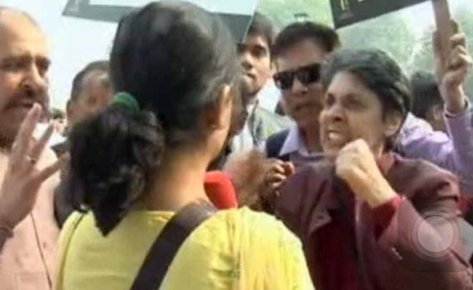
Did you know that the return of awards by writers, film-makers and scientists was a plot hatched jointly by the United States of America, Saudi Arabia and Pakistan? Well, if you did not, you will probably not ever understand why the ‘tolerant’ multitude that turned out at Anupam Kher’s March for India rally today, could so vilely abuse and attack NDTV’s Bhairavi Singh and Aaj Tak’s Mousmi Singh. After all, it is one thing for the netas to simulate their anger and laughter on TV channels and elsewhere, but how do you actually get ordinary people to go crazy? How and why does the ordinary Hindutva footsoldier act the way he or she does? Basically, he (and occasionally, she) is made to believe things that most people would know to be false. So why does as innocuous an act as the returning of awards by writers become such a big threat to India’s position in the world and to the very existence of the government of the day? Well, because, it is not a simple matter of some writers acting out of their conscience but already a part of an international conspiracy plotted by the US-Saudi Arabia-Pakistan nexus!

Defenders of the great tradition of tolerance, image courtesy Saikat Datta

Published below is the text of a note that has been circulating over different social media platforms. We have left the typographical and printing errors as they are in the original. Paranoid in its content, it is also illustrative of the way the RSS ‘rumour-machine’ works to produce lies. In earlier days, it used to start circulating from the morning shakhas via the shakha participants. Nowadays it moves from one social media platform to another, with lightning speed. Continue reading How the Hindutva Propaganda Machine Manufactures Lies

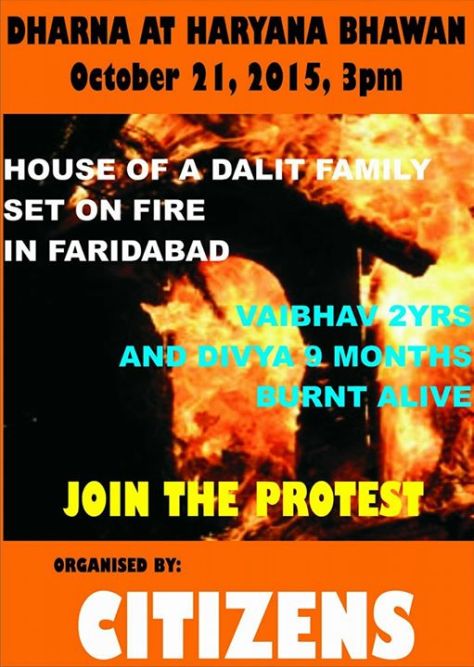
Protest Demonstration Against Burning of Dalit House and Children in Haryana

The endless violence that has always been part of Dalit life is now acquiring new dimensions as Dalits refuse to carry out upper caste diktat and confront aggressive upper castes emboldened by the Hindutva brigade.

Citizens call for demonstration