Tag Archives: Modi

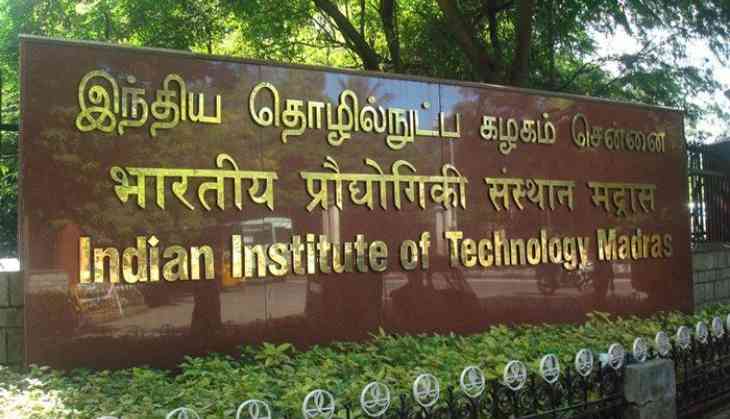
IIT-Madras, a Modern Day Agraharam ?

The institute’s recent order, now withdrawn, of separate entrance for non-vegetarians is just a part of the overall policing and push for vegetarianism after the Modi government’s ascent.
IIT Madras
Image Courtesy: Catch News


Nagesh (name changed), a bright student at the Indian Institute of Technology- Madras, who hails from a very poor economic background, had a shock of his life when he was entering the hostel mess. Someone literally stopped him at the gate and asked him to enter the mess from the other door if he is not a vegetarian.

A notice was duly pasted at the entrance of the mess, informing everyone of this ‘new order’. Even separate basins were demarcated for the students’ cuisine choices. Talking to a reporter with rage in his eyes, Nagesh questioned how the IIT-Madras management could issue such a discriminatory order without even consulting the students.

As of now, the notices have been removed after taking into consideration the uproar this ‘untouchability of a different kind’ caused at the national level. management is now trying to save itself by putting the blame on the caterer. Anybody can guess that a caterer, who is basically a contractor serving food for a fixed period, cannot suddenly disturb the existing arrangements, divide the mess into two separate sections, and have the courage ‘instructing’ his customers to use separate gates.

Commenting on this episode, the Ambedkar Periyar Study Circle – a student group within the institute- which brought this issue to national attention, says:

“Caste masquerades as something else in ‘modern’ society. In IIT Madras campus, it manifests itself as separate entrance, utensils, dining area and wash area in the mess for vegetarian and non-vegetarian students…:

( Read the rest of the article here : https://www.newsclick.in/iit-madras-modern-day-agraharam)

Continue reading IIT-Madras, a Modern Day Agraharam ?

Under the Shadow of ‘Holy Book!’

Inching Towards Majoritarian Democracy

Image result for madhu dandavate

( Madhu Dandavate)

1.

These are times when the state of democracy is a cause of worry everywhere. With the emergence of populists, demagogues of various hues as custodians of the future of their countries, growing fascination for illiberal ideologies among masses in different parts of the world, the concern is not misplaced and it is apt that we are having this brainstorming where our focus would be on India itself.

‘Working Group on Alternative Strategies’ – which comprises of some of the finest public intellectuals and activists of our times – need to be thanked that they have been organising such seminars since last thirteen years and in this way commemorating the life and works of Prof Madhu Dandavate, a great Parliamentarian and Socialist ideologue. Continue reading Under the Shadow of ‘Holy Book!’

Bharatiya Janata Party or Bharatiya Jumla Party !

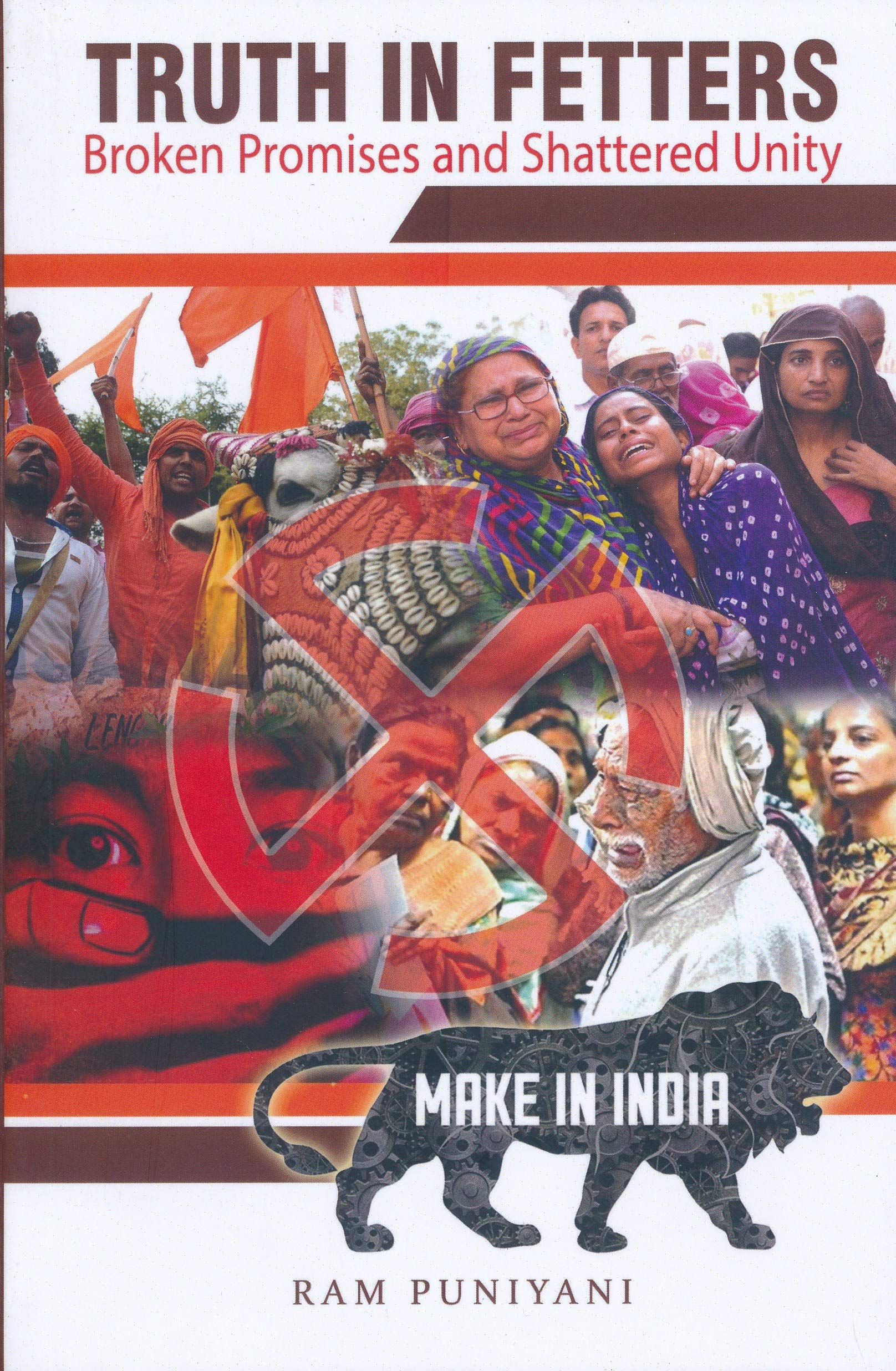
Review of ‘Truth in Fetters : Broken Promises and Shattered Unity’

Image result for media house ram puniyani truth in fetters

“Change is in the air”!

A retired academic who had his last assignment as Vice Chancellor of a leading university said to me the other day, while we were discussing the contemporary political scenario. Frankly admitting that he had supported Modi’s candidature then and had even discreetly campaigned for him, during 2014 elections, he said that what a ‘disaster’ it has been these last four and half years to our polity with him at the helm of affairs.

What surprised me more was that he was from Eastern UP and belonged to one of the dominant upper castes in the region. Continue reading Bharatiya Janata Party or Bharatiya Jumla Party !

Statement Issued by NSI on the recent arrests : Democracy Under Siege !

A Statement Issued by New Socialist Initiative (NSI) on the recent arrests of human rights defenders and public intellectuals

Democracy Under Siege !

With Ground Slipping Fast Beneath Its Feet, BJP government Resorting to Draconian Measures !

1.

New Socialist Initiative strongly condemns the arbitrary and malicious manner in which the Pune Police, at the behest of its saffron masters, raided the houses of leading human rights activists, lawyers, professors and poets in different cities simultaneously and arrested five of them – Sudha Bharadwaj, Gautam Navlakha, Arun Ferreira, Vernon Gonsalves and Varavara Rao – under concocted charges.

Demanding immediate release of all these persons unconditionally and withdrawal of fabricated charges filed against them under the draconian Unlawful Activities Prevention Act (UAPA) , it also said that appropriate action should be taken against the guilty policemen as well involved in this act. Continue reading Statement Issued by NSI on the recent arrests : Democracy Under Siege !

Deendayal Upadhyaya : BJP’s ‘Gandhi’ !

( This article would appear in the coming issue of ‘Think India Quarterly’)

(Photo Courtesy : jansatta)


 ..Kovind acknowledged that “the key to India’s success is its diversity” and “our diversity is the core that makes us so unique” and ended his speech with a call to build an egalitarian society as “envisioned by Mahatma Gandhi and Deendayal Upadhyayaji”… The Congress took umbrage at the way Kovind mentioned Upadhyaya in the same breath as the Mahatma. “The President should remember that he is not a BJP candidate any more. He is the President of India. He has to… rise above and think beyond party politics,” Congress veteran Ghulam Nabi Azad said.

(https://www.telegraphindia.com/1170726/jsp/frontpage/story_163934.jsp)

1.

In Search of an Icon

Fighters for Hindu Rashtra who have reached topmost echleons of power in this part of South Asia and are expected to extend and deepen their influence in coming times – if secular and democratic and left forces do not act together now – find themselves in a typical quandary. Continue reading Deendayal Upadhyaya : BJP’s ‘Gandhi’ !

Modi mocks ‘pessimists’, but RBI says a whole lot of Indians are pretty pessimistic about the economy

Last week, Prime Minister Modi gave an hour long speech denouncing ‘pessimists’ who refused to see the bright side of demonetisation and other transformations that his government’s able management had visited upon the economy.

We at Kafila, did a quick fact-check offering many reasons for pessimism, but as they say in Delhi – humari kya aukaat hai?

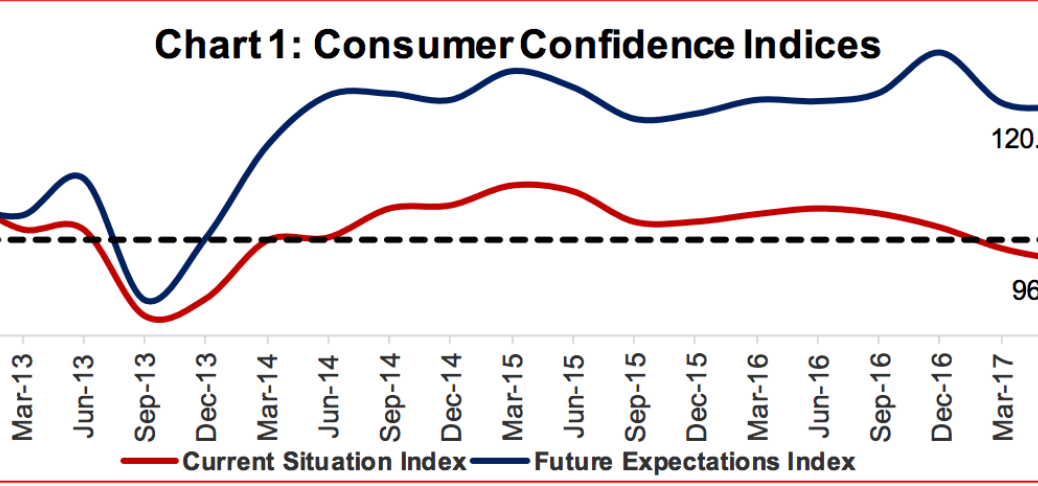
Now, a set of surveys by the Reserve Bank of India have concluded that 65% of the 5100 metropolitan households polled feel the economic situation has either worsened or stayed the same. It’s a small sample, but the results are revealing.  To quote :

Households’ current perceptions on the general economic situation remained in the pessimistic zone for four successive quarters, with the outlook worsening — RBI

For those you wondering – “four successive quarters” is a full year.

I would urge most readers to read the report in full, but here are some key takeaways:

Continue reading Modi mocks ‘pessimists’, but RBI says a whole lot of Indians are pretty pessimistic about the economy

Modi says the economy isn’t so bad; He’s right – it’s worse

by Samarth Bansal and Aman Sethi

On October 4, Prime Minister Narendra Modi offered a robust defence of his government’s management of the economy, shortly after the Reserve Bank of India lowered its Gross Value Added (GVA) growth estimates for the current fiscal year from 7.3% to 6.7%.

Since then, the ruling party has been pains to push a positive narrative on the economy,  extent of emailing clips of the speech to journalists who write about the economy.

So, what is the current state of the economy? Here’s a reality check.

How many jobs has the economy created?

Modi said: “Upto March 2014, the subscriber base of the Employees Provident Fund Organization (EPFO) stood at 3.26 crore. Over the last three years, the numbers increased to 4.8 crore. Some people forget that this number can’t increased without a corresponding increase in employment.”

Reality Check: EPFO numbers have increased, but this doesn’t necessarily mean that total employment has increased. In July this year, this jump in EPFO subscribers was attributed to a government amnesty scheme which allowed firms to come clean on their actual staff strength without being penalized. In a detailed note, Mahesh Vyas, Managing Director and CEO of the Centre for Monitoring Indian Economy (CMIE), explained why using EPFO data as a proxy for job creation is “fraught with danger.”

Referring to the jump in the subscriber base, Vyas wrote: “This is not new employment. It is merely enrollment of employed persons into EPFO.”

Continue reading Modi says the economy isn’t so bad; He’s right – it’s worse

Promoting Superstition – Everything Official About It !

Image result for superstition

Bhupendra Singh Chudasama, Education minister of Gujarat and his colleague Atmaram Paramar, who handles the Social Justice Ministry, were in the news sometime back- albeit for wrong reasons. A video went viral which showed them participating in a felicitation ceremony of exorcists in Botad. They were also seen watching how a couple of the exorcists were beating themselves with metal chains to live music near the stage.

Perhaps it did not matter to them that the Constitution frowns upon such activities and Article 51A (h) of the Indian constitution clearly says that it shall be a fundamental duty of all citizens “to develop the scientific temper, humanism and the spirit of inquiry and reform.” Neighbouring state Maharashtra has even enacted a law (The Maharashtra Prevention and Eradication of Human Sacrifice and other Inhuman, Evil and Aghori Practices and Black Magic Act, 2013) to rein in all such activities and it criminalises practices related to black magic, human sacrifices, use of magic remedies to cure ailments and other such acts which exploit people’s superstitions. And it was a culmination of a prolonged movement led by activists led by Dr Dabholkar – who even faced martyrdom for his activities. Continue reading Promoting Superstition – Everything Official About It !

X ways in which Modi is different from Trump: Rama Srinivasan

Guest post by RAMA SRINIVASAN

Prime Minister Modi is set to meet President Trump on June 26 and we can anticipate an exciting contest between bear hugs and crushing handshakes. We indeed live in interesting times where symbols rather than spoken words determine the fate of nations (Trump is rumoured to have partly pulled out of the Paris Agreement after losing a handshake duel with the new French President). Both Modi and Trump deploy symbols effectively to further a conservative agenda that is in many ways self-serving rather than ideologically dogmatic. I wondered if a list of ways in which they are different despite being strikingly similar in many ways might be an interesting experiment but all my points could be bracketed under one larger word: privilege. Everything that follows in this article are ways in which this privilege operates in the case of Trump and how the lack of the same has shaped much of Modi’s career.

Continue reading X ways in which Modi is different from Trump: Rama Srinivasan

Demonetization, ‘Financial Inclusion’ and the Great ‘Unbanked’

A Prologue

There is a lot of talk these days about ‘exclusion’ – which is almost unquestioningly assumed to be a bad thing. The corollary to this understanding of exclusion is that all inclusion is necessarily good. One hears a lot about ‘financial inclusion’ these days,  which truth be told, makes me shudder. There is thus a lot of angst expressed these days, especially by the rich and powerful, over the ‘financial exclusion’ of the masses. Here is the basic argument (read the full article, disowned by the edit department, here):

Inclusive growth would mean that all sections of society benefit from economic prosperity. A key metric for inclusion is ‘financial inclusion’ i.e. the access to banking services and affordable financial products such as bank accounts, loans, and deposits for all individuals and businesses. When the poorest of the poor have access to credit and savings facilities, this translates to their financial security. They can grow larger businesses, manage consumption and household expenses better and plan for shocks. The standard of living improves and poverty falls, allowing people to contribute more to the economy as well.

Remember, however, before we proceed:

(i) That in 1997, the Asian financial crisis that wiped out the hard earned life-savings of millions of people, in one fell swoop, was an instance of financial inclusion.

(ii) That it was the banks that were fully responsible for the crises across the USA and Europe, 2008 onward. That the Occupy Wall Street movement was basically a movement against the  robbery of ordinary people’s money saved in banks by the banks, who on top of everything wanted to be bailed out with tax payers’ money.

(iii) That very recently Iceland has had to jail 26 bankers responsible for the 2008 financial crisis, “for crimes ranging from insider trading to fraud, money laundering, misleading markets, breach of duties and lying to the authorities”.

(iv) That one of the major reasons India escaped the worst effects of that crisis was because effectively 70 percent of its population still lies outside the banking and financial sector. Of course, the other important difference with the Western capitalist economies was that India’s banks were still largely in the public sector. In other words, banks do not only do what they and the economists say they do. Banks play with the hard-earned savings of the relatively poor, often simply handing handing them over to predator corporations and then writing off!

The Demonetization Gamble

A lot has already been said by now on the Modi government’s decision to demonetize Rs 500 and Rs 1000 notes. Economists and economic analysts from the Left-wing Prabhat Patnaik to others like  World Bank Chief Economist and former advisor to the Indian government, Kaushik Basu and journalist Swaminathan Aiyar have expressed serious doubts about both the rationale and feasibility of the move.  The point has been effectively made by them and others like Arvind Kejriwal (who have been centrally concerned with the issue of corruption and ‘black money’ for a long time now), that this measure does not touch the real big players in the game of black and unaccounted money. Big corporate sharks don’t need to go the ‘black money’ route because government policy itself is written by them and everything they do is made ‘legal’ either in advance, or retrospectively, because the government is in their pockets. Of course illegal activities even at those high levels often go on nevertheless, because the power-corporate elite has become so used to the idea that nothing really matters in this country – that everything they want is theirs. And in any case, the real big money lies deposited in Swiss banks or in circulation elsewhere, in other forms. Continue reading Demonetization, ‘Financial Inclusion’ and the Great ‘Unbanked’

Modi’s Demonetization, Black Money and Surveillance: Baidurya Chakrabarti

Guest post by BAIDURYA CHAKRABARTI

  • The demonetization drive of Modi is neither new in content nor in form. In India, it has been done earlier by Morarji Desai; the initial conversion to Euro in the European Union happened within a month’s span. Currency is routinely taken out of circulation. What is significant about Modi’s demonetization is the amount of sensation he has generated out of an otherwise insignificant move. What is routinely done through phasing out denominations is being done in an extremely abrupt manner. He is dressing up a withdrawal and issuing of currency notes as a revolutionary move, and it is being executed in the manner more suited to currency change. What we need to thus ask ourselves is this: why is a routine monetary policy being enacted in this—which I shall later call ‘terroristic’—manner? Clearly, the answer is not economic; even the government does not pretend it to be a strictly economic issue (when they harp on the ‘terror’ factor).

(But before we move on, an aside. This demonetization exposes how the nostalgia for socialist development has fuelled the rise of Modi. Disenchantment with neoliberalism has produced an obscene amount of nostalgia for the pre-liberalization days among the Indian middle class, especially among the left-leaning ones. However, now that a gesture right out of those hoary days have returned to our world, it turns out to be a nightmare.)

  • Let us state the obvious things first: demonetization will do next to nothing to the so-called ‘black money’, which are routinely converted into fixed assets or foreign currency. This move dis-incentivizes hoarding of cash, but not speculation, all sorts of accounting practices that can produce the so-called ‘black money’ while bypassing the level of cash transaction altogether. Demonetization is simply an old-school, brute-force monetary policy to curb hyperinflation. The Head of European Central Bank in Europe and Larry Summers, US treasury secretary, has proposed demonetization of their high-currency notes this year. But none of them dream of doing it within a notice of 4 hours!

Continue reading Modi’s Demonetization, Black Money and Surveillance: Baidurya Chakrabarti

Dalit Uprising and After …

Why Hindutva Would Not Be The Same Again ?

Image result for una struggle

(Photo Courtesy : newsclick.in)

When I was born I was not a child
I was a dream, a dream of revolt
that my mother, oppressed for thousands of years ,
dreamt.
Still it is untouched in my eyes
Covered with wrinkles of thousand years, her face
her eyes, two lakes overflowing with tears
have watered my body…..

– Sahil Parmar*

Well known Gujarati poet Sahil Parmar’s poem ‘When I Was Born’ perhaps reverberates these days in Gujarat when we are witnessing a Dalit Upsurge- a first of its kind at least in that regions history. It will be a talk of folklore for times to come how flogging of dalits in a village in Saurashtra by Hindutva fanatics suddenly erupted into a mass movement of dalits which could catch imagination of the people cutting across different sections of society. An attempt is being made here to understand the dynamics of the movement and its likely impact on the future trajectory of Hindutva.

Continue reading Dalit Uprising and After …

Cow Vigilantism as Terror : New Socialist Initiative

Guest Post by  New Socialist Initiative

Can the Saffron Establishment ever wash its hands of the growing menace?

(For Hindi version, click the link http://nsi-delhi.blogspot.in/2016/07/blog-post_26.html)

( Courtesy : Cartoonist Satish Acharya, https://www.facebook.com/cartoonistsatishacharya/)

Cow vigilantism which has received tremendous boost since the ascendance of BJP at the centre got its first fitting reply in Gujarat recently. The way in which a self-proclaimed Gau Rakshak Dal – owing allegiance to Shiv Sena – attacked a group of Dalits in Una (11 th July 2016) who were skinning a dead cow, publicly flogged them, led them to the police station charging them with cow slaughter and even circulated a video of the whole incident on social media to spread further terror, has caused tremendous uproar. Continue reading Cow Vigilantism as Terror : New Socialist Initiative

Modiversary – Mera Desh Badal Raha Hai! Really

It was late mid-eighties when we use to do streetplays in Varanasi as part of our activities as a left student group – which called itself ‘Gatividhi Vichar Manch’ in Banaras Hindu University. One such plays was titled Desh ko Aage Badhao. The 5-7 minute play was part of a compilation of many other plays brought out possibly by Jana Natya Manch. We must have done hundreds of shows of the other play Raja Ka Baja – which was about the dire state of education and employment.

The theme of this short play Desh ko Aage Badhao was rather crisp. It showed a Netaji/leader in white clothes telling people gathered around him how the ‘nation is progressing’. When the innocent people ask for details, then he starts listing out his personal achivements and the wealth he has acquired through all these years of ‘serving the masses’. The tagline was Arrey Murkhon, dekho desh kaise aage badh raha hai‘ ( You fools, look how the nation is progressing)

The end scence showed people coming together, getting organised and slowly pushing the Netaji. When the terrified Netaji use to ask Arrey Murkhon, yeh kya kar rahe ho. (What are you doing idiots). The awakened people use to answer in unison Netaji, desh ko aage badha rahe hain ( We are pushing the nation forward).

I was reminded of this short play when TV started showing the ad how the nation is changing and how it is progressing with a tagline Mera Desh Badal Raha Hai, Aage Badh Raha Hai. ( How my nation is changing, and advancing) focussing itself on two years of Modi government at the centre. Continue reading Modiversary – Mera Desh Badal Raha Hai! Really

Congratulations on the Completion of Two Years of Government: Reaction of JNU student, Bihu Chamadia

Guest Post by BIHU CHAMADIA

Congratulations on the completion of two years of government. But I just want to ask a simple one line question. Completion of two years but at what cost? At the cost of increase in the number of farmer suicides, at the cost of creating war-like situations in educational institutions, at the cost of acting as a catalyst of widening the gap between hindu-muslim, at the cost of increasing imports and decreasing exports. Celebration on such a large scale because of course it is the first ever government in the history of the world to complete 2 years of governance ! With on-going crisis in the country BJP spends 1000 crores on a programme for this celebration. We would have no problem if this money was yours but sadly it’s not its ours. So now to all the tax payers who had problem with JNU raising its voice I ask you have you people become blind and deaf or are suffering from amnesia and forgot how to read and write.

Well, you speak well Mr Modi but the problem is that you only speak. You and your whole cabinet knows that each and every student of these educational institutes can give you people a befitting reply to all your one liners but we choose not to. People laugh at what your ministers says and say what a fool but I have a completely opposite view. You people are not fool you people are smart, very smart indeed.  Your every policy and every one liner can have a nice reply. Continue reading Congratulations on the Completion of Two Years of Government: Reaction of JNU student, Bihu Chamadia

Degrees of Self-Deception: Rama Srinivasan

Guest post by RAMA SRINIVASAN

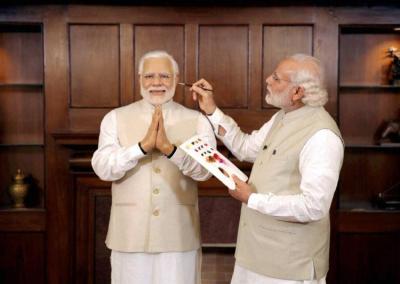
Modi and his double, image courtesy, IndiaTV news

As the crisis of fake degrees blows over I want to be the one to ask the naïve question: Why would Narendra Modi lie? I know it is a naïve question because lies are the most banal political strategy ever. There is a man in US today who repeatedly states that he will make the Mexican government pay for a beautiful, great wall on the border of US and Mexico and people believe him with a degree of sincerity that is frightening. In 2014, at least 31 percent of eligible Indian voters believed in Modi’s promises of development and some of them still do. There may be some who, at the end of the five years, actually believe that Modi has delivered on those promises. But such lies are different. My question is simply: why would he lie on an affidavit which functions as a legally-binding oath?

In his previous election affidavit filed for 2012 Gujarat elections he had left the spouse’s name column empty but following ‘strict legal advice’ he agreed to mention his wife’s name on the affidavit filed for Lok Sabha elections. Technically he had withheld information in previous affidavits which amounts to a legal offence since he had not filed his papers to ‘the best of his knowledge’ but this is not the same as actively lying as it now turns out could be the case with his educational qualifications. Legal experts will determine what is tantamount to punishable crime but if Modi did have legal counsel, who advised him to “come clean on the marriage” as this Times of India article states, why would he continue to provide inaccurate information on other aspects of life?

One speculative answer could be that he knew he was being closely watched as he made his bid for the PM’s post and that his papers would be scrutinised and compared with previous drafts. So it made sense to remain consistent with some of the information even though he had obviously been cornered on the question of his marital status. And yet, as the story of how Modi came to acknowledge the existence of his wife Jashodaben proves, if he had to reveal inconsistencies in previous records, 2014 would have been the best time to do this. No amount of exposés could have hurt the man at that time – his bhakt army, on and offline, on Twitter, were efficiently managing the show and could provide a useful media spin/misdirection to take the focus away from the affidavit that declared to the world that Jashodaben’s repeated claims regarding her marriage and abandonment were not unfounded. Even as the Gujarat Congress urged the state Election Commission, unsuccessfully, to reject his application on the grounds that he had not provided information regarding his spouse’s assets or PAN card number, Modi cruised to victory since his deliberate inconsistencies seem to matter very little to voters.

At that point Modi, indeed, seemed invincible. He was giving explosive speeches and deftly avoiding uncomfortable questions from journalists. In an interview with Rajdeep Sardesai, Modi replied to an indirect question on 2002 with this classic deflection tactic: “My best wishes are with you, Rajdeep Sardesai. You have been living off this issue for the last 10 years … I have heard that those who curse Modi get Rajya Sabha seats or Padma awards. So you have my best wishes to continue this campaign (against Modi) and reach Rajya Sabha or win Padma awards with help of your friends.” What was apparent in the interview is now widely acknowledged as the process of constructing a larger-than-life image, where the man referred to himself in third person. Continue reading Degrees of Self-Deception: Rama Srinivasan

Hate as Harmony – Law and Order under Saffrons


Muslims were equated to “demons” and “descendants of Ravana”, and warned of a “final battle”, as the Sangh Parivar held a condolence meeting here for VHP worker Arun Mahaur, who was killed last week allegedly by some Muslim youths. Among those present on the dais were Union Minister of State, HRD, and BJP Agra MP Ram Shankar Katheria as well as the BJP’s Fatehpur Sikri MP Babu Lal, apart from other party local leaders, who joined in the threats to Muslims. Speaker after speaker urged Hindus to “corner Muslims and destroy the demons (rakshas)”, while declaring that “all preparations” had been made to effect “badla (revenge)” before the 13th-day death rituals for Mahaur.

(http://indianexpress.com/article/india/india-news-india/muslims-warned-of-final-battle-at-sangh-meet-mos-katheria-says-weve-to-show-our-strength/#sthash.ZBMcpoFo.dpuf)


What does someone do in the winter of one’s own life when you discover that the values you cherished, the principles for which you fought for have suddenly lost their meaning and the world  before you is turning upside down ?

Perhaps you express your anguish to your near and dear ones or write a letter about the deteriorating situation around you in your favourite newspaper or as a last resort appeal to the custodians of the constitution that how you are ‘forced to hang your head in shame’.

Admiral Ramdas, who has served Indian Military for more than four decades and has remained socially active since then, followed his voice of conscience. Continue reading Hate as Harmony – Law and Order under Saffrons

Rebellion as Contagion

IMG_2231

Perhaps this is the infection, the gangrene, that Justice Pratibha Rani fears: a slogan, chanted in the streets of Srinagar as a matter of routine, finds an opening at a university campus in New Delhi. Freed from the usual suspects, unmoored from the routine skirmishes, deaths, and encounters, along the Line of Control, the slogan floats through a university corridor – distracting rows of disciplined students from their academic pursuits.

A slogan’s explosive power, it seems, is not just about what is shouted – but rather where it appears, and who takes up the call. This realisation offers us an opportunity, long sought, to think through this troubling question of “Freedom of Expression.” Read the rest of this piece here

Delhi Stands With JNU Students and Against the Evil Modi Regime

Because things are the way they are, things will not stay the way they are...”-

Bertholt Brecht

This slideshow requires JavaScript.

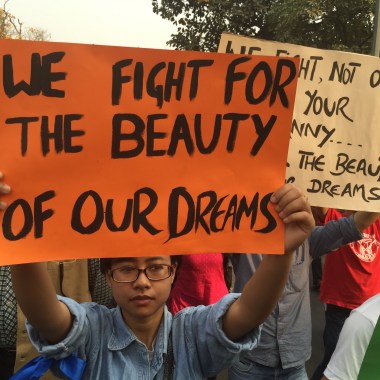
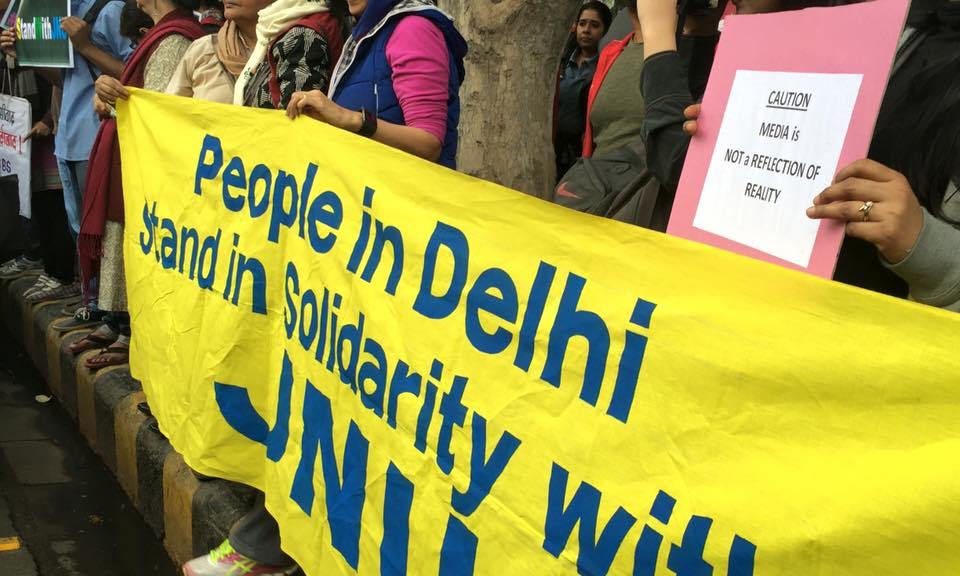
This afternoon saw an amazing, uplifting show of peaceful, joyful strength by students, young people, teachers, friends in Delhi, in support of JNU, in memory of Rohith Vemula, in solidarity with Kanhaiya, Umar and all the students in JNU who are being so stellar in their principled opposition to this evil, venal Modi regime. Reports of massive protests are coming in from Kolkata, Russia to and elsewhere. Something is changing in the air.
It was a perfect spring afternoon, overcast like our times, but breezy like our morale. There must have been at least 15,000 people on the march today. We met old and long lost friends and made new ones.

The gathering was totally peaceful. Young  women and men, student profits from JNU in the eighties, grey haired, felt young again as their student held aloft flowers, flags, signs and homemade banners. Everyone looked their best, as if they had come to a massive street party.

It was so infectious, the mood this afternoon, such a contrast to the vile bad temper of the men who attacked Kanhaiya and his supporters two days in a row at the Patiala House Courts two days in a row that the difference between two entirely different visions of politics was palpable on your skin. The contrast sent a clear message to all our senses.

The RSS-ABVP-BJP brand of politics is diseased. It’s on its last legs and that is why it is so desperate. It cannot perform, it has no ideas, it is morally and culturally bankrupt.

Universities are in crisis and all that the bad TV actress who makes a joke of her ministry (HRS) every day can think of today while thousands March against her and her boss is about sticking giant flagpoles into the ground and stitching gigantic silk shrouds for her  government and her party.

Modi, Rajnath and Manusmriti Irani should quake in fear. Their time is up.

Very proud of JNU students and the people of Delhi today.

#StandwithJNU #StandwithKanhaiya

#StandwithUmar

#Standwithallstudents

#NowitchHuntofStudents

Missing the Forest for Trees – Caste System’s Shadow on Rohith’s Suicide : Sanjay Kumar

Guest Post by Sanjay Kumar

(Photo Courtesy : Prokerala.com)

Mainstream politics over Rohith Vemula’s suicide is becoming hot and ugly. Although whisper campaigns against Rothith’s dalit identity were on since his suicide, the BJP’s central leadership had been relatively quiet after HRD minister’s rather shrieky ‘appeal’ to not play caste politics over his suicide. However, now it seems daggers are out. The party in power, whose two ministers are accused of creating conditions leading to Rohith’s suicide, has decided that Rohith’s non-dalit status is the dog it is going to beat to counter its anti-dalit image. Rohith’s mother is a Mala, a Scheduled Caste, who lives seperately from his father, a backward caste Vaddera. He got an SC certificate on the basis of showing that he grew up in his mother’s Mala household. BJP’s strategy may look petty, but it is based on the age-old great Hindu tradition which can not contenance any violation of the privileges of the patrilineal system. After all, marital rape does enjoy legal sanction in India to this day. Continue reading Missing the Forest for Trees – Caste System’s Shadow on Rohith’s Suicide : Sanjay Kumar

The Need for Black-South Asian Solidarity: Lavanya Nott

This is a guest post by LAVANYA NOTT

In February 2013, George Zimmerman, a 28-year old neighbourhood watch coordinator in Sanford, Florida, stalked and fatally shot 17-year old unarmed Trayvon Martin, an African-American high school student. In July of that year, Zimmerman was acquitted of his crime.

On August 9, 2014, unarmed Black teenager Michael Brown was shot several times by police officer Darren Wilson in Ferguson, Missouri after Brown stole several packs of cigarillos from a neighbourhood store. In late November of that same year, a grand jury did not indict Wilson of his crime.

The Black Lives Matter movement began after Zimmerman’s acquital, and the Ferguson non-indictment saw the movement surge forward, with thousands of citizens taking to the streets all over the United States in protest. In the months that followed, the movement gained rapid momentum, spurred on by yet another non-indictment—that of a White police officer in Staten Island who put 43-year-old Eric Garner in a fatal chokehold in broad daylight, without provocation. His death was ruled by a medical examiner as a homicide, but his killer Daniel Pantaleo escaped indictment.

In mid-September 2015, Mohammad Akhlaq’s house in Dadri was broken into, his family attacked, and his life taken by a rampaging mob of RSS workers who were responding to a rumor that Akhlaq killed a cow and subsequently consumed its meat on Eid.

Less than a month later, a gang of upper-caste Rajputs set fire to the house of a sleeping Dalit family, killing two-year-old Vaibhav and his nine-month-old sister Divya. This attack, in BJP-ruled Faridabad, was set against the backdrop of a long-standing caste-related dispute between the Dalit and Rajput communities in the city.

Continue reading The Need for Black-South Asian Solidarity: Lavanya Nott