All posts by Aarti Sethi

I am an M.Phil student at the School of Arts and Aesthetics, JNU, New Delhi. This blog is meant to be a space for conversation with friends on my ongoing work on cinema and the city. And since all of you know me there not much else to say ;)

Crude Questions about Crude Bombs: Biju Mathew

This is a guest post by BIJU MATHEW

Tarun Mandal, Narahari Sahu and Manas Jena are dead, blown up by what the media has described as a “crude” bomb. All bombs are crude. They kill. They are meant to destroy flesh and bone. They are aimed at sucking out life. Lakshman Mandal battles for his life in a Cuttack hospital. He knows how crude a bomb is. Hopefully he will live to tell the tale of its crudeness.

This is a partisan piece. But it aims to produce balance. Almost all media reports so far have had a strong spin that the three – Narahari, Tarun and Manas – were killed while making a crude bomb. So says Mr. Satyabrata Bhoi, Jagatsinghpur SP. Nobody has bothered to ask him any further questions. It’s quite understandable. Asking any more questions might make the entire spin untenable. For instance, they could have asked: why is it that something illegal, such as crude bomb making, was being done out in the open and not within the confines of a house? Especially given that for the last month, the police have been constantly in and out of the village? Especially because there are at least a few dozen pro-POSCO folks in the village? Why would three leaders of an oppositional movement sit outside on the porch of a house that is fully identified with POSCO Pratirodh Sangran Samiti (PPSS) and make bombs – openly, for all to see – at 6.30 PM when there is enough light for anybody to see them? Isn’t crude bomb making normally confined to the indoors? How many incidents do we know of where crude bomb making was happening outside in broad daylight? Isn’t the RSS, the most famous outfit that makes crude bombs and occasionally manages to blow up its own, always known to make its bombs indoors? Continue reading Crude Questions about Crude Bombs: Biju Mathew


Some Urgent Considerations on Genetically Modified Crops and Food Security: Neha Saigal

This is a guest post by NEHA SAIGAL: The Budget Session is upon us and we might be witness to one of UPA’s most ambitious flagship programmes, the National Food Security Bill (NFSB), becoming a reality. So it seems like Food Security is the flavour of this session with President, Mr Pranab Mukherjee, reiterating UPA 2’s commitment to food security in his maiden speech at the start of the Budget Session.

But this commitment comes under serious question when one of the responsible agencies of the Government dilutes the issue of food security and further misleads the debate on an important issue like hunger and malnutrition. I am referring to the Ministry of Agriculture (MoA) under Sharad Pawar mindlessly promoting GM crops as a solution to food security. Continue reading Some Urgent Considerations on Genetically Modified Crops and Food Security: Neha Saigal

Meanderings of a Female Atheist Muslim Indian: Samina Motlekar

This is a guest post by SAMINA MOTLEKAR: I come with baggage, with tags not all of my own making. I was born female, and as much as I want to be acknowledged as a person, I learnt early that it was pointless to deny so physical a part of my identity. I was born to Muslim parents, but that does not make me Muslim, a distinction that is unfortunately far too subtle for many minds to comprehend. Complacent in their own inherited identities, they pile on the labels smothering me into little  boxes of their making. Female, Muslim, Indian – all accidents of birth. But not all of me is accidental. By age eleven, the idea of a deity in the sky, concepts of heaven and hell, were at best stories, at worst ramblings of deluded minds to me. Not for me the fence sitting of agnosticism. I was an atheist before I hit my teens, and my belief system has endured the trials and tribulations of time. Yet they call me Muslim.

Continue reading Meanderings of a Female Atheist Muslim Indian: Samina Motlekar

Elements of Bomb (Blast) Making – Understanding Dilsukhnagar: Biju Mathew

hydblast2

This is a guest post by BIJU MATHEW: The story is always the same, isn’t it? A perfectly ordinary day becomes extraordinary. A day when the daily tribulations of thousands of workers and small merchants is instantly transformed into tragedy. 15 dead, 5 still critical and over 100 others injured– some of them maimed for life – thinking of what recovery might mean. Ravinder, a farm hand from a Nalgonda village has lost a leg. His wife, Lakshmi might still yet lose her foot. Their 1 year old is missing. And they were in Dilsukhnagar for a hospital visit because the 1 year old has a congenital heart condition. There is no justice to be had here. Continue reading Elements of Bomb (Blast) Making – Understanding Dilsukhnagar: Biju Mathew

Shahbagh: The Forest of Symbols: Naeem Mohaiemen

This is a guest post by NAEEM MOHAIEMEN

Shahbagh_SyedLatifHossain
© Syed Latif Hossain

There is a particular way of lensing mass movements, when we are observing from within immediate tactics. In a fast moving situation, with opponents and allies squared off, the first thing to shrink is the space for internal critique. Professor Azfar Hussain uses the term “critical solidarity” for his approach to Shahbagh. A critique that seeks to help the movement, but also a critique some are not ready to hear yet.

For the last sixteen days, Bangladesh has been in an intense new political phase. The ground has shifted and been recast by the scale of the Shahbagh movement. The flash point was the sentencing of the “Butcher of Mirpur” (a war criminal who collaborated with the Pakistan army in 1971). But, by now, the demands have expanded to a call for a ban on the main Islamist party Jamaat-e-Islami, or even Islamist politics altogether. Older leftist thinkers like Badruddin Umar are daring to ask questions of the hallowed place of “state religion” in the constitution. Younger bloggers are urging all to make it clear that the movement is about war criminals, not religion. But of course, with war criminals conflated with the Jamaat-e-Islami, and that party eager to present themselves as standing for “Islam,” category errors will happen. Continue reading Shahbagh: The Forest of Symbols: Naeem Mohaiemen

Gird Your Loins

A new product ’18 Again’ has hit the Indian market. A vaginal tightening gel, the advertisement left us mildly bemused.

With her newly tautened privates, the saree-clad lady seems in remarkably good cheer, given she apparently ‘feels like a virgin’ and ‘it’ (it presumably being sex), ‘feels like the very first time’. Namely awkward, painful, inexperienced fumbling? Ah well! There’s no accounting for tastes, not least the fantasies of the Indian man.

Regardless, we think this is a step in the right direction. Virgins being a scarce commodity these days, a handy at-home converter for any sacrifices you may have planned is a thoughtfully designed product indeed. (The makers of ’18 Again’ are unclear on what to do with those of us who escaped the wastelands of virginity before 18, but there you have it. You can’t please everyone, certainly not those sluts who didn’t even wait till they were legal). The makers of 18 Again are hoping for strong revenues on the back of exponential domestic demand.

As this article details, the Indian vagina now caters to a broad spectrum of consumer taste and preference. Backed by a strong commitment to product diversification, the Indian vagina is set to enter the 21st century  with applications and appliances, room fresheners and Christmas trees. Needless to say, we are delighted; our only grouse being that the products are somewhat limited in scope and vision. And so with an eye to the future we present a small list of potential uses and a plea that we all broaden, rather than tighten, our imagination. Continue reading Gird Your Loins

NWMI Condemns The Violent Abuse Of Meena Kandasamy

[We at Kafila are absolutely horrified at the abuse directed at poet and activist Meena Kandasamy for expressing her views on twitter regarding the beef-eating festival at Osmania University. That supposedly ‘neutral’ educational institutions replicate upper-caste Hindu dietary taboos, is no surprise, nor that the ABVP reacted with its customary violence to that questions upper caste privilege. What is shocking is the attitude of the Vice Chancellor and the sexist, misogynist, violent speech directed at her on the web. It is telling that those who take such umbrage at the eating of cows, think nothing of advocating the public rape of women. Below is a statement issued by the The Network of Women in Media condemning the hate speech directed at her. We stand in solidarity with Meena Kandasamy.]

The Network of Women in Media, India (NWMI), strongly condemns the violent and sexist abuse unleashed on poet, writer, activist and translator Meena Kandasamy, presumably in response to her posts on Twitter about the beef-eating festival at Osmania University, Hyderabad, on 15 April 2012 and the ensuing clashes between groups of students. Continue reading NWMI Condemns The Violent Abuse Of Meena Kandasamy

Of Shared Spaces and Experiences in Gujarat: Ayesha Khan

This is a guest post by Ayesha Khan

The other day, my brother dug out an old DD animation film on unity in diversity – Ek Titli, Anek Titli… We replayed it umpteen times in a fit of summer nostalgia, until we got all the lines correct. We  ignored the political subtext.  But only until it rebounded starkly on us, with the wails of  a baby that had newly come in to the family. The little one foisted on us the first ponderous responsibility – finding him a name.

The family brief for me, aunt to a six day old nephew, and equally to childhood pal Vandana, who is soon-to-be aunt to a niece in US,  was to think up  names resonating a core Indian-ness, the Muslimness, the TamBram-ness (in Vandana’s case), with a universal appeal and encapsulating  everything that is pious, lucky and great.

Continue reading Of Shared Spaces and Experiences in Gujarat: Ayesha Khan

Growing up with PTV in Poonch: Saqib Mumtaz

Guest post by SAQIB MUMTAZ

Away from the revolution of direct to home (DTH) and cable TV networks, the nineties were the time of one channel, when Doordarshan was synonymous with Television for most Indians, especially in rural areas. There was not much on television for a kid growing up except the occasional cartoon clips and Shaktimaan. I was fond of Meena and her parrot Mithu. They were loveable unthreatening characters. The duo imparted important lessons on a variety of social issues. Movies were a strict no-no and the news was other things adults were interested in. Every evening my grandfather would tune in to the Hindi news which was followed by another news broadcast in English. Even as a kid I could sense the repetition but never the reason of watching the same news twice.

In my memory of those days, it’s not Doordarshan that I associate myself with. Luckily for many of us near the border there was PTV.

Continue reading Growing up with PTV in Poonch: Saqib Mumtaz

Our Corruption, Our Selves: Arjun Appadurai

This is a guest post by ARJUN APPADURAI

Partha Chatterjee and Shuddhabrata Sengupta rightly argue that “corruption” is indeed a new Indian label for “the lives of others”. The East German Stasi also surely saw their vigilance as directed against the politics of “the enemies of the people”, except that in their case the state and the party were seen to contain all the good people, with the bad people choosing to remain in the unmobilized parts of civil society. Hence the pro-Hazare gatherings certainly have some of the disturbing echoes of mass rallies under Hitler and Stalin with the working and middle-classes adoring a mediocre and Chaplinesque figure who promises a new wave of moral cleansing. Continue reading Our Corruption, Our Selves: Arjun Appadurai

Birds, tea, ghosts and the Indian National Congress: Sumana Roy

Guest post by SUMANA ROY

A few years ago, I took my students to the cemetery in Darjeeling. I lived in an apartment just above the Happy Valley Tea Estate, from where I saw the prettiest of sunsets, had a colleague point out the ranges of Sandakphu to me quite often, and from whose long narrow balcony I imagined shadows of, as the lingo among Bengalis in Darjeeling went, “Sahib Ghosts”. Apart from the weather, perfect and monstrous in turns, what kept Darjeeling alive to “professors from the plains”, as we were called, was the mythology of “biliti” (“foreign”) ghosts waiting for the appropriate moment to reclaim what they had created – tea-gardens, the schools and colleges, the architecture, the cookies and cakes, the “style”, a word in which we tried to condense the British legacy. We spoke about planchettes, about ghosts we wanted to invite for tea, while history professors debated with political science researchers whether that meeting would be a post-postcolonial one or an anti-postcolonial moment. Continue reading Birds, tea, ghosts and the Indian National Congress: Sumana Roy

Militant Rationalities: Ali Usman Qasmi

This is a guest post by ALI USMAN QASMI

Stark indifference of various religious organizations and scholars over suicide bombings and the recurrent target killing in Pakistan during the last few years is appalling. Woefully the mainstream print and electronic media deems it enough to issue the obligatory bland statements signifying absolutely nothing in condemnation of killings of innocent civilians. The act of terrorism in itself is relentlessly condoned, although the lost lives of civilians evoke some reaction which too is quite guarded to say the least. Even while expressing sympathy over the death of civilians,  the ‘atrocities’ of the Western powers in general and USA in particular are invariably referred to as the catalyst resulting in all the mess that the Pakistani people find themselves in, at the moment. Thus, unequivocal condemnation of those responsible for all the mayhem in the country is conspicuously missing, which amounts to a tacit approval of these terrorist acts. Far more tormenting than the devil may care attitude of religious parties and their leadership, is the role played by writers of the right wing persuasion, particularly in the Urdu media. While the mass appeal of the religious parties is considerably thin, nevertheless, right-wing ideology is widely shared and adhered to. Continue reading Militant Rationalities: Ali Usman Qasmi

School Days…

I sometimes wonder if Foucault had gone to school in India if he would not have written his opus on punishment on the school rather than the prison. Anyone who has gone to school in India will tell you there is no institution that combines discipline and punishment in quite the same way as school. Everyone has tales to tell. Continue reading School Days…

Osama and Obama: Or How Much Work Can One Death Do…

Yesterday Osama Bin Laden was killed in an operation by American troops in Abbottabad, Pakistan. Barack Obama addressed the American nation in a televised address at 11:30 P.M. at night. It is a curious address. You can watch it below.

Continue reading Osama and Obama: Or How Much Work Can One Death Do…

Trysts at Midnight: Calcutta, Now: Prasanta Chakravarty

This is a guest post by PRASANTA CHAKRAVARTY

[The Bangla film Sthaniya Sambaad (Spring in the Colony, 2009) was recently released. The film, by way of mapping the diurnal workings of a refugee colony in contemporary Calcutta, asks important questions about the changing cityscape, of the new, emerging world of land grabbers and fly-by-night investors and of the bemused young and old who are outside of this world and yet are sucked within its machinations. This is a conversation about education, humanities and the nature of artistry in the age of modularization—between MOINAK BISWAS, one of the directors of the film (with Arjun Gourisaria) & Reader, Film Studies, Jadavpur University, Calcutta and PRASANTA CHAKRAVARTY, Associate Professor of English, University of Delhi.]

Prasanta: Your film got a commercial release finally, which is wonderful. Among the initial reactions, in reviews, internet discussions and so forth, one notices a lot of interest in the polyvalent nature of your craft. I would like to take one particular strand of the film and probe a little: that is, its quite sharp critique of the phenomenon of vocationalization of education. This is a constant and niggling thread, right? Now, one fundamental argument for modular training, especially in humanities and social sciences, at this point, is a democratic one: that it will provide competence to a large number of the unemployed, ensure jobs and help in national growth. Continue reading Trysts at Midnight: Calcutta, Now: Prasanta Chakravarty

Sri Lanka’s 18th Amendment: A Charter for Dictatorship: Rohini Hensman

Guest post by ROHINI HENSMAN

Different sections of Sri Lankans protest against the 18th Amendment

Sri Lanka’s claim to be a democracy has been tenuous for years, but the passing of the Eighteenth Amendment to the Constitution by parliament on 8 September 2010 dealt it a fatal blow. It changed Sri Lanka into a de facto dictatorship like Zimbabwe and Myanmar, where it is abundantly clear that elections alone cannot unseat Mugabe or Than Shwe.

Continue reading Sri Lanka’s 18th Amendment: A Charter for Dictatorship: Rohini Hensman

A Public Service Announcement: Rukavat ke liye Khed Hai

Dear Readers,

There has been some consternation in the ranks regarding delays in comment moderation. If you do not see your comment up immediately, it is not because Central Committee has suddenly issued gag orders (we knew it!), we are becoming “un-democratic” (tyrants!), “authoritarian” (fascist bastards!), or coy (the dynamite of true revolutionaries is too much for our bourgeois souls). It is simply because all except one administrator are currently out of action.

Please have some sympathy for the lone Kafila elf, and desist from sending us 300 emails a day about Kafila’s sudden pact with the devil. Normal services will resume shortly :)

Who claims responsibility for the Headline?

The Times of India sub-editor who let today’s headline go through should lose his or her job. “Terrorists, not Maoists”, it declared. This before the CPI(Maoist) had claimed responsibility for the derailment of the Gyaneshwari Express. Indeed before there was any clarity regarding how the train was derailed. At least the Hindustan Times, not usually known for its temperance, made some attempt to adhere to journalistic protocol to say “Naxals Blamed”, and not “Naxals did it”. Though it then goes on to say “All fingers point at Maoists, their spokesman denied hand in Bengal Mishap”. Meanwhile the West Bengal police, in other reports, claim that the PCPA have taken responsibility for the derailment, when Chatradhar Mahato has explicitly said the PCPA is not involved. Today the CPIM(Maoist) has also denied any involvement. The Maoists, historically, have not exactly been shy of claiming responsibility for actions they have carried out. Even when, such as with the recently blown up bus in Dantewada, they are likely to be at the receiving end of severe censure. Continue reading Who claims responsibility for the Headline?

On Maoist Regret

There is no room for doubt anymore that the landmine attack on a bus plying on the Dantewada-Sukhma road was planned and executed by the CPIM (Maoist). About 36 people have died, a majority of them civilians. This was not a mistake.The Maoists have said this was a calculated attack to target the Koya Commando wing of the SPOs. This means that the Maoists knew there were civilians on board. The Maoists have taken responsibility for the attack and in a statement to the press, Ramanna has said they “deeply regret the loss of civilian lives”. Continue reading On Maoist Regret

Integration of the Army and New Constitutionalism in Nepal: Menaka Guruswamy

This post comes to us from Menaka Guruswamy

Constitution-making is a process involving a contested terrain and this is reflected in Nepal’s political situation today, particularly
on the question of integration of rebel combatants into the army and its “democratisation”. It is important for Nepal’s political parties and forces to leave aside their past mistrust and come together to reach an equitable settlement while integrating combatants. Political foresight is also needed to appreciate that democratisation of all institutions, including the army, is imperative for creating the new constitutional democracy that is Nepal.

This piece originally appeared in the Economic and Political Weekly, February 2010, Vol. XLV No.9

Guruswamy EPW Nepal

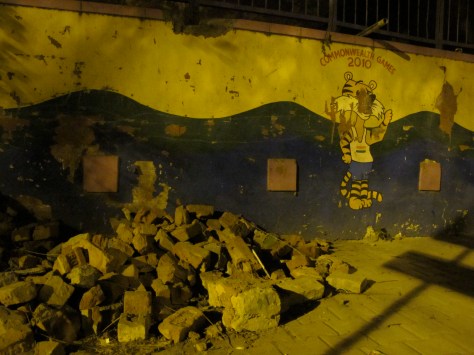
City Walls That Talk II

This image comes to us from Anand Vivek Taneja