All posts by subhash gatade

Waiting to Become Eichmann? Unpacking the Moral Relativism of a People

“They took so much away from us that they ended up taking away our fear”
— Message scrawled on a placard in a women’s march in Spain

’How does Justice feel?’

A difficult query to answer but perhaps Bilkis Bano would be the best person to respond to it.

Yes the same Bilkis – survivor of a mass rape and the only witness to horrific massacre of her 14 relatives – when the state she lived witnessed a carnage when officially one thousand innocents perished in the communal pogrom and many thousands were displaced from their homes and were condemned to live as internal refugees.

One can still recollect her words when the highest courts of the country finally cancelled the remission of sentences to her perpetrators who had been convicted for this heinous crime. [1].

She frankly narrated her feelings before a reporter.

’It feels like a stone the size of a mountain has been lifted from my chest, and I can breathe again. This is what justice feels like.”

Time for a Judicial Enquiry into the Violence in Haldwani!

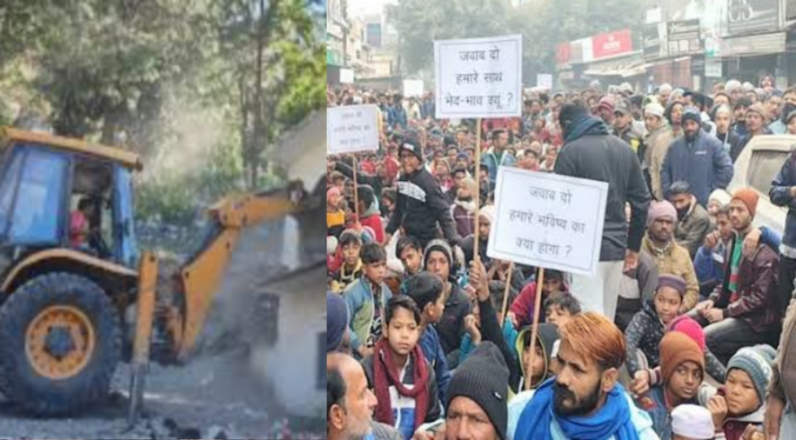
The sounds raised by Bulldozers demolishing ‘illegal Mosque and Madarasa’ in Haldwani, on 8 th February evening, which  have resulted in few deaths and injuries to several people which includes even policepersons as well, are now over.

Peace seems to be returning and life seems to coming back to normal ..

No doubt violence of any kind cannot be justified and people’s opposition to government’s steps should always remain in the bounds of constitution…

……Question arises, whether a judicial enquiry preferably under a retired judge of the Supreme Court will be ordered so that a clear picture of the whole incident emerges and one may better comprehend, how an area which was site a peaceful mass movement merely a year back, a movement which was joined by civil society activists, writers etc, suddenly changed colour.

Say No To Hate, We Need Jobs

A Joint Statement and Appeal issued by people’s organisations, intellectuals and concerned citizens from Uttarakhand about the violent incidents on 8 th February

( This is an attempt at English translation of the original statement issued by writers, journalists, social activists and people’s organisations. For original statement , please see here )

Developments on 8th February are serious, condemnable as well as tragic. We would like to express our deep concern for the dead as well as the injured and demand proper compensation for them

We appeal to people in Uttarakhand and rest of India to maintain peace and harmony . We condemn all sorts of violence and want that an impartial legal action be taken about the incident. We are of the opinion that every type of resistance, opposition should always remain in the bounds of law and constitution.

We also appeal to the administration that no action should be contrary to Constitutional principles and values.

  • Negligence, hurry and biased approach of the administration can be clearly seen in these developments. Even the language of the administration sounds sectarian. When the allegedly illegally built mosque and madarsa were in the control of the administration itself and the next hearing in the case was scheduled to be heard on 14 th February, what was the necessity to go for demolition in such a hurried manner. It is time that the District Magistrate and Senior Superintendent of Police are immediately transferred and a judicial enquiry be done about the whole incident.
  • We need to bear in mind that since 2017 the Uttarakhand government has desisted from taking an impartial legal action against vigilante violence and hate speeches. Right from citizens groups, people organisastions, opposition parties, leading intellectuals, advocates of Supreme Court to ex generals of the army from the state have been raising their voices in this connection. When the government does not appear impartial it emboldens anti-social elements. In this background voices have been raised to underline how use of hate, communal and violent incidents for political benefits ultimately engenders further challenges to social harmony and rule of law. It is high time that steps on war footing be taken to strictly implement decisions of the Supreme Court in 2018 and later, regarding hate speeches and violence.
  • We have always maintained that the “anti encroachment drive” is plagued by unnecessary hurry and a biased approach. Hundreds of such incidents have occurred since last one year . We are of the opinion that without resettlement nobody should be made homeless and every such action be undertaken in proper legal manner and with enough sensitivity. As far as Uttarakhand is concerned today lakhs of people are living on 4 lakh hectare Nazul land. In Haldwani itself a large population has settled on Nazul land which comprises people belonging to all religions. It has been a long time demand that people living on nazul land be given the ownership of the land. The state government has even sent proposal to the central government in this connection. Despite all this it is beyond comprehension to see that government seems to be in an unnecessary hurry regarding the issue of encroachment. Since quite some time the state government is engaged in these efforts under the name of anti encroachment drive. We feel that the government is pushing its sectarian agenda under the name of anti encroachment drive. This should be immediately stopped.

Say No To Hate, We need Jobs

  • Rajiv Lochan Sah, Uttarakhand Lok Vahini; Naresh Nautiyal, General Secretary, Uttarakhand Parivartan Party ; Tarun Joshi, Van Panchayat Sangharsh Morcha; Bhuvan Pathak and Shankar Dutt, Sadbhavna Samiti Uttarakhand; Shankar Gopal and Vinod Badoni, Chetna Aandolan; Islam Hussain, Sarvoday Mandal ; Lalit Upreti and Munish Kumar, Samajwadi Lok Manch ; Trilochan Bhatt, Independent Journalist; Heera Jangpani, Mahila Kisan Adhikar Manch ; Mukul, Mazdoor Sahyog Kendra

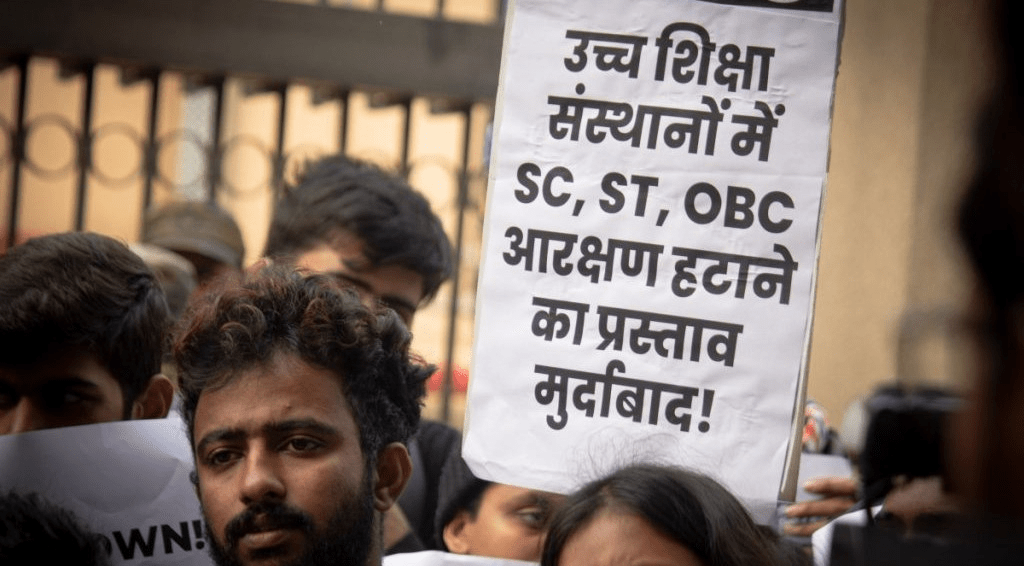
‘Dereservation’ -Whether the genie is out of the bottle finally

UGC led by Chairman Jagdeesh Kumar refuses to remain beyond controversy for long time.

The latest being its draft proposal of ‘dereservation’ of seats if not a suitable candidate from reserved category is found wherein it asked people’s views till 28 th January.

As expected this proposal which smacked of the ruling dispensation’s surreptitious and even direct attempts at attacking or biting away at the affirmative action policies emanating from the Constitution rightly led to protests in various quarters, There were protests opposing this proposal on JNU and other campuses and even opposition parties attacked the ruling party for its compromising attitude towards reservation rights and its desire and moves to either dilute or hollow out the provisions of these socially progressive policies and this led to an intervention from the Human Resources Ministry underlining that there is no such proposal.

अजेयता का मिथक: 2024 में मोदी की वापसी होगी या 2004 की होगी पुनरावृत्ति?

2024 की शुरूआत में भारत एक प्रचंड बदलाव की दहलीज पर खड़ा है। सभी जनतंत्र प्रेमी, इन्साफ पसंद और अमन के चाहने वालों के सामने यही बड़ा सवाल मुंह बाए खड़ा है कि 2024 के संसदीय चुनावों में- जो मई माह के अंत तक संपन्न होगा तथा नयी सरकार बन जाएगी (अगर उन्हें पहले नहीं कराया गया तो)- का नतीजा क्या होगा?

क्या वह सत्ता के विभिन्न इदारों पर भाजपा की जकड़ को ढीला कर देगा, क्या वह जनतंत्र की विभिन्न संस्थाओं को निष्प्रभावी करने की या उनका हथियारीकरण करने की सोची समझी रणनीति को बाधित कर देगा, क्या वह धर्म के नाम पर उन्मादी तक हो चुकी जनता में इस एहसास को फिर जगा देगा कि 21वीं सदी में धर्म और राजनीति का घोल किस तरह खतरनाक है या वह भारतीय जनतंत्र की अधिकाधिक ढलान की तरफ जारी यात्रा को और त्वरान्वित कर देगा, भारत के चुनावी अधिनायकतंत्र ( electoral autocracy) की तरफ बढ़ने की उसकी यात्रा आगे ही चलती रहेगी

.

ग्राहम स्टेंस और उनकी संतानों की याद में…

‘Men never do evil so completely and cheerfully as when they do it from religious conviction.’
Blaise Pascal, French Mathematician and Physicist who lived some 400 years ago and died young (1623 to 1662 AD)

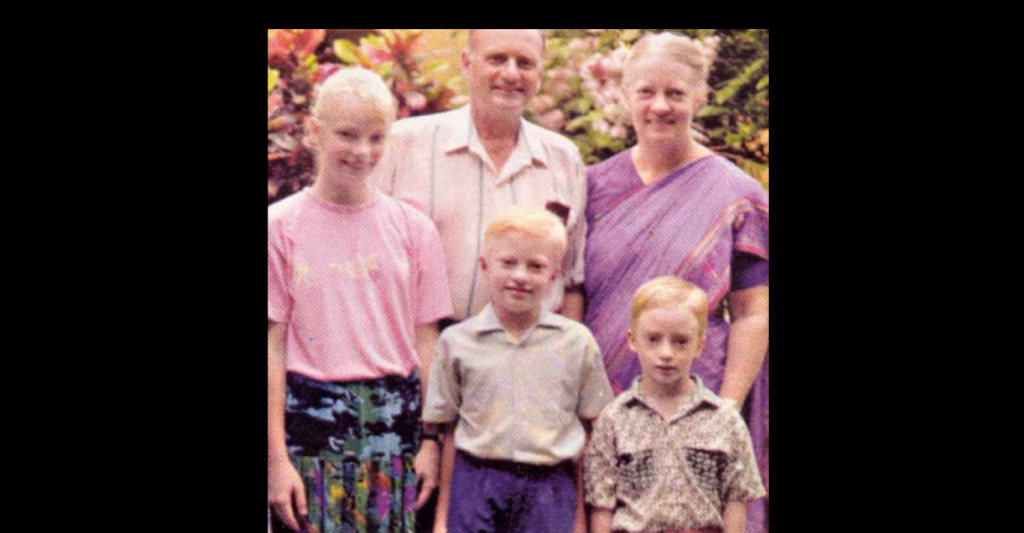
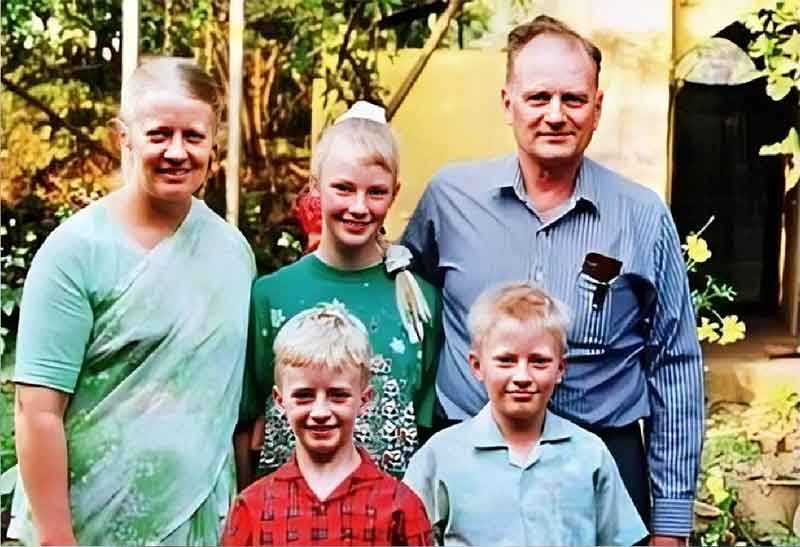
ग्राहम स्टेंस, जो ऑस्ट्रेलिया से भारत पहुंचे ईसाई पादरी थे और ओडिशा के बेहद पिछड़े आदिवासी बहुल इलाकों में गरीबों एवं कुष्ठरोगियों की सेवा में संलग्न थे, उन्हें और उनकी दो संतानों फिलिप और टिमोथी को कथित तौर पर हिंदुत्ववादी जमातों से जुड़े मानवद्रोहियों ने 22 जनवरी 1999 को जिंदा जलाया था.

22 जनवरी की तारीख की बीती तारीख को इस घटना की पच्चीसवीं सालगिरह थी.

राम मंदिर आयोजन की चकाचौंध में किसी ने इस बर्बर हत्या और उसके निहितार्थों को याद करना भी मुनासिब नहीं समझा, जबकि हम पाते हैं कि इस बर्बर हत्याकांड में वह तमाम संकेत मिलते हैं, जिन्हें 21वीं सदी की बहुसंख्यकवादी राजनीति में भरपूर प्रयोग में लाया गया.

Thinking Graham Staines and his Children in times of Jubilation over Ram Temple

The life of the dead is placed in the memory of the living.

– Marcus Tullius Cicero

Politics is nothing but theology in action

– Ambedkar


Right-wing politics suffers from a common syndrome everywhere.

It never feels confident to project its own icons for the rest of the humanity, whatever might be their claims about their worldview,  it knows that its own icons are detested by a wide spectrum of people.

The easiest way it finds to overcome this lacunae is to appropriate already established icons – who  were even opposed to their world view as well  and claim them their own. In fact, it does not have any qualms in utilising dates – bearing special significance for exploited and oppressed and marginalised of the world – to put their stamp on it.

The project of Hindutva Supremacism – which yearns / strives to transform a Secular, Socialist, Democratic and Sovereign Republic into a Hindu Rashtra has perhaps achieved near perfection in this kind of politics.

Our History, Their History, Whose History? : Prof Romila Thapar

Prof Romila Thapar, great historian and public intellectual , will be delivering the 28 th Lecture in the Democracy Dialogues Series  on Sunday 28 th January 2024 at 6 PM (IST). 

Please reserve the time and date for the lecture. Details are given below

Democracy Dialogues – 28 th Lecture

Organised by

New Socialist Initiative (NSI)

Theme : Our History, Their History, Whose History?

Speaker : Professor Romila Thapar

Time : 6 PM (IST)

Sunday, 28 th January 2024

The lecture will be live on facebook.com/newsocialistinitiative.nsi.

The zoom invite will be shared closer to the date.  

Abstract:
My purpose in this talk would be to examine the link between history and particular kinds of nationalism. I hope to show that nationalism can be a process, bringing together and uniting all the communities that inhabit a particular territory in support of a change in society or opposing a target common to all. This earlier form is what I would like to call a unitary, integrative nationalism that cut across communities and drew them together in a particular country to support a single purpose. This I would differentiate from the latter forms in some countries which identified with units of society or communities according to certain common features, such as a particular religion or language, or caste or ethnicity. I would call it segregated nationalism, where each community is segregated and treated as having a distinctly different identity and its own separate goal. History is brought in when the community that gives an identity to its nationalism insists on tracing its origins to a historical past. This pattern of integrated and segregated nationalisms would seem to apply to India of the twentieth century. There was the all-inclusive national movement whose participants were from every community; its objectives were to maintain the unity of the Indian people and overthrow colonial rule. The other nationalism, segregated nationalism, was seeded in the 1920s and assumed the existence of two nations – the Hindu and the Muslim – which, it was argued, go back to earlier times. Integrated nationalism succeeded in 1947 in bringing about independence, but its foundations needed strengthening, for we are now witnessing the strong presence of religious nationalism in the attempt to inaugurate a Hindu Rashtra in India.

– Romila Thapar

About the Speaker:

Internationally renowned scholar of Ancient History, Prof Thapar was elected General President of the Indian History Congress in 1983 and a Fellow of the British Academy in 1999. In 2008, she was awarded the prestigious Kluge Prize of the US Library of Congress which complements the Nobel, in honouring lifetime achievement in disciplines not covered by the latter.  
Prof Thapar has been a visiting professor at Cornell University, the University of Pennysylvania, and the College de France  in Paris and holds honorary doctorates from the University of Chicago, the Institut National des Langues et Civilisations Orientales in Paris, the University of Oxford, the University of  Edinburgh (2004), the University of Calcutta and from the University of Hyderabad

 Here is a select list of Prof Thapar’s publications
Ashoka and the Decline of the Mauryas, 1961 ( Oxford University Press) ; A History of India : Volume 1, 1966 ( Penguin) ; The Past and Prejudice, NBT ( 1975) ; Ancient Indian Social History : Some Interpretations, 1978 ( Orient Blackswan) ; From Lineages to State 1985 : Social Formations of the Mid-First Millenium B.C. in the Ganges Valley, 1985 ( Oxford University Press) ; Interpreting Early India, 1992 ( Oxford University Press) ; Sakuntala : Text, Reading, Historie, 2002 ( Anthem) . Somanatha : The Many Voices of History, Verso ( 2005)  ; The Aryan : Recasting Constructs, Three Essays ( 2008) ; The Past As Present: Forging Contemporary Identities Through History, (2014) ;Voices of Dissent: An Essay, (2020); The Future in the Past: Essay ( 2023)

Myth of Invincibility!

Whether Modi will get a third term in 2024 or these elections can spring a surprise?

India at the beginning of the year stands at the cusp of a Momentous Change

The biggest question before everyone is whether the elections for the Parliament – the lower house – which will be over by end of May ( if they are not advanced by the ruling dispensation) would be able to disturb the stranglehold of the BJP-RSS over the levers of power at the Centre, whether it will lead to loosening of sorts of the grip it holds over the various institutions of Democracy ( critics even call that they have been subverted, weaponised) or it will slide the Indian Democracy further into the electoral autocracy mode much to the chagrin of well wishers of democracy everywhere.

Jorg Haider to Geert Wilders : Far-right Normalised in Europe

Jorg Haider. Image Courtesy: Wikimedia Commons

Jorg Haider, a far-right Austrian politician who died in 2008, is largely forgotten. It is also forgotten that merely two decades ago, he was considered a very dangerous man in Europe, whose ascent to power had prompted rare European Union unity aimed to thwart his ambitions.

Twice elected as governor of the southern state of Carinthia, Haider—who opposed immigration and was critical of Islam and Muslims—once praised the Nazi regime’s “employment policies”. 

His Freedom Party of Austria allied with another party, the OVP, which allowed Haider to become the country’s chancellor. But the possibility of a ‘right-wing extremist’ ruling a European Union member country prompted the other 14 members to join hands punitively against Australia, putting Haider out of the chancellorship race.

The European Union stuck by the 1997 Treaty of Amsterdam principles and emphasised that nobody would be allowed to “breach them”. 

Many European countries threatened to recall envoys from Austria, and some said that Austria could be shunted out of the union if the need arose. The Belgian foreign minister at the time said, “Europe can very well do without Austria. We don’t need it.

After much water has flown down the Thames, the Rheins, the Danubes and all other rivers of Europe, the world has Geert Wilders in the Netherlands, a “political earthquake”, whom some consider more extreme and fanatical than Haider. But Wilders’ views on immigration and Islam cause no similar outrage in European capitals today.

Wilders’s party, which promised to ban mosques and compared the Quran with the infamous Mein Kampf, has won 37 seats in a 150-member Parliament. It is now the number one party in the country’s parliament. 

( Read the full text here)


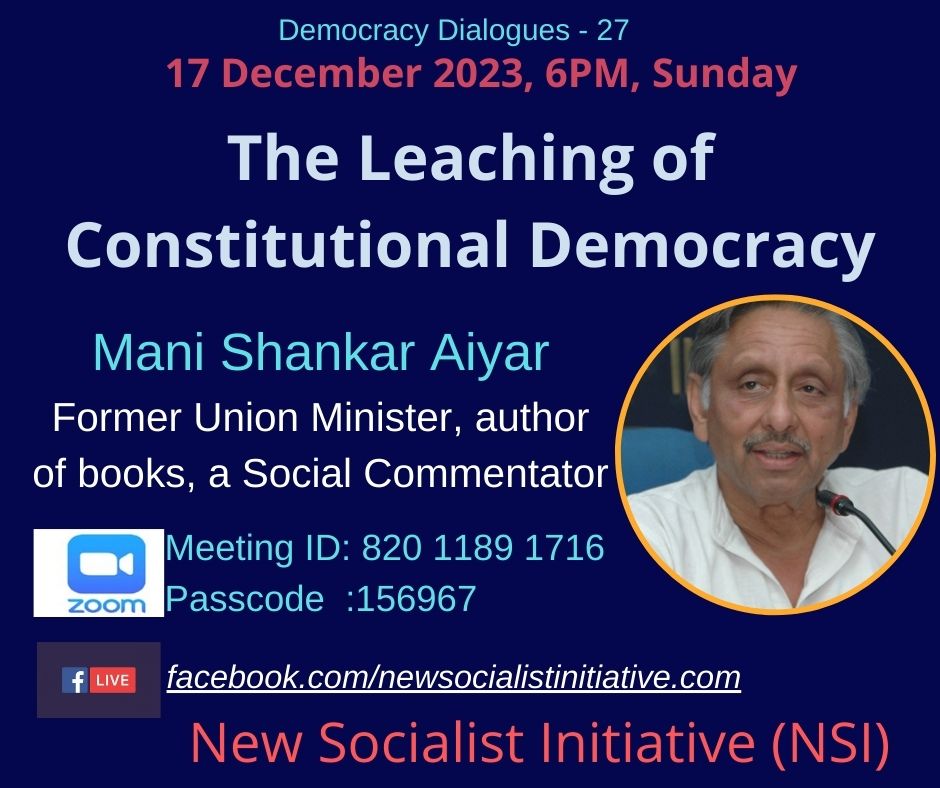
 The Leaching of Constitutional Democracy : Mani Shankar Aiyar

Mr Mani Shankar Aiyar, Ex Union Minister, author and eminent political personality will be delivering the 27th lecture in the 

Democracy Dialogues Series,organised by  New Socialist Initiative (NSI)

Theme : The Leaching of Constitutional Democracy

Speaker : Mani Shankar Aiyar

Former Union Minister, author of books, a Social Commentator, 

Time : 6 PM ( IST)

Sunday, 17 th December 06.00 PM (IST)

Join Zoom Meeting
https://us02web.zoom.us/j/82011891716?pwd=bExFdmY1eHVDdHovR3ZzVWh4VE1LZz09

Meeting ID: 820 1189 1716
Passcode: 156967

facebook.com/newsocialistinitiative.com

NEW SOCIALIST INITIATIVE

Theme:

On the face of it, we are an on-going democracy. We have a Constitution which has been honoured by the present government declaring 26 November as Constitution Day. We have regular elections at national, State and panchayat levels. We have the various institutions of democracy in place: an elected Parliament; an independent judiciary; an accountable executive; and a functioning, non-governmental media. Yet, there is fear all around. a new fear, a fear not seen since the Emergency, that has been spreading over the past decade. Why? Is it perhaps because the “spirit of constitutionalism”, as Fali Nariman has put it in his latest work, missing? Can we continue to be the nation envisaged by Gurudev Rabindranath Tagore: “Where the mind is without fear/And the head is held high”? Are we progressing towards or in retreat from that “Heaven of Freedom” of which Tagore sang?. Are the institutions of democracy functioning? Is the Preamble being venerated or violated? Are our civil servants really free? Is our civil society being muzzled? Is the media glowing in the light of freedom of expression? Is the investigative and judicial process being made the punishment? Is the economy in any meaningful sense “socialist” as enjoined by the Preamble? Is the Constitution being reduced in practice to a non-justiciable set of Directive Principles of State Policy? Above all, are we as a nation still ‘secular” – again as enjoined by the Preamble? Is Hindutva compatible with the basics and parameters of the Constitution? Is our ‘unity in diversity” threatened or is it being revered?What are the challenges ahead that need to be addressed before we cease being the world’s largest democracy? 

Speaker :

Mani Shankar Aiyar

Author of many books and a regular social commentator, Mani Shankar Aiyar, has had a distinguished foreign service career , he was Union Ministers during Congress led government (2004 till 2009) and has handled different ministries. Ministry of Petroleum and Natural Gas, ( 2004-06) Youth Affairs and Sports (2006-08), and Development of North Eastern Region ( 2008-09).

Here is a list of few of his publications :Memoirs of a Maverick Juggernaut, 2023 ; A Time of Transition: Rajiv Gandhi to the 21st CenturyPenguin, 2009 ; Confessions of a Secular FundamentalistPenguin, 2004; Rajiv Gandhi’s India, 4 vols. (General Editor), UBSPD New Delhi, 1997,  Knickerwallahs, Silly-Billies and Other Curious Creatures, UBS Publishers, 1995 . Pakistan Papers, UBSPD, New Delhi, 1994 ; One Year in Parliament, Konark, New Delhi, 1993 ; Remembering RajivRupa & Co., New Delhi, 1992 ; Rajiv Gandhi: The Great Computer Scientist of India, Mughal Publishers, New Delhi, 1991 ;  How To Be A Sycophant, NBS, New Delhi, 1990

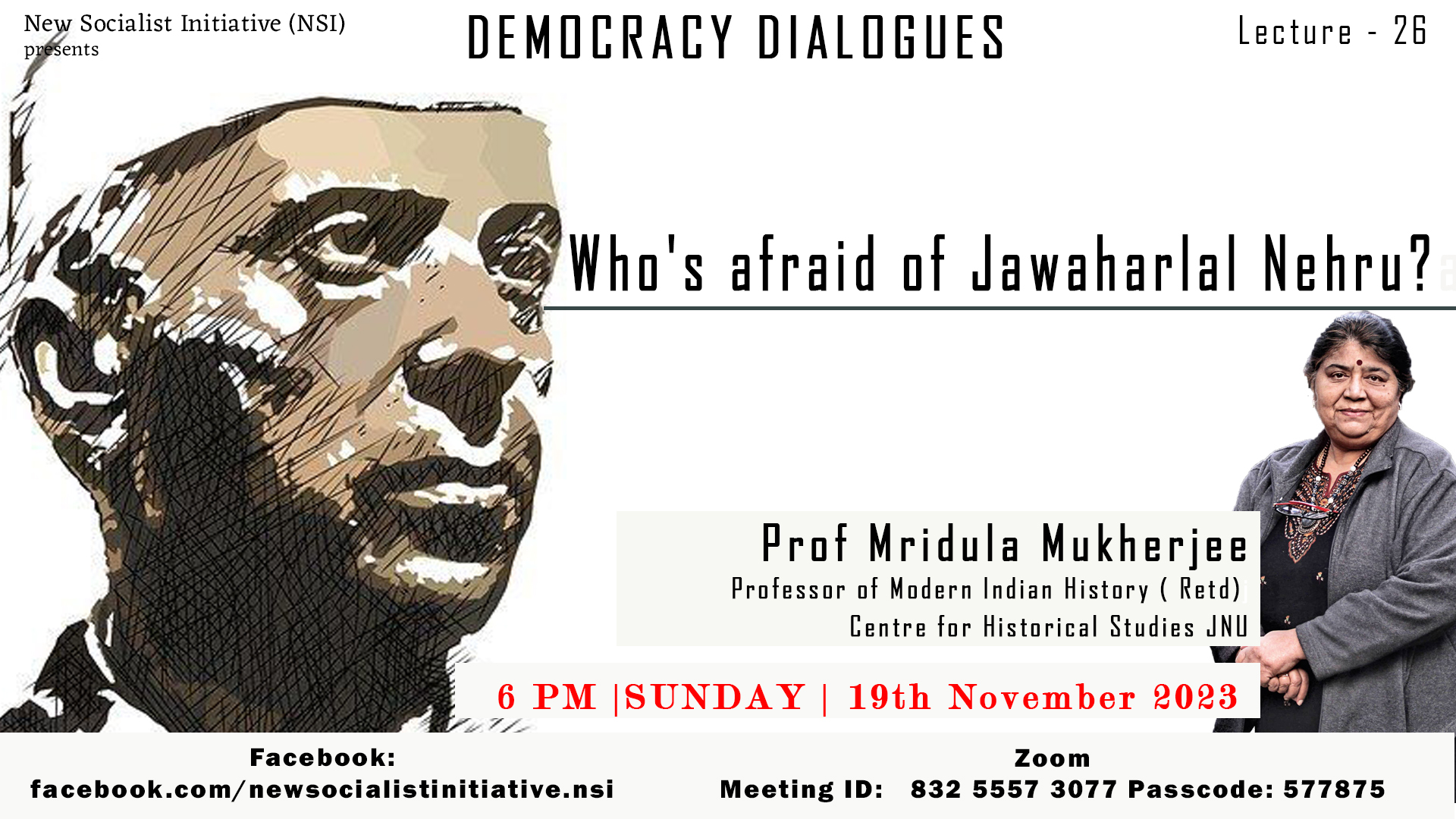
‘Who’s Afraid of Jawaharlal Nehru?’ Mridula Mukherjee – Lecture notice

Professor Mridula Mukherjee, Professor of Modern Indian History ( Retd), Centre for Historical Studies, JNU, will be delivering the 26 th Democracy Dialogues Series lecture on Sunday, 19 th November 2023 at 6 PM (IST).

Theme :
Who’s Afraid of Jawaharlal Nehru?
Time: Nov 19, 2023 06:00 PM India

Join Zoom Meeting
https://us02web.zoom.us/j/83255573077?pwd=RXdiblVjcWZaeDdqVmJaSjI3aW9Qdz09

Meeting ID: 832 5557 3077
Passcode: 577875

Also live streamed at: facebook.com/newsocialistinitiative.com
——————
Theme : 
‘Who’s Afraid of Jawaharlal Nehru?’

Summary :
In his lifetime, Jawaharlal Nehru was recognized the world over as a statesman and an Indian leader second only to Gandhiji. A foremost leader of the freedom struggle, who gave it a decided socialist orientation, he remained unrivaled as Prime Minister after independence and built the solid foundations of a sovereign, secular, democratic, and egalitarian republic. He evolved the concept of non-alignment which enabled many ex-colonial countries to avoid becoming a part of the two power blocs engaged in the Cold War.

However, he is today the favourite whipping boy of the establishment.  We are told he was responsible for the partition, for the mess in Kashmir, for the death of Subhash Bose, for delaying the integration of Hyderabad, and of Goa, for the defeat at the hands of China in 1962, for neglecting agriculture, and primary education, and much else. The reason for the defamation is of course that he stood for the exact opposite of what is valued today. His life and work present a continuous question mark to the regressive trends in fashion.

This will become evident as we focus in the talk especially on two areas of great relevance today in which we are facing a grave crisis: Democracy and Civil liberties, and Communalism/Secularism. We will also focus attention on Nehru’s evolving understanding of  Mahatma Gandhi’s vision and method of non-violent struggle, of which he became the most ardent advocate after his death.

Speaker :

Author of many books, Prof Mukherjee has been a visiting Scholar at Duke University, USA, and at the Institute of Oriental Culture, University of Tokyo and was also Director of Nehru Memorial Museum and Library, ( NMML), New Delhi.
She has published widely in the areas of agrarian history, peasant movements, social movements and the Indian national movement.

Here is a list of a few of her publications :
Colonializing Agriculture, The Myth of Punjab Exceptionalism Sage (2005) ;  Peasants in India’s Non Violent Revolution : Practice and Theory (Sage 2004).

This list also includes India’s Struggle for Independence (1999) and India After Independence 1947–2000 (2000), RSS, School Texts and the Murder of Mahatma Gandhi The Hindu Communal Project (2008) co-authored with Prof Bipan Chandra and others.

INDIA’S DEMOCRATIC LONGEVITY AND ITS HUGELY TROUBLED TRAJECTORY : PROFESSOR ASHUTOSH VARSHNEY

Democracy Dialogues Lecture Series (Online )
Organised by New Socialist Initiative

25th Lecture ( Sunday, 15 th October 2023)

Theme: India’s Democratic Longevity and its Hugely Troubled Trajectory

 Speaker:  Professor Ashutosh Varshney Sol Goldman Professor of International Studies and the Social Sciences at Brown University )

Theme :India’s Democratic Longevity and its Hugely Troubled Trajectory

Summary

India celebrated 75 years of its independence last year with a lot of enthusiasm.

Celebrations did not hide the fact it is also one of the leading countries which is passing through what is popularly known as ‘democratic backsliding’.

A country which, like many others, is using democratic processes to secure undemocratic outcomes, where freely contested elections are being deployed for the purpose of expressing, cultivating, or enhancing majoritarian prejudices—to target minorities and turn them into lesser citizens.

In this scenario, there is an urgent need to unpack this journey of democratic India further , there is a need to make a distinction between India as an electoral democracy and India as a liberal democracy.

Background Reading for the talk :

# India’s Democratic Longevity and its Hugely Troubled Trajectory ( Attached with this mail)

#. How India’s Ruling Party Erodes Democracy

Ashutosh Varshney

Journal of Democracy, Volume 33, Number 4, October 2022, pp. 104-118 (Article)

Click to access project_muse_866645.pdf

Speaker

Prof Ashutosh Varshney is Sol Goldman Professor of International Studies and the Social Sciences and Professor of Political Science at Brown University, where he also directs the Center for Contemporary South Asia. Previously, he taught at Harvard (1989-98) and the University of Michigan, Ann Arbor (2001-2008).

His books include Battles Half Won: India’s Improbable Democracy (2013), Collective Violence in Indonesia (2009), Ethnic Conflict and Civic Life: Hindus and Muslims in India (Yale 2002), India in the Era of Economic Reforms (1999), and Democracy, Development and the Countryside: Urban-Rural Struggles in India (Cambridge 1995)

India’s Democratic Longevity and its Hugely Troubled Trajectory : Professor Ashutosh Varshney

[Democracy Dialogues Lecture by Professor Ashutosh Varshney scheduled for coming Sunday has to be rescheduled. New dates will be announced as soon as Professor Varshney is in a position to deliver the lecture. Apologies.]

Topic :  India’s Democratic Longevity and its Hugely Troubled Trajectory

Speaker : Professor Ashutosh Varshney

Theme : India’s Democratic Longevity and its Hugely Troubled Trajectory

Questions and Answers on Looking for an Idea of India for the Indian Left : Dr Ravi Sinha

Looking for an Idea of India for the Indian Left : Dr. Ravi Sinha

यूनिवर्सिटी की दहलीज़ पर ‘विश्वगुरु’ के जासूस

क्या बुद्धिजीवी वर्ग को पालतू बनाए रखने की सरकार की कोशिश या विश्वविद्यालयों में इंटेलिजेंस ब्यूरो को भेजने की उनकी हिमाक़त उसकी बढ़ती बदहवासी का सबूत है, या उसे यह एहसास हो गया है कि भारत एक व्यापक जनांदोलन की दहलीज़ पर बैठा है.

So you are the little woman who wrote the book that made this great (American) civil war’

( ‘‘‘तुम हो वह महिला जिसने उस किताब को रचा जिसने इस महान /अमेरिकी/ गृह युद्ध को मुमकिन बनाया)

[गुलामी प्रथा की समाप्ति के लिए छेड़े गए गृह  युद्ध के खात्मे के बाद तत्कालीन अमेरिकी राष्टपति अब्राहम लिंकन द्वारा गुलामी प्रथा के खिलाफ लिखे गए उपन्यास ‘अंकल टाॅम्स केबिन’ / 1852/ की लेखिका हैरियट बीचर स्टोव Harriet Beecher Stowe से मिलने पर प्रगट उदगार]

लेखक, कलाकार, विद्वान आदि से हुक्मरान हमेशा ही चिंतित रहे हैं।

मिसाल के तौर पर क्रांतिपूर्व  फ्रांस के बारे में यह बात मशहूर है कि वहां की राजशाही ने अपने पुलिस महकमे को अपने दौर के अहम लेखकों, कलाकारों की जासूसी करते रहने के निर्देश दिए थे। हम अठारहवीं सदी के पुलिस महकमे की मुलाजिमों की मुश्किलों को समझ सकते हैं जिन्हें ‘खंूखार अपराधियों और राजनीतिक व्यक्तियों’ के अलावा लेखकों, कलाकारों पर अपनी फाइल रखनी पड़ती थी। (द स्टेटसमैन, हिन्दुस्तान टाईम्स, नई दिल्ली, 26 सितम्बर 2006)

एक क्षेपक के तौर पर बता दें कि इस जासूसी का विधिवत विवरण जनाब ब्रूनो फुल्गिनी की किताब में मिलता है जिसका शीर्षक है ‘राइटर्स पुलिस’ – दरअसल फ्रेंच संसद के इस कर्मचारी को यह जिम्मेदारी मिली कि वह पार्लियामेंट लाइब्रेरी के पुराने दस्तावेजों को खंगाले और इस बेहद उबाउ काम के दौरान उसे यह ‘खजाना’ मिल गया था।

अगर हम अपने यहां निगाह दौड़ाएं तो मौजूदा हुक्मरानों का रूख इस मामले में कोई अलग नहीं दिखता, बल्कि वह ढाई सौ सदी पहले के फ्रांसिसी सम्राटों से कभी कभी एक कदम आगे ही दिखते हैं। ( Read the full text here)

Vishwa Guru’s Sleuths

( Photo : Courtesy – countercurrents.org)

Writers, scholars, artists have always worried the powers that be.

There was a time when the Parisian police had been given the onerous task of keeping the greatest writers of late 18 th Century who were living in Paris at that time under their watch. Poor fellows, one can imagine their difficulty in maintaining files on writers and artists and scholars ‘beyond criminals and political figures.’

The present dispensation at the centre is no different.

It could be said that it may be a step ahead.

The French Monarchs – who within few decades witnessed a mass upheaval which finally overthrew them – were wise enough to ask their minions to be rather discreet in their activities, not to offend the writers, scholars directly ; the harbingers of today’s ‘New India’ have even abandoned that discreetness for good.

( Read the rest of the article here)

.

Vishwa Guru of Hate?

How India is Slowly Emerging as a ‘World Teacher’ albeit of a different kind

( Illustration : coutesy CJP, Citizens for Justice and Peace)

France has moved towards normalcy some time back.

The anger and anguish of the still marginalised in the society, which spilled over into the streets, over the killing of a 17 year old Nahel – son of an Algerian single woman of Muslim origin – by the trigger happy traffic police, recorded on a camera, has long subsided.

No doubt the questions raised by it are not going to go away so easily.1

Experiences of two countries cannot be compared easily but perhaps one could easily see in the uproar shades of the ‘black lives matter moment’ for the French society. Not only in terms of the brutality of the police as witnessed in American society after the killing of George Floyd but the soul searching of sorts which seems to have begun afresh there, a churning has accelerated within the French people after this killing.

( Read the full article here)

The Erosion Of Liberal Democracy in India: An Analysis – Prof Pranab Bardhan

Prof Pranab Bardhan,  Professor Emeritus, UC Berkeley, delivred the 24th Democracy Dialogues Lecture on August 27, 2023, Sunday at 10 AM India Standard Time.

Theme : The Erosion Of Liberal Democracy in India: An Analysis

Speaker : Prof Pranab Bardhan

Professor Emeritus of Economics at the University of California, Berkeley

It was also live streamed at:

facebook.com/newsocialistinitiative.com

Topic : The Erosion Of Liberal Democracy in India: An Analysis

A Brief Outline of the theme shared by Prof Bardhan

I’ll start with the global context of the turn of politics to right-wing extremism in much of the world.

One of the major factors behind this is the weakening of trade unions and of labour movements in general, which in earlier days used to act as a major force of resistance.

I shall then look into the weakening of labour movements in India and the pathetic failure of the Left political organizations. I shall analyze the deficiencies in their economic policies, mobilization strategies and governance failures even in areas where they used to be influential. Just blaming the semi-fascist Right is not good enough.

I shall end with a general discussion of how in prevailing Indian ideologies (including that of the Left) liberal democracy has often been under-valued.

Speaker :

Pranab Bardhan is Distinguished Professor Emeritus of Economics at the Department of Economics at the University of California, Berkeley.

He was educated at Presidency College, Kolkata and Cambridge University, England. He had been at the faculty of MIT, Indian Statistical Institute and Delhi School of Economics before joining Berkeley. 

He has done theoretical and field studies research on rural institutions in poor countries, on political economy of development policies, and on international trade. 

He was Chief Editor of the Journal of Development Economics for 1985-2003. 

He is the author of 17 books and editor of 14 other books, and author of more than 150 journal articles including in leading Economics journals 

His latest book titled A World of Insecurity: Democratic Disenchantment in Rich and Poor Countries was  published by Harvard University Press in late 2022.

His memoir titled Charaiveti: An Academic’s Global Journey is being published by Harper Collins India in late 2023.

His memoir in Bengali (titled Smriti-kanduyan, ‘Memory-Sratching’) has been serialized in Kolkata’s leading literary magazine, Desh, and the book came out in January 2014.

He has also contributed essays to popular outlets and some of these popular pieces have now been collected in his latest books, Globalization, Democracy and Corruption and Indian Polity and Economy:A Mirror to Difficult Times (Frontpage Publications). A collection of his Bengali essays has been published by Ananda Publishers in Kolkata in 2020.

Debating Hindutva

Background :
A close friend of decades prodding you to read / listen to something and ask for your views is such a great moral incentive which nobody would refuse.
The following note is an end product of similar undertaking which this pen pusher rather reluctantly took initially when one received a YouTube link of a conversation / debate between Congress M. P Shashi Tharoor and Supreme Court lawyer and commentator J Sai Deepak, held sometime back, where the focus of the programme was on  Congress M.P. Shashi Tharoor’s book ‘Why I am a Hindu ?’

 The book deals with how Mr Tharoor understands Hinduism, looks at its Great Souls, unpacks political Hinduism and dwells also at the violence committed by its followers and differentiates his Hinduism from that Hinduism practised by who can be called as ‘Bhakts’.

J Sai Deepak, a very popular commentator who has written a few books and also shared his views, dealt with Tharoor’s arguments.


As an aside it needs to be added that J Sai Deepak is one among the new crop of commentators , writers whose interventions very much resonate with what can be termed as ‘rightwing’ . There are few other names  like Vikram Sampath, Sanjeev Sanyal, Anand Ranganathan etc of the same stream, whose arrival on the scene has been a moment of celebration among a section of the media  (https://www.firstpost.com/politics/why-is-left-academia-so-rattled-by-vikram-sampath-sai-deepak-or-sanjeev-sanyal-10433791.html) which is critical of the left and its towering intellectuals.


Here follows the communication with the friend 
 ]