All posts by subhash gatade

Myth of Invincibility!

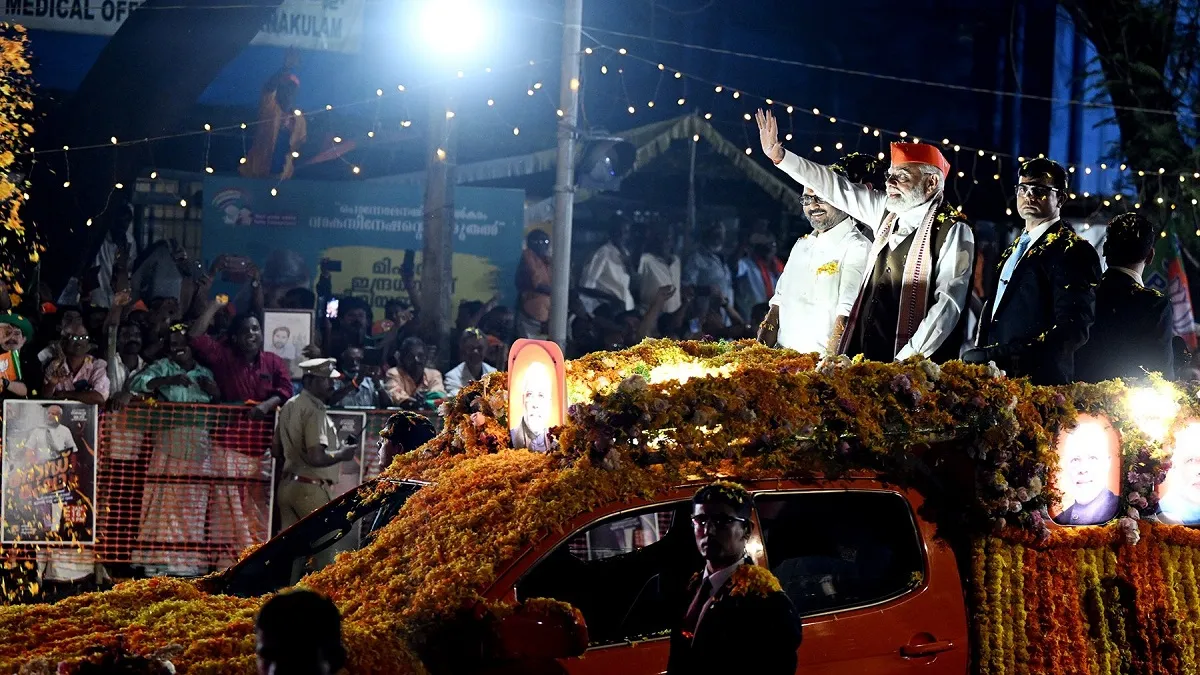
Whether Modi will get a third term in 2024 or these elections can spring a surprise?

India at the beginning of the year stands at the cusp of a Momentous Change

The biggest question before everyone is whether the elections for the Parliament – the lower house – which will be over by end of May ( if they are not advanced by the ruling dispensation) would be able to disturb the stranglehold of the BJP-RSS over the levers of power at the Centre, whether it will lead to loosening of sorts of the grip it holds over the various institutions of Democracy ( critics even call that they have been subverted, weaponised) or it will slide the Indian Democracy further into the electoral autocracy mode much to the chagrin of well wishers of democracy everywhere.

Jorg Haider to Geert Wilders : Far-right Normalised in Europe

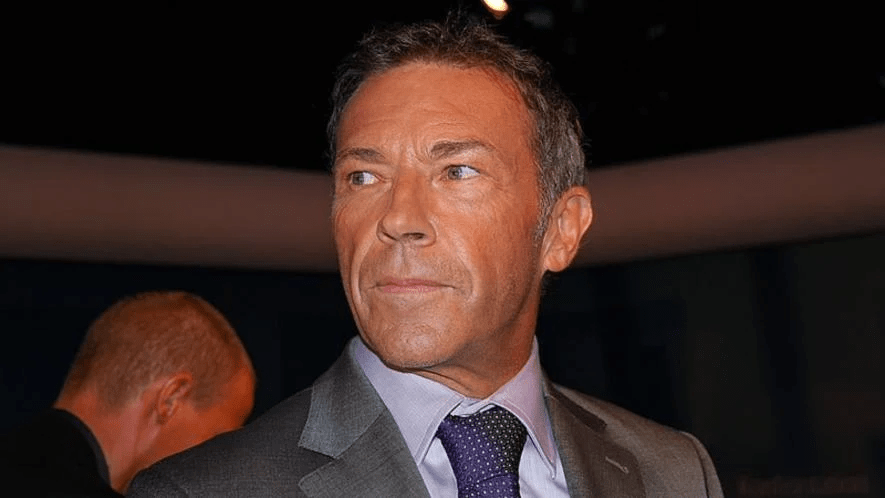
Jorg Haider. Image Courtesy: Wikimedia Commons

Jorg Haider, a far-right Austrian politician who died in 2008, is largely forgotten. It is also forgotten that merely two decades ago, he was considered a very dangerous man in Europe, whose ascent to power had prompted rare European Union unity aimed to thwart his ambitions.

Twice elected as governor of the southern state of Carinthia, Haider—who opposed immigration and was critical of Islam and Muslims—once praised the Nazi regime’s “employment policies”. 

His Freedom Party of Austria allied with another party, the OVP, which allowed Haider to become the country’s chancellor. But the possibility of a ‘right-wing extremist’ ruling a European Union member country prompted the other 14 members to join hands punitively against Australia, putting Haider out of the chancellorship race.

The European Union stuck by the 1997 Treaty of Amsterdam principles and emphasised that nobody would be allowed to “breach them”. 

Many European countries threatened to recall envoys from Austria, and some said that Austria could be shunted out of the union if the need arose. The Belgian foreign minister at the time said, “Europe can very well do without Austria. We don’t need it.

After much water has flown down the Thames, the Rheins, the Danubes and all other rivers of Europe, the world has Geert Wilders in the Netherlands, a “political earthquake”, whom some consider more extreme and fanatical than Haider. But Wilders’ views on immigration and Islam cause no similar outrage in European capitals today.

Wilders’s party, which promised to ban mosques and compared the Quran with the infamous Mein Kampf, has won 37 seats in a 150-member Parliament. It is now the number one party in the country’s parliament. 

( Read the full text here)


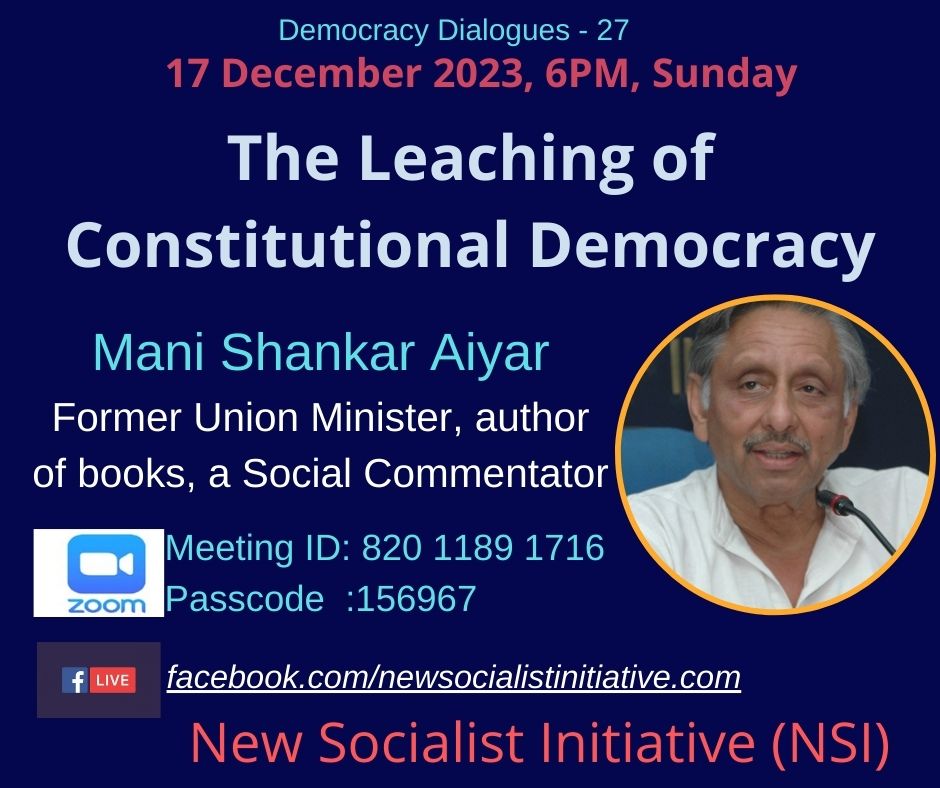
 The Leaching of Constitutional Democracy : Mani Shankar Aiyar

Mr Mani Shankar Aiyar, Ex Union Minister, author and eminent political personality will be delivering the 27th lecture in the 

Democracy Dialogues Series,organised by  New Socialist Initiative (NSI)

Theme : The Leaching of Constitutional Democracy

Speaker : Mani Shankar Aiyar

Former Union Minister, author of books, a Social Commentator, 

Time : 6 PM ( IST)

Sunday, 17 th December 06.00 PM (IST)

Join Zoom Meeting
https://us02web.zoom.us/j/82011891716?pwd=bExFdmY1eHVDdHovR3ZzVWh4VE1LZz09

Meeting ID: 820 1189 1716
Passcode: 156967

facebook.com/newsocialistinitiative.com

NEW SOCIALIST INITIATIVE

Theme:

On the face of it, we are an on-going democracy. We have a Constitution which has been honoured by the present government declaring 26 November as Constitution Day. We have regular elections at national, State and panchayat levels. We have the various institutions of democracy in place: an elected Parliament; an independent judiciary; an accountable executive; and a functioning, non-governmental media. Yet, there is fear all around. a new fear, a fear not seen since the Emergency, that has been spreading over the past decade. Why? Is it perhaps because the “spirit of constitutionalism”, as Fali Nariman has put it in his latest work, missing? Can we continue to be the nation envisaged by Gurudev Rabindranath Tagore: “Where the mind is without fear/And the head is held high”? Are we progressing towards or in retreat from that “Heaven of Freedom” of which Tagore sang?. Are the institutions of democracy functioning? Is the Preamble being venerated or violated? Are our civil servants really free? Is our civil society being muzzled? Is the media glowing in the light of freedom of expression? Is the investigative and judicial process being made the punishment? Is the economy in any meaningful sense “socialist” as enjoined by the Preamble? Is the Constitution being reduced in practice to a non-justiciable set of Directive Principles of State Policy? Above all, are we as a nation still ‘secular” – again as enjoined by the Preamble? Is Hindutva compatible with the basics and parameters of the Constitution? Is our ‘unity in diversity” threatened or is it being revered?What are the challenges ahead that need to be addressed before we cease being the world’s largest democracy? 

Speaker :

Mani Shankar Aiyar

Author of many books and a regular social commentator, Mani Shankar Aiyar, has had a distinguished foreign service career , he was Union Ministers during Congress led government (2004 till 2009) and has handled different ministries. Ministry of Petroleum and Natural Gas, ( 2004-06) Youth Affairs and Sports (2006-08), and Development of North Eastern Region ( 2008-09).

Here is a list of few of his publications :Memoirs of a Maverick Juggernaut, 2023 ; A Time of Transition: Rajiv Gandhi to the 21st CenturyPenguin, 2009 ; Confessions of a Secular FundamentalistPenguin, 2004; Rajiv Gandhi’s India, 4 vols. (General Editor), UBSPD New Delhi, 1997,  Knickerwallahs, Silly-Billies and Other Curious Creatures, UBS Publishers, 1995 . Pakistan Papers, UBSPD, New Delhi, 1994 ; One Year in Parliament, Konark, New Delhi, 1993 ; Remembering RajivRupa & Co., New Delhi, 1992 ; Rajiv Gandhi: The Great Computer Scientist of India, Mughal Publishers, New Delhi, 1991 ;  How To Be A Sycophant, NBS, New Delhi, 1990

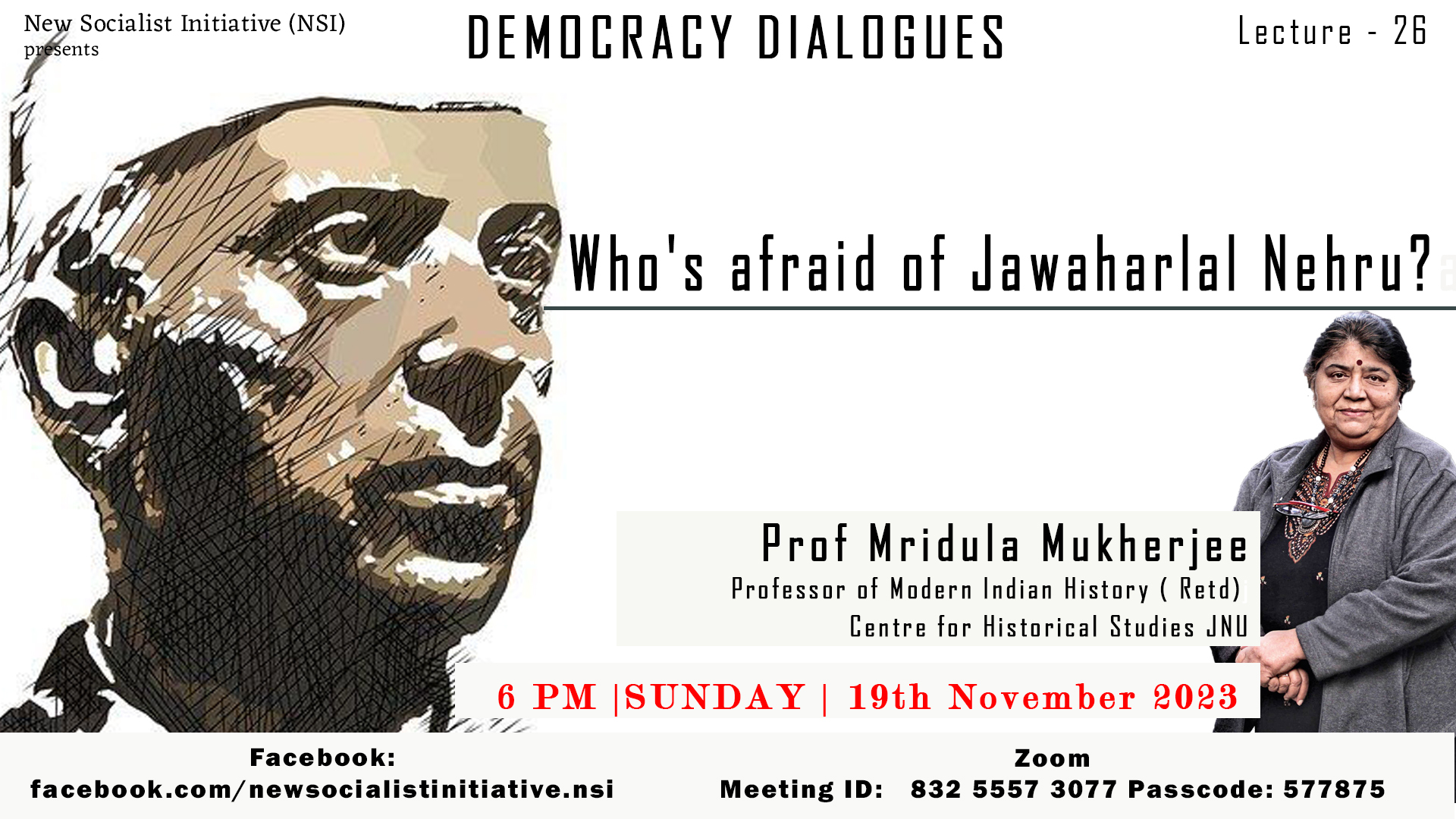
‘Who’s Afraid of Jawaharlal Nehru?’ Mridula Mukherjee – Lecture notice

Professor Mridula Mukherjee, Professor of Modern Indian History ( Retd), Centre for Historical Studies, JNU, will be delivering the 26 th Democracy Dialogues Series lecture on Sunday, 19 th November 2023 at 6 PM (IST).

Theme :
Who’s Afraid of Jawaharlal Nehru?
Time: Nov 19, 2023 06:00 PM India

Join Zoom Meeting
https://us02web.zoom.us/j/83255573077?pwd=RXdiblVjcWZaeDdqVmJaSjI3aW9Qdz09

Meeting ID: 832 5557 3077
Passcode: 577875

Also live streamed at: facebook.com/newsocialistinitiative.com
——————
Theme : 
‘Who’s Afraid of Jawaharlal Nehru?’

Summary :
In his lifetime, Jawaharlal Nehru was recognized the world over as a statesman and an Indian leader second only to Gandhiji. A foremost leader of the freedom struggle, who gave it a decided socialist orientation, he remained unrivaled as Prime Minister after independence and built the solid foundations of a sovereign, secular, democratic, and egalitarian republic. He evolved the concept of non-alignment which enabled many ex-colonial countries to avoid becoming a part of the two power blocs engaged in the Cold War.

However, he is today the favourite whipping boy of the establishment.  We are told he was responsible for the partition, for the mess in Kashmir, for the death of Subhash Bose, for delaying the integration of Hyderabad, and of Goa, for the defeat at the hands of China in 1962, for neglecting agriculture, and primary education, and much else. The reason for the defamation is of course that he stood for the exact opposite of what is valued today. His life and work present a continuous question mark to the regressive trends in fashion.

This will become evident as we focus in the talk especially on two areas of great relevance today in which we are facing a grave crisis: Democracy and Civil liberties, and Communalism/Secularism. We will also focus attention on Nehru’s evolving understanding of  Mahatma Gandhi’s vision and method of non-violent struggle, of which he became the most ardent advocate after his death.

Speaker :

Author of many books, Prof Mukherjee has been a visiting Scholar at Duke University, USA, and at the Institute of Oriental Culture, University of Tokyo and was also Director of Nehru Memorial Museum and Library, ( NMML), New Delhi.
She has published widely in the areas of agrarian history, peasant movements, social movements and the Indian national movement.

Here is a list of a few of her publications :
Colonializing Agriculture, The Myth of Punjab Exceptionalism Sage (2005) ;  Peasants in India’s Non Violent Revolution : Practice and Theory (Sage 2004).

This list also includes India’s Struggle for Independence (1999) and India After Independence 1947–2000 (2000), RSS, School Texts and the Murder of Mahatma Gandhi The Hindu Communal Project (2008) co-authored with Prof Bipan Chandra and others.

INDIA’S DEMOCRATIC LONGEVITY AND ITS HUGELY TROUBLED TRAJECTORY : PROFESSOR ASHUTOSH VARSHNEY

Democracy Dialogues Lecture Series (Online )
Organised by New Socialist Initiative

25th Lecture ( Sunday, 15 th October 2023)

Theme: India’s Democratic Longevity and its Hugely Troubled Trajectory

 Speaker:  Professor Ashutosh Varshney Sol Goldman Professor of International Studies and the Social Sciences at Brown University )

Theme :India’s Democratic Longevity and its Hugely Troubled Trajectory

Summary

India celebrated 75 years of its independence last year with a lot of enthusiasm.

Celebrations did not hide the fact it is also one of the leading countries which is passing through what is popularly known as ‘democratic backsliding’.

A country which, like many others, is using democratic processes to secure undemocratic outcomes, where freely contested elections are being deployed for the purpose of expressing, cultivating, or enhancing majoritarian prejudices—to target minorities and turn them into lesser citizens.

In this scenario, there is an urgent need to unpack this journey of democratic India further , there is a need to make a distinction between India as an electoral democracy and India as a liberal democracy.

Background Reading for the talk :

# India’s Democratic Longevity and its Hugely Troubled Trajectory ( Attached with this mail)

#. How India’s Ruling Party Erodes Democracy

Ashutosh Varshney

Journal of Democracy, Volume 33, Number 4, October 2022, pp. 104-118 (Article)

Click to access project_muse_866645.pdf

Speaker

Prof Ashutosh Varshney is Sol Goldman Professor of International Studies and the Social Sciences and Professor of Political Science at Brown University, where he also directs the Center for Contemporary South Asia. Previously, he taught at Harvard (1989-98) and the University of Michigan, Ann Arbor (2001-2008).

His books include Battles Half Won: India’s Improbable Democracy (2013), Collective Violence in Indonesia (2009), Ethnic Conflict and Civic Life: Hindus and Muslims in India (Yale 2002), India in the Era of Economic Reforms (1999), and Democracy, Development and the Countryside: Urban-Rural Struggles in India (Cambridge 1995)

India’s Democratic Longevity and its Hugely Troubled Trajectory : Professor Ashutosh Varshney

[Democracy Dialogues Lecture by Professor Ashutosh Varshney scheduled for coming Sunday has to be rescheduled. New dates will be announced as soon as Professor Varshney is in a position to deliver the lecture. Apologies.]

Topic :  India’s Democratic Longevity and its Hugely Troubled Trajectory

Speaker : Professor Ashutosh Varshney

Theme : India’s Democratic Longevity and its Hugely Troubled Trajectory

Questions and Answers on Looking for an Idea of India for the Indian Left : Dr Ravi Sinha

Looking for an Idea of India for the Indian Left : Dr. Ravi Sinha

यूनिवर्सिटी की दहलीज़ पर ‘विश्वगुरु’ के जासूस

क्या बुद्धिजीवी वर्ग को पालतू बनाए रखने की सरकार की कोशिश या विश्वविद्यालयों में इंटेलिजेंस ब्यूरो को भेजने की उनकी हिमाक़त उसकी बढ़ती बदहवासी का सबूत है, या उसे यह एहसास हो गया है कि भारत एक व्यापक जनांदोलन की दहलीज़ पर बैठा है.

So you are the little woman who wrote the book that made this great (American) civil war’

( ‘‘‘तुम हो वह महिला जिसने उस किताब को रचा जिसने इस महान /अमेरिकी/ गृह युद्ध को मुमकिन बनाया)

[गुलामी प्रथा की समाप्ति के लिए छेड़े गए गृह  युद्ध के खात्मे के बाद तत्कालीन अमेरिकी राष्टपति अब्राहम लिंकन द्वारा गुलामी प्रथा के खिलाफ लिखे गए उपन्यास ‘अंकल टाॅम्स केबिन’ / 1852/ की लेखिका हैरियट बीचर स्टोव Harriet Beecher Stowe से मिलने पर प्रगट उदगार]

लेखक, कलाकार, विद्वान आदि से हुक्मरान हमेशा ही चिंतित रहे हैं।

मिसाल के तौर पर क्रांतिपूर्व  फ्रांस के बारे में यह बात मशहूर है कि वहां की राजशाही ने अपने पुलिस महकमे को अपने दौर के अहम लेखकों, कलाकारों की जासूसी करते रहने के निर्देश दिए थे। हम अठारहवीं सदी के पुलिस महकमे की मुलाजिमों की मुश्किलों को समझ सकते हैं जिन्हें ‘खंूखार अपराधियों और राजनीतिक व्यक्तियों’ के अलावा लेखकों, कलाकारों पर अपनी फाइल रखनी पड़ती थी। (द स्टेटसमैन, हिन्दुस्तान टाईम्स, नई दिल्ली, 26 सितम्बर 2006)

एक क्षेपक के तौर पर बता दें कि इस जासूसी का विधिवत विवरण जनाब ब्रूनो फुल्गिनी की किताब में मिलता है जिसका शीर्षक है ‘राइटर्स पुलिस’ – दरअसल फ्रेंच संसद के इस कर्मचारी को यह जिम्मेदारी मिली कि वह पार्लियामेंट लाइब्रेरी के पुराने दस्तावेजों को खंगाले और इस बेहद उबाउ काम के दौरान उसे यह ‘खजाना’ मिल गया था।

अगर हम अपने यहां निगाह दौड़ाएं तो मौजूदा हुक्मरानों का रूख इस मामले में कोई अलग नहीं दिखता, बल्कि वह ढाई सौ सदी पहले के फ्रांसिसी सम्राटों से कभी कभी एक कदम आगे ही दिखते हैं। ( Read the full text here)

Vishwa Guru’s Sleuths

( Photo : Courtesy – countercurrents.org)

Writers, scholars, artists have always worried the powers that be.

There was a time when the Parisian police had been given the onerous task of keeping the greatest writers of late 18 th Century who were living in Paris at that time under their watch. Poor fellows, one can imagine their difficulty in maintaining files on writers and artists and scholars ‘beyond criminals and political figures.’

The present dispensation at the centre is no different.

It could be said that it may be a step ahead.

The French Monarchs – who within few decades witnessed a mass upheaval which finally overthrew them – were wise enough to ask their minions to be rather discreet in their activities, not to offend the writers, scholars directly ; the harbingers of today’s ‘New India’ have even abandoned that discreetness for good.

( Read the rest of the article here)

.

Vishwa Guru of Hate?

How India is Slowly Emerging as a ‘World Teacher’ albeit of a different kind

( Illustration : coutesy CJP, Citizens for Justice and Peace)

France has moved towards normalcy some time back.

The anger and anguish of the still marginalised in the society, which spilled over into the streets, over the killing of a 17 year old Nahel – son of an Algerian single woman of Muslim origin – by the trigger happy traffic police, recorded on a camera, has long subsided.

No doubt the questions raised by it are not going to go away so easily.1

Experiences of two countries cannot be compared easily but perhaps one could easily see in the uproar shades of the ‘black lives matter moment’ for the French society. Not only in terms of the brutality of the police as witnessed in American society after the killing of George Floyd but the soul searching of sorts which seems to have begun afresh there, a churning has accelerated within the French people after this killing.

( Read the full article here)

The Erosion Of Liberal Democracy in India: An Analysis – Prof Pranab Bardhan

Prof Pranab Bardhan,  Professor Emeritus, UC Berkeley, delivred the 24th Democracy Dialogues Lecture on August 27, 2023, Sunday at 10 AM India Standard Time.

Theme : The Erosion Of Liberal Democracy in India: An Analysis

Speaker : Prof Pranab Bardhan

Professor Emeritus of Economics at the University of California, Berkeley

It was also live streamed at:

facebook.com/newsocialistinitiative.com

Topic : The Erosion Of Liberal Democracy in India: An Analysis

A Brief Outline of the theme shared by Prof Bardhan

I’ll start with the global context of the turn of politics to right-wing extremism in much of the world.

One of the major factors behind this is the weakening of trade unions and of labour movements in general, which in earlier days used to act as a major force of resistance.

I shall then look into the weakening of labour movements in India and the pathetic failure of the Left political organizations. I shall analyze the deficiencies in their economic policies, mobilization strategies and governance failures even in areas where they used to be influential. Just blaming the semi-fascist Right is not good enough.

I shall end with a general discussion of how in prevailing Indian ideologies (including that of the Left) liberal democracy has often been under-valued.

Speaker :

Pranab Bardhan is Distinguished Professor Emeritus of Economics at the Department of Economics at the University of California, Berkeley.

He was educated at Presidency College, Kolkata and Cambridge University, England. He had been at the faculty of MIT, Indian Statistical Institute and Delhi School of Economics before joining Berkeley. 

He has done theoretical and field studies research on rural institutions in poor countries, on political economy of development policies, and on international trade. 

He was Chief Editor of the Journal of Development Economics for 1985-2003. 

He is the author of 17 books and editor of 14 other books, and author of more than 150 journal articles including in leading Economics journals 

His latest book titled A World of Insecurity: Democratic Disenchantment in Rich and Poor Countries was  published by Harvard University Press in late 2022.

His memoir titled Charaiveti: An Academic’s Global Journey is being published by Harper Collins India in late 2023.

His memoir in Bengali (titled Smriti-kanduyan, ‘Memory-Sratching’) has been serialized in Kolkata’s leading literary magazine, Desh, and the book came out in January 2014.

He has also contributed essays to popular outlets and some of these popular pieces have now been collected in his latest books, Globalization, Democracy and Corruption and Indian Polity and Economy:A Mirror to Difficult Times (Frontpage Publications). A collection of his Bengali essays has been published by Ananda Publishers in Kolkata in 2020.

Debating Hindutva

Background :
A close friend of decades prodding you to read / listen to something and ask for your views is such a great moral incentive which nobody would refuse.
The following note is an end product of similar undertaking which this pen pusher rather reluctantly took initially when one received a YouTube link of a conversation / debate between Congress M. P Shashi Tharoor and Supreme Court lawyer and commentator J Sai Deepak, held sometime back, where the focus of the programme was on  Congress M.P. Shashi Tharoor’s book ‘Why I am a Hindu ?’

 The book deals with how Mr Tharoor understands Hinduism, looks at its Great Souls, unpacks political Hinduism and dwells also at the violence committed by its followers and differentiates his Hinduism from that Hinduism practised by who can be called as ‘Bhakts’.

J Sai Deepak, a very popular commentator who has written a few books and also shared his views, dealt with Tharoor’s arguments.


As an aside it needs to be added that J Sai Deepak is one among the new crop of commentators , writers whose interventions very much resonate with what can be termed as ‘rightwing’ . There are few other names  like Vikram Sampath, Sanjeev Sanyal, Anand Ranganathan etc of the same stream, whose arrival on the scene has been a moment of celebration among a section of the media  (https://www.firstpost.com/politics/why-is-left-academia-so-rattled-by-vikram-sampath-sai-deepak-or-sanjeev-sanyal-10433791.html) which is critical of the left and its towering intellectuals.


Here follows the communication with the friend 
 ]

How to Draw a Line on the Ground : Ravi Sinha

Comments for the Washington DC Diaspora Program on “Karnataka Election Outcome and the Two Contesting Ideologies”

Guest Post by Dr Ravi Sinha

I must begin with a disclaimer. I am no expert on how elections are won or lost. Nor can I claim any competence in deciphering an electionresultfor what has worked and what has not. I will not be offering, therefore, any fresh insights into the results of recently concluded Assembly elections in Karnataka beyond what is already well-known from the media reports and analyses. I plan to focus primarily on the latter half of the title of the discussion today – the Two Contesting Ideologies.

The question of ideologies too is not easy to pose, let alone answer, especially when it comes to the muddy fields of politics on the ground. It is one thing to draw a clear ideological line on paper; it is quite another to do so on the actual ground of politics. In the normal course of politics – at least in a polity that has managed to settle into a normal course – ideological lines are seldom clearly drawn. Those whoinsist ondrawing a clear ideological line in all circumstances are invariably pushed to the margins of thenormal mode of politics.

There are times, however, when politics must undergo a paradigm shift. Ideological battle lines are,more or less,clearly drawn under such conditions, and sometimes, even if rarely, revolutionary transformations ensue from such shifts. The ideological lines may or may not be clearly visible during the actual political turbulence, but one can decipher them in hindsight after the polity and the society settle into a new normal.

One cannot say that India today sits on the brink of a political paradigm shift that promises a revolution. In fact, a shift of decidedly regressive kind has taken place with the rise of Hindutva. Nearly a decade after 2014, it is clear now, at least to those who would care to see, what a disaster India has brought upon itself. The damage done to the economy, to the social fabric, to theinstitutions of governance, and to the democratic process itself,is being felt in the bones of the country. India has been pushed back by decades in what has been at best a slow advance to a reasonably enlightened democratic republic with a moderately prosperous and not too uncaring economy. It will take many decades to recover what has been lost in just one decade. And yet, there is no guarantee that we will stop hurtling towards an even greater disaster in 2024.

Under these circumstances,one should not be considered naïve or conservative if one were to wish fora restorative kind of paradigm shift. One realises now that merelyturning the political clock back by a decade would bring a huge sigh of relief to the country. In times of disasters like this one, it is not a crime to hope for a kind of restoration, especially when revolutions are nowhere on the horizon. It is for this reason that the success of Rahul Gandhi’s Bharat Jodo Yatra followed by the resounding victory of Congress Party in the Karnataka Assembly elections have come as a big sigh of relief and a desperately needed ray of hope in the aware citizenry and, to a significant extent, even among the suffering masses and oppressed communities across the country.

One must, however, ask the question: has the Karnataka outcome resulted from clearly drawing an ideological line at the ground level? Disappointing as it may sound, the answer is largely in the negative. Actually, it should not be as disappointing as it sounds. As I said,drawing such a line in the muddy fields of electoral politics is not a simple or at times even a desirable thing to do. Insisting on this in all circumstances may in fact be counter-productive. One can however ask the converse question: do these results shed some useful light on how to draw an ideological dividing line on the ground? The answer to this question is clearly affirmative. I will be dwelling mostly on this apparently paradoxical situation.

First thing to be noted in the Karnataka outcome is that Congress, which confronted the BJP and the saffron brigade directly, did score a decisive victory, but it is far from the case that Hindutva has suffered a fatal blow. The BJP maintained its vote percentage of roughly 36 percent it had garnered in 2018. At this aggregate level of electoral analysis, the gains of Congress appear to have come at the cost of Janata Dal Secular (JDS),a regional party whose vote percentage has declined by the same 5 percentage points.Despite its name, this party has clearly moved closer to the BJP in the aftermath of the elections.

But one should not rush to conclusions just on the basis of aggregate numbers. Congress has not won only because of its gains in the Mysore region where JDS has been strong. It has won most of the seats in northern Karnataka adjacent both to the Telugu states and to Maharashtra. It has made gains in the rural areas all over the state. The point to note, however, is that not only has the BJP maintained its aggregate vote percentage, it has also made gains in many areas. It has gained ground wherever communal divide has been pronounced and Hindutva is entrenched. In the coastal region of Udupi-Mangalore it has stood its ground and even improved its vote percentage. Same is the case with the urban conglomerate of Bengaluru where it has won 15 out of 28 seats. Spectacular is the case of Srirangapatna where its vote share skyrocketed from 6.4 percent in 2018 to 22.8 percent in 2023. This is the place where an intense communal campaign has been around claims of yet another mosque being a temple. It will be foolhardy to think that Hindutva has lost its ground in Karnataka.

A tell-tale sign of the hold of Hindutva was in the episode of Bajrang Dal and Bajrang Bali. When none other than the Prime Minister himself equated the hooligans with the monkey god, and sought help from the muscle power of one and the blessings of the other, many across the country laughed at this mockery. And yet, it was not a laughing matter. Many leaders of Congress bent over backwards to put on display their religious credentials – even D K Shivakumar, a key architect of Karnataka victory, made well-publicized visits to temples and Congress campaigners began to count how many Hanuman temples Mallikarjun Kharge, the Congress President, had built in his native Hyderabad region of Karnataka. Those who knew the situation on ground, and those who knew a thing or two about how elections are won and lost in India, did not take this matter lightly.

In the electoral analyses splattered across the media, the victory of Congress has been attributed to multiple factors, but three among them stand out – the so-called anti-incumbency of an exceptionally corrupt government, the economic hardships of the poor who area vast majority of the population, and a relatively strong organizational presence of the Congress Party in Karnataka. Such analyses also factor-in the role ofvote bankssupposedly based on castes and communities – Lingayats, Vokkaligas, Kurubas, Dalits, Muslims and so on. But, managing such vote banks is a necessary detail of any electoral strategy – often expressed in the euphemistic phrase of social engineering. It does not define an ideological dividing line. If one tries hard to extract some such line from the enormous complexity of Indian politics, two large conglomerates of factors stand out – Hindutva, cultural nationalism, religious and other traditional identities form one such conglomerate and the issues of poverty, class, basic security of life and material well-being form the other.

Given the history of the 20th century, class has been the centre-piece of the canonical definition of ideological dividing line. Many who swear by this definition and reject the possibility of any other definition would underline the fact that the Karnataka election was won because the poor, especially in the rural hinterlands, supported Congress. While this underlines the fact that the class factor hasn’t gone away anywhere, it does not explaina far more effective presence of the other factors. As I have already mentioned, the victory of Congress does not mean that Hindutva has been defeated in Karnataka and it is not the case that the poor have voted for Congress because they detest Hindutva.

Fact of the matter is that there seem to exist two different axes along which ideological dividing lines can be drawn in today’s politics. The class axis has been the canonical one, but there seems to be another axis.For want of a well-thought-out nomenclature let us call it the cultural axis.It includes identities based on religion, caste, race, ethnicity, community, languages and even civilisations.This axis has become far more operational in the arena of democratic and electoral politics. Actually, part of the question can be posed even more sharply. Why is it that the ever-present class axis almost never gives rise to a politically operational class identity? (The same question can be posed in relation to the gender axis too, even if in a different way.) As many a leftist trade unionist would testify, the class that comes together on the factory floor seldom remembers the class identity and solidarity in the voting booth. Here I would not even try to get into the high theory of relationship between class and culture. For the purpose at hand, I will take a pragmatic tack and treat these two realms as relatively autonomous even if connected at some deep subterranean layer.

The rise of culture in politics is not confined to the so-called Third World. Samuel Huntington, the Harvard don famous for his Clash of Civilizations, can be easily chastised by other dons of the progressive kinds, especially after he showed his true colours by prodding the Americans to ask the question – Who Are We? – and encouraged them to be wary of the Latino immigrants who pose a threat, in his reckoning, to the American national identity. Chastising him is the easy part. But how does one explain the rise of Donald Trump in American politics which has happened more or less along the same lines Huntington theorised? Trumps do not arise just because the likes of Huntington construct their theories. The sources of Trumpism lie in the deeper layers of American society. Similarly, the political traction of Hindutva arises, at least in parts, from the deeper layers of the Indian social mind.

To add to the puzzle and to the tragedy, democracy itself, especially of the fiercely competitive kind, plays a role in bringing the worst out of the hidden layers of the social mind. Who in the world can claim to have a better alternative to democracy? And yet, there are examples galore of democracy landing itself in very strange places. The example of Hitler coming to power through democracy may sound hackneyed except that the phenomenon is far more ubiquitous in the world today. You in the United States had your Trump and I am told that Trumpism hasn’t gone away anywhere. We in India haveNarendra Modi; Turkey just re-elected Erdogan who has been in power since 2003, first as Prime Minister and subsequently as President; Bolsanaro of Brazil was barely defeated; Putin is too well-known an example to forget. One can go on and on and cite examples where democracy finds curious ways to commit suicide. But one thing would be common in all such examples.The cultural axis playsa crucially important political role.

In saying all this I am aware of the fact that the cultural axis does not become operationalon its ownin the political arena. Popular democracy with competitive elections is not exclusively a cultural phenomenon. After all, this whole exercise is for constituting a State and electing a government for running an economic and a political system. This system constitutes itself in the political arena and ostensibly operates in that arena, but competitive electoral processes force it to dig into the cultural unconscious of the social mind. In analogy with depth psychology, I often describe it as depth politics. The cultural unconscious of the Indian social mind, whose layers have been deposited over centuries and millennia, becomes operational in modern politics through competitive electoral democracy.

In the case of the United States,one often hears about the deep state that pulls the wires of democracy while itself remaining beyond the reach of constitutional and democratic powers and procedures. In India the deep state may not be as deep, but it is definitely there and the existence of a cultural unconscious comes very handy to it. In fact, the Indian deep state does not feel the necessity to remain invisible and confined to the depths. There are examples galore of unconstitutional, undemocratic and unscrupulous acts on the part of the political as well as economic forces and agents. All that is being done to the Indian economy, to the public resources, to the constitutional and democratic institutions, is not very hidden. But the point to note is that the state, whether deep or otherwise, finds it handy to manipulate the cultural unconscious and democracy itself becomes an accomplice in this exercise.

Michael Walzer, the Princeton political philosopher, has drawn attention to another curious phenomenon in which, I suspect, the cultural axis is deeply implicated. In his book, The Paradox of Liberation, he points out examples of national liberation movements that led to independence from foreign rule and to establishment of secular, liberal and enlightened democracies, but within a few decades the secular revolutionsmade way forreligious counter-revolutions. The irony is that the counter-revolutions were brought about through the same democratic process which had been instituted by the founding fathers for the purpose of erecting a secular, democratic and enlightened republic. India figures prominently in Walzer’s Paradox, although being a large and complex country the replacement of “revolution” by “counter-revolution” has taken its time. It took half a century after the departure of Jawaharlal Nehru for someone like Narendra Modi to come to power and replace the Nehruvian hegemony with the hegemony of Hindutva.

In saying all this my purpose is to underline the obvious that is often ignored by those who are accustomed to drawing the ideological dividing line only across the class axis. The dividing line on the actual ground of politics cuts across both the axes of class and of culture. In the rough and tumble of competitive electoral politics one is no wiser if one can prove that the latter is a derivative of the former. If class were to be the only operational axis, the Left would have conquered the world rather easily. On the other hand, if culture were to be the only operational axis,it would become impossible to ward off the ascendance of the right-wing. Fortunately, this is not the case on the ground. Even the Sangh Parivar cannot live by Hindutva alone. Even Narendra Modi has to see beyond the Hindu-Muslim divide and talk – at least talk – of Sabka Saath, SabkaVikaas.

It is in this light that the lessons of Karnataka should be read off. By and large the cultural axis was tilted against Congress while the class axis was tilted in its favour. The art of drawing an ideological line on the actual ground requires navigating the political topography along both these axes. Congress managed to do this in Karnataka this time. The BJP lost primarily because the class axis became steeply tilted against it. Hardships faced by the poor had been greatly exacerbated by corruption and misrule.

One should not, however, read too much into the relative importance of class in the Karnataka example. As I have mentioned already, Hindutva has not disappeared from Karnataka. Congress managed to hit the sweet spot because it could take advantage of the class dimension without hurting itself along the culture axis. This situation can be contrasted with a hypothetical situation if the Left were to be the principal opponent of BJP. An equally strong Left would not have fared as well as Congress mainly because it does not know how to navigate itself along the cultural axis which is tilted too steeply against it in most places on the subcontinent.

At the same time, one should not take the eyes off the absolute necessity of drawing a clear ideological line. In the situation that has arisen in India after nearly a decade of Modi Rule, this has become a must even for electoral battles. Given the importance of two axes and the uneven-ness of the political topography, such a line may not be straight, but it must be clear. One can see its importance in the example of the Janata Dal (Secular) debacle. It failed to take up a clear ideological position and planned for winning enough seats through its traditional influence and regular vote-bank politics to be in the position of a king-maker. This tactic has worked in the past but it backfired in the present situation. People were wary of its lack of ideological commitment.

Beyond uplifting the morale of forces opposed to Hindutva and in addition to appearing as a ray of hope in the distressing political atmosphere in India, Karnataka results also have reasonably clear lessons for the all-important battle of 2024. But there are no strong indications that these lessons are being learnt by the entire opposition. In theloud clamours for opposition unity, parties and leaders areadopting negotiating positions as if they are already on the table for seat-sharing. Everyone seems to be angling for the largest piece of the opposition cake. There are talks of putting up one candidate of united opposition against each BJP candidate. There is much advice to Congress to be large-hearted and make sacrifices for the sake of opposition unity.

The obvious necessity of drawing a clear ideological line is getting lost in this noise of opposition unity. There are only two political forces with a relatively unblemished record of fighting against Hindutva – the Congress and the Left. The record of every other force is tainted in varying degrees. Some have been confused or short-sighted while there are many who have been downright opportunists.

There are problems with the two resolute fighters too. Left, as mentioned already, has been especially inept at fighting along the axis of culture. This adds to its handicaps arising out of other ailments such as dogmatism, sectarianism or unthinking populism. Congress, on the other hand, is a much larger political force, but it also has had much bigger problems. Given its long and complicated history, and its more recent omissions and commissions in the political arena, it cannot entirely be absolved from accusations of paving the way for Hindutva. It has often functioned as a half-way-house between secularism and Hindutva and has had leaders and cadres who can cross over to the other side without batting an eye-lid. Congress has never been a shining example of a clear ideology or a cadre-based party. And yet, things have been changing for the better in recent months and years. There has been much internal churning and Congress has emerged as the central force around which all other anti-Hindutva forces could be mobilised for the battle at hand.

Emergence of Rahul Gandhi as an ideological leader and a resolute fighter has been a turning point in the recent history of Congress. Bharat Jodo Yatra has changed the political atmosphere in the country. And yet, Rahul’s Congress is not in a strong enough position to bring about an ideological unity among the disparate political forces of the opposition. The problem is further complicated by the fact that many of the regional parties stand to lose if Congress gains ground in their part of the country. Nearly everyone wants Congress to be strong elsewhere but weak or non-existent in their own areas.

People like us cannot really chart out the course for the opposition in India. We are neither at the drawing board nor at the negotiating table. All we can do is to have a reasonable wish-list.But we have to be receptive to complexity when it comes to larger strategies. One corner of India is so different from another. In Kerala, for example, where Congress and Left are faced with each other, it will be alright if they continue to be at each other’s neck provided they keep the doors shut for BJP. In West Bengal on the other hand, it is not unthinkable that Congress and Left together fight against Mamta Banerjee’s TMC but in such a way that they snatch the ground from BJP and become the main opposition to TMC. In that part of India, this may be the most effective way to fight BJP at the national level. There are other parts of the country where, for example, opposing BJP by putting up one united opposition candidate in each constituency will be tantamount to ensuring that BJP gets more than 50 percent of the votes. One could go on and on about the complexities of India’s political geography.

Ideological line must be drawn but we cannot expect it to be very straight. We should expect Congress to play the lead role in the battle at hand and yet we should not expect it to bind its hand and feet with ideological ropes in such a way that it becomes as ineffective in fighting the real battle against Hindutvaas, for example, Left has become.

In the end, we should also remember that fascists may come to power through elections but they are not very amenable to being dislodged from power through elections. January 6th in the United States had a happy outcome thanks to the relative robustness of American institutions. The Indian analogue of the January 6thwould more likely be a death knell for Indian democracy which is already under a great deal of stress.

On that depressing note, let me stop here.

June 10, 2023

( Ravi Sinha is an activist-scholar who has been associated with progressive movements for nearly four decades. He is one of the founders and a leading member of New Socialist Initiative.)

Reimagining Jawaharlal Nehru Today

 https://youtu.be/041eWWvhC1c

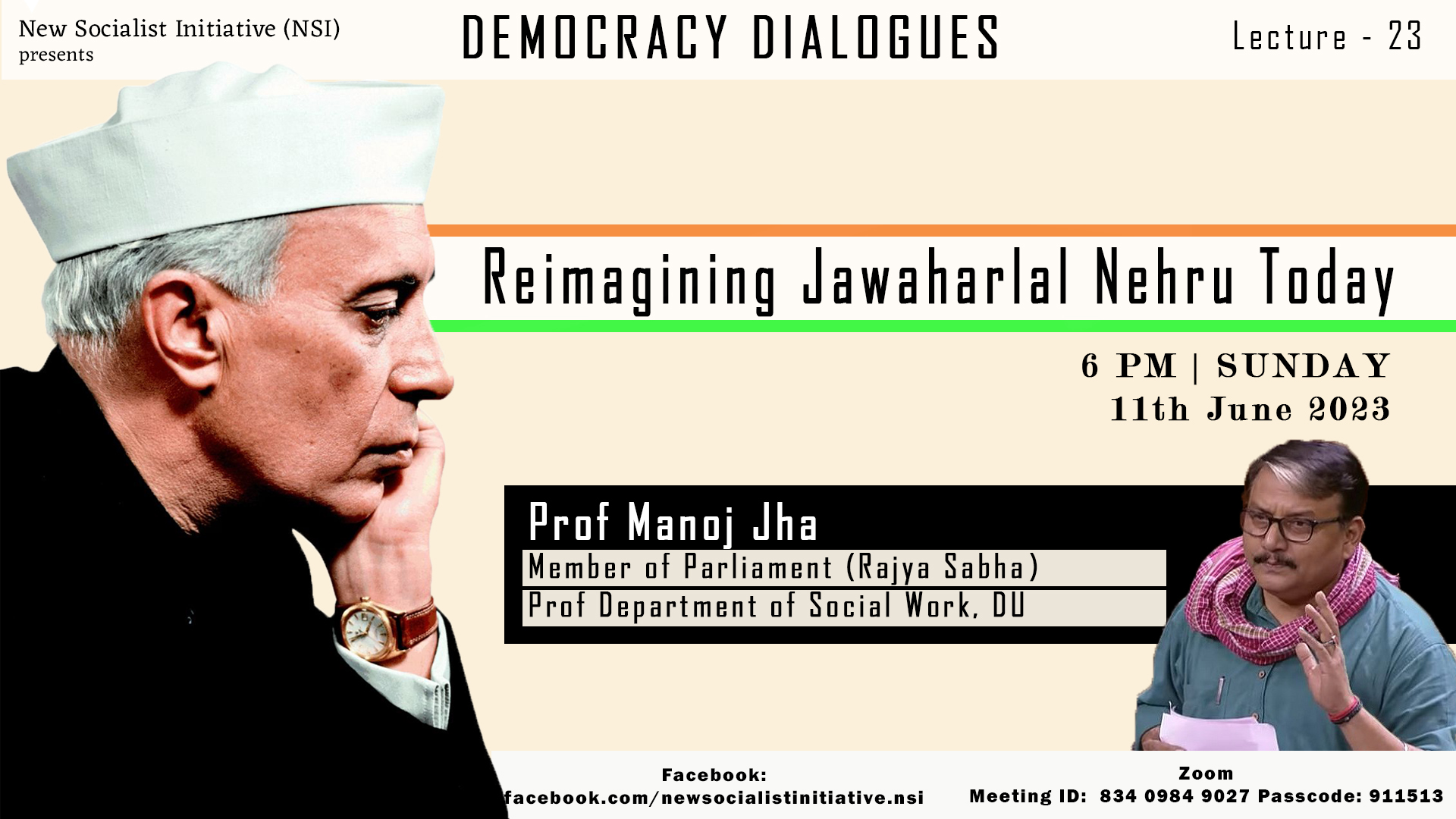
Prof Manoj Kumar Jha, who is a National Spokesperson of the Rashtriya Janata Dal, (RJD), and a Member of Parliament in Rajya Sabha ( upper house of the Parliament) who works as a Professor at the Department of Social Work, Delhi University, Delhi has kindly agreed to deliver the 23 nd lecture in the Democracy Dialogues Series , organised by New Socialist Initiative.

He will be speaking on ‘Reimagining Jawaharlal Nehru Today’ on Sunday, 11 th June, 2023 at 6 PM.

The lecture will also be live streamed at facebook.com/newsocialistinitiative.nsi

Topic :

Reimagining Jawaharlal Nehru today would involve examining his legacy and contributions in the context of the present day. Nehru, the first Prime Minister of India, played a crucial role in shaping the country’s political, economic, and social landscape after its independence in 1947. While we reimagine today presuming he was here we shall have to look at our parliamentary democracy and the core policy issues which have undergone so much of change that he would disown. The idea is to speak about some of the critical concerns we face as a nation through the Nehruvian lens. 

Speaker:

Prof Manoj K Jha, who is a National Spokesperson of the Rashtriya Janata Dal, (RJD), and a Member of Parliament in Rajya Sabha is a leading voice of the opposition.

A consistent votary of the idea of social justice and a strong opponent of the politics of majoritarian authoritarianism, his debates and interventions in the Upper House of the Parliament are appreciated across the political spectrum and are widely watched.

Prof Jha, is a very popular teacher in the Delhi University, was also head of the Department of Social Work, Delhi University , for a few years.

Aggressors Claim Hurt Sentiments While Victims Face Trial

History is a thin excuse for unrelenting majoritarianism in India and its neighbourhood

Recently, a senior advocate in Karachi was charged with blasphemy after another fellow lawyer complained about his having affixed ‘Syed’ to his name in an affidavit. This, supposedly, hurt the lawyer’s religious sentiments. The case is just one instance of the tremendous persecution the Ahmadiyya minority in Pakistan has faced since the eighties when the Benazir Bhutto regime declared it non-Muslim. Ever since, no Ahmadiyya can use Islamic symbols or names, such as Syed. Their persecution began with the notion that Islam has no space for another prophet, as the followers of Mirza Qadiani, founder of the sect, believed he was. That declaration brought the community into the spotlight of Pakistan’s blasphemy law, and their exclusion has continually expanded—from being denied space in public life, education, and employment, now they are even proceeded against for using certain names or titles.

The situation in India is sometimes no different. ( Read the complete article here)

Hindutva Brigade Must Break Silence Over Espionage Allegation

The list of people associated with Hindutva outfits caught in damning revelations keeps growing.

Recent revelations involving alleged espionage involving Prof Pradeep Kurulkar at the Defence Research and Development Organisation should have shaken up the establishment. After all, Kurulkar is said to have handled crucial projects related to India’s defence and reportedly was the lead designer or team leader for projects on missile launchers and subsonic cruise missiles.

Reports say Kurulkar was in contact, over WhatsApp, with a Pakistani Inter-Services Intelligence (ISI) agent late last year. His suspicious activities were reported to the police by DRDO, and in January, his laptop and two mobile phones were seized. The Maharashtra Anti-Terrorism Squad (ATS) is now handling the case. Kurulkar’s foreign trips are also under the scanner.

Such discoveries have long-term implications for India’s national security. Initial reports from ANI, a news agency known for its proximity to the ruling regime, did not mention Kurulkar’s name. The news agency did not initially mention his name in its tweets, though pictures of his face were circulating on social media and news outlets. The sequence of events left many wondering if the tweets deliberately concealed his name to create a doubt over his identity.

No doubt, Indian investigators will examine if the neighbouring country’s sleuths have penetrated India’s defence research sector and the extent to which Kurulkar has compromised India’s secrets. But it’s worth noting this case has not been handed over to the National Investigation Agency. Formed in the immediate aftermath of the 2008 Mumbai terrorist attack and supposedly more equipped and experienced to handle cases with cross-border ramifications, this agency has been busy filing plenty of cases—so, why not this one? ( Read the full article here)

Science as a Cultural Ideal – Ravi Sinha

Theme :

Science as a Cultural Ideal

Despite frequent misgivings about universal claims of modern science and despite it being taken often as an accomplice of western imperialism, it is impossible for any culture or civilization to avoid science or to create a culturally distinct version of it. And yet, how does science seep into and reshape a culture would have as many answers as there are cultures. The example of the West is invariably taken as canonical wherein science appears as a key factor in triggering the Great Divergence catapulting Western Europe in pole position ahead of far advanced civilizations such as China or India. It is far more tractable to draw some approximately generalizable lessons from this example than to comprehensively answer the famous Needham Question about why the rest of the world missed out on the Scientific Revolution and the subsequent percolation, even if partial and fragmentary, of the cognitive values promoted by science into the layers of cultural values.

Yet, the fact remains that the cultures and the civilization on the Subcontinent are irreducibly distinct from the West and also from the rest of the world. It is not possible to draw out serviceable prescriptions just from the western example for cultivating science in the cultural soil of the Subcontinent. It will be necessary to cast a bird’s eye-view on the civilizational contours of this vast land to have some idea about what have been the obstacles in the past and what possible pathways to future are available in the present.

While the right-wing of the Hindutva kind seeks glory in ancient India and considers the arrival of Islam as the despoiler of a great civilization, the left-wing, both of the liberal and the leftist kinds, puts all the blame at the doors of colonialism. Both miss out, in their respective ways, a very large fact. The thickest layer of the mass cultural soil on the subcontinent was deposited during the millennium between the 7th and the 17th century and in this the Bhakti Movement played the most important role. If in Europe the theological debates and religious wars led to modern philosophy and modern science, in India the philosophical debates, such as in the Upanishads and between the Buddhists and the Sanatanis, led to devotional movements of mass religions and theologies.

After sketching out these broad contours I will conclude this talk by making some tentative suggestions about how to seek pathways to a future in which science can attain the status of a cultural ideal, which in turn may facilitate emergence of an Indian modernity worthy of a glorious civilization.

About the Speaker :

Ravi Sinha is an activist-scholar who has been associated with progressive movements for nearly four decades. Trained as a theoretical physicist, Dr. Ravi has a doctoral degree from MIT, Cambridge, USA. He worked as a physicist at University of Maryland, College Park, USA, at Physical Research Laboratory, Ahmedabad and at Gujarat University, Ahmedabad before resigning from the job to devote himself full time to organizing and theorizing. He is the principal author of the book, Globalization of Capital, published in 1997, co-founder of the Hindi journal, Sandhan, and one of the founders and a leading member of New Socialist Initiative.

This will be a Zoom meeting which will also be live streamed at Facebook ( facebook.com/newsocialistinitiative.nsi). Please send an email at democracydialogues@gmail.com if you would like to have the zoom link.

When Does Democracy Undermines Itself : Dr Ravi Sinha

Dear Friends

New Socialist Initiative ( NSI) South, recently organised two lectures by one of its senior Comrades Dr Ravi Sinha in Hyderabad. 

First lecture was on ‘Fascism and Democratic Polity : How Did India Land in This Crisis ?‘ and the second lecture was on ‘When Does Democracy Undermines Itself ?

Here is a YouTube Link of the second lecture. We had already shared YouTube link of the first lecture earlier

We will appreciate it very much if you are able to share your views / comments with us

Topic – When Does Democracy Undermines Itself

Speaker – Dr Ravi Sinha

Date : 19 th February 2023

Venue: Sundarayya Vignana Kemdram

Hyderabad

Organised by : New Socialist Initiative (South)

Fascism and Democratic Polity : How Did India Land in This Crisis ? – Dr Ravi Sinha

New Socialist Initiative ( NSI) South, recently organised two lectures by one of its senior Comrades Dr Ravi Sinha in Hyderabad. 

First lecture was on ‘Fascism and Democratic Polity : How Did India Land in This Crisis ?‘ and the second lecture was on ‘How Does Democracy Undermines Itself ?

Here is a YouTube Link of the first lecture.

Topic – Fascism and Democratic Polity : How Did India Land in This Crisis

Speaker : Dr Ravi Sinha

Date : 17 th February 2023

Place : Tarnaka, Hyderabad

Organised by : New Socialist Initiative ( South)

हिंदी प्रदेश : प्रगतिशीलता की विरासत – प्रोफेसर बजरंग तिवारी

विषय : हिंदी प्रदेश : प्रगतिशीलता की विरासत

इस व्याख्यान में निम्न पहलुओं को समेटने की कोशिश रहेगी –

अर्वाचीन बोध क्या है? हिंदी प्रदेश में इसकी बुनियाद को कैसे समझें ? छठी से ग्यारहवीं शताब्दी का दौर।

भक्ति आंदोलन के दौर में क्या बदलाव हुए ? कला और साहित्य में दरबारीपन को कैसे समझें ?

स्वतंत्रता आंदोलन में साहित्य और साहित्यकारों की क्या भूमिका रही? अपने विगत से इस आंदोलन ने क्या ग्रहण किया ?

प्रगतिवाद ने हिंदी-उर्दू-संस्कृत साहित्य को कैसे प्रभावित किया ? प्रगतिवाद के आरंभिक चरण में क्या मुद्दे रहे ?

अस्मितामूलक साहित्य के उभार को कैसे समझें? दलित साहित्य की विकासयात्रा का हाल-मुकाम क्या है ?