All posts by Sunalini Kumar

What the UGC Gazette Notification 2016 Portends for the State of Higher Education in India: Rina Ramdev and Debaditya Bhattacharya

This is a guest post by RINA RAMDEV AND DEBADITYA BHATTACHARYA

The much-debated API (Academic Performance Indicator) system, linking promotions of faculty members in Indian universities/colleges to a quantifiable assessment of their performance, was introduced by the University Grants Commission (UGC) in its 2010 Regulations. Since then, there has been mounting resistance and discontent among massive sections of the teaching community – forcing the UGC to withdraw the said assessment framework for a while in 2013, before reintroducing it across institutions of higher education. However, over the years, the ire of protesting teachers has translated into a sustained critique of the API system and its failure to account for the infrastructural inadequacies of public institutions as adversely impacting the promotion prospects of thousands of teachers across the country.

It was rightly argued that a point-based appraisal pattern reduces teaching as an adventure of ideas into a standardised set of visible-verifiable outcomes and deliverables, expending in this, the necessary surplus of every academic encounter. The clock-timed hours of classroom-teaching – convertible into digits and decimals – were not only incommensurate to the disaggregation of thought beyond workdays and work-hours, but also insisted on a corporate-model professionalism limiting the exact interface between the teacher[-as-service-provider] and the student[-as-client].

The perils of quantification notwithstanding, the API system practically sought to make teaching a redundant exercise in terms of ‘necessary qualifications’ for faculty promotions. With a lucrative price-tagging of the ‘value’ of research activities conducted by individual teachers outside of teaching-schedules and the consequent structures of waging intellectual productivity through the numbers of projects and publications, the API contributed to a voiding of the classroom in undergraduate colleges in many parts of the country. Forced to prove her/his levels of productivity as the most essential claim to survival and growth within the field, the teacher needed but little to do by way of engaging students. And yet, on the contrary, the government persisted with its policy of withdrawing research grants and forcing research organisations to look for alternative sources of funding to sustain their work. Consequently, teachers have been infrastructurally forced into producing dubious research in the cause of ‘career advancement’, self-funding their way into business-rackets parading as scholarly platforms.
Continue reading What the UGC Gazette Notification 2016 Portends for the State of Higher Education in India: Rina Ramdev and Debaditya Bhattacharya

How We Destroy our Future by Proxy – On The Ruination of Ruins: Rahul Sharma

This is a guest post by RAHUL SHARMA

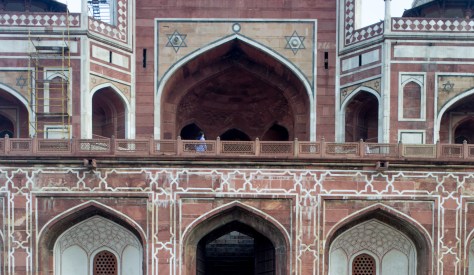
humayun-1-2

Why do we, if at all we do, really care about our material cultural heritage? Is it because it reminds us of what was, and is, good and great in humanity? Or is it the case that we look at a cultural objet and recognise that it is the Ozymandias complex materialized, that even the great and the mighty fail? Or is it that we may never attain the great heights in purity, simplicity, or other qualities we idolize and project on the remnants of the times past?

Or maybe we just want the tourism dollars and euros. Be that as it may, only someone obtuse, or with exaggerated tendency towards the behavior philistine, would say that our cultural heritage, our miniature paintings, our ruins, our tombs, forts, wall paintings, temples, mosques , books, manuscripts, and other things this essay is too short to quantify, are not worth preserving. Also note here that I said we, because we might be a bunch of separate kingdoms and separate principalities earlier, but deep down, we were one people, separated by religion and language, but united (willingly or unwillingly), by the plain and simple fact that you can’t chose your neighbor.

Continue reading How We Destroy our Future by Proxy – On The Ruination of Ruins: Rahul Sharma

The HLEC and the Aporias of ‘Committeed’ Enquiries: Rina Ramdev and Debaditya Bhattacharya

This is a guest post by Rina Ramdev and Debaditya Bhattacharya

Students of JNU have been on an indefinite hunger-strike for over 15 days now, and the administration’s only official response so far had been the Vice Chancellor’s May 4 statement invoking the vocabulary of the ‘lawful’ and the ‘constitutional’ — in ambivalences closer to threat than appeal. The subsequent May 10 Academic Council meeting has been historic, both for its 53 members’ overwhelming denunciation of the HLEC report, as also for the indelible image of a fleeing VC now forever etched in campus folklore. Further, the Delhi High Court’s stay on the fine imposed upon one of the students lends hope for similar stays with the remaining beleaguered students’ cases. The VC has consequently been referring to the enquiry mandate as being sub-judice, only to grant it an interim legitimacy that may symbolically defeat the stridency of student resistance. Letters have been sent out to the parents of striking students, in an attempt to re-route intimidation and pressure through other non-official means of paternalism. Given the conditions of duress being thus created, until the HLEC’s report is revoked in entirety, there is every reason to believe that the administration’s vindictive punitive designs will leech into the future of university freedoms and campus democracy irreversibly.

Continue reading The HLEC and the Aporias of ‘Committeed’ Enquiries: Rina Ramdev and Debaditya Bhattacharya

Statement of Solidarity with Hyderabad Central University from Columbia University, New York

This is a statement of March 29, 2016 from students, faculty and affiliates of Columbia University. We publish it below with apologies for the delay.

We, students, faculty and affiliates of Columbia University, strongly condemn the violation and atrocities brought upon the students and faculty of the Hyderabad Central University (HCU) on March 22, 2016. Since Professor Appa Rao Podile was on leave and under investigation for the institutional murder of Rohith Vemula, his return to the campus to resume duties as the Vice Chancellor was unacceptable. The students justifiably organized a peaceful protest in the campus that day. The institutional responses to that, by the University authorities, the Andhra and Telangana police force, Rapid Action Force personnel, the media, and the members of the Akhil Bharatiya Vidyarthi Parishad (ABVP) on campus, were outrageous, inhuman, and fascist. The University authorities, instructed by Prof Podile, shut down the Internet connection, dining hall and drinking water facilities in retaliation to the peaceful student protest. The Andhra and Telangana police force lathi-charged students and faculty, violently beat up and severely injured them, molested and threatened to rape female students, targeted Muslims and Dalits, abused them verbally, and eventually arrested 24 students and 3 faculty. The ABVP members resorted to violence and aggressive sloganeering from the very beginning of the students’ peaceful protest and also attacked and injured them. The mainstream media has been ignoring these atrocious events at a Central university campus and has decidedly turned away from its responsibility and its accountability to the public. This is ironic, at the very least, when some of the news anchors just last month were so focused on fabricating stories of “terrorist” and “anti-national” activities at the Jawaharlal Nehru University, Delhi. The media ultimately failed to demonize the students then. Now, yet again, the media is unabashedly siding with the authoritarian regime of corporate and state power; this time by ignoring the brutality of the police and the HCU authorities.

We strongly condemn

–       the fascist abuse of power by the University authorities, who decided to deprive the students of basic facilities as ‘revenge’ for the peaceful demonstration

–      the violence, the targeting and the brutality of the police force

–   the irresponsibility of the media for not reporting this on prime time and for effectively siding with the tyrannical regime in power

–       the atrocities unleashed by the casteist, capitalist, Hindu fundamentalist government and its affiliates, especially ABVP.

Continue reading Statement of Solidarity with Hyderabad Central University from Columbia University, New York

Non-representation at the NGT puts slum dwellers in Chennai at a disadvantage: Pradeepan Ravi

This is a guest post by PRADEEPAN RAVI

The Cooum River; Photo Courtesy Vijay Senthil.

In an ongoing case at the Southern Bench of National Green Tribunal (NGT), the government of Tamil Nadu’s position is that slum settlements located on the banks of the Cooum river are the primary reason for its pollution and an impediment to carry out the restoration of the river. Not only is the data on slums as polluters insufficient, but slum dwellers cannot defend these allegations because shockingly they are not represented in the case!

During the hearings the counsel for the government used every opportunity to put the entire blame on the slum dwellers for polluting the Cooum and stressed that the encroachments by the slum dwellers prevent them from carrying out any work to clean the river. At one point the counsel for the government even sought the direction of the NGT to allow them to take the aid of police to evict the slum dwellers. To this the bench said that they cannot issue any direction regarding this but indicated that if removing encroachments is as per law then there is no need for any direction from the NGT to do that.

Continue reading Non-representation at the NGT puts slum dwellers in Chennai at a disadvantage: Pradeepan Ravi

University of Minnesota Stands in Solidarity with the University of Hyderabad

We, the undersigned at the University of Minnesota, strongly condemn the current onslaught on protesting students and faculty at the University of Hyderabad. Following the tragic death of Dalit scholar Rohith Vemula earlier this year, the UoH community has been questioning the role of the university administration in the circumstances leading to his suicide. Days before he took his life, five Dalit scholars including Vemula were expelled by the university administration. At the behest of the ruling government, they were punished for screening a film which documents the frightening spread of Hindu fundamentalism in India today. In the wake of their expulsion and then Vemula’s suicide, the UoH community spearheaded a nation-wide movement which draws attention to the horrific normalization of caste discrimination and the growing criminalization of dissent in universities in India. Instead of responding to the concerns raised by the movement, the university administration recently reinstated P Appa Rao to the office of the Vice Chancellor. As P Appa Rao has been charged for abetting Vemula’s suicide, this amounts to an utter mockery of the movement and also threatens the integrity of the on-going judicial enquiry about his death. This has rightfully angered the UoH community which registered its protest by peacefully occupying the office of the Vice Chancellor on 22 March 2016.

Continue reading University of Minnesota Stands in Solidarity with the University of Hyderabad

“I used to feed fish to my widowed grandmother” by Buddhadeb Dasgupta: Soumashree Sarkar

This is an English translation by SOUMASHREE SARKAR of a column by Buddhadeb Dasgupta which appeared in the Sunday special supplement, Rabibashoriyo, of the Bengali daily Anandabazar Patrika on March 20, 2016 and can be found in the original Bengali here.

It was probably the month of November. Winter had set in firmly in a city that neighboured Kolkata. The quilts had come out even before that. Morning had not even broken and there was still a lot of sleep left to be slept when Ma yanked the quilt away from me and woke me up, “Don’t you remember who’s coming today? Get up and hurry, I’ve been calling you for the longest time, Khrushchev and Bulganin are coming, they might have reached already. My cooking’s almost done.” The words were pouring out of my mother’s mouth with frightening speed and excitement, all in the Dhaka’s native Bengali tongue.

Bathed in cold water, shivering through chattering teeth, and sufficiently clothes, we siblings went and stood in front of our mother. With a comb in hand, Ma sat on a chair, and neatly parted all our heads of hair.

I asked, “What does Khrushchev look like? What does Bulganin look like? The same rice-dal-fish curry that we eat – do they also eat that?”

Continue reading “I used to feed fish to my widowed grandmother” by Buddhadeb Dasgupta: Soumashree Sarkar

When Crime Becomes Ordinary, Ordinary Life Will be Criminalised

  1. Zee News Anchor Sudhir Chaudhary whose heart beats for India tried to extort 100 crores from the Jindals, remember? No, no, please, kindly, take a few minutes to watch this, at least until 3.55.


  1. This is a photo comparing Chaudhary with that the whistleblower in the Vyapam scam, who exposed a long-running case of serious corruption by the state and political parties which has involved the murders of over 45 individuals! The current government is providing Chaudhary X category security while with this cycle-borne ‘security’ the Vyapam whistleblower has survived 14 attacks on his life.
main-qimg-ce1f1542701c71d0da51f68ad43ecab8
Courtesy: Quora.com

Continue reading When Crime Becomes Ordinary, Ordinary Life Will be Criminalised

Consolidated Solidarity Statements in Support of JNU

JNU Solidarity Poster

Kafila posted a set of solidarity statements recently in support of the students, faculty and autonomy of JNU. We are posting another set, received from the following organisations:

  1. First-Decade JNU Graduates and Other Graduates – 548 signatories.
  2. Faculty, Staff and Students at the Indian Institute of Management, Bangalore.
  3. California Students and Faculty. California, U.S.
  4. Current Fellows of the Jawaharlal Nehru Institute of Advanced Study, JNU, Delhi.
  5. Colorado College, Colorado, U.S.
  6. Faculty at DePaul University, Chicago, U.S.
  7. Faculty, Students and Staff, Brown University, Rhode Island School of Design (RISD) and University of Rhode Island, Providence, U.S.
  8. McGill and Concordia Universities, Canada.
  9. Canadian Academics from Various Universities.

Please click on Read More below for the statements and signatories:

Continue reading Consolidated Solidarity Statements in Support of JNU

जेनयू की सफाई पर स्मृति ईरानी की सफाई: नियति शर्मा

Guest post by NIYATI SHARMA

लोकसभा में स्मृति ईरानी जी की सफाई उर्फ़ भाषण बहुत भावुक, मनोरंजक और प्रभावशाली था। लोग उन्हें ‘आयरन लेडी’ का खिताब दे रहे हैं- यह उनके तर्क के लिए या उनके तेवर के लिए, या फिर उनके यह कहने के लिए की वो अपना सर काट के मायावती जी के चरणों में रख देंगी, पता लगाना थोड़ा मुश्किल है । सोचा था स्मृति जी कुछ सवालों का जवाब देंगी पर असल में मिली एक लम्बी, मेलोड्रामाटिक सफाई जिससे उन्होंने अपनी सरकार की सारी गलतियों पे पर्दा डाल दिया।ऐसी स्तिथि में हम मजबूर हो गए हैं की स्मृति जी से जो सवाल पूछे जाएँ वो तथ्य-सम्बंधित होने के साथ साथ अति भावनात्मक भी हों।

स्मृति जी के अभिनय के सारे सालों का अनुभव उनके भाषण में साफ़ दिखाए दिया। लोकसभा में स्मृति जी के हाव भाव से आक्रोश टपक रहा था पर क्या उन्हें इतना क्रोधित होने का हक़ है? स्मृति जी का यह मानना है की उनके ऊपर काफी बेबुनियादी आरोप लगे हैं, पर यह मामला स्मृति ईरानी जी के बारे में नहीं है, यह मामला उन मासूम छात्रों के बारे में है जिनकी ज़िन्दगी को उन्होंने दांव पर लगा दिया है। आखिर उन ‘बच्चों’ का क्या जिनके ऊपर उन्होंने और उनकी सरकार ने पिछले कुछ दिनों में अनगिनत आरोप लगाये हैं? स्मृति ईरानी जी तो मंत्री हैं, अगर आरोप लगे भी, तो उनकी ज़िन्दगी बर्बाद नहीं होगी, पर जिस क्रूरता से सरकार और मीडिया ने छात्रों का चरित्र-हनन किया, वह कभी भी इससे उभर नहीं पाएंगे। कन्हैया, उमर और अनिर्बान न ही मंत्री हैं जिनके पास कोई राजनैतिक सहारा है और न ही उनके परिवार इतने धनी हैं की वह अपना जीवन, अपनी इज़्ज़त पुननिर्मित कर पाएं। स्मृति जी, आप तो सिर्फ अपने बारे में सोच रही थीं की आप पर और आपकी परफॉरमेंस पर क्या क्या सवाल उठाये गए, क्या आपने एक बार भी सोचा की इन छात्रों के पास आगे ज़िन्दगी में सफाई देने का कोई मौका नहीं होगा? क्या आपने, माँ होने के नाते, यह सोचा की यह छात्र अब कभी भी साधारण जीवन नहीं जी पाएंगे?

Continue reading जेनयू की सफाई पर स्मृति ईरानी की सफाई: नियति शर्मा

Jat Quota Stir and Violence in Haryana: Satendra Kumar

This is a guest post by SATENDRA KUMAR


jaat-protest--_647_022016112612
IMAGE COURTESY: INDIA TODAY

There is an uncanny academic public silence over the Jat quota stir and the unjustified violence enacted during the stir in Haryana. The scale of violence and destruction is such that it competes for the worst instance of caste violence in Haryana’s post-Independence history. So far 30 people have lost their lives while over 200 people were injured in the nine-day violent Jat agitation demanding job quotas in Haryana. There is anger, fear and helplessness among those who lost their kin, homes, businesses and properties.At least 10 Haryana districts were severely affected by the violence. After such a huge loss, as if it was a routine, matter the Union Home Minister announced that a committee led by M Venkaiah Naidu will examine the demand by Jats for reservation in central government jobs.

In Haryana, the BJP’s government in the state has promised to bring a Bill granting OBC status to Jats in the upcoming assembly session. The Jats’ demand for reservations in the central OBC list is not new. Since 1995, Jats in Haryana have been demanding an OBC (Other Backward Class) status, which will help them secure the 27 per cent reservation in government jobs. Earlier in 1997, the Jats in Haryana, Uttar Pradesh and Madhya Pradesh had demanded themselves to be included in the central OBC list. It was rejected by the National Commission for Backward Classes. Subsequently UPA government’s decision to include Jats from 9 states in the OBC list was also rejected by the Supreme Court in March 2015. Despite all this, political parties such as Congress and BJP continue promising quota to Jats during election campaigns. These promises have encouraged the Jats to organize and agitate for quotas. However, their agitations for reservations have not been so violent. That is why the most pressing and important question that needs analyses is why has the current agitation by Jats been so violent? Perhaps three factors will help us to understand this severe violence and loss of property worth crores of rupees.

Continue reading Jat Quota Stir and Violence in Haryana: Satendra Kumar

Chalo Dilli! Report on 23 Feb Protest March for Rohith Vemula: Saagar Tewari

This is a guest post by SAAGAR TEWARI

Rohith Protest 3

rohith-vemula-protest 4
IMAGES COURTESY: INDIAN EXPRESS

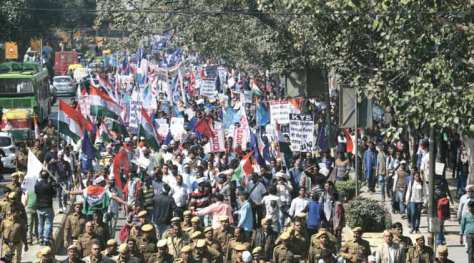
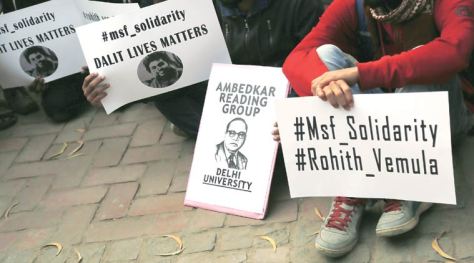
The call for a protest rally by the Joint Action Committee for Social Justice, constituted in the aftermath of Hyderabad Central University research student Rohith Vemula’s suicide galvanised large number of students and activists on 23rd February. On a bright sunny day, thousands descended on the streets of central Delhi marching from Ambedkar Bhawan to Jantar Mantar. The attendance was perhaps lower and the organization less cohesive than the JNU protest rally of 18th February. However, it trumped its predecessor in terms of attracting a far-wider political cross-section of the voices openly choosing to dissent against the current ruling establishment. The protestors proudly displayed anti-Brahmanism banners, flags, badges (featuring excerpts of Rohith’s suicide note) and even a radical inversion of Modi-style masks (featuring Rohith Vemula’s smiling face) thereby signaling that the same youth-brigade which was instrumental in BJP’s rise to political power in 2014 has started turning against it.

Continue reading Chalo Dilli! Report on 23 Feb Protest March for Rohith Vemula: Saagar Tewari

Consolidated Solidarity Statements in Support of JNU

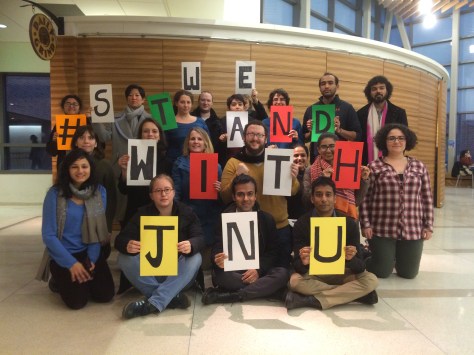
Kafila has been receiving a huge number of solidarity statements from around the world in support of JNU students who have been arrested or charged recently. We are consolidating the statements received in the past few days in the following post. The institutions/groups are as follows in order of date received, starting from February 24, 2016: 

We Stand With JNU
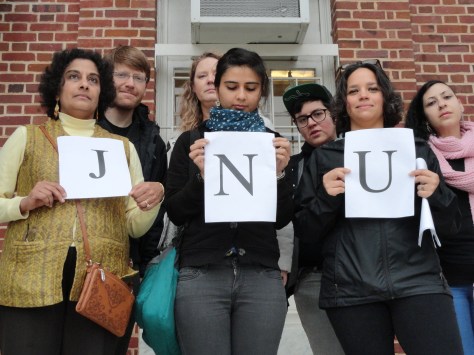
Johns Hopkins Stands With JNU


Duke University Stands With JNU
  1. Teachers at Delhi University
  2. Professional Staff Congress, the City University of New York faculty and staff union (PSC-CUNY)
  3. Pinjra Tod, Delhi.
  4. Academics, Students, Writers, Academics and Activists from Australia.
  5. U.S Community Organisations.
  6. Students and Faculty at Johns Hopkins University, U.S.
  7. Academicians in Gujarat
  8. Students at Cornell University, U.S.
  9. South Asian Communities at Tufts and Harvard Universities, U.S
  10. Students, Faculty and Other Workers at Duke University, U.S.
  11. Mumbai students.

Please click on “read more” for the statements and signatories:

Continue reading Consolidated Solidarity Statements in Support of JNU

Apologise to the Nation, All of You.

You, who shout your nationalism from the rooftops; you whose blood runs hot for “Mother India”; you who turn red with rage when contradicted; you who set agendas like patriarchs drunk on father-right; you who refuse to let another speak, you! who don a suit every night on television to disguise your cheap tricks; you who abuse your guests if they happen to be young, powerless and honest; you who bloat on adrenaline while your viewers turn to idiotic jelly; you who abuse the highest offices of this land; you who give a bad name to khaki; you who wear lawyers’ robes to beat students and teachers; you who are protected by your political masters; you who strike deals in the privacy of your offices, chambers and boardrooms; you who live by ratings and upvotes; you who tell lies so long you forget the truth; you who form bands of cowards hiding in plain sight; you who roam the streets showing your fist to all; you for whom a martyred soldier is more valuable than a living citizen; you who abuse the power that history gave you; you who mistake that accident of history for a moral right; you whose imagination of revenge always involves rape; you who have brought this country to the brink of civil war; you who speak in the name of the mythical motherland while the actual children of that land are hungry, thirsty and unemployed; you who claim this moment, this nation, this public, this history, this land. Apologise.

Apologise to those who work everyday to make this country decent; who work for too little, and for too long; those whose deaths become statistics in the great churning pots of state economists; those whose parents taught them to keep their heads down and quit an ugly fight; those who argue, debate, disagree without the urge to kill or maim their opponents; those who understand when an argument becomes too heated; those who pull back from the brink every time because they know that to be alive is not always to be right; those who reclaim the streets to protest when it’s hard, when it’s inconvenient, and when it’s dangerous, because it’s the only way to disagree; those who see that an eye for an eye makes the whole world blind; those who understand and accept this land in all its confounding conflict; those who risk death to expose the powerful and corrupt; those who have no choice but to join the army to feed their families; those who laugh when there is nothing left; those who write, think and reason, and take time over all three; those who appreciate the beauty of the stars on a still night; those who make love like it’s a gift and not a right; those whose parents live after they died because they were on the wrong side at the wrong time.

Above all, you deranged “nationalists”, apologise to three fellow citizens – one born in a caste that could only speak from the protection of death; another who is languishing in jail for no crime at all; and perhaps most of all, a third who is on the run from a police none of us ever trusted. Apologise. These young people are the future of this country, not you with your bloodlust. WE are the nation, and we demand an apology from you.

5 Colleges Faculty and Student Statement in Solidarity with JNU

This is a statement sent by scholars at five universities in the U.S

We, the undersigned at the University of Massachusetts – Amherst, Smith College, Hampshire College, Mount Holyoke College, and Amherst College wish to express our solidarity with the students, faculty, staff and wider community of Jawaharlal Nehru University (JNU), India’s premier academic institution. We demand that all charges against all students being targeted as ‘anti-national,’ including JNU Student Union president Kanhaiya Kumar, be dropped immediately. We understand the arrest of Mr. Kumar, and the intention to arrest or interrogate another 50 students on some unspecified list of the Delhi Police, to be associated with a wider campaign to quell dissent in India’s universities, a campaign which includes the harassment faced by Hyderabad Central University student Rohit Vemula, resulting in Mr. Vemula’s suicide. We are concerned about the well-being of the students who continue to be debarred from all academic activities at JNU, without any due process or proof of wrong doing, and we condemn the scapegoating and media trial of Umar Khalid, based largely upon his identity as a minority. We demand that the Delhi police should withdraw from the JNU campus. We believe that the ultimate responsibility for the campaign of harassment against universities throughout the country lies with the present Indian Government and we demand that the government desist.

We are aware and are in agreement with the fact that the case against Mr. Kumar is false in every way. We are also in agreement with eminent economist Professor Prabhat Patnaik, that the government’s actions are nothing less than the beginning of a campaign to undermine the Indian Constitution itself. The events in Hyderabad, JNU, and most recently, Jadavpur University, all point to a pattern of harassment, wherein the central government has deployed campus-based student groups to silence dissent. We take the use of the state’s machinery to physically attack vocal and articulate students speaking against the government extremely seriously. We are particularly concerned by this government’s tacit approval of the violence exhibited by lawyers at Patiala house this week. As scholars and students based in the US, we have already witnessed efforts by representatives of the Hindu right to undermine academic debate and scholarship in the context of South Asian Studies in the US and in India. We collectively represent years of scholarly and activist experience in addressing threats to academic freedom, and see that these threats are part of a larger project to undermine democracy and to rationalize a fundamentally unequal society. Continue reading 5 Colleges Faculty and Student Statement in Solidarity with JNU

Statement of Solidarity with Students in JNU, India – by students in KU Leuven, Belgium

We, the undersigned, students in the social sciences and humanities programs at KU Leuven, strongly condemn the Indian state’s heavy handed and politically motivated action against the students at the Jawaharlal Nehru University (JNU), Delhi.

We condemn the brutal police action against students, especially the arrest of JNU Students’ Union (JNUSU) president, Kanhaiya Kumar on 12 February 2016 – who has been charged under colonial-era sedition laws. We equally condemn the witch-hunt against and media trials against JNU, its faculty, and its students – especially Umar Khalid, an atheist-Leftist activist, who is wrongfully being called an ‘Islamist’ by some in the media.

Over the last few months, Indian universities have become a crucial site to contest and resist the arbitrary and concerted efforts of the Indian state to quash academic autonomy and dissent – from the scrapping of non-NET fellowships in 2015, to the death of Dalit PhD scholar Rohith Vemula at the Hyderabad Central University, earlier in January.

We underscore the fact that universities have historically been sites of critical thinking and politics, and need to remain the same. Furthermore, as the recent cases in India have shown, it is often students from under-privileged backgrounds who raise critical questions against the workings of the state, and also question structures of privilege within universities, in peaceful and non-violent ways.

The government and police action against the students at JNU seriously undermines and threatens these values. These (re)actions are based on questionable facts and charges of anti-nationalism and sedition. Indeed, no is within the space of the university that ideas of the ‘nation’ – who is included within it, and who is excluded – can be questioned and debated.

Continue reading Statement of Solidarity with Students in JNU, India – by students in KU Leuven, Belgium

Purdue University Stands in Solidarity with JNU

We, the undersigned faculty and students at Purdue University, strongly condemn the arrest of JNUSU President Kanhaiya Kumar. We oppose the systematic and deliberate attempts to humiliate, bully and terrorize the university’s community of scholars and political activists. It is unethical for a government to spread canards about students with the hope of distracting attention away from its over-zealous, slapdash interventions in academic institutions. We demand that this scapegoating and hounding of Umar Khalid, and all other students, cease immediately.

We salute the courageous JNU community that stands proud and resolute in the face of physical violence, media trials, and sectarian, antediluvian discourses that confuse students for enemies, and dissent – the cornerstone of democracy – for sedition.

More generally, we detect a pattern in this government’s deployment of the state machinery against young adults committed to addressing the inequities and discriminations so blatant in our country today. We insist, therefore, that the central government end its programmatic assault on public educational institutions and the spirit of free-thought. Institutions of higher education must be created and preserved as spaces where caste oppression, gender and minority-exclusion can be studied, and their resistance practiced. JNU exemplifies a dual commitment to combining academic rigor with a political-ethical conscience. We stand in solidarity with JNU’s vision of a diverse campus, charged with a robust polity, where no monolithic, auto-corrected version of the nation or patriotism dominates. We believe that university campuses, like society at large, can thrive only when celebrations of the myriad manifestations of the nation are accompanied by an honest and fearless capacity to criticize its inadequacies. Continue reading Purdue University Stands in Solidarity with JNU

Resolution in support of the student protests in India against the militant suppression of intellectual freedom and dissent by the BJP-government

This is a resolution passed by the Doctoral Students’ Council, City University of New York (CUNY)

WHEREAS, on 12 February, the Delhi Police raided student hostels at the Jawaharlal Nehru University (JNU) and arrested the JNU Students’ Union President Kanhaiyya Kumar on the arbitrary and anti-democratic charge of sedition; and

WHEREAS, this application of a draconian, colonial law which criminalizes dissent stands in stark contradiction to the very democratic character of the nation that affirms an individual’s right to free speech, however radical and unpopular the opinion; and

WHEREAS, this arrest of an elected student representative and the subsequent militarization of the campus with an overwhelming police presence is sanctioned and sponsored by the Bharatiya Janata Party (BJP) led ruling regime, in conjunction with its affiliate organizations RSS and ABVP, its student wing; and

WHEREAS, this coercive presence of the police on the university premises and elsewhere is compounded by their complicity in the physical assaults by lawyers of the Hindu Right on JNU teachers and students at the courthouse before Kanhaiyya’s hearing; and

Continue reading Resolution in support of the student protests in India against the militant suppression of intellectual freedom and dissent by the BJP-government

Human Rights in India: Who defends the defenders?: Srishti Agnihotri

This is a guest post by SRISHTI AGNIHOTRI

Reports have come in of an attack on Tribal Rights Activist and leader Soni Sori. Reports suggest that oil paint mixed with chemicals was thrown on her face by unknown assailants. This attack, which has left the activist in intense pain, and other reports of intimidation of persons such as lawyers and journalists working in the Jagdalpur area raises the question of the safety of human rights defenders, and shows that there isn’t enough being done by the State machinery to defend the defenders.

Human rights defenders are those who work to protect or promote human rights. The State has an obligation to protect human rights defenders from violence, and also to create an enabling environment for them to work in. The phrase ‘human rights defenders’ been used increasingly since the Declaration on Human Rights Defenders was adopted in 1998. Though the Declaration is not a legally binding document, the roots of the State’s duty to protect the defenders can also be found in the International Covenant on Civil and Political Rights, which India has ratified. These rights can also be derived from Indian Constitutional law, particularly the celebrated golden triangle of Article 14, 19 and 21 of the Constitution.

We often refer to human rights defenders using many phrases such as ‘activists’ ‘monitors’ ‘development professionals’ etc. It is not necessary to be a person being paid to do full time human rights work, to qualify as a human rights defender, and many other professionals may be doing work that is strongly allied with human rights. For example journalists, doctors, teachers, or even engineers may, in the course of their work, promote or protect the human rights of people, and as such they are human rights defenders. Further it is not necessary to be correct to qualify as a human rights defender. For example, the criticism of a Human Rights Defender to a particular development project may not be legally correct. However, this does not and should not disentitle them to the protection of the State against violence and reprisals. The reason for this will become clear when we examine the role human rights defenders play in a society.

Continue reading Human Rights in India: Who defends the defenders?: Srishti Agnihotri

Support and stand for Jagdalpur Legal Aid Group: Mohammad Zafar

This is a guest post by MOHAMMAD ZAFAR

We are going into a dangerous situation now. It is that time when we all should come together to work against autocracy, state led atrocities, bullying, dictatorship and authoritarianism and any other form of injustice. We all know about JNU case, role of Lawyers & MLA O. P. Sharma in the shameful acts of abuse and warnings to people who take initiative to speak against atrocities and injustice all-over the country. Now Raman Singh’s model of development has also showed us two shameful cases in Chhattisgarh. One is attack on Tribal activist and AAP’s leader Soni Sori who has faced a lot of humiliation, atrocities and pain but always stood steadfast on her path and is still fighting. And one more case of state-led dictatorship is related to Jagdalpur Legal Aid Group, which is a legal aid group to support tribal people who are facing problems in that region in terms of false cases, fake encounters, etc. for details about its existence see this link of the Hindu’s article (http://www.thehindu.com/news/national/a-group-of-lawyers-trying-bring-law-to-lawless-bastar-region/article7735079.ece) They worked for people facing false charges of Naxalism, against controversial encounters and other issues where there is a need to work hard for giving support to the voice of justice among tribes.

This has become problematic for state and police. They first started annoying them, throwing false allegations against their degrees and eligibility to fight case. When they fought and won against those charges now some organizations (with the support of state officials & police) also warned them to leave that place and said that they are Maoist sympathizers. And now finally they left their landlord’s rented home in Jagdalpur when police pressurized their landlord who (according to one member of Jagdalpur Legal Aid Group (JAGLAG) in an interaction to a reporter) is very good for them and they don’t want to be a problem for him. For further details and mail of a member of JAGLAG see the article in this link.

            We should think again, is it development where state itself making people speechless and generating more mistrust among people for government, where they do violence by their own way and more than that they are even silencing voices of resistance. These officers will get awards by government like Ankit Garg who shamelessly ordered humiliation and sexual abuse of Soni Sori. They want to silence voices like JAGLAG so that they will punish more innocents in the name of Naxalism as they did with Kartam Joga, who because of lot of efforts of Lawyers and activists found a new life after 3 years’ Jail and pain of brutality of Police. They don’t want any voices of resistance because they know their reality will emerge; so they beat people without any reason as they did with Lakhan Lal and broke his legs just for replying “Laal Salaam” in the dead of the night; their shameful act of humiliating Soni Sori in jail in the name of police inquiries is also for the same reasons. In the name of Anti-Naxalism/Maoism they are trying to silence all voices and justifying all their acts as their friends are trying to do in the name of nationalism in other parts of country. We should support now all members of Jagdalpur Legal Aid Group and raise this issue on all platforms.

University of Minnesota Stands in Solidarity with Jawaharlal Nehru University

IMG_20160219_151429805

We, the undersigned at the University of Minnesota, strongly condemn the concerted attack on the students, faculty and academic culture of Jawaharlal Nehru University. At the behest of the government, the Delhi police has pressed sedition charges on unnamed students of the university. Reminiscent of the Emergency, the students’ union president Kanhaiya Kumar has been arrested, several students have been suspended and the Delhi police has been hounding students in hostels, homes as well as public spaces in the city. Sections of the mainstream media have launched a vicious campaign to declare JNU an “anti-national” university, and some journalists have gone so far as to spin lies about the “terrorist connections” of student activist Umar Khalid. As a consequence, mob violence against JNU students and faculty has spread across the city and even entered the courtrooms where the case against the JNU students’ union president was being heard. We strongly condemn this hate campaign and demand the immediate release of the JNU students’ union president. We also demand that the suspension of students is revoked and unsubstantiated sedition charges are withdrawn immediately.

Continue reading University of Minnesota Stands in Solidarity with Jawaharlal Nehru University