All posts by Shivam Vij

Shivam Vij is a writer and journalist based in New Delhi.

Birthday Wishes from the Hindustan Times

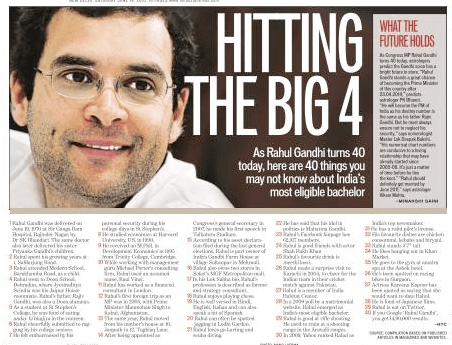
The Hindustan Times marked Rahul Gandhi’s fortieth birthday by tell us 40 things we “may” not know about “India’s most eligible bachelor”.

Nothing surprising about this. Why, don’t you remember how they told you 54 things about you didn’t know about Mayawati on Mayawati’s 54th birthday six months ago?

See also:
Why Hindol Sengupta Needn’t Fear Mayawati
Happy Ambedkar Jayanti

“Caste census will increase incidence of Japanese encephalitis”: Sociologist

Just four years ago, during “Mandal II”, everyone opposing the extension of OBC reservations to central educational institutions were saying we don’t even know how many OBCs there are. Now, when there is a proposal to count the OBCs, these voices are not to be heard. Just like “Mandal II”, a new term, “caste census” has been invented, as if the census already does not count the Scheduled Castes. The term “caste census” is used repeatedly in a way that suggests that a secular, progressive pro-development exercise is being sullied, polluted, by this monster of caste because of those uncouth cow belt politicians. Chee chee!

Obfuscation and intellectual dishonesty are in order. So, a lot of bullshit is being written about “caste census” to prevent us from knowing just how many of us are OBCs, to prevent the Other Backward Classes from entering the privileged spaces of the upper castes. This one takes the cake: Continue reading “Caste census will increase incidence of Japanese encephalitis”: Sociologist

Mohamad Junaid: What Does the Chatham House Poll in Kashmir Tell Us?

Guest post by MOHAMAD JUNAID

The Chatham House poll conducted in the autumn of 2009 in Jammu, Ladakh, Kashmir and Azad Kashmir has revealed an interesting pattern of opinions held across these regions on issues ranging from the perception of major problems people face to effective solutions to the Kashmir issue and the best means to achieve them. Robert Bradnock, under whose supervision the poll was conducted, however presented the results somewhat shoddily leading to confusion over the real import of the opinion poll. This confusion has prompted media in India and Pakistan to portray the polls selectively or in a self-serving manner, largely reflecting their nationalist stances on the Kashmir question. The poll, in reality, points to some interesting developments in Kashmir and indicates a way toward an eventual, mutually agreeable solution.

Consistent with every other poll on the issue, Chatham House poll has shown again that an overwhelming number of people (74—95 percent) in Kashmir region demand independence. This figure comes as no surprise because the support for independence for Kashmir over accession to Pakistan has been steadily growing over the last 20 years. This feeling is more concretely reflected in the fact that most Kashmiris (more than 90 percent) support withdrawal of Indian troops from Kashmir, while a similar figure (around 80 percent) want Pakistan to withdraw its troops from Azad Kashmir. Along with demilitarization, there is a clear demand for de-weaponization (more than 80 percent) and an end to militant violence (around 90 percent) in the Kashmir region. The Line of Control in its present form is uniformly rejected in both Kashmir and Azad Kashmir. Continue reading Mohamad Junaid: What Does the Chatham House Poll in Kashmir Tell Us?

‘The Moral Obligation of Indian Civil and Political Society’: Rekha Chowdhary on Fake Encounters in Kashmir

Guest post by REKHA CHOWDHARY

With another incident of fake encounters in Kashmir, it is a moment of introspection for the political and civil society of India. For all those who are proud of Indian democracy, it is a moment to reflect as to how this democracy fares for the people in Kashmir. It is important to note that democracy does not remain limited to the electoral choices and the extent and intensity of competition in the formation of government – it also involves the political and civil rights of people. Even when democracy has been restored in Kashmir in its procedural form and is kicking in the form of intensely competitive politics, its substantive effect is missing. The right to life is the minimum that is provided by any democracy, the range of rights however goes much beyond this and involves the basic civil liberties as well. However, the way the hapless innocent persons were cruelly murdered in Nadihal in north Kashmir and declared as militants – it is the denial of the minimum. It is not only the murder of three people, it is also the murder of Indian democracy! Continue reading ‘The Moral Obligation of Indian Civil and Political Society’: Rekha Chowdhary on Fake Encounters in Kashmir

Holy Cow: Jyoti Rahman on Indophobia in Bangladesh

I am grateful to JYOTI RAHMAN, a Bangladesh-focused blogger, for contributing this guest post

Once upon a time, slaughter of cow was a major political issue in Bengal. There was a clause about it in the Bengal Pact — an agreement which, if implemented, could have avoided partition. And now, six decades after partition, there is a thriving trade in cows from India to Bangladesh. A recent LA Times article reports:

Continue reading Holy Cow: Jyoti Rahman on Indophobia in Bangladesh

There’s a khap panchayat next to your house

So when he khap panchayats of Haryana got Kurukshetra MP Navin Jindal to air their views to the Parliament, as he likes to put it, the story became simpler. Now it was one individual (Jindal) vs. modern India. Now it was an educated babalog neta letting us down. How could you? Now one didn’t have to enagage with the khap panchayats themselves. It could now be given more ai time and column space than when the khap panchayats were getting same-gotra couples killed.

Now, a ‘section’ of the Arya Samaj in Haryana says it won’t allow Arya Samaj temples to be used for marriage of same-gotra couples, or for any marriage without the consent of not only both sets of parents but also the entire village. Outrage is in order, though perhaps “shocker” is not a great word. Continue reading There’s a khap panchayat next to your house

Murder, not accident

“At the airport and blah =_= Only thing to look forward to is the rain.” That was Harshi’s last tweet. She was travelling to Mangalore to attend a wedding. She might have been able to enjoy the rain had it not been for the negligence of the negligence of the guardians of civil aviation in India. The crash, then, must be called murder, not accident.

This was no accident, but the direct result of deliberate failure of officials at the highest level in the Director General of Civil Aviation, Airports Authority of India, Ministry of Civil Aviation and the Government of Karnataka for allowing this 2nd runway to be built in criminal negligence of applicable norms and standards. Such a strong charge is being made as the likelihood of this kind of a crash (the worst case scenario) was predicted. A series of Public Interest Litigations were fought by the undersigned to stop the construction of this 2nd runway in Mangalore airport on grounds that the design simply did not conform to the most basic national and international standards of airport design. The PILs also highlighted that the airport does not conform with the most minimum safeguards for emergency situations – particularly during landings and takeoffs, and could not have emergency approach roads within a kilometre on all sides of the airport as required. [Environment Support Group]

To P Chidambaram: Response from a member of civil society, by AK Agrawal

By ARUN K AGRAWAL

Dear Shri Chidambaram,

This is in response to your repeated taunts on NDTV that the civil society must respond to the wanton killing by the Naxals. It appears that the interview was tailor made for getting the consent of the Cabinet for more firepower and airpower to combat the Maoist. The diabolic support of Arun Jaitly, be it by describing you an injured martyr, was designed to achieve his ambition through the support of the mining barons of the BJP ruled states.

As a member of society I hope I am being civil in disagreeing with you on your hard line approach against the innocent tribal. I also hope you will not find it too shocking for being accused of being largely responsible for the rise and growth of Naxalism, as the following happened on your watch as Finance minister.

Continue reading To P Chidambaram: Response from a member of civil society, by AK Agrawal

‘An acceptance of Israel’s legitimacy does not imply an acceptance of all that it does’: Amitav Ghosh

Given the long discussion on an earlier post on this subject, I think it is important to post here Amitav Ghosh’s long, persuasive response to the campaign that requested him not to accept the Dan David Prize. I’m taking the liberty of copying this response from here.

May 14, 2010

Dear Signatories to the letter of May 7:

I am sorry I have been slow to respond to your letter expressing disappointment in my decision to to accept the Dan David prize. I will attempt to do so now. Continue reading ‘An acceptance of Israel’s legitimacy does not imply an acceptance of all that it does’: Amitav Ghosh

Rahul Gandhi and the Dalit votebank in Uttar Pradesh

This article by me has appeared (.pdf) in the Economic and Political Weekly.

On 14 April this year party general secretary Rahul Gandhi launched the Congress’ biggest campaign to revive itself since 1989. The date was carefully chosen, Ambedkar Jayanti, because he is trying to win over dalit votes in Uttar Pradesh (UP). In 1989 the Congress’ support base in UP was made up of a rainbow coalition of brahmins, Muslims and dalits. The Congress has to woo these communities again to regain power in UP.

The brahmin community took to the now ruling Bahujan Samaj Party (BSP) in small numbers in the 2007 Vidhan Sabha election primarily because there was no strong brahmin leader after Bharatiya Janata Party (BJP) leader Atal Behari Vajpayee became politically inactive. Brahmins see in Rahul Gandhi a potential “brahmin” leader. The UP Congress president, legislative leader and Youth Congress president in the state are all from the brahmin community.

Muslim support is no longer enchained to the Samajwadi Party (SP) because their bete noire, the BJP, is powerless these days in both the centre and the state. As a result the Muslim vote is being fought for, as a three-way contest between BSP, SP and Congress. BSP head and Chief Minister Mayawati’s stratagem is to therefore change her party’s core support base constructed out of the “brahmin-dalit” alliance into a Muslim-dalit alliance.

The dalits, wooed away en masse by the Kanshi Ram-Mayawati duo of the BSP for years, would be the hardest to win back for the Congress. In fact, a year ago the very idea would have sounded ludicrous. But today, Mayawati’s angry reaction to the Congress’ bid to woo dalits is indication that the Congress may be winning over dalits. How is this happening? Continue reading Rahul Gandhi and the Dalit votebank in Uttar Pradesh

An election in Nottingham

This is a guest post by AMAN BHARTI on the elections in UK

I had nipped out during my lunch break to post my voting ballot. The route back took me past Nottingham’s speaker’s corner, where for the first time ever, I saw some speakers. They appeared to be two of the three main political party candidates.

Intrigued, I joined the small crowd for my first experience of local electioneering. A desi chap in his shalwaar-kameez (or is that only what women wear?), sleeveless jacket and one of those Ahmad Shah Masood caps (I know they are called something, but I forget what) was just about to ask a question. In broken, accented English, he talked about the Muslim community suffering due to anti-terror laws, and asked which party would bring in “transparency and accountability” in the exercise of anti-terror laws, and adhere to the European courts’ views on individual human rights?

The brown faces in the audience cheered loudly. The white faces were conspicuously (and a little worryingly) silent. Continue reading An election in Nottingham

‘Boycott of Israel would not serve any useful tactical purpose’: Amitav Ghosh

The British Committee for the Universities of Palestine (BRICUP) and Pakistanis for Palestine amongst others have appealed to the novelist Amitav Ghosh to decline the Israeli Dan David Prize he is being given jointly with Margaret Atwood.

The BRICUP open letter to Ghosh reads:

It’s surprising to have to raise Israeli colonialism with a writer whose entire oeuvre seems to us an attempt to imagine how human beings survived the depredations of colonialism. Gosh, even the Dan David judges like the way you evoke ‘the violent dislocations of people and regimes during the nineteenth and twentieth centuries’.

Those making him this appeal have reminded him of his rejection of the Commonwealth Writers’ Prize in 2001.

Give below is Ghosh’s response to the appeal: Continue reading ‘Boycott of Israel would not serve any useful tactical purpose’: Amitav Ghosh

Happy Ambedkar Jayanti

The Congress Party will use the occassion of Ambedkar Jayanti tommorow to reach out to UP’s Dalits. Commenting on this, NDTV  says, “Mayawati, who knows a thing or two about appropriating the Dalit legacy, is going on the offensive as well.”

Appropriating? Hello! You mean to say Rahul Gandhi is a Dalit and Mayawati a half-Italian, one-fourths Parsi and one-fourth Kashmiri Pandit, trying to pass off as an Allahbad Brahmin and collecting Dalit votes on the side?

Of course there will be other memorable celebrations, but they won’t be as ‘news-worthy’.

Maoists issue a statement, the media plays it down

The CPI (Maoist) has issued a statement after the killing of the CRPF men in Dantewada. You would imagine that the statement should be all over the media. If you Google you will find it here and there, and if you’ve been reading the papers I won’t blame you for missing it. It’s buried in the inside pages today, and only the Hindustan Times yesterday had put it on its front page. This is not surprising considering that after the CRPF killings the media has gone into war mode. It’s war out there, they’re saying again and again. Anchors are shouting, news-magazines are declaring war and calling the Indian state impotent and the top editors are saying it’s a turning point, ab bas bahut ho gaya, now let’s just shoot ’em dead. What, no air strikes? get real guys.

Continue reading Maoists issue a statement, the media plays it down

Two Overheard Conversations, Delhi 2010

Guest post by ANAND VIVEK TANEJA

Conversation One. I’m sitting in a barber-shop in Sector 34, Noida, getting a haircut. The older guy sitting next to me, getting a shave, asks this younger fellow who’s just got up from a haircut –

  • Tu kahaan se hai bhai? Where are you from?
  • Main to Noida se hi hoon. I’m from Noida only.
  • Noida ka to na laage hai. You don’t look like you’re from Noida.

The young man in question was slight and skinny, and was dressed in what could be described as  generic global college student/hipster style. The conversation continued. The barber said, no he’s definitely not from Noida. The young man turned on him and said, Tum kaunse Noida ke ho, Well, you’re not from Noida either. The barber says, Main to Bihar se hoon. Main thodai hi chhupa ke rahkta hoon. I’m from Bihar. I don’t hide the fact. Then the barber says, Yeh to lawaris hai ji. He has no parentage, sir.

‘Nice. Nice. Good shot. Thank you.’

The Truth Behind the Strike

In a recent guest post, SIMON HARDING of Delhi’s AMAN Trust had explained why Delhi’s autowallah is not the villain he is made out to be but a victim of the Delhi government’s policies, the Supreme Court’s whims and the financier mafia’s greed. In this post he writes about the strike by Delhi’s auto drivers yesterday and why a majority of the drivers were not in support of it.

Yesterday there was an auto strike in Delhi. The city was crippled. Taxis tripled their fares and buses ran full to bursting. The strike, called by Rajendra Soni of the Dilli Autorickshaw Sangh (DAS) and supported by many other auto unions, was well observed with few drivers plying the streets. The striking unions demanded that Sheila Dikshit retract her recent comments about “phasing out” autos. They also called for a raise in the meter fare (Rs.4.5 per km) following an increase in the price of CNG. Continue reading The Truth Behind the Strike

Auto-rickshaws in Delhi: Why Sheila Dikshit’s comments are misguided

Guest post by SIMON HARDING

As every Delhite knows, taking an auto journey in the capital is not a pleasant experience. Drivers speed off at the very mention of your home or office, leaving you stranded on the roadside. When an auto-wallah finally agrees to go where you want, he steadfastly refuses to run by the meter and instigates a minute or so of stressful haggling. You arrive at your destination frazzled, irritated and over-charged. This situation has not gone unnoticed. Chief Minister, Sheila Dixshit recently announced plans to phase out the auto-rickshaw after five decades of service. Auto-rickshaws are “not a good option”, she complained, auto-wallahs “harass” passengers and up to half are plying the streets “illegally”. With the Commonwealth Games fast approaching, the eyes of the world will soon turn to Delhi. Auto-rickshaws do not fit with the CM’s desire to see visitors return home “with the impression that they have been to a truly civilised city”. She promised futuristic battery powered taxis, which thrilled middle class Delhi.

But before the auto-rickshaw and the much-maligned auto-wallah can be condemned, we must look at how the auto-rickshaw sector in Delhi operates: at the rules, regulations and policies, which govern the livelihoods of the city’s 80000 or so auto-drivers. Some questions need to be answered: why are Delhi’s auto-wallahs so greedy and grumpy? Why won’t they switch on the meter? Why do so many ply “illegally”? Continue reading Auto-rickshaws in Delhi: Why Sheila Dikshit’s comments are misguided

Moonwalking with the Comrades: Anirban Gupta Nigam

Guest post by ANIRBAN GUPTA NIGAM

The last book François Furet wrote before his death in 1997 was called The Passing of an Illusion. At the very beginning of the first chapter of that book, Furet spelt out the central question driving his study:

    What is surprising is not that certain intellectuals should share the spirit of the times, but that they should fall prey to it, without making any effort to mark it with their own stamp. […] twentieth century French writers aligned themselves with parties, especially radical ones hostile to democracy. They always played the same (provisional) role as supernumeraries, were manipulated as one man, and were sacrificed when necessary, to the will of the party. So we are bound to wonder what it was that made those ideologies so alluring, that gave them an attraction so general yet so mysterious.

Furet’s book emerged from an autopsy of his own past as a as a Communist “between 1949 and 1956.” He wrote, further, that his years as a Communist bequeathed to him an enduring desire to unlock the mystique of revolutionary ideology. Given this, it’s not difficult to see why he pioneered some of the most brilliant historiographical work on the French Revolution. The question we are concerned with here is the one I have quoted at length above; for it seems that in our own day, this strange romance between (formerly) fiercely independent intellectuals, scholars, activists and the – a – party, continues.

The latest document of this affair is a long essay by Arundhati Roy (once famous for her declaration of herself as an”independent mobile republic”), titled ‘Walking with the Comrades,’ published in the latest issue of Outlook. It makes for exciting reading, as a lot of well-written travel literature does; but it is significant for another reason: in the current debate over ‘Operation Green Hunt,’ with many versions of ‘ground realities’ fighting amongst themselves, this document is Roy’s attempt at producing an (her) authentic truth, so immersed in the charming details of revolutionary existence that everything else becomes secondary. If we were ever to perform an autopsy of our twentieth century’s ‘Communist’ pasts, ‘Walking with the Comrades’ would probably be as good a place to start as any. Continue reading Moonwalking with the Comrades: Anirban Gupta Nigam

Point Forty Five

Dear Mr P. Chidambaram,

On 8 March last year, Aman Kachroo was lynched to death in a college hostel in Himachal Pradesh. It was just another case of ragging. It happened nearly eight years after the Supreme Court of India banned ragging in May 2001. In fact, since May 2001, there has been at least one ragging death every other month, as reported by the English language media. You can imagine how many cases are hushed up, blamed on academic pressure and ‘depression’, and never investigated. We are also not going into the much larger number of cases of attempted suicides, drop-outs, and not even measuring the psychological impact on freshers.

In 2001, the Supreme Court’s orders said that an educational institution that is unable to control ragging would face grant cuts or even disaffiliation by affiliating bodies such as the UGC, AICTE, Medical Council of India and a host of others. Not one of them ever found any college unable to control ragging. Their bureaucrats issued circulars and thought their signatures on the circulars were good enough. Years later, some of them told the Supreme Court that they did not have the powers to act against institutions – even though a Supreme Court order had empowered them to do so!

Such matters clearly concern your colleague Kapil Sibal, so why am I writing to you? We shall come to that, just let me tell you what happened thereafter. Continue reading Point Forty Five